"Do Daiso's dust-removal brushes really work?" Many people want to ask this question. How do budget anti-static brushes such as Daiso's differ from professional brands such as Tamiya? Can they really remove dust effectively and prevent static?
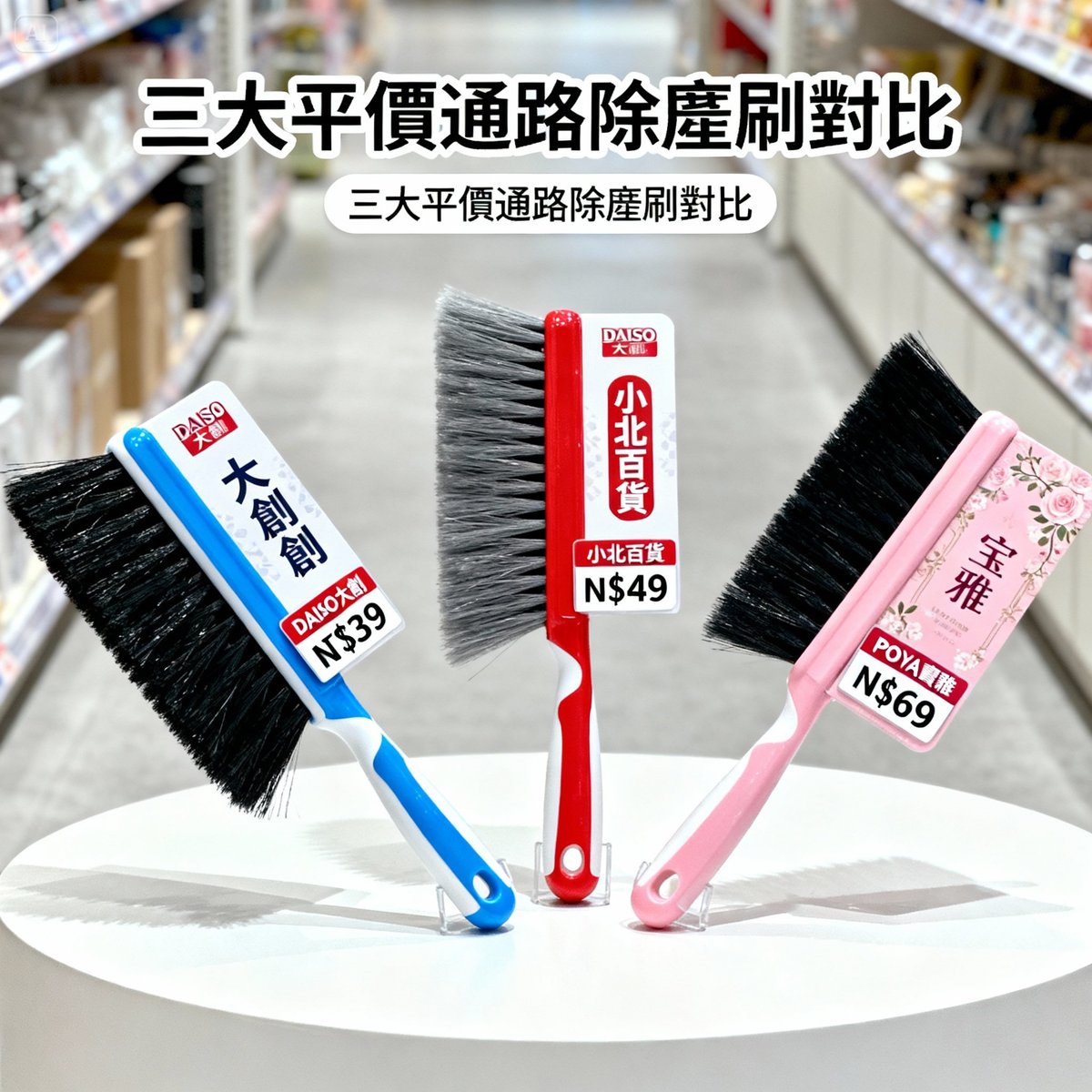
This article fully tests the dust-removal brushes sold by three budget retail chains in Taiwan, Daiso, Showba (Xiaobei, a Taiwanese general-goods chain) and Poya (a Taiwanese drugstore and variety chain), and compares their performance with the professional brand Tamiya. It analyzes the pros and cons, the situations each suits and the value for money, to help you judge whether a budget dust-removal brush meets your needs. The stores, prices and products described are those of the Taiwan market.
The anti-static brushes of the three budget retail chains
Daiso (DAISO) dust-removal brush
Daiso is a well-known budget household goods store in Taiwan, with nearly 100 stores across the island. Its dust-removal brushes take the budget route and are among the cheapest dust-removal brushes on the market.
Product features:
- Bristle material: plastic fiber with anti-static treatment (not carbon fiber)
- Bristle length: about 3 cm
- Handle design: a simple plastic grip
- Colors: mainly black and gray
- Anti-static effect: an anti-static coating with limitations
The anti-static effect of the Daiso dust-removal brush comes from an anti-static agent on the surface. It is not true conductive fiber. The effect diminishes with the number of uses.
Full test: the three budget dust-removal brushes compared
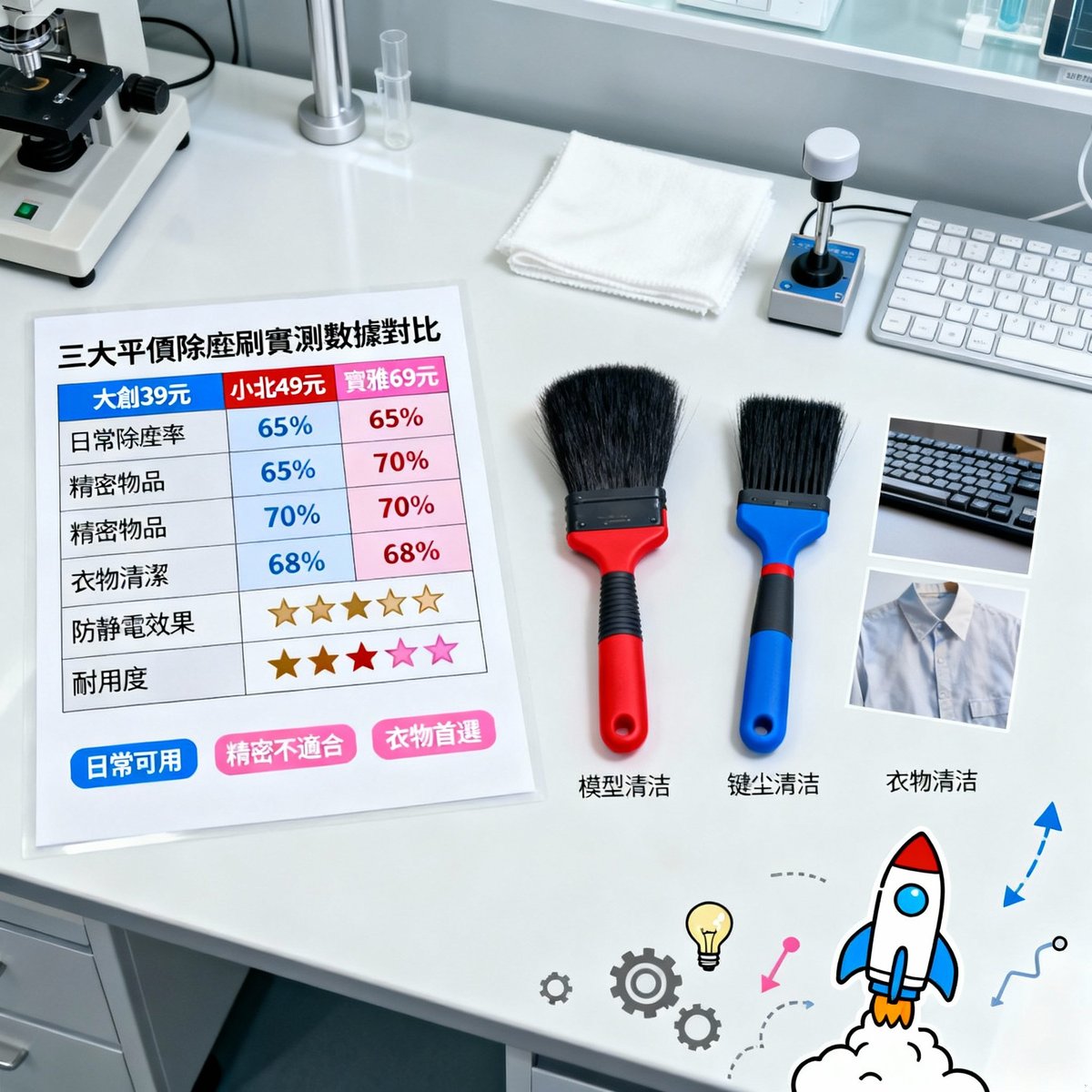
Test method: the same amount of dust, the same number of strokes and the same force throughout. The dust removal rate was measured. The anti-static effect was measured with a static tester.
Test 1: Everyday dusting
Test objects: everyday items such as a desk, keyboard, monitor and books
Daiso dust-removal brush:
- Dust removal rate: 65%
- Anti-static effect: surface resistance 10^10 ohms (above the range commonly recommended in practice, 10^6-10^9 ohms)
- Comment: basically usable, but needs several passes
Showba dust-removal brush:
- Dust removal rate: 70%
- Anti-static effect: surface resistance 10^9 ohms (at the upper limit of the range commonly recommended in practice, 10^6-10^9 ohms)
- Comment: slightly better than Daiso, cleaner after a single pass
Poya dust-removal brush:
- Dust removal rate: 68%
- Anti-static effect: surface resistance 10^10 ohms (above the range commonly recommended in practice, 10^6-10^9 ohms)
- Comment: nicely soft, suited to clothes and furniture
Conclusion: all three can just about cope with everyday dusting. Showba performs best.
Test 2: Precision items
Test objects: precision items such as Gundam models, figures and camera lenses
Daiso dust-removal brush:
- Dust removal rate: 60%
- Bristle stiffness: on the stiff side, may scratch paintwork
- Comment: not recommended for precision models
Showba dust-removal brush:
- Dust removal rate: 63%
- Bristle stiffness: medium, just about usable with care
- Comment: not the best choice, but will do on a limited budget
Poya dust-removal brush:
- Dust removal rate: 62%
- Bristle stiffness: softer, relatively safe
- Comment: soft, but the anti-static effect is limited
Conclusion: none of the three budget dust-removal brushes is suitable for cleaning precision items. We suggest a professional brand such as Tamiya.
See the full unboxing review of the Tamiya anti-static brush to understand how the performance of a professional product differs.
Test 3: Dusting clothes
Test objects: clothes such as suits, coats and sweaters
Daiso dust-removal brush:
- Dust removal rate: 68%
- Comment: usable on ordinary fabrics, but the result is average
Showba dust-removal brush:
- Dust removal rate: 72%
- Comment: suited to dusting everyday clothes, decent value for money
Poya dust-removal brush:
- Dust removal rate: 75%
- Comment: designed for clothes, the best result
Conclusion: the Poya dust-removal brush performs best on clothes. The bristles are soft and do not damage fabric.
Budget dust-removal brushes vs professional brands
Compared with the Tamiya (TAMIYA) anti-static brush
Difference in bristle softness:
- Tamiya: organic conductive fiber combined with fine PBT fiber bristles, softness 10/10, as fine as cat fur
- Daiso / Showba / Poya: plastic fiber, softness 3-4/10, clearly stiffer
- Gap: a 3-fold difference in softness
How it actually feels: Tamiya's bristles are clearly finer. You can feel the difference as soon as you touch them.
Difference in dust removal rate:
- Tamiya: 90% dust removal rate on Gundam models, 85% for computer cleaning
- Budget products: 60-63% dust removal rate on models, 65-70% for computer cleaning
- Gap: a 20-30% difference in dust removal rate
Why the gap? Tamiya's bristles are finer and denser and can reach into tiny gaps. The bristles of budget products are coarser and can only remove dust on the surface.
Difference in durability:
- Tamiya: lasts 2-3 years with normal use; the bristles do not easily deform or fall out
- Budget products: after 3-6 months of use the bristles are clearly thinner, falling out and deformed
- Gap: a 4-6-fold difference in durability
Long-term cost: Tamiya has a higher unit price, but it can last 2-3 years; Daiso is cheap, but has to be replaced frequently. Spread over time, Tamiya actually works out as better value in long-term use.
Difference in price:
- Tamiya: high price range
- Daiso: budget
- Showba: budget
- Poya: budget
- Gap: clearly higher in price
The price is reflected in the material, the manufacturing workmanship and the quality control. Budget products aim to be "good enough". Tamiya pursues "ultimate" performance.
💼 Volume purchasing offers for businesses
If you need:
- Dust-removal brushes in bulk (group purchases for schools, companies or studios)
- Custom brush specifications (special sizes, specified materials, particular requirements)
- Factory-direct prices (no middleman, with wholesale discounts)
YC Brushes - over 40 years of professional manufacturing experience
- ✅ ESD anti-static certified, meeting industrial standards
- ✅ Tooling and custom production from drawings or samples
- ✅ Order quantities and lead times are quoted per specification; email us with your requirements
- ✅ Advice on material selection (carbon fiber / conductive fiber / anti-static fiber)
Request a quote now
- 📞 Phone: +886-2-2988-2721
- 📧 Email: [email protected]
- 🌐 Online form: Contact YC Brushes
Factory-direct × professional custom work × assured quality
Summary comparison table
| Item compared | Tamiya | Daiso | Showba | Poya |
|---|---|---|---|---|
| Price | High price range | Budget | Budget | Budget |
| Bristle material | Organic conductive fiber + PBT | Anti-static plastic | Mixed fiber | Anti-static plastic |
| Softness | ★★★★★ | ★★☆☆☆ | ★★★☆☆ | ★★★☆☆ |
| Everyday dust removal rate | 95% | 65% | 70% | 68% |
| Precision dust removal rate | 90% | 60% | 63% | 62% |
| Anti-static effect | ★★★★★ | ★★☆☆☆ | ★★★☆☆ | ★★☆☆☆ |
| Durability | 2-3 years | 3-6 months | 4-8 months | 4-8 months |
| Overall score | 9.5/10 | 5/10 | 6/10 | 5.5/10 |
| Recommended use | Precision models | Everyday dusting | General cleaning | Dusting clothes |
The pros and cons of budget dust-removal brushes in depth
5 advantages
1. Extremely cheap, so trying one costs almost nothing
The budget price means you hardly need to think about it. Want to find out whether a dust-removal brush suits you? Buying a Daiso product to try will not hurt at all. If you do not like it, you have lost only the price of a drink.
This is the biggest advantage of budget products. They let more people get to know the dust-removal brush as a tool.
2. Extremely convenient to buy
There are nearly 100 Daiso stores across Taiwan, plus 194 Showba stores and 470 Poya stores. You can easily buy one in any shopping district. No waiting for an online order, no trip to a model shop and no worry about stock running out.
Need it right now? Walk to the nearest Daiso and buy it immediately. This convenience is something professional brands cannot match.
3. Genuinely good enough for everyday dusting
If you are only cleaning everyday items such as a desk, keyboard, monitor and books, the 65-70% dust removal rate of a budget dust-removal brush is enough. There is no need to bring out a high-priced Tamiya, which would be like using a cannon to shoot a sparrow.
For users who do not pursue perfection and only want basic cleaning, budget products fully meet the need.
4. Many styles to choose from
Daiso, Showba and Poya each have several designs: long handles, short handles, large heads, small heads and different colors. You can choose according to personal preference and habits.
Poya has even launched streamlined designs and pink-toned looks, so that a cleaning tool can be attractive as well.
5. No great loss if it does not work out
Bought one and do not like it? You spent only a little money. Give it to someone else, keep it as a spare or use it as a rough-work brush; it does not matter. It is nothing like the pain of buying a high-priced Tamiya and finding it does not suit you.
The low price brings very little psychological burden.
5 disadvantages
1. The bristles are stiffer and may scratch precision items
This is the most serious problem. The plastic fiber bristles are clearly coarser than Tamiya's bristles. Brushing the painted surface of a precision model may leave fine scratches.
For items such as high-priced models, precision instruments and high-end camera lenses, the risk of a budget dust-removal brush is too high.
2. The anti-static effect is extremely limited
The surface resistance is 10^10 ohms, which is above the range commonly recommended in practice (10^6-10^9 ohms). It can only slightly "reduce" static and cannot truly "eliminate" it.
When cleaning the inside of a computer case, static may damage electronic components. The protection a budget dust-removal brush provides is not enough. Serious enthusiasts should not take the risk.
3. Low durability, so frequent replacement is needed
After 3-6 months of use the bristles start to thin out, fall out and deform. The anti-static coating also gradually stops working. You have to keep buying again.
It looks cheap in the short term, but over the long term it is not necessarily good value. Tamiya can last up to 3 years, while a Daiso brush has to be replaced several times a year; spread over time, it does not necessarily save money.
4. Unstable quality
Even among Daiso dust-removal brushes, quality can differ greatly from batch to batch. Some have dense bristles, some sparse. Some are soft, some on the stiff side. Quality control is not as strict as with professional brands.
5. The bristles fall out easily
The bristles easily fall out during use and drop into the gaps of a model or a keyboard. They have to be picked out with tweezers, which is a real nuisance.
The bristles of professional brands are fixed more securely and shed less. Budget products clearly fall short here.
Value-for-money analysis: are budget dust-removal brushes worth buying?
Value for money = performance / price. But the criteria differ for different needs.
Scenario 1: Everyday dusting (desk, keyboard, monitor, books)
Performance: 7/10 (dust removal rate 65-70%, acceptable) Price advantage: 10/10 (budget price, a real bargain) Value-for-money score: 10/10
Conclusion: for everyday dusting, a budget dust-removal brush is extremely good value. There is no need at all to buy a Tamiya.
Scenario 2: Precision items (models, figures, camera lenses)
Performance: 4/10 (dust removal rate 60%, stiff bristles with a risk of scratching) Price advantage: 10/10 (budget price, a real bargain) Value-for-money score: 4/10
Conclusion: for cleaning precision items, a budget dust-removal brush is extremely poor value. The risk outweighs the benefit. We strongly suggest buying a professional brand such as Tamiya.
See Do anti-static brushes work? A test-based analysis for the measured data of different brands.
Scenario 3: Dusting clothes (suits, coats, sweaters)
Performance: 7-8/10 (the Poya model has a 75% dust removal rate and soft bristles) Price advantage: 10/10 (budget price, good value) Value-for-money score: 9/10
Conclusion: for dusting clothes, budget dust-removal brushes (especially the Poya model) are very good value. Worth buying.
Scenario 4: Cleaning the inside of a computer case
Performance: 5/10 (insufficient anti-static effect, some risk) Price advantage: 10/10 (budget price, a real bargain) Value-for-money score: 5/10
Conclusion: for cleaning the inside of a computer, a budget dust-removal brush is medium value for money. If the computer is valuable, we suggest buying a professional brand that meets the ESD standard.
Overall value for money
Clear positioning means high value: if you clearly understand the limits of a budget dust-removal brush and use it where it fits (everyday dusting, cleaning clothes), the value for money is very high.
The wrong scenario means low value: if you expect a budget product to perform like a professional brand and use it to clean precision models or electronic products, the value for money is extremely low and there is risk.
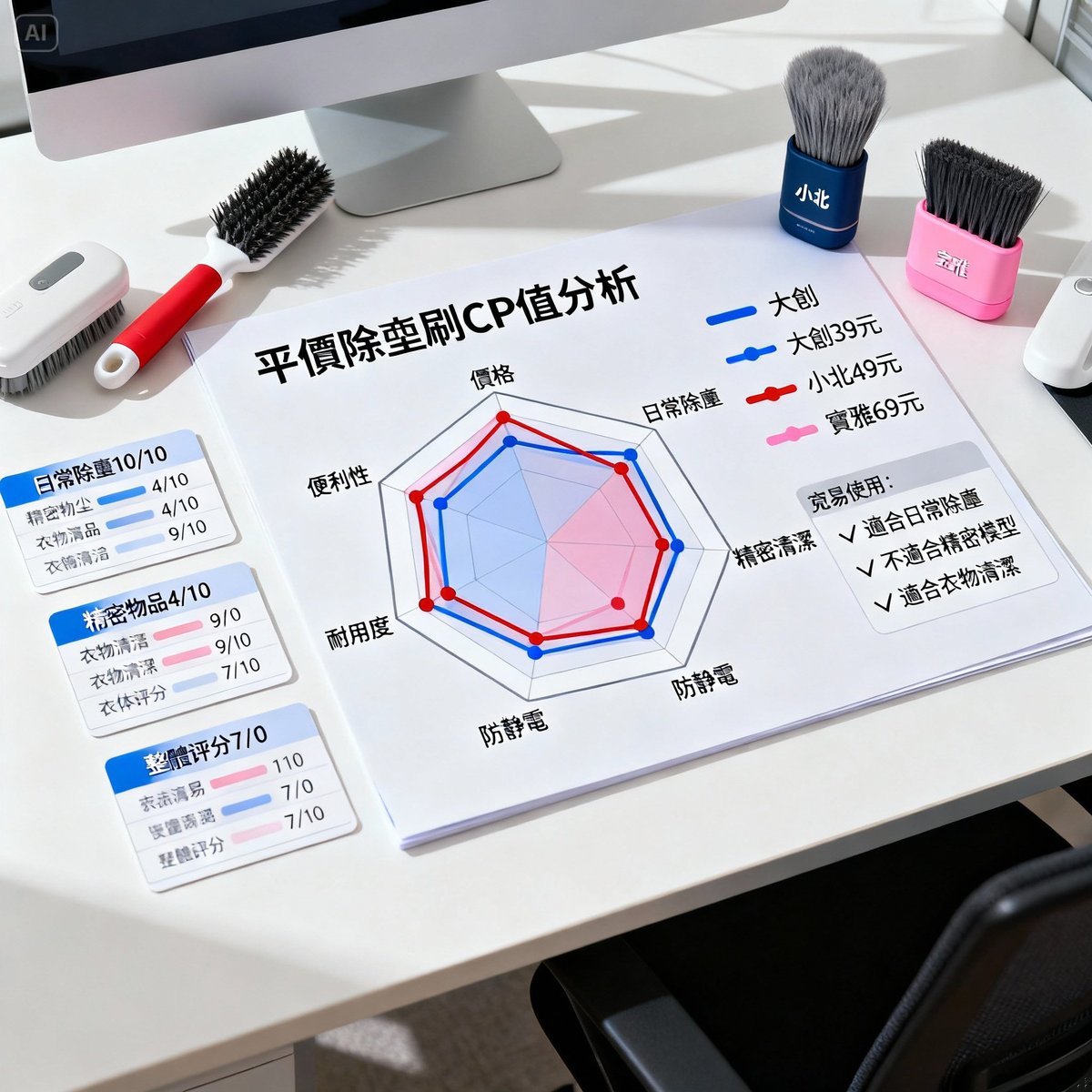
Where they fit: when should you buy a budget dust-removal brush?
✅ 5 situations where a budget dust-removal brush is suitable
1. Everyday household cleaning
Cleaning everyday items such as desks, bookcases, keyboards, monitors, televisions and audio equipment. The surfaces of these items do not need to be absolutely perfect. A dust removal rate of 65-70% is enough. Daiso or Showba is fully up to the job.
2. Dusting and caring for clothes
Dusting clothes such as suits, coats, sweaters and jackets. The Poya dust-removal brush is designed for this kind of need. The bristles are soft and the dust removal rate is 75%. At a budget price it is very good value.
3. Trying a dust-removal brush for the first time
Never used a dust-removal brush? Not sure whether you need one? Buy a budget Daiso model to try first. Upgrade to a professional brand once you are sure you like it. The cost of trying is extremely low.
4. Cleaning rough surfaces
Rough surfaces such as plastic storage boxes, toolboxes and the back panels of bookcases. There is no worry about scratching. A budget dust-removal brush is entirely suitable.
5. Bulk purchases for use in many places
Many desks in an office, school classrooms, several workbenches in a studio. You need to buy in bulk so that every position has a dust-removal brush. Budget products cut the cost considerably.
❌ 5 situations where a budget dust-removal brush is not suitable
1. Cleaning precision models (Gundam, architectural models, action figures)
The paintwork on a model's surface is fragile. The bristles of a budget dust-removal brush are on the stiff side and may leave fine scratches. Scratching a model you worked hard to build is not worth it. Be sure to buy a professional brand such as Tamiya.
For a detailed review, see the full unboxing review of the Tamiya anti-static brush.
2. High-priced precision instruments (camera lenses, microscopes, measuring instruments)
This equipment is worth tens of thousands or even hundreds of thousands of NT dollars. The surface coatings are extremely fragile. Using a budget product with coarse, stiff bristles is too risky. Use professional dust-removal tools.
3. Cleaning the inside of a computer case
The components inside a computer are sensitive to static. An ESD event above 100 V may damage the motherboard, memory or graphics card. The anti-static effect of a budget dust-removal brush is insufficient (surface resistance 10^10 ohms). This is above the range commonly recommended in practice.
Use an industrial-grade dust-removal brush that is labeled as ESD compliant, with a surface resistance within the range commonly recommended in practice (10^6-10^9 ohms).
4. Professional work (repairing consumer electronics, electronics manufacturing, precision assembly)
Professional work demands high-quality tools. It needs a stable anti-static effect and reliable bristle quality. Budget products are unstable in quality and low in durability. They are not suited to professional settings.
5. Enthusiasts who pursue perfection
If you are a model builder, a photography enthusiast or a collector, you demand a very high standard of cleaning. The 60-70% dust removal rate of budget products cannot satisfy you. Buy a professional brand such as Tamiya directly.
For where to buy, see Where to buy anti-static brushes: purchasing channels.
Tips for using a budget dust-removal brush: getting the most out of a budget brush
Even with a budget product, correct use improves the result.
Tip 1: Use an even lighter touch
The bristles of a budget dust-removal brush are stiffer. You must use a lighter touch than with a professional brand. Sweep across as lightly as a feather. Do not press hard.
The wrong way: pressing hard as you brush, so the bristles scratch the surface The right way: sweeping lightly across the surface, with only the tips of the bristles touching
Tip 2: Brush in one direction and avoid rubbing back and forth
Brush in a single direction. Do not rub back and forth. Rubbing back and forth increases the risk of scratching.
The right way: brush from left to right 3 times, not back and forth from side to side
Tip 3: Use it with an air blower to double the effect
First blow off the large dust particles with an air blower. Then remove the fine dust with the dust-removal brush. Finally blow once more to make sure. This raises the dust removal rate to 80% or higher.
The combination: air blower → dust-removal brush → air blower = the best dust removal
Tip 4: Avoid cleaning finely painted surfaces
If the surface of the item has fine paintwork (models, high-end furniture), it is better to clean only the unimportant areas than to risk brushing the painted surface.
The cautious rule: better to leave a little dust than to cause a scratch
Tip 5: Clean the bristles regularly
Budget dust-removal brushes collect dust easily. Wash the bristles every week in warm water with a little dish soap. Let them air dry naturally. This extends the service life.
Cleaning steps: soak in warm water → rub gently → rinse clean → air dry naturally (do not use a hair dryer)
Tip 6: Keep it as a "rough-work brush"
When you have upgraded to a professional brand such as Tamiya, do not throw the budget dust-removal brush away. Keep it as a "rough-work brush" for cleaning unimportant places such as toolboxes, shoe cabinets and balconies.
The division of labor: Tamiya for precision items, Daiso for rough surfaces
Upgrade advice: when should you switch to a professional brand?
5 signs it is time to upgrade
Sign 1: You have started collecting models or precision items
When you start collecting Gundam models, action figures or finely detailed figures, it means you value these items. They are worth investing in better cleaning tools. Upgrade to a Tamiya anti-static brush.
Sign 2: You find the budget brush scratches things easily
After using a budget dust-removal brush you notice fine lines on the surface of an item. This is a warning that the bristles are too stiff. Stop using it immediately and upgrade to a professional brand with soft bristles.
Sign 3: Your standards for cleaning have risen
You have gone from "as long as the dust comes off" to "it has to be very clean". That means your standards have risen. The 60-70% dust removal rate of budget products can no longer satisfy you.
Sign 4: You need to clean the inside of a computer case
Getting ready to clean the inside of a desktop computer? You must upgrade to a professional brand that meets the ESD standard. The anti-static effect of budget products is insufficient and may damage electronic components.
Sign 5: Replacing budget brushes so often is no longer good value
You find you have to buy a new budget dust-removal brush every 3-4 months, and the spending adds up. At that point it is better to invest in a Tamiya once and use it for several years.
Recommended upgrade path
Entry stage: Daiso / Showba (budget) → everyday use, getting familiar with how to use a dust-removal brush
Professional stage: TAMIYA (high price range) → extremely soft, does not damage paintwork at all
Industrial stage: industrial-grade ESD (high price range) → meets industrial standards, for professional repair work
There is no need to get there in one step. Upgrade gradually as your needs grow.
Why keep the budget brush
Even after upgrading to a professional brand, we suggest keeping the budget dust-removal brush and dividing the work:
- Tamiya: models, cameras, precision items
- Daiso / Showba: toolboxes, shoe cabinets, balconies, rough surfaces
This extends the service life of the professional brush and avoids using a fine tool for rough work.
Conclusion: is a budget dust-removal brush right for you?
The positioning of the budget dust-removal brushes from Daiso, Showba and Poya is very clear: an entry-level choice for everyday dusting.
When they are worth buying:
- Everyday household cleaning (desk, keyboard, monitor) → value for money 10/10
- Dusting and caring for clothes (suits, coats) → value for money 9/10
- Trying a dust-removal brush for the first time → the cost of trying is extremely low
- Cleaning rough surfaces → fully up to the job
- Bulk purchases for use in many places → lower cost
When they are not recommended:
- Cleaning precision models → stiff bristles with a risk of scratching
- High-priced precision instruments → the risk outweighs the benefit
- The inside of a computer case → insufficient anti-static protection
- Professional work → unstable quality
- Pursuing perfection → cannot meet the need
Buying advice:
- Be clear about your needs: first confirm how you will use it
- Keep expectations reasonable: do not expect a budget product to perform like a professional brand
- Start by trying: if you are not sure, buy a Daiso brush to try first
- Upgrade at the right time: do not hesitate to upgrade when your needs grow
- Divide the work: let the budget brush and the professional brush each do their own job
A budget dust-removal brush is not a perfect product, but used in the right situation it is extremely good value. The most important thing is to understand your own needs and choose a suitable tool.
Need a professional custom dust-removal brush? Contact YC Brushes: with over 40 years of manufacturing experience, we provide a complete service from material selection to tooling and volume production.
FAQ
Q1: Does Daiso's budget dust-removal brush really have an anti-static effect?
Yes, but the effect is very limited. The anti-static property of the Daiso dust-removal brush comes from a coating of anti-static agent on the surface, not from true conductive fiber. The surface resistance is about 10^10 ohms, which is above the range commonly recommended in practice (10^6-10^9 ohms). It can only slightly reduce static and cannot eliminate it completely. The coating also diminishes with use, and the effect drops clearly after about 3-6 months. If you need a true anti-static effect, we suggest buying a conductive fiber product such as Tamiya.
Q2: Can a budget dust-removal brush be used to clean Gundam models?
We do not recommend it. The bristles of a budget dust-removal brush are clearly thicker and stiffer than Tamiya's bristles and may leave fine scratches on the painted surface of a model; the dust removal is also not as good as with a professional model. For high-priced or carefully painted models, we strongly suggest a Tamiya anti-static brush. For cheap straight-built kits used for practice, a budget product can be used with care, but with an extremely light touch.
Q3: Which brand is better, Daiso, Showba or Poya?
It depends on the use. Everyday dusting: Showba works best (dust removal rate 70%), is affordable and is good value. Dusting clothes: Poya is the most suitable (dust removal rate 75%), with soft bristles, an attractive design and a mid-range price. Saving as much as possible: Daiso is the cheapest; the result is slightly weaker but acceptable. Overall, Showba is the most balanced all-round performer, but each has its own character.
Q4: How long does a budget dust-removal brush last?
About 3-6 months with normal use. After that the bristles become clearly thinner, fall out and deform, and the anti-static effect fades. With frequent use (every day), it needs replacing after about 3-4 months. With occasional use (1-2 times a week), it can last 6-8 months. This is far shorter than Tamiya's 2-3 years. Considering the low price, though, the durability is acceptable. Washing the bristles regularly extends the life a little.
Q5: Can a budget dust-removal brush be used to clean the inside of a computer case?
We do not recommend it. The components inside a computer are sensitive to static, and an ESD event above 100 V may damage the motherboard, memory or graphics card. The surface resistance of a budget dust-removal brush is about 10^10 ohms, above the range commonly recommended in practice (10^6-10^9 ohms), so it cannot provide enough static protection. If the computer is of low value and you are willing to accept the risk, you can use one with caution. But we suggest buying an industrial-grade dust-removal brush that meets the ESD standard, to make sure the cleaning is safe.
Q6: After using a Tamiya, would you still want to use a Daiso brush?
After using a Tamiya, you feel the difference very clearly. Tamiya's bristles are as soft as cat fur, while Daiso's are clearly on the stiff side. Tamiya's dust removal rate is 90%, Daiso's only 65%. But that does not make the Daiso brush useless. We suggest dividing the work: Tamiya for important items such as precision models and cameras, and the Daiso brush kept for cleaning rough surfaces such as toolboxes and shoe cabinets. This protects the precision items and also avoids shortening the Tamiya's life by using it for rough work. Each doing its own job is the ideal arrangement.
Q7: Are budget dust-removal brushes cheaper online than in physical stores?
Not necessarily. In physical stores, Daiso, Showba and Poya are all in the budget price range. Online platforms (Shopee / PChome, both widely used in Taiwan) may have special offers or bundle discounts, but shipping has to be taken into account. Our suggestion: if you need it right away → buy in a physical store; if you are not in a hurry and want to compare prices → use an online platform. The price difference is usually small, though, unless you are buying in bulk. For bulk purchases (50 pieces or more) we suggest asking a factory (such as YC Brushes) directly for a quote, to get wholesale discounts.
Q8: How do I know when a budget dust-removal brush needs replacing?
3 signs that it needs replacing: (1) the bristles are clearly thinner or falling out in quantity - this affects dust removal; (2) the bristles are deformed or bent - it can no longer brush properly; (3) dust removal has clearly declined - it takes many passes to get things clean. In addition, the anti-static effect cannot be judged by eye, but the coating usually fades after 3-6 months. For general household cleaning, you can keep using the brush as long as it looks normal. For precision items, we suggest replacing it after 3 months, so that the bristles are always in the best condition.
Q9: Daiso has many kinds of dust-removal brush. Which one should I buy?
Daiso usually has 3-4 kinds of dust-removal brush. Recommended choices: (1) an "anti-static dust-removal brush" - with the word "static" or "antistatic" on the packaging; (2) a model with finer, denser bristles - it removes dust better; (3) a model with a longer handle - it is easier to apply force. Avoid: (1) ordinary dust-removal brushes (no anti-static function); (2) models with bristles that are too coarse. If you are not sure, ask the store staff for an "anti-static dust-removal brush". The models may differ slightly from store to store, so compare a few stores.
Q10: Are there discounts for businesses buying dust-removal brushes in bulk?
Yes! If you need to buy in bulk (schools, companies, studios), we suggest contacting a brush factory directly. YC Brushes offers a wholesale service for businesses: the larger the quantity, the better the price. Specifications can also be customized to your needs (specified bristle material, length, stiffness and handle design). Order quantities and lead times are quoted per specification, so please email us with your requirements. We are ESD certified and can provide inspection reports. For inquiries, phone +886-2-2988-2721 or use the online form: Contact YC Brushes