Did you know that choosing the wrong industrial brush can lead to a whole batch of product being scrapped?
In an electronics plant, a cleaning brush that sheds can short-circuit a PCB. In a food plant, a brush that does not meet food-grade standards can mean a shutdown. On a semiconductor line, static problems can cut the yield by 10% outright.
An industrial brush is not something you simply buy off the shelf. It has to be chosen precisely according to the industry, the operating environment and the functional requirements. This article looks in depth at industrial brush applications in 5 industries and gives practical advice on material selection and purchasing.
This article is further reading for The complete guide to brush manufacturing and focuses on an in-depth look at industrial applications.
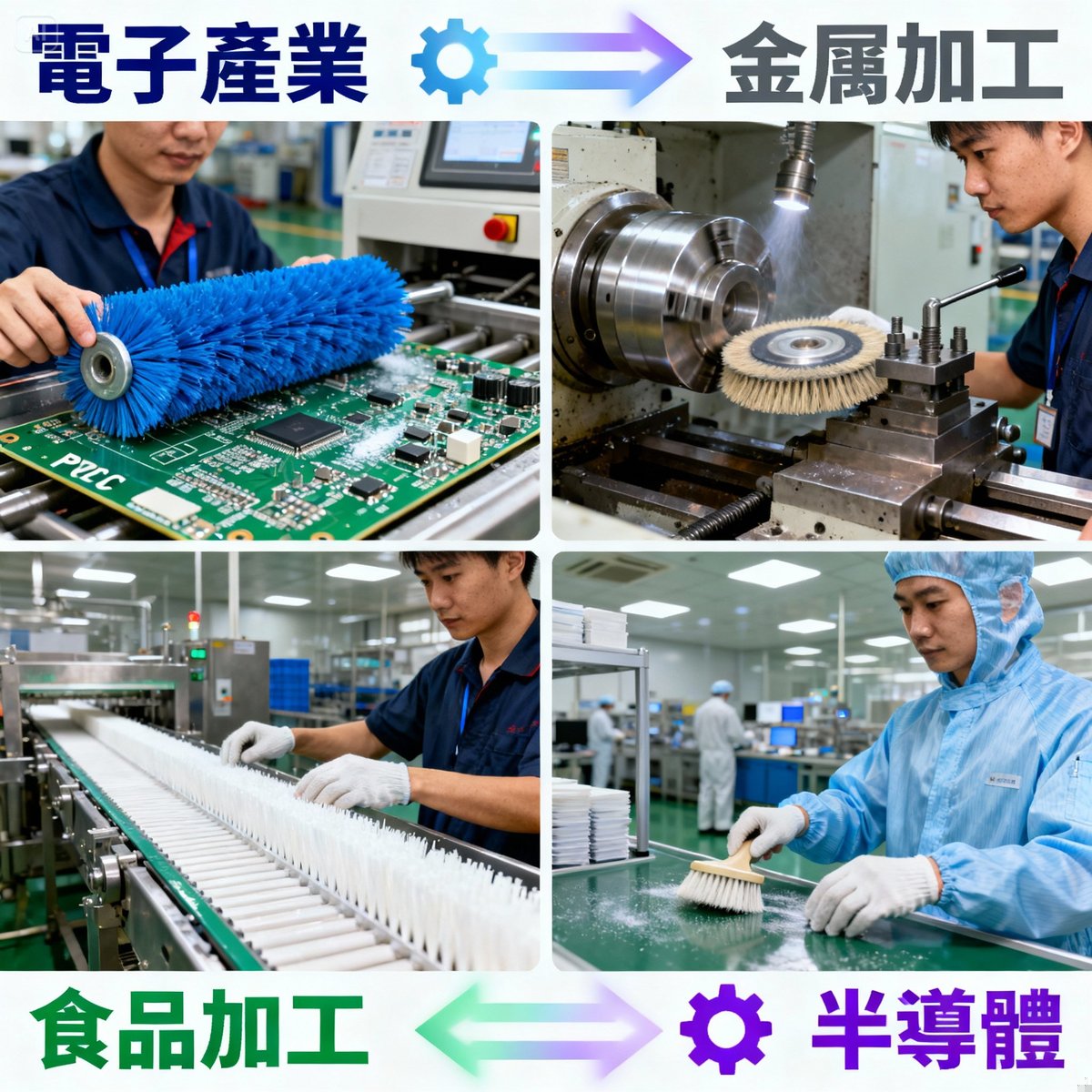
Industrial brush applications in the electronics industry
The electronics industry demands a great deal of an industrial brush: it must not shed, must not scratch, and must also be anti-static.
PCB cleaning brush
Applications:
- Surface cleaning before SMT placement
- Removal of flux residue
- Removal of metal chips and dust
Material selection:
- First choice: natural horsehair brush
- Soft, does not scratch fine circuitry
- Naturally anti-static
- Does not shed easily
- Second choice: ultra-fine PBT filament
- Lower cost
- Highly durable
- Static needs attention
Recommended specification:
- Filament diameter: 0.05-0.1 mm
- Trim length: 15-25 mm
- Tuft density: 60-70% (dense)
- Base material: aluminum alloy or anti-static plastic
Common problems:
- Using a nylon brush → may scratch the circuitry
- Filament too hard → damages solder joints
- A brush that sheds → risk of short circuits
Static elimination brush
Applications:
- Eliminating static in film conveying
- Removing static in plastic part production
- Static removal before labels are applied
Material selection:
- High-end option: conductive fiber brush
- Resistance: 10^6-10^9 Ω
- The best static removal
- Higher price (NT$200-500 each)
- Economy option: natural horsehair brush
- Naturally anti-static
- Affordable (NT$80-150 each)
- Needs regular replacement
Testing the effect:
Measured with a static meter, an acceptable anti-static brush should be able to bring the surface voltage down from 5000V to below 500V (a reduction of >90%).
Want to know more about how anti-static brushes work and how to choose one? See Anti-static brushes explained in full.
Film dust-removal brush
Applications:
- LCD/OLED panel production
- Dust removal before protective film is applied
- Dust removal on optical films
Material selection:
- Ultra-fine nylon filament (0.03 mm in diameter)
- Or ultra-fine PBT filament
- Must meet the cleanroom class requirement
Key specifications:
- Cleanroom class: Class 100 or better
- Non-shedding test: pull test
> 5kg - Static control: surface resistance below 10^9 Ω
Success story: After a TFT-LCD plant introduced ultra-fine PBT dust-removal brushes, the defect rate in film lamination fell from 3.2% to 0.8%, saving more than NT$5,000,000 a year in losses.
See the YC Brushes range for the electronics industry, or contact us for free sample testing.

Industrial brush applications in metalworking
Metalworking places very high demands on a brush's wear resistance, hardness and heat resistance.
Deburring brush
Applications:
- Removing burrs after CNC machining
- Edge treatment of sheet metal parts
- Removing flash from castings
Material selection:
- Heavy burrs: wire brush
- The hardest
- Fast removal
- But may scratch the surface
- Medium burrs: stiff hog bristle brush
- Moderate hardness
- Unlikely to harm the surface
- Long life
- Light burrs: stiff nylon brush
- Suits precision parts
- Does not harm the base material
- Resistant to wear and high temperatures
Recommended specification:
- Filament hardness: chosen according to the severity of the burrs
- Rotation speed: 500-3000 RPM
- Trim length: 25-40 mm
- Shape: disc brush, cup brush, strip brush
Surface polishing brush
Applications:
- Polishing stainless steel surfaces
- Matte finishing of aluminum parts
- Polishing copper parts
Material selection:
- Rough polishing: stiff nylon + abrasive grit
- Intermediate polishing: horsehair brush
- Fine polishing: wool brush or ultra-fine nylon
Matching the polishing compound:
- Rough polishing: #320-#600 grit
- Intermediate polishing: #800-#1200 grit
- Fine polishing: #1500-#3000 grit or polishing wax
Common mistakes:
- Filament too hard → scratches
- Speed too high → burns the surface
- Wrong polishing compound → poor result
Rust-removal brush
Applications:
- Removing rust from steel surfaces
- Refurbishing old equipment
- Surface preparation before welding
Material selection:
- Severe rust: wire wheel brush
- Medium rust: brass wire brush (does not harm the base material)
- Light rust: stiff nylon brush
Safety notes:
- Safety goggles must be worn (wires can break and fly off)
- Use a dust mask (to avoid inhaling rust powder)
- Check the brush for damage (a broken brush is dangerous)
Success story: A machinery plant used brass wire rust-removal brushes from YC Brushes on old molds. Rust-removal efficiency rose by 40% with no harm to the base material, and mold life was extended by 2 years.
Want to know more about choosing brushes for metalworking? Contact YC Brushes now for free application advice.
Industrial brush applications in food processing
Brushes for the food industry must meet food-grade standards. That is a bottom line with no room for compromise.
Conveyor belt cleaning brush
Applications:
- Cleaning food conveyor belts
- Cleaning packaging lines
- Cleaning bakery lines
Material selection:
- First choice: food-grade nylon (PA66)
- Complies with FDA food-contact material regulations (21 CFR 177), with an SGS test report
- Heat resistant to 120°C
- Does not absorb water, dries fast, does not go moldy
- Second choice: food-grade PBT
- Soft, does not harm the conveyor belt
- Good resilience
- Heat resistant to 100°C
Key regulations and certifications:
- Complies with FDA (US Food and Drug Administration) food-contact material regulations (21 CFR 177)
- SGS testing of food-contact materials
- ISO 22000 food safety management
Cleaning and maintenance:
- Wash after each day's work
- Disinfect every week
- Replace every month (recommended)
Bakery oiling brush
Applications:
- Oiling baking trays
- Brushing egg wash on bread
- Brushing syrup on pastries
Material selection:
- Modern option: food-grade silicone brush
- Heat resistant to 180-230°C
- Does not shed at all
- Easy to wash, durable
- Higher price
- Traditional option: natural hog bristle brush
- Holds oil well and spreads it evenly
- Low price
- But needs frequent replacement (sheds easily)
Hygiene standards:
- Must be washed and disinfected before and after use
- Replace regularly (hog bristle brush 1-2 months, silicone brush 6-12 months)
- Store in a dry, ventilated place
- Do not mix with non-food utensils
Fruit and vegetable washing brush
Applications:
- Washing root vegetables (potatoes, carrots)
- Cleaning the surface of fruit
- Pre-treatment before grading farm produce
Material selection:
- Food-grade nylon (soft type)
- Filament diameter: 0.2-0.3 mm
- Soft, does not harm the skin
Integration with equipment: Usually a roller brush design combined with a water rinse, which is efficient and cleans thoroughly.
Success story: A fruit and vegetable processing plant introduced food-grade roller washing brushes from YC Brushes. Washing efficiency rose by 60%, and the plant met the hygiene standards for export to Japan.
See the food-grade products from YC Brushes. All products have passed SGS food-grade testing.
Industrial brush applications in the semiconductor industry
The semiconductor industry takes the demands on an industrial brush to the extreme: particle-free, anti-static, non-shedding and highly precise.
Wafer cleaning brush
Applications:
- Dust removal before and after wafer transfer
- Cleaning wafer cassettes
- Cleaning precision parts
Material selection:
- High-end option: PVA (polyvinyl alcohol) filament
- Super-hydrophilic, used with pure water
- Cleanroom Class 10
- Does not shed at all
- Extremely expensive
- Standard option: ultra-fine PBT filament
- 0.03-0.05 mm in diameter
- Cleanroom Class 100
- More reasonably priced
Key specifications:
- Particle generation:
< 10particles/m² - Surface resistance: 10^6-10^9 Ω
- Filament pull strength:
> 8kg (no shedding allowed)
Cleaning protocol:
- Wash with pure water (DI water)
- Combine with ultrasonic cleaning
- Replace regularly (usually every 3-6 months)
Cleanroom dust-removal roller
Applications:
- Dust removal at the cleanroom entrance
- Dust removal on product surfaces
- Anti-static dust removal
Material selection:
- Conductive fiber (carbon fiber blend)
- Or natural horsehair (with anti-static treatment)
Cleanroom class requirements:
- Class 10: use PVA or ultra-fine PBT
- Class 100 (ISO 5): use ultra-fine PBT or nylon
- Class 1000 (ISO 6): use ordinary anti-static nylon
Success story: After a wafer fab introduced conductive fiber dust-removal rollers from YC Brushes, the particle count on the wafer surface fell from an average of 28 per wafer to 5 per wafer, the yield rose by 3.5%, and the added benefit exceeded NT$20,000,000 a year.
Want to know the full range of anti-static brush applications in the semiconductor industry? See Anti-static brushes explained in full.
💡 Need to find the best brush solution for your industry?
Contact YC Brushes now for a free application assessment, material advice and sample testing. Over 40 years of industrial brush experience will help you raise the efficiency of your production line.
Industrial brush applications in the machinery industry
The machinery industry asks for durable brushes and flexibility in specifications.
Sealing strip brush
Applications:
- Keeping dust out at machine inlets and outlets
- Sealing the gaps of elevator doors
- Sealing the bottom of automatic doors
- Keeping chips in on CNC machines
Material selection:
- General environments: PP filament + aluminum base
- Weather resistant, low price
- Life of 2-3 years
- High-temperature environments: nylon filament + stainless steel base
- Heat resistant to 120°C
- Life of 3-5 years
- Premium applications: horsehair + stainless steel base
- The best seal, and quiet
- Life of 5 years or more
Choosing the specification: See The complete guide to brush manufacturing | strip brush section for detailed instructions on measuring dimensions and on installation.
Conveyor roller brush
Applications:
- Conveying and cleaning products
- Guiding paper during conveying
- Guiding products on packaging lines
Material selection:
- Choose the filament hardness according to the product material
- Metal parts → stiff nylon
- Plastic parts → medium-hardness nylon or PP
- Paper → soft nylon or horsehair
Made-to-order specifications:
- Shaft diameter: depends on the equipment (commonly 20-50 mm)
- Roller length: custom (50-1000 mm)
- Trim length: depends on the gap (10-50 mm)
Purchasing advice: For conveyor roller brushes used in large quantities, customization is recommended and can lower costs by 20-30%. For the detailed process, see The custom brush process explained in full.
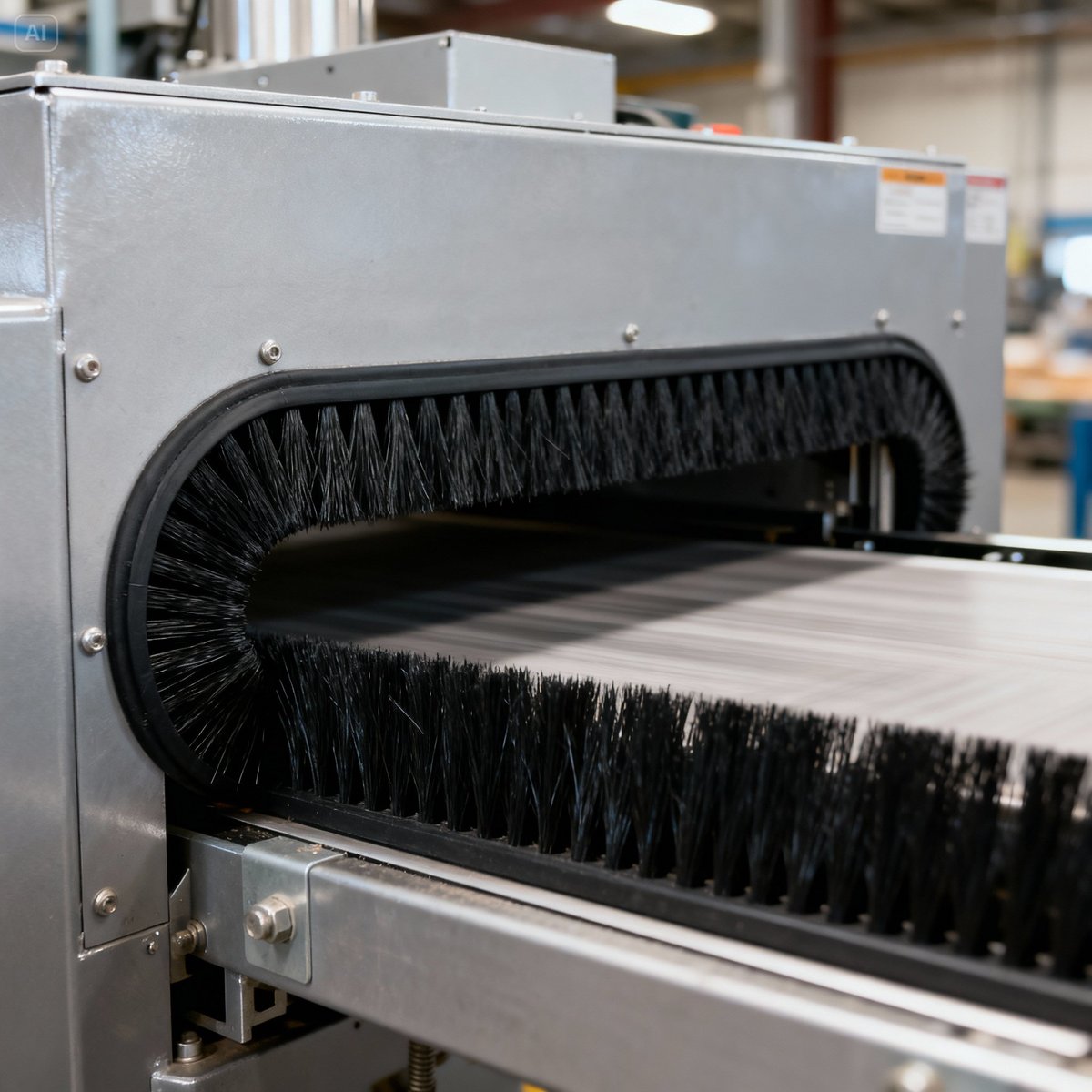
Guide to choosing industrial brush materials
Choosing the right material is the first step toward a successful industrial brush application.
Choosing by operating environment
High-temperature environments (> 100°C)
- First choice: nylon filament (heat resistant to 120-150°C)
- Second choice: stainless steel wire brush (heat resistant to
> 300°C) - Avoid: natural bristle brushes (they deform at
< 80°C)
Damp environments
- First choice: nylon or PP filament (does not absorb water, does not go moldy)
- Second choice: stainless steel wire brush
- Avoid: natural bristle brushes (they go moldy and deteriorate easily)
Chemical environments
- Acid and alkali resistant: nylon, PP, stainless steel
- Solvent resistant: PP, PTFE (Teflon)
- To be confirmed: give the supplier the chemical data for assessment
Anti-static requirements
- First choice: conductive fiber brush (the best result)
- Second choice: natural horsehair brush (naturally anti-static)
- Avoid: ordinary nylon brushes (they generate static)
Choosing by function
Cleaning
- Rough cleaning: stiff nylon, hog bristle, steel wire
- Precision cleaning: horsehair, ultra-fine PBT
- Food cleaning: food-grade nylon, PBT
Polishing
- Rough polishing: stiff nylon + abrasive grit
- Intermediate polishing: horsehair
- Fine polishing: wool, ultra-fine nylon
Conveying and guiding
- Heavy products: stiff nylon
- Light products: soft nylon, PP
- Precision products: horsehair (does not scratch)
Choosing by budget
Economy (below NT$50 each)
- PP filament + plastic base
- Suits high consumption and frequent replacement
Standard (NT$50-150 each)
- Nylon filament + aluminum base
- Suits general industrial applications
High-end (> NT$150 each)
- Natural bristle brush + stainless steel base
- Conductive fiber brush
- Cleanroom-grade brush
- Suits precision and special applications
Want a detailed performance comparison of natural bristle brushes and synthetic fiber brushes? See The complete guide to brush manufacturing | material comparison.
Purchasing and acceptance criteria for industrial brushes
Buying the right brush is not enough; you also have to make sure the quality is stable.
Preparation before purchasing
Define the specification clearly:
- Application and function
- Environmental conditions (temperature, humidity, chemicals)
- Dimensions (length, width, trim length)
- Quantity required
- Budget range
- Lead time required
Ask for samples to test:
- Test at least 2-3 suppliers
- Test in the actual environment for 1-2 weeks
- Record the performance and durability
- Assess the value for money
Acceptance checklist
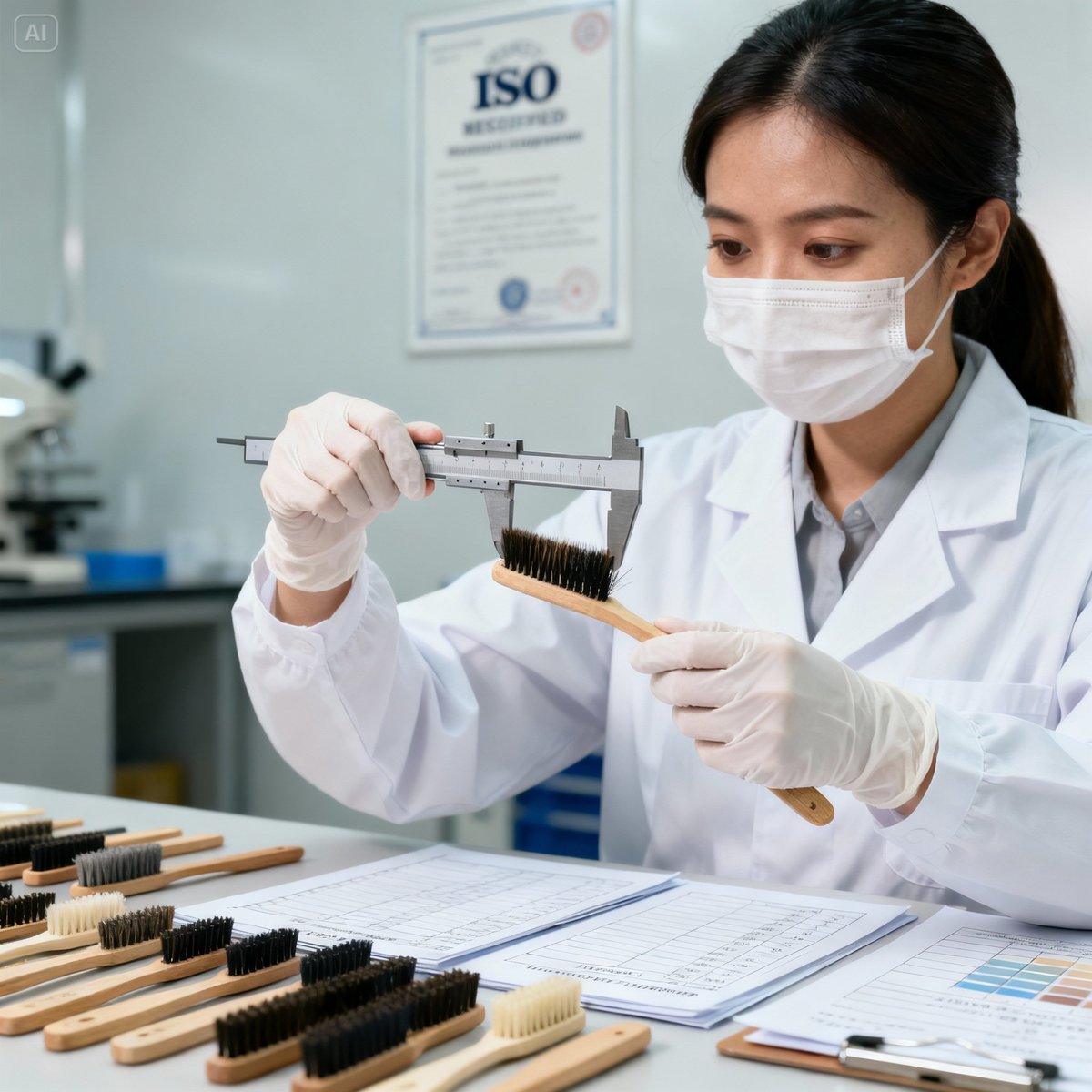
Appearance check (100% inspection):
- Filament color is uniform, with no off-color filaments
- Trim length is consistent (deviation
< 2mm) - Tuft density is even, with no thin areas
- The base has no deformation, cracks or burrs
- Fixing features (screw holes, shaft) are the correct size
Functional check (10% sampled):
- Retention test: pull hard on the filament; it should not come out easily
- Dimensional test: check the key dimensions with calipers
- Hardness test: confirm the filament hardness meets the requirement
- Anti-static test (if needed): use a static meter
Document check:
- Material certificate (especially for food-grade or special materials)
- Test reports (such as SGS)
- Quality guarantee
- Instructions for use and maintenance
Common quality problems and countermeasures
Problem 1: Filament comes out easily
- Cause: insufficient tuft retention, poor-quality wire
- Countermeasure: ask for a pull test report (
> 3kg), change supplier
Problem 2: Uneven trim length
- Cause: imprecise cutting, careless trimming
- Countermeasure: require a tolerance of ± 1 mm, tighten the trimming operation
Problem 3: Large dimensional errors in the base
- Cause: insufficient tooling precision, poor control of material shrinkage
- Countermeasure: ask for a dimensional inspection report, 100% inspection of key dimensions
Problem 4: Uneven filament color
- Cause: raw material from different batches mixed together, uneven dyeing
- Countermeasure: require shipment from a single batch, provide a color difference standard
Key points for assessing a supplier
Technical capability:
- Whether it can do custom work
- Whether it has a quality control system
- Whether it has experience in the relevant industry
Service quality:
- Whether delivery is on time
- Whether after-sales service is complete
- Whether technical support is professional
Price competitiveness:
- Whether the unit price is reasonable
- Whether the volume discount is attractive
- Whether the tooling fee is reasonable
YC Brushes holds ISO 9001 certification, inspects 100% of all products before shipment, and provides complete material certificates and test reports. Contact us now for professional purchasing advice.
Success stories
No amount of theory is as convincing as a real case.
Case 1: Reducing static defects at a PCB plant
Customer background:
- A PCB manufacturer in northern Taiwan
- Static defect rate on the line of 8-12%
- Monthly scrap cost of more than NT$500,000
Previous solution:
- Ordinary nylon cleaning brushes
- No anti-static function
- Serious static problems
The YC Brushes solution:
- Introduced natural horsehair cleaning brushes
- Combined with conductive fiber static elimination brushes
- Adjusted the line layout
Results:
- Static defect rate fell to 1.5% (down 85%)
- NT$400,000 saved in scrap cost every month
- Payback period: 2.5 months
- The customer placed further orders and introduced the solution across all lines
Case 2: A food plant passes its hygiene audit
Customer background:
- A bakery food plant in central Taiwan
- Preparing to apply for certification to export to Japan
- Extremely high hygiene requirements
Previous solution:
- Ordinary hog bristle oiling brushes
- Had not passed food-grade testing
- Concerns about shedding
The YC Brushes solution:
- Introduced food-grade silicone brushes
- Provided SGS test reports
- Set up an SOP for regular replacement
Results:
- Passed the Japanese customer's audit without difficulty
- Won export orders (annual output value NT$12,000,000)
- Established a long-term supply relationship
- Recommended us to 3 other manufacturers in the same industry
Case 3: Cost optimization at a machinery plant
Customer background:
- A machinery manufacturer in southern Taiwan
- Uses 500 conveyor roller brushes a month
- High purchasing cost
Previous solution:
- Bought standard products from an importer
- Unit price NT$250 each
- Monthly cost NT$125,000
The YC Brushes solution:
- Custom-designed roller brush
- Production with dedicated tooling (tooling fee NT$35,000)
- Volume order discount
Results:
- Custom unit price NT$150 each (down 40%)
- NT$50,000 saved every month
- Tooling fee recovered in 1 month
- NT$600,000 saved in purchasing cost every year
Want to know how customization lowers costs? See The custom brush process explained in full.
Contact YC Brushes now and tell us about your application, and let us help you find the best solution!
Conclusion: choose the right industrial brush, and use it the right way
Industrial brushes look simple, but there is a great deal to know.
Three keys to choosing
1. Understand the requirement
- Define the application
- Assess the environmental conditions
- Confirm the functional requirements
2. Choose the right material
- Refer to the material selection guide in this article
- Ask for samples and test them
- Do not look only at price
3. Find the right supplier
- Technical capability
- Stable quality
- Complete service
Professional service from YC Brushes
Over 40 years of industrial brush experience
- Has served 500+ corporate customers
- Covers applications in 5 industries
- Has built up extensive experience in solutions
A complete product line
- Standard products supplied quickly
- Flexible custom design
- Project development for special applications
Professional technical support
- Free application assessment
- Advice on material selection
- Sample testing service
- After-sales technical support
Explore the full YC Brushes product catalog, or contact us now and let over 40 years of experience help your production line find the best brush solution.
Want to read more specialist knowledge about industrial brushes? Go to the blog to explore more articles.