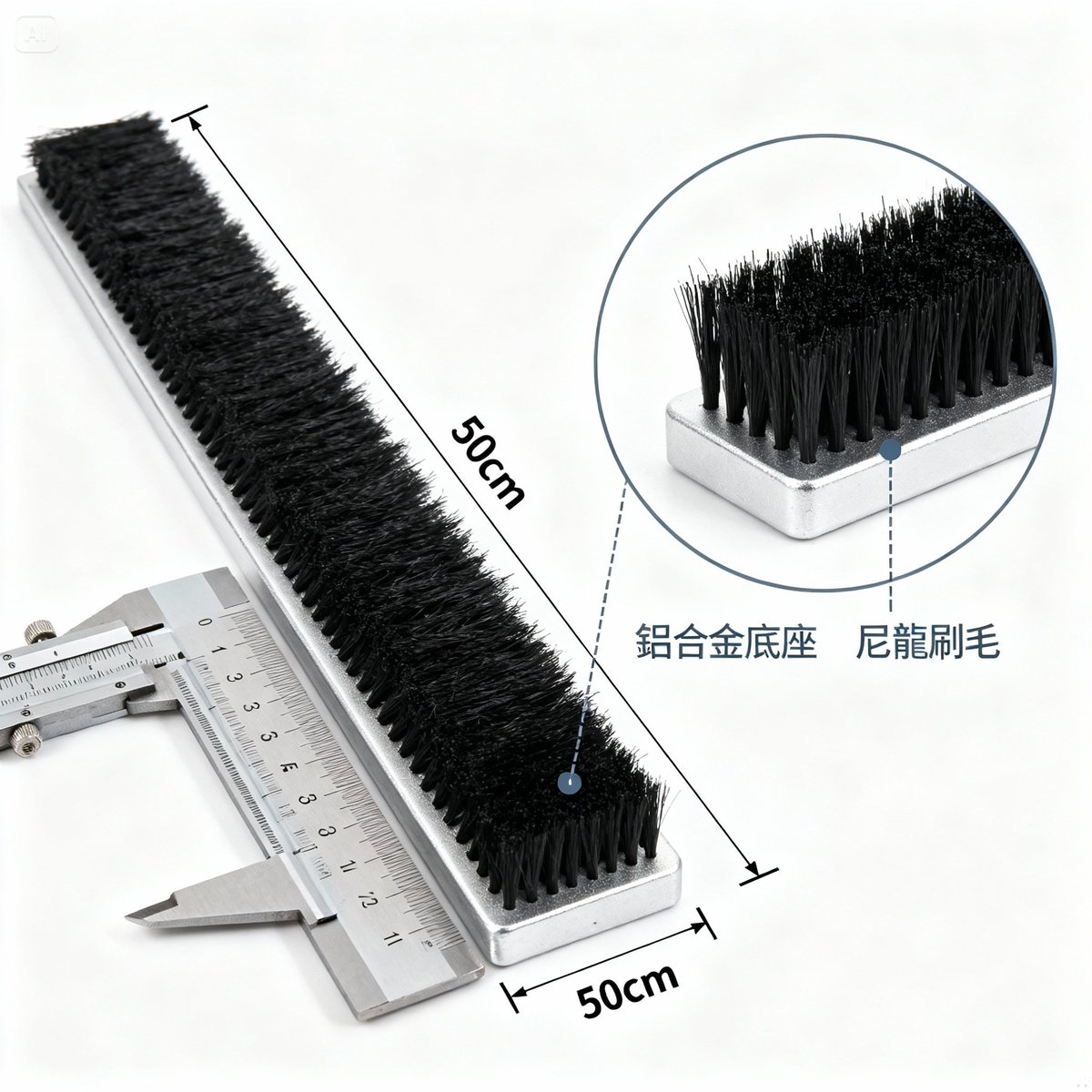
One tiny static spark can scrap a wafer worth a million NT dollars.
In the electronics industry, static electricity is an invisible killer. You cannot see it, yet it can punch through an IC in an instant, short out a PCB and undo an entire semiconductor process. The losses caused by ESD are hard to count precisely, but it is one of the main risks that electronics manufacturers keep spending protection resources on.
The anti-static brush is an effective weapon against this invisible enemy.
But there are all kinds of anti-static brushes on the market: conductive fiber, natural horsehair, with prices from a few dozen NT dollars to more than a thousand. How do you choose? This article starts from how static electricity works and then covers how anti-static brushes work, application cases and how to select one.
This article is further reading for The brush manufacturing process explained, with a closer look at anti-static applications.
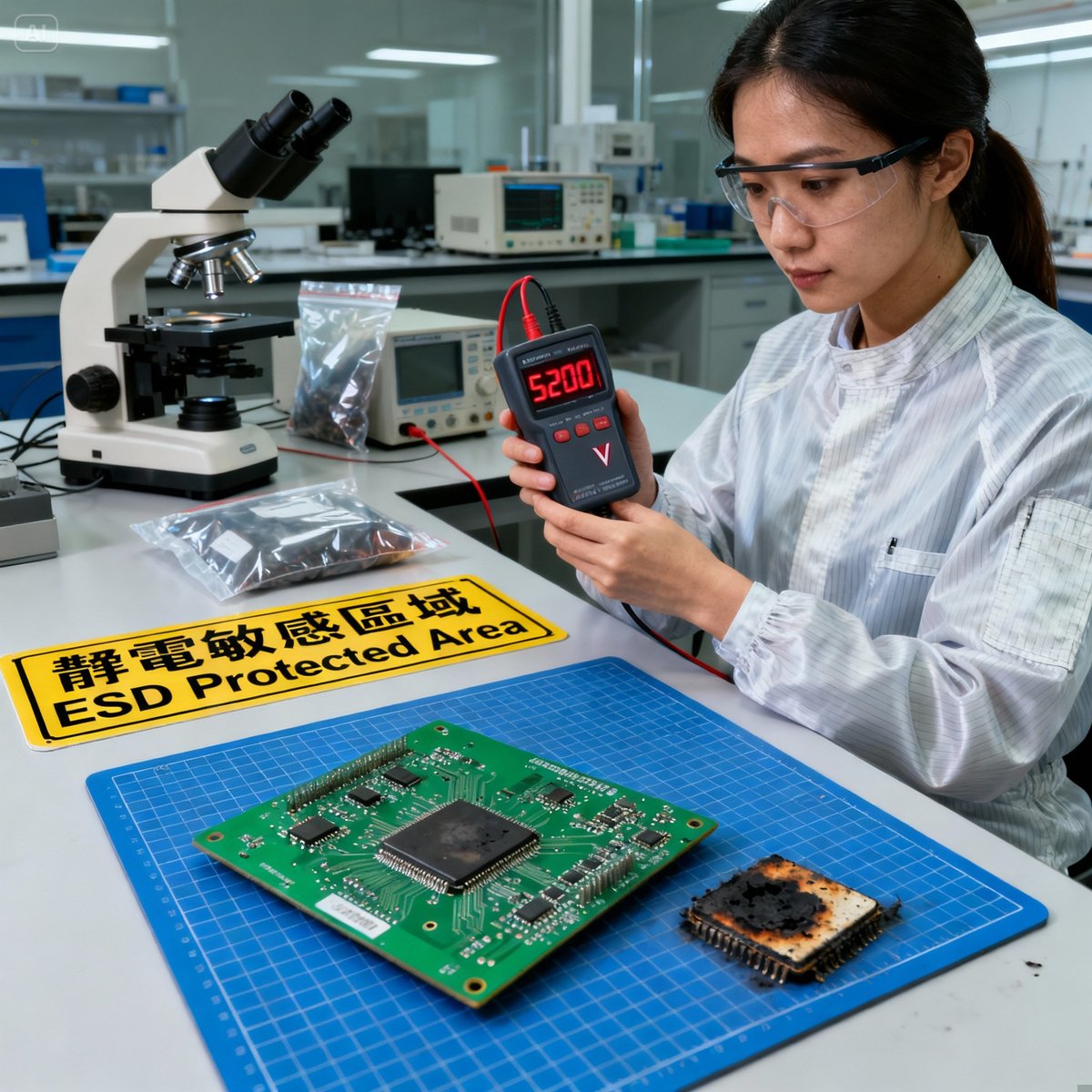
How static is generated and the harm it does | Why the electronics industry needs static protection
Static electricity is everywhere, but in the electronics industry it is especially destructive.
How is static electricity generated?
Static electricity comes from "triboelectric charging" (friction) and "induction charging".
Static in everyday life:
- The crackle when you take off a sweater (the voltage can reach 10,000V)
- Hair standing up when you comb it (5,000-10,000V)
- Getting a shock from a car door (3,000-5,000V)
Static in industrial environments:
- Conveying plastic film (the voltage can reach 20,000-50,000V)
- Printing on paper (10,000-30,000V)
- Transporting circuit boards (500-5,000V)
People cannot feel static below 3,000V, but electronic components can be damaged at 100V!
The three ways static harms the electronics industry
Harm 1: Direct breakdown of components
An electrostatic discharge (ESD) produces high voltage and high heat in an instant.
- CMOS chips: can break down at 100V
- MOSFETs: break down at 200-1,000V
- LEDs: break down at 500-2,000V
In one instant, a chip worth several thousand NT dollars is scrap.
Harm 2: Latent damage
Even worse is the damage you cannot see.
The component does not fail immediately, but its internal structure has been damaged, which leads to:
- Lower performance
- Shorter service life
- Lower yield
- More customer complaints
An ESD event can also cause "latent damage": the component is partly degraded but still works for the moment. Such damage is hard to detect and may lead to early failure after shipment. However, this concept is still debated in the technical community and is not universally accepted (ESDA, citing ESD ADV1.0).
Harm 3: Attracting dust and contamination
Static attracts dust, hair and particles from the air.
The effect on precision industries:
- Semiconductors: particle contamination lowers yield
- Optics: dust affects lens quality
- LCD: dust causes display defects
How large is the economic loss?
The losses caused by static have long been taken seriously in electronics manufacturing: lower line yield, early component failure, and complaints and returns after shipment can all originate from uncontrolled electrostatic discharge. The actual loss ratio differs considerably by industry, process environment and existing level of protection, so we suggest using the defect statistics of your own production line as the basis for assessment.
This is why the electronics industry cannot ignore static protection!
How anti-static brushes work | Conductive fiber vs natural horsehair
How does an anti-static brush remove static?
The key is "providing a discharge path".
How conductive fiber brushes work
Material composition:
- Base fiber: nylon or PBT
- Conductive component: carbon fiber, metal fiber or a conductive coating
Working mechanism:
- The filament touches the charged object
- The static charge is conducted through the conductive fiber
- It passes through the brush block to the ground wire
- It is released safely to earth
Resistance range:
- Surface resistance of the static-dissipative type: 10^4 Ω or more and below 10^11 Ω
- Too low (below 10^4 Ω, the conductive type): discharges too fast
- Too high (10^11 Ω or more): poor static removal
Advantages:
- Static removal is stable and can be quantified
- Not affected by humidity
- Highly durable (3-5 years)
- Can be connected to a ground wire for a stronger effect
Disadvantages:
- Higher price
- The resistance has to be checked regularly
- High-end products have to be imported
How natural horsehair brushes work
Why can horsehair prevent static?
The natural properties of horsehair:
- It contains a trace of moisture (it is hydrophilic)
- Protein fiber is slightly conductive
- Its surface roughness is moderate
Working mechanism:
- The bristle touches the charged object
- The static charge is conducted through the moisture layer on the surface of the horsehair
- The static charge is gradually neutralized
Resistance range:
- Surface resistance: 10^9-10^11 Ω
- Higher than conductive fiber, but still effective
Advantages:
- Soft, does not scratch precision surfaces
- Moderate price
- A natural, environmentally friendly material
- Suited to general anti-static needs
Disadvantages:
- Static removal is affected by humidity (poor in dry environments)
- Shorter service life (1-2 years)
- Not as stable as conductive fiber
Comparison test of the two
| Test item | Conductive fiber brush | Natural horsehair brush |
|---|---|---|
| Initial voltage | 5000V | 5000V |
| Voltage after 1 second | 300V | 800V |
| Voltage after 5 seconds | Below 50V | 200V |
| Static removal efficiency | 99% | 96% |
| Stability | ★★★★★ | ★★★☆☆ |
| Suitable environment | Any humidity | Humidity above 40% |
Conclusion:
- High-end applications (semiconductors, cleanrooms) → conductive fiber brush
- General applications (PCB cleaning, static removal from film) → a horsehair brush is enough
Want to know more about the other properties and applications of natural horsehair brushes? See Natural bristle brushes compared.
Applications in the electronics industry | PCB cleaning and static removal from film
What are the actual applications of anti-static brushes in the electronics industry?
PCB cleaning
Where it is used:
- Surface cleaning before SMT placement
- Removing flux residue
- Removing static and dust at the same time (two in one)
Why is static protection needed?
When an ordinary nylon brush cleans a PCB:
- Friction generates static (up to 3,000-8,000V)
- It may break down an IC or a capacitor
- It attracts even more dust (the opposite of what is wanted)
With an anti-static brush:
- Static is removed while cleaning
- Component damage is avoided
- Secondary contamination is prevented
Recommended specification:
- Material: natural horsehair (soft, does not scratch)
- Bristle diameter: 0.05-0.1mm
- Resistance: 10^9-10^10 Ω
- Form: roller brush or hand brush
Success case: After a PCB plant switched to horsehair anti-static brushes, its SMT yield rose from 96.5% to 98.8%, and scrap costs fell by NT$150,000 a month.
Static removal from film
Where it is used:
- Production and lamination of protective film
- LCD/OLED panel processes
- Static removal from optical film
The static problem:
- Conveying film generates high static (up to 20,000V)
- Particles in the air are attracted
- Poor lamination and bubbles
- A sharp drop in yield
Anti-static brush setup:
- Position: both sides, before and after the conveyor
- Type: conductive fiber roller brush
- Used with: a copper ground wire
- Result: voltage falls from 20,000V to below 200V
Important reminder: Static removal from film usually has to be combined with an ionizing blower or a static eliminator bar. A brush alone has a limited effect.
Static removal before labeling
Where it is used:
- Applying product labels
- Printing and applying barcodes
- Packaging automation
Common problems:
- Labels are pulled askew by static
- Labels scatter or stick together
- A high failure rate on automatic labeling machines
Solution: Use an anti-static roller brush before labeling:
- Removes static from the product surface
- Improves labeling accuracy
- Reduces equipment failures
See the anti-static products of YC Brushes, or contact us for a free application assessment.
Semiconductor applications | Wafer cleaning and cleanroom dust removal
The semiconductor industry takes its anti-static requirements to the extreme.
Static removal during wafer transport
Where it is used:
- When wafers are taken out of the storage box
- On the wafer conveyor
- Before wafer inspection
Key challenges:
- Class 10 cleanroom requirements
- Static below 100V (wafers are extremely sensitive)
- Absolutely no shedding (it would contaminate the wafer)
Solution:
- Material: PVA or ultra-fine PBT
- Resistance: 10^6-10^8 Ω
- Combined with an ionizing air knife for stronger static removal
- Resistance and cleanliness checked every month
Specification requirements:
- Particle generation: fewer than 5 particles/m²
- Filament pull strength: more than 8 kg (no shedding at all)
- Surface resistance: ESD certified
Cleanroom dust-removal rollers
Where it is used:
- Dust removal at the cleanroom entrance
- Dust removal from equipment surfaces
- Cleaning work surfaces
Material choice:
- High-end: conductive fiber brush
- Standard: anti-static nylon brush
- Economy: PP brush with anti-static treatment
Configuration:
- Fixed: installed at a doorway or passage
- Handheld: used as a cleaning tool
- Automatic: integrated into the equipment
Wafer box cleaning
Where it is used:
- Cleaning the FOUP (front opening unified pod, the wafer transfer box)
- Removing dust from the inner walls of the wafer box
- Cleaning the wafer box lid
Special requirements:
- Must not scratch the inner walls of the box
- Must remove static (to prevent particles from being attracted)
- Cleanroom-grade cleanliness
Recommended solution:
- Ultra-fine PBT anti-static brush
- Soft, does not scratch
- Used with pure water (DI water) for cleaning
Success case: After a wafer fab introduced anti-static rollers from YC Brushes, the particle count on the wafer surface fell from an average of 32 per wafer to 6 per wafer, yield rose by 4.2%, and the annual benefit exceeded NT$30 million.
Want to know more about how industrial brushes are used in the semiconductor industry? See The complete guide to industrial brushes | Semiconductor applications.
⚡ Need anti-static brushes that meet semiconductor industry standards?
Contact YC Brushes now. We offer cleanroom-grade anti-static brushes, ESD certification and free sample testing, and help you find the anti-static solution that fits best.
How to test anti-static performance | Verifying static removal
You have bought an anti-static brush. How do you know it really works?
Surface resistance test (the most basic)
Test tool:
- Surface resistivity meter
Test method:
- Lay the brush flat on an insulating mat
- Touch the meter probes to the filament
- Read the resistance (Ω)
Pass criteria:
- Conductive type: below 10^4 Ω
- Static-dissipative type (anti-static): 10^4 Ω or more and below 10^11 Ω
- Insulating type: 10^11 Ω or more
How to judge:
- Below 10^4 Ω: conductive type, discharges too fast, to be avoided for sensitive components
- 10^4 Ω or more and below 10^11 Ω: static-dissipative type, suitable for general anti-static use
- 10^11 Ω or more: insulating, poor static removal
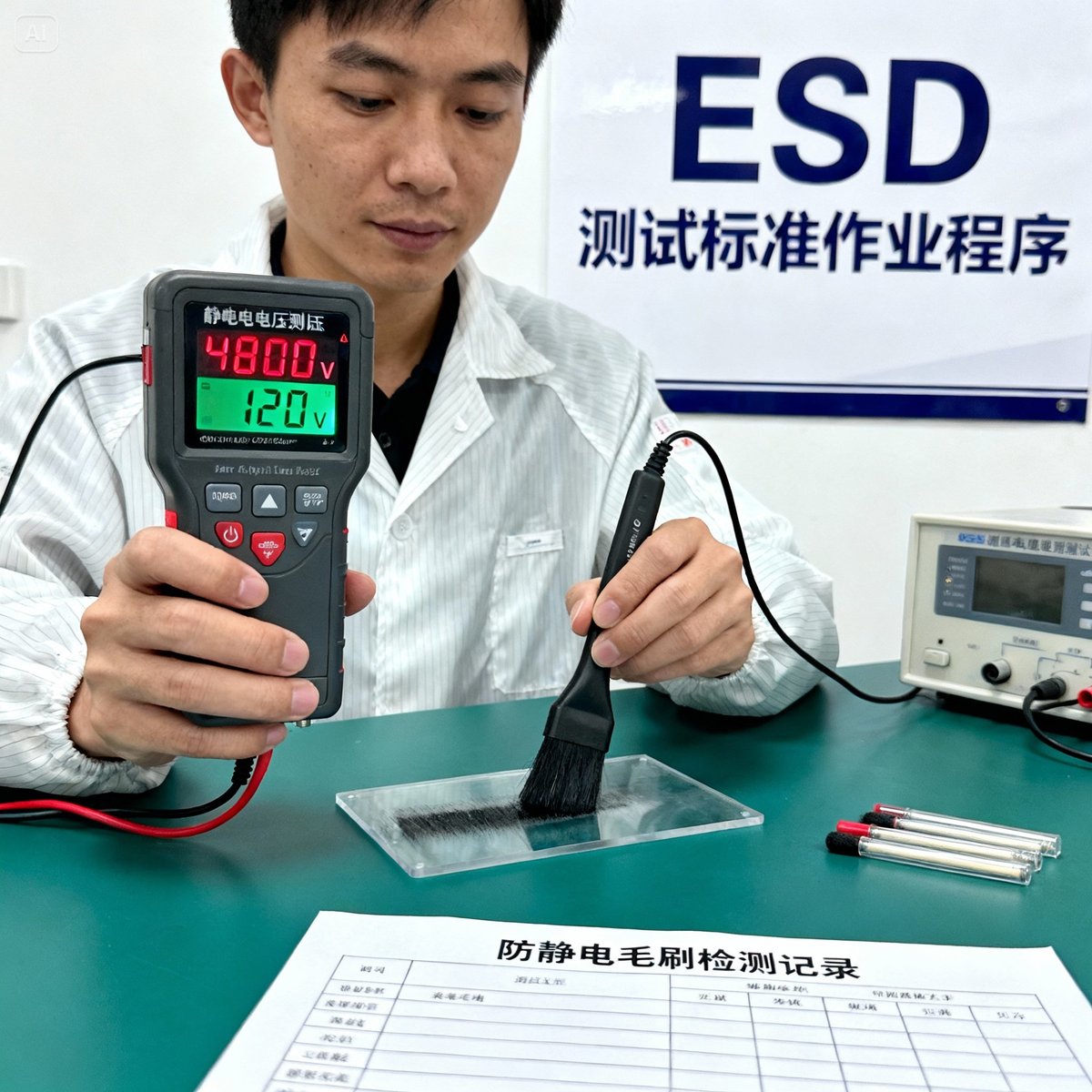
Static voltage test (the most practical)
Test tool:
- Static voltage meter
- Non-contact, can monitor in real time
Test method:
- Rub a plastic film to generate static
- Measure the initial voltage (V1)
- Brush it with the anti-static brush
- Measure the voltage after removal (V2)
- Calculate the static removal rate: (V1-V2)/V1 × 100%
Pass criteria:
- Excellent: removal rate above 95% (V2 below 200V)
- Good: removal rate 85-95% (V2 = 200-500V)
- Fair: removal rate 70-85% (V2 = 500-1000V)
- Poor: removal rate below 70% (V2 above 1000V)
Particle attraction test (high-end applications)
Purpose of the test: To verify whether static causes dust to be attracted
Test method:
- Test in a cleanroom environment
- Use a particle counter
- Compare the particle count before and after the test
Pass criteria: After brushing, the particle count in the test environment must still stay within the limit for that cleanroom class. Taking the old FED-STD-209E classes as an example (that standard was withdrawn in 2001 and has been replaced by ISO 14644-1):
- Class 10 cleanroom: no more than 10 particles of 0.5µm or larger per cubic foot (about 353 per m³)
- Class 100 cleanroom: no more than 100 particles of 0.5µm or larger per cubic foot (about 3,530 per m³)
Recommended testing frequency
By operating environment:
- Semiconductors / optics: test every month
- Electronics industry: test every quarter
- General industry: test every six months
When to replace:
- Resistance is outside the standard range
- Static removal has clearly declined
- The filament is worn or shedding
Anti-static brush buying guide | Choosing by need, environment and budget
Now that the principles and applications are clear, how do you choose?
Choosing by industry need
Semiconductor industry
- First choice: conductive fiber brush + PVA brush
- Resistance: 10^6-10^8 Ω
- Grade: Class 10 cleanroom
Electronics industry (PCB, SMT)
- First choice: natural horsehair brush
- Resistance: 10^9-10^10 Ω
- Grade: general cleanliness
Film / printing industry
- First choice: conductive fiber roller brush
- Resistance: 10^7-10^9 Ω
- Form: roller type (can be connected to a ground wire)
General industry
- First choice: anti-static nylon brush
- Resistance: 10^8-10^10 Ω
- Form: handheld or fixed
Choosing by operating environment
Low-humidity environments (below 40%)
- Natural horsehair performs poorly (it needs a moisture layer)
- A conductive fiber brush is recommended
- Or add humidifying equipment
High-humidity environments (above 70%)
- Natural horsehair performs well
- Conductive fiber can also be used
- Watch out for rust (choose a stainless steel base)
High-temperature environments (above 80°C)
- Natural bristle brushes are not suitable
- Use heat-resistant conductive fiber
- Or heat-resistant anti-static nylon
Cleanroom environments
- A cleanroom-grade brush is a must
- No shedding allowed
- Particle generation below the standard value
Choosing by budget
Economy
- PP or nylon brush with anti-static treatment
- Suited to general industrial use
- Average performance, but meets basic needs
Standard
- Natural horsehair brush
- Suited to general applications in the electronics industry
- The best value for money
High-end
- Conductive fiber brush, PVA brush
- Suited to the semiconductor and optics industries
- The most stable and reliable performance
Buying checklist
Confirm the following before you buy:
- Is a resistance test report provided?
- Does it meet industry standards (such as ESD certification)?
- Is the filament held securely (pull test)?
- Is sample testing offered?
- Maintenance and replacement advice
- After-sales technical support
Not sure which anti-static brush to choose? Contact YC Brushes for free buying advice and sample testing.
Maintenance and precautions for use
Buying the right brush is not enough. It also has to be used and maintained correctly.
Correct use
Conductive fiber brushes:
- The base must be grounded (ground wire connected to the machine or to earth)
- Check that the ground wire is secure
- Test the ground resistance regularly (below 10 Ω)
- Avoid contact with chemical solvents
Natural horsehair brushes:
- Keep the ambient humidity at 40-70% (for the best effect)
- Avoid high-temperature environments (above 60°C)
- Clean the bristles regularly (to remove oil and dirt)
- Store in a dry, ventilated place
Cleaning and maintenance
Weekly:
- Blow off dust with compressed air
- Check whether the filament is shedding
Monthly:
- Wash with pure water (DI water) or alcohol
- Let it air dry (do not use a dryer)
- Test whether the resistance is normal
Quarterly:
- Deep cleaning
- Check whether the base has deformed
- Check whether the ground wire has oxidized
When to replace
Must be replaced:
- Resistance is outside the standard range
- Static removal has clearly declined (below 70%)
- Heavy shedding (above 20%)
- The filament is deformed and has lost its spring
Recommended replacement cycle:
- Conductive fiber brush: 3-5 years
- Natural horsehair brush: 1-2 years
- Cleanroom brush: 6-12 months
Common mistakes in use
❌ Mistake 1: The conductive brush is not grounded
- Consequence: no static removal at all
- Correct: always connect the ground wire
❌ Mistake 2: Washing a conductive brush with water
- Consequence: the conductive component may be damaged
- Correct: use alcohol or a dedicated cleaner
❌ Mistake 3: Pressing the brush too hard
- Consequence: the filament deforms and sheds
- Correct: light contact is enough
❌ Mistake 4: Never testing the resistance
- Consequence: the brush has failed and nobody knows
- Correct: test regularly
Success cases | Real application results
The data speaks for itself.
Case 1: Higher yield at a PCB plant
Customer background:
- A PCB manufacturer in northern Taiwan
- Static-related defect rate of 8-12% on the SMT line
- Monthly scrap cost of more than NT$500,000
Previous setup:
- Ordinary nylon cleaning brushes (which generate static)
- An ionizing blower only at the end of the line
The YC Brushes solution:
- Introduced natural horsehair anti-static cleaning brushes
- Cleaning and static removal at the same time, before placement
- Adjusted the line layout
Results:
- Static-related defect rate fell from 10% to 1.5% (a drop of 85%)
- NT$400,000 saved in scrap costs every month
- Payback period: 2.5 months
- The customer placed follow-up orders and introduced the brushes on all 5 lines
Case 2: Less particle contamination at an LCD panel plant
Customer background:
- An LCD panel plant in central Taiwan
- Protective film lamination defect rate of 5-8%
- Main cause: particles attracted by static
Previous setup:
- Static removal by ionizing blower only
- Unstable results
The YC Brushes solution:
- Introduced conductive fiber roller brushes
- Installed on both sides of the conveyor
- Combined with a ground wire and an ionizing blower
Results:
- Protective film lamination defect rate fell to 0.8% (a drop of 84%)
- NT$600,000 saved in material costs every month
- Capacity up 12% (less rework)
- A marked rise in customer satisfaction
Case 3: Lower particle count at a wafer fab
Customer background:
- A wafer fab in southern Taiwan
- A high particle count on the wafer surface (an average of 32 per wafer)
- Yield and customer satisfaction were affected
Previous setup:
- Ordinary cleanroom brushes
- Static protection was not considered
The YC Brushes solution:
- Introduced ultra-fine PBT anti-static dust-removal rollers
- Meets the Class 10 cleanroom standard
- Resistance 10^7-10^9 Ω
Results:
- Particle count on the wafer surface fell to 6 per wafer (a drop of 81%)
- Yield rose by 4.2%
- Annual benefit of more than NT$30 million
- It became standard equipment at the fab
Contact YC Brushes now and tell us about your static problem, so we can help you find the best anti-static solution!
Conclusion: static protection is not a cost, it is an investment
Static protection is not optional. It is a necessity.
The three kinds of value an anti-static brush brings
1. Lower losses
- Less component damage
- Higher product yield
- Fewer customer complaints
2. Better quality
- Less particle contamination
- More consistent products
- Meets customer requirements
3. Long-term benefit
- One investment, a long-term return
- The ROI payback period is usually less than 6 months
- Builds a quality advantage
The advantages of choosing YC Brushes
Over 40 years of experience with anti-static brushes
- Has served the semiconductor, electronics, optics and other industries
- A wealth of accumulated application experience
- Professional technical support
A complete product line
- Conductive fiber brushes
- Natural horsehair brushes
- Cleanroom-grade brushes
- Custom development
Professional service
- Free diagnosis of static problems
- Free sample testing
- Test reports provided
- After-sales technical support
- Regular testing service
Explore the anti-static products of YC Brushes, or contact us now and let over 40 years of experience help you solve your static problem.
Want to read more specialist articles? Go to the blog to explore more.
References
- ESD Association, "ANSI/ESD S20.20-2021 Electrostatic Discharge Control Standard" (2021)