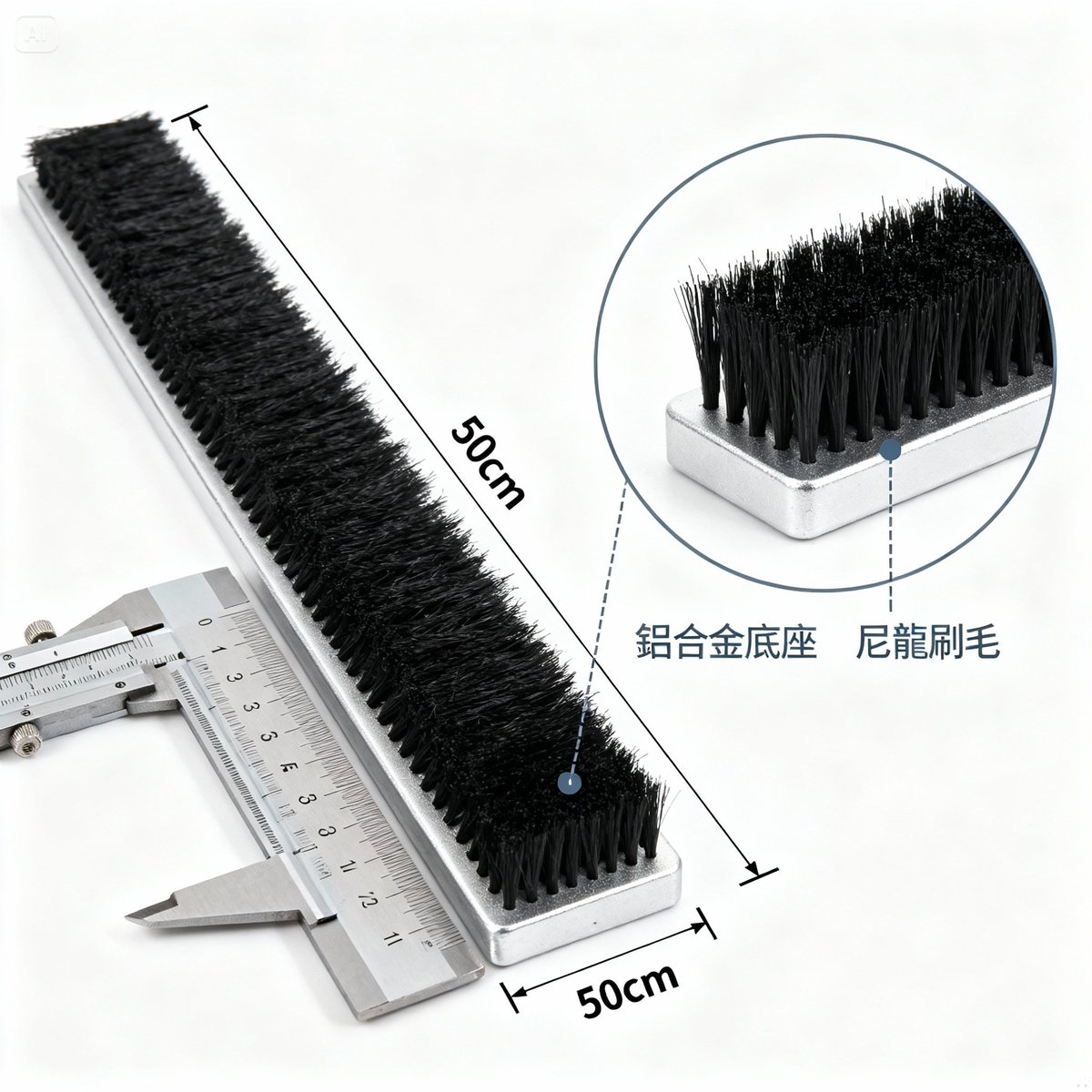
Introduction: why is factory-direct the best value for volume-production brushes?
Did you know? The same industrial brush can cost 30-50% more when bought through a trading company than when bought factory-direct.
For a business that buys brushes in large quantities, that can mean spending hundreds of thousands of NT dollars more every year.
Worse, a middleman often cannot provide technical support. When you have a special specification, communication is costly, changes are difficult and the lead time slips.
That is why more and more businesses choose to work directly with a brush factory. This article covers everything that matters about volume-production brushes: the advantages of buying factory-direct, the product types, the manufacturing process, the cost analysis, and how to choose a reliable brush manufacturer.
Whether you are buying brushes for the first time or looking for a better supplier, this guide will help you make a well-informed decision.
What is a volume-production brush, and why buy factory-direct?
Definition and characteristics of volume-production brushes
Volume-production brushes are brush products made in large batches with a standardized process. They usually have fixed specifications and dimensions, uniform material standards and stable quality.
Unlike small custom orders made by hand, volume-production brushes are made with automated equipment on a production line, which can turn out thousands or even tens of thousands of pieces to the same specification in a short time.
Core features of volume-production brushes:
- Standardized specifications: dimensions, filament and density are all clearly defined
- Consistent quality: every brush is held to the same level of quality
- Stable lead times: the efficiency of large-batch production makes lead times more predictable
- Cost advantage: economies of scale lower the unit cost
- Mature technology: a stable process proven in the market
Factory-direct vs trading company
When buying brushes, many businesses face a choice between "factory-direct" and "trading company". Here is a detailed comparison of the two:
Price difference:
- Factory-direct: no middleman markup, transparent cost
- Trading company: usually a markup of 30-50%; even large-volume purchases still pay the intermediary's margin
Technical support:
- Factory-direct: you talk to the engineering team directly, so specification problems are solved quickly
- Trading company: everything has to be relayed to the factory, which lengthens communication and makes it easy to misunderstand the requirement
Customization flexibility:
- Factory-direct: specifications can be adjusted and new products developed to match the actual need
- Trading company: limited to the existing product line, with limited customization capability
Control over lead time:
- Factory-direct: the production schedule is transparent, and rush orders can be given priority
- Trading company: has to fit in with the factory's schedule, so there is less flexibility
Quality assurance:
- Factory-direct: full control from process to inspection, so problems can be corrected right away
- Trading company: quality problems have to be reported through the middleman, so handling takes longer
YC Brushes: over 40 years of experience
YC Brushes was founded in 1985 and has built up more than 40 years of professional manufacturing experience. We focus on the production of industrial-grade brushes. Starting from traditional hand tufting, we introduced automated equipment step by step, and today we have a complete production line and quality control system.
Our core strengths:
- Production in our own factory, with no middleman markup
- 3D-printed sampling, for fast validation of custom designs
- A professional tufting team carrying on over 40 years of experience
- A complete quality inspection system, with 5% sampling to ensure quality
- Order quantities and lead times quoted per specification; email us with your requirements
Types of customer suited to volume production
Volume-production brushes are especially suitable for the following types of customer:
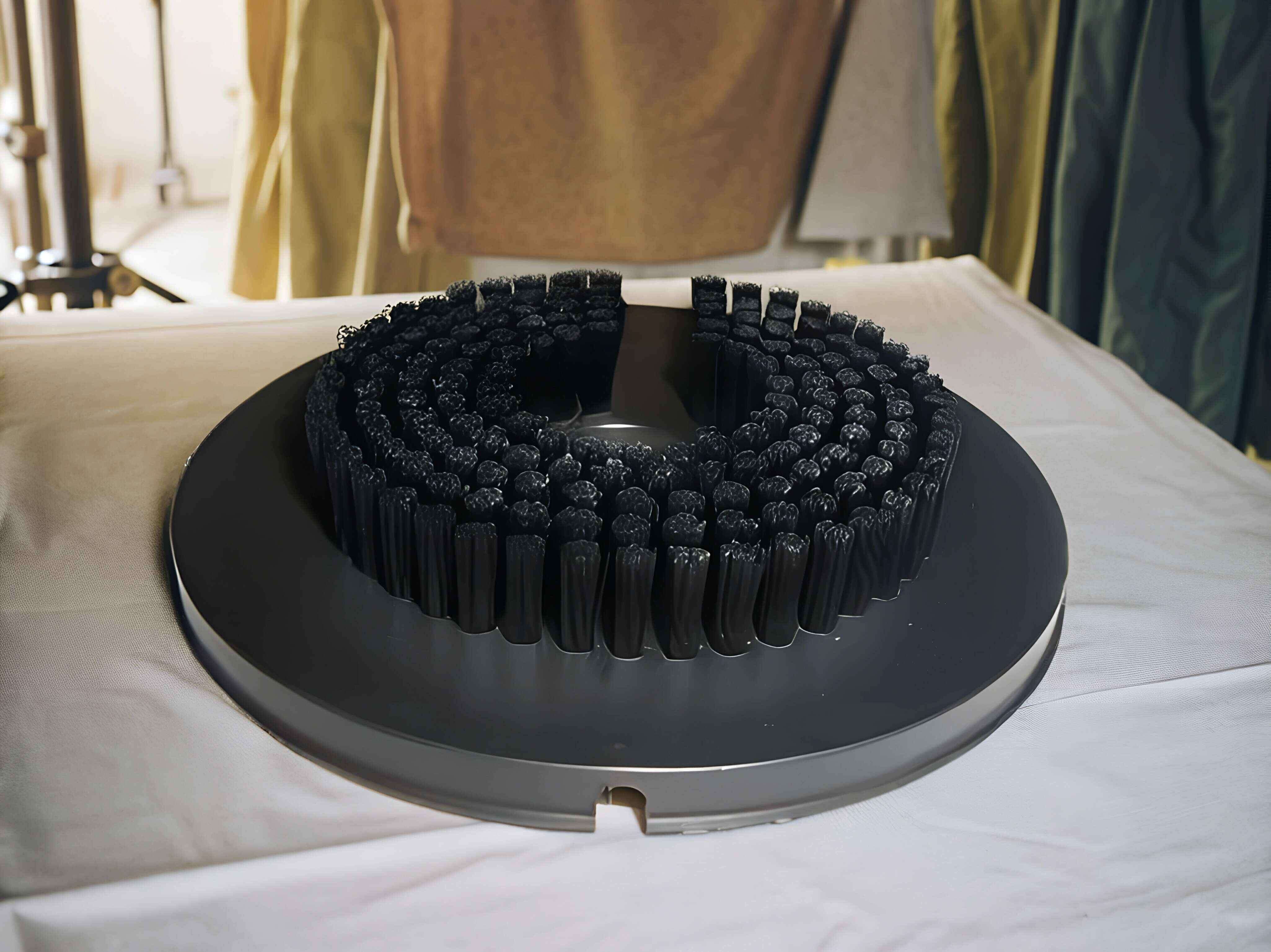
Industrial equipment manufacturers: Need a stable supply of accessories such as cleaning brushes and dust-removal brushes for conveyor belts, production lines and other equipment.
Cleaning product companies: Buy all kinds of cleaning brushes in bulk, then package and sell them to end consumers or distributors.
Car detailing businesses: Need professional tools such as car wash brushes, wheel brushes and interior cleaning brushes, and restock regularly in large quantities.
Food processing plants: Use cleaning brushes that meet food-grade standards and replace them regularly to maintain hygiene standards.
Hardware wholesalers: Need a diverse range of brush products and a stable source of supply.
If your annual purchase volume exceeds 500 pieces, or you need to restock regularly, choosing a factory-direct volume production service will save you a great deal of cost. To learn more about the criteria for evaluating manufacturers, see our complete guide to choosing a brush factory.
Types of volume-production brush and where they are used
Industrial brushes (roller brushes, cleaning brushes, horsehair brushes)
Industrial brushes are the largest category of volume-production brushes and are used in all kinds of manufacturing and automated equipment.
Roller brushes:
- Materials: steel wire, nylon, PP, PBT and others
- Applications: conveyor belt cleaning, surface polishing, dust removal, deburring
- Features: withstand high-speed rotation and are highly durable
- Common specifications: diameter 50-300 mm, length customized to the equipment
Industrial cleaning brushes:
- Materials: steel wire, brass wire, nylon, PP and others
- Applications: pipe cleaning, rust removal on equipment, surface treatment
- Features: filament stiffness can be adjusted to the requirement
- Common specifications: hand-held, machine-mounted, special shapes
Horsehair brushes (natural-bristle brushes):
- Materials: horsehair, hog bristle, goat hair
- Applications: dust removal on precision equipment, shoe care, car cleaning
- Features: the natural material is soft and does not scratch surfaces
- Common specifications: hand brushes, dust-removal brushes, polishing brushes
For a closer look at how natural-bristle brushes differ, see Horsehair brush vs hog bristle brush: the complete comparison.
Household brushes (soft brushes, fine-pile brushes, grooming brushes)
Household brushes are supplied mainly to channels such as cleaning product companies and hardware wholesalers.
Soft brushes:
- Materials: hog bristle, goat hair, fine nylon filament
- Applications: scrubbing clothes, cleaning furniture, dusting delicate items
- Features: soft bristles that do not damage surfaces
- Wholesale advantage: factory-direct pricing is the best value
If you are looking for where to buy soft brushes and how the prices compare, we suggest reading The complete guide to buying soft brushes.
Fine-pile brushes:
- Materials: microfiber, soft nylon
- Applications: cleaning glasses, dusting screens, caring for jewelry
- Features: extremely fine filaments, suited to precision cleaning
Grooming brushes (for pets):
- Materials: nylon pins, natural hog bristle
- Applications: pet grooming, removing loose hair
- Features: pin spacing and density can be customized
Custom brushes (development from drawings, 3D printing, contract tufting)
Besides volume-production products in standard specifications, we also offer custom services.
Development from drawings:
- Based on the design drawing or sample you provide
- The engineering team assesses feasibility and quotes
- Dimensions are verified with a 3D print before tooling
- Formal volume production starts once everything is confirmed
3D-printed sampling:
- An advantage exclusive to YC Brushes
- Samples can be made quickly without tooling
- Saves sampling cost and time
- Design flaws can be corrected quickly
Contract tufting:
- The customer provides the brush body (handle or base)
- We tuft the filament into it
- Suited to manufacturers that already have tooling but no tufting equipment
- Flexible enough to handle all kinds of material and density requirements
To understand the full custom process and its costs, see The professional guide to custom brushes.
The manufacturing process for volume-production brushes
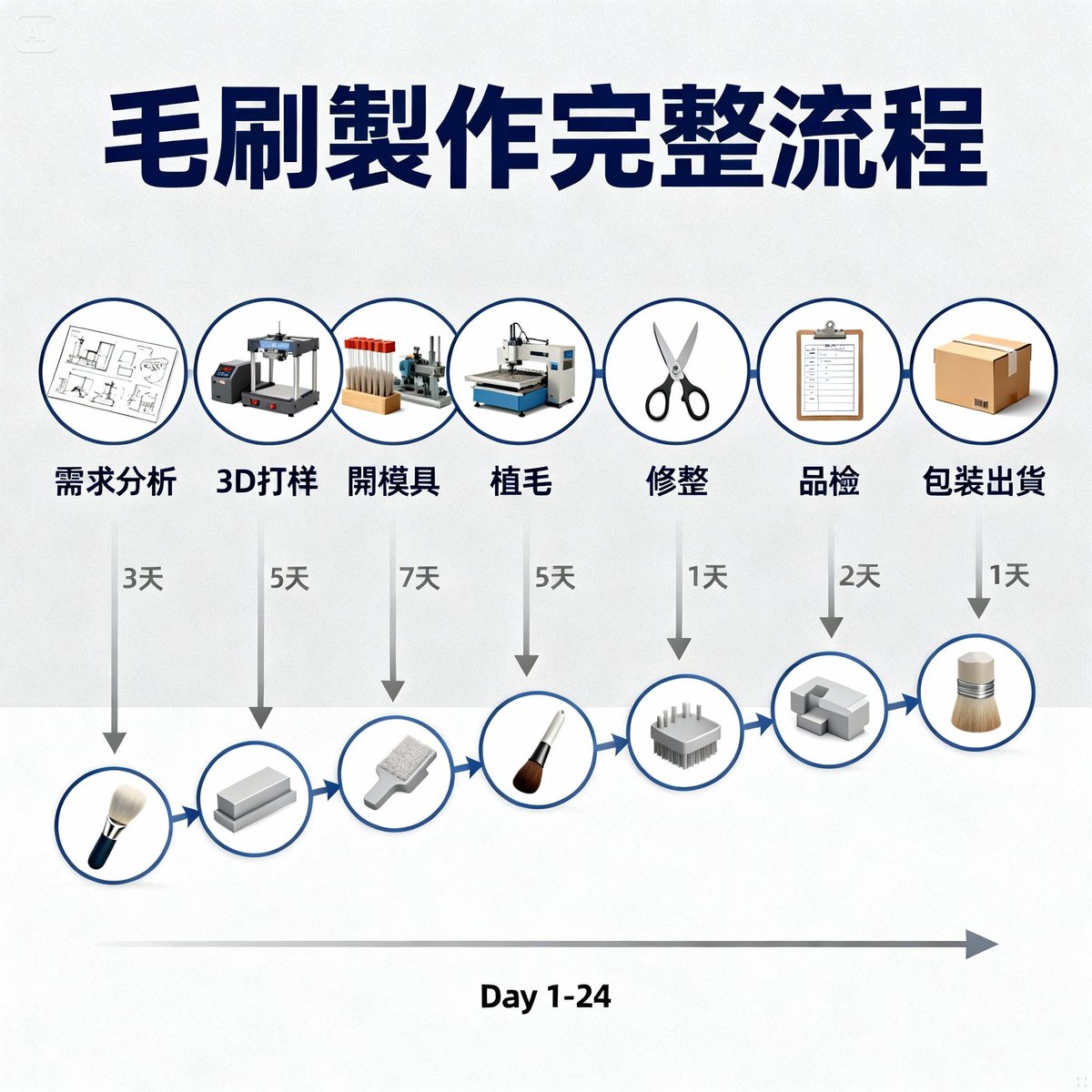
Step 1 - Requirements analysis and design
The first step in volume production is to understand exactly what the customer needs.
What we discuss:
- Operating environment (temperature, humidity, substances in contact)
- Brush specification (dimensions, shape, material)
- Quality requirements (filament density, durability)
- Quantity and lead time requirements
- Budget range
Technical assessment: Based on the requirements, the engineering team assesses:
- The most suitable combination of materials
- Process feasibility
- Tooling requirements (for custom products)
- Estimated production cost and time
Design confirmation:
- A specification confirmation sheet is provided
- Technical drawings are prepared
- Material samples are provided
- After the customer signs off, the project moves to the next stage
Step 2 - Sampling and confirmation
Volume-production products in standard specifications can usually skip sampling and go straight into production. For custom products or a first order, however, we recommend confirming with a sample first.
Sampling methods:
- Standard sampling: a small number of samples are made with existing tooling
- 3D-printed sampling: a prototype of the brush body is made quickly (a technique exclusive to YC Brushes)
- Hand sampling: special specifications are made by hand for verification
What to check on the sample:
- Dimensional accuracy (within
±0.5mm) - Filament density and evenness
- How securely the filament is fixed (pull test)
- Overall appearance and feel
Revision cycle: If there is any problem with the sample, we adjust it immediately and make a new one, until the customer is fully satisfied.
Step 3 - Volume production
Once the sample is confirmed, formal volume production begins.
Production scheduling:
- Production lines are assigned according to the order quantity
- Lead times for standard and custom products (including tooling fabrication) are quoted per specification; please email us with your requirements
Automated process:
- Automatic tufting machines produce quickly and steadily
- Filament cutting and fixing are completed in one pass
- Output can reach 500-1000 pieces per hour (depending on the specification)
Quality monitoring:
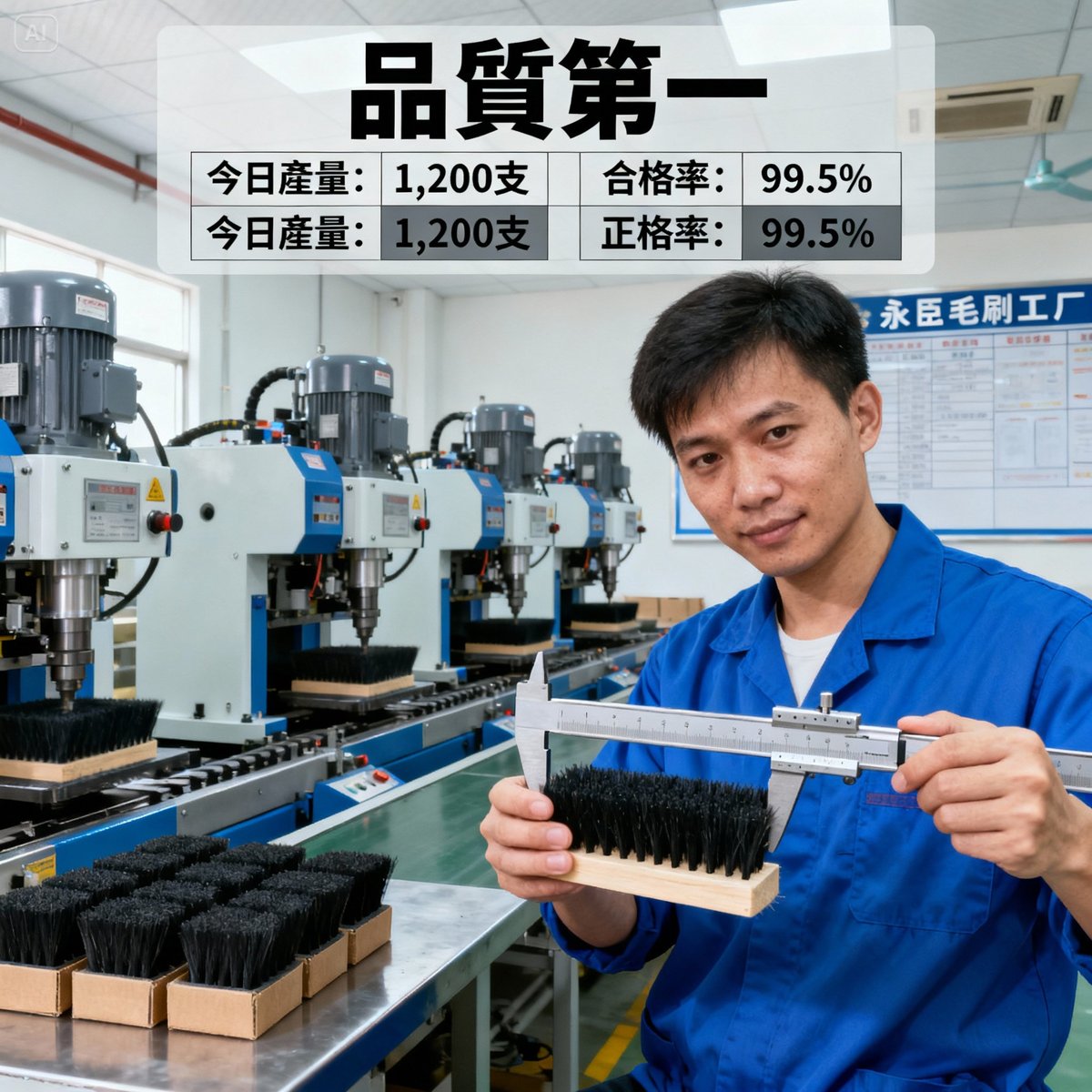
- First Article Inspection
- Sampling of every batch during the process
- A 5% sampling rate on finished goods
- Defective pieces are removed immediately to ensure shipment quality
Step 4 - Packaging and shipping
When production is finished, the goods move on to packaging and shipping.
Packaging options:
- Bulk: suited to industrial customers buying in large quantities
- Simple packaging: OPP bags or cartons
- Custom packaging: the customer's brand logo can be printed (quoted separately)
Quality documents:
- Outgoing inspection report
- Material certificate (if required)
- Dimensional measurement record
Logistics:
- We work with several logistics companies, so there is a flexible choice
- Large orders can be delivered directly by truck
- Shipment tracking is provided
After-sales service:
- Free replacement for quality problems within 7 days
- Long-term customers get scheduling priority
- Technical consultation is free for life
Learn more about the professional services of YC Brushes, including custom development and contract tufting.
Cost advantages of producing brushes in large quantities
The relationship between quantity and unit price
The biggest advantage of volume-production brushes is "economies of scale": the larger the purchase quantity, the lower the unit cost.
Example price tiers (taking a standard industrial cleaning brush as an example):
| Purchase quantity | Unit price | Total price | Note |
|---|---|---|---|
| 100 pieces | NT$ 50 | NT$ 5,000 | Small trial order |
| 500 pieces | NT$ 40 | NT$ 20,000 | 20% lower |
| 1,000 pieces | NT$ 35 | NT$ 35,000 | 30% lower |
| 5,000 pieces | NT$ 28 | NT$ 140,000 | 44% lower |
| 10,000 pieces or more | NT$ 25 | To be negotiated | 50% lower |
Important note: the prices above are for illustration only. The actual quote varies with the material, the specification and the complexity of the process.
How tooling cost is amortized
A custom brush requires tooling, and this cost can be amortized over a large production run.
Tooling fees:
- Tooling for a simple brush body: NT$ 15,000 - 30,000
- Tooling for a complex structure: NT$ 50,000 - 100,000
- Tooling life: can produce 100,000-500,000 pieces (depending on material and design)
Example amortization calculation: Assume a tooling fee of NT$ 30,000. If only 500 pieces are produced, each piece carries NT$ 60 of tooling cost; if 10,000 pieces are produced, each piece carries only NT$ 3 of tooling cost.
Advantages of a long-term partnership:
- The tooling fee is paid once, and repeat orders do not pay it again
- For customers with stable orders, we lower the quote on our own initiative
- An annual contract can be signed to lock in a preferential price
Cost comparison with small custom orders
Let us compare the actual cost difference between "small custom orders" and "large-quantity production".
Scenario: a factory needs conveyor belt cleaning brushes, with annual demand of about 2,000 pieces
Option 1: several small batches (200 pieces each time)
- Unit price: NT$ 55
- 10 purchases a year × 200 pieces = 2,000 pieces
- Total cost: NT$ 110,000
- Administrative cost: 10 rounds of ordering and receiving
- Inventory pressure: storage space has to be set aside
Option 2: one large purchase (2,000 pieces)
- Unit price: NT$ 32
- One purchase of 2,000 pieces
- Total cost: NT$ 64,000
- Administrative cost: 1 round of ordering and receiving
- Annual saving: NT$ 46,000 (a 42% cost saving)
But buying in large quantities also carries risks:
- More money has to be paid up front
- Storage costs go up
- If the product is revised, inventory may be left unsold
Recommended strategy:
- Products with stable usage: buy 3-6 months of usage at a time
- Testing a new product: start with a small trial order, and buy in quantity after the quality is confirmed
- Seasonal products: adjust purchasing frequency to the low and peak seasons
Long-term partnership programs
YC Brushes values long-term partners and offers the following:
Annual contract program:
- Sign an annual purchasing contract (with a minimum committed quantity)
- Lock in a preferential price for the whole year
- Scheduling priority (rush orders handled first)
- Free technical consultation and help with new product development
Services exclusive to VIP customers:
- A dedicated sales contact
- Free sampling 1-2 times a year
- Fast handling of quality problems
- Participation in new product testing programs
💡 Need a professional brush solution?
Contact YC Brushes now and let over 40 years of manufacturing experience help you find the most suitable brush product or custom solution.
How do you choose a reliable brush manufacturer?
Choosing a brush manufacturer is not only about price. You also need to assess how stable the long-term relationship will be and how capable the technical support is.
5 evaluation criteria
1. Production track record and experience
- Years in business (at least 10 years is recommended)
- The types of industry served
- Whether there are successful cases for reference
- The professional background of the technical team
YC Brushes was founded in 1985, has over 40 years of manufacturing experience, and has served a range of industries including industrial equipment, cleaning products and car detailing.
2. Equipment and capacity
- Whether it has automated production equipment
- Whether the monthly capacity meets your needs
- Whether there is a backup production line (so that an equipment failure does not affect lead time)
- Whether the inspection equipment is complete
3. Quality control system
- Whether there is a standardized inspection procedure
- The sampling ratio (at least 5% is recommended)
- How defective pieces are handled
- Whether quality certification documents are provided
4. Custom development capability
- Whether there is an engineering design team
- Whether it can develop from drawings or samples
- Whether it can make samples quickly
- Experience with past custom projects
The 3D-printed sampling technique exclusive to YC Brushes can validate a design quickly without tooling, which greatly shortens the development schedule.
5. Lead time and after-sales service
- Whether lead times for standard products are stable
- Ability to handle rush orders
- Speed of response to after-sales problems
- Whether technical consultation is provided
Real cases
Case 1: cleaning brush supply for a food processing plant
A food processing plant needed cleaning brushes that meet food-grade standards, using about 500 pieces a month. It used to buy from a trading company, where the unit price was clearly on the high side and no material certificate could be provided.
After switching to YC Brushes:
- The factory-direct price dropped to NT$ 38 (37% lower)
- Material certificates meeting food-grade standards are provided
- Regular monthly deliveries, with no need to worry about running out of stock
- Annual purchasing cost fell significantly
Case 2: custom wheel brushes for a car detailing chain
A car detailing chain needed wheel brushes printed with its brand logo, with filament of moderate stiffness and a non-slip handle.
The solution YC Brushes provided:
- 3D-printed sampling to confirm the handle design quickly
- Custom filament stiffness to match the use
- The brand logo printed on the handle to strengthen the brand image
- A first order of 2,000 pieces, followed by steady monthly orders of 500 pieces
Case 3: dust-removal brushes for an industrial equipment manufacturer
A conveyor equipment manufacturer needed heat-resistant dust-removal brushes able to withstand a 120°C environment.
The YC Brushes technical team:
- Recommended a high-temperature nylon material (heat resistant to 150°C)
- Customized the filament density and the fixing method
- Provided samples for on-site testing
- Went into volume production after the quality was confirmed, and became a long-term supplier
For more detail on evaluating manufacturers, read the complete guide to choosing a brush factory.

FAQ
1. What is the minimum order quantity for volume-production brushes?
Order quantities at YC Brushes are quoted per specification, for standard-specification products, custom products (which require tooling) and contract tufting alike. Please email us with your requirements.
If this is a first order and you would like to try us out, we can provide a small number of samples (10-20 pieces) so that you can test the quality before deciding whether to buy in quantity.
2. How long is the lead time for brushes produced in large quantities?
Lead times depend on the product type and quantity and are quoted per specification, whether for standard-specification brushes, custom brushes (tooling already exists), all-new development (including tooling) or rush orders (VIP customers can apply for expedited handling, at extra cost). Please email us with your requirements.
We state the expected lead time clearly when we accept the order, and report progress on our own initiative during production.
3. What payment methods are available for wholesale brushes?
YC Brushes offers flexible payment methods:
- Cash transaction: cash on delivery, or shipment after bank transfer
- Monthly account: long-term customers can apply for 30-day monthly settlement
- Deposit + balance: custom projects usually require a 50% deposit, with the balance paid before shipment
- Installments: an installment plan can be discussed for large projects
For a first order we suggest "deposit + balance", which protects both sides.
4. Can the brush factory provide samples?
Yes! We provide samples in the following ways:
- Standard-specification products: 1-2 samples free of charge (the customer pays shipping)
- Custom development: a 3D-printed sample or a hand-made sample (charged at cost, and credited against a later volume order)
- Comparison with a competing sample: if you already have a sample from another manufacturer, we can make one to the same specification for comparison
We suggest confirming the quality and specification of the sample first, and buying in quantity once you are satisfied.
5. What is the difference between a soft brush and a stiff brush?
The main differences between soft brushes and stiff brushes are the filament material and the applications:
Soft brushes:
- Materials: hog bristle, goat hair, soft nylon
- Features: soft bristles that do not scratch surfaces
- Applications: cleaning clothes, dusting furniture, maintaining precision equipment
Stiff brushes:
- Materials: steel wire, stiff nylon, PP
- Features: stiff filaments that remove stubborn dirt
- Applications: floor cleaning, rust removal on equipment, clearing pipes
When choosing, consider:
- The material of the object being cleaned (whether it scratches easily)
- The degree of soiling (light or heavy)
- Frequency of use (soft brushes are usually more durable)
For a detailed material comparison and buying advice, see The complete guide to buying soft brushes.
6. Where is the best value for buying strip brushes?
Strip brushes are commonly used for sealing door gaps, cleaning conveyor belts and similar purposes. The places to buy them are:
- Hardware stores: higher retail prices, suited to small urgent purchases
- Online stores: mid-range prices, with a limited choice of specifications
- Factory-direct: the best prices, with length and filament made to order
Example price comparison (a nylon strip brush 1 meter long):
- Hardware store: higher price
- Online store: mid-range price
- YC Brushes factory-direct: NT$ 60-80 (wholesale price)
If your annual usage exceeds 100 meters, we suggest buying directly from the factory. The price is better, and the filament material, density and base dimensions can also be customized.
7. What is the contract tufting service?
Contract tufting is a service in which the customer provides the brush body (handle or base) and YC Brushes tufts the filament into it.
When it applies:
- You already have tooling for the brush body but no tufting equipment
- The brush body is made of a special material (such as wood or metal) that calls for professional tufting skills
- You want to reduce investment in equipment
Service process:
- Provide a sample of the brush body and a description of the requirement
- YC Brushes assesses the feasibility of tufting and quotes
- A small trial batch is made to confirm quality
- Volume production and delivery
How it is charged: Priced according to filament material, density and tufting difficulty; the tufting fee is usually NT$ 5-20 per piece (depending on complexity)
To learn more about contract tufting, see The full custom brush process.
8. Can you produce to a custom design from drawings?
Of course! YC Brushes offers a complete custom development service.
Custom process:
- Provide the requirement: drawings, a sample, or a verbal description
- Technical assessment: the engineering team assesses feasibility and gives advice and a quote
- 3D-printed sampling: a sample is made quickly to verify dimensions and appearance
- Confirmation and tooling: tooling is made once you are satisfied with the sample
- Volume production and delivery: formal production and shipment
Advantages of our custom service:
- An engineering team with over 40 years of experience that can handle all kinds of complex requirements
- Fast 3D-printed sampling, saving time and cost
- Transparent tooling fees, with nothing more to pay on repeat orders
For the detailed custom process and cases, see The professional guide to custom brushes.
9. Does the brush factory provide after-sales service?
YC Brushes values long-term relationships and provides full after-sales service:
Quality assurance:
- Free replacement for quality problems within 7 days
- 100% responsibility for manufacturing defects
- Quality inspection reports provided
Technical support:
- Technical consultation free for life
- Help with problems that come up in use
- Free care and maintenance advice
Benefits for long-term customers:
- VIP customers get scheduling priority
- Free sampling 1-2 times a year
- First invitation to new product testing
If you have any questions, contact us at any time: +886-2-2988-2721 or [email protected]
10. How do you ensure consistent quality in large-quantity production?
Consistent quality is the core requirement of volume-production brushes. YC Brushes ensures it through the following mechanisms:
Standardized process:
- Every production step has an SOP (standard operating procedure)
- Equipment is calibrated and maintained regularly
- Operators are professionally trained
Three inspections:
- First article inspection: before each batch is produced, the first article is checked against the specification
- In-process sampling: random sampling during production
- Finished goods inspection: 5% sampling before shipment to ensure quality
Quality records and traceability:
- Every batch has a production history
- Material lot number, production date and inspection results are recorded
- If a quality problem occurs, the cause can be traced quickly
Statistical process control (SPC):
- Data analysis is used to keep track of process stability
- Abnormal trends are spotted early and corrected
- Process parameters are optimized continuously
Why choose YC Brushes?
Over 40 years of professional experience you can rely on
Since it was founded in 1985, YC Brushes has worked in brush manufacturing for more than 40 years. We have seen the industry change, from traditional hand tufting to modern automated production. The technology keeps improving, but our commitment to quality has never changed.
Factory-direct, with transparent and competitive prices
We are a genuine factory-direct supplier, with no middleman markup. Every cent you pay goes directly into product quality and service. Compared with a trading company, our prices usually save 30-50% of the cost.
Strong custom capability, with fast 3D-printed sampling
YC Brushes has brought in 3D printing technology and can make samples quickly without tooling. This exclusive advantage greatly shortens the custom development schedule and also lowers the cost of sampling. However unusual your requirement, our engineering team can offer a professional solution.
Assured quality and full after-sales service
Our quality management system includes three inspections: first article inspection, in-process sampling and finished goods inspection. Every batch has a detailed, traceable production history. Quality problems are replaced free of charge within 7 days, and long-term customers get scheduling priority and technical support.
Fast lead times, flexible to your needs
Order quantities and lead times are quoted per specification. Please email us with your requirements. VIP customers can also apply for expedited service. We understand how important lead time is to running a business, and we commit to delivering on time.
References
- International Organization for Standardization (ISO), ISO 9001 quality management system standard (2026)