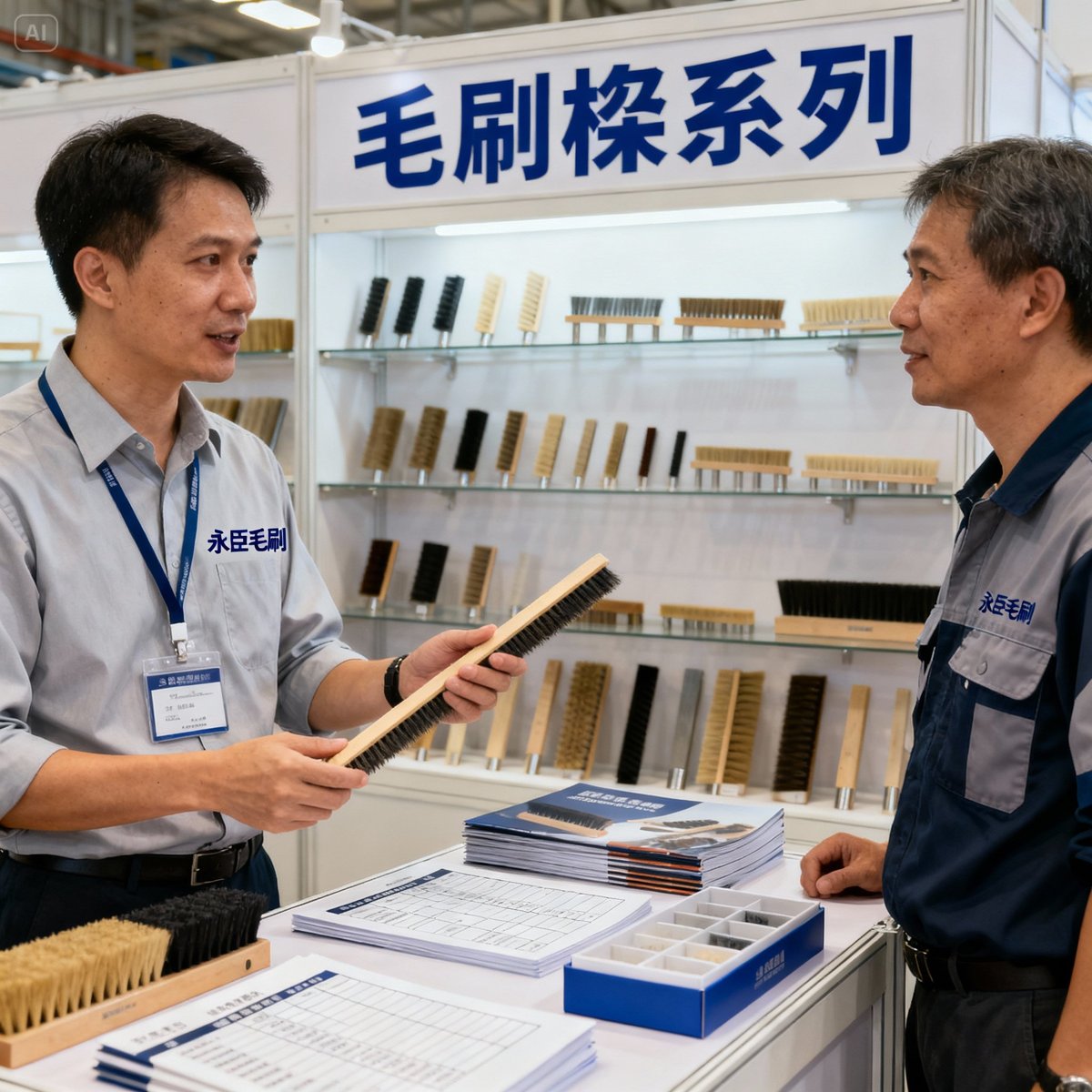
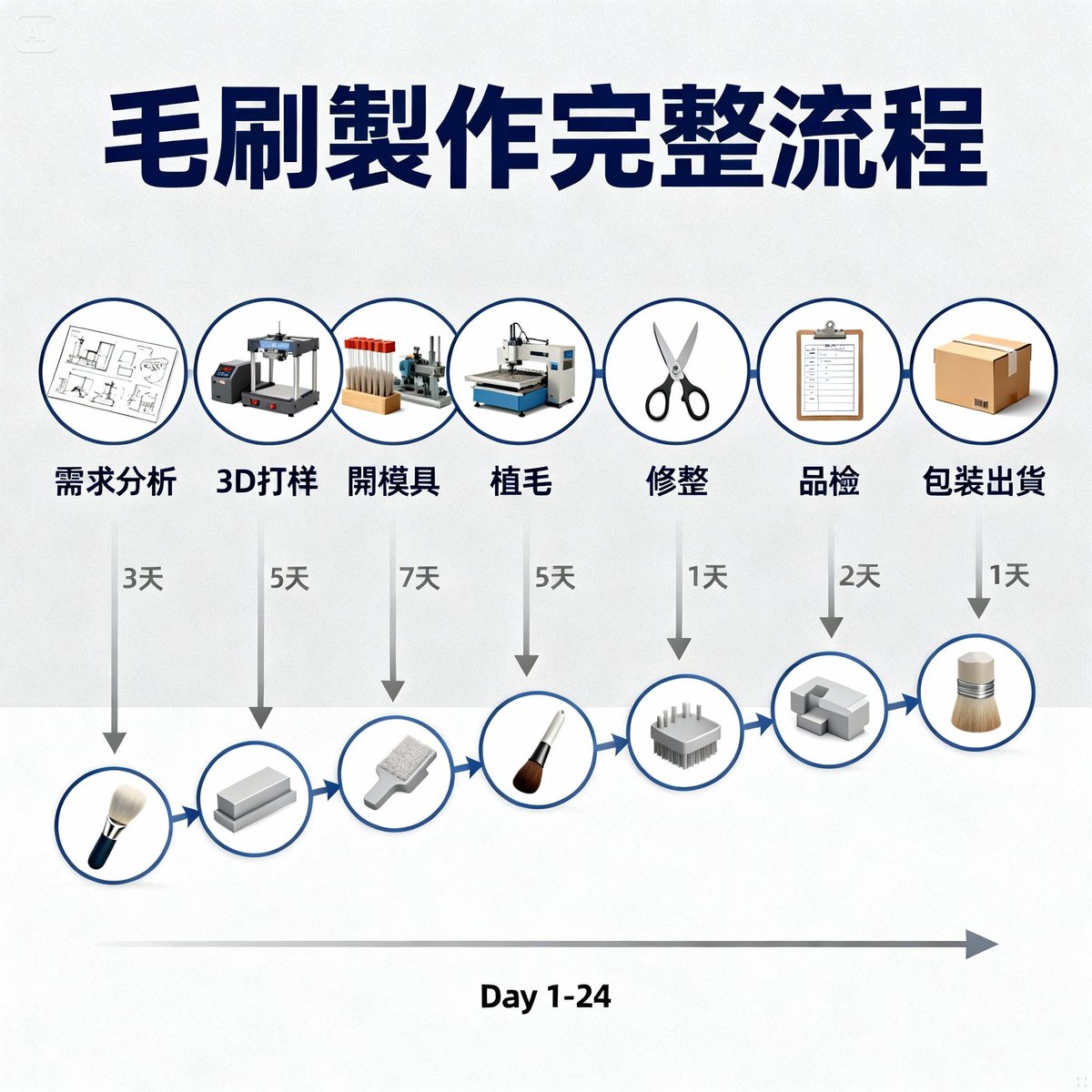
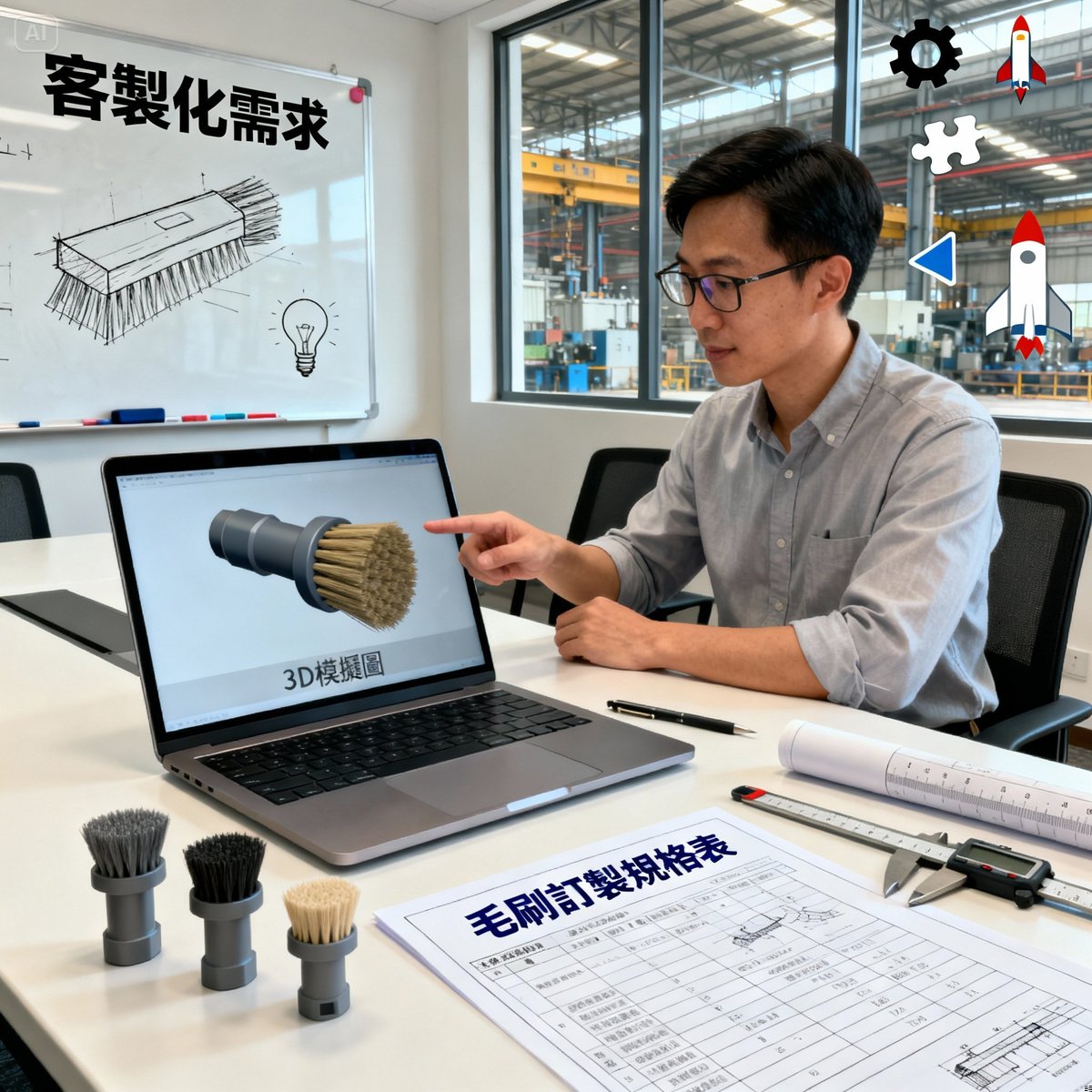
Introduction: what is a strip brush, and why is it so useful?
A draft coming through the door gap? A conveyor belt that needs cleaning? Machinery that needs protecting from dust?
The answer to all of them: a strip brush.
The strip brush is one of the most widely used brush types in both industrial and everyday applications. Its structure is simple but it does a great deal: a long strip-shaped base with continuous tufting that can be cut to any length, is easy to install and is extremely flexible in use. From sealing doors and windows at home to cleaning conveyor belts in factories, from elevator anti-pinch protection to guarding machine tools, strip brushes are found almost everywhere.
This guide gives a full account of the structure and characteristics of strip brushes, the standard specifications, material selection, 10 application scenarios, 4 installation methods and a comparison of purchasing channels, to help you choose the strip brush that fits best.
If you would like information on customizing strip brushes and on prices, see The complete guide to custom brushes and Custom brush prices explained in full.
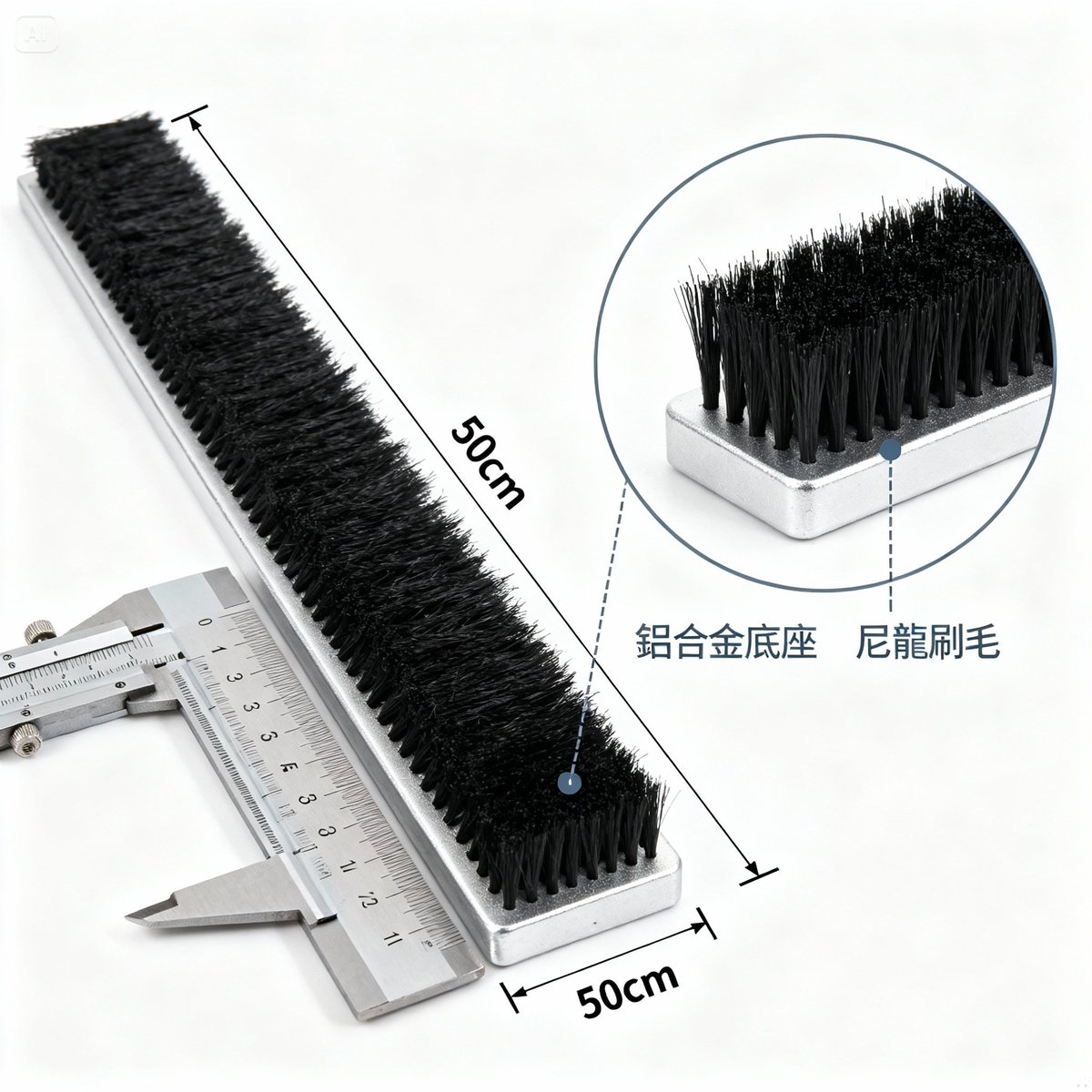
Structure and characteristics of a strip brush
First, the basic construction of a strip brush.
Basic structure
A strip brush is made up of two main parts.
Base (Base/Holder) A long strip-shaped supporting structure, usually made of:
- Metal: aluminum alloy, stainless steel, galvanized steel sheet
- Plastic: PP, ABS, PVC
The base has regularly arranged tuft holes that hold the filament in place.
Filament (Bristle) The filament tufted continuously into the base, in materials such as:
- Synthetic fiber: nylon, PP, PBT, PVC
- Natural bristle: hog bristle, horsehair
- Metal wire: stainless steel wire, brass wire, steel wire
Core characteristics of a strip brush
1. Can be cut to any length This is the greatest advantage of a strip brush. The standard shipping length is usually 50 cm or 100 cm, but you can cut it to the length you need (a plastic base can be cut with a utility knife or scissors; a metal base needs a hacksaw or a cutting tool). For example, for a door gap of 87 cm, cut 87 cm; for a conveyor belt of 2.3 m, join three pieces (100 + 100 + 30 cm), or order a custom length.
2. Continuous tufting with no breaks A strip brush is made by a continuous tufting process, so the filament density is the same from one end to the other, unlike tufting in individual holes, which leaves gaps.
3. Many installation methods It can be fixed with screws, stuck on with adhesive backing, slid into an aluminum channel or mounted magnetically, to suit all kinds of situations.
4. Economical cost Compared with having a whole brush custom made, the unit cost of a strip brush is far lower, which suits large areas or long runs.
5. Easy to replace and maintain When it wears out, only the strip brush needs replacing, not the whole assembly, so maintenance costs are low.
These characteristics make the strip brush the most popular type of industrial brush.
Standard strip brush sizes and specifications
Knowing the standard specifications makes choosing easier.
Length
Standard lengths
- 50 cm (the most common)
- 100 cm (for long runs)
- Custom lengths: made to order as required
Cutting advice Buy a standard length and cut it yourself. For example, if you need 75 cm, buy 100 cm and cut it. Avoid ordering a custom length that is too short, as it gives you less flexibility.
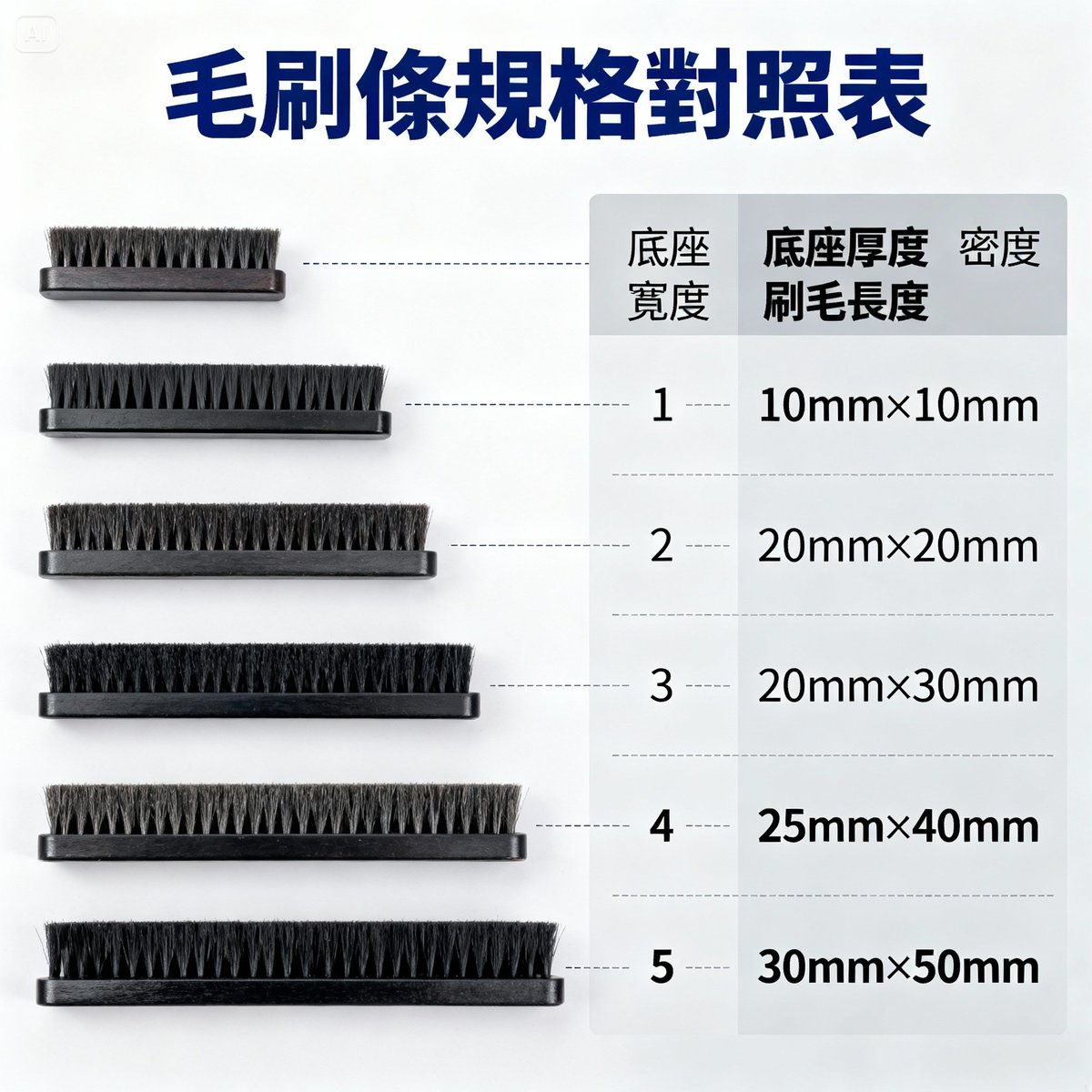
Base dimensions
Base width
- Narrow: 10-15 mm
- Standard: 20 mm
- Wide: 25-30 mm
Base thickness
- Thin: 2-3 mm
- Standard: 4-5 mm
- Thick: 6-8 mm
The wider and thicker the base, the more stable the structure, but the more installation space it needs.
Trim length
Common trim lengths
- Extra short: 10-15 mm (for sealing)
- Short: 20-25 mm (general cleaning)
- Medium: 30-40 mm (deep cleaning)
- Long: 50-100 mm (special protection)
How to choose
- Door gap sealing: short, 10-20 mm
- Conveyor belt cleaning: short to medium, 20-30 mm
- Machine protection: medium to long, 30-50 mm
- Dust removal and guiding: long, 40-80 mm
Tuft density
Density grades
- Low density: 3-5 mm spacing (ventilation and guiding)
- Medium density: 2-3 mm spacing (general cleaning)
- High density: 1-2 mm spacing (sealing and dust protection)
- Very high density: less than 1 mm spacing (precision sealing)
The higher the density, the better the sealing and cleaning result, but the higher the cost.
Quick size selection table
| Application | Recommended base width | Recommended trim length | Recommended density |
|---|---|---|---|
| Door and window sealing | 10-15 mm | 10-20 mm | High density |
| Conveyor belt cleaning | 20-25 mm | 20-30 mm | Medium density |
| Machine protection | 20-30 mm | 30-50 mm | Medium density |
| Elevator anti-pinch | 15-20 mm | 15-25 mm | High density |
| Dust-removal brush | 20-25 mm | 40-60 mm | Medium to low density |
Want to know more about how custom sizes are made? See The brush manufacturing process explained.
Guide to choosing strip brush materials
Material decides performance and durability.
Filament materials in detail
Nylon (Nylon 6/6.6)
- Properties: wear resistant, good elasticity, strong recovery, low water absorption
- Temperature resistance: -40°C to 100°C
- Suitable for: general cleaning, conveyor brushes, door gap sealing
- Price: ★★★ medium
- Rating: ★★★★★ the most commonly used
Polypropylene (PP)
- Properties: acid and alkali resistant, chemical resistant, does not absorb water, relatively stiff
- Temperature resistance: -20°C to 80°C
- Suitable for: chemical plants, washing equipment, chemically aggressive environments
- Price: ★★ lower
- Rating: ★★★ specific situations
PBT polyester fiber
- Properties: heat resistant, wear resistant, excellent recovery, dimensionally stable
- Temperature resistance: -40°C to 150°C
- Suitable for: high-temperature environments, food processing, precision cleaning
- Price: ★★★★ higher
- Rating: ★★★★ high-end applications
Metal wire (stainless steel / brass)
- Properties: high hardness, strong rust removal, high-temperature resistant, conductive
- Temperature resistance: -40°C to 400°C
- Suitable for: rust removal, surface treatment, anti-static, polishing
- Price: ★★★★★ the highest
- Rating: ★★★ special requirements
Natural bristle (hog bristle / horsehair)
- Properties: soft, good oil absorption, natural and environmentally friendly
- Temperature resistance: -20°C to 60°C
- Suitable for: precision cleaning, polishing, artistic uses
- Price: ★★★★ higher
- Rating: ★★ niche requirements
Base materials in detail
Aluminum alloy
- Pros: lightweight, does not rust easily, high machining precision, good appearance
- Cons: higher cost
- Suitable for: long-term use and situations where appearance matters
Stainless steel
- Pros: corrosion resistant, high strength, high-temperature resistant, high hygiene grade
- Cons: heavier, the highest cost
- Suitable for: high-standard environments such as food processing, medical and chemical
Galvanized steel sheet
- Pros: high strength, low cost, rust-proofed
- Cons: may rust over long-term use
- Suitable for: general industrial environments, cost-conscious projects
Plastic (PP/ABS)
- Pros: the lowest cost, lightweight, easily shaped
- Cons: lower strength, not heat resistant
- Suitable for: light loads, indoor use, low-cost requirements
Recommended material combinations
Door and window sealing: nylon filament + plastic base (economical)
Conveyor belt cleaning: nylon or PP filament + aluminum alloy base (a balance of durability)
Food processing: PBT filament + stainless steel base (meets food safety requirements)
Chemical equipment: PP filament + stainless steel base (corrosion resistant)
Rust removal and polishing: metal wire + stainless steel base (high strength)
Want to know how to choose the best material for your operating environment? Contact YC Brushes now; we offer free advice on materials.
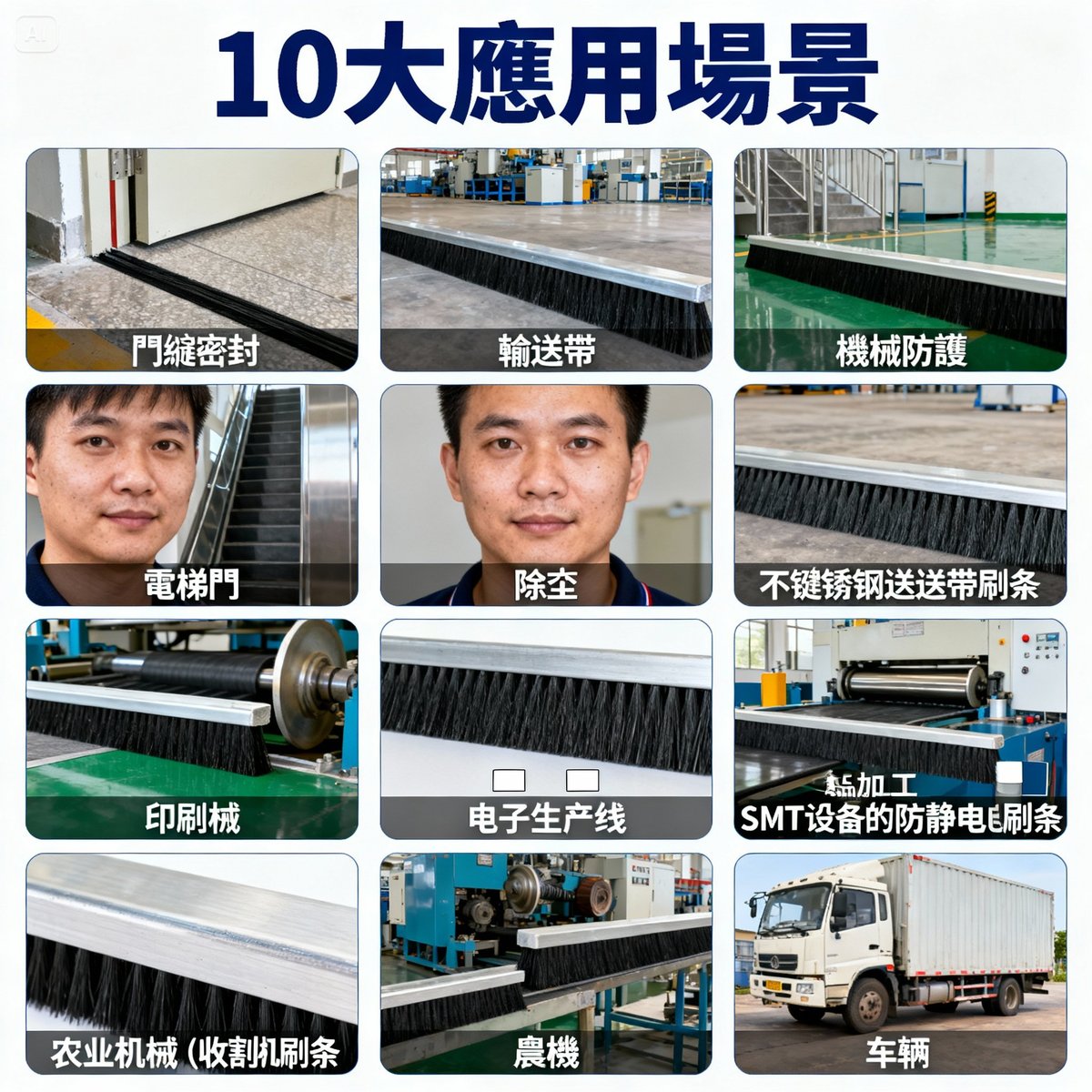
10 application scenarios for strip brushes
The range of uses for strip brushes is wider than you might imagine.
Scenario 1: Door gap sealing against wind and dust
Description Installed on the bottom of doors, door frames and window frames to keep out wind-blown sand, dust, insects and noise.
Recommended specification
- Filament: short nylon, 10-20 mm
- Base: plastic or aluminum alloy, 10-15 mm wide
- Density: high density, for a good seal
Installation Adhesive backing or screws.
Scenario 2: Conveyor belt cleaning and dust removal
Description Installed along the sides of or beneath a conveyor belt to remove material debris, dust and lint.
Recommended specification
- Filament: medium nylon or PP, 20-30 mm
- Base: aluminum alloy, 20-25 mm wide
- Density: medium density
Industries Food plants, packaging plants, printing plants, electronics plants and others.
See the conveyor brush products from YC Brushes, available in many specifications.
Scenario 3: Machine and equipment protection
Description Installed at the openings of machine tools, CNC machines and automation equipment to keep chips and dust out of the interior.
Recommended specification
- Filament: medium to long nylon, 30-50 mm
- Base: aluminum alloy or stainless steel, 20-30 mm wide
- Density: medium to high density
Benefits Extends equipment life, reduces the failure rate and lowers repair costs.
Scenario 4: Elevator anti-pinch safety device
Description Installed along the edge of elevator doors as a cushioning and sensing device, to prevent passengers from being pinched.
Recommended specification
- Filament: soft nylon, 15-25 mm
- Base: aluminum alloy, 15-20 mm wide
- Density: high density
Safety standards Must comply with elevator safety regulations, and the material must be flame-resistant or flame-retardant.
Scenario 5: Industrial dust removal and static elimination
Description Installed on dust-removal equipment and static eliminators to remove surface dust and static electricity.
Recommended specification
- Filament: conductive carbon fiber or metal wire, 40-60 mm
- Base: grounded aluminum alloy, 20-25 mm wide
- Density: medium density
Electronics industry applications PCB production lines, panel plants, semiconductor plants and others. See the anti-static strip brush products.
Scenario 6: Food processing cleaning
Description Cleaning food processing equipment, conveyor belts, baking trays and so on, in line with food safety standards.
Recommended specification
- Filament: PBT compliant with the FDA regulations for food contact materials (21 CFR 177), 20-30 mm
- Base: stainless steel, 20-25 mm wide
- Density: medium to high density
Food safety certification The material must comply with FDA standards for food contact materials.
Scenario 7: Printing machinery cleaning
Description Removing ink residue and paper dust from printing rollers and plates.
Recommended specification
- Filament: fine PBT, 20-30 mm
- Base: aluminum alloy, 20 mm wide
- Density: high density
Benefits Improves print quality and reduces the defect rate.
Scenario 8: Dust protection in electronics manufacturing
Description Dust protection and guiding on SMT production lines and assembly lines.
Recommended specification
- Filament: anti-static nylon, 20-30 mm
- Base: aluminum alloy, 20 mm wide
- Density: medium to high density
Scenario 9: Agricultural machinery cleaning
Description Cleaning and guiding on farm machinery, harvesters and threshers.
Recommended specification
- Filament: wear-resistant PP or nylon, 30-50 mm
- Base: galvanized steel sheet, 25-30 mm wide
- Density: medium to low density
Durability Used outdoors, so it must resist UV, moisture and wear.
Scenario 10: Vehicle sealing and cleaning
Description Sealing truck roll-up doors, brush strips for car wash machines, vehicle door sealing and so on.
Recommended specification
- Filament: weather-resistant nylon, 20-40 mm
- Base: aluminum alloy or plastic
- Density: depends on the use
Want to know which specification suits your application? Consult YC Brushes now and draw on over 40 years of experience for professional advice.
🚀 Cannot find a strip brush in the right size?
How does YC Brushes meet your strip brush needs?
✅ A wide range of stock specifications: 20+ commonly used specifications available from stock; lead times are quoted per specification, so please email us with your requirements ✅ Flexible customization: any length, trim length, density or material can be made to order; order quantities are quoted per specification ✅ Professional selection advice: engineers with over 40 years of experience recommend the most suitable specification for your operating environment ✅ Rapid sampling: custom samples made with 3D printing; sample lead times are quoted per specification ✅ Quality assurance: three inspections, a pull test of ≥5 kg and a 90-day warranty
💡 Why choose strip brushes from YC Brushes?
- A wide choice of materials: nylon, PP, PBT, metal wire and natural bristle, to meet every need
- Factory-direct: no middleman, so the price is the most favorable
- Technical support: installation guidance and advice on use
Special offer: order 500 or more strip brushes and the installation accessories are free!
👉 See the YC Brushes strip brush range now!
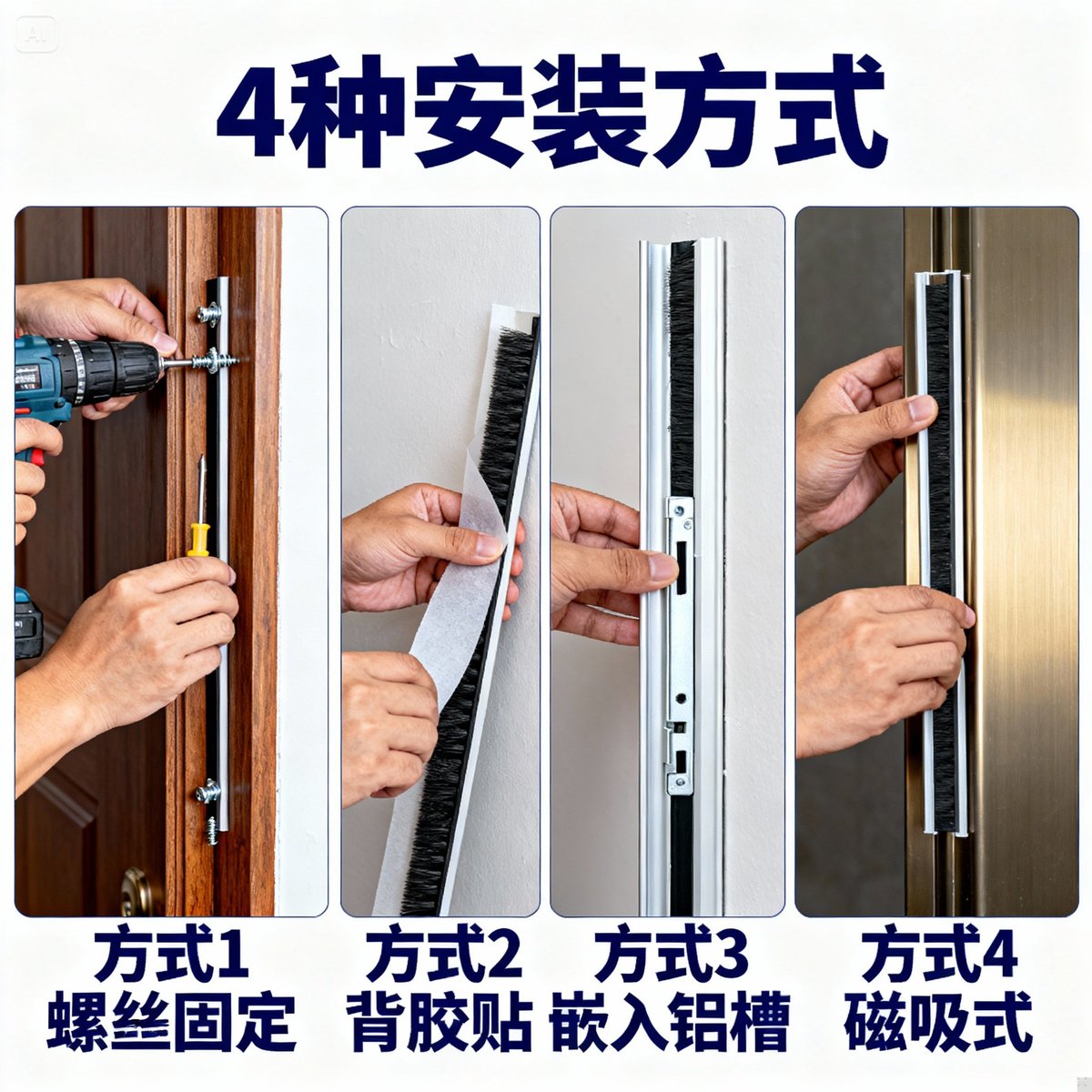
The 4 strip brush installation methods explained in full
Choose the right installation method and the result is twice as good.
Method 1: Screws (the most secure)
Where it fits Long-term use, heavier loads, vibrating environments.
Installation steps
- Pre-drill screw holes in the base (20-30 cm apart)
- Align the strip brush with the installation position
- Fix it with self-tapping screws or machine screws
- Confirm that it is firmly fixed with no looseness
Pros
- The most secure fixing
- Suited to heavy loads
- Resists vibration and impact
Cons
- Drilling is required
- Removal and refitting take more work
- May damage the substrate
Recommended screws
- Stainless steel self-tapping screws, M3-M4
- 20-30 cm apart
- Flat-head or countersunk screws, to avoid protruding
Method 2: Adhesive backing (the quickest)
Where it fits Light loads, smooth surfaces, quick installation.
Installation steps
- Clean the installation surface (remove oil and dust)
- Peel off the protective film on the adhesive backing
- Align it and press it firmly into place
- Press hard for 30 seconds to make sure it sticks
- Leave it for 24 hours before use
Pros
- The quickest to install
- Does not damage the substrate
- A clean appearance
Cons
- Adhesion decreases over time
- Not suited to hot or humid environments
- Leaves adhesive residue when removed
Choosing the adhesive
- 3M VHB double-sided tape (high adhesion)
- Weather-resistant acrylic adhesive
- Choose an adhesion level to suit the environment
Method 3: Aluminum channel mounting (the best looking)
Where it fits Frequent replacement, high appearance requirements, professional designs.
Installation steps
- Install the aluminum channel (U type or C type) in the target position
- Slide the base of the strip brush into the channel
- Tighten the fixing screws (if any)
- Confirm that it is held tight with no looseness
Pros
- The best looking and most professional appearance
- Very easy to replace
- The position can be adjusted
- Suited to precision equipment
Cons
- The aluminum channel has to be bought separately
- Higher cost
- Installation space has to be allowed for
Channel sizes Choose according to the base width of the strip brush:
- 10 mm base → 12 mm channel
- 20 mm base → 22 mm channel
- 30 mm base → 32 mm channel
Method 4: Magnetic (the most flexible)
Where it fits Frequent removal and refitting, iron or steel surfaces, temporary applications.
Installation steps
- Stick a magnetic strip to the back of the strip brush base
- Attach it directly to the iron or steel surface
- Adjust the position until it is right
Pros
- The easiest to remove and refit
- The position can be adjusted at any time
- Does not damage the surface
- Suited to testing and trials
Cons
- Only works on iron or steel surfaces
- Limited holding force, not suited to heavy loads
- May come off under vibration
Choosing the magnetic strip
- Rubber magnetic strip (good flexibility)
- Neodymium magnets (strong holding force)
- Thickness 1-2 mm
Quick installation method selection table
| Installation method | Security | Speed of installation | Ease of removal and refitting | Cost | Where it fits |
|---|---|---|---|---|---|
| Screws | ★★★★★ | ★★ | ★ | ★★ | Long-term use, heavy loads |
| Adhesive backing | ★★★ | ★★★★★ | ★★ | ★ | Light loads, quick installation |
| Aluminum channel | ★★★★ | ★★★ | ★★★★★ | ★★★★ | Frequent replacement, high appearance requirements |
| Magnetic | ★★ | ★★★★★ | ★★★★★ | ★★ | Temporary use, testing |
Want the specific installation steps and points to note? Contact YC Brushes; we offer free installation guidance.
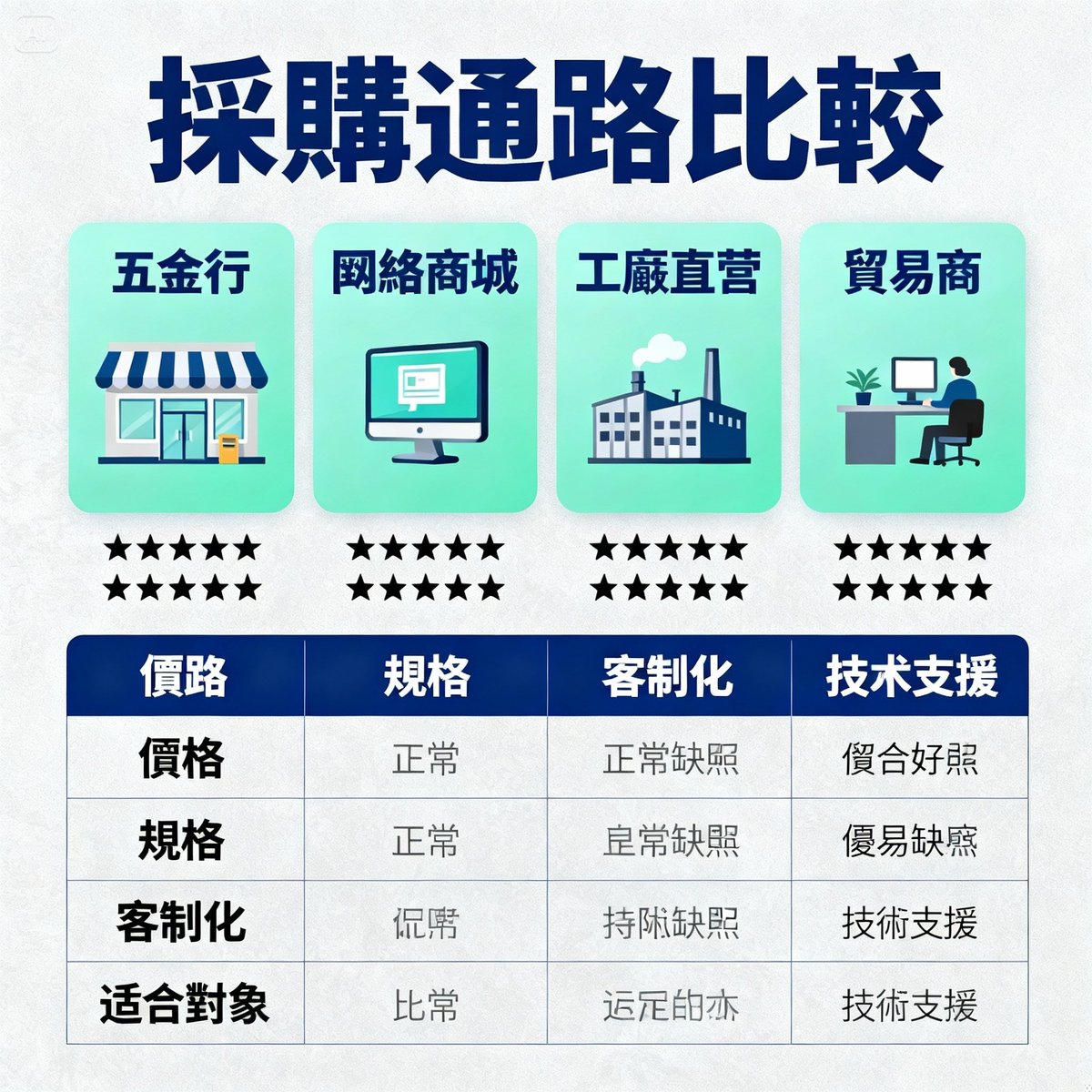
A full comparison of strip brush purchasing channels
Where is the best place to buy strip brushes? (The channels and NT$ prices below describe the Taiwan market.)
Channel 1: Hardware stores / building materials stores
Pros
- Take it away immediately, with no waiting
- You can see the actual product on the spot
- No pressure when buying small quantities
Cons
- Few specifications to choose from (usually only basic models)
- A higher unit price (retail prices)
- No custom service
- Uneven quality
Who it suits Individuals or small businesses with an urgent need, small quantities and no demanding specification requirements.
Reference prices
- Nylon strip brush, 50 cm: mid-to-high price (retail unit price)
- Limited choice, mostly basic models
Channel 2: Online marketplaces (Shopee/PChome/Ruten)
Pros
- Transparent prices that are easy to compare
- Convenient home delivery
- Reviews to refer to
Cons
- You cannot check the quality of the actual product
- Specification descriptions may be inaccurate
- After-sales service is not always thorough
- Customization is difficult
Who it suits General consumers, small trial quantities, standard specification needs.
Reference prices
- Nylon strip brush, 50 cm: mid-price
- Metal wire strip brush, 50 cm: mid-to-high price
Points to note Pay attention to seller ratings, the return and exchange policy and the actual dimensions.
Channel 3: Factory-direct (such as YC Brushes)
Pros
- The most favorable price (no middleman)
- The widest choice of specifications
- Custom design available
- Stable, assured quality
- Professional technical support
- Even better value on large orders
Cons
- There is usually a minimum order quantity
- Custom products involve a wait (lead times are quoted per specification; email us with your requirements)
- You have to make contact and ask for a quote
Who it suits Corporate purchasing, steady demand, custom requirements, large orders.
Reference prices (taking 500 pieces as an example)
- Nylon strip brush, 50 cm: NT$35-55 per piece
- Metal wire strip brush, 50 cm: NT$90-130 per piece
- PBT food-grade strip brush, 50 cm: NT$45-65 per piece
See the full YC Brushes product catalog, with 20+ specifications to choose from. Want to know how to assess and choose a brush factory systematically? See Custom brush recommendations | Comparing factories, which provides a complete factory selection checklist.
Channel 4: Trading companies / distributors
Pros
- Sales staff to serve you
- Several brands available
- Credit terms
Cons
- Higher prices than factory-direct
- The lead time may be longer
- Customization has to go through the factory, so communication is more cumbersome
Who it suits Companies that already work with a trading company or need to consolidate purchases of many kinds of product.
Purchasing channel comparison table
| Channel | Price | Choice of specifications | Customization | Technical support | Suitable purchase quantity | Rating |
|---|---|---|---|---|---|---|
| Hardware store | ★★ high | ★★ few | ✗ | ✗ | 1-10 pieces | ★★ |
| Online marketplace | ★★★ medium | ★★★ medium | ✗ | ✗ | 1-50 pieces | ★★★ |
| Factory-direct | ★★★★★ best | ★★★★★ most | ✓ | ✓ | 50+ pieces | ★★★★★ |
| Trading company | ★★★ medium to high | ★★★★ many | △ | △ | 100+ pieces | ★★★ |
Purchasing advice
A small trial quantity (1-10 pieces) → A hardware store or online marketplace
A medium quantity of standard products (10-100 pieces) → An online marketplace or factory-direct (ask about small-quantity prices)
Large quantities or custom work (100+ pieces) → Factory-direct is the best value
Long-term, steady demand → Set up a direct supply relationship with the factory; an annual contract gives the best terms
Want to set up a long-term supply relationship? Contact YC Brushes; we offer annual contract terms and dedicated service.
FAQ
Here are the 6 questions we are asked most often about choosing and using strip brushes.
Can a strip brush be cut? Will it come apart?
Yes, it can be cut. A strip brush is made by a continuous tufting process and does not come apart after cutting. A plastic base can be cut with a utility knife or scissors; a metal base such as aluminum alloy or stainless steel needs a hacksaw or a cutting tool. Tidy the filament with scissors. If you are worried about filaments coming loose at the cut, put a drop of instant adhesive on the cut end to hold them.
How can I tell whether a strip brush is good quality?
Look at three things: (1) Pull test: pull hard on the filament; in a good product it does not come out easily. (2) Recovery: bend the filament and let go; it should spring back quickly. (3) Even density: the density should be consistent along the whole strip, with no thin areas or gaps. All YC Brushes products pass a pull test of ≥5 kg, so quality is assured.
How long does a strip brush last before it needs replacing?
It depends on how hard it is used. For general cleaning, about 6-12 months. For heavily loaded conveyor brushes, about 3-6 months. For door gap sealing, as long as 2-3 years. The criteria: replace it when more than 30% of the filament is worn away, when it has lost its elasticity, or when the density is clearly thinner. If the brush body is sound and only the filament is worn, you can consider our contract tufting service, at only 30-50% of the cost of a new brush.
How much do standard and custom products differ in price?
The unit price of a standard product falls in the mid-price range (50 cm nylon, varying by channel). A custom unit price is about NT$45-70 per piece (order quantities are quoted per specification; please email us with your requirements), only a little more, and the specification matches your needs exactly. If the quantity reaches 1,000 pieces, the custom unit price can even drop to NT$30-45 per piece, cheaper than a standard product. For detailed prices, see Custom brush prices explained in full.
What special requirements apply to strip brushes used in food plants?
They must comply with FDA standards for food contact materials. We recommend PBT filament with a 304 stainless steel base. The filament must withstand high temperatures (at least 120°C), must not shed, and must be non-toxic and odorless. Wash and disinfect regularly; washing with a food-grade cleaner every week is recommended. YC Brushes supplies strip brushes that meet food safety certification, and material certificates are available on request.
How do I clean and maintain a strip brush?
Everyday care: (1) Remove dust regularly with a vacuum cleaner or compressed air. (2) Oily dirt can be washed off with a neutral cleaner and warm water; rinse and leave to dry. (3) Avoid baking at high temperature or leaving it in strong sun. (4) Check regularly whether the fixing screws have come loose. Food-grade strip brushes need to be washed and disinfected thoroughly with a food-grade cleaner every week.
Conclusion: choose the right strip brush and get twice the result for half the effort
A strip brush looks simple, but the devil is in the details.
Only with the right size, material and installation method does it perform at its best.
Three keys to buying a strip brush
1. Be clear about the requirement First confirm the purpose (sealing, cleaning, protection), the environment (temperature, humidity, chemicals) and the machine specifications; only then can you choose the right specification and material.
2. Choose a reliable supplier Buying factory-direct means stable quality, favorable prices and thorough technical support. With over 40 years of professional manufacturing, 20+ specifications in stock and custom orders quoted per specification, YC Brushes is your best partner.
3. Install and maintain it correctly Choose the installation method to suit the load and environment, and clean and maintain the brush regularly, to extend its service life and lower the total cost.
The strip brush advantages of YC Brushes
- A full range of specifications: 20+ standard specifications in stock, covering 90% of common needs
- Lead times: quoted per specification; please email us with your requirements
- Flexible customization: any size, material or density can be made to order; order quantities are quoted per specification
- Favorable prices: factory-direct with no middleman, and even better value on large orders
- Quality assurance: three inspections, a pull test of ≥5 kg and a 90-day warranty
- Technical support: free selection advice, installation guidance and consultation on use
Still not sure which strip brush to buy?
Contact YC Brushes now and tell us what you need, and let our engineers with over 40 years of experience recommend the most suitable solution.
Or see the full strip brush product range and choose the specification you need directly.
Want to learn more about brushes? Visit the YC Brushes blog to explore more technical articles and application cases.