Introduction: choose the wrong material and a stainless steel straw may get more damaged the more you scrub
Have you ever had this experience: you bought a reusable stainless steel straw, paired it with a cheap nylon straw brush, and after a few months found fine scratches on the inner wall of the straw?
Or you bought a silicone straw brush and found that a plastic straw would not come clean however much you scrubbed?
The problem lies in the choice of material. Silicone and nylon each have advantages and disadvantages, and choosing the right material not only improves the cleaning result but also protects your straw from damage.
This article analyzes, from a manufacturer's professional point of view, the differences between silicone and nylon, their pros and cons and where each is suitable, to help you make the right choice. The stores, shopping platforms and price levels it mentions describe the Taiwan market.
Want to start with the basics of straw brushes? First read The complete cleaning brush buying guide | Straw brushes, tube brushes and electric cleaning brushes all covered.
Silicone straw brushes explained in full
What is a silicone straw brush?
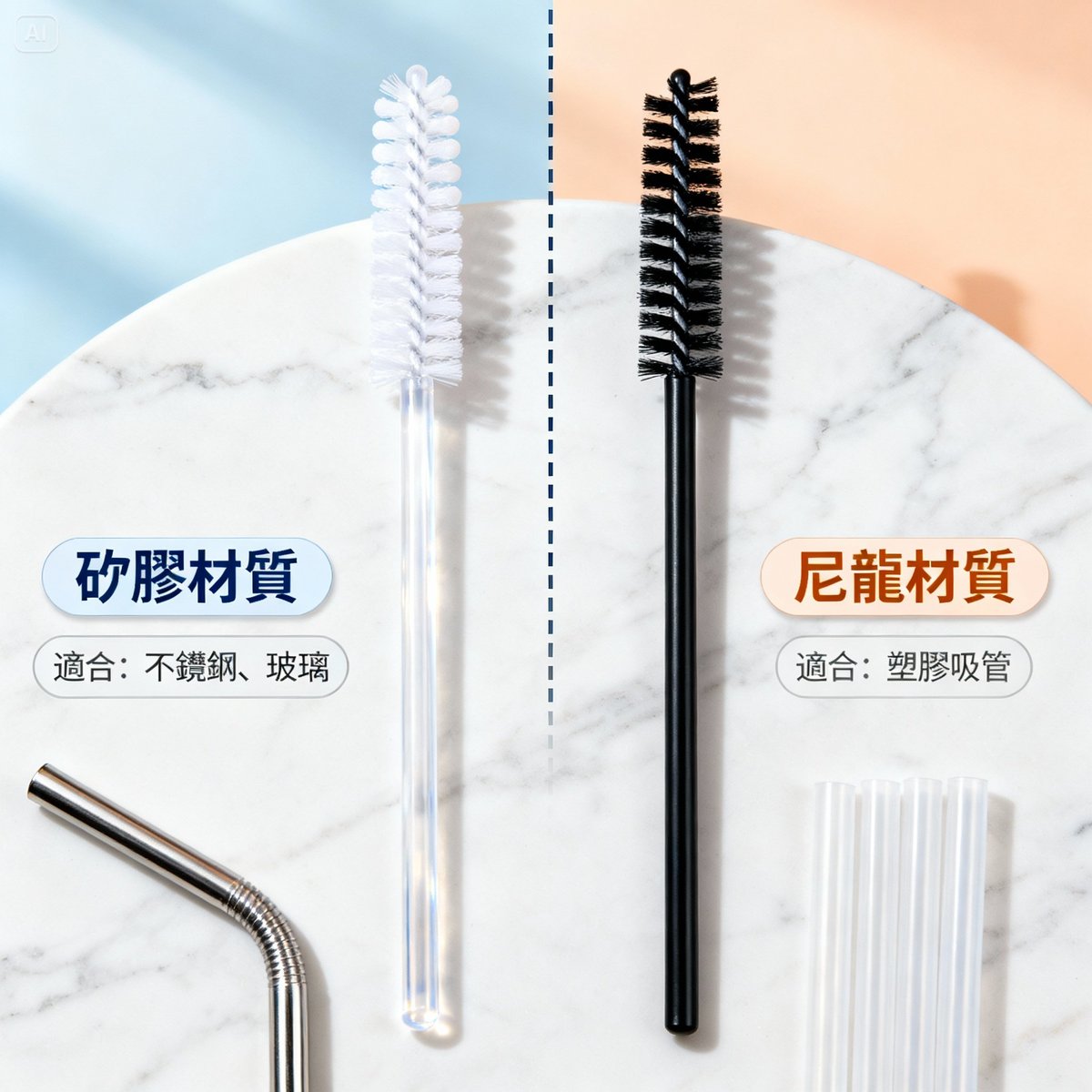
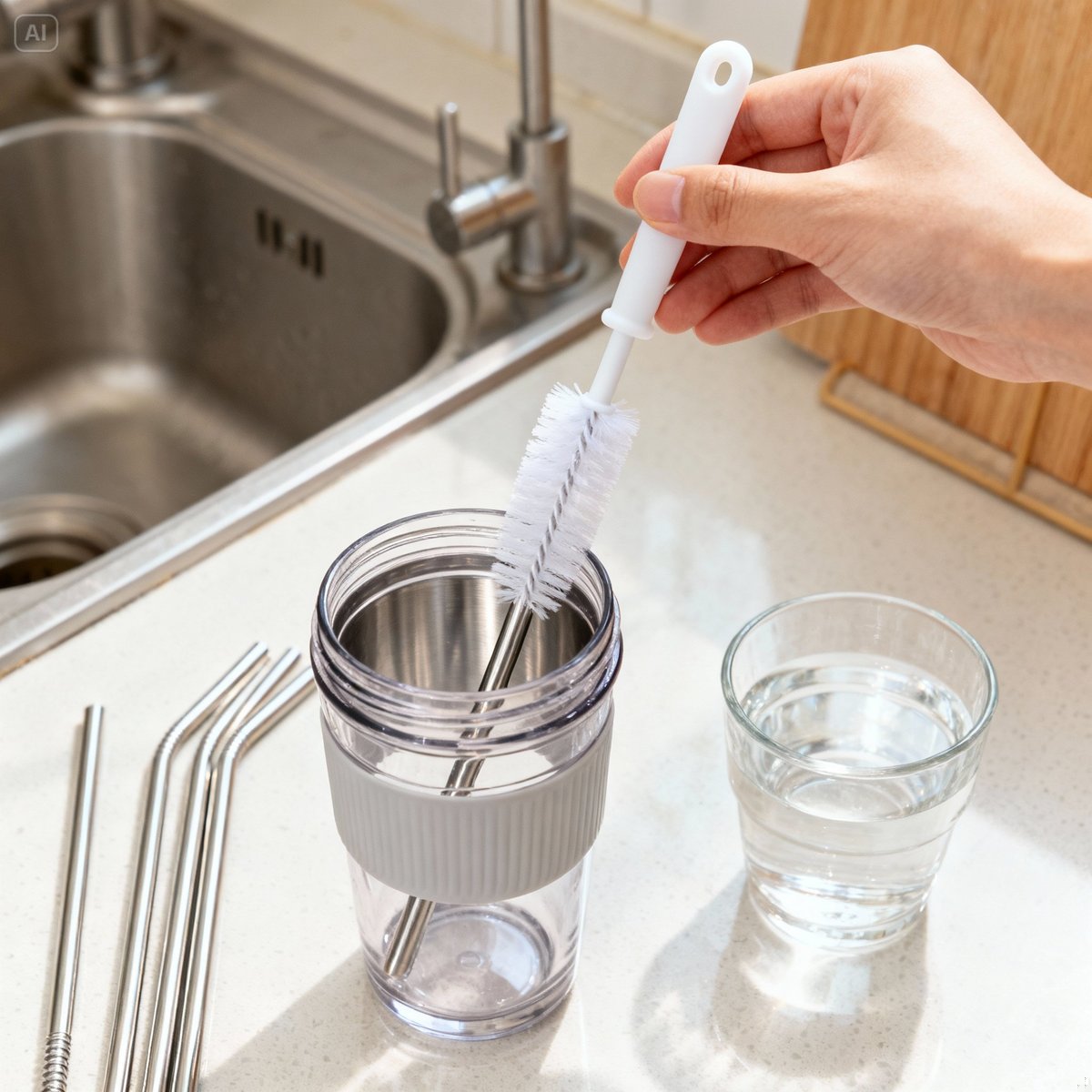
A silicone straw brush is made of food-grade silicone. Its bristles are soft and elastic and do not scratch the surface of the item being cleaned.
Material properties:
- Composition: food-grade silicone
- Hardness: soft and elastic
- Temperature range: -40°C to 230°C
- Food-contact regulations: commonly labeled as compliant with US FDA 21 CFR 177.2600 and German LFGB
Manufacturing process (the professional view of YC Brushes):
- Made by liquid silicone injection molding
- Bristles and handle are molded in one piece, with no adhesive
- The bristle surface is smooth and free of pores, so it does not trap dirt easily
- In a good-quality silicone brush, the elasticity of the bristles is even and consistent
The 5 advantages of silicone straw brushes
Advantage 1: Does not scratch surfaces at all
This is the biggest advantage of a silicone straw brush.
- Principle: silicone is softer than stainless steel and glass, so physically it cannot cause scratches
- Measured: in a YC Brushes laboratory test, a silicone brush was rubbed on a stainless steel surface 10,000 times with no scratches at all
- Suitable for: stainless steel straws, glass straws, the inner wall of high-end insulated bottles
Why should a stainless steel straw be cleaned with a silicone brush?
- If the inner wall of a stainless steel straw is scratched, it traps dirt easily
- Scratches damage the protective layer of the stainless steel and lower its corrosion resistance
- With a silicone brush you can scrub firmly without fear of damage
Advantage 2: Heat resistant and can be disinfected by boiling
Silicone withstands an extremely wide range of temperatures.
- High temperature: withstands heat of 230°C
- Low temperature: withstands cold of -40°C (it can even be used in a freezer)
- Disinfecting by boiling: boil in water for 3-5 minutes for complete disinfection
- Dishwasher: can go straight into the dishwasher
Where this applies:
- Baby bottle straws (which need high-temperature disinfection)
- Cleaning utensils used when eating out (where hygiene is a concern)
- Cleaning medical devices (which need strict disinfection)
Advantage 3: Easy to clean and does not trap dirt
The surface properties of silicone make it extremely easy to clean.
- Smooth surface: no pores, so dirt cannot soak in
- Hydrophobic: does not readily pick up grease
- Clean with a rinse: 10-20 seconds under clean water is enough
- Does not go moldy: just keep it dry; mold does not grow on it easily
Compared with a nylon brush:
- Dirt easily gets stuck in the gaps between nylon filaments
- It has to be soaked in a cleaning agent to come clean
- If it is not completely dry, it goes moldy easily
Advantage 4: Long service life (1-2 years)
Silicone is extremely durable.
- Does not deform: the bristles do not bend out of shape with long use
- Does not become brittle: it does not crack with age
- Does not shed: molded in one piece, so the bristles never fall out
- Service life: 1-2 years or more in normal use
Cost analysis:
- Silicone brush: a higher purchase price, but it lasts 1-2 years, so the average monthly cost works out lower
- Nylon brush: a lower purchase price, but it needs replacing after about 3-6 months, so spread over the long term it is not necessarily good value
- Conclusion: the long-term cost of a silicone brush is lower!
Advantage 5: Environmentally friendly and safe, non-toxic and odorless
Silicone is an environmentally friendly material.
- Non-toxic: food-grade silicone, completely non-toxic
- BPA-free: contains no bisphenol A or other harmful substances
- Odorless: no plastic or chemical smell
Suitable for:
- Baby products (safety first)
- Those who care about health (a non-toxic material)
- Those who care about the environment (durable, fewer replacements)
The 3 disadvantages of silicone straw brushes
To be objective, silicone brushes have disadvantages too.
Disadvantage 1: Weaker cleaning power
The softness of silicone is a double-edged sword.
- Low friction: cannot quickly remove stubborn tea and coffee stains
- Needs repeated scrubbing: it may take 2-3 passes to get clean
- Not suitable for: heavy dirt, dried-on stains
Solutions:
- Soak with a cleaning agent for 5-10 minutes
- Apply moderate pressure when scrubbing
- Or keep a nylon brush for stubborn stains
Disadvantage 2: Higher price
Silicone brushes cost more to manufacture.
- Price range: mid-to-high (clearly higher than nylon brushes)
- Reason: food-grade silicone raw material is expensive and the process is more complex
Is it worth it?
- If you use stainless steel / glass straws → very much worth it
- If you only clean plastic straws → a nylon brush is worth considering
- Considering the long-term cost → a silicone brush is the better deal
Disadvantage 3: Softer bristles, not suited to deep gaps
Silicone bristles cannot reach into certain special structures.
- The corner of an L-shaped straw: the bristles are too soft to scrub it with any force
- Thread gaps: they cannot get into the grooves of a screw thread
- Stubborn stains: stiff filament is needed to scrape them off
Advice:
- Keep one silicone brush + one nylon brush
- Use the silicone brush for everyday cleaning
- Use the nylon brush for stubborn stains
What is a silicone straw brush suitable for?
Best for cleaning:
- Stainless steel straws: does not scratch at all
- Glass straws: protects the glass surface
- Baby bottle straws: can be disinfected by boiling
- The inner wall of high-end insulated bottles: does not damage the coating
- Silicone straws: cleaning with the same material works best
Not suitable for cleaning:
- Cheap plastic straws (a nylon brush is faster)
- Heavily soiled tubes (not enough cleaning power)
- Industrial pipe cleaning (stiff filament is needed)
Nylon straw brushes explained in full
What is a nylon straw brush?
A nylon straw brush is made of nylon (polyamide) fiber. Its filament is stiffer and its cleaning power is strong.
Material properties:
- Composition: PA6 or PA66 nylon fiber
- Hardness: harder than silicone
- Filament diameter: 0.1-0.3 mm
Manufacturing process (the professional view of YC Brushes):
- Twisted-wire fixing method (industrial grade): held by tightly twisted metal wire, so the filament does not come out easily
- Adhesive fixing method (cheap models): bonded with glue, comes loose easily
- Tuft density: a high-quality nylon brush has more than 50 tufts of filament per square centimeter
Differences in quality:
- Industrial-grade nylon brush: filament shedding rate below 3%
- Ordinary retail models: the filament shedding rate can reach 10-30%
The 5 advantages of nylon straw brushes
Advantage 1: Strong cleaning power and fast stain removal
Nylon filament is stiffer and gives more friction.
- Speed of stain removal: 2-3 times that of a silicone brush
- Suited to stubborn stains: tea stains, coffee stains, milk stains and so on
- Reaches into gaps: the stiffer filament gets into small gaps
- Fast cleaning: clean after 1-2 passes
Measured comparison (cleaning tea stains from a plastic straw):
- Silicone brush: 5-8 passes needed
- Nylon brush: 2-3 passes are enough
Advantage 2: Affordable and good value for money
A nylon brush is the most economical choice.
- Price range: budget
- Multi-packs: good prices (10-20 pieces)
Cost advantages:
- Suited to frequent replacement
- Low cost when bought in quantity
- Wear and tear does not hurt
Advantage 3: Fast cleaning that saves time and effort
For busy modern people, speed matters.
- Cleaning time: saves 50-70% of the time compared with a silicone brush
- No soaking needed: just scrub directly
- Suited to people who often eat out: clean quickly and use again
Time compared:
- Silicone brush: 5 minutes of soaking + 2 minutes of scrubbing = 7 minutes
- Nylon brush: 1-2 minutes of direct scrubbing = 2 minutes
Advantage 4: Many styles and a full range of sizes
Nylon brushes are the mainstream of the market and offer the most choice.
- Sizes: everything from 0.5 cm to 2.0 cm
- Lengths: 10 cm up to long-handled models of 50 cm
- Functional styles: bendable, double-ended, multi-packs and more
- Easy to buy: in Taiwan they are sold at PX Mart, Daiso and online
Special styles:
- L-shaped bendable straw brush
- Double-ended straw brush (one thick end, one thin end)
- Extra-long-handled brush for the tall cups used for hand-shaken tea drinks
Advantage 5: Easy to get, available at any time
Nylon brushes are the most widely available type.
- Physical stores: PX Mart, Daiso, Showba and POYA (all retail chains in Taiwan) carry them
- Online platforms: Shopee, momo and PChome have a huge choice
- No fear of stock running out: you can restock at any time
Want to know where the best deal is? Read Where to buy straw brushes? The latest 2026 comparison of places to buy and prices.
The 3 disadvantages of nylon straw brushes
Disadvantage 1: May scratch precision surfaces
Nylon is harder, so there is a risk of scratching.
- High-risk materials: stainless steel, glass, ceramic inner walls
- Consequences of scratches: they trap dirt, damage the protective layer and spoil the appearance
- Causes of scratching: hard impurities mixed into the filament, too much force
YC Brushes experiment:
- A poor-quality nylon brush scrubbed on a stainless steel surface 100 times: fine scratches appeared
- A good-quality nylon brush scrubbed 500 times: slight scratches
- A silicone brush scrubbed 10,000 times: no scratches at all
Advice:
- A nylon brush is not recommended for stainless steel / glass straws
- If you must use one, choose a soft nylon brush
- Do not scrub with too much force
Disadvantage 2: The filament sheds easily
This is the most common problem with nylon brushes.
- Cheap models: start shedding heavily after 1-2 months of use
- Mid-priced models: start shedding after 3-6 months
- Industrial grade: shed only after more than 1 year of use
Causes of shedding:
- The adhesive fixing method (the glue fails when it meets water)
- Low filament density (the filament works loose easily)
- Too much force (the filament is torn off)
How to tell whether a brush will shed:
- Pull the filament gently by hand; if it comes out easily → do not buy
- Look at the root of the filament for tightly twisted metal wire → brushes that have it are more durable
- Check the product reviews for comments about "shedding"
Disadvantage 3: Less heat resistant than silicone
The heat resistance of nylon brushes varies from product to product.
- Heat-resistance temperature: go by the product label; it varies widely between models
- Boiling and dishwashers: repeated high temperatures easily deform the filament, so check the label before use
What this means:
- Check the product label before disinfecting at high temperature
- Models that cannot be disinfected at high temperature can be disinfected another way (diluted bleach)
What is a nylon straw brush suitable for?
Best for cleaning:
- Plastic straws: strong cleaning power, no worry about scratching
- Bamboo straws: removes stains quickly
- Ordinary tubes: sinks, water bottle tubing and so on
- Stubborn stains: dried-on tea and coffee stains
- Limited budgets: a low cost of entry
Not suitable for cleaning:
- Stainless steel straws (scratch easily)
- Glass straws (risk of scratches)
- Baby products that need repeated high-temperature disinfection (check the heat-resistance label first)
💡 Need professional advice on choosing the most suitable straw brush material?
Contact YC Brushes now: with over 40 years of manufacturing experience, we offer free material consultation and help you find the most suitable solution.
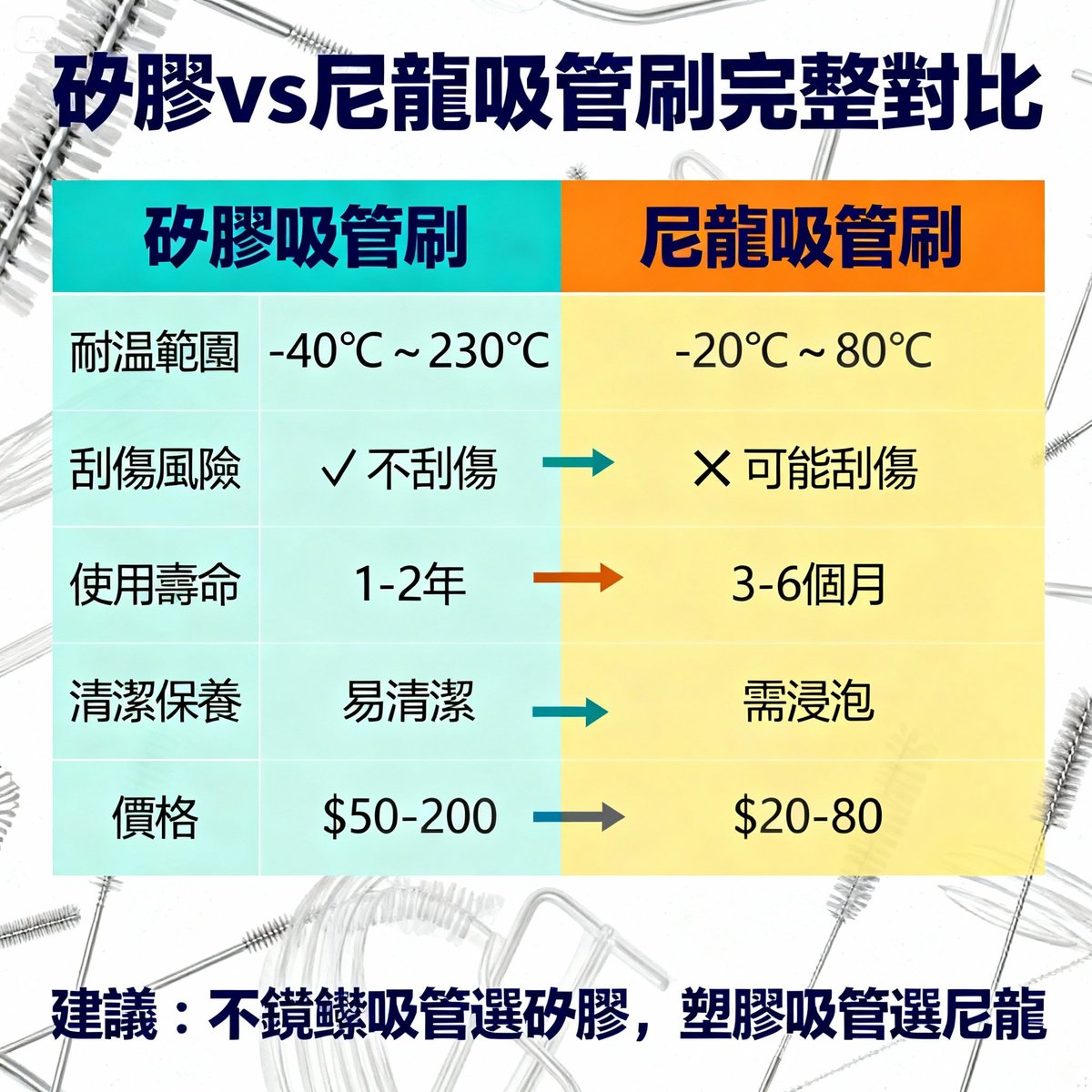
Silicone vs nylon: a detailed comparison table
A full comparison of the two materials at a glance.
| Item compared | Silicone straw brush | Nylon straw brush |
|---|---|---|
| Material | Food-grade silicone | PA6/PA66 nylon fiber |
| Hardness | Soft | Harder |
| Cleaning power | ⭐⭐⭐ Weaker | ⭐⭐⭐⭐⭐ Strong |
| Risk of scratching | ✓ Does not scratch at all | ✗ May scratch precision surfaces |
| Temperature range | -40°C to 230°C | Less heat resistant than silicone |
| Can it be boiled? | ✓ Yes | Depends on the product label |
| Service life | ⭐⭐⭐⭐⭐ 1-2 years | ⭐⭐⭐ 3-6 months |
| Shedding | ✓ Molded in one piece, never sheds | ✗ May shed (depends on quality) |
| Cleaning and care | ⭐⭐⭐⭐⭐ Extremely easy to clean | ⭐⭐⭐ Needs soaking in a cleaning agent |
| Price | Mid-to-high | Budget |
| Value for money (long term) | ⭐⭐⭐⭐⭐ High | ⭐⭐⭐ Medium |
| Ease of purchase | ⭐⭐⭐ Medium | ⭐⭐⭐⭐⭐ High |
| Environmental friendliness | ⭐⭐⭐⭐⭐ Durable, fewer replacements | ⭐⭐⭐ Average |
| Suitable straws | Stainless steel, glass, silicone | Plastic, bamboo |
| Suitable for | Those who care about the environment, baby products, those who value durability | Limited budgets, fast cleaning, stubborn stains |
Summary advice:
- Quality and durability first → silicone brush
- Speed and economy first → nylon brush
- The best combination → keep one of each and use whichever suits the situation
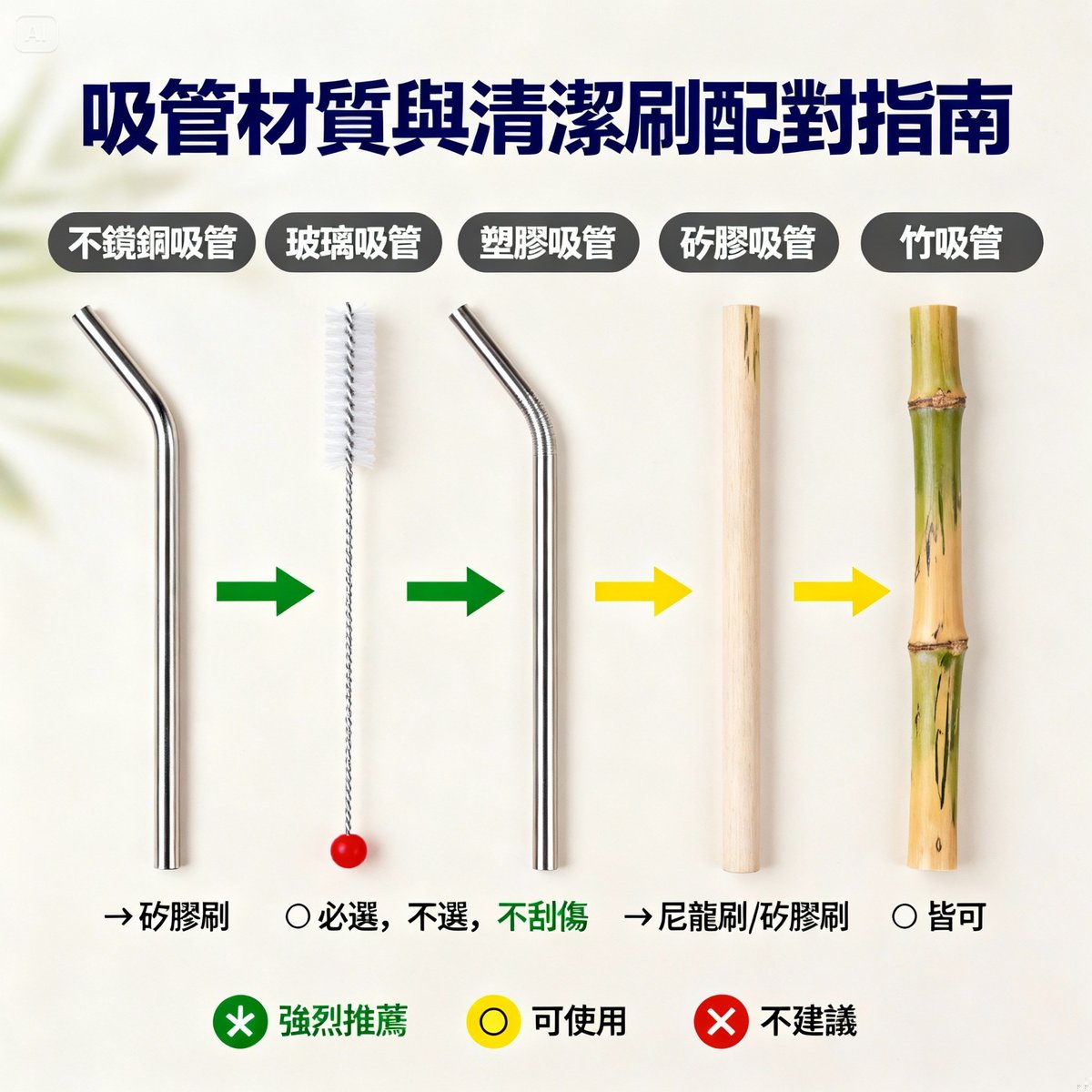
A guide to choosing by straw material
Different straw materials need to be paired with different cleaning brushes.
Stainless steel straws → silicone brush (a must)
Why must a silicone brush be used?
Stainless steel straws are the mainstream reusable straw, but they are also the most easily scratched.
- Risk of scratching: a nylon brush may cause fine scratches
- Consequence: the scratched areas trap dirt and rust easily
- Solution: a silicone brush does not scratch at all
Professional advice from YC Brushes:
- Choose a food-grade silicone brush first
- Bristle density should be high (for a good cleaning result)
- It can be disinfected by boiling, which ensures hygiene
Recommended models:
- Silicone straw brush set of 2-5 (mid-to-high price)
- Includes different thicknesses to fit various tube diameters
Glass straws → silicone brush (a must)
Why are glass straws fragile?
Glass straws are transparent and attractive, but very easily damaged.
- Scratching: a nylon brush easily scratches the inner wall of the glass
- Risk of cracking: too much force may cause tiny cracks
- Advantage of a silicone brush: gentle cleaning that does not harm glass
Tips for use:
- Do not use too much force
- Soak with a cleaning agent to soften the dirt
- Keep the pressure moderate when scrubbing
Plastic straws → either a nylon brush or a silicone brush
The properties of plastic straws:
Plastic is softer, and both kinds of brush are suitable.
- Nylon brush: fast cleaning, suited to stubborn stains
- Silicone brush: gentle cleaning that does not harm plastic
How to choose:
- Limited budget → nylon brush (budget price)
- Durability first → silicone brush (mid-to-high price)
- The best combination → one of each
Silicone straws → silicone brush (the best)
The principle of cleaning with the same material:
When a silicone brush cleans a silicone straw, the coefficient of friction is the most moderate.
- Not too slippery: enough friction to remove dirt
- Not too hard: does not damage the silicone surface
- The same level of heat resistance: both can be disinfected by boiling together
Bamboo straws → nylon brush (better)
The cleaning needs of bamboo straws:
The surface of bamboo has tiny pores that trap dirt easily.
- Stiff filament is needed: to reach into the pores and clean them
- Advantage of a nylon brush: strong cleaning power and fast stain removal
- Silicone brush: not enough cleaning power
Points to note:
- Always dry a bamboo straw completely after cleaning
- Avoid leaving it in water for long (it goes moldy easily)
- Check regularly for cracks
Paper straws → no brush needed (disposable)
Paper straws are for single use and need no cleaning brush.
But if you want to reuse one (for environmental reasons):
- Rinse immediately after use
- Clean gently with a silicone brush
- Dry completely before using again
- Reusing it more than 3 times is not recommended
Professional advice from YC Brushes
Professional buying advice from a manufacturer's point of view.
Criteria for judging quality
Judging the quality of a silicone brush:
-
Material certification:
- Whether it is labeled as compliant with FDA food-contact regulations (21 CFR 177.2600)
- Whether the purity of the silicone is stated
- Whether there is an SGS test report
-
Bristle elasticity:
- Press the bristles with your hand; they should spring back immediately
- Bend the bristles; there should be no white stress marks
- Pull the bristles; they should not tear easily
-
One-piece molding:
- There should be no seam between the bristles and the handle
- No traces of adhesive
- Even, consistent color
Judging the quality of a nylon brush:
-
How the filament is fixed:
- Twisted-wire fixing (the best): the tightly twisted metal wire is visible
- Adhesive fixing (poorer): the root of the filament is flat
- Test: pull the filament gently; it should not come out easily
-
Filament density:
- Press with your finger to feel the density
- High density: the filament is tight and the base is hard to see
- Low density: the filament is sparse and deforms easily
-
Filament stiffness:
- Too stiff: scratches easily
- Too soft: not enough cleaning power
- Just right: springy but not limp
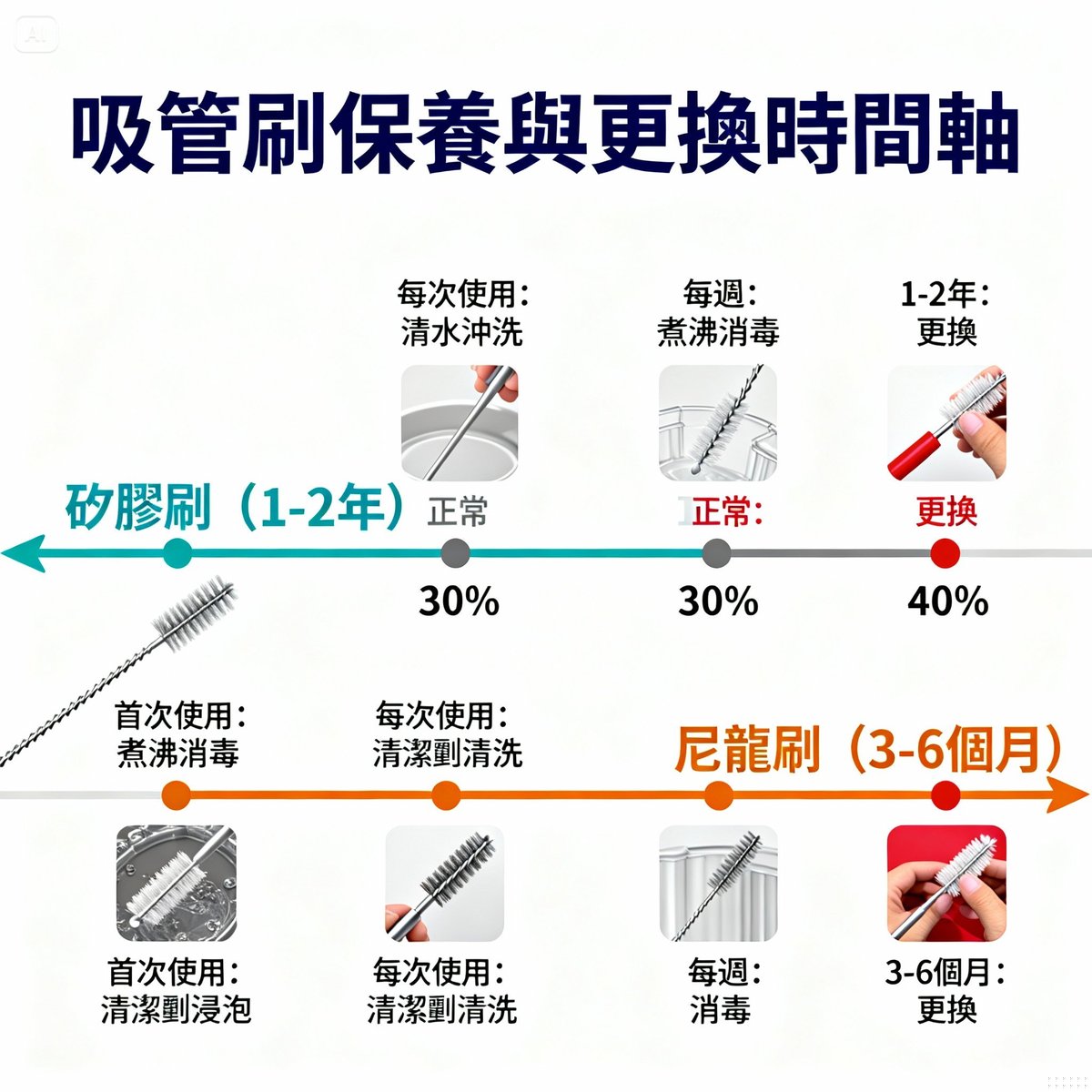
Advice on use and maintenance
Tips for using a silicone brush:
-
First use:
- Boil in hot water for 3-5 minutes to disinfect
- Rinse thoroughly before use
-
Everyday cleaning:
- Rinse with clean water for 10-20 seconds after use
- Shake off the water
- Hang to dry with the brush head downward
-
Deep cleaning (once a week):
- Disinfect by boiling for 3-5 minutes
- Or soak in diluted bleach for 5 minutes
- Rinse thoroughly
-
Things to avoid:
- Do not let it touch sharp objects (it will be cut)
- Do not leave it in the sun for long (it will age)
- Do not clean the silicone brush itself with a wire brush
Tips for using a nylon brush:
-
First use:
- Soak in a cleaning agent for 5 minutes
- Rinse thoroughly (to remove manufacturing residue)
-
Everyday cleaning:
- Rinse immediately after use
- Soak in a cleaning agent for 2-3 minutes
- Rinse thoroughly until no foam remains
- Shake off the water and hang with the brush head downward
-
Deep cleaning (once a week):
- Soak in a cleaning agent for 10-15 minutes
- Or disinfect with diluted bleach for 5 minutes
- Rinse thoroughly
-
Things to avoid:
- Do not exceed the heat-resistance temperature on the product label
- Do not twist it with too much force
- Do not leave it soaking in water for a long time
Judging when to replace
When to replace a silicone brush:
- ✓ The bristles are torn or broken
- ✓ The bristles have lost their elasticity (they do not spring back when pressed)
- ✓ Mold or an odor has appeared
- ✓ It has been used for more than 2 years
When to replace a nylon brush:
- ✓ More than 10% of the filament has fallen out
- ✓ The filament is clearly deformed or bent
- ✓ Mold or an odor has appeared
- ✓ The cleaning result has clearly dropped
- ✓ It has been used for more than 6 months (cheap models) or 12 months (branded models)
Custom service
YC Brushes offers a professional custom service.
What can be customized:
-
Choice of material:
- Food-grade silicone (different hardnesses)
- PA6/PA66 nylon (different stiffnesses)
- Natural hog bristle
- Stainless steel wire
-
Custom sizes:
- Diameter: 0.3-5.0 cm
- Length: 10-100 cm
- Filament density: adjustable
-
Special requirements:
- Printed brand logo
- Custom packaging
- Specified brand colors
- Mixed materials (silicone + nylon)
Where it applies:
- Special straw specifications in food service
- Cleaning the tubes of industrial equipment
- Cleaning medical devices (must meet medical-grade standards)
- Branded orders (printed logo, custom packaging)
Need custom straw brushes? Contact YC Brushes now for free sample testing and professional consultation. Or see our full range of services.
FAQ
Are silicone straw brushes really better?
A silicone straw brush is not better in absolute terms; it depends on your needs.
The clear advantages of a silicone brush:
- ✓ Does not scratch at all (suited to stainless steel and glass)
- ✓ Can be disinfected by boiling (essential for baby products)
- ✓ Extremely durable (1-2 years)
- ✓ Easy to clean (a rinse is enough)
The weaknesses of a silicone brush:
- ✗ Weaker cleaning power
- ✗ Higher price
When to choose a silicone brush?
- You use reusable stainless steel / glass straws
- You clean baby products
- You value durability
- You have an ample budget and can accept a mid-to-high price
When to choose a nylon brush?
- You clean plastic straws
- You need fast cleaning
- You have a limited budget and prefer a budget price
- You are dealing with stubborn stains
For detailed recommendations, see Straw brush recommendations 2026 | 9 straw brushes reviewed, with buying criteria.
Will a nylon straw brush scratch a stainless steel straw?
Yes, a nylon brush really can scratch a stainless steel straw.
How the scratching happens:
- Although nylon is softer than stainless steel, it may still cause fine scratches
- If hard impurities are mixed into the filament, scratching is more likely
- Scrubbing with too much force increases the risk of scratching
YC Brushes experimental data:
- Poor-quality nylon brush: scratches appeared after 100 scrubs
- Good-quality nylon brush: slight scratches appeared after 500 scrubs
- Silicone brush: no scratches after 10,000 scrubs
The effects of scratches:
- They trap dirt (hard to clean)
- They damage the protective layer (rust forms easily)
- They spoil the appearance
Advice:
- Always use a silicone brush for stainless steel straws
- If you only have a nylon brush, choose a soft one
- Do not scrub with too much force
Is the cleaning power of a silicone straw brush really that weak?
The cleaning power of a silicone brush is indeed not as good as a nylon brush, but it is not "very weak".
Actual cleaning results:
- Ordinary dirt: a good cleaning result (1-2 passes are enough)
- Tea and coffee stains: 3-5 passes needed
- Stubborn dried-on stains: not enough cleaning power
How to improve the cleaning power of a silicone brush?
- Use a cleaning agent: soak for 5-10 minutes to soften the dirt
- Apply moderate pressure: use appropriate force when scrubbing
- Scrub repeatedly: a few more passes will get it clean
- Clean with warm water: warm water improves stain removal
Value-for-money analysis:
- It takes a few more passes, but it does not harm the straw
- It is the better deal over the long term (a life of 1-2 years)
- It avoids the problem of scratches that make cleaning difficult later
Conclusion: the cleaning power of a silicone brush is weaker, but with the right method it still cleans effectively.
Can a silicone brush and a nylon brush be used together?
Yes, and this is in fact the ideal combination!
The advantages of a two-brush combination:
The silicone brush takes care of:
- Everyday cleaning of stainless steel / glass straws
- Gentle cleaning that does not harm the material
- Keeping the surface of the straw smooth
The nylon brush takes care of:
- Stubborn stains
- Cleaning plastic straws
- Fast deep cleaning
Examples of use:
- Everyday cleaning of a stainless steel straw → silicone brush
- A stainless steel straw with stubborn tea stains → one pass with the nylon brush first, then the silicone brush
- Plastic straws → nylon brush
Recommended combination:
- Silicone straw brush set of 2
- 1 set of nylon straw brushes
- Total budget: a mid-range budget is enough to get the two-brush combination
Where can I buy a good-quality silicone straw brush?
Places to buy a good silicone straw brush in Taiwan.
Physical stores:
- POYA: many branded models
- Cosmed, Watsons: the baby products section
- MUJI: the assurance of Japanese quality
- Working House: imported brands
Online platforms:
- momo: many official brand flagship stores
- PChome: convenient 24h delivery
- Shopee: the most choice, but read the reviews carefully
Things to watch when buying:
- Check the material labeling: compliance with FDA food-contact regulations, with an SGS test report
- Look at the reviews: 4.5 stars or above and 200+ reviews
- Real photos: listings with buyers' own photos are more reliable
- A reasonable price: mid-to-high is the reasonable range; too cheap may mean poor quality
For a detailed buying guide, see Where to buy straw brushes? The latest 2026 comparison of places to buy and prices.
What should a business do if it needs silicone or nylon straw brushes in volume?
For volume purchasing, we suggest that a business order directly from a factory.
Advantages of buying factory-direct:
- ✓ Wholesale prices (30-50% less than retail)
- ✓ Material and size can be customized
- ✓ Stable supply
- ✓ Industrial-grade quality
YC Brushes plans for businesses:
- Silicone brushes: hardness and size made to order; order quantities and lead times are quoted per specification (email us)
- Nylon brushes: quantities quoted per specification, with quality assured by the twisted-wire fixing method
- Free services: sample testing, material consultation
- Custom work: printed logo, special specifications
Industries served:
- Drinks shops and cafes (a large need for straw brushes)
- Cleaning companies (needs in many specifications)
- Schools and kindergartens (food-grade silicone brushes)
- Medical institutions (medical-grade standards)
Contact YC Brushes now for a wholesale quote for businesses and free sample testing.
Conclusion: choose the right material to protect your straw and save money
Silicone and nylon each have advantages and disadvantages. Neither is better in absolute terms; what matters is choosing the material that suits.
Quick decision guide:
Should I choose a silicone brush?
- ✓ You use reusable stainless steel / glass straws
- ✓ You clean baby bottle straws
- ✓ You value durability (1-2 years)
- ✓ You need to disinfect by boiling
- ✓ You have an ample budget (can accept a mid-to-high price)
Should I choose a nylon brush?
- ✓ You clean plastic straws
- ✓ You need fast cleaning
- ✓ You are dealing with stubborn stains
- ✓ You have a limited budget (prefer a budget price)
- ✓ You do not mind replacing it regularly (every 3-6 months)
The best solution: buy both!
- Silicone brush: everyday cleaning of stainless steel / glass straws
- Nylon brush: stubborn stains and cleaning plastic straws
- Total budget: mid-range is enough
Professional advice from YC Brushes: From a manufacturer's point of view, we suggest that users of reusable straws choose a silicone brush first, to avoid the long-term problems caused by scratching. If you have special requirements or need to buy in volume, you are welcome to contact us for custom service.
Need professional consultation or custom service? Contact YC Brushes now: with over 40 years of manufacturing experience, we offer free material advice. Or see the full product range.
Want to learn more about cleaning brushes? Go back to The complete cleaning brush buying guide, or go to the blog to explore more specialist articles.