Introduction: why is ceiling cleaning such a headache?
You look up and see cobwebs hanging in the corner of the ceiling.
You want to clean them, but the ladder is too short. You stretch up on tiptoe and worry about falling.
In the end you give up: out of sight, out of mind.
This is the reality of ceiling cleaning for many people. The ceiling is the part of the home most easily overlooked when cleaning, not because people do not want to clean it, but because it is too difficult and too risky.
The good news is that with the right tool and the right method, ceiling cleaning can actually be simple.
This article shares the complete technique for cleaning a ceiling with a long-handle brush, from choosing the tool and the cleaning steps to safety precautions, so that you can clean high places easily while standing on the floor, with no ladder and no risk.

Why is ceiling cleaning so difficult?
The difficulty of ceiling cleaning comes from three core problems.
The height problem
Ceilings in ordinary homes are all higher than you can reach.
Standing on the floor, your arm reaches 2 meters at most, nowhere near the ceiling.
The traditional solution is to climb a ladder, but that brings another problem.
Safety risk
Among accidents in the home, falls have always been one of the largest categories, and cleaning a ceiling, which requires standing on something, sits squarely in this risk zone.
When you stand on a chair or ladder to clean something high up, the common dangers include:
- Missing a step and falling
- An unstable ladder tipping over
- Reaching too far and losing balance
These are all dangers that really happen.
The wrong tools
Many people use a short-handled mop or broom to clean the ceiling.
The problems are:
- The handle is too short: you have to climb to reach
- The brush head is too hard: it easily scratches the ceiling finish
- Poor maneuverability: corners and gaps cannot be cleaned
The result is poor cleaning that takes time and effort, and in the end people simply give up.
How does a long-handle brush solve these problems?
The advantages of a long-handle brush for ceilings are very clear:
- Wide reach: with a handle of 120-180 cm, you can clean the whole ceiling standing on the floor
- Safe: no ladder needed, which removes the risk of falling
- Efficient: a large brush head covers the whole ceiling quickly
- Gentle on the surface: soft bristles clean gently and leave no scratches
Choosing a long-handle brush for ceilings
The right tool gets twice the result for half the effort.
A long-handle brush for cleaning ceilings has several key specifications that deserve attention.
Handle length
Handle length is the first factor to consider.
Formula: handle length = ceiling height - shoulder height + 20-30 cm
| Ceiling height | Recommended handle length | Suited to |
|---|---|---|
| 2.4m | 120-140cm | Ordinary homes (body height 160-170cm) |
| 2.7m | 150-170cm | Ordinary homes (body height 160-180cm) |
| 3.0m | 170-200cm | High-rise homes, high-ceilinged spaces |
Note: a handle that is too long makes the brush harder to handle. Choose on the principle of "reaching comfortably" and do not go for extra length.
If your ceiling height varies, consider a telescopic long-handle brush, whose length can be adjusted freely.
Brush head shape
A flat brush head is recommended for ceiling cleaning.
Advantages of a flat brush head
- Large contact area: covers a width of 20-30 cm in one pass
- Even pressure: does not put local pressure on the ceiling
- Suited to flat surfaces: most of a ceiling is flat
Recommended brush head width
- Smaller spaces (living room under 15 ping, a unit of floor area used in Taiwan): 15-20 cm wide
- Larger spaces (living room over 15 ping): 20-30 cm wide
Bristle material
This is where mistakes are made most easily.
Never use a hard brush!
Ceiling surfaces usually carry paint or a coating, and a hard brush scratches them easily.
Recommended materials, ranked
- Wool: the softest, does not harm the ceiling at all and picks up dust well (higher price)
- Hog bristle: good softness, good value for money, cleans well
- Soft nylon: affordable and durable, suited to general cleaning
- Electrostatic dusting fiber: specially treated fiber that attracts dust extremely well
Material comparison chart
| Bristle material | Softness | Dust pickup | Durability | Price | Recommendation |
|---|---|---|---|---|---|
| Wool | ★★★★★ | ★★★★★ | ★★★☆☆ | $$$$$ | ★★★★☆ |
| Hog bristle | ★★★★☆ | ★★★★☆ | ★★★★☆ | $$$$ | ★★★★★ |
| Soft nylon | ★★★☆☆ | ★★★☆☆ | ★★★★★ | $$ | ★★★★☆ |
| Electrostatic fiber | ★★★★☆ | ★★★★★ | ★★★★☆ | $$$ | ★★★★☆ |
Want to know more about choosing brush materials? See How to choose the best materials in brush manufacturing.
Handle material
The handle material affects how the brush feels in use.
Wooden handle
- Pros: comfortable grip, moderate weight
- Cons: may absorb moisture and warp with long-term use
- Suited to: ordinary household use
Aluminum alloy handle
- Pros: lightweight, strong and durable
- Cons: feels cold in the hand, higher price
- Suited to: professional cleaning, frequent use
Fiberglass handle
- Pros: ultra-light, high strength
- Cons: the highest price
- Suited to: long working sessions, professional needs
Other useful accessories
Bendable brush head
The corners where the ceiling meets the walls are where dust builds up most easily.
A bendable brush head can be set at an angle to reach into the corners.
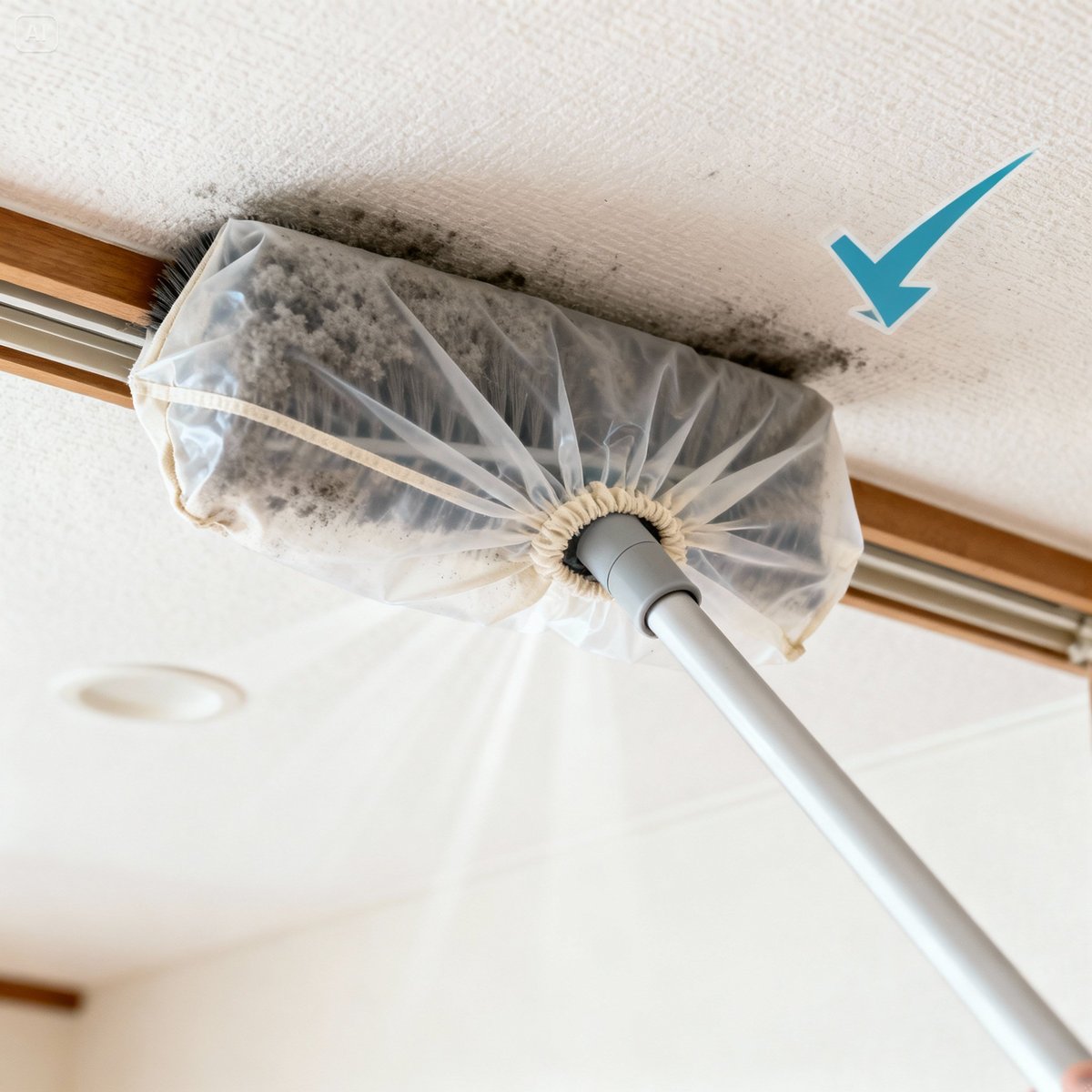
Dust cover
Fitted over the brush head during use, it keeps dust from flying up and falling.
After cleaning, simply throw the dust cover away, and the brush head stays clean.
Bristle density: a key specification that is easily overlooked
Bristle density directly decides how much dust one pass of the brush takes away. Ceiling cleaning is large-area, light-soil work, and a medium-to-high density is recommended.
| Density grade | Proportion | Suitable work |
|---|---|---|
| High density | 80% or more | Precision cleaning, where one pass must do the job |
| Medium density | 60–80% | Ceilings, general household cleaning |
| Low density | 40–60% | Rough work, construction sites |
If the density is too low, dust gets pushed around on the ceiling instead of being carried away, and brush marks are left behind.
Grip design: what makes or breaks overhead work
The biggest difference between cleaning a ceiling and cleaning a floor is that the arms must be held up for a long time. If the grip does not fit the hand, you will not last ten minutes.
- The grip should fit your hand; too thin concentrates the force on the fingers, too thick cannot be held firmly.
- It must be non-slip: hands are often damp with moisture or detergent while cleaning.
- An ergonomic curve is better than a straight pole, as it reduces the twisting load on the wrist when working at an upward angle.
A longer handle is not always better. Too long makes the direction hard to control, takes more strength and makes storage difficult. Choose according to the height you actually need to reach, allowing an extra 30–50 cm.
Cleaning methods for different ceiling materials
Different ceiling materials are cleaned in different ways.
The wrong method may cause permanent damage.
Cement paint ceilings
This is the most common type of ceiling.
Characteristics
- Fine pores in the surface
- Does not stand up to repeated wiping
- Water marks are left easily
Cleaning method
- Dry-brush the dust off: dry-brush with a long-handle brush to remove surface dust
- Avoid wet wiping: cement paint does not tolerate water, and wet wiping easily leaves marks
- Spot treatment: if there is a stain, dab it lightly with a slightly damp cloth; do not rub back and forth
Recommended tools: soft long-handle brush + electrostatic dusting cloth
Latex paint ceilings
Latex paint is more water resistant and can be wiped wet.
Characteristics
- Smooth surface
- Good water resistance
- Washable
Cleaning method
- Dry-brush the dust off: first remove loose dust with a long-handle brush
- Wipe slightly damp: wipe gently with a slightly damp soft brush
- Wipe clean with water: finally wipe once with a clean damp cloth to remove remaining stains
Note: even though it is water resistant, using a lot of water is not recommended, so that moisture does not seep into the ceiling.
Calcium silicate board ceilings
Common in damp environments such as bathrooms and kitchens.
Characteristics
- Good water resistance
- A harder surface
- Can take more vigorous cleaning
Cleaning method
- Dry or wet brushing both work: choose according to how dirty it is
- Detergent can be used: a neutral detergent can be used on stubborn stains
- Dry thoroughly: be sure to wipe dry after cleaning, so that no water marks remain
Recommended tool: a nylon brush of medium hardness
Wooden ceilings
Wooden ceilings need special care.
Characteristics
- Sensitive to water and damp
- Scratch easily
- Need regular maintenance
Cleaning method
- Dry-brush only: never wipe wet
- Brush along the grain: clean in the direction of the wood grain to avoid scratches
- Use ultra-soft bristles: wool or microfiber is recommended
Recommended tool: wool long-handle brush
PVC ceilings
Characteristics
- Water and damp resistant
- Smooth surface
- Easy to clean
Cleaning method
- Dry or wet both work: dry-brush dust, wet-wipe stains
- Avoid scratches: PVC is fairly durable, but a soft brush should still be used
- Wipe regularly: PVC builds up static easily and attracts dust; cleaning once a month is recommended
Cleaning chart by material
| Ceiling material | Wet wiping? | Recommended bristles | Cleaning frequency | Notes |
|---|---|---|---|---|
| Cement paint | ✗ | Soft | Every 2-3 months | Sensitive to water, dry-brush only |
| Latex paint | ✓ (slightly damp) | Soft | Every 2-3 months | Can be wiped slightly damp, must not be soaked |
| Calcium silicate board | ✓ | Medium-hard nylon | Every 1-2 months | Detergent can be used |
| Wood | ✗ | Wool | Every 1 month | Never wipe wet |
| PVC | ✓ | Soft | Every 1 month | Builds up static easily |
Want to look deeper into brush choices for each material? See the brush material selection guide.
Steps for cleaning a ceiling with a long-handle brush (illustrated tutorial)
With the right steps, cleaning becomes more efficient.
Below is the 3-step cleaning method.
Step 1: Clear the space
Purpose: to keep dust from falling on the furniture
What to do
- Move the furniture under the ceiling (sofa, table, cabinets)
- If it cannot be moved, cover it with old bed sheets or newspaper
- Open the windows and keep the room ventilated
Time: 5-10 minutes
Tip: if the space is too large to clear completely, work in sections and clean one area at a time.
Step 2: Prepare tools and protection
Tools needed
- Long-handle brush (handle 120-180cm, soft flat brush head)
- Dust mask
- Safety goggles (optional, but recommended)
- Old clothes (dust will fall on you)
- Vacuum cleaner or broom (to clear up the fallen dust)
Protective measures
- Wear a dust mask to avoid inhaling dust
- Wear safety goggles, or at least have a damp towel ready, so that dust falling into the eyes can be dealt with at once
- Wear old clothes that can get dirty
Step 3: Dry-brush from the outside in
This is the most critical step.
Cleaning sequence
- Start from the corners: the junction of ceiling and wall collects dust most easily
- Advance in order: clean from the far end of the room toward the door
- From the outside in: work from the edges toward the center to avoid cleaning the same area twice
Technique
- Glide gently: do not press hard; let the bristles touch the ceiling naturally
- Keep a rhythm: a steady speed, not alternating between fast and slow
- Overlap the strokes: overlap each stroke with the previous one by 5-10 cm so that nothing is missed
Posture
- Stand firmly with feet shoulder-width apart
- Raise the arms naturally and do not overstretch
- Move position when needed; do not strain to reach
🚀 Need professional ceiling cleaning tools?
YC Brushes long-handle brushes for ceiling cleaning
Contact YC Brushes now and let over 40 years of manufacturing experience provide you with the most suitable ceiling cleaning tool: safe, efficient, and high-level cleaning made easy.
Safety precautions
Safety always comes first.
Even though a long-handle brush needs no ladder, there are still some safety details to watch.
Checks before use
Check the brush
- Whether the handle has cracks
- Whether the brush head is firmly attached
- Whether the telescopic mechanism is properly locked (if a telescopic brush is used)
Check the surroundings
- Whether the floor is level and dry (to avoid slipping)
- Whether there is a ceiling fan or pendant lamp overhead (to avoid hitting it)
- Whether there is exposed wiring on the ceiling (to avoid electric shock)
During operation
Correct posture
- Stand firmly with feet shoulder-width apart
- Do not stand on tiptoe or overstretch
- Move position when needed; do not strain
Controlling the force
- A gentle glide is enough; do not press hard
- Avoid bending and deforming the handle
- If it feels like hard work, stop at once and check your posture
Protective measures
- A dust mask must be worn
- Safety goggles are recommended
- Wear old clothes
Dealing with special situations
Dust falls into the eyes
- Stop cleaning at once
- Do not rub the eyes
- Rinse with plenty of clean water
- If discomfort continues, see a doctor
The handle breaks
- Discard it at once and do not keep using it
- A broken handle may injure someone
- Choosing a manufacturer with reliable quality is important
Touching wiring
- If you find exposed wiring on the ceiling, stop cleaning
- Contact a professional electrician
- Never clean an area with wiring using a long-handle brush with a metal handle
When a long-handle brush is not suitable
The ceiling is too high
- If the ceiling is higher than 3.5 meters, it is hard to apply force even with a long-handle brush
- A professional cleaning company is recommended
Special ceilings
- Ceilings with decorative paint finishes
- Wallpapered ceilings
- Old ceilings that flake easily
In these cases we recommend consulting a professional.
FAQ
How often should a ceiling be cleaned?
Recommended frequency
- Ordinary homes: once every 2-3 months
- Dust-prone environments (near a road or a construction area): once every 1 month
- Households with allergies: once every 1 month
- Damp environments (prone to mold): once every 1 month, with particular attention to mold spots
Judging whether cleaning is needed
Shine a flashlight across the ceiling at an angle. If you see a clear layer of dust or cobwebs, it is time to clean.
Will a long-handle brush scratch the ceiling?
Not if the right bristle material is chosen.
Safe materials
- Wool: does not scratch at all
- Hog bristle: does not scratch in normal use
- Soft nylon: does not scratch when used correctly
Risky materials
- Hard nylon: may scratch
- Wire brush: will certainly scratch
How to test
Test first in an inconspicuous corner: brush lightly a few times and check for scratches.
YC Brushes offers free sample testing, so you can confirm with confidence that the ceiling will not be harmed.
Can a vacuum cleaner be used instead of a long-handle brush?
Yes, but with limitations.
Advantages of a vacuum cleaner
- Dust does not fall
- Cleaning is more thorough
Disadvantages of a vacuum cleaner
- The power cord has to be pulled along, so moving around is inconvenient
- The nozzle may scratch the ceiling
- Corners and gaps cannot be cleaned
- It is heavy, and holding it up for long is tiring
Recommended approach
Dry-brush with a long-handle brush first, then vacuum up the dust that has been brushed down.
Used together, the two give the best result.
What should I do about mold spots on the ceiling?
Mold spots need special treatment.
Steps
- Dry-brush to remove surface mold
- Spray with diluted bleach (diluted 1:10)
- Leave for 10 minutes
- Wipe with a damp cloth
- Dry thoroughly
Precautions
- Confirm that the ceiling material tolerates water and bleach
- Wear gloves and a mask to avoid harm from the bleach
- Keep the room ventilated
The root solution
Mold spots are usually a damp problem, which calls for:
- Improving ventilation
- Using a dehumidifier
- Checking for leaks
How should a long-handle brush be cared for after cleaning?
With correct care, the brush will last noticeably longer.
Cleaning
- Take it outdoors and shake off the dust
- If washing is needed, rinse the bristles with clean water
- Shake off the water
- Hang to dry with the bristles facing down
Storage
- Store hanging, so the bristles do not deform
- Store in a dry place
- Avoid heavy pressure
Regular checks
- Check the handle and brush head before each use
- If the bristles are shedding heavily, replace the brush at once
Is detergent needed to clean a ceiling?
In most cases, no.
When dry brushing is enough
- Simple dust build-up
- Cement paint ceilings
- Wooden ceilings
When detergent is needed
- Cooking grease stains (kitchen ceilings)
- Mold spots
- Other stubborn stains
Recommended cleaners
- Neutral detergent (used diluted)
- Baking soda solution (the environmentally friendly choice)
- Diluted bleach (for mold spots only)
How to use
- Spray the cleaner on a cloth, not directly on the ceiling
- Wipe the stain gently
- Wipe with clean water to remove residue
- Dry thoroughly
What should I do if dust keeps falling while I clean?
This is normal, but it can be reduced.
Ways to reduce falling dust
- Use an electrostatic dusting cloth: fitted over the brush head, it attracts the dust
- Dampen the brush: with slightly damp bristles (water-resistant ceilings only), dust does not fly up easily
- Slow down: brush slowly to raise less dust
- Clean in stages: clean a small area at a time to reduce the total amount of dust
Protective measures
- Wear a mask and safety goggles
- Cover the furniture with old bed sheets
- Open the windows for ventilation
Further reading
Want to know more about the uses of long-handle brushes and techniques for them? We recommend the following articles:
- Recommended long-handle car wash brushes - how to choose a car wash brush that does not harm the paintwork
- A complete review of telescopic long-handle brushes - the pros and cons of telescopic brushes on the market compared
Need professional cleaning tools? See the full YC Brushes product catalog, or contact us now for professional advice.