Electric car wash brushes save effort, but there are also concerns about them scratching the paint. Are they worth buying or not? Today we use YC Brushes' own test data to give you a complete analysis!
Introduction: why are electric car wash brushes so popular?
Electric car wash brushes have been a hot topic among car washing tools in recent years, with common questions such as "Is an electric car wash brush worth buying?" and "Will an electric brush scratch the paint?"
Electric brushes do have their appeal: a rotating head, less effort and time, and high cleaning efficiency. But they are not cheap, and the high-speed rotating head carries a risk of scratching the paint.
YC Brushes has been making brushes for more than 40 years. Today we combine our own test data to analyze the 5 main advantages vs the 5 main disadvantages of electric brushes, to help you make the wisest choice. The NT$ prices describe the market in Taiwan.
Want to know more about the types of car wash brush? See "The Complete Car Wash Brush Buying Guide 2026 | Types Compared, Recommended Brands, Tips to Avoid Damaging Your Car".
1. How an electric car wash brush works
First, how an electric brush operates.
Basic construction
An electric car wash brush has four main parts:
1. Motor (the core component)
A built-in DC motor spins the brush head. The rotation speed varies by model; go by the brand's official specifications.
The higher the speed, the stronger the cleaning power, but the higher the risk to the paint as well.
2. Replaceable brush heads
Electric brushes usually come with several heads:
- Soft-bristle head (for the body)
- Sponge head (for windows)
- Stiff-bristle head (for wheel rims)
- Detail head (for gaps)
The heads can be removed and swapped to suit the part being washed.
3. Waterproof body
An electric brush needs a waterproof design to keep water from entering and damaging the motor. The waterproof rating is marked as IPX; common examples:
IPX4: splash-proof (basic protection) IPX7: immersion-proof (can be immersed for a short time)
Confirm the waterproof rating when buying, to avoid ending up with a model that is not waterproof.
4. Grip and battery
- Corded models: need a power cord; no limit on running time, but inconvenient to use.
- Cordless models: a built-in lithium battery; convenient to use but need charging, and the running time and charging time vary by model.
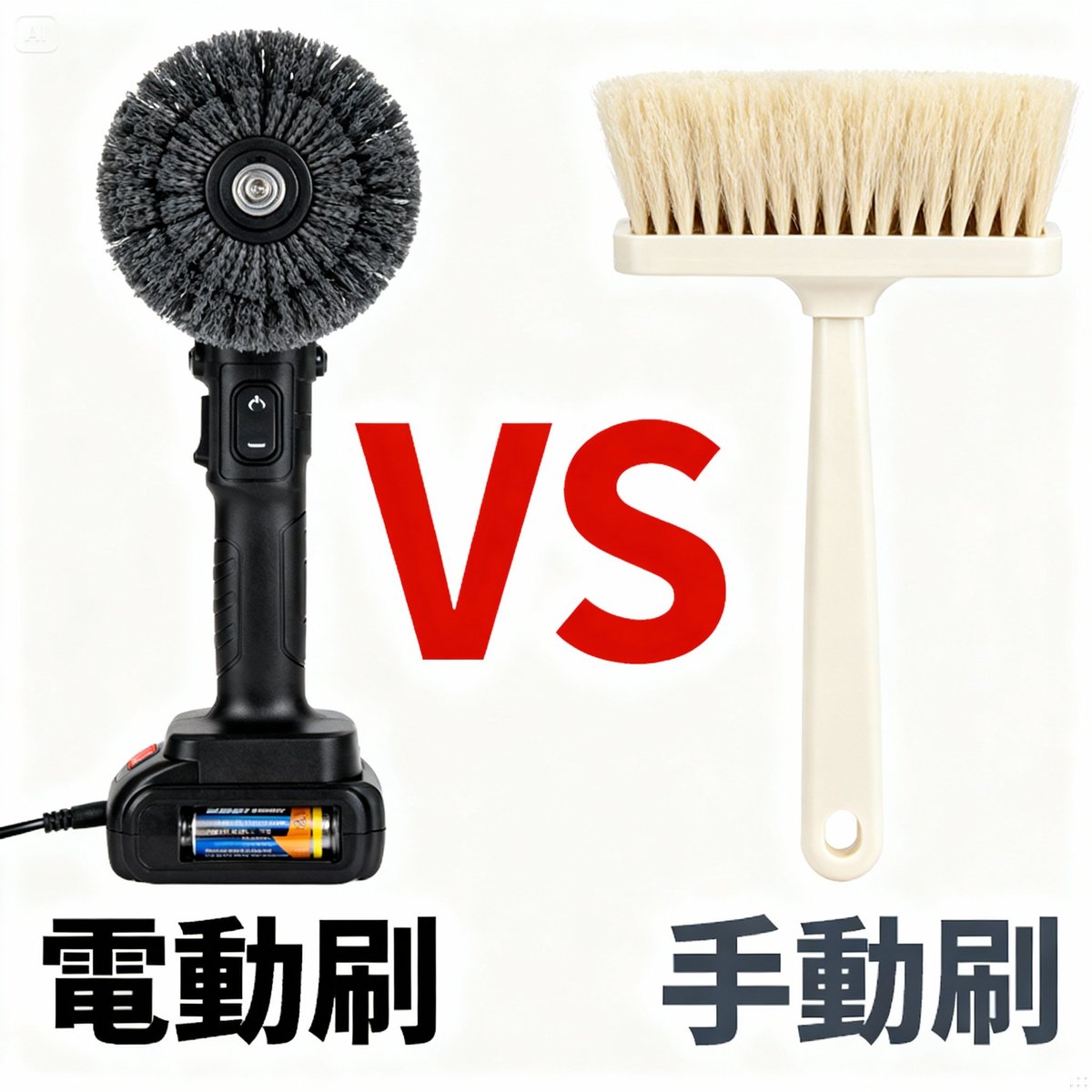
Differences from a manual brush
| Item | Electric brush | Manual brush |
|---|---|---|
| Cleaning method | Motor-driven rotation | Scrubbing back and forth by hand |
| Cleaning efficiency | High (saves effort and time) | Medium |
| Cleaning power | Strong (rotation carries the dirt away) | Medium to strong (depends on technique) |
| Risk to the paint | High (high-speed rotation scratches easily) | Low (when used correctly) |
| Price | Higher | Lower |
| Weight | Heavier (includes motor and battery) | Lighter |
| Running time | Limited (needs charging) | Unlimited (no charging) |
| Detail work | Poor (large head) | Good (reaches into gaps) |
| Consumables cost | High | Low |
Conclusion:
An electric brush is clearly better than a manual brush on "efficiency" and "effort", but a manual brush is better on "safety", "detail work" and "price".
Want more brand comparisons? See "Top 10 Car Wash Brush Recommendations 2026 | A Complete Review of YC Brushes, 3M, Chemical Guys and Other Brands".
2. The 5 main advantages in depth
Electric brushes do have attractive advantages.
Advantage 1: Saves effort and time, about 40-50% more efficient
This is the biggest advantage of an electric brush!
YC Brushes test data:
Washing a standard sedan (Toyota Altis):
- Manual brush: 40-45 minutes
- Electric brush: 25-30 minutes
- About 40-50% more efficient
If you wash your car once a week, you save about 13 hours a year!
Who it suits:
- Frequent washing (2 or more times a week)
- Owners who find washing physically demanding, and older owners
- People who wash several vehicles (fleets, car washes)
Advantage 2: Strong cleaning power that removes even stubborn dirt
The rotating head carries dirt away quickly, and the cleaning power is clearly better than that of a manual brush.
When it fits:
- The car is often very dirty (frequently driven in the countryside or on construction sites)
- Stubborn dirt needs removing (a lot of bird droppings and tree sap)
- Wheel rims need a lot of cleaning
Advantage 3: Suits large vehicles and frequent washing
Large vehicles (SUVs, tour buses, vans) have a large surface area. A manual brush is tiring, and an electric brush saves a lot of effort.
For owners who wash frequently, the return on an electric brush is higher.
Want to know about brushes made for large vehicles? See "Long-Handle Car Wash Brush Recommendations 2025 | A Buying Guide to Cleaning Tools for Tour Buses and Large Vehicles".
Advantage 4: Many uses
An electric brush is not only for washing cars. It can also be used for:
1. Washing scooters and motorcycles
Scooters and motorcycles are small with many gaps, and the rotating head of an electric brush works well on them.
2. Household cleaning
- Bathroom wall tiles and floor tiles
- Window glass
- Kitchen grease
3. Outdoor cleaning
- Balcony floors
- Garden walls
- Camping equipment
Value for money:
If you use an electric brush for several kinds of cleaning, the value for money goes up. If you only use it to wash the car, the value for money is lower.
Advantage 5: Fun to use, with a high-tech feel
This advantage is more subjective: if you like new technology products, an electric brush really is more fun than a manual brush.
3. The 5 main disadvantages in depth
The disadvantages of electric brushes are just as clear.
Disadvantage 1: Expensive, with a high initial outlay
This is the biggest disadvantage!
Besides a higher purchase price, an electric brush needs its heads replaced regularly, so its long-term total cost is clearly higher than that of a manual brush.
YC Brushes recommends:
If you do not wash your car frequently (2 or more times a week), a manual brush is better value for money.
The YC Brushes soft-bristle brush costs NT$350, cleans well and does not harm the car, and its 3-year total cost is only NT$1,430.
See YC Brushes manual brushes, the best choice for value for money!
Disadvantage 2: Heavy, so your arm tires during long use
With a built-in motor and battery, an electric brush is heavier overall than a manual brush, and holding it up for a long time easily tires your arm.
YC Brushes recommends:
If you are worried about weight, choose a lightweight manual brush.
The YC Brushes long-handle telescopic brush has an aluminum alloy handle and weighs only 950g at a length of 200cm, lighter than most electric brushes and less effort to use.
Disadvantage 3: Needs charging, with limited running time
A cordless electric brush needs charging, and its running time is limited. The running time and charging time vary by model: check the brand's official specifications before buying, and remember to charge it fully before washing.
YC Brushes recommends:
A manual brush needs no charging. You can wash whenever you want, with no running-time problem.
Disadvantage 4: Poor at detail work
The head of an electric brush is fairly large and cannot reach into small gaps.
Areas it cannot clean:
- The gaps around the window frames
- The underside of the side mirrors
- The gaps around the door handles
- Wheel rim details
- Air vents
YC Brushes recommends:
Even if you buy an electric brush, you still need a manual detail brush.
The YC Brushes 3-piece detail brush set costs NT$220 and cleans every detail area. An electric brush cannot replace it.
Buy the YC Brushes 3-piece detail brush set, the best partner for an electric brush!
Disadvantage 5: A higher risk to the paint
This is the most serious disadvantage!
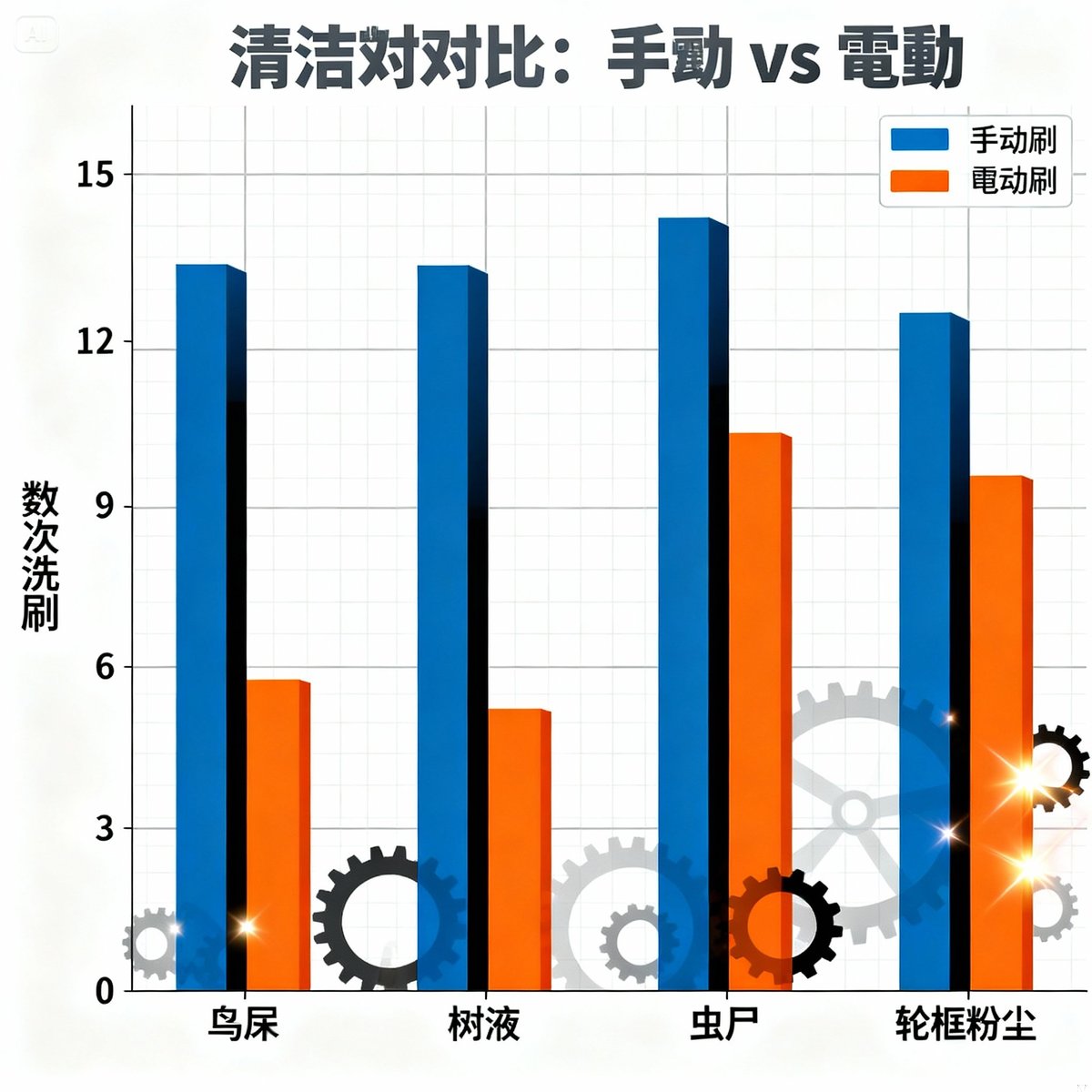
The high-speed rotation of an electric brush tends to leave swirl marks and fine scratches.
YC Brushes paint test data:
Conditions: rinsing first, correct technique
| Brush type | Number of scratches (per 10cm²) | Depth of deepest scratch (microns) | Safety rating |
|---|---|---|---|
| Manual wool brush | 2-5 | 0.5 | ⭐⭐⭐⭐⭐ |
| Manual soft nylon brush | 5-10 | 1.0 | ⭐⭐⭐⭐ |
| Electric brush (soft head) | 15-25 | 2.5 | ⭐⭐⭐ |
| Electric brush (hard head) | 30-50 | 4.0 | ⭐⭐ |
Conclusion:
An electric brush leaves 3-5 times as many scratches as a manual brush, and its deepest scratch is 4-8 times as deep! On dark-colored cars (black, dark blue), the fine scratches are even more obvious.
How to lower the risk:
- Always rinse before washing (to remove the grit)
- Choose a soft brush head (sponge or soft bristles)
- Do not press hard; light contact is enough
- Avoid staying in one spot for too long
But even if you do all four, the risk to the paint is still higher than with a manual brush.
Want to know how to avoid scratches? See "Will a Car Wash Brush Damage Your Car? A Professional Analysis + 5 Key Tips to Avoid Scratches".
💡 Worried about an electric brush scratching your paint? Consider a safe manual brush!
Contact YC Brushes and let a professional team with over 40 years of manufacturing experience recommend the safest car wash brush for you: gentle on the car and good value for money!
4. Overall conclusion: who should buy an electric brush?
Who an electric brush suits:
✅ Frequent washing (2 or more times a week) ✅ Large vehicles, SUVs, tour buses ✅ People who find washing physically demanding, and older people ✅ People who do not mind fine scratches much ✅ People who will use it for several kinds of cleaning (not just the car)
Who should not buy an electric brush:
❌ Occasional washing (once every 1-2 weeks) ❌ Premium cars, dark-colored cars ❌ High demands on paint protection ❌ Limited budgets ❌ Only for washing the car
YC Brushes recommends:
For most car owners, a manual brush is enough.
The YC Brushes soft-bristle brush costs NT$350, cleans well, does not harm the car and is good value for money, with a 3-year total cost of only NT$1,430, clearly lower than that of an electric brush.
Only owners who wash frequently, have large vehicles or find washing physically demanding will find an electric brush worth the investment.
5. Purchase decision flowchart
A flowchart to help you decide quickly whether to buy an electric brush.
The decision process
Question 1: How often do you wash your car?
- 2 or more times a week → Question 2
- Once a week or less → An electric brush is not recommended (a manual brush is better value for money)
Question 2: What type of vehicle do you have?
- Large SUV, tour bus, van → Question 3
- Ordinary sedan, small car → An electric brush is not recommended (a manual brush is enough)
Question 3: Do you mind fine scratches in the paint?
- Not much → Question 4
- Very much → An electric brush is not recommended (high risk to the paint)
Question 4: Is your budget enough for a branded electric brush with a warranty?
- Yes → An electric brush is worth considering
- No → An electric brush is not recommended (low-priced models are poor quality and high risk)
Quick decision table
| Your situation | Recommendation | Reason |
|---|---|---|
| Occasional washing (once every 1-2 weeks) | ❌ Do not buy an electric brush | Poor value for money; a manual brush is enough |
| Ordinary sedan | ❌ Do not buy an electric brush | A manual brush is efficient enough and safer |
| Premium car, dark-colored car | ❌ Do not buy an electric brush | High risk to the paint |
| Limited budget | ❌ Do not buy an electric brush | Low-priced models are poor quality |
| Large vehicle + frequent washing | ✅ An electric brush is worth considering | A clear gain in efficiency |
| Physically demanding + comfortable budget | ✅ An electric brush is worth considering | Saves effort well |
| Cleaning needs of several kinds | ✅ An electric brush is worth considering | Better value for money |
YC Brushes recommends:
An electric brush is only worth buying if you meet the following conditions:
- Frequent washing (2 or more times a week)
- A large vehicle or several vehicles
- You do not mind fine scratches much
- A comfortable budget
- You will use it for several kinds of cleaning
If you do not meet these conditions, a manual brush is the better choice.
6. Buying tips: which electric brushes not to buy
Brands and models of electric brushes on the market change quickly. When buying, go by the rotation speed, running time and waterproof rating stated on the brand's official website or the retailer's product page; the kind below is not recommended.
Avoid: ultra-cheap models of unknown origin
Why not?
❌ Specifications and quality are hard to confirm ❌ The waterproof rating is not stated or cannot be verified, with a risk of water getting in and electric leakage ❌ The bristle material is unknown and may scratch the paint ❌ No warranty, no after-sales service
YC Brushes recommends:
If your budget is limited, you are better off buying a YC Brushes manual brush at NT$350: good quality, safe and good value for money.
Do not buy a low-priced electric brush to save money. The risk is high!
7. Professional advice from YC Brushes: the best car washing setup
The best advice for each situation.
The role of an electric brush: an aid, not a complete replacement
An electric brush cannot do everything. Its role is to be "an aid", not "a complete replacement" for a manual brush.
The best setup: an electric main brush + YC Brushes manual detail brushes
- Electric brush: for washing the large areas of the body (less effort, more efficient)
- Manual detail brush: for gaps and details (which an electric brush cannot reach)
YC Brushes recommends:
Even if you buy an electric brush, always pair it with a manual detail brush.
Buy the YC Brushes 3-piece detail brush set for only NT$220, the best partner for an electric brush!
Value for money: worth the investment for frequent washing, a manual brush for occasional washing
Situation 1: Frequent washing (2 or more times a week)
An electric brush is worth the investment:
- Time saved: about 13 hours a year
- Efficiency gain: 40-50%
Situation 2: Occasional washing (once every 1-2 weeks)
A manual brush is better value:
- 3-year total cost: NT$1,430 (YC Brushes soft-bristle brush)
- Cleaning power: not much different from an electric brush
- Safety: much higher than an electric brush
3-year total cost of YC Brushes manual brushes:
| Option | Purchase cost | Consumables cost | Total cost | Value-for-money rating |
|---|---|---|---|---|
| YC Brushes soft-bristle brush | NT$350 | NT$1,080 | NT$1,430 | ⭐⭐⭐⭐⭐ |
| YC Brushes long-handle brush | NT$680 | NT$1,080 | NT$1,760 | ⭐⭐⭐⭐⭐ |
Conclusion:
Manual brushes (YC Brushes) are far better value for money than electric brushes!
YC Brushes manual brush alternatives (strongly recommended)
Option 1: Standard set for ordinary car owners (NT$570)
- YC Brushes soft-bristle body brush (NT$350)
- YC Brushes 3-piece detail brush set (NT$220)
Advantages: ✅ The best value for money ✅ Safe and gentle on the car (only 5-10 scratches per 10cm²) ✅ Strong cleaning power (close to an electric brush) ✅ No charging needed ✅ Lightweight (only 350g)
Option 2: Set for SUV owners (NT$900)
- YC Brushes long-handle telescopic brush (NT$680)
- YC Brushes 3-piece detail brush set (NT$220)
Advantages: ✅ Suits large vehicles ✅ Saves effort (no ladder climbing) ✅ Lighter than most electric brushes (only 950g)
Option 3: Complete set (NT$1,250)
- YC Brushes soft-bristle body brush (NT$350)
- YC Brushes long-handle telescopic brush (NT$680)
- YC Brushes 3-piece detail brush set (NT$220)
Advantages: ✅ Covers every washing need ✅ Safer and more durable
Why is a YC Brushes manual brush the better choice?
- Cheaper: a 3-year total cost of NT$1,430, far lower than an electric brush
- Safer: only 5-10 scratches vs 15-50 for an electric brush
- No charging needed: wash whenever you want
- Lighter: only 350g, lighter than most electric brushes
- Good at detail work: reaches into gaps
- Highly durable: 12-18 months vs an electric brush that breaks down easily
See the YC Brushes manual brush options, the safest choice and the best value for money!
FAQ
Is an electric car wash brush worth buying?
It depends on your needs.
It is worth buying if you meet the following conditions:
- Frequent washing (2 or more times a week)
- A large vehicle or several vehicles
- You do not mind fine scratches much
- A comfortable budget
If you do not meet these conditions, a manual brush (the YC Brushes soft-bristle brush at NT$350) is better value.
Will an electric brush scratch the paint?
Yes, and the risk is higher than with a manual brush!
YC Brushes tests show that an electric brush leaves 3-5 times as many scratches as a manual brush.
On dark-colored cars in particular (black, dark blue), the swirl marks are very obvious.
Which brand of electric brush do you recommend?
Brands and models on the market change quickly, so this article does not recommend specific models. When buying, go by the rotation speed, running time and waterproof rating stated on the brand's official website or the retailer's product page, and avoid ultra-cheap models of unknown origin with unclear specifications.
For a detailed brand comparison, see "Top 10 Car Wash Brush Recommendations 2026 | A Complete Review of YC Brushes, 3M, Chemical Guys and Other Brands".
Which is better, an electric brush or a manual brush?
Each has pros and cons:
Electric brush advantages: less effort, efficient, strong cleaning power Electric brush disadvantages: expensive, heavy, high risk to the paint, needs charging, poor at detail work
Manual brush advantages: cheap, light, safe, no charging needed, good at detail work Manual brush disadvantages: has to be scrubbed by hand, less efficient
For most car owners, a manual brush is enough.
Is an electric brush good for cleaning wheel rims?
Yes! This is the biggest advantage of an electric brush.
The rotating head removes brake dust from wheel rims with less effort than a manual brush.
But buying an electric brush just to clean the wheel rims is not good value. A dedicated wheel rim brush will do.
Does an electric brush need maintenance?
Yes!
- Rinse the brush head thoroughly after use (to remove the grit)
- Wipe the body with a dry cloth (to avoid standing water)
- Check the brush head regularly for wear (replace it when the bristles are deformed or falling out)
- Look after the battery (do not wait until it is completely flat before charging)
- Store it in a dry place (away from damp)
Poor maintenance leads to breakdowns easily, and repairs are expensive.
I have already bought an electric brush. How do I lower the risk to the paint?
Do the following five things:
- Always rinse before washing (to remove the grit)
- Choose a soft brush head (sponge or soft bristles)
- Do not press hard (light contact is enough)
- Avoid staying in one spot for too long (keep moving quickly)
- Pair it with a manual detail brush (for the places an electric brush cannot reach)
Want more tips on avoiding scratches? See "Will a Car Wash Brush Damage Your Car? A Professional Analysis + 5 Key Tips to Avoid Scratches".
If I do not buy an electric brush, what are the alternatives?
A YC Brushes manual brush is the best alternative!
Option 1: Ordinary car owners (NT$570)
- YC Brushes soft-bristle body brush (NT$350)
- YC Brushes 3-piece detail brush set (NT$220)
Option 2: SUV owners (NT$900)
- YC Brushes long-handle telescopic brush (NT$680)
- YC Brushes 3-piece detail brush set (NT$220)
Better value for money than an electric brush, and safer and more durable!
See the YC Brushes manual brush options.
9. Summary and recommendations
Is an electric car wash brush worth buying? The final conclusion.
Pros and cons at a glance
5 main advantages:
- Saves effort and time (about 40-50% more efficient in YC Brushes tests)
- Strong cleaning power (removes even stubborn dirt)
- Suits large vehicles and frequent washing
- Many uses (not just washing the car)
- Fun to use, with a high-tech feel
5 main disadvantages:
- Expensive (plus the cost of consumables)
- Heavy (includes motor and battery, tiring during long use)
- Needs charging (limited running time)
- Poor at detail work (cannot reach into gaps)
- High risk to the paint (3-5 times as many scratches as a manual brush)
Buying advice
Who an electric brush is worth buying for:
✅ Frequent washing (2 or more times a week) ✅ Large vehicles, SUVs, tour buses ✅ People who find washing physically demanding, and older people ✅ People who do not mind fine scratches much ✅ A comfortable budget ✅ People who will use it for several kinds of cleaning
Who should not buy an electric brush:
❌ Occasional washing (once every 1-2 weeks) ❌ Ordinary sedans ❌ Premium cars, dark-colored cars ❌ High demands on paint protection ❌ Limited budgets ❌ Only for washing the car
Final advice from YC Brushes
For most car owners, a manual brush is enough!
YC Brushes soft-bristle brush, NT$350:
- Strong cleaning power (close to an electric brush)
- Safe and gentle on the car (only 5-10 scratches per 10cm²)
- No charging needed, light (350g)
- A 3-year total cost of only NT$1,430, clearly lower than an electric brush
- The best value for money ⭐⭐⭐⭐⭐
YC Brushes long-handle telescopic brush, NT$680:
- Suits SUVs and large vehicles
- Saves effort (no ladder climbing)
- Lighter than most electric brushes (only 950g)
See the YC Brushes manual brush options, the safest choice and the best value for money!
Further reading
Want to learn more about car wash brushes? We recommend:
- "The Complete Car Wash Brush Buying Guide 2026 | Types Compared, Recommended Brands, Tips to Avoid Damaging Your Car"
- "Car Wash Brush Types Compared 2025 | Soft-Bristle Brush vs Sponge Brush vs Electric Brush: Which Is Better?"
- "Top 10 Car Wash Brush Recommendations 2026 | A Complete Review of YC Brushes, 3M, Chemical Guys and Other Brands"
- "Will a Car Wash Brush Damage Your Car? A Professional Analysis + 5 Key Tips to Avoid Scratches"
- "Long-Handle Car Wash Brush Recommendations 2025 | A Buying Guide to Cleaning Tools for Tour Buses and Large Vehicles"
Take action now
YC Brushes offers a complete line of manual brushes at the best factory-direct prices.
See the product catalog, or contact us for professional advice.
Want to learn more about brushes? Go to the blog to explore more specialist articles.