Introduction: why do soft brushes matter so much?
Have you ever cleaned with a stiff brush and scratched the surface of an expensive piece of equipment? Or bought a cheap soft brush whose filaments shed heavily and contaminated the product?
In precision cleaning, car detailing, food processing and similar fields, the soft brush is an indispensable tool. Its strength is that it is gentle and does not damage surfaces, but buyers often run into questions: what exactly is a real soft brush? Where can you buy one with assured quality? How do factory-direct and retail channels differ? How do you tell good quality from bad?
Many products on the market are labeled "soft brush", but quality varies widely. Some filaments are simply not soft enough and scratch the surface; some are cheap but soon shed and have to be scrapped. A wrong choice not only wastes budget but can also cause losses.
This article is written by the manufacturing team at YC Brushes, with over 40 years of professional experience, and covers the definition of a soft brush, its applications, how to judge quality and where to buy. After reading it you will know: what is a real soft brush? How do you judge quality? Where is the best value? What are the advantages of buying factory-direct?
Whether you are a buyer in the electronics industry, a car detailing operator, an equipment engineer in a food plant, or simply a reader who wants to know how to choose a good brush, this article will help you find the most suitable soft brush supplier.
What is a soft brush? Definition and characteristics
Before buying, be clear about what a real soft brush is.
Definition of a soft brush
A soft brush is not simply a brush that "feels soft". It has a clear definition.
Technical definition:
A soft brush is a brush made with fine filament (0.1-0.3 mm in diameter) or with a soft material (PE, soft PP). Its defining feature is that it is gentle and does not damage surfaces.
Criteria:
- Filament diameter: 0.1-0.3 mm (fine filament)
- Material: PE, soft PP, fine nylon
- Resilience: soft but springy
- Shore hardness: 50-70A (on the soft side)
Physical characteristics of a soft brush
1. Fine filament diameter
- Ordinary brushes: filament diameter 0.5-1.0 mm
- Soft brushes: filament diameter 0.1-0.3 mm
Why is fine filament softer?
The finer the diameter, the lower the bending strength, and so the softer the filament.
2. Soft material
Common soft brush materials:
- PE (polyethylene): the softest, about Shore A 50-60
- Soft PP: medium softness, about Shore A 60-70
- Fine nylon: nylon filament 0.1-0.2 mm in diameter
3. Good resilience, resistant to deformation
Although soft, a good soft brush is still springy and does not deform permanently.
How to test:
- Bend the filament 90 degrees and release it
- It should return to its original shape within 1 second
- No permanent deformation
Want to know the characteristics of different materials? See The complete guide to nylon brushes, plastic brushes and synthetic filament.
Soft brush vs stiff brush: the core differences
| Item | Soft brush | Stiff brush |
|---|---|---|
| Filament diameter | 0.1-0.3 mm | 0.5-1.0 mm |
| Material | PE, soft PP, fine nylon | Nylon, PP, steel wire |
| Cleaning power | Gentle | Strong |
| Scratching | Unlikely to scratch | Easily scratches soft materials |
| Suitable surfaces | Precision, soft, painted | Rough, hard |
| Price | Medium to high | Low to medium |
Rule of thumb:
- Precision parts, painted surfaces → soft brush
- Heavy dirt, rough surfaces → stiff brush
Soft brush applications and recommended types
Soft brushes are used very widely. The main scenarios are below.
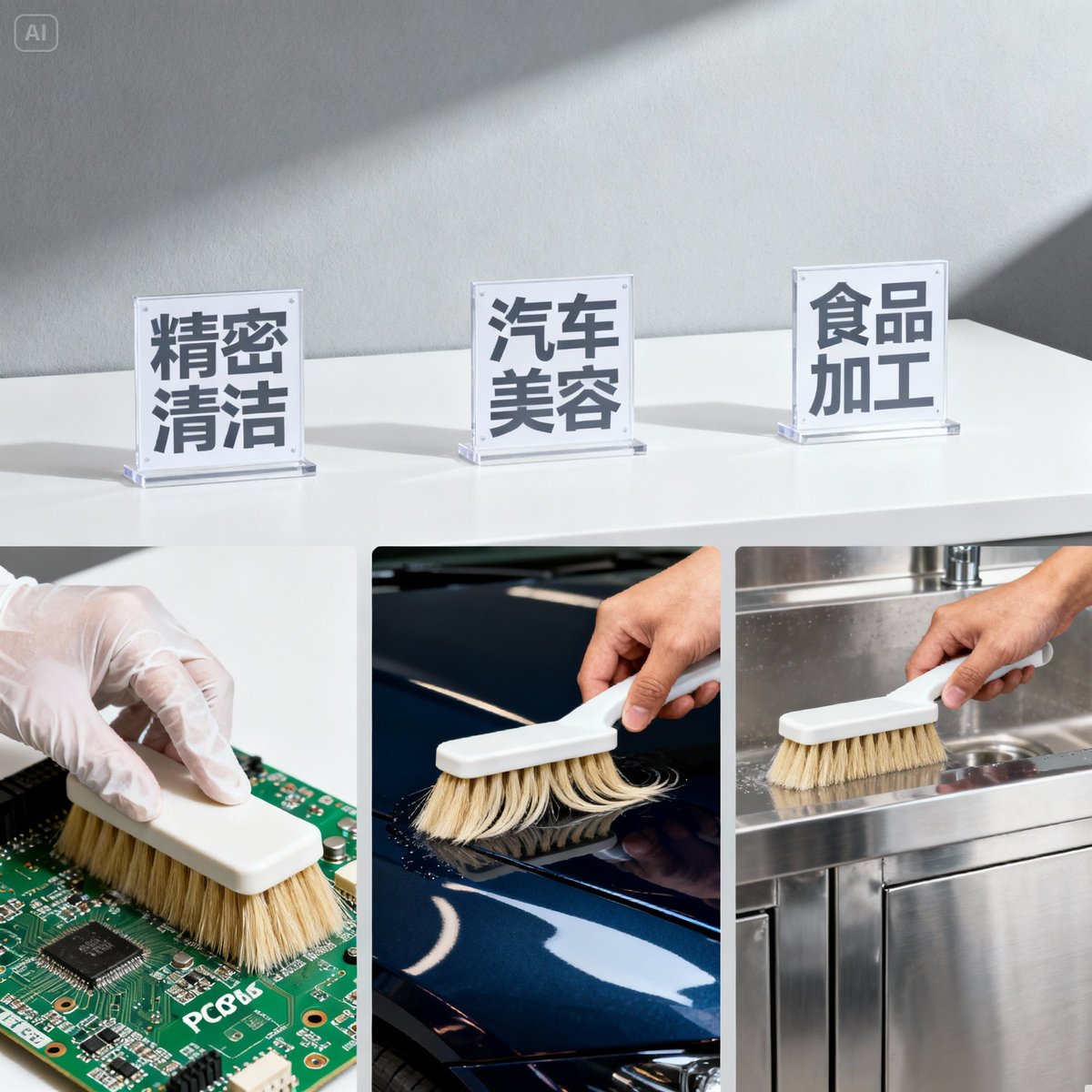
Application 1: Precision cleaning
Industries:
- Electronics: PCBs, wafers, precision instruments
- Optics: lenses, optical components
- Medical: precision medical devices
- Laboratories: glassware, precision equipment
Why a soft brush?
The surfaces of precision parts scratch easily, and a stiff brush will damage them.
A soft brush removes dust gently without harming the surface.
Recommended type:
- Material: PE or 0.1 mm fine nylon
- Filament diameter: 0.1-0.2 mm (very fine)
- Shape: small round-head brush, fine pen brush
- Special requirements: anti-static (ESD), cleanroom grade
Price range: budget to upper mid-range (varies by specification and brand; actual retail prices are as marked by each channel)
Purchasing advice:
For precision cleaning, be sure to choose a supplier whose quality is assured, so that shed filaments do not contaminate the product.
YC Brushes supplies cleanroom-grade soft brushes. You are welcome to inquire.
Application 2: Car detailing
Used for:
- Cleaning painted surfaces
- Detail cleaning of interiors
- Wheel rim cleaning (soft)
- Glass cleaning
Why a soft brush?
Car paint is expensive, and a stiff brush leaves fine scratches (commonly called swirl marks).
A soft brush cleans safely without harming the paint.
Recommended type:
- Material: soft PP or 0.2-0.3 mm nylon
- Filament diameter: 0.2-0.3 mm
- Shape: wheel brush, hand brush
- Special requirements: resistant to chemical cleaners
Price range: mid-range to upper mid-range (varies by specification and brand)
Professional advice:
Car detailing operators should choose professional-grade soft brushes to avoid damaging customers' vehicles.
Application 3: Food processing
Equipment:
- Stainless steel conveyor belts
- Food processing equipment
- Fruit and vegetable washing
- Baking utensils
Why a soft brush?
The food industry needs a brush that:
- Does not damage equipment surfaces
- Does not shed easily (to avoid contamination)
- Complies with the regulations on food-contact materials
A soft brush can meet these needs.
Recommended type:
- Material: nylon or PP that complies with FDA 21 CFR 177
- Filament diameter: 0.2-0.4 mm
- Shape: depends on the equipment
- Special requirements: compliance with food-contact regulations, high-temperature resistance
Price range: mid-range to high (varies by specification and regulatory requirements)
Important reminder:
The food industry must choose brushes that comply with the regulations on food-contact materials (such as Taiwan's Sanitation Standard for Food Utensils, Containers and Packages).
Contact YC Brushes now to ask about food-grade soft brushes.
Application 4: Jewelry and craft cleaning
Used for:
- Jewelry cleaning
- Antique restoration
- Craft maintenance
- Cleaning of luxury goods
Why a soft brush?
Jewelry and antiques are valuable and must never be scratched.
A soft brush is the safest cleaning tool.
Recommended type:
- Material: PE or very fine nylon (0.1 mm)
- Filament diameter: 0.1-0.2 mm (very fine)
- Shape: small pen brush, round-head brush
- Special requirements: extremely high softness
Price range: budget to mid-range (varies by specification)
Summary of applications
| Application | Recommended material | Filament diameter | Price range |
|---|---|---|---|
| Precision cleaning | PE, fine nylon | 0.1-0.2 mm | Budget to upper mid-range |
| Car detailing | Soft PP, nylon | 0.2-0.3 mm | Mid-range to upper mid-range |
| Food processing | Food-grade PP / nylon | 0.2-0.4 mm | Mid-range to high |
| Jewelry cleaning | PE, very fine nylon | 0.1-0.2 mm | Budget to mid-range |
Want to know the detailed differences between stiff and soft? See the section on soft and stiff brushes in The complete guide to nylon brushes, plastic brushes and synthetic filament.
How do you judge the quality of a soft brush?
The quality of soft brushes on the market varies widely. How do you judge it?
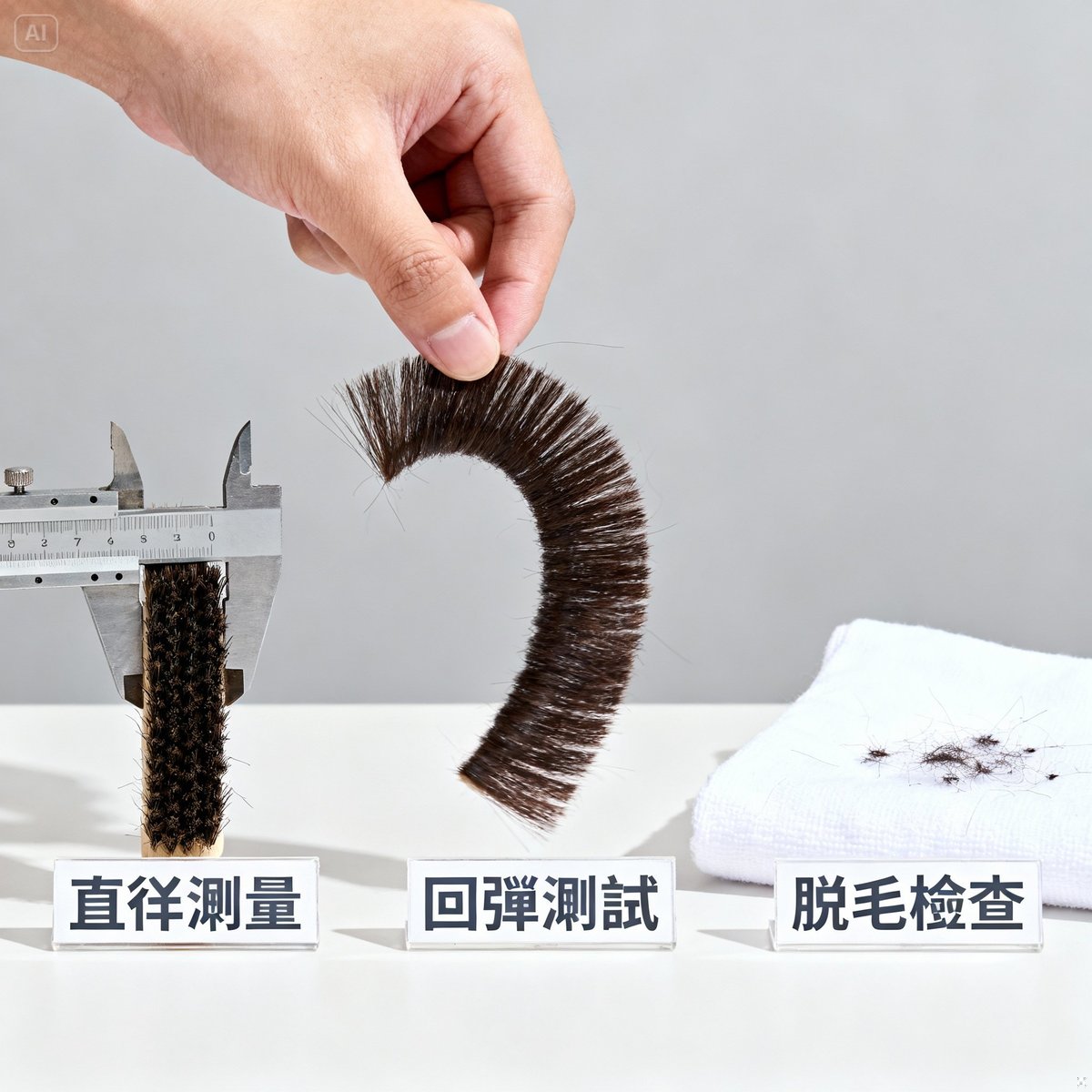
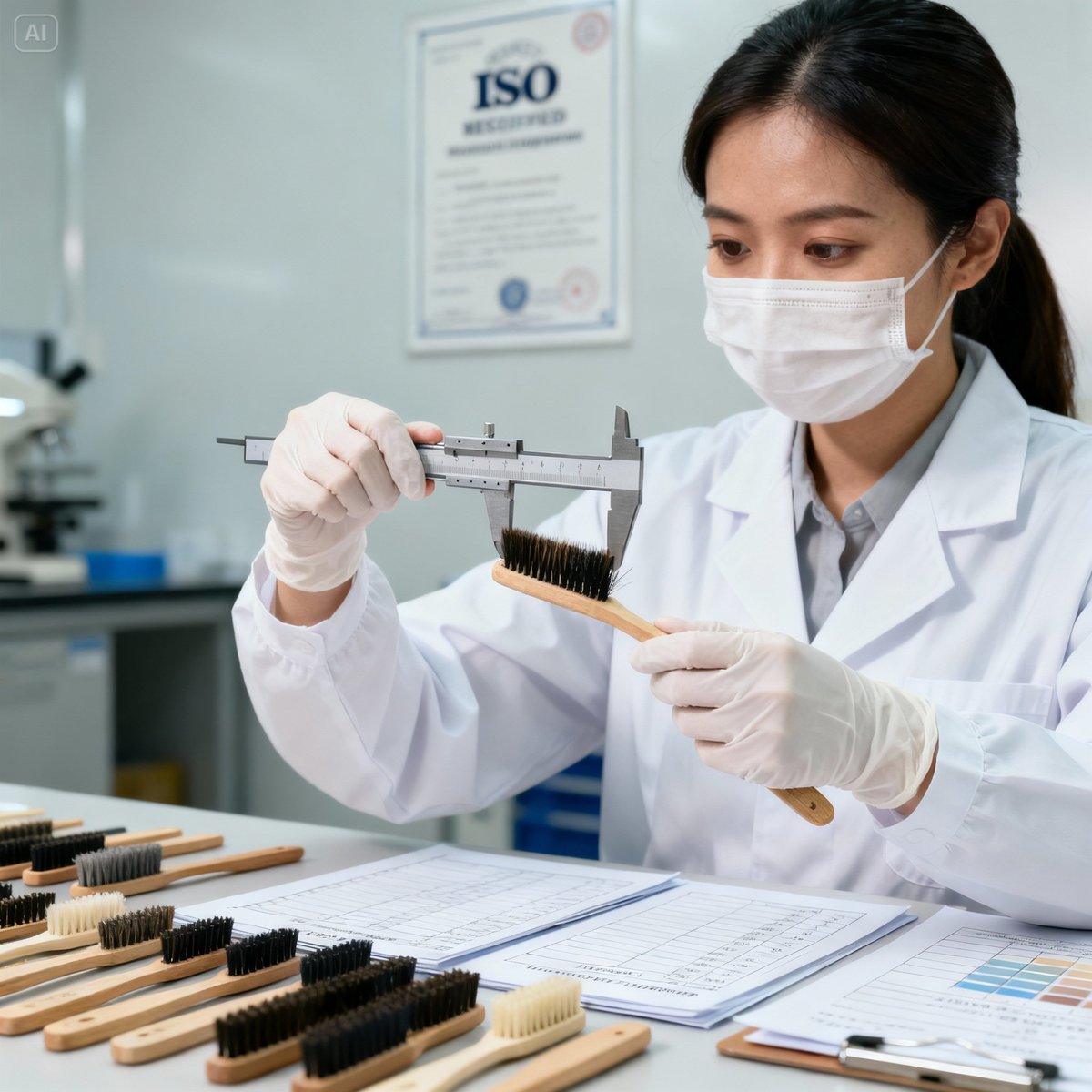
Quality check 1: Measuring filament diameter
Tools: calipers or a microscope
How to measure:
- Pick 5-10 filaments at random
- Measure the diameter with calipers
- The average diameter should be within the stated range
Criteria:
- Good soft brush: uniform diameter, deviation below 0.02 mm
- Poor soft brush: uneven diameter, large differences in thickness
Why does it matter?
Filaments of uneven diameter clean inconsistently and shed easily.
Quality check 2: Resilience test
How to test:
- Bend the filament 90 degrees
- Release it and watch how fast it springs back
- Repeat 10 times and see whether it deforms
Criteria:
- Good soft brush: recovers fully within 1 second, with no permanent deformation
- Poor soft brush: recovers slowly or deforms permanently
Why does it matter?
Filaments with poor resilience deform after use, which affects cleaning performance.
Quality check 3: Shedding rate
How to test:
- Comb through the filaments by hand 20 times
- Count the filaments that come out
- Shedding rate = number shed ÷ total number of filaments × 100%
Criteria:
- Good soft brush: shedding rate
<1% - Poor soft brush: shedding rate
>5%
Why does it matter?
A brush with a high shedding rate contaminates the product, which is especially dangerous in the food and electronics industries.
Where to buy soft brushes? Purchasing channels compared
There are many channels for buying soft brushes, and prices and quality differ a great deal. The pros and cons of each are compared below.
Channel 1: Factory-direct (recommended)
Representative supplier: YC Brushes
Advantages:
-
Price advantage
- No middleman costs
- Better prices for large orders
- Can be customized to the budget
-
Quality assurance
- Over 40 years of professional manufacturing experience
- Traceable raw materials
- Strict in-process quality control
- Material certificates and certifications provided
-
Custom service
- Development from drawings or samples
- 3D-printed rapid sampling
- Order quantities quoted per specification
- Lead times quoted per specification; please email us with your requirements
-
Technical support
- Professional selection advice
- Training in use
- After-sales service
- One-to-one consultation
Disadvantages:
- There is usually an MOQ (minimum order quantity)
- You need to get in touch and discuss (YC Brushes quotes quantities per specification; please email us with your requirements)
Suitable for:
- Large-volume purchasing
- Buyers who want quality and value for money
- Buyers who need customization
- B2B corporate purchasing
How to buy
Contact YC Brushes now for free selection advice and sample testing.
Channel 2: Hardware stores / building-supply stores
Advantages:
- Convenient; buy and take away
- No pressure when buying small quantities
- You can choose on the spot
Disadvantages:
- Limited choice, mostly standard products
- Higher prices (the middleman's margin)
- Quality varies widely
- No customization
- No professional advice
Suitable for:
- Urgent needs
- Occasional purchases
- General household use
Advice:
Suitable for a temporary need, but for long-term purchasing we recommend factory-direct.
Channel 3: Online marketplaces
Representative platforms: Shopee, Taobao, Amazon
Advantages:
- A wide choice
- Fierce price competition
- Easy to compare prices
- Delivered to your door
Disadvantages:
- Quality is hard to guarantee (you cannot test before buying)
- Possible counterfeits and poor-quality goods
- Unreliable after-sales service
- No professional advice
- Returns and exchanges are a hassle
Suitable for:
- General household use
- Non-critical applications
- Buyers willing to accept the risk
Advice:
If you buy online, choose a highly rated seller that also has a physical store.
For professional use, though, we still recommend factory-direct.
Channel 4: Imported foreign brands
Representative brands: imported brands from Germany and Japan
Advantages:
- Quality is usually more stable
- Good brand reputation
Disadvantages:
- Expensive (clearly more than Taiwan-made)
- Long lead times (they must be imported)
- Inconvenient after-sales service
- Hard to customize
Suitable for:
- Ample budgets
- Buyers who want an international brand
- Special certification requirements
Advice:
The quality of Taiwan-made brushes has reached international standards, and they offer better value for money.
Unless you have a special requirement, buying factory-direct in Taiwan is the better deal.
Purchasing channel comparison
| Channel | Price | Quality | Customization | Technical support | Recommendation |
|---|---|---|---|---|---|
| Factory-direct | ★★★★★ | ★★★★★ | ★★★★★ | ★★★★★ | ★★★★★ |
| Hardware store | ★★☆☆☆ | ★★★☆☆ | ☆☆☆☆☆ | ☆☆☆☆☆ | ★★☆☆☆ |
| Online marketplace | ★★★★☆ | ★★☆☆☆ | ☆☆☆☆☆ | ☆☆☆☆☆ | ★★☆☆☆ |
| Imported brand | ★☆☆☆☆ | ★★★★☆ | ★★☆☆☆ | ★★★☆☆ | ★★★☆☆ |
Conclusion:
B2B corporate purchasing, or quality and value for money → factory-direct (YC Brushes)
General household use, occasional purchases → hardware store or online
The advantages of buying factory-direct from YC Brushes
Why do we recommend YC Brushes? Here is the detailed explanation.
Advantage 1: Over 40 years of professional manufacturing experience
Proof of capability:
- Founded in 1985, with over 40 years in brush manufacturing
- Has served more than 1,000 corporate customers
- Covers the electronics, automotive, food, construction and other industries
- Has built up extensive application experience and technical know-how
Why does experience matter?
Brush manufacturing looks simple, but there are many technical details:
- Choice of filament material
- Control of tuft density
- Design of the fixing method
- Consistency of quality
A manufacturer without experience makes brushes of unstable quality.
Advantage 2: Order quantities quoted per specification
The problem with most factories:
- An MOQ (minimum order quantity) as high as 500-1000 pieces
- Small requirements cannot be made to order
- Buyers are forced to take standard products
The YC Brushes advantage:
- Order quantities are quoted per specification; please email us with your requirements
- Order what you actually need, with no waste
- Suited to small and medium-sized businesses and start-ups
A real case:
An electronics company needed 50 soft brushes to a special specification. Other manufacturers had an MOQ of 500 pieces and could not help.
YC Brushes accepted the small custom order and solved the customer's problem.
Advantage 3: Free sample testing
Why do we offer free samples?
Because we are confident!
Customers can test the performance for themselves and place an order only after confirming it meets their needs, which avoids waste.
Sample testing process:
- Contact YC Brushes and describe your requirement
- Receive a free sample
- Test it in actual use
- Place a formal order once confirmed
Customer testimonial:
"We tested the sample when it arrived. The cleaning result was excellent and it did not scratch the surface at all, so we ordered 500 pieces right away." - a car detailing company
Advantage 4: Complete certification, assured quality
We hold:
- ISO 9001: quality management system certification
- FDA regulations: food-grade brushes comply with the FDA regulations on food-contact materials (21 CFR 177)
- Material certificates: provided for all products
- SGS testing: third-party quality testing
Why does certification matter?
- Food industry: must comply with the Sanitation Standard for Food Utensils, Containers and Packages
- Electronics industry: must comply with the RoHS environmental standard
- All industries: ISO certification stands for stable quality
A brush without certification may not meet industry standards and carries a compliance risk.
Advantage 5: Fast delivery of standard products
Standard products:
- Ample stock
- Lead times, including for rush orders, are quoted per specification; please email us
Custom products (lead time quoted separately):
- 3D-printed rapid sampling
- Order quantities and lead times are quoted per specification; please email us with your requirements
Why does speed matter?
When a production line is stopped waiting for brushes, the loss can run to hundreds of thousands of NT dollars a day.
Fast delivery reduces the loss to the business.
Advantage 6: Transparent pricing, factory-direct
Price advantage:
- No middleman costs
- Open, transparent prices
- Discounts for large orders
Price examples:
| Product | Retail price | YC Brushes factory price | Saving |
|---|---|---|---|
| Precision soft brush | Mid-range | NT$100 | 33% |
| Car detailing brush | Upper mid-range | NT$180 | 28% |
| Food-grade soft brush | High | NT$250 | 29% |
Why is it cheaper?
Buying factory-direct means no markup at each level, and the saving is passed on to the customer.
Quality is not discounted, though. It is actually better (controlled at the source).
Ask for a quote now to find out the actual price.
Price analysis and value-for-money assessment
With the advantages covered, let us talk about price.
Market price reference (2025)
Below are reference prices for soft brushes in the Taiwan market:
Disclaimer: prices are for reference only; please ask for an actual quote
| Soft brush type | Retail price | Factory-direct price | Saving |
|---|---|---|---|
| Precision cleaning brush (0.1 mm) | Mid-range | NT$80-180 | 25-35% |
| Car detailing brush (0.2 mm) | Upper mid-range | NT$120-250 | 28-35% |
| Food-grade soft brush (FDA) | Upper mid-range to high | NT$180-350 | 22-28% |
| Small jewelry cleaning brush | Budget to mid-range | NT$30-80 | 33-40% |
Why is factory-direct cheaper?
It cuts out:
- The distributor's margin
- Retail listing fees
- Advertising and marketing costs
The saving is passed on to the customer, but quality is not discounted.
Total cost of ownership (TCO)
Do not look only at the unit price; look at the total cost.
Example: precision cleaning brush (electronics industry)
Option A: cheap brush (bought online)
| Item | Amount |
|---|---|
| Unit price | Budget |
| Service life | 1 month |
| Replacements needed in 1 year | 12 times |
| Total purchase cost | On the high side (frequent replacement adds up) |
| Loss from shedding contamination | At risk (unstable material) |
| 1-year TCO | Clearly on the high side |
Option B: YC Brushes factory soft brush
| Item | Amount |
|---|---|
| Unit price | NT$100 |
| Service life | 6 months |
| Replacements needed in 1 year | 2 times |
| Total purchase cost | NT$200 |
| Loss from shedding contamination | NT$0 (good quality) |
| 1-year TCO | NT$200 |
Conclusion:
The 1-year TCO of the YC Brushes soft brush is only NT$200, a saving of 82% compared with the cheap retail brush!
Why?
- A long service life means less frequent replacement
- Good quality means no loss from shedding contamination
How to get the best value for money
1. Buy factory-direct
Lower prices and better quality.
2. Order in quantity
- 10 pieces or more: about 10% off (90% of list price)
- 50 pieces or more: about 20% off (80% of list price)
- 100 pieces or more: negotiable
3. Ask for a free sample
Test before you order, to make sure the performance meets your needs.
4. Build a long-term relationship
A long-term relationship brings better prices and service.
Contact YC Brushes now to discuss the best purchasing plan.
Use and maintenance
Once you have bought a good soft brush, using and maintaining it correctly is important.
How to use it correctly
1. Choose the right brush
- Precision cleaning: 0.1-0.2 mm fine filament
- General cleaning: 0.2-0.3 mm medium-fine filament
- Do not use a soft brush on heavy dirt (it works poorly)
2. Use suitable pressure
- The strength of a soft brush is its gentleness
- A light touch is enough; there is no need to press
- Pressing hard may actually break the filaments
3. Use it with a cleaner
- A suitable cleaner can improve the result
- Check whether the cleaner harms the filament (nylon is vulnerable to strong acids and alkalis)
- Always rinse thoroughly after use
Maintenance
1. Clean after use
- Rinse the filaments with clean water
- Shake off the water
- Avoid soaking (nylon absorbs water)
2. Dry storage
- Dry with the filaments facing down
- Store in a dry place
- Avoid direct sunlight (plastic ages)
3. Regular checks
- Check whether the filaments are shedding heavily
- Check whether the filaments are permanently deformed
- Replace the brush when performance is affected
Tips for a longer service life
1. Rotate brushes
- Keep 2-3 soft brushes and use them in rotation
- This gives the filaments time to rest and recover their resilience
2. Avoid high temperatures
- Do not wash with hot water (plastic softens)
- Keep away from hot environments
3. Store correctly
- Do not let the filaments be compressed
- Hang the brush or lay it flat
- Avoid deformation
FAQ
How long does a soft brush last?
It depends on the material, the frequency of use and the maintenance.
Typical service life:
| Frequency of use | Material | Service life |
|---|---|---|
| Daily use | PE soft brush | 3-6 months |
| Daily use | Fine nylon soft brush | 6-12 months |
| Occasional use | PE soft brush | 1-2 years |
| Occasional use | Fine nylon soft brush | 2-3 years |
Factors that affect service life:
- Material: nylon lasts longer, PE less long
- Frequency of use: frequent use shortens the life
- Maintenance: correct maintenance extends the life
- Quality: a good brush lasts longer
When to replace:
- The filaments are shedding heavily
- The filaments are permanently deformed
- Cleaning performance has clearly declined
How to extend the service life:
- Clean and dry after use
- Avoid hot environments
- Store correctly
- Choose a good brush (such as one from YC Brushes)
Will a soft brush scratch the surface?
A good soft brush will not scratch the surface.
But note the following:
-
Choose the right filament diameter
- 0.1-0.2 mm for precision surfaces
- 0.2-0.3 mm for general surfaces
-
Use the right pressure
- A light touch is enough
- Do not press hard
-
Make sure the filaments are clean
- Hard particles caught in the filaments may scratch
- Check before use
-
Choose a good brush
- Poor brushes have filaments of uneven thickness
- A thicker filament may scratch the surface
Which surfaces suit a soft brush?
- Car paint
- Precision instruments
- Optical lenses
- Electronic components
- Stainless steel surfaces
- Glass
Which surfaces do not?
- Extremely soft surfaces (such as soft coatings)
- These may need an even softer material, or no brush at all
Advice:
The first time you use the brush, test it on an inconspicuous area and confirm that it does not scratch before using it everywhere.
YC Brushes offers free sample testing. Apply now.
Which regulations must a soft brush for the food industry meet?
Brushes for the food industry must comply with the regulations on food-contact materials; which set applies depends on where the brush is used and sold.
Relevant regulations:
-
Taiwan's Sanitation Standard for Food Utensils, Containers and Packages
- The legal standard that food utensils used or sold in Taiwan must meet
-
FDA 21 CFR 177
- Title 21, Part 177 of the US Code of Federal Regulations (indirect food additives: polymers)
- Regulates polymer materials that may contact food; applies when exporting to the US
-
LFGB
- Germany's Food, Consumer Goods and Feed Code (Lebensmittel-, Bedarfsgegenstände- und Futtermittelgesetzbuch); applies when exporting to Germany
Why confirm regulatory compliance?
If a food-contact material releases toxic substances, it contaminates the food and endangers health.
Only by asking the supplier for test reports showing compliance with the relevant regulations can you confirm that the material is safe.
Besides regulatory compliance, also pay attention to:
-
Low shedding
- Shed filaments contaminate food
- Choose a brush of good quality
-
High-temperature resistance (if needed)
- The food industry may need high-temperature washing
- Choose a heat-resistant material
-
Easy to clean
- The brush itself must be easy to wash
- It should not trap dirt
Food-grade brushes from YC Brushes:
- Comply with the FDA regulations on food-contact materials (21 CFR 177)
- Material certificates provided
- Stable quality, low shedding
- Can withstand high-temperature washing
Ask about food-grade soft brushes now.
How do factory-direct brushes differ from retail brushes?
The differences are mainly in price, consistency of quality, customization and technical support.
Factory-direct (YC Brushes):
Advantages:
- Lower price (no middleman costs, about 25-35% cheaper)
- Stable quality (controlled at the source)
- Customizable (made to your requirement)
- Technical support (professional advice)
- Material certification (documents provided)
- Order quantities quoted per specification (email us with your requirements)
Disadvantages:
- You need to get in touch and discuss (but our service is very good)
Retail brushes (hardware stores, online):
Advantages:
- Convenient; buy and take away
- No pressure when buying small quantities
Disadvantages:
- Higher prices (the middleman's margin)
- Quality varies widely
- No customization
- No professional advice
- May have no material certification
Our recommendation:
- B2B corporate purchasing → factory-direct (YC Brushes)
- Customization needed → factory-direct (YC Brushes)
- Quality and value for money → factory-direct (YC Brushes)
- Occasional household purchases → hardware store or online
A real case:
An electronics company used to buy soft brushes online. The unit price was on the high side and the quality was unstable, with shed filaments often contaminating the product.
After switching to YC Brushes, the unit price was NT$100 (33% cheaper), the quality was stable and there was no shedding problem, which greatly reduced production losses.
How do I start buying soft brushes from YC Brushes?
It is very simple! Just 3 steps:
Step 1: Contact us
Option 1: Fill in the online form
Option 2: Call +886-2-2988-2721
Option 3: Email: [email protected]
Step 2: Describe your requirement
Tell us:
- The application (precision cleaning, car detailing, food processing and so on)
- The expected quantity
- Any special requirements (certification, customization and so on)
Our team will:
- Give selection advice
- Recommend the most suitable soft brush
- Provide a quote
Step 3: Sample testing (free)
- Receive a free sample
- Test it in actual use
- Confirm that it meets your needs
Once you are satisfied, place a formal order.
Delivery time:
- Standard products and custom products: lead times are quoted per specification; please email us with your requirements
Payment:
- Bank transfer
- Monthly settlement (for long-term customers)
After-sales service:
- Full refund or exchange if there is a quality problem
- Professional technical support
- Discounts for long-term cooperation
Start now!
Contact YC Brushes now and find the soft brush that suits you best.
Over 40 years of experience you can rely on.
Conclusion: the right supplier wins on both quality and price
Having read this far, you should know how to choose and buy a soft brush.
Quick summary
Definition of a soft brush:
- Filament diameter 0.1-0.3 mm
- Soft material (PE, soft PP, fine nylon)
- Gentle, does not damage surfaces
Main applications:
- Precision cleaning (electronics, optics)
- Car detailing (paint protection)
- Food processing (equipment cleaning)
- Jewelry and crafts (care of luxury goods)
Judging quality:
- Measure the filament diameter
- Test the resilience
- Check the shedding rate
- Confirm the material certification
- Check the overall design
Purchasing advice:
- Factory-direct is best (YC Brushes)
- Prices 25-35% lower
- Stable, assured quality
- Custom service
- Free sample testing
Why choose YC Brushes?
- Over 40 years of professional experience: a supplier you can rely on
- Order quantities: quoted per specification; email us
- Free samples: test before you order
- Complete certification and compliance: ISO, compliance with FDA 21 CFR 177, material certificates
- Fast delivery of standard products: lead times quoted per specification; email us
- Transparent pricing: factory-direct, 25-35% saved
Act now
If you need:
- Soft brushes for precision cleaning
- Professional brushes for car detailing
- Food-grade brushes
- Custom soft brushes
Contact YC Brushes now. We provide:
- Free selection advice
- Free sample testing
- Factory-direct prices
- Professional technical support
Or see the full product catalog to explore more brush options.
Want to learn more about brushes? Explore the related articles:
- The complete guide to nylon brushes, plastic brushes and synthetic filament
- The complete buying guide to nylon wheel brushes
- Plastic brush vs nylon brush | 5 key differences compared
- How to use nylon tube brushes
References
- FDA 21 CFR 177 - safety regulations for food-contact materials
- ISO 9001 - quality management system standard