Introduction: choose the right industrial brush and raise production efficiency by 30%
Did you know? One well-chosen conveyor belt cleaning brush can cut production line stoppages by 50%.
Many factory managers have had this experience: dust and debris build up on the conveyor belt, which leads to unstable product quality, faster machine wear and even production interruptions. Traditional manual cleaning is not only time-consuming but also cannot clean continuously.
This is where choosing the right industrial-grade large brush becomes essential. Whether it is dust removal on a conveyor belt, maintenance of machinery, cleaning large floor areas or maintaining boiler tubes, different applications need different brush materials and designs.
This article covers the definition of large brushes, their material classes, industrial applications, buying criteria and maintenance advice, to help you find the most suitable industrial cleaning solution.

Definition and classification of large brushes
What is a large brush?
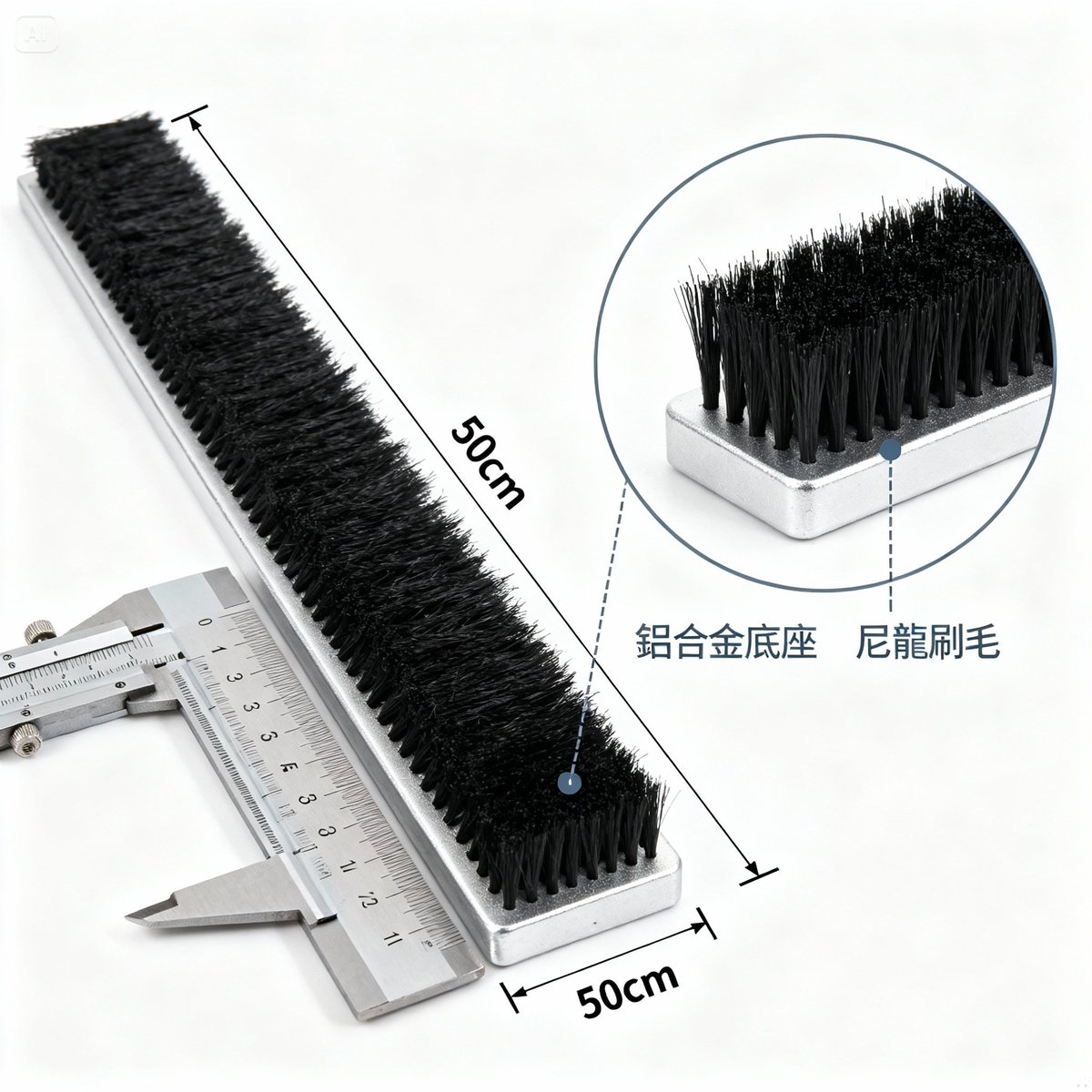
A large brush usually means an industrial-grade brush with a brush face larger than 20 cm × 10 cm, or an overall length of more than 50 cm. Brushes of this kind are mainly used for cleaning large areas, removing dust from industrial equipment, or in automated mechanical cleaning systems.
How it differs from an ordinary brush:
| Item | Ordinary brush | Large brush |
|---|---|---|
| Size | Under 20 cm | Over 20 cm (up to several meters) |
| Application | Household and personal cleaning | Industrial and equipment cleaning |
| Material | Natural bristle, soft nylon | Stiff nylon, steel wire, PP |
| Durability | 6-12 months | 12-36 months |
| Price | Budget | Mid-range to high-end (varies widely with the specification) |
| Purchase quantity | Retail (1-10 pieces) | Wholesale (10-1,000 pieces) |
Material classes of large brushes
Large brushes use different materials for different purposes.
Steel wire:
Properties:
- Extremely hard, removes stubborn stains
- Heat resistant (up to 300°C)
- Suited to heavy-duty cleaning
Applications:
- Removing rust from metal surfaces
- Cleaning up after welding
- Cleaning boiler tubes
- Treating concrete surfaces
Disadvantages:
- Easily scratches precision surfaces
- Needs regular replacement (it wears easily)
Nylon filament (PA6, PA66, PA610):
Properties:
- Adjustable stiffness (by diameter, 0.1-1.0 mm)
- Wear resistant, with a long service life
- Resistant to chemical corrosion
- Low water absorption
Applications:
- Conveyor belt cleaning (the most common)
- Dust removal on food processing equipment
- Cleaning in electronics manufacturing
- General industrial dust removal
Advantages:
- The best value for money
- A wide range of applications
- Stiffness can be adjusted to the requirement
PP/PBT filament:
Properties:
- Affordable
- Acid and alkali resistant
- Extremely low water absorption
- Good resilience
Applications:
- Cleaning in damp environments
- Acid and alkaline environments
- Food processing (meets food-grade standards)
Natural bristle (horsehair, hog bristle):
Properties:
- Soft, does not damage surfaces
- Naturally anti-static
- Suited to precision cleaning
Applications:
- Dust removal on precision machinery
- Cleaning electronic equipment
- Cleaning rollers in the printing industry
Disadvantages:
- More expensive
- Less durable than synthetic fiber
- Needs regular maintenance
See the full YC Brushes product range, which includes industrial brushes in all kinds of materials to meet different application needs.
Industrial applications of large brushes
Conveyor belt cleaning brushes
This is the most widespread industrial application of large brushes.
Why is a conveyor belt brush needed?
The problem:
- Dust and debris build up on the conveyor belt
- Product quality is affected
- Equipment wears faster
- Production is interrupted
The solution: Install a roller brush to clean the surface of the conveyor belt continuously.
Types of conveyor belt brush:
Single roller brush:
- Suited to light dust removal
- Simple to install
- Lower cost
Double roller brush:
- Cleans better
- One above and one below, gripping the conveyor belt
- Suited to heavy contamination
Spiral brush:
- The filament is arranged in a spiral
- It guides dust to both sides
- Suited to wide conveyor belts
Choice of material:
- Nylon filament: general dust removal (the most common)
- Steel wire: removing adhered material
- PP filament: the food industry (food-grade compliant)
Specifications:
- Filament diameter: 0.3-0.8 mm
- Roller diameter: 50-300 mm
- Length: custom made to the width of the conveyor belt (up to 3 meters)
Case: After a food processing plant installed nylon conveyor belt brushes, the product contamination rate fell from 5% to 0.5%, saving NT$500,000 a year in cleaning labor costs.
To learn more about the properties of brush materials and how to choose them, see The complete guide to buying soft brushes, which compares hog bristle, goat hair, nylon, PP and other materials in detail.
Dust-removal brushes for machinery
Industrial machinery produces dust as it runs and needs dust-removal brushes to clean it.
Applications:
Printing industry:
- Dust removal on printing press rollers
- Removing paper dust and powder
- Improving print quality
Woodworking industry:
- Dust removal on CNC machines
- Removing wood chips
- Protecting machine accuracy
Metalworking:
- Dust removal on lathes and milling machines
- Removing metal chips
- Extending tool life
Choice of material:
- General dust: nylon filament
- Metal chips: steel wire
- Precision equipment: horsehair (anti-static)
Installation method:
- Fixed: installed at a fixed position on the machine
- Rotary: rotates to remove dust as the machine runs
- Hand-held: operated manually
Large brushes for floor cleaning
Cleaning large floor areas needs wide brushes.
Applications:
Factory floors:
- Daily cleaning of dust and debris
- Keeping the environment tidy
- Complying with 5S management
Warehouse floors:
- Fast cleaning of large areas
- Removing carton scraps and dust
Parking lots:
- Removing fallen leaves and sand
- Keeping the ground clean
Types of floor cleaning brush:
Push broom:
- Brush face width 50-100 cm
- Pushed by hand
- Suited to small and medium areas
Brush heads for automatic floor scrubbers:
- Disc brush or roller brush
- Used with a floor scrubber
- Suited to large areas
Choice of material:
- PP filament: general floors (wear resistant)
- Steel wire: rough floors, removing oil stains
- Mixed materials: both cleaning power and gentleness
Boiler tube cleaning brushes
Boilers and tubes need regular cleaning to maintain efficiency and safety.
Why is cleaning needed?
The problem:
- Carbon deposits and corrosion lower thermal efficiency
- Blockages affect the flow
- Safety hazards
The solution: Use a dedicated tube cleaning brush.
Types of tube cleaning brush:
Straight rod type:
- Suited to straight tubes
- Simple to operate
- Length up to 5 meters
Flexible hose type:
- Suited to bent tubes
- The hose bends to get in
- Cleans deep inside
Rotary type:
- Connected to an electric drill to rotate
- Strong cleaning action
- Quickly removes stubborn deposits
Choice of material:
- Steel wire: removing carbon deposits and corrosion
- Nylon filament: general dirt
- Brass wire: does not damage the tube wall
Specifications:
- Brush head diameter: chosen by the inner diameter of the tube (10-20% smaller)
- Filament length: chosen by the degree of fouling
- Handle length: chosen by the depth of the tube
Browse the YC Brushes industrial brush catalog to see conveyor belt brushes, dust-removal brushes, tube cleaning brushes and other products for industrial applications.
How to choose a suitable large brush
Choose the material by the operating environment
Different environments need brushes in different materials.
Temperature:
| Ambient temperature | Recommended material | Temperature range |
|---|---|---|
| Normal temperature (below 60°C) | Nylon PA6 | -20°C ~ 100°C |
| Medium temperature (60-120°C) | Nylon PA66 | -20°C ~ 150°C |
| High temperature (120-200°C) | PBT, steel wire | -20°C ~ 250°C |
| Very high temperature (above 200°C) | Stainless steel wire | -20°C ~ 300°C |
Humidity:
Dry environments:
- Nylon, PP and natural bristle are all suitable
- No special restrictions
Damp environments:
- Prefer PP or PBT (low water absorption)
- Avoid natural bristle (it goes moldy easily)
- Nylon needs to be dried regularly
Use in water:
- PP, PBT, steel wire
- Avoid natural bristle and materials that absorb water easily
Chemical environment:
Acidic environments:
- PP, PBT (good acid resistance)
- Avoid nylon (it degrades)
Alkaline environments:
- Nylon, PP (good alkali resistance)
Organic solvents:
- Steel wire, brass wire
- Avoid plastic materials
How do you choose a brush manufacturer with professional knowledge of materials? We suggest reading The complete guide to choosing a brush factory to learn the 5 criteria for assessing a manufacturer.
Choose the stiffness by what is being cleaned
The stiffness of the brush must match what is being cleaned.
What is being cleaned:
Precision surfaces (optical lenses, precision instruments):
- Choose very soft filament: horsehair, goat hair, soft nylon (0.1 mm)
- Avoid scratching
General surfaces (conveyor belts, equipment housings):
- Choose medium stiffness: nylon (0.3-0.5 mm), PP
- Both cleaning power and gentleness
Rough surfaces (floors, walls):
- Choose stiff materials: stiff nylon (0.8 mm or more), steel wire
- Removes stubborn stains
Degree of soiling:
Light soiling (dust, paper scraps):
- Soft filament is enough
- Avoid over-cleaning, which wears the surface
Medium soiling (oil stains, dirt):
- Medium-stiff filament
- Use with a cleaning agent
Heavy soiling (carbon deposits, corrosion):
- A stiff wire brush
- A rotary type may be needed for more cleaning power
Choose the specification by the equipment
The specification of a large brush has to match the equipment.
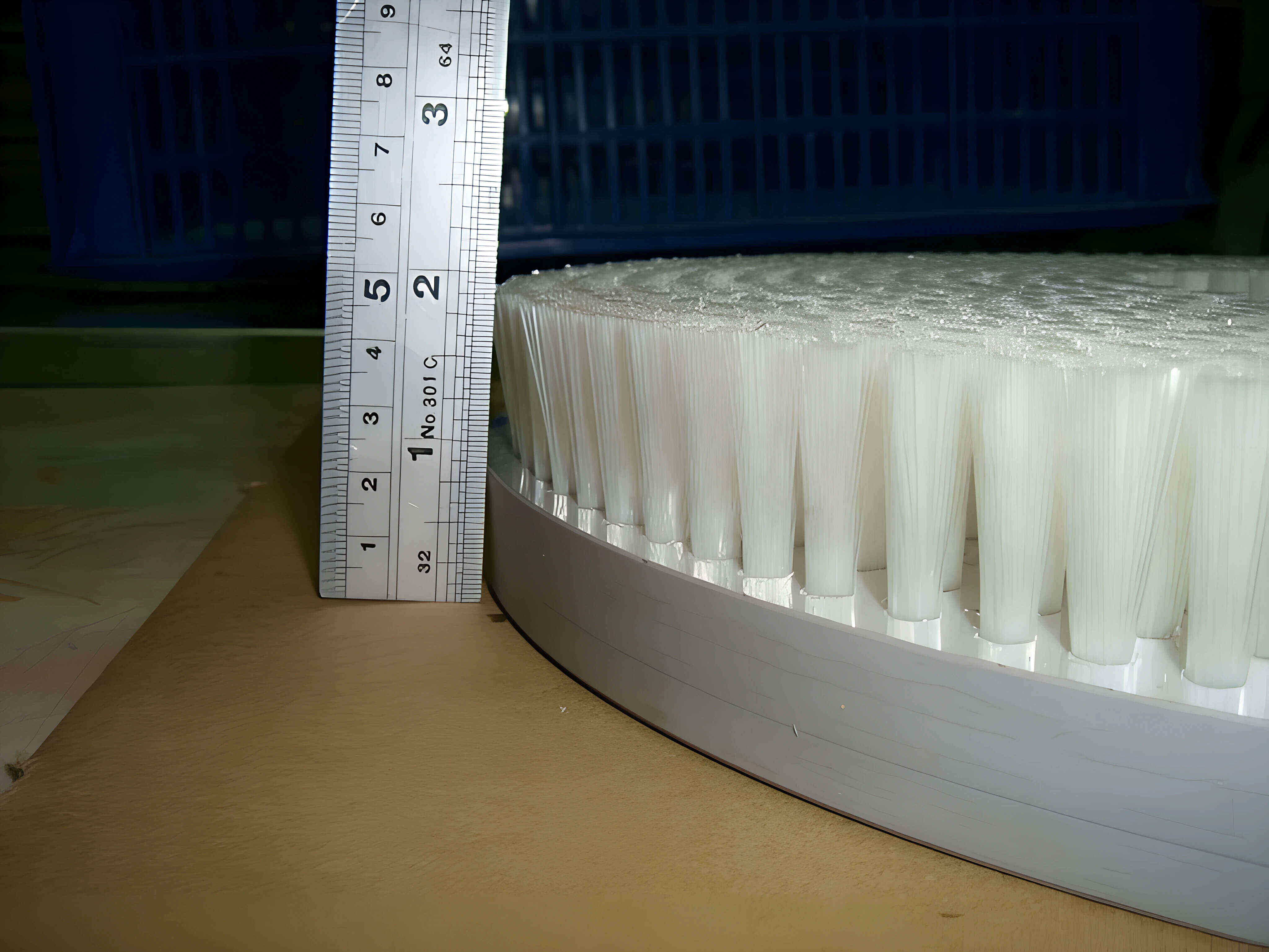
Conveyor belt brushes:
Width:
- Chosen by the width of the conveyor belt
- Usually 5-10 cm wider than the belt
- Ensures full coverage
Diameter:
- Roller diameter 50-300 mm
- The larger the diameter, the larger the cleaning area
- But the installation space has to be considered
Installation method:
- Shaft type (mounted through the bore)
- Flange type (fixed at both ends)
- Confirm the interface on the equipment
Tube cleaning brushes:
Brush head diameter:
- 10-20% smaller than the inner diameter of the tube
- Too large and it cannot get in
- Too small and it does not reach the tube wall
Handle length:
- Chosen by the depth of the tube
- Leave room to operate
Floor cleaning brushes:
Brush face width:
- Hand-pushed: 50-80 cm (too wide is hard to push)
- Mechanical: can be 100 cm or more
Filament length:
- General floors: 30-50 mm
- Rough floors: 50-80 mm
If you need industrial brushes in natural materials and want to understand how natural bristle brushes differ, see Horsehair brushes vs hog bristle brushes: a full comparison, which explains where horsehair and hog bristle are used.
💡 Not sure which specification and material to choose?
Contact YC Brushes now. Our engineering team, with over 40 years of experience, helps with selection free of charge and offers the most suitable solution. +886-2-2988-2721.
Maintaining and replacing large brushes
Day-to-day maintenance
Proper maintenance can extend the service life of a large brush by 50% or more.
Cleaning after use:
Conveyor belt brushes:
- Remove the dust built up on the filament before the end of each working day
- It can be blown clean with compressed air
- Or combed with a small brush
Floor cleaning brushes:
- Knock out the dust after use
- Wash with water regularly (for washable materials)
- Dry before putting away
Tube cleaning brushes:
- Wash immediately after use
- Keep dirt from hardening and sticking
- Hang up to dry
Regular inspection:
Weekly checks:
- Whether filament is shedding
- Whether filament is deformed
- Whether the fixing parts are loose
Monthly maintenance:
- Deep cleaning
- Check the degree of wear
- Adjust the installation angle (if needed)
Avoiding damage:
Excessive pressure:
- Do not apply too much pressure
- It deforms the filament permanently
- It shortens the service life
The wrong cleaning agent:
- Avoid strong acids and alkalis (unless the material is acid and alkali resistant)
- Avoid organic solvents (a plastic brush body will dissolve)
Heat and sun exposure:
- Do not leave it in the sun for long periods
- A plastic brush body ages and becomes brittle
When is replacement needed?
How to judge when to replace:
Filament wear:
- The filament length has decreased by 30% or more
- The filament tips are badly split
- Cleaning performance has clearly declined
Filament shedding:
- Heavy shedding every time it is used
- The filament density has clearly thinned
- The filament is not held firmly
Damage to the brush body:
- The brush body is cracked
- It does not rotate smoothly
- The mounting hole is worn
Average service life:
| Material | Operating environment | Average life |
|---|---|---|
| Steel wire | Heavy-duty cleaning | 6-12 months |
| Nylon | General dust removal | 12-24 months |
| PP | Damp environments | 18-30 months |
| Natural bristle | Precision cleaning | 6-12 months |
Tips for a longer life:
- Clean and maintain regularly
- Avoid excessive pressure
- Store correctly
- Rotate regularly (for types that can be rotated)
Advice on replacement and purchasing
Purchasing strategy:
Spare brushes:
- We recommend keeping 1-2 spares
- This avoids waiting with the line stopped
- Using them in rotation extends their life
Buying in batches:
- Buy 3-6 months of supply at a time
- Get wholesale prices
- Ensure a stable supply
A regular replacement plan:
- Set up a system of regular replacement
- Replace preventively (do not wait for complete failure)
- Improve the running efficiency of the equipment
Buying and quotes (purchasing channels, reference prices, volume discounts)
Purchasing channels compared
Hardware stores / industrial supply stores:
- Advantage: collect on the spot
- Disadvantages: little choice, high prices, no custom work
- Suited to: urgent needs in small quantities
Online retailers:
- Advantage: easy to compare prices
- Disadvantages: quality is hard to judge, the specification may not match
- Suited to: standard specifications, small purchases
Buying direct from the factory (most recommended):
- Advantages: better prices, custom work possible, technical support, stable quality
- Disadvantage: there is usually an MOQ
- Suited to: industrial customers, regular purchasing, special specifications
Reference prices
Below are market reference prices (retail vs wholesale).
Conveyor belt brush (roller brush, 100 mm diameter, 1 meter long):
| Material | Retail price | Wholesale price (10 pieces or more) |
|---|---|---|
| Nylon | Mid-range | Mid-range |
| PP | Budget | Budget |
| Steel wire | Mid-range to high | Mid-range to high |
| Natural bristle | High-end | High-end |
Push broom for floor cleaning (80 cm wide):
| Material | Retail price | Wholesale price (10 pieces or more) |
|---|---|---|
| PP | Budget | Budget |
| Nylon | Mid-range | Mid-range |
Tube cleaning brush (50 mm diameter, 2 meters long):
| Material | Retail price | Wholesale price (10 pieces or more) |
|---|---|---|
| Nylon | Budget | Budget |
| Steel wire | Mid-range | Mid-range |
Important note: the above are market price bands for reference. The actual quote depends on the specification and the quantity.
Volume discounts
YC Brushes offers flexible volume purchasing options.
Discounts by quantity band:
| Quantity | Discount | Additional benefits |
|---|---|---|
| 10-50 pieces | 5% off (95% of list price) | - |
| 51-100 pieces | 10% off (90% of list price) | Free shipping |
| 101-500 pieces | 15% off (85% of list price) | Free shipping + free sampling |
| 500 pieces or more | 20% off (80% of list price) | Free shipping + dedicated customer service |
Annual contract:
- Sign an annual purchasing agreement
- Lock in the discount price for the whole year
- Get priority in scheduling
- Dedicated technical support
Custom order benefits:
- Custom orders of 500 pieces or more
- The tooling fee can be paid in installments or spread into the product cost
- The 3D-printed sampling fee can be credited
💡 Want to know how much your purchase could save?
Contact YC Brushes now for a free quote and cost analysis. Our team will help plan the best purchasing option. +886-2-2988-2721.
FAQ
1. How do I choose where to install a conveyor belt brush?
The installation position affects the cleaning result. Consider the following factors.
Choosing the installation position:
Above the conveyor belt (the most common):
- Cleans the carrying side of the belt
- Removes debris dropped by the product
- Prevents contamination of the next batch of product
Below the conveyor belt:
- Cleans the underside of the belt
- Prevents dust from building up
- Extends the life of the belt
At both sides of the conveyor belt:
- Cleans the edges of the belt
- Prevents dust from piling up on the rollers
Installation angle:
- A contact angle of 30-45 degrees between the filament and the belt is recommended
- Too small an angle gives too little cleaning power
- Too large an angle damages the filament easily
Pressure adjustment:
- The filament only needs to press lightly on the belt
- Avoid excessive pressure, which causes wear
- An adjustable bracket allows fine adjustment of the pressure
2. Can large brushes be custom made? What quantity is needed?
Yes! YC Brushes offers a custom service for industrial brushes.
What can be customized:
- Brush body dimensions (length, diameter)
- Filament material and stiffness
- Filament density
- Installation method (shaft, flange, thread)
- Special shapes (curved, spiral)
Order quantities:
- Standard specifications: order quantities are quoted per specification; please email us with your requirements
- Custom: order quantities are quoted per specification (tooling or special machining is needed); please email us with your requirements
Custom process:
- Provide photos of the equipment and the specification requirements
- The engineering team assesses and quotes
- A sample is made for confirmation (3D-printed sampling is possible)
- Volume production
For the detailed custom process, see The professional guide to custom brushes.
3. How do I judge the quality of a large brush?
Quality criteria:
How firmly the filament is held:
- Pull hard on the filament; it should not come out in large amounts
- A good brush has a shedding rate below 1%
- A poor one may be 5-10%
Filament uniformity:
- Consistent filament length
- Even density with no bald patches
- Neatly arranged
Strength of the brush body:
- The shaft does not deform
- The welds are firm
- The material is solid, not hollow
Smoothness of rotation (roller brushes):
- Rotates without catching
- The bearings run smoothly
- No abnormal noise
Authenticity of the material:
- Nylon PA6/PA66 with certification
- Food-grade PP with proof
- Stainless steel material tested
How to make sure of quality:
- Buy from a reputable manufacturer
- Ask for samples to test
- Ask for quality documentation
4. What special requirements apply to brushes used in food processing plants?
The food industry has strict requirements for brushes.
Standards that must be met:
Material regulations:
- Compliant with the FDA regulations on food contact materials (21 CFR 177)
- Compliant with EU 10/2011, the EU regulation on plastic food contact materials
- Taiwan's Sanitation Standard for Food Utensils, Containers and Packages
Materials that can be used:
- Food-grade PP
- Food-grade nylon PA6
- Food-grade PBT
- Natural hog bristle (needs special treatment)
Avoid:
- Ordinary industrial-grade plastics
- Materials containing heavy metals
- Poor-quality filament that sheds easily
Other requirements:
No shedding:
- The filament must be held extremely firmly
- This keeps filament from getting into the product
Easy to clean:
- A smooth surface that does not trap dirt
- Can be disinfected at high temperature (depending on the material)
- Can be removed for washing
Color management:
- Specific colors are used to distinguish uses
- For example: blue for the raw food area, red for the cooked food area
The YC Brushes food-grade service:
- Materials that comply with the FDA regulations on food contact materials (21 CFR 177) provided
- Material certificates provided
- Designs can be customized to meet HACCP requirements
5. How often does a conveyor belt brush need replacing?
How often depends on the intensity of use and the environment.
Normal use (8 hours a day, light dust removal):
- Nylon filament: 12-18 months
- PP filament: 18-24 months
- Steel wire: 6-12 months
Heavy use (24 hours a day, heavy contamination):
- Nylon filament: 6-12 months
- PP filament: 12-18 months
- Steel wire: 3-6 months
Signs that it is time to replace:
- Cleaning performance has clearly declined
- The filament length has decreased by 30% or more
- Heavy shedding
- Contamination on the conveyor belt is increasing
A preventive replacement strategy:
- Set up a system of regular replacement
- Do not wait for complete failure
- Keep spare brushes ready at all times
- Avoid losses from stoppages
6. Why do the prices of industrial brushes differ so much?
The price differences come mainly from the following factors.
Material cost:
- Natural bristle > food-grade plastics > ordinary nylon > PP
- Stainless steel wire > ordinary steel wire
Manufacturing process:
- Hand tufting > semi-automatic > fully automatic
- High precision requirements mean higher cost
Quality grade:
- Industrial grade > commercial grade > general grade
- The strictness of inspection affects the cost
Brand and service:
- With a brand guarantee > no brand
- With after-sales service > no service
- Technical support > product only
Purchase quantity:
- Small retail quantities are the most expensive
- Wholesale is 30-50% cheaper
- An annual contract is cheaper still
Advice on choosing:
- Do not look only at the price; look at the overall value for money
- A poor-quality brush needs frequent replacement, so the long-term cost is higher
- Choosing a reputable manufacturer is the safest
Want to learn more about volume production services and industrial brush applications? See The complete guide to volume-production brushes for the full advantages of buying factory-direct.
Start your industrial cleaning upgrade project
Choosing the right industrial brush is not just a new cleaning tool. It also means higher production efficiency, assured product quality and a longer equipment life.
YC Brushes was founded in 1985 and has built up over 40 years of experience in industrial brush manufacturing. We have served a variety of industries including food processing, electronics manufacturing, metalworking and printing, and we offer:
✅ Professional selection advice: our engineering team, with over 40 years of experience, helps you choose the most suitable material and specification free of charge ✅ Factory-direct prices: 40-60% cheaper than retail, with further discounts for volume purchases ✅ Custom service: dimensions, material and installation method made to suit your equipment ✅ Lead times: order quantities and lead times are quoted per specification, for both standard items and custom work. Please email us with your requirements ✅ Quality assurance: a 5% sampling inspection rate, and free exchange for quality problems within 7 days
Act now:
- 📞 By phone: +886-2-2988-2721 (Monday to Friday 08:00-17:00, Saturday 08:00-12:00)
- 📧 Inquiries by email: [email protected]
- 🌐 Online form: send us your requirements and we will reply within 24 hours
- 📸 Send photos of your equipment: we will help assess the best solution
Browse the YC Brushes industrial brush range to see the full range of conveyor belt brushes, dust-removal brushes, cleaning brushes and more.
References
- ISO 22000 food safety management system standard (2018)