The Gundam model you worked so hard on is finished. The paintwork is perfect too. But after a week on display it is covered in dust. You are afraid wiping it by hand will scratch the paint. An air blower does not get it clean. And with an ordinary dust-removal brush you worry the bristles are too stiff and will damage the surface.
Model builders all know the Tamiya anti-static brush. But why is Tamiya the first choice? Are there other options? Can budget products be used? This article explains in full what to look for when choosing model dusting tools, recommends suitable brands (Tamiya / GIC), and shares techniques for dusting during assembly and caring for finished models, so that your models always look new. The brands, shops and prices described are those of the Taiwan market.
For a full review of the Tamiya anti-static brush, see A complete introduction to the Tamiya anti-static brush, which includes tips for telling genuine products from fakes. If you want to know about more brand options, we suggest Anti-static brush recommendations 2026 | Tamiya / GIC / Daiso anti-static brushes fully compared and reviewed.
Why do models need a dedicated dust brush?
3 ways model paintwork is fragile
Fragility 1: The paint layer is extremely thin
The paint film on a model is extremely thin, much thinner than a sheet of paper.
A paint layer this thin:
- Is extremely easy to scratch
- May be marked by mere rubbing
- Is permanently damaged by contact with hard objects
Fragility 2: Many kinds of surface finish
Model surface finishes include:
- Matte spray paint (shows scratches most easily)
- Gloss spray paint (scratches look like cracks in a mirror)
- Metallic paint (cannot be repaired once scratched off)
- Water-slide decals (the edges lift easily)
- Stickers (the adhesive weakens over time)
Each surface tolerates bristle stiffness differently. Matte surfaces are the most fragile.
Fragility 3: Many protruding detail parts
Models have many detail parts:
- Antennas
- Sensors
- Weapon accessories
- Sharp protrusions
Ordinary dusting tools easily catch on these protrusions, causing parts to snap or fall off.
4 risks of ordinary dusting tools
Risk 1: Bristles that are too stiff scratch the paintwork
The bristles of an ordinary plastic brush are coarser and stiffer. Brushing hard scratches the painted surface.
It is most obvious on matte paintwork. The scratches show up as white marks. They cannot be repaired.
Risk 2: Static is generated and attracts more dust
Ordinary brushes have no anti-static function. Brushing generates static through friction, which actually makes the model attract dust more easily.
It looks clean right after brushing. The next day it is covered in dust again.
Risk 3: Catching on detail parts
Bristles that are too thick and too stiff easily catch on the protruding parts of a model:
- Antennas are snapped off
- The edges of water-slide decals are brushed up
- Small parts are pulled off
The V-fin antenna of a Gundam model is the most common victim.
Risk 4: Dust pushed into the gaps
With the wrong brushing technique, surface dust is pushed deep into the gaps of the model, where it is even harder to clean out.
4 advantages of a dedicated dust brush
Advantage 1: Extremely soft bristles
A dedicated model dust brush (such as Tamiya 74078):
- Bristle material: organic conductive fiber + PBT resin bristles
- Softness: as fine as cat fur
The bristles are fine and soft, and with normal use they are unlikely to scratch the paintwork.
Advantage 2: Good anti-static effect
The conductive fiber effectively eliminates static on the surface of the model. After brushing, the model does not attract dust easily.
In tests:
- Ordinary dust-removal brush: dusty again the day after brushing
- Tamiya anti-static brush: still clean 3-5 days after brushing
Advantage 3: High bristle density
The bristles of a professional model brush are extremely dense. Dust removal is efficient. A single pass removes 90% of the dust.
The bristles of an ordinary dust-removal brush are sparse. Many passes are needed, which increases the risk of scratching.
Advantage 4: Does not catch on parts
The bristles are extremely fine and soft. Brushing lightly over detail parts does not catch on them.
Antennas, water-slide decals and small parts can all be cleaned safely.
For a detailed Tamiya unboxing review, see the full unboxing review of the Tamiya anti-static brush.
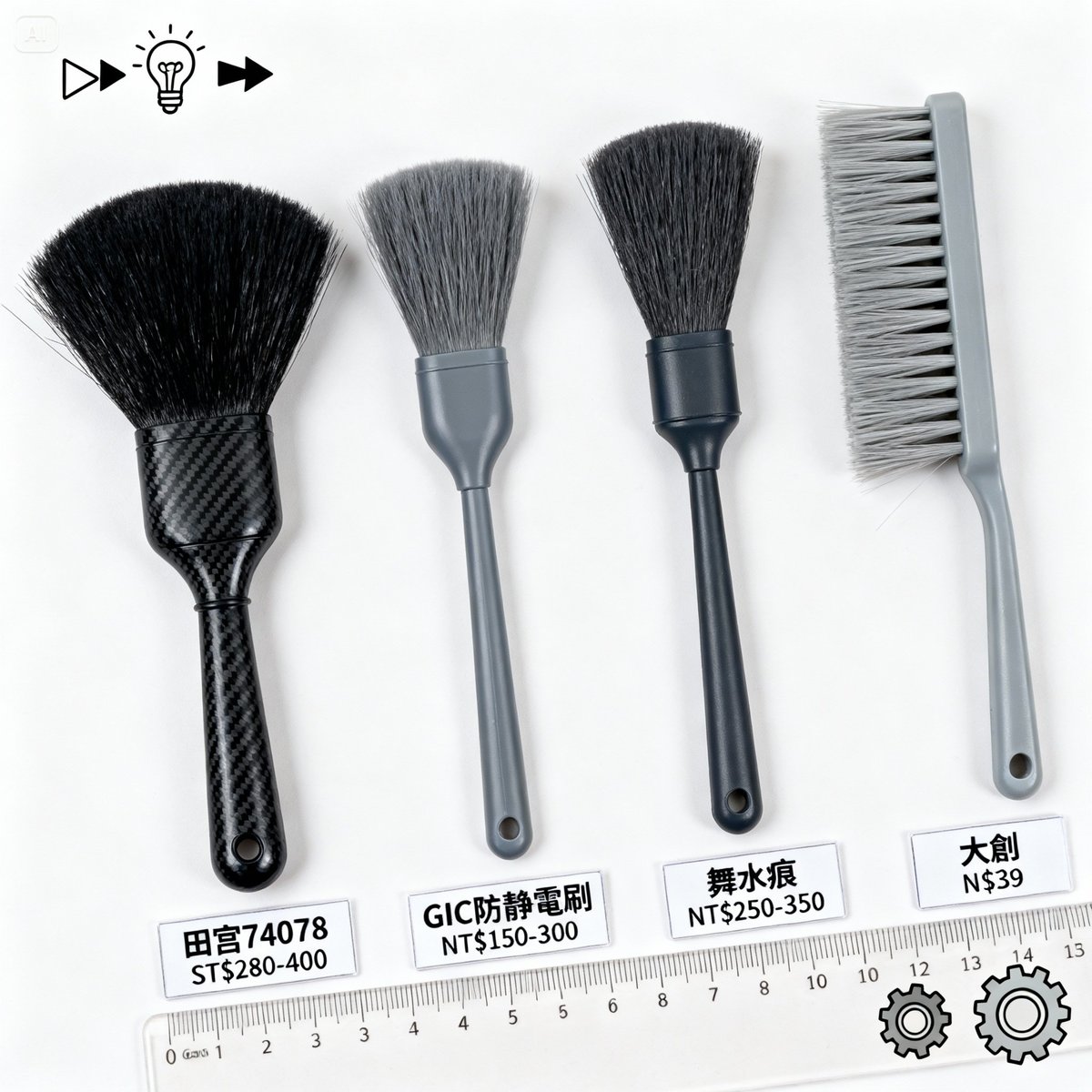
Model dust brush recommendations: 3 products compared
Recommendation 1: TAMIYA 74078 (the first choice of model builders)
Product features:
- Brand: TAMIYA (a major Japanese model maker)
- Model number: 74078 (the most popular model)
- Bristle material: organic conductive fiber + PBT resin bristles (extremely soft)
- Price: mid-to-high price range (go by the price shown by each sales channel)
Why is it the first choice?
- Top-class bristle softness: the bristles are fine and soft, and with normal use they are unlikely to scratch paintwork
- The best anti-static effect: it uses organic conductive fiber
- Extremely durable: still fluffy after 2-3 years of normal use
- Backed by the TAMIYA brand: the most trusted brand in the model world
Suitable for:
- Gundam models (HG / RG / MG / PG)
- Architectural models
- Action figures / figures
- Vinyl records
- Camera bodies
The only drawbacks:
- Higher price
- Many counterfeits (take care to tell genuine from fake)
- Fewer places to buy it
Where to buy (in Taiwan):
- In store: specialist model shops in each area
- Online: search for "Tamiya 74078" on online shopping platforms or online model shops
Telling genuine from fake:
- The bristles are extremely soft (counterfeits are stiffer)
- The printing on the handle is sharp (blurred on counterfeits)
- We suggest buying from a model shop with a good reputation
Recommendation 2: GIC anti-static brush (the second choice)
Product features:
- Brand: GIC
- Bristle material: conductive fiber
- Price: close to Tamiya's (go by the price shown by each sales channel)
Suitable for:
- Beginner model builders
- Straight builds or simple paint jobs
- Practice models
Advantages:
- Decent anti-static effect
- Good durability (1.5-2 years)
Disadvantages:
- The bristles are not as soft as Tamiya's
- Dust removal rate about 85% (Tamiya 90%)
- Lower bristle density
Who should buy it?
- Beginners in model building
- Those who want to try out an anti-static brush first
- Then upgrade to Tamiya once they are sure they like it
Where to buy: model supply shops, online platforms
❌ Not recommended: budget dust-removal brushes from Daiso / Showba
Why not?
A comparison of measured data:
| Item compared | Tamiya | GIC | Daiso |
|---|---|---|---|
| Softness | 10/10 | 7/10 | 3/10 |
| Dust removal rate | 90% | 85% | 60% |
| Anti-static | ★★★★★ | ★★★★☆ | ★★☆☆☆ |
| Risk of scratching | Extremely low | Low | Medium to high |
The problems with Daiso's dust-removal brush:
- The bristles are coarser and stiffer, far less soft than Tamiya's
- It may leave scratches on matte paintwork
- The anti-static effect is extremely limited
- The bristles are sparse and the dust removal rate is low
Where it is acceptable to use it:
- Unpainted straight-built practice models
- Dusting model boxes
- Cleaning the workbench
- Unimportant rough work
Never use it on:
- Carefully painted finished models
- Matte-finish models
- High-priced models (MG / PG / resin kits)
- Water-slide decals
A model is worth anywhere from a few hundred to tens of thousands of NT dollars. The paintwork takes dozens of hours. Risking scratches to save a little money on a brush is a very poor trade.
For detailed tests of budget products, see Daiso / Showba anti-static brushes tested. (Daiso and Showba, also known as Xiaobei, are budget retail chains in Taiwan.)
Summary of recommendations
First choice: Tamiya 74078 (the greatest peace of mind) Second choice: GIC anti-static brush (priced close to Tamiya) A very limited budget: Daiso (only for straight builds or rough work)
Investment advice: model building takes a great deal of time and money. A Tamiya brush lasts for several years, so the cost spread over time is not high. Compared with the value of the models and the time spent building them, it is absolutely worth it.
Model dusting: situations and techniques
Situation 1: Dusting during assembly
When: dust each part before assembling it
Why does it matter?
Parts have manufacturing dust on their surface. Dusting before assembly:
- Makes sure the parts fit together better
- Keeps dust from affecting paint adhesion
- Reduces impurities on the painted surface
Steps:
- After cutting the part off and sanding it
- Brush the surface lightly with a Tamiya anti-static brush
- Blow off the remaining dust with an air blower
- Then assemble or paint
Force: gentle is enough; bare plastic parts are less easily scratched
Situation 2: Dusting before spray painting
When: before spraying primer or color coats
Why does it matter?
Any dust or grease on the surface affects the paint job:
- It forms raised specks
- The paint adheres poorly
- The part has to be sanded again after spraying
Steps:
- Brush the surface of the part lightly with the anti-static brush
- Blow off the dust with an air blower
- Check whether any dust remains
- Spray immediately (to keep dust from settling again)
Environment:
- Spraying in a dust-free environment is best
- Turn off electric fans before spraying
- Avoid windy places outdoors
Situation 3: Caring for assembled, finished models
When: regular dusting every week or every two weeks
Why does it matter?
Finished models on display keep collecting dust. Regular dusting:
- Keeps them looking new
- Keeps dust from building up and becoming hard to clean
- Reduces static attraction
Steps:
- Take the model out of the display cabinet
- First blow off the large dust particles with an air blower
- Brush the surface lightly with a Tamiya anti-static brush
- Brush along the edges of the parts, avoiding the water-slide decals
- In the gaps, touch lightly with the tips of the bristles
- Check again with the air blower
- Put it back in the display cabinet
Force: extremely gentle, like a feather sweeping across
A note on painted surfaces: matte paintwork needs an even gentler touch
Situation 4: Cleaning display-cabinet pieces
When: a deep clean every month
Why is it needed?
Display cabinets collect dust too. The monthly deep clean:
- Cleans the glass and shelves of the display cabinet
- Dusts the models all over
- Checks whether any parts have come loose
Steps:
- Take out all the models
- Wipe the display cabinet with a microfiber cloth
- Dust each model carefully
- Check the condition of the parts
- Arrange them again
Time needed: about 1 hour for 10-15 models
Result: the display cabinet looks new and the models stay in the best condition
💼 Group purchase offers for model studios and clubs
If you are:
- A model studio: professional building / commission services
- A model club: a school or company model club
- A model shop: selling model dusting tools
- A large collector: with 50 or more models
YC Brushes - over 40 years of professional manufacturing experience
- ✅ Tamiya-grade carbon fiber anti-static brushes can be made to order
- ✅ Order quantities are quoted per specification (email us), with discounts for group purchases
- ✅ Bristle length / density / stiffness can be adjusted to your needs
- ✅ Factory-direct wholesale prices, better than retail
Request a quote now
- 📞 Phone: +886-2-2988-2721
- 📧 Email: [email protected]
- 🌐 Online form: Contact YC Brushes
Factory-direct × carbon fiber material × wholesale discounts

Model dusting techniques in detail (illustrated tutorial)
5 key points of basic brushing
Point 1: Brush lightly along the edges of the parts
Model parts have edges and parting lines. Brush in the direction of the edge. Do not brush across the edge.
Take a Gundam shield as an example:
- Brush along the curve of the shield
- Do not cut across the edges
- Keep the bristles from catching on protrusions
Point 2: Use the tips of the bristles for gaps
The gaps in a model cannot be brushed with the whole brush head. Touch the edge of the gap lightly with the tips of the bristles, and blow the dust out with an air blower.
Do not poke at gaps with hard objects such as toothpicks (they may scratch).
Point 3: Avoid water-slide decals and stickers
The edges of water-slide decals are fragile. The bristles may lift the edges.
What to do:
- Sweep extremely gently over decal areas
- Or avoid them completely
- It is safer once a protective clear coat has been applied
Point 4: It works better with an air blower
The best dusting routine:
- First blow off 70-80% of the large dust particles with the air blower
- Deal with the remaining fine dust with the anti-static brush
- Check deep in the gaps again with the air blower
The anti-static brush alone gives a dust removal rate of 70%. With an air blower it reaches 90-95%.
Point 5: An extremely gentle touch
Use even less force than when cleaning clothes. Like a feather drifting past. Only the tips of the bristles need to touch.
Model paintwork is more fragile than fabric fibers. You must be extremely gentle.
Techniques for different types of model
Gundam models (HG / RG / MG / PG)
Characteristics: many parts, rich detail, many protrusions such as antennas
Techniques:
- Take extreme care with the V-fin antenna (the easiest part to snap)
- A lot of dust collects at the shoulder armor joints
- Backpack parts are complicated and need careful brushing
- Brush weapon accessories separately
Painted surfaces:
- Matte surfaces need an extremely gentle touch
- Gloss surfaces can take a slightly more normal touch, but still be gentle
- Metallic paint is the most fragile; avoid brushing it
Action figures:
- Dust builds up easily at the joints
- Use a clothes brush for fabric clothing
- Take extreme care with the paintwork on the face
Architectural models
Characteristics: many flat surfaces, intricate detail, easily broken
Techniques:
- Brush roof tiles in one direction
- Use the tips of the bristles for window details
- Be extremely gentle with trees and plants
- Take care not to snap supporting structures
Vinyl records
Characteristics: the surface is extremely sensitive, and scratches affect the sound quality
Techniques:
- Brush in the direction of the grooves (from the inside out or from the outside in)
- Use the very lightest touch
- A dedicated vinyl brush is better
- The Tamiya anti-static brush can serve as an alternative
Figures / statues
Characteristics: fine paintwork, many protruding parts
Techniques:
- Take extreme care with the paintwork on the face
- Sculpted hair has many gaps; use the tips of the bristles
- Clothing details need patient brushing
- The base can take a more normal touch
3 common mistakes
❌ Mistake 1: Too much force
People assume they have to brush hard to get things clean. In fact it is the bristles and the anti-static effect that do the work, not force.
The risks of brushing hard:
- White scratches appear on matte paintwork
- The edges of water-slide decals lift
- Parts snap
The right way: a touch like a feather, sweeping gently across
❌ Mistake 2: Brushing the same spot back and forth
Worried that it is not clean, people brush the same spot again and again. That actually increases the risk of scratching.
The right way: brush each area in one direction 2-3 times and no more
❌ Mistake 3: Using the same brush for everything
Using the Tamiya brush to clean:
- Precision models
- Computer keyboards
- Desks
- Toolboxes
makes the brush get dirty and worn quickly.
The right way: keep the Tamiya brush for models only. Use a GIC or Daiso brush for other jobs.
For detailed techniques, see How to use and maintain a dust-removal brush.
To learn more about where to buy anti-static brushes, see Where to buy anti-static brushes? 10 purchasing channels with price comparisons and offers and find the channel that suits you best.
Conclusion: invest in a Tamiya anti-static brush and your models will always look new
Model building takes a great deal of time and money. From entry-level HG models to high-end PG models, the price range is wide, and the paintwork takes dozens of hours. A finished model deserves the best care tools.
Recommended choices:
- First choice: TAMIYA 74078 (mid-to-high price range) → the greatest peace of mind, the very best
- Second choice: GIC anti-static brush (priced close to Tamiya) → another option
- Avoid: Daiso / Showba → only suited to straight builds or rough work
Key points of use:
- An extremely gentle touch (like a feather sweeping across)
- Brush along the edges of the parts
- Avoid water-slide decal areas
- It works better with an air blower
- Dust regularly (every week or every two weeks)
Investment advice:
- A Tamiya lasts for several years, so the cost spread over time is not high
- It protects models worth several thousand to tens of thousands of NT dollars
- Compared with the value of the models and the time spent building them, it is absolutely worth it
Care:
- Clean it with an air blower after use
- Rinse it with clean water every month
- Store it hanging up so it does not deform
- Keep it for models only; do not mix uses
Invest in a good brush and your models will always look new. Enjoy the pleasure of building and collecting.
Need a group purchase for a model studio or club? Or a Tamiya-grade carbon fiber brush made to order? Contact YC Brushes: with over 40 years of manufacturing experience, we offer custom carbon fiber anti-static brushes and wholesale discounts.
FAQ
Q1: Is the Tamiya anti-static brush really worth buying? Is the price too high?
Very much worth it! The reasons: (1) durability - 2-3 years with normal use, so the cost spread over time is not high; (2) protecting the model - the loss from a single scratch far exceeds the price of the brush itself (a model is worth a few hundred to tens of thousands of NT dollars and the paintwork takes dozens of hours); (3) dust removal - a 90% dust removal rate, reaching 95% together with an air blower; (4) peace of mind - the bristles are fine and soft and unlikely to scratch paintwork with normal light brushing, though matte surfaces still need an extremely light touch. By comparison: budget models such as Daiso's are cheap, but the bristles are stiff, they scratch easily and they last 3-6 months, so over the long term they are actually poorer value. Model building is a long-term hobby, and investing in good tools definitely pays off.
Q2: What is the difference between GIC and Tamiya? Which should a beginner buy?
The main differences: (1) bristle softness - Tamiya 10/10 (like cat fur), GIC 7/10 (slightly stiffer); (2) dust removal rate - Tamiya 90%, GIC 85%; (3) price - the two sell for similar prices in shops; (4) durability - Tamiya 2-3 years, GIC 1.5-2 years. Our suggestion: as the prices are similar, consider Tamiya first; high-priced models (MG / PG) or fine paintwork → Tamiya is a must; straight builds or simple paint jobs → GIC is enough.
Q3: Can Daiso's budget dust-removal brush be used on Gundam models?
On unpainted straight builds, yes; on fine paintwork, we do not recommend it. The problems with Daiso: (1) coarse, stiff bristles - far less soft than Tamiya's; (2) risk of scratching - it may leave white scratches on matte paintwork; (3) low dust removal rate - about 60%, so many passes are needed; (4) poor anti-static effect - dust is attracted again soon after brushing. Acceptable uses: straight-built practice models / cleaning model boxes / dusting the workbench. Never use it on: finely painted finished models / matte-finish models / high-priced MG / PG models / water-slide decals. The model itself is not cheap, and there is the painting time on top; risking scratches to save a little money on a brush is not worth it.
Q4: How do I use a model dust brush without scratching the paintwork?
5 key techniques: (1) an extremely light touch - like a feather drifting past, with only the tips of the bristles touching, and no pressing; (2) brush in one direction - from top to bottom or along the edges of the parts, without rubbing back and forth; (3) use an air blower - blow off the large particles before using the brush, so that large dust does not scratch; (4) avoid water-slide decals - be extremely gentle on decal areas or avoid them completely, as the edges lift easily; (5) limit the passes - 2-3 passes per area are enough; do not over-brush. The situations most likely to cause scratches: too much force / brushing back and forth repeatedly / bristles that are too stiff / not using the air blower first. How to practice: practice first on a straight-built model or a model box, and use the brush on fine pieces once you have the feel of "gentle".
Q5: What else can the Tamiya anti-static brush be used on besides models?
Many things: (1) model-related - Gundam models / architectural models / action figures / figures / Nendoroids / prize figures and blind-box toys; (2) electronic products - camera bodies (not lenses) / mobile phones / game consoles / monitor bezels; (3) vinyl records - brush in the direction of the grooves, with good dust removal; (4) housings of precision instruments - microscope bodies / housings of measuring instruments. Not suitable for: (1) the inside of a computer case - its anti-static rating is not sufficient, so use a GIC or an ESD-grade brush; (2) clothes - too wasteful, use a dedicated clothes brush; (3) rough items - toolboxes / shoe cabinets, which dirty the brush quickly. Our suggestion: keep the Tamiya for precision items such as models, and use a GIC or a budget brush for other jobs, to extend the life of the Tamiya.
Q6: How often should models be dusted?
It depends on how they are displayed and on the environment. In a display cabinet (enclosed): dust every 2-3 weeks, as dust builds up more slowly; on open display (shelves): dust once a week, as they are directly exposed to airborne dust; dusty environments (ground floor / next to a road): once a week; low-dust environments (high floors / closed rooms): once every two weeks. The rule of thumb: when dust is visible on dark parts, it is time to dust. During assembly: dust each part before assembling it; before spray painting: always dust; finished models: regular care. Too seldom: the dust becomes thick and hard to clean, and static attracts even more; too often: the risk of scratching increases and the brush wears out quickly. Our suggestion: make a fixed habit of dusting every week or every two weeks, 10-15 minutes each time, and your models will always look new.
Q7: How do I care for a Tamiya anti-static brush? Can it be washed with water?
It can be washed with water, but in the right way. Everyday cleaning (after every use): tap the handle lightly to shake off the dust → blow off what remains with an air blower → store it hanging up. Deep cleaning (once a month): rinse with clean water at room temperature (not hot water) → press gently to squeeze out the dirt (do not wring) → shake hard to remove the water → hang it to dry in the shade for 2-4 hours. Do not: (1) use detergent - it destroys the anti-static effect; (2) use a hair dryer - high heat damages the bristles; (3) lay it flat under weight - the bristles deform permanently; (4) wring it hard - the bristles break. Storage environment: room temperature 15-30°C, humidity 40-70%, away from light, ventilated. With correct care a Tamiya lasts 2-3 years; with the wrong care it is ruined in half a year.
Q8: Are there discounts for group purchases by model studios or clubs?
Yes! Bulk purchases qualify for factory-direct wholesale discounts. YC Brushes offers professional options: (1) custom carbon fiber brushes - Tamiya-grade bristles can be made to order, with softness / density / length adjusted to your needs; (2) order quantities - quoted per specification, so please email us with your group's requirements; (3) wholesale discounts - the larger the quantity, the higher the discount, cheaper than a retail Tamiya; (4) stable quality - over 40 years of manufacturing experience, with consistent quality from batch to batch. Suitable for: model studios (professional commission work) / model clubs (school or company clubs) / model shops (selling tools) / large collectors (50 or more models). A real example: a university model club made a group purchase for 30 people, and the unit price per brush was 30% cheaper than retail. Inquiries: phone +886-2-2988-2721 or the online form Contact YC Brushes.
Q9: How do I tell a genuine Tamiya anti-static brush from a fake when buying online?
5 points to check: (1) packaging - genuine products have sharp printing; counterfeits have blurred printing and off colors; (2) bristle softness - genuine products are extremely soft, like cat fur; counterfeits are stiffer and rougher; (3) printing on the handle - on genuine products the word "TAMIYA" is sharp; on counterfeits it is blurred or misspelled; (4) price - genuine products are in the mid-to-high price range; be wary of prices clearly below the going rate; (5) seller ratings - choose a specialist model shop with a good reputation. Buying advice: physical model shops are the safest; when buying online, choose a specialist online model shop and avoid sellers of unknown origin; always be suspicious of a price that is too low. If you do end up with a fake: the bristles are clearly stiffer, dust removal is poor and it may scratch your models, so the loss outweighs the gain.
Q10: What is the difference between the Tamiya anti-static brush and a dedicated vinyl record brush?
The main differences are the intended use and the bristle material. Dedicated vinyl brush: the bristles are often goat hair or carbon fiber, extremely fine and longer, designed for brushing in the direction of the grooves, and in the high price range. Tamiya 74078: organic conductive fiber and PBT resin bristles, designed for dusting models, in the mid-to-high price range. Compatibility: the Tamiya can serve as an alternative to a vinyl brush and removes dust well, but a dedicated brush is better; a vinyl brush can be used on models, but it costs more and the design is not an exact fit. Our suggestion: vinyl enthusiasts should buy a dedicated brush; model builders should buy the Tamiya; on a limited budget, the Tamiya can cover both.