Do you want to develop a toothbrush under your own brand but do not know where to start?
The tufting process looks complicated, but once you have the right steps you can move smoothly from design to volume production.
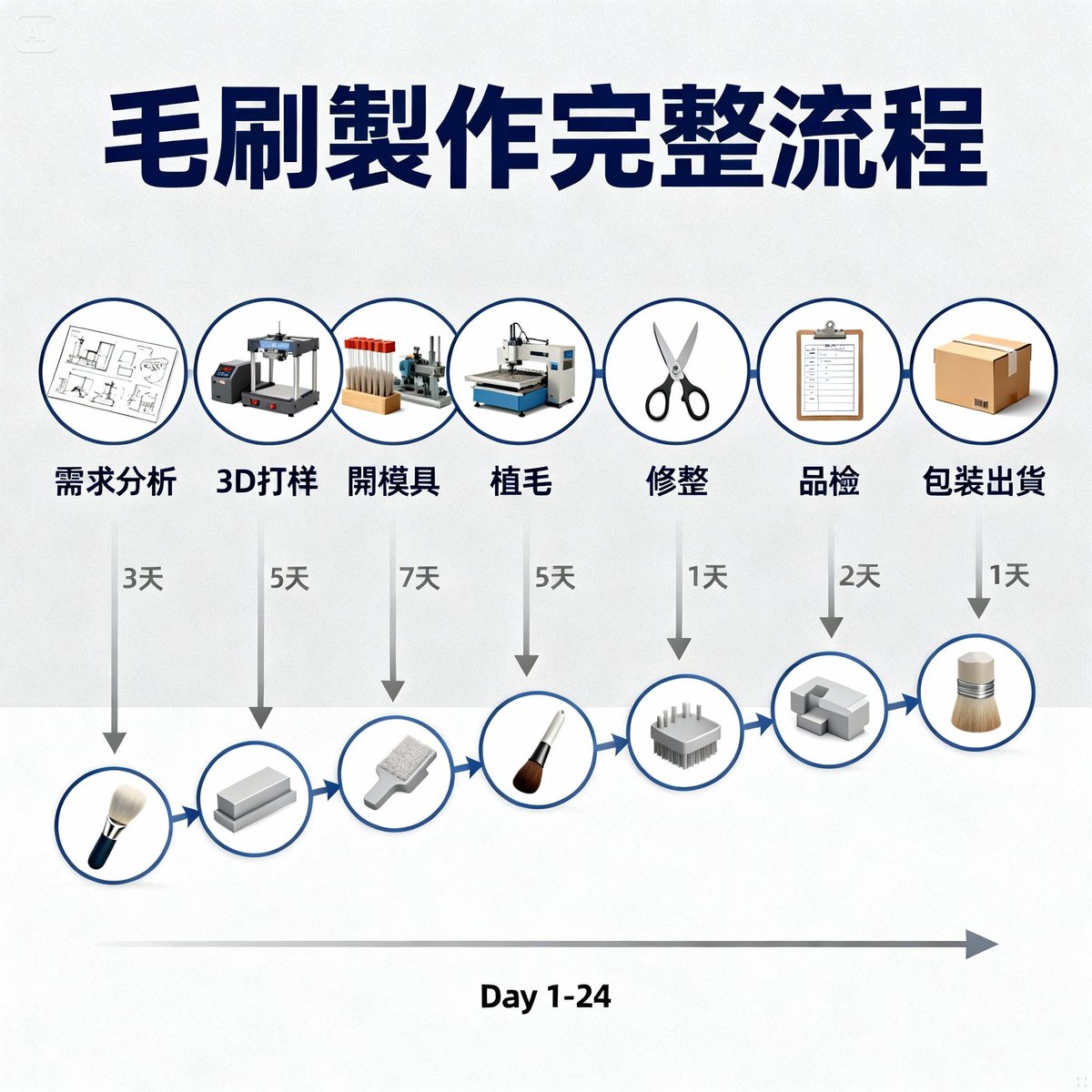
This article breaks the toothbrush tufting process down into its 7 steps, from requirements consultation, 3D sampling, tooling and trial production to formal volume production, and makes the key points, schedule and things to watch at every stage fully transparent. With over 40 years of experience, YC Brushes has helped more than 500 customers develop products successfully, so you can avoid the detours.
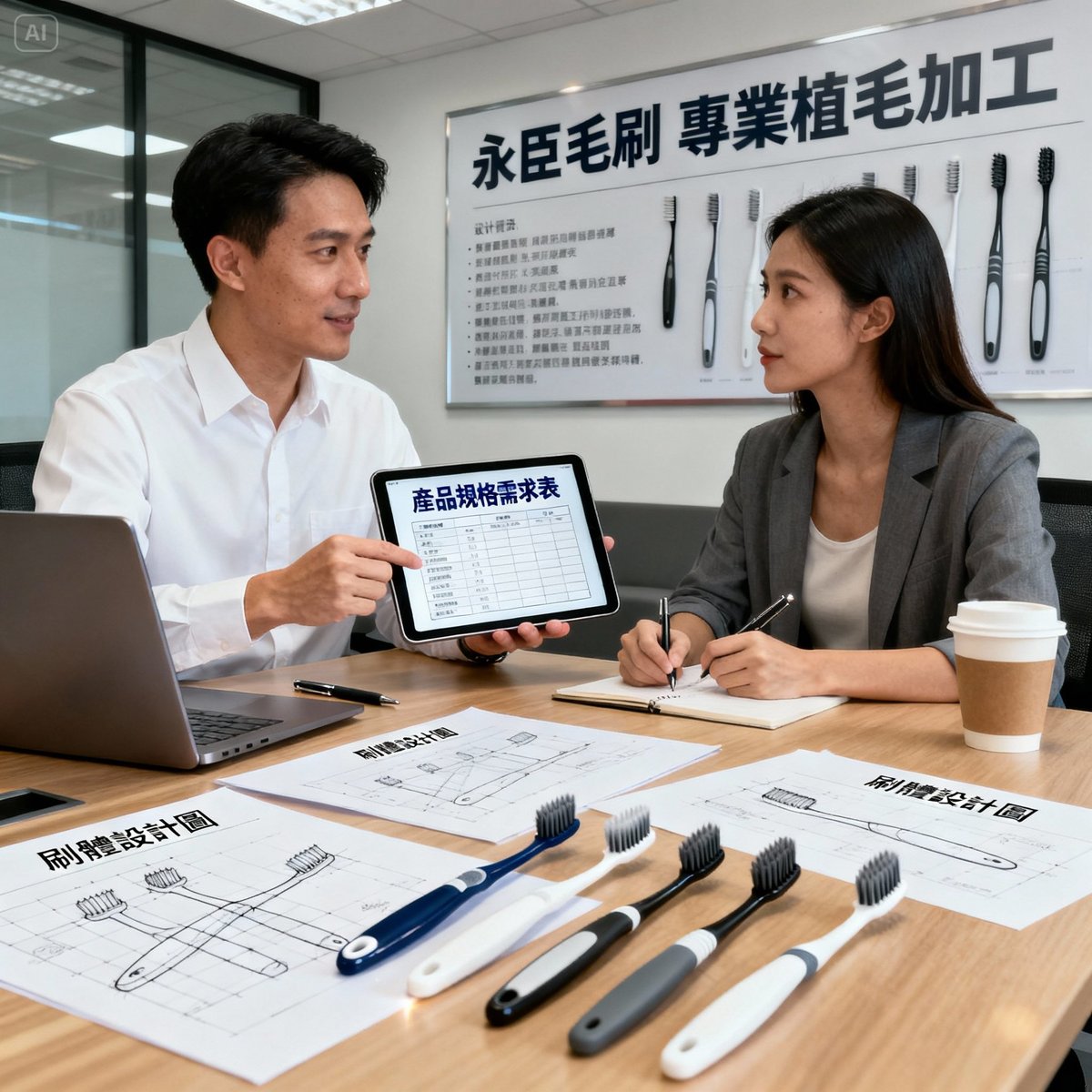
Step 1 - Requirements consultation and sample analysis (1-3 days)
The first step is the most critical foundation. Thorough communication avoids 80% of the problems that come later.
Information the customer needs to provide
A professional tufting factory will find out about your requirements in detail, including:
Product use and positioning:
- Toothbrush type (adult / children's / sensitive / orthodontic)
- Target market (Taiwan / Japan / United States / Europe)
- Price positioning (budget / mid-range / high-end)
- Planned sales channels (e-commerce / physical stores / wholesale)
Specification and quantity:
- Filament stiffness required (soft / medium / hard)
- Preferred brush body color and material
- Special functional requirements (such as antibacterial or eco-friendly materials)
- Expected order quantity (affects the MOQ and unit price)
Budget and lead time:
- Budget range (including the tooling fee)
- Desired lead time (a surcharge can be negotiated for rush orders)
- Payment terms
Reference samples or drawings:
- A sample of a competing product (the most direct)
- A design drawing or 3D file
- Photos or a hand-drawn sketch
Preliminary assessment and quote
After receiving the requirements, YC Brushes will provide the following within 24 hours:
Technical feasibility assessment:
- Whether the design can be realized
- Technical solutions for special requirements
- Advice on material selection
Preliminary quote:
- An estimate of the tooling fee (depending on complexity)
- A unit price range (depending on quantity)
- An estimated development schedule
- An explanation of the MOQ
Professional advice:
- Suggestions for optimizing materials (balancing quality and cost)
- Suggestions for adjusting the specification (to improve production efficiency)
- Market trends (from over 40 years of experience)
Step 2 - Material selection and specification confirmation (2-3 days)
Once the requirements are confirmed, the project moves to material selection and detailed specification. This step decides the quality and cost of the toothbrush.
Confirming the filament specification
Material selection:
| Material | Characteristics | Suitable products |
|---|---|---|
| Nylon PA612 | Balanced, the most commonly used | Ordinary toothbrushes |
| PBT | High-end, good recovery | High-end toothbrushes |
| Hog bristle / horsehair | Natural, a distinctive feel | Specialty products |
| Bamboo charcoal fiber | Eco-friendly, antibacterial | Environmental positioning |
Stiffness selection:
- Soft
- Medium
- Hard
(The international standard ISO 22254 measures toothbrush filament stiffness by how much a tuft resists bending under load.)
Color selection:
- Single-color filament (the lowest cost)
- Two-color filament (adds visual appeal)
- Gradient-color filament (high-end products)
Filament treatment:
- End-rounding (the filament tips are smooth and do not scratch the gums)
- Wave cut (increases the cleaning contact area)
- Spiral cut (a special cleaning effect)
Confirming the brush body specification
Material selection:
- PP (polypropylene): low cost, the most commonly used, NT$3-5 per piece
- ABS: good look and feel, can be electroplated, NT$5-8 per piece
- Bamboo / wood: environmental positioning, NT$8-15 per piece
Design confirmation:
- Brush body length, width and thickness
- Handle shape and non-slip design
- Number and layout of holes
- Brush head size and angle
Special features:
- Added antibacterial material
- Tongue cleaner design
- Hanging hole design
- Position of an embossed logo or text
Confirming the packaging specification
Packaging options:
- Clear PE bag: NT$0.2-0.5 each (the lowest cost)
- Paper box: NT$1-3 each (good look and feel)
- Blister pack: NT$2-5 each (good for display)
Printing requirements:
- Logo print position
- Product information text
- Barcode position
- Multilingual requirements
Specification confirmation documents
Once every specification is confirmed, YC Brushes provides:
- A detailed specification confirmation sheet
- Material samples (so the feel can be confirmed by touch)
- A final quotation (with every line item)
- A development schedule
After the customer signs and returns the confirmation sheet, the project moves to the next step.
Step 3 - 3D sampling and confirmation (3-5 days)
3D sampling is the most important risk control step, because it confirms the design before tooling.
Why 3D sampling matters
Why is 3D sampling needed?
Tooling usually costs NT$20,000-80,000. If there is a problem with the design, the tooling fee is wasted.
3D sampling takes only 3-5 days and costs far less than making the tooling again, so it lowers the risk effectively.
Advantages of 3D sampling:
- Fast: finished in 3-5 days, far faster than tooling (15-20 days)
- Low cost: YC Brushes offers a free 3D sampling service
- Can be revised: when a problem is found, the design can be adjusted immediately
- Physical confirmation: you can actually hold it and confirm the grip and dimensions
- Lower risk: avoids finding out that the design is not ideal only after the tooling is made
The 3D sampling process
Step 1: 3D modeling
- A 3D model is built from the confirmed specification
- It includes the brush body shape and hole layout
- All dimensions and details are confirmed
Step 2: 3D printing the brush body
- The brush body is made on a 3D printer
- Time: 1-2 days
- Material: resin (close to the feel of PP)
Step 3: Hand tufting
- Filament is tufted by hand into the 3D-printed brush body
- Time: 1-2 days
- The filament is laid out to the specification (stiffness, color, quantity)
Step 4: Sample confirmation
- The sample is sent to the customer
- The customer actually holds it and tries it
- Every detail is confirmed
Step 4 - Tooling development and trial run (15-20 days)
After the 3D sample is confirmed, the project formally enters the tooling development stage.
The tooling development process
Tooling design:
- The tooling is designed from the confirmed 3D sample
- Draft angles and parting lines are considered
- Stability in volume production is ensured
- Time: 3-5 days
Tooling fabrication:
- The tool steel is CNC machined
- High precision is required (deviation below 0.05mm)
- Time: 10-12 days
- Cost: NT$20,000-80,000 (depending on complexity)
Tooling assembly and adjustment:
- The parts of the tooling are assembled
- The clearances are adjusted
- Time: 2-3 days
Trial run and adjustment
First trial run:
- Brush bodies are injection molded with the production tooling
- Whether they release from the mold smoothly is checked
- Dimensional accuracy is confirmed
- Appearance is checked
Troubleshooting:
Common problems and solutions:
- Dimensional deviation: adjust the mold temperature or pressure
- Surface defects: optimize the injection parameters
- Difficult release: adjust the draft angle
- Flash: rework the parting line of the tooling
Second trial run:
- Another trial run after the adjustments
- Confirms the problems are solved
- Usually complete within 2-3 runs
Confirming the trial-run samples
YC Brushes sends the trial-run samples to the customer for confirmation:
- Actual production brush bodies (not 3D printed)
- Dimensions, appearance and feel are confirmed
- Whether they meet expectations is confirmed
- The customer signs and returns the confirmation sheet
About the tooling fee
Fee range:
- Simple brush body: NT$20,000-35,000
- Ordinary brush body: NT$35,000-50,000
- Complex brush body: NT$50,000-80,000
- Very complex brush body: NT$80,000 and above
The fee includes:
- Tooling design fee
- Tooling material cost (high-quality tool steel)
- Machining cost
- Trial-run cost (including material and labor)
Tooling ownership:
- Once the customer has paid the tooling fee, the tooling belongs to the customer
- YC Brushes keeps the tooling in custody on the customer's behalf
- No tooling fee for later orders
- The tooling life is usually enough to produce 500,000 to 1,000,000 pieces
Step 5 - Tufting machine setup and trial production (5-7 days)
When the tooling is finished, the project moves to the tufting machine setup stage. This step needs each parameter to be tuned precisely.
Setting the tufting machine parameters
Tufting is a highly specialized technique and needs precise tuning:
Depth setting:
- The depth to which the filament is set (usually 8-12mm)
- Ensures retention of ≥15N
- Avoids setting the filament so deep that it damages the brush body
Angle setting:
- The angle at which the filament is set (perpendicular or angled)
- Deviation kept within
±1degree - Special designs may need tufting at several angles
Tuft count and density setting:
- The number of filaments set in each hole
- Control of the overall filament density
- Ensures evenness and consistency
Speed setting:
- The running speed of the tufting machine
- Balances efficiency and quality
- High-speed tufting: 100-200 tufts per minute
First trial production
Trial quantity:
- A first batch of 50-100 pieces
- Used for quality inspection and confirmation
- Not counted in the formal order quantity
Trial production process:
- Brush bodies are injection molded with the production tooling
- The production filament specification is used
- The tufting machine tufts automatically
- Manual trimming (removing excess filament)
- Quality inspection
Step 6 - Formal volume production and quality inspection (10-15 days)
After the trial production is confirmed, the project formally enters volume production.
Production scheduling
Production plan:
- Scheduled according to the order quantity
- Estimated number of production days (depending on quantity)
- Raw material purchasing and preparation
- Allocation of machine capacity
Volume production schedule:
- 5,000 pieces: 7-10 days
- 10,000 pieces: 10-12 days
- 50,000 pieces: 12-15 days
- 100,000 pieces: 15-20 days
The volume production process
Step 1: Injection molding the brush bodies
- The production tooling is used
- 500-1,000 brush bodies can be produced per hour
- Brush body quality is sampled in every batch
Step 2: Brush body inspection and preparation
- Flash is removed from the brush bodies
- The brush bodies are checked for completeness
- The brush body surface is cleaned
- Ready for tufting
Step 3: Automatic tufting
- The fully automatic tufting machine runs
- Speed: 100-200 tufts per minute
- One toothbrush takes about 1-2 minutes to complete
- The machine detects abnormalities automatically
Step 4: Manual trimming
- Excess filament is removed
- The filament is trimmed even
- Loose filament fragments are cleared from the brush body
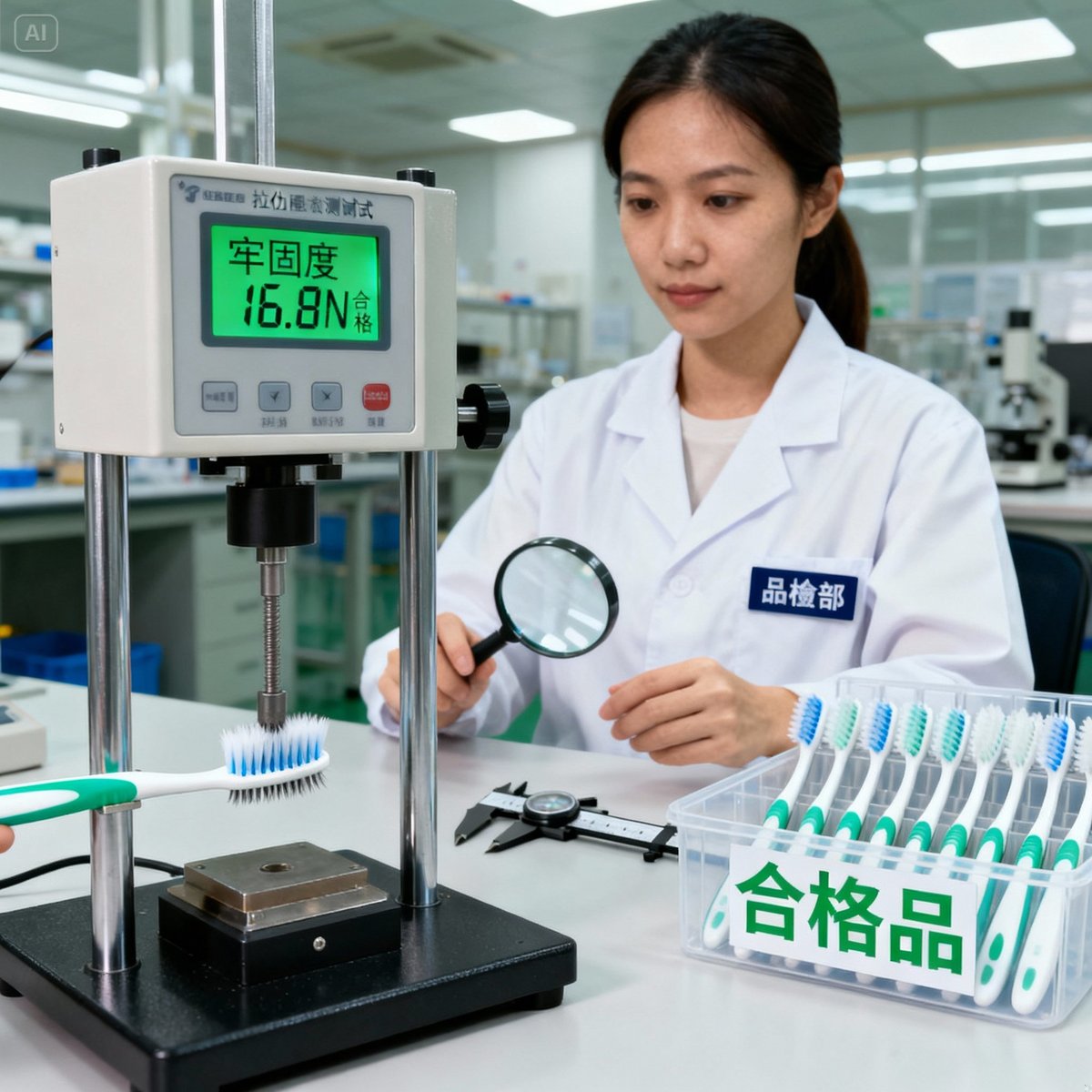
Step 5: Quality inspection
- First article inspection (the first 5-10 pieces of each batch)
- In-process sampling (1 piece sampled from every 500 pieces)
- Final inspection (100% visual before shipment)
The quality control process
The three inspection checkpoints at YC Brushes:
Checkpoint 1: First article inspection
- When: before each batch starts
- Quantity inspected: the first 5-10 pieces
- Items inspected: retention, height, density, appearance
- Standard: volume production continues only when 100% pass
- Handling of failures: the parameters are adjusted and the first article inspection is repeated
Checkpoint 2: In-process sampling
- When: during production
- Frequency: 1 piece sampled from every 500 pieces
- Items inspected: retention, height, appearance
- Purpose: to ensure the process stays stable
- Handling of abnormalities: the machine is stopped and checked as soon as a problem is found
Checkpoint 3: Final inspection
- When: after all products are finished
- Method: 100% visual inspection
- Items inspected: appearance, shedding, broken filament, brush body defects
- Failure rate: below 2% (the industry standard is 3-5%)
- Handling of failures: defective pieces are picked out and not counted in the order quantity
Quality commitment
The quality commitment of YC Brushes:
- Defect rate: below 2%
- Inspection report: a complete report with every batch
- Quality standard: retention ≥15N, height deviation ≤
±0.5mm - Handling of failures: redone free of charge, with no extra cost
- After-sales service: free returns and exchanges for quality problems
Step 7 - Packaging and shipping (2-3 days)
When production is complete, the last stage is packaging and shipping.
Packaging options
Standard PE bag:
- Clear plastic bag
- Cost: NT$0.2-0.5 each
- Suitable for: wholesale and OEM orders
Paper box:
- Printed paper box
- Cost: NT$1-3 each
- Suitable for: retail products
Blister pack:
- Clear blister shell plus backing card
- Cost: NT$2-5 each
- Suitable for: high-end products, display
Custom printing:
- Logo printing
- Product information text
- Barcode printing
- Multilingual packaging
Shipping methods
Main island of Taiwan:
- Home delivery: arrives in 1-2 days, freight NT$500-2,000
- Freight company: for large orders, freight calculated by weight
- Self-pickup: you are welcome to collect from the factory
Overseas shipments:
- Sea freight: suited to large orders, 1-2 months
- Air freight: suited to rush orders, 1-2 weeks
- Courier: small orders, 3-5 days
Delivery documents
When shipping, YC Brushes provides:
- Delivery note: lists the items and quantities in detail
- Invoice: an official invoice
- Inspection report: includes inspection data such as retention and height
- Certificate of origin: (for export)
- SGS test report: (at the customer's request)
After-sales service
Quality assurance:
- Returns and exchanges within 7 days of receiving the products
- Quality problems handled free of charge
- A full refund for defects not caused by misuse
Benefits on later orders:
- No tooling fee from the second order on
- Long-term customers enjoy a 5-10% price discount
- Priority in the production schedule
Technical support:
- Advice on product use
- Market trends
- Suggestions for new product development
💡 Ready to start your toothbrush project?
Contact YC Brushes now for a professional assessment and quote, or learn about our full range of services. Over 40 years of experience you can rely on.
Process overview and schedule planning
Now that the 7 steps are clear, here is the overall schedule.
Schedule overview
| Step | Content | Estimated time |
|---|---|---|
| Step 1 | Requirements consultation and sample analysis | 1-3 days |
| Step 2 | Material selection and specification confirmation | 2-3 days |
| Step 3 | 3D sampling and confirmation | 3-5 days |
| Step 4 | Tooling development and trial run | 15-20 days |
| Step 5 | Tufting machine setup and trial production | 5-7 days |
| Step 6 | Formal volume production and quality inspection | 10-15 days |
| Step 7 | Packaging and shipping | 2-3 days |
Total schedule for a first development: The step durations above are typical. The overall schedule for your project is quoted per specification; please email us with your requirements.
From the second order on
A much shorter schedule:
The tooling already exists, so steps 3-4 are skipped and the schedule is much shorter:
| Step | Content | Time |
|---|---|---|
| 1 | Confirm the order and specification | 1-2 days |
| 2 | Formal volume production | 10-15 days |
| 3 | Packaging and shipping | 2-3 days |
Total schedule for a second order: The step durations above are typical. The overall schedule for your project is quoted per specification; please email us with your requirements.
Handling rush orders
If you have a rush order:
A surcharge can be negotiated to shorten the lead time:
- Normal lead time: standard price
- Rush order: a surcharge of 10-20%
- Very urgent order: a surcharge of 20-30%
- Rush lead times are quoted per specification; please email us with your requirements
Limits on rush orders:
- Existing tooling must be used (volume production or contract tufting)
- It depends on the factory's capacity at the time
- We suggest getting in touch early
Recommended related articles
Conclusion: a transparent process you can work with confidently
Now that you know the 7 steps of tufting in full, you should have a clear picture of the whole development process.
The process advantages of YC Brushes
Transparent:
- Every step is explained clearly
- Clear schedule commitments
- Open, transparent prices
- No hidden charges
Professional:
- Over 40 years of brush-making experience
- 500+ successful cases
- A professional team of engineers
- Complete quality control
Flexible:
- Free 3D sampling
- Negotiable order quantities, quoted per specification (email us for a quote)
- Flexible handling of rush orders
- Benefits for long-term customers
Start your project
If you are planning the development of a toothbrush product:
First: get in touch
- Describe your requirements and budget
- Provide a reference sample or design drawing
- YC Brushes replies within 24 hours
Second: free 3D sampling
- Confirm that the design is feasible
- Hold it in your hand to confirm
- Lower the tooling risk
Third: formal development
- Sign the contract
- Enter the 7-step process
- Lead time quoted per specification; please email us with your requirements
Want to know more about the technology and materials of toothbrush tufting? See our complete guide to toothbrush tufting, which covers everything from technology, materials and process to prices.
💡 Ready to begin your toothbrush project?
Contact YC Brushes now to request free 3D sampling and a professional assessment. Over 40 years of experience and a transparent process you can rely on.
Or go to the blog to read more specialist articles and learn more about brush manufacturing.
References
- ISO 9001, "Quality management systems - Requirements", international standard (2026)