Do you know how the neat rows of filament on the toothbrush you use every day are "planted" there?
Tufting is the core operation in toothbrush manufacturing, and it is also the key step that decides product quality.
Whether you are a brand owner developing a new product, a trading company looking for a reliable contract manufacturer, or a manufacturer wanting to outsource the tufting operation, this complete guide can answer your questions.
YC Brushes has over 40 years of brush-making experience. From volume production to custom work, and from contract tufting to full manufacturing, we provide a professional one-stop service. This article sets out the technology, materials, process and prices of tufting in full, and how to choose a reliable tufting factory.
💡 Want a quick read on your project requirements and a quote?
Contact YC Brushes now and let a professional team with over 40 years of experience tailor the tufting solution that suits you best. A free assessment and quote are provided within 24 hours.
What is tufting? (Definition and scope of application)
Tufting, also known in the Taiwanese trade by a couple of colloquial names such as "bristle setting", is the specialized process of fixing filament into the holes of the brush body.
The technique sounds simple, but in practice it needs precise machines and a great deal of setup experience.
The core technical features of tufting
The key to tufting lies in three elements:
- Precision: the filament must be set perpendicular, with the angle deviation kept within
±2degrees - Retention: the pull-out force of the filament must reach 15N (newtons) or more, so that it does not come out in long-term use
- Consistency: the height, density and angle of every tuft must stay stable
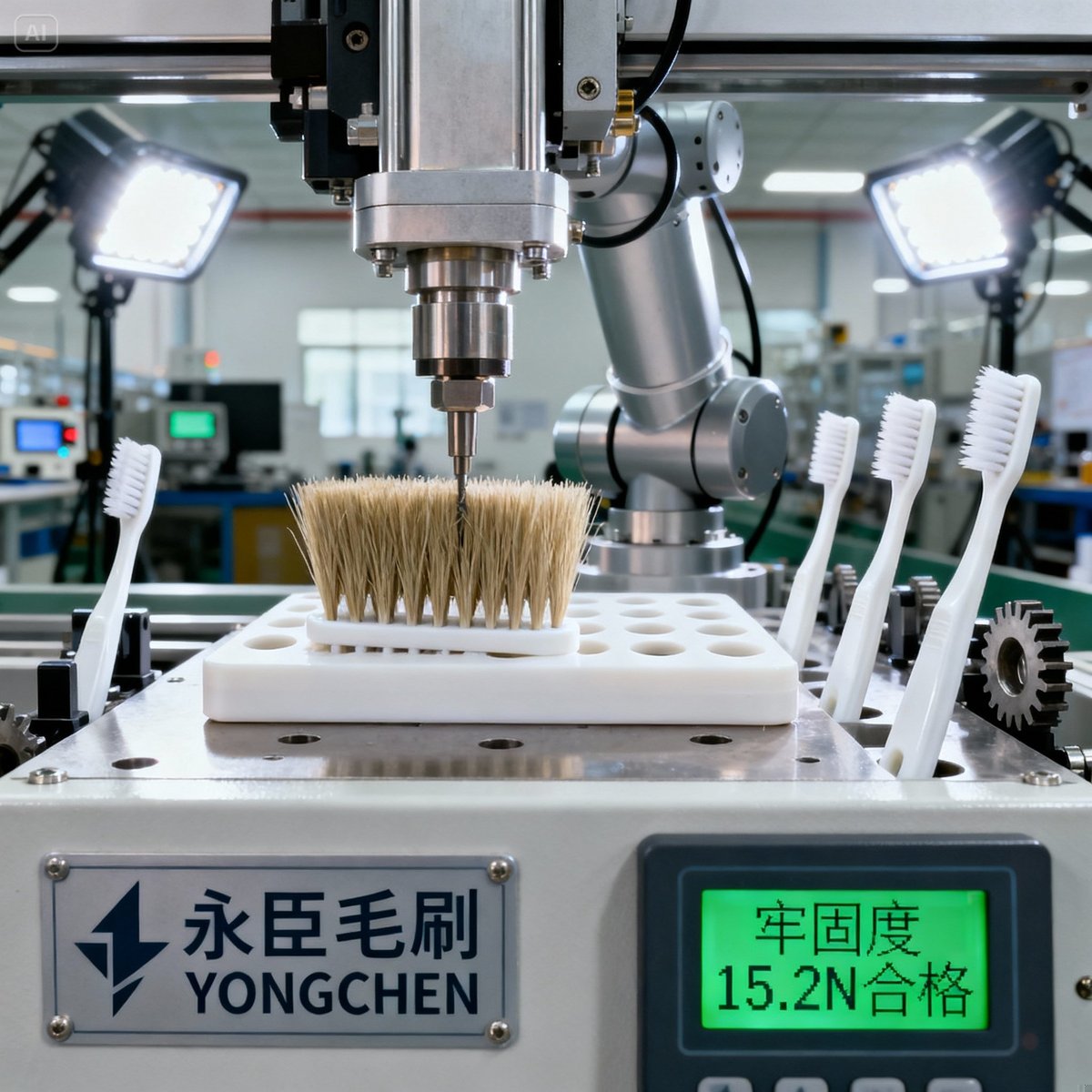
YC Brushes uses fully automatic tufting machines imported from Japan, together with over 40 years of setup experience, to make sure every toothbrush meets international quality standards.
The three types of tufting service
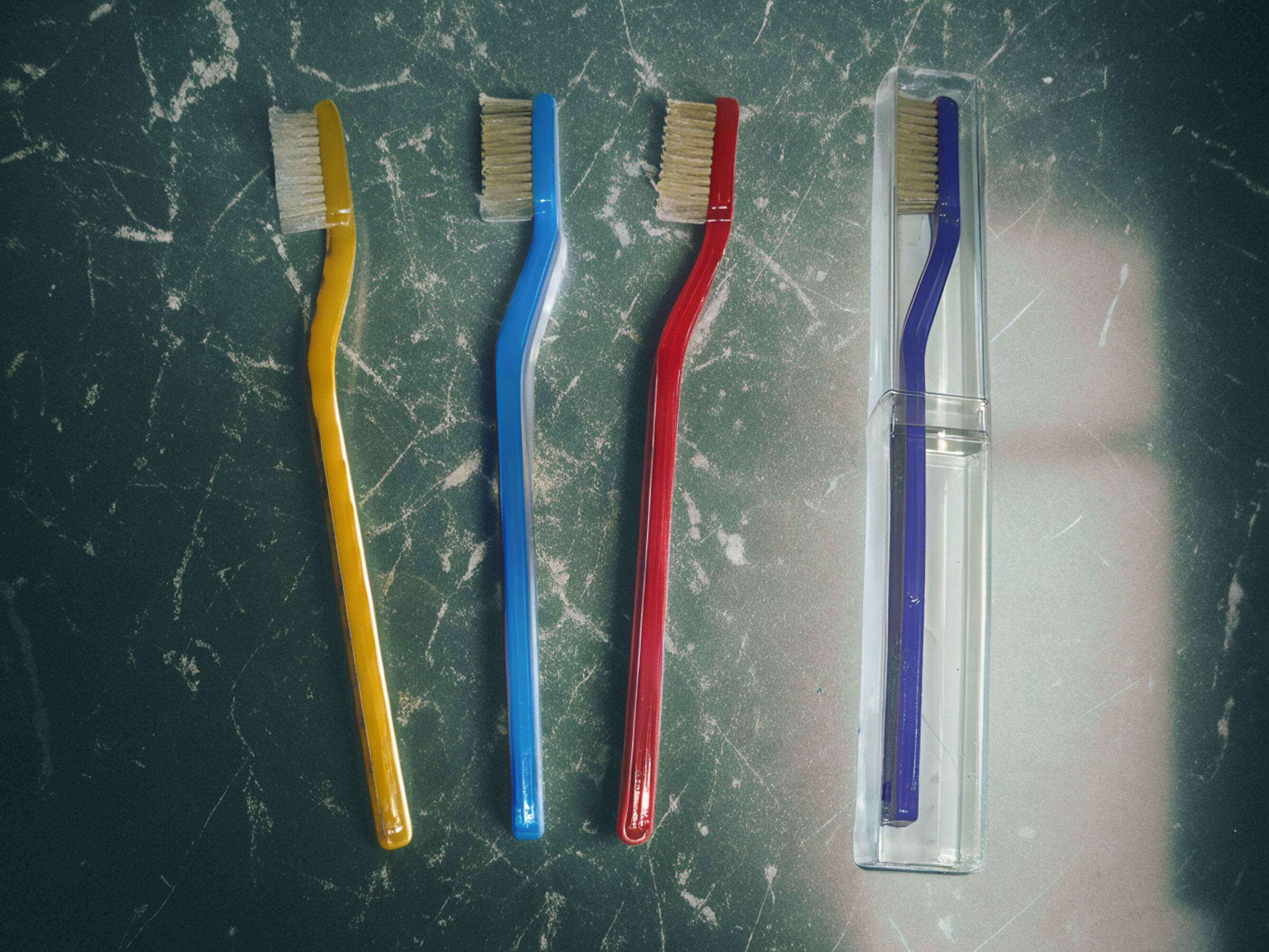
Depending on what the customer needs, tufting can be divided into three service models.
Understanding how the three differ helps you choose the way of working together that suits you best.
1. Volume-production brushes (standard specifications, fast shipment)
What is a volume-production brush?
A volume-production brush is a product for which the factory already has tooling and a standard specification, so the customer can order volume production directly.
Who it suits:
- Trading companies that need fast shipment
- Brand owners testing the market response
- Distributors placing replenishment orders
Service description:
- Uses the factory's existing brush body tooling
- Standard filament specifications (soft / medium / hard)
- Filament color and packaging can be adjusted
- No tooling fee to pay
Advantages:
- Lead time: quoted per specification; please email us with your requirements
- Favorable price: no tooling amortization, so the unit price is the lowest
- Low risk: no tooling investment, so small-quantity tests are feasible
MOQ and price:
- Order quantity and lead time: quoted per specification; please email us with your requirements
- Unit price: NT$8-15 per piece (depending on quantity)
Note:
The limitation of volume-production brushes is that the shape of the brush body and special filament layouts cannot be customized. If you need a unique product design, we suggest the "custom tufting" service below.
2. Custom tufting (from design to volume production)
What is custom tufting?
Custom tufting means designing the brush body and developing the tooling from scratch according to the customer's requirements, to create an exclusive product.
Who it suits:
- Brand owners developing a new product line
- A unique appearance is needed
- Special functional requirements (such as children's toothbrushes or toothbrushes for sensitive teeth)
- Building brand differentiation
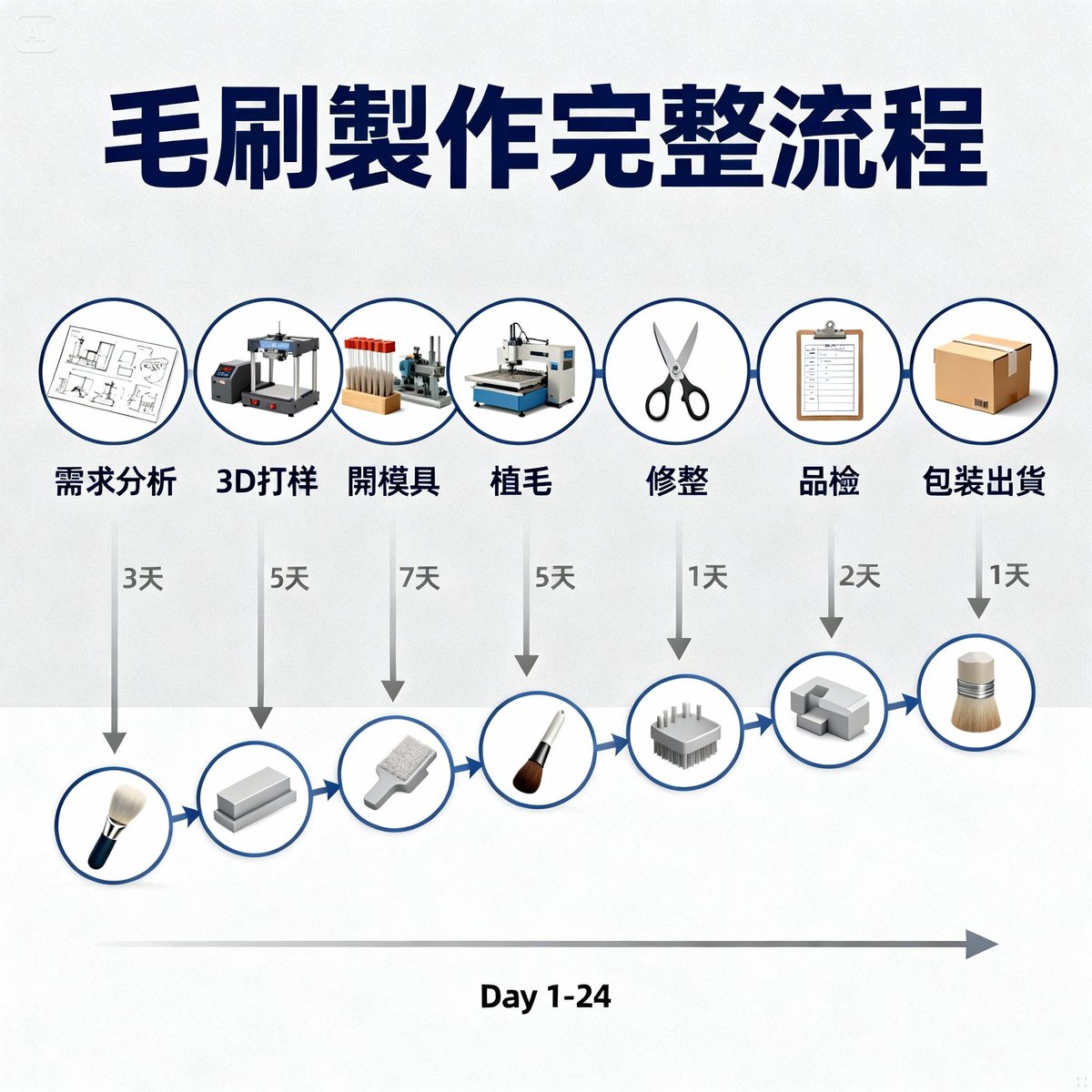
The full development process (5 steps):
Step 1: Requirements consultation
- Discuss the product's use, target market and budget
- Provide a reference sample or design drawing
- YC Brushes gives professional advice and a preliminary quote
Step 2: 3D sample confirmation
- A 3D-printed sample (finished in 3-5 days)
- The customer confirms the dimensions, grip and filament layout
- Lowers the risk in the later tooling stage
Step 3: Tooling development
- Brush body tooling fabrication (15-20 days)
- A trial run to confirm quality
- Tooling fee: NT$20,000-80,000 (depending on complexity)
Step 4: Tufting machine setup
- Set the filament depth, angle and number of tufts
- A first trial run of 50-100 pieces
- Quality inspection and adjustment
Step 5: Formal volume production
- Volume production and quality control
- Packaging and shipping
- An inspection report is provided
MOQ and price:
- Order quantity: quoted per specification (the first order includes the tooling fee)
- Unit price: NT$12-25 per piece (depending on the specification)
- Tooling fee: NT$20,000-80,000 (one-time; free for later orders)
- Lead time for first development and for repeat orders: quoted per specification; please email us with your requirements
The YC Brushes advantage:
YC Brushes offers a free 3D sampling service that helps customers confirm the design before tooling and avoid wasting the tooling fee. Our team of engineers with over 40 years of experience gives professional advice and assists throughout, from material selection to cost optimization.
💡 Ready to develop your custom toothbrush product?
See the full service process, or contact us now to discuss your project requirements.
3. Contract tufting (the tufting operation only)
What is contract tufting?
Contract tufting is the service model in which the customer supplies semi-finished brush bodies and YC Brushes is responsible only for the tufting operation.
It is the most economical and most flexible way of working together, and it especially suits customers who already have a brush body supply chain.
Who it suits:
- You already have brush body tooling or a supplier
- You want to lower the overall manufacturing cost
- You need the flexibility to adjust the filament specification
- You want better inventory management
Core advantages:
Advantage 1: Much lower cost
- Saves the brush body manufacturing cost and the tooling amortization
- Lowers the overall cost by 30-50%
- You pay only for the tufting operation
Advantage 2: High production flexibility
- One brush body can be paired with different filament (soft / medium / hard)
- Several versions can be launched quickly to test the market
- Filament color can be adjusted flexibly
Advantage 3: Better inventory management
- Brush bodies can be stocked centrally
- Tufting is done to order, right when it is needed
- Lowers the pressure on inventory turnover
MOQ and price:
- Order quantity and lead time: quoted per specification; please email us with your requirements
- Unit price: NT$3-8 per piece (the tufting operation only)
Brush body specification requirements:
- Hole diameter: 1.5-2.5mm (depending on filament thickness)
- Hole positions: regularly arranged, 8-12mm deep
- Material: PP, ABS, wood and bamboo are all acceptable
- Heat resistance: must withstand 80-100°C (the tufting temperature)
A real case:
A Taiwanese cleaning products brand used to have the whole toothbrush contract-manufactured at a cost of NT$18 per piece. With annual purchases of 50,000 pieces, the total cost was NT$900,000.
After switching to contract tufting:
- Brush bodies purchased by the brand itself at NT$8 per piece
- Tufting at NT$5 per piece
- Total cost NT$13 per piece × 50,000 = NT$650,000
- A saving of NT$250,000 (28%)
The brand could also launch a soft version and a hard version flexibly, and inventory turnover fell from 90 days to 50 days.
Want to know how contract tufting can save costs for your product line? See our complete guide to the contract tufting service.
The technology and materials of toothbrush tufting
The quality of tufting depends on getting both the technology and the materials right.
This section describes the types of tufting technology in detail, and how to choose suitable filament and brush body materials.
Types of tufting technology
Conventional tufting vs high-speed tufting
Conventional tufting:
- Speed: 30-50 tufts per minute
- Suitable for: hand-made brushes, special specifications
- Advantage: flexible, can handle complex shapes
- Disadvantage: slower and more expensive
High-speed automatic tufting:
- Speed: 100-200 tufts per minute
- Suitable for: volume production, standard specifications
- Advantage: high efficiency, good consistency, low cost
- Disadvantage: a large initial investment in equipment
YC Brushes uses fully automatic high-speed tufting machines imported from Japan together with manual sampling inspection, balancing efficiency and quality.
Single-tuft tufting vs multi-tuft tufting
Single-tuft tufting:
- Definition: one tuft of filament is set at a time
- Suitable for: precision brushes, sparse layouts
- Advantage: accurate positioning, adjustable density
- Applications: toothbrushes, makeup brushes
Multi-tuft tufting:
- Definition: several tufts of filament are set at a time
- Suitable for: high-density brushes
- Advantage: fast, high density
- Applications: dish brushes, industrial brushes
The precision of automated tufting
A modern fully automatic tufting machine can achieve:
- Angle deviation:
±1degree - Height deviation:
±0.3mm - Retention: held steadily at 15-20N
- Density consistency: the number of filaments per tuft varies by less than 5%
The quality standard at YC Brushes:
- Retention ≥15N (the international standard)
- Height deviation ≤
±0.5mm - 100% visual inspection of appearance
- An inspection report with every batch
How do you choose a professional tufting factory?
Choosing the right partner is the first step toward a successful product.
Below are five evaluation criteria to help you find a reliable tufting factory.
Five evaluation criteria
Criterion 1: Production track record and scale
Why does it matter?
A track record stands for accumulated experience, and scale stands for stable capacity.
Points to evaluate:
- Year founded (10 years or more is recommended)
- Monthly capacity and amount of equipment
- Main customer base (whether it includes well-known brands)
- Export experience
The YC Brushes advantage:
- Founded in 1985, with over 40 years of brush-making experience
- Monthly capacity of 500,000 pieces
- 5 fully automatic tufting machines
- More than 500 customers served
- Exports to Japan, the United States and Europe
How to verify:
- Ask for proof of company registration
- Ask about past customer cases
- Visit the factory in person (the most direct way)
💡 Want to confirm the production capability of YC Brushes with your own eyes?
You are welcome to book a factory visit. Our professional team will walk you through the production process and quality control in detail.
Criterion 2: Custom capability
Why does it matter?
Custom capability decides whether a factory can meet your special requirements.
Points to evaluate:
- Whether a 3D sampling service is offered
- Whether there is a professional design team
- Whether they can advise on materials and specifications
- Whether they have plenty of tooling experience
Why 3D sampling matters:
3D sampling lets you confirm the product's dimensions, grip and filament layout before formal tooling, and avoid wasting the tooling fee (usually NT$20,000-50,000).
YC Brushes offers:
- A free 3D sampling service (timing quoted per project; email us)
- A team of engineers with over 40 years of experience
- Advice on material selection and cost analysis
- Full support through the development process
Criterion 3: Quality certification and control
Why does it matter?
Stable quality is the basis of long-term cooperation.
International certifications:
- ISO 9001 (quality management system)
- GMP (Good Manufacturing Practice)
- Compliance with FDA regulations (manual toothbrushes are listed under 21 CFR 872.6855; for exports to the United States)
The full QC process:
First article inspection:
- Before each batch starts, the first 5-10 pieces are inspected
- Retention, height, density and angle are confirmed
- Volume production begins only after they pass
In-process sampling:
- 1 piece is sampled from every 500 pieces
- Ensures the process stays stable
Final inspection:
- 100% visual inspection before shipment
- Checks filament appearance, length and shedding
Inspection items and standards:
| Item | Inspection standard | Handling of failures |
|---|---|---|
| Retention | ≥15N | Re-tufted |
| Height deviation | ±0.5mm | Trimmed or redone |
| Density uniformity | Visual inspection | Re-tufted |
| Appearance | No shedding, no broken filament | Defective pieces picked out |
The YC Brushes commitment:
- An inspection report with every batch
- Defect rate below 2% (the industry standard is 3-5%)
- All failed pieces are redone at no extra charge
Want to know the full process and quality control of professional tufting? See the 7 steps of tufting explained in detail.
Criterion 4: MOQ and flexibility
Why does it matter?
The MOQ (minimum order quantity) affects your cash pressure and inventory risk.
Market MOQ for reference:
| Service type | Typical MOQ | YC Brushes MOQ |
|---|---|---|
| Standard volume-production items | 5,000-10,000 pieces | Quoted per specification; email us |
| Custom, first order | 10,000-20,000 pieces | Quoted per specification; email us |
| Custom, second order on | 5,000 pieces | Quoted per specification; email us |
| Contract tufting | 3,000-5,000 pieces | Quoted per specification; email us |
Evaluating flexibility:
- Whether a lower MOQ can be negotiated for the first order
- Whether the MOQ can be lowered after long-term cooperation
- Whether mixed orders are accepted (the same brush body with different filament)
Flexibility at YC Brushes:
- The MOQ can be negotiated for a first order
- Long-term customers enjoy a lower MOQ
- Mixed orders of the same brush body with different filament specifications are accepted
Suggestion:
Choose a factory whose MOQ fits the scale of your business, to avoid too much cash pressure at the start.
Criterion 5: Price transparency and communication efficiency
Why does it matter?
Prices that are not transparent easily lead to disputes, and communication efficiency affects the progress of the project.
A complete quotation should include:
- A breakdown of material costs (filament, brush body)
- Operation costs (tufting, trimming, packaging)
- Tooling fee (for custom projects)
- Total price and unit price
- A lead time commitment
- Payment terms
Warning signs to avoid:
- Only a total price, with no willingness to break down the costs
- An abnormally low quote (corners may be cut)
- Unwillingness to provide a written quotation
- Verbal promises that do not match what is written
Transparent quotes at YC Brushes:
- A detailed written quotation
- A complete breakdown of costs
- No hidden charges
- A reply to inquiries within 24 hours
Communication efficiency:
- Speed of reply (a reply within 24-48 hours is recommended)
- Level of expertise (whether technical questions can be answered)
- Language ability (export customers need to consider communication in English)

What a quote is made of: the four major cost items
Only by understanding the cost structure can you judge whether a quote is reasonable, and know where there is room to trim.
Materials account for 50–60% of the total cost. They are the largest item and the main reason quotes differ from one another. Material cost in turn has two parts:
| Item | Common choices | Characteristics |
|---|---|---|
| Filament | Nylon PA612 / PA610 | The most common; durable, with good elasticity; about 0.5–1 g used per piece |
| PBT | More heat resistant and antibacterial; often used in higher-end toothbrushes | |
| Natural hog bristle / horsehair | Natural materials, suited to special requirements | |
| Brush body | PP | The most economical; light and durable |
| ABS | Better look and feel, highly moldable | |
| Eco-friendly bamboo | An environmental selling point, at a higher cost |
The difference in unit price between filament materials is magnified by "the amount used per piece": 0.5 g and 1 g are on completely different scales on an order of one hundred thousand pieces. So the filament density and length specifications must be settled at the inquiry stage, otherwise the quotes cannot be compared.
Tufting prices revealed
Price is the question every customer cares about most.
This section sets out the cost structure of tufting in full to help you plan your budget correctly.
Six factors that affect the price
Factor 1: Filament type and quality
The cost of filament in different materials differs noticeably.
| Filament material | Amount per piece |
|---|---|
| Nylon PA612 | 0.5-1g |
| PBT | 0.5-1g |
| Natural hog bristle | 0.8-1.2g |
| Bamboo charcoal fiber | 0.5-1g |
Factor 2: Tufting density and number of tufts
The more tufts there are, the longer tufting takes and the higher the cost.
Typical toothbrushes:
- Adult toothbrush: 30-50 tufts
- Children's toothbrush: 20-35 tufts
- High-density toothbrush: 60-80 tufts (cost increases by 20-30%)
Factor 3: Complexity of the brush body
The more complex the brush body design, the higher both the tooling fee and the difficulty of tufting.
Simple brush body:
- Flat design
- Regular hole positions
- Tooling fee: NT$20,000-35,000
Complex brush body:
- Curved design
- Irregular hole positions
- Tufting at several angles
- Tooling fee: NT$40,000-80,000
Factor 4: Order quantity
The larger the quantity, the lower the unit price. This is the iron rule of manufacturing.
Example of a price ladder (standard toothbrush):
- 3,000 pieces: NT$15 per piece
- 10,000 pieces: NT$12 per piece (20% less)
- 50,000 pieces: NT$9 per piece (40% less)
Factor 5: Degree of customization
The higher the degree of customization, the higher the cost.
Standard specification (volume production):
- Uses existing tooling
- Standard filament specification
- The lowest unit price
Light customization:
- Filament color adjustment
- Printed packaging
- Adds 10-15% to the cost
Full customization:
- A unique brush body design
- A special filament layout
- Adds 30-50% to the cost
- The tooling fee has to be amortized
Factor 6: Lead time requirement
A rush order means adjusting the production schedule and may incur a rush fee.
Normal lead time: standard price Rush order (within 7 days): a surcharge of 10-20% Very urgent order (within 3 days): a surcharge of 20-30%
Supplement: brush body material limits for contract tufting
Brush body material limits and points to note
Not every brush is suitable for contract tufting.
Brush body materials suited to contract tufting
✅ Metal brush bodies (the most suitable)
- Stainless steel: the best; strong and durable, can be reused 5 times or more
- Aluminum alloy: good; light and strong, can be reused 3-5 times
- Galvanized steel sheet: acceptable, but check whether the coating is peeling
✅ Rigid plastic brush bodies (suitable)
- ABS, POM, PC: hard enough to withstand re-tufting
- PP: softer; the thickness and structure need to be assessed
- Can be reused 2-3 times
✅ Wooden brush bodies (case by case)
- Hardwood (such as beech or oak): acceptable
- Softwood (such as pine): the condition needs to be assessed
- The condition is that there is no rot and no cracking
Situations not suited to contract tufting
❌ A badly damaged brush body
- Cracks, deformation, severe rust
- Broken screw holes, a bent shaft
- Structural damage
❌ Material that is too soft
- Thin plastic sheet (thinner than 2 mm)
- Foam or sponge material
- Re-tufting would damage the brush body
❌ A structure that is too complex
- Removing the old filament would destroy the structure
- The tuft holes are already damaged
- A glued structure (it would come apart when the filament is removed)
❌ A brush body of too little value
- The brush body costs less than 20% of the total cost
- Contract tufting costs more than replacing the whole brush
- Not economically worthwhile
How to judge
Self-check list
- □ The brush body is metal or rigid plastic
- □ The brush body has no cracks and no deformation
- □ The fixing structure is intact (screw holes and shaft undamaged)
- □ The brush body is worth more than 30% of the total cost
- □ The tuft holes are not badly damaged
If all 5 items are met, contract tufting is feasible.
When you are not sure Send a sample to YC Brushes for a free assessment, and we will tell you whether it is suitable for contract tufting.
Service life recommendations
How many times a brush body can be reused
- Stainless steel brush body: 5-8 times
- Aluminum alloy brush body: 3-5 times
- Rigid plastic brush body: 2-3 times
- Wooden brush body: 1-2 times
Ways to extend the life of a brush body
- Clean and maintain it regularly
- Avoid overloading it
- Store it in a dry environment
- Check the screws and fixings regularly
FAQ
Below are the 10 questions customers ask most often, to help you understand the tufting service quickly.
What is tufting?
Tufting is the specialized process of fixing filament into the holes of the brush body.
The technique needs precise machines to make sure the filament is set perpendicular, the retention meets the standard and the height is consistent.
YC Brushes uses fully automatic tufting machines together with over 40 years of setup experience to make sure the quality of every toothbrush is stable.
What is the contract tufting service?
Contract tufting is the service model in which the customer supplies semi-finished brush bodies and YC Brushes is responsible only for the tufting operation.
Advantages:
- Costs lowered by 30-50%
- High production flexibility (the filament specification can be adjusted)
- Better inventory management
Order quantity and lead time: quoted per specification; please email us with your requirements Unit price: NT$3-8 per piece
Want the detailed process and case analysis for contract tufting? See the complete guide to the contract tufting service.
What is the minimum order quantity (MOQ)?
Order quantities at YC Brushes are quoted per specification and type of service (standard volume-production items, custom first orders, custom repeat orders and contract tufting).
Please email us with your requirements. You are welcome to contact us to discuss it.
How long does custom development take?
First development schedule (including tooling): lead times are quoted per specification; please email us with your requirements.
The main steps of the process:
- Requirements consultation and quote: 1-3 days
- 3D sample confirmation: 3-5 days
- Tooling development and trial run: 15-20 days
- Tufting machine setup and trial production: 5-7 days
- Formal volume production and inspection: 10-15 days
- Packaging and shipping: 2-3 days
From the second order on: no new tooling is needed; the lead time is quoted per order
What quality certifications do you have?
YC Brushes has passed the following certifications and standards:
- ISO 9001 quality management system
- GMP Good Manufacturing Practice
- Compliance with the standards of the FDA, the US Food and Drug Administration (for exports to the United States)
Quality assurance:
- An inspection report with every batch
- Retention ≥15N (the international standard)
- Height deviation ≤
±0.5mm - Defect rate below 2%
What is the difference between soft and hard toothbrushes?
Filament stiffness is decided mainly by the material and the diameter.
Soft toothbrush:
- Shore A hardness: 65-72
- Diameter: 0.12-0.15mm
- Advantage: protects the gums, suits sensitive teeth
- Suitable for: most adults, children, people with sensitive gums
Hard toothbrush:
- Shore A hardness: 78-85
- Diameter: 0.18-0.22mm
- Advantage: strong cleaning power, long life
- Disadvantage: may hurt the gums and wear the enamel
What dentists recommend: most adults should use a soft toothbrush to protect gum health.
Want a detailed comparison of soft and hard filament? See the complete guide to choosing between soft and hard toothbrushes.
How often should a toothbrush be replaced?
The American Dental Association (ADA) recommends: replace your toothbrush every 3 to 4 months.
Why replace it regularly?
- Once the filament is worn or clearly splayed, cleaning performance drops
- A toothbrush carries bacteria after use; rinse it clean after brushing and let it air-dry standing upright
4 situations that call for earlier replacement:
- The filament is splayed or deformed (replace immediately)
- After a cold or an oral disease (replace as soon as you recover)
- The filament has changed color or gone moldy (replace immediately)
- It has fallen on the floor or been contaminated (replace immediately)
Want tips on toothbrush care and when to replace it? See the complete guide to toothbrush replacement frequency and care.
Is it true that a soft toothbrush does not clean properly?
No! The problem is not the filament but the way of brushing.
With the correct brushing technique, a soft toothbrush cleans just as well as a hard one, and it protects the gums better.
The Bass brushing technique (recommended by dentists):
- Hold the filament at a 45-degree angle to the teeth, pointing toward the gum line
- Brush 2-3 teeth at a time with small vibrating strokes (1-2mm)
- Vibrate 10-15 times at each position
- Work through all the teeth in order (outer surfaces, inner surfaces, chewing surfaces)
- Brush for at least 2-3 minutes
Tips for better cleaning:
- Use dental floss or an interdental brush as well
- Use a plaque disclosing agent to check the result
- Choose a suitable soft filament diameter (0.15mm)
Want to learn the correct brushing technique? See how to use a soft toothbrush correctly and the Bass brushing technique.
Where can I buy YC Brushes toothbrushes?
YC Brushes works on a factory-direct model, and the customers we mainly serve are:
B2B customers:
- Brand owners (developing own-brand toothbrushes)
- Trading companies (wholesale and resale)
- Manufacturers (outsourcing the tufting operation)
- Hotels and guesthouses (purchasing guest amenities)
- Companies (employee benefits)
Wholesale benefits:
- Factory-direct prices
- Discounts for larger quantities
- Custom logo printing available
- ODM/OEM service
Individual consumers:
We currently focus on the B2B market and do not offer retail sales for now. You are welcome to recommend us to your company's purchasing department, though, to enjoy factory-direct prices.
💡 Wholesale purchasing or a corporate custom order?
Contact YC Brushes now for factory-direct prices and over 40 years of quality assurance.
Which products can tufting be used for?
The tufting technology of YC Brushes can be applied to all kinds of brush products:
Personal care:
- Toothbrushes (adult / children's / sensitive / orthodontic)
- Combs
- Makeup brushes
- Nail brushes
- Bath brushes
Household cleaning:
- Laundry brushes
- Dish brushes
- Toilet brushes
- Dust-removal brushes
- Car wash brushes
Industrial applications:
- Industrial brushes (cleaning, polishing, dust removal, conveying)
- Roller brushes (printing, coating)
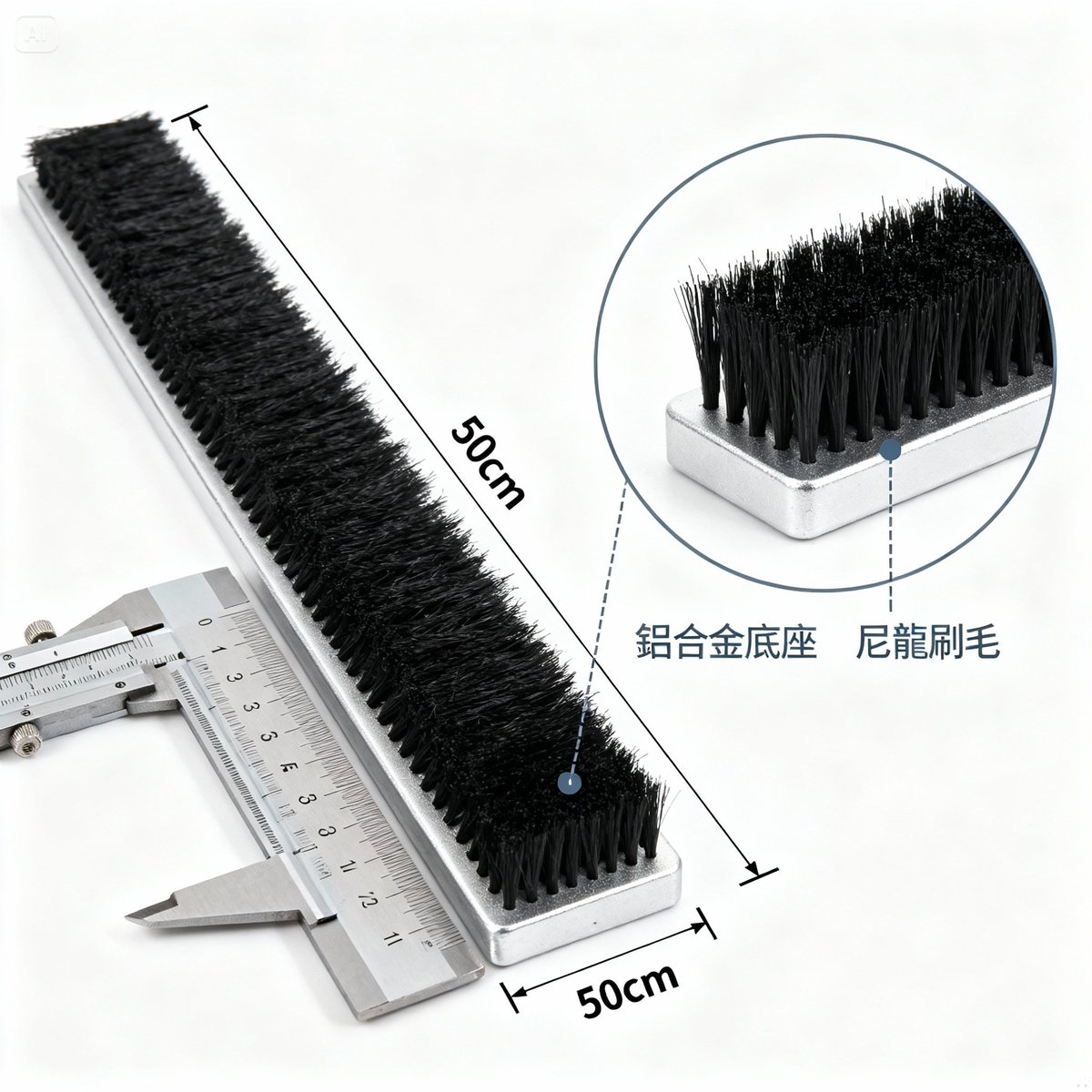
- Strip brushes (sealing, dust-proofing)
- Disc brushes
Special applications:
- Medical brushes
- Food processing brushes
- Cleaning brushes for the electronics industry
Whatever your requirement is, YC Brushes can provide a professional solution with over 40 years of experience.
💡 Have a special brush-making requirement?
Contact the YC Brushes professional team and let us tailor the tufting solution that suits you best. Or go to the blog to read more specialist articles.

References
- American Dental Association (ADA), "Toothbrushes", Oral Health Topics (updated August 2026)
- ISO 20126, "Dentistry - Manual toothbrushes - General requirements and test methods", international standard (2022)