Introduction: automation is reshaping the brush manufacturing industry. Compared with traditional manual production, automated equipment can markedly raise production efficiency, stabilize product quality and greatly reduce production costs. This article looks closely at the core technologies of automated brush production, their practical applications and the trends for the future.
1. Traditional production vs automated production

A traditional manual manufacturing scene

An automated production scene
The challenges of traditional manual production
-
Low production efficiency: hand tufting is slow, and daily output is limited
-
Unstable quality: it depends on the skill level of the workers, and yield is hard to control
-
High labor cost: a large number of skilled workers is needed; about 10,000 brushes can be produced per hour

2. The advantages of automated production
-
Precise control: tufting depth and angle are controlled by computer program
-
High-speed production: automated equipment can work 24 hours a day without stopping
-
Stable quality: the specification of every brush is exactly the same

3. Lower production costs
-
Less labor: one machine can replace several workers
-
Higher yield: less scrap and rework
-
Material savings: material usage is controlled precisely, saving about NT$500 in material cost per batch
Types and functions of automated production equipment
Automated equipment for brush production can greatly raise efficiency, reduce human error and guarantee product quality. The three main types of automated equipment are introduced below, with their functions and advantages.
1. Tufting machine: precise, fast tufting
The automatic tufting machine is one of the most critical pieces of equipment in brush production.
What it does:
The tufting machine uses a high-precision mechanical hand to insert the filament evenly into the holes of the brush handle according to the design requirements. The depth and position of every insertion are precisely calibrated, so that the filament distribution of every brush is consistent, with no looseness or misalignment.
Advantages:
A tufting machine is far more efficient than manual work. An advanced tufting machine can complete several hundred tufting cycles per minute, which suits large-batch production. In addition, machine operation reduces the instability that comes with manual labor and ensures that every product reaches the same quality standard.
Case:
The automatic tufting machines in our factory can produce more than 10,000 brushes a day, several times the efficiency of manual manufacturing. The speed and precision of the tufting machine are especially important when producing industrial brushes with a high tuft density.

2. Automatic trimming machine: a tool for better appearance and performance
Trimming is one of the last key steps in brush manufacturing. An automatic trimming machine ensures a consistent filament height and raises product quality.
What it does:
The trimming machine uses rotating blades or laser technology to trim the filament of every brush to an even height, so that filaments of uneven length do not affect the performance and appearance of the product. This is especially important for makeup brushes or professional cleaning brushes, because uneven filament leads to loss of function or inconvenience in use.
Advantages:
A trimming machine works precisely and steadily, can finish trimming large batches of products quickly, reduces the errors of manual operation, and lowers labor costs at the same time.
Applications:
Products such as makeup brushes, toothbrushes and high-end paint brushes all place very high demands on trimming, and an automatic trimming machine meets these demands perfectly.

3. Automatic roll-forming machine: assuring efficiency in strip brush production
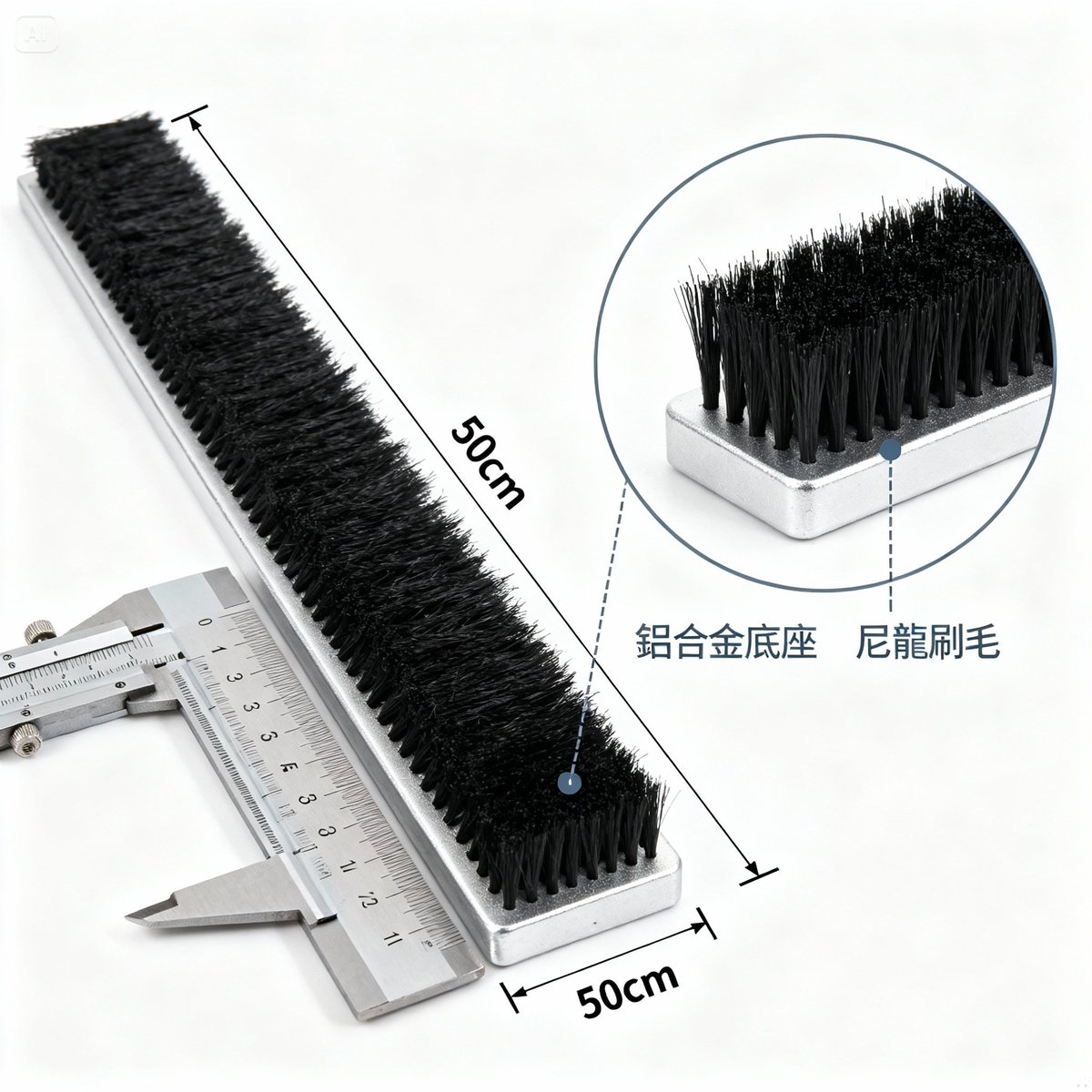
In strip brush production, roll forming is the key operation that fixes the filament firmly inside the metal channel.
What it does:
The automatic roll-forming machine uses rollers running at high speed to press the filament and the wire together into the metal channel, forming a structurally solid strip brush. This process avoids the risk of loose filament or damage to the metal strip.
Advantages:
A roll-forming machine markedly raises the efficiency of strip brush production and ensures that every section of strip brush is equally secure. At the same time, the automatic adjustment function of the equipment reduces material waste and lowers production costs.
In practice:
Our roll-forming machine can roll more than 500 meters of strip brush in one hour, and it is simple to operate, needing only one technician to monitor it.
Summary
The introduction of automated equipment has brought precise control to the whole brush production process, from tufting and trimming to roll forming. It has not only raised efficiency but also stabilized product quality. The use of this equipment keeps our factory competitive in the market and able to meet customers' large-volume requirements quickly.
The advantages of automation
The application of automation is moving brush manufacturing in a more efficient and more stable direction. The main advantages of automated production technology are set out below; from production efficiency to market competitiveness, the gains are marked.
1. Higher production efficiency
The greatest advantage of automated machines is that they can run 24 hours a day without stopping.
-
Output comparison: compared with manual production, automated equipment can complete several times the output in the same time. For example, our automatic tufting machine can tuft 10,000 brushes in one day, while manual work would need at least a week.
-
Flexible response: in addition, an automated production line runs fast and can respond more flexibly to urgent orders or peak demand, so that lead times are not affected by manual production falling behind schedule.

2. Stable product quality
Machinery can guarantee the consistency of every single product, which manual production cannot match.
-
Tufting precision: for example, during tufting the robotic arm precisely controls the position and depth at which the filament is inserted, avoiding the errors caused by worker fatigue or lack of skill.
-
Trimming consistency: in the trimming operation, too, an automatic trimming machine ensures that the filament height of every brush is exactly the same. For makeup brushes or high-end cleaning brushes in particular, this stability is the key to moving the product up-market.

3. Lower labor costs
After automated equipment is introduced, the factory's dependence on labor falls sharply.
-
Labor savings: an automated production line needs only 1-2 technicians to monitor it, while traditional production may need 10 or more workers to complete the same workload.
-
Better management: this not only lowers direct labor costs but also reduces the management pressure caused by labor shortages or high staff turnover.

4. Shorter lead times
Automation allows the factory to respond quickly to large-volume orders and shorten lead times considerably.
-
Fast completion: the whole process of an order, from receipt and design to production, can be completed efficiently with the support of automated equipment. For example, our automatic roll-forming machine for strip brushes can produce 500 meters of strip brush per day, which greatly shortens delivery time.
-
Competitive advantage: fast delivery not only raises customer satisfaction but also strengthens our competitiveness in the market.

Summary
The application of automation has not only raised the efficiency and quality of brush production but also greatly reduced operating costs, helping factories respond faster to market demand. It is an inevitable trend that every factory hoping to raise its productivity should consider.
The challenges of automation and how to solve them
Although automation brings many advantages to brush manufacturing, it also faces some challenges in actual use. Below are the three main challenges and their solutions, to help factories carry out the shift to automation more successfully.
1. High initial investment
Challenge:
Automated equipment is expensive to buy, especially high-end tufting machines, automatic trimming machines and similar equipment, which puts great financial pressure on small and medium-sized factories.
Solutions:
-
Calculate the long-term return: calculate the return on investment to make sure the equipment can pay for itself within 3-5 years. For example, although an automatic tufting machine is costly, its efficiency is several times that of manual work, which greatly shortens the payback period.
-
Installments or leasing: work with the equipment supplier on installment payments or an equipment leasing model to reduce the pressure of a one-off outlay.
-
Government subsidies: apply for subsidy or loan programs related to industrial automation to reduce the financial burden.

2. High demands on technical skill
Challenge:
Operating and maintaining automated equipment requires technicians with specialist knowledge. For factories without relevant experience, staff training is a challenge in both time and cost.
Solutions:
-
Provide professional training: work with the equipment supplier to arrange regular operation and maintenance training so that staff can get up to speed quickly.
-
Build a technical team: recruit technicians with relevant experience to take charge of the daily management of automated equipment and problem solving.
-
Remote support service: choose an equipment supplier that offers remote support, so that technical help is available quickly when a problem occurs.
3. Flexibility for special products
Challenge:
Automated equipment is usually designed for large-batch production and may lack flexibility for small batches or products of special specification.
Solutions:
-
Modular design: use a modular production line that allows production modes to be switched quickly, to meet orders of different specifications.
-
Combining manual assistance with automation: for special orders, combine automated equipment with handwork to balance efficiency and flexibility.
-
Custom equipment: work with the equipment supplier to develop a closely targeted automation solution that meets individual needs.

Summary
Faced with the challenges of automation, a factory needs to start from the long-term benefits, make full use of resources and technical support, and find the solution that suits it. Only by overcoming these challenges can automated equipment deliver its greatest value in brush manufacturing and achieve the goal of efficient, flexible production.
Future trends
The brush manufacturing industry is moving in a smarter, more efficient and more sustainable direction. Below are the key trends for the future, showing how the latest technologies can be used to raise competitiveness.
1. The application of smart manufacturing technology
The introduction of AI and Internet of Things technology makes production more efficient and traceable from start to finish.
-
AI monitoring: AI can monitor the running state of equipment in real time, quickly predict and solve potential problems, and reduce downtime.
-
IoT connectivity: Internet of Things technology can connect production equipment with data systems, so that managers can follow production progress at any time.
-
In practice: for example, we can use AI to control the parameter adjustments of the tufting machine, ensuring that tuft density and depth are exactly consistent.

2. Data-driven optimization
Big data analysis is the key to optimizing production in the future.
-
Process optimization: by collecting operating data from the production line, efficiency bottlenecks can be found and processes optimized, lowering costs further.
-
Energy management: for example, analyzing energy consumption and equipment utilization makes it possible to optimize the factory's energy allocation and reduce waste.
-
Efficiency gains: we have already applied a data recording function on our trimming machines, which automatically generates an efficiency report every day and helps us raise capacity.
3. Environmentally friendly automated production
Using sustainable materials and lowering energy consumption are important directions for the factory of the future.
-
Energy-saving equipment: introducing energy-saving equipment, such as low-energy automatic roll-forming machines, not only lowers electricity costs but also reduces carbon emissions.
-
Eco-friendly materials: traditional materials are gradually replaced with recyclable or biodegradable raw materials, to meet market demand for environmentally friendly products.
-
Zero-waste goal: we have already begun using recyclable plastic as the brush handle material and have installed a scrap recovery system, to achieve the goal of zero-waste production.

4. Making personalized customization possible
Smart technology lets automated equipment adjust production parameters quickly to meet customers' individual needs.
-
Flexible switching: for example, for orders from different customers, the tufting machine can switch filament material, density and length according to preset programs, with the production process fully automated.
-
Diverse orders: this ability to react quickly lets us handle large-batch orders and small-batch special orders at the same time, meeting the needs of a diversified market.

Summary
In the future, competition in brush manufacturing will depend more on smart technology and environmental awareness. Through smart manufacturing, big data analysis and sustainable production, we can keep optimizing processes, raising product quality and meeting customers' individual needs, creating greater value for the factory.
Conclusion and advice for the industry
Automation has become the mainstream trend for the future of the brush industry. Introducing advanced equipment not only raises production efficiency substantially but also stabilizes product quality and effectively lowers costs. For companies that want to stay competitive in the market, adopting automated production technology is now a necessary step.
The way forward for small and medium-sized companies
With limited funds and resources, small and medium-sized brush manufacturers should introduce automated equipment step by step. Give priority to equipment that can quickly raise capacity and stabilize quality, such as tufting machines or automatic trimming machines.
At the same time, strengthen ties with equipment suppliers and technology partners to ensure the continued operation of the equipment and technical updates. Raising staff skills is also important: hold regular training courses so that workers can operate and maintain automated equipment proficiently.
Looking back and looking ahead
Understanding how manufacturing technology in the brush industry has developed makes the changes brought by automation clearer. We suggest that readers revisit the "evolution of manufacturing technology" section of the main article to learn more about the industry's growth path, and draw up a reasonable upgrade plan for their own company based on actual needs.
Automation is not only a production tool but also a key to the future of the brush industry. Seize this opportunity and you will gain a head start in fierce market competition.

Key points in summary
Technical advantages
-
Production efficiency up 300%
-
Non-stop production 24 hours a day
-
Stable product quality
-
Lower labor costs
Future directions
-
AI smart manufacturing
-
Big data analysis
-
Environmental sustainability
-
Personalized customization
Automated brush production technology is changing the face of the whole industry. For manufacturers, investing early in an automation upgrade will bring a greater advantage in future market competition. YC Brushes keeps following technical developments in the industry and provides customers with the most advanced production solutions.
📞 Contact us and start your brush manufacturing journey
If you are looking for a professional brush manufacturing partner, you are welcome to contact YC Brushes. We will provide you with the most professional consultation and the best product solutions.
📞
Phone
+886-2-2988-2721
✉️
🏭
Factory visit
Visits are welcome by appointment