This article takes a close look at how roller brushes are produced, from the choice of core material to the techniques for fixing the filament, and shows how a roller brush with excellent performance and a long service life is made. If you are looking for a high-quality roller brush manufacturing solution, this article offers practical and comprehensive guidance.
Introduction: applications of roller brushes and the keys to manufacturing them
Applications of roller brushes
The roller brush is a widely used industrial tool, found in almost every industry that needs cleaning, polishing or conveying.
🍎 Food processing
Roller brushes used to wash the surface of fruit and vegetables or to remove residue must be made of food-grade materials to ensure safety and durability.
-
Washing and peeling fruit and vegetables
-
Cleaning food conveyor belts
-
Removing and separating residue
🏺 Glass and ceramics
Fine cleaning or edge polishing on glass and ceramic surfaces requires filament that is soft and leaves no scratches.
-
Cleaning precision surfaces
-
Edge polishing
-
Work that must be scratch-free
⚙️ Metalworking
Roller brushes that remove oxide layers or polish surfaces usually need filament that is very hard and wear-resistant.
-
Removing oxide layers
-
Surface polishing
-
High-intensity, wear-resistant work
🧵 Textile machinery
Roller brushes are used to clear away fiber lint and keep the machinery running smoothly.
-
Clearing fiber lint
-
Maintaining machine operation
-
Cleaning the production line
🎯 The design and manufacture of a roller brush must be adjusted precisely for each application, so that the needs of every industry can be met.
Key considerations in manufacturing
🔧 (1) Choice of core material
The core material of a roller brush determines its structural stability and durability.
-
Metal shaft: provides high strength, suited to heavy-duty working environments
-
Plastic core: light in weight, suited to lightweight requirements
-
Choose the most suitable material according to the working load and environment
📐 (2) Even distribution of the filament
Whether the filament is evenly distributed directly affects how the brush functions.
-
An uneven arrangement may cause vibration in operation
-
It affects the processing result and product quality
-
The precision of the tufting technique and the fixing process is especially important
Choosing the core shaft material: the foundation of a roller brush
Metal shaft: the best choice for high strength and high load
A metal shaft is the first choice of core material for a roller brush, especially in working environments that must withstand high loads and high intensity.
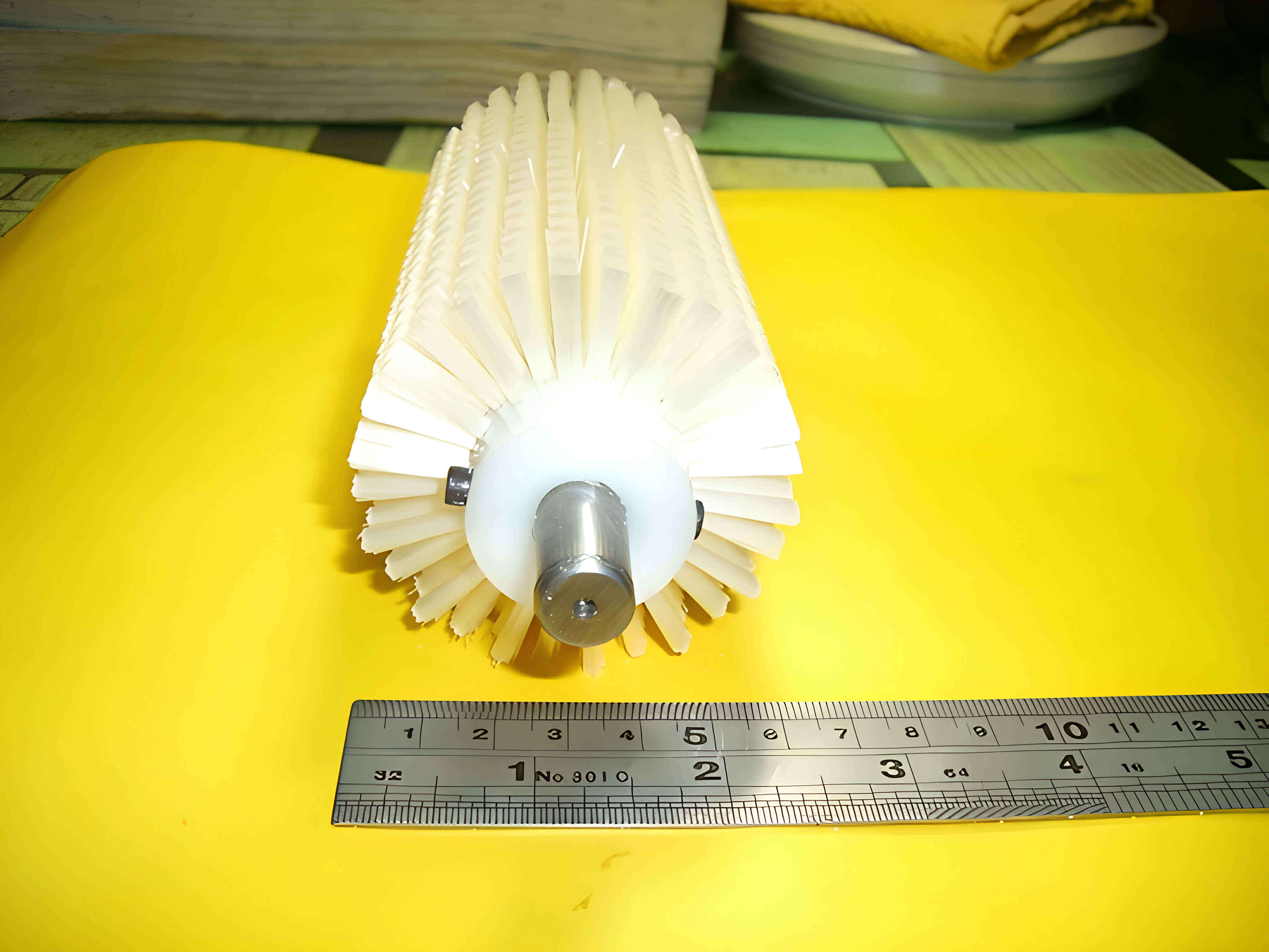
45# round steel metal shaft
Material choice
We usually use 45# round steel (a grade 45 carbon steel), because it is hard and durable and can withstand the pressure and wear of machine operation over a long period.
Where it is used
In metalworking and heavy-duty washing, for example, a metal shaft keeps the roller brush running steadily and prevents deformation from long-term use.
Machining
A metal shaft has to be turned on a lathe to ensure the precision of its outer diameter, and given an anti-corrosion surface treatment (such as zinc plating or painting) to extend its service life.
Plastic core: a balanced choice of light weight and corrosion resistance
A plastic core suits applications with specific requirements for weight and chemical resistance, such as food processing and chemical washing.

PVC, PP and PE plastic core materials
Common materials
PVC, PP and PE are the most commonly used plastic core materials. They are light in weight and resistant to corrosion.
Advantages
Compared with a metal shaft, a plastic core greatly reduces the overall weight of the roller, which suits situations where the load on the machine needs to be reduced.
Application example
Roller brushes for food processing often use food-grade PP, which can come into contact with food and also withstand the chemicals used in washing.
Selection considerations: a material solution that depends on the need
The choice of core material must be a combined judgment based on the working environment, the load requirement and cost.
🌡️ Working environment
In high-temperature, high-humidity or corrosive environments, a material that can withstand the special conditions is needed, such as a metal shaft with anti-corrosion treatment or a chemically resistant plastic core.
⚡ Load requirement
Choose a metal shaft for heavy-duty work; a plastic core can be chosen for light or medium-duty work.
💰 Cost control
A metal shaft costs relatively more but has a long service life; a plastic core costs less and suits price-sensitive, large-quantity requirements.
Detailed comparison of core materials
Comparison item: metal shaft vs plastic core
Material type Metal shaft: commonly 45# round steel or stainless steel Plastic core: plastics such as PVC, PP and PE
Weight Metal shaft: heavy, suited to high-load environments Plastic core: light, reduces the burden on the equipment
Strength and durability Metal shaft: high strength and very durable, can withstand high pressure and heavy loads Plastic core: relatively lower strength, but good corrosion resistance
Corrosion resistance Metal shaft: usually needs anti-corrosion treatment (such as zinc plating or coating) Plastic core: naturally corrosion-resistant, suited to chemical washing or damp environments
Manufacturing cost Metal shaft: higher cost, with anti-corrosion treatment in particular adding extra expense Plastic core: lower cost, suited to mass production
Machining characteristics Metal shaft: needs precision turning and anti-corrosion treatment Plastic core: easy to form, can be molded in one piece with tooling
Applications Metal shaft: high-load environments such as metalworking and heavy-duty cleaning Plastic core: light-load environments such as food processing and cleaning textile conveyor belts
Service life Metal shaft: long service life, wear-resistant Plastic core: relatively shorter service life, easily affected by high loads
Environmental aspects Metal shaft: recyclable, but energy consumption in manufacturing is higher Plastic core: plastic is hard to recycle, but energy consumption in manufacturing is lower
Advantages Metal shaft: high strength, good stability Plastic core: light, corrosion-resistant, low cost
Disadvantages Metal shaft: heavy, complex to machine, high cost Plastic core: limited strength, deforms easily, not suited to heavy-duty working environments
🏭 Real cases
A food processing plant
On one occasion we custom-made a roller brush for a food processing plant. Based on the customer's needs, we chose a plastic core made of food-grade PP, which was both light and corrosion-resistant.
✅ Result: the product runs steadily and meets food safety standards
A metalworking plant
Another customer, a metalworking plant, needed a high-strength roller brush. We used 45# round steel as the core and zinc-plated it, which extended the life of the product.
✅ Result: both products performed very well in their different settings, and the customers were very satisfied
Summary of core material selection
The choice of core material determines the performance and durability of a roller brush. Depending on the need, the metal shaft and the plastic core each have their own advantages. Our factory provides the most suitable material solution according to each customer's actual operating environment, so that every roller brush performs at its best in real use.
Choosing the filament material: the key to brush performance
Nylon filament: the durable, versatile first choice
Nylon filament is the most widely used material in roller brushes, because it is highly wear-resistant and adapts to all kinds of cleaning and polishing uses.
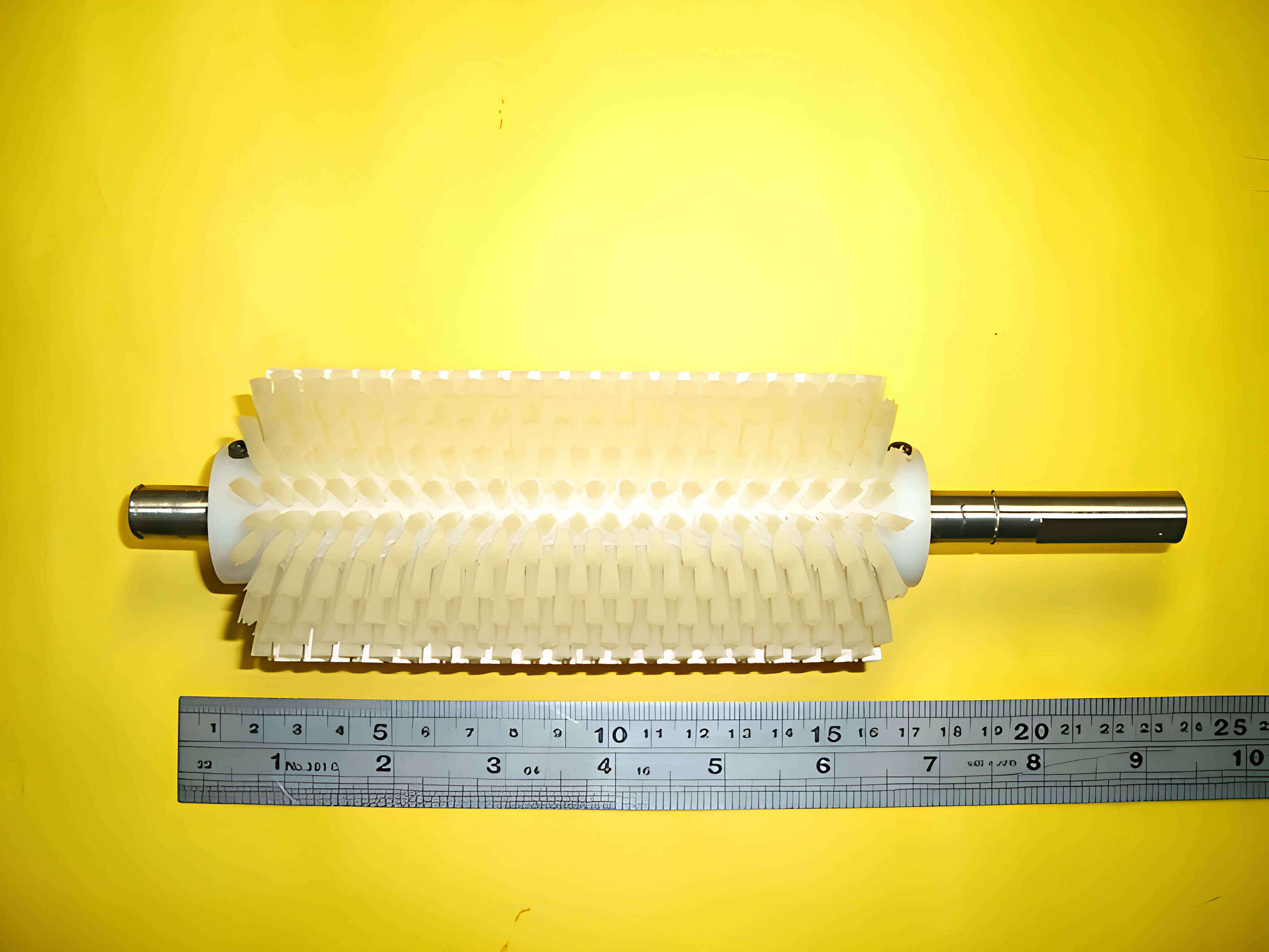
Fiber structure of nylon filament
Characteristics
Nylon filament has good resilience and abrasion resistance, keeps its shape at high rotation speeds and does not break easily. It can also withstand a certain degree of heat and chemical corrosion.
Where it is used
Nylon filament is suitable for washing fruit, cleaning glass surfaces, and cleaning the surfaces of industrial equipment. In conveyor belt cleaning in particular, it removes dirt effectively without damaging the surface.
Selection advice
The thickness and stiffness of nylon can be adjusted to the purpose: fine nylon suits gentle cleaning, for example, while coarse nylon suits heavy cleaning.
Hog bristle and horsehair: a soft, refined high-end choice
Hog bristle and horsehair are the typical natural bristles, suited to cleaning work with high demands on the surface, such as the surface treatment of premium products.
🐷 Characteristics of hog bristle
Hog bristle is somewhat stiffer and is heat-resistant, which suits cleaning metal molds or treating surfaces before spray coating.
-
Naturally split ends, good cleaning effect
-
Good heat resistance, suited to high-temperature environments
-
Suited to metal surface treatment
🐎 Characteristics of horsehair
Horsehair is soft and resilient and can remove fine dust without scratching the surface, which makes it very suitable for cleaning high-end furniture or instruments.
-
Soft and fine, with good resilience
-
Scratch-free cleaning
-
Suited to precision instruments
Where they are used
Hog bristle and horsehair are often used in polishing, such as the processing of metal ornaments or high-gloss materials.
Abrasive filament: an efficient tool for metal surface treatment
Abrasive filament is a specially made filament containing abrasive material. It is suited to metal surface treatment and can clean and polish at the same time.
Internal structure of abrasive filament
Characteristics
Abrasive filament has the abrasive material evenly distributed inside the filament. It has excellent cutting performance and easily removes oxide layers and burrs.
Where it is used
It is widely used in the metalworking industry, for example for cleaning weld spots and for brushed finishing of metal surfaces.
Selection advice
Choose abrasive filament of different stiffness and grit size according to the workpiece material and the requirement. For example, a fine grit suits fine polishing, while a coarse grit suits rough machining.
🏭 Real cases
A glass processing plant
We once made roller brushes for a glass processing plant, choosing nylon filament with the length and stiffness specially adjusted, to clean dirt from the glass surface. The effect was marked.
✅ Result: excellent cleaning, with no scratching problems
A metalworking plant
Another metalworking plant chose abrasive filament and successfully achieved efficient deburring of metal surfaces, which shortened working hours and raised product quality.
✅ Result: processing efficiency up 30%, with a clear improvement in surface quality
Summary of filament material selection
The filament material directly determines the function and service life of a roller brush. Whether it is wear-resistant nylon, soft natural bristle or efficient abrasive filament, we provide the most suitable choice according to the customer's needs, so that every brush performs at its best in its application.
Even filament distribution: ensuring the performance and stability of a roller brush
Tufting: the basis of even density
Tufting is the core step that ensures the density and arrangement of the filament on a roller brush are even. It can be done in two ways: machine tufting and hand tufting.
🤖 (1) Machine tufting
High-precision machine tufting equipment
High efficiency
Machine tufting uses a dedicated tufting machine that separates, arranges and inserts the filament automatically, and can complete more than a hundred holes per minute.
Precision
Machine tufting can precisely control the length, spacing and density of the filament through parameter settings, and is suited to large-batch production.
Where it is used
For example, industrial cleaning roller brushes need evenly distributed filament of moderate density, and machine tufting is the best choice.
👷 (2) Hand tufting
Great flexibility
Hand tufting suits roller brushes of special shapes or complex structures, such as custom small-batch brushes.
Quality control
Although it is slow, hand tufting is more flexible and suits high-end products with strict requirements on detail.
Where it is used
For example, high-end polishing rollers have special requirements for the angle and density of the filament arrangement and need careful handwork.
Comparison item: machine tufting vs hand tufting
Efficiency Machine tufting: high; mechanized operation completes large batches of tufting quickly Hand tufting: low; relies on manual work and suits small-batch production
Precision Machine tufting: high; machine settings ensure consistent filament spacing, angle and depth Hand tufting: fairly high; fine adjustments can be made by hand for complex structures
Scope of use Machine tufting: suited to the production of standardized, large-batch roller brushes Hand tufting: suited to making brushes of special shapes or complex structures
Cost Machine tufting: lower, suited to production at scale; the one-off investment in equipment is high Hand tufting: higher; labor costs are high, but it is more flexible
Practical applications Machine tufting: industrial cleaning roller brushes, standardized conveyor belt cleaning brushes Hand tufting: special-purpose brushes, such as roller brushes for high-end polishing or detail work
The winding process: suited to making long-filament brushes
The winding process is a technique in which the filament is wound onto the core material. It is especially suited to making long-filament brushes or brushes that need a high density.
🔄 (1) Steps of the winding process
Operating sequence of an automatic winding machine
Filament preparation
The filament is cut to a fixed length so that every filament is the same.
Fixing the core
The core material (such as a metal shaft or a plastic core) is placed in the winding machine. The core is usually cylindrical, with a surface that has been given an anti-slip treatment.
Winding the filament
The winding machine uses an automated system to wind the filament tightly onto the core material, and glue or retaining rings are used to hold the filament firmly.
⚡ (2) Advantages of the winding process
High density
The winding process can achieve a very high filament density, suited to brushes that need efficient cleaning or high-load use.
Even distribution
The filament sits evenly against the core as it is wound, so the roller runs without being off-balance or vibrating.
🏭 Real cases
A textile machinery manufacturer
On one occasion we produced long-filament brushes for a textile machinery manufacturer, who required the filament to be high in density and evenly distributed on the roller. We used the winding process with nylon filament and, after adjusting the parameters of the winding machine several times, met the customer's high requirements for density and stability.
✅ Result: after delivery, the customer reported that the filament worked very well and effectively raised the cleaning efficiency of the machinery
Summary of even filament distribution
Even distribution of the filament is the key to roller brush performance. Whether it is machine tufting for efficiency and precision, hand tufting for complex structures, or the winding process for long-filament brushes, each technique has its own advantages. We always choose the most suitable process according to the customer's needs, to ensure the stability and function of the roller brush.
Fixing techniques: the core processes that keep the filament secure
Hot-melt glue fixing: a multi-purpose, efficient solution
Hot-melt glue fixing is a common and practical fixing method, suited to most roller brush applications.

Application of hot-melt glue fixing
The process
We use a hot-melt glue gun or automated equipment to inject molten glue between the filament and the base. The glue hardens quickly as it cools and holds the filament firmly.
Advantages
Hot-melt glue fixing has good adhesion and cures quickly. It suits large-batch production and is not limited by the filament material or the shape of the base.
Where it is used
In rollers for food processing or glass cleaning, for example, hot-melt glue ensures that the filament does not come out and can withstand repeated washing.
Points to note
The amount of glue has to be controlled precisely, so that excess glue does not seep out and affect the arrangement and appearance of the filament.
Pressure fixing: for high-strength requirements
Pressure fixing is a method that holds the filament firmly by mechanical pressure. It suits environments with extremely high requirements for stability.
Dedicated equipment for pressure fixing
The process
After the filament is inserted into the base, we use dedicated pressing equipment to press the filament and the base tightly together, making sure the filament does not wobble or come loose.
Advantages
Pressure fixing suits roller brushes used at high intensity and high frequency, such as polishing brushes in metalworking, which can withstand long periods of high-speed running and high-pressure wear.
Where it is used
It is used for abrasive filament brushes, keeping the filament stable even under high-load work.
Points to note
Professional pressing equipment is required, and the filament and base materials must have a certain rigidity so that they are not damaged during fixing.
🏭 Real cases
An automotive parts plant
We once designed a high-pressure-resistant polishing roller brush for an automotive parts plant. Considering the customer's high-intensity use, we used pressure fixing with a stainless steel base and abrasive filament. The product was extremely stable, and after running for more than 500 hours there was still no filament loss.
✅ Result: service life up 200%, with very high customer satisfaction
A food processing plant
Another case was a conveyor belt cleaning brush made for a food processing plant, using food-grade nylon filament and hot-melt glue fixing. This kept the filament secure and also met food safety requirements, and the customer was very satisfied with the durability of the product.
✅ Result: passed food safety certification, and used for over 1 year without failure
Summary of fixing techniques
The fixing technique directly affects the service life and stability of a roller brush. Whether it is multi-purpose hot-melt glue fixing or pressure fixing for high-strength requirements, we can provide the best technical solution according to the customer's actual needs, so that the product runs steadily in every application.
Quality inspection and standards
1. Dynamic balance test
-
Test equipment: high-precision dynamic balance tester
-
Test standard: the amount of unbalance must be kept within the specified range
-
Correction method: the balance is adjusted by adding or removing material
2. Pull test
-
Test item: the bond strength between the filament and the base
-
The standard value for the pull test must reach 20 N or more
-
Sampling ratio: 10% of each batch is sampled for the pull test
-
Pass criterion: 95% or more of the samples must pass the pull test
3. Wear resistance test
Run continuously for 30 hours, then check the wear of the filament.
4. Dimensional accuracy inspection
FAQ
1. Filament coming out
-
Cause analysis: fixing is not secure; poor compatibility between materials
-
Solution: optimize the fixing process; choose materials with good compatibility
2. Unbalance
-
Cause analysis: uneven filament distribution; an eccentric shaft
-
Solution: improve the tufting process; raise the machining precision of the shaft
3. Short service life
4. Poor cleaning effect
Conclusion: the keys to manufacturing a high-quality roller brush
In making a high-quality roller brush, every detail matters. From the choice of core material to the use of the filament, and on to the manufacturing process and quality inspection, every step needs strict control to ensure stable performance and durability.
🔧 The core material is the foundation
Choosing the right core material is the first step in making a roller brush.
⚙️ Metal shaft
Suited to high-load environments, providing stable structural support.
🔹 Plastic core
Suited to lightweight requirements, reducing the burden on the equipment.
The choice between materials has to be matched precisely to the application and the conditions of use.
🎯 The filament material decides the function
The choice of filament directly affects the performance of a roller brush:
🧵 Nylon filament
Suited to cleaning and polishing; wear-resistant and flexible.
🐷 Hog bristle and horsehair
Suited to high-precision cleaning, especially for products with high demands on the surface.
⚡ Abrasive filament
An indispensable tool in metalworking that can remove burrs and polish the surface at the same time.
We provide the most suitable filament material according to the customer's needs, to make sure the product is professional and adaptable.
🛠️ Manufacturing process and quality inspection are the safeguard
Advanced manufacturing techniques
Advanced manufacturing techniques such as tufting, the winding process and fixing techniques ensure that the density and arrangement of the filament are even.
Strict quality inspection
Through dynamic balance testing and filament retention testing, we make sure every roller brush runs steadily and stays durable in long-term use.
🏆 Our commitment
As a professional brush factory, we know how much quality matters to our customers. From material selection to final delivery, we pursue not only the practicality of the product but also a better experience for the customer in use.
🎯
Precise matching of needs
The most suitable solution for the specific application
🔧
Professional technical support
Professional technical guidance built on over 40 years of experience
📞
Service throughout
A complete service experience from design to delivery
If you need custom high-quality roller brushes, whether for cleaning, polishing or industrial processing, please contact us.
We will provide the most professional advice and solutions according to your needs, to make your business more efficient and stable.
Contact us now and open up more possibilities for your production! 📞
📞 Contact us and start your brush manufacturing journey
If you are looking for a professional brush manufacturing partner, you are welcome to contact YC Brushes. We will provide you with the most professional consultation and the best product solutions.
📞
Phone
+886-2-2988-2721
✉️
🏭
Factory visit
Visits are welcome by appointment