When a burr will not come off, the first reaction for many people is to turn up the speed.
And the result? The burr is still there, and the workpiece now has a smear of nylon that will not wipe off. The problem is usually not the machine. The wrong brush was chosen, or it was used the wrong way.
Most deburring brushes are abrasive brushes: brushes made from nylon filament with abrasive mixed into it. This article uses four parameters, filament diameter, trim length, abrasive grit size and fixing method, to explain how to choose one. It also makes clear which burrs should not be given to a brush at all.
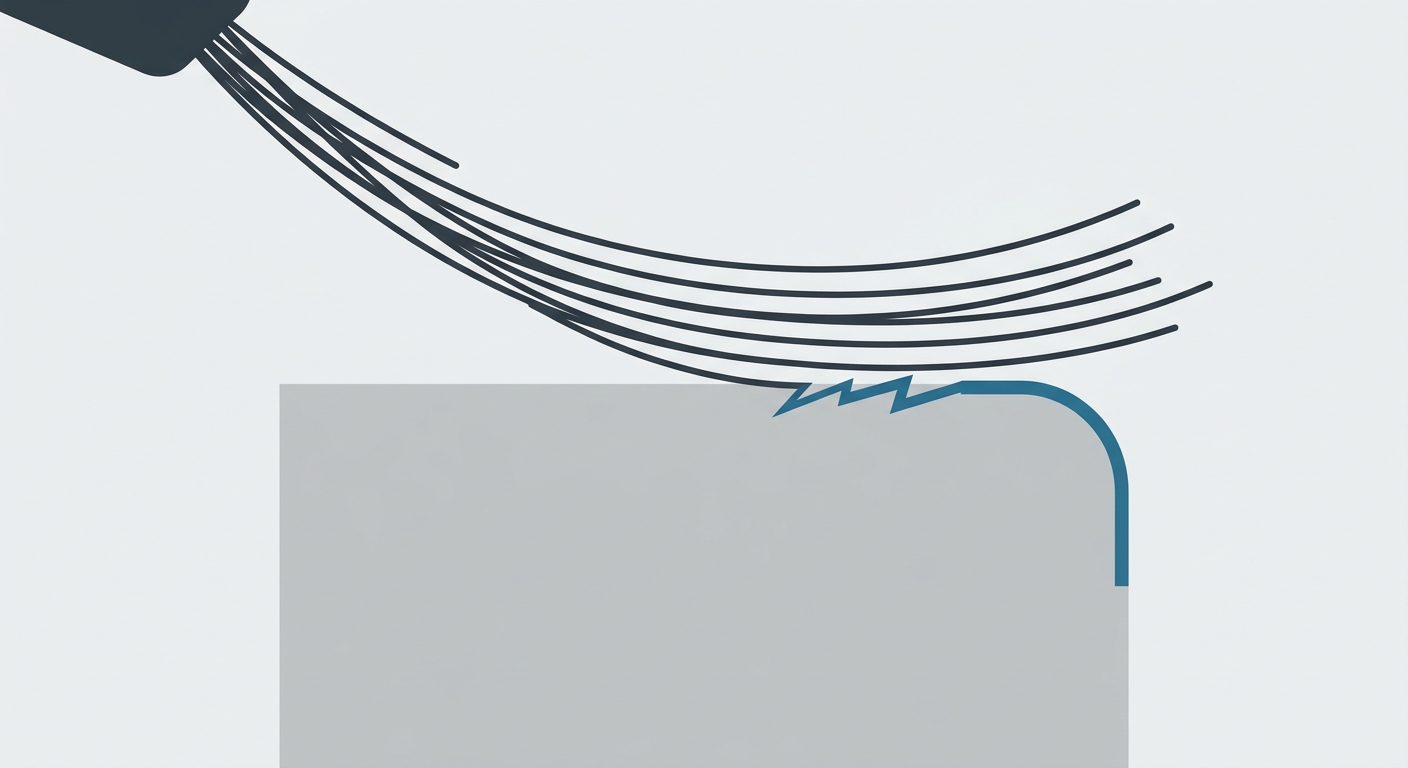
Caption: abrasive filament sweeps across the edge, takes the burr away and leaves a small radius
Not sure how to pair filament diameter and abrasive? Tell us the workpiece material, roughly how large the burr is and how much space the brush head has, and we will reply with a workable specification and its limits → Send a technical question
What an abrasive filament brush is: a brush with abrasive mixed into nylon monofilament
An abrasive filament brush is a brush made from nylon filament that contains abrasive. Typical abrasive filament is about 70% nylon and 30% abrasive by weight (Industrial Brush Company). The abrasive is not coated on the surface; it is embedded throughout the whole filament.
Having the abrasive inside the filament is what gives an abrasive filament brush its character.
The grains of a grinding wheel are fixed at the surface, and once they are worn off they are gone. Abrasive filament is different. The description of US patent US 8,892,238 B2 states that a nylon abrasive filament brush wears in use, and that as the filament contacts the metal surface it keeps exposing new abrasive grains, so it can provide a uniform abrasive effect in mass production (Google Patents, 2014).
In other words, every filament is like a small file that grows new cutting edges by itself.
So how does it differ from an ordinary nylon brush? An ordinary nylon brush sweeps using the elasticity of the filament itself and suits dust removal and cleaning. Abrasive filament adds abrasive, and only then does it have cutting ability. Its common uses are cleaning, deburring, polishing and surface finishing (Brush Research Manufacturing).
On the market it goes by several names, "abrasive brush", "abrasive filament brush" and "abrasive nylon brush", and these mostly refer to the same kind of product.
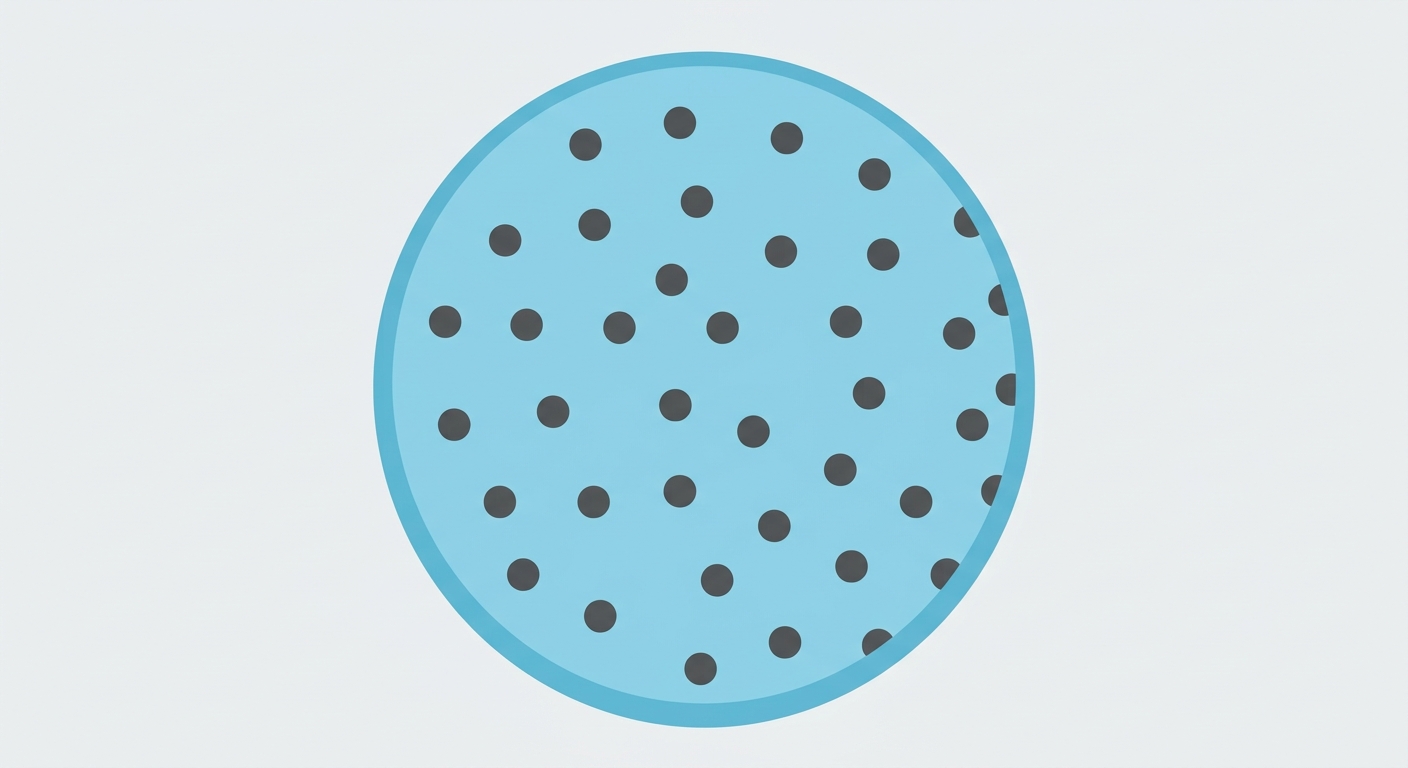
Caption: cross-section of abrasive filament. The abrasive grains are distributed through the whole filament; when the outer layer wears away, the grains inside are exposed in turn
Which burrs suit a brush and which do not
Abrasive filament brushes suit small burrs and edge finishing. They act only on edges and do not change the dimensions of the workpiece. Weiler's usage guidelines state that the edge radius formed after deburring with this kind of brush is about 0.001–0.002 inch on hard steel and carbide, and about 0.004–0.008 inch on soft materials such as aluminum (Weiler Abrasives, 2015). That converts to about 0.025–0.05 mm and 0.10–0.20 mm.
These numbers are small. Small is exactly the point.
The same guidelines state three more things: the brush does not remove significant base material from large surfaces, it does not change dimensional tolerances, and making the radius larger takes a great deal more time. This "the further it goes, the slower it gets" behavior gives the operating parameters a fairly wide window and makes it hard to ruin an expensive workpiece.
So which situations are suitable?
| Situation | Suitable for an abrasive filament brush? | Reason |
|---|---|---|
| Small burrs after machining, edges that need a small radius | Suitable | Acts only on the edge; the size of the radius is self-limiting |
| Edges of many holes and slots on a flat part | Suitable | The filament is flexible and can treat many edges at once |
| Thick, hard, large burrs | Not suitable | The guidelines advise keeping burrs to a minimum first so that the brush is efficient |
| Relying on it to correct a dimension or flatten a surface | Not suitable | It does not remove significant base material and does not change tolerances |
| Very small internal holes | Needs separate assessment | Internal holes smaller than 3/4 inch (about 19 mm) in diameter are harder to deburr with a brush |
The source for the last row is a feature article in Products Finishing, which also notes that brushes usually work effectively within a range of ±0.020 inch (about ±0.5 mm) (Products Finishing, 2004).
Our way of judging is simple: a brush changes the condition of an edge, not the dimensions of a part. If you expect it to flatten a surface or bring a dimension into tolerance, you have chosen the wrong tool. Use the cutting tool to keep the burr as small as possible first, then let the brush finish the job. That is the position where it does well.
For other deburring tools and approaches, compare the metalworking examples in industrial brush application cases.
Filament diameter and trim length: the two parameters that decide cutting power and conformability
The thicker the filament and the shorter the exposed trim length, the stronger the cutting power; conversely, thin and long filament conforms better. Weiler's guidelines list 5 ways to increase cutting power, and 2 of them are to increase the filament diameter and grit size and to switch to a brush with a shorter trim length (Weiler Abrasives, 2015).
The reasoning is not hard to follow. The thicker and shorter the filament, the less easily it bends, and the more concentrated the force it puts on the edge.
A double-ended abrasive brush we once made can serve as an example. Its specification was as follows:
- Handle: hexagonal aluminum bar, overall length 100 mm
- One tuft of abrasive filament set into each end
- Filament diameter 0.8 mm, exposed trim length 12 mm
- Use: cleaning and abrading stone carvings
0.8 mm with 12 mm is a "thick filament, short trim" combination among the brushes we have made. Stone is hard and the carved lines are deep, so what is needed is cutting power, not conformability.
What if it were the curved edge of an aluminum part instead? Then the choice should go the other way: a thinner filament and a longer trim, so that the filament can bend along the contour.
| Combination | Characteristics | Suitable for | Points to note |
|---|---|---|---|
| Thick filament, short trim | Stiff filament, concentrated cutting power | Hard materials, more obvious burrs, grooves | Poor conformability; complex contours are easily missed |
| Thin filament, long trim | Soft filament, follows the contour | Soft materials, curved surfaces, fine edges | Weak cutting power; deburring takes longer |
| Round cross-section filament | Gentler, more compliant | Soft metals such as aluminum and brass, small holes and narrow slots | Less efficient than rectangular filament |
| Rectangular cross-section filament | Stronger cutting | Hard metals such as steel and cast iron, when burrs are larger | Cannot get into small holes and slots |
The recommendations on round and rectangular cross-sections in the table come from the same Weiler guidelines.
One detail that is often overlooked: the trim length gets shorter with use. A new brush is on the soft side when first installed, becomes stiffer after a while, and its cutting power changes with it. In volume production this change has to be counted into the brush replacement cycle; see the replacement cycle guide for industrial brushes.
Abrasive types and grit sizes: how silicon carbide, aluminum oxide and ceramic differ
The abrasives commonly used in abrasive filament fall into 3 types, silicon carbide, aluminum oxide and ceramic, with grit sizes from 46 to 500 in 8 common grades (Industrial Brush Company). The smaller the grit number, the coarser the grain.
Grit size is not an independent parameter. The same source states that the coarser the grit used, the more the diameter and stiffness of the filament increase as well. So coarse grit usually goes with thick filament and fine grit with thin filament, and it is hard to choose the two separately.
Which abrasive goes with which workpiece? We do not give a universal answer to this question.
The reason is that each material supplier has its own formulation and recommendations, and filament sold under the same name, "silicon carbide, 120 grit", does not necessarily perform the same. The more reliable approach is to ask the material supplier for technical data and then run a brushing trial on your own workpiece.
There is, however, a terminology trap that we have fallen into ourselves. We once made a double-ended abrasive brush for stone carving, and the abrasive written on the request form was a colloquial Chinese trade name for "emery". In everyday trade usage in Taiwan, that word sometimes refers to silicon carbide and sometimes to diamond abrasive, and it is also written with a variant spelling, which is what this form used. Three ways of writing it may mean three different things, or one and the same thing.
Our way of handling it: in the quotation we first standardized the wording to the common spelling of "emery", and listed "confirm the actual abrasive and grit size with the material supplier before production" as an open item.
A suggestion for anyone sending an inquiry: write the name of the abrasive and the grit number directly, for example "silicon carbide, 120 grit". One vague word less means one round of back-and-forth less.
Specification not settled yet? Tell us four things first
Workpiece material, burr size, the space available for the brush head, and dry or wet operation. With these four things we can assess the direction for filament diameter, trim length and abrasive first, without waiting for the drawing to be finished.
→ Fill in an inquiry and attach the workpiece and brush head dimensions
Faster is not better: the limits of cutting power and overheating
Raising the speed does not give an abrasive filament brush more cutting power. Weiler's rule of thumb is to keep the surface speed below 3,500 SFPM, about 17.8 meters per second (Weiler Abrasives, 2015). The maximum safe speed marked on a brush is not the best working speed either.
This runs against intuition. Why?
Abrasive filament works by a "wiping" and "filing" action. The guidelines compare it to a flexible file: the workpiece has to be pressed deep enough into the filament for the filament to bite on the edge. If the brush turns too fast, the filament is flung away before it has time to make contact.
For stronger cutting power, the guidelines give these 5 measures:
- Lower the speed and increase the depth of penetration
- Lower the feed rate
- Switch to rectangular cross-section filament
- Increase the filament diameter and grit size
- Switch to a brush with a shorter trim length
Not one of them is "turn it faster".
Overheating is the other limit. Nylon melts. The guidelines state that excessive speed and excessive penetration build up heat, which melts the nylon filament and smears it on the workpiece surface. When the parameters cannot be changed, adding coolant is recommended.
Coolant has a second purpose as well: flushing swarf and worn-off abrasive grains away from the machine's bearings and slideways. The guidelines recommend pairing it with filtration of at least 50 microns. For a precision machine, flushing the abrasive grains away and filtering them out deserves more attention than the deburring itself.
Adhesive fixing and mechanical tufting: why small brush heads often use adhesive
Small brush heads with a hole diameter of only a few millimeters often use adhesive to fix the whole tuft in the hole. We once made a double-ended abrasive brush whose two ends had hole diameters of 4.6 mm and 3.2 mm, both with a hole depth of 22 mm, and it was fixed with adhesive.
Why not use the ordinary tufting method?
Ordinary tufting folds the tuft in half and presses it to the bottom of the hole with an anchor wire or a staple. When the hole is too small and the filament is thick, 0.8 mm abrasive filament is very hard to fold and push into a 3.2 mm hole. Applying adhesive to one end of the whole tuft and inserting it into a deep hole is the more practical approach. The purpose of the 22 mm hole depth is to give the adhesive enough length to wrap around the filament.
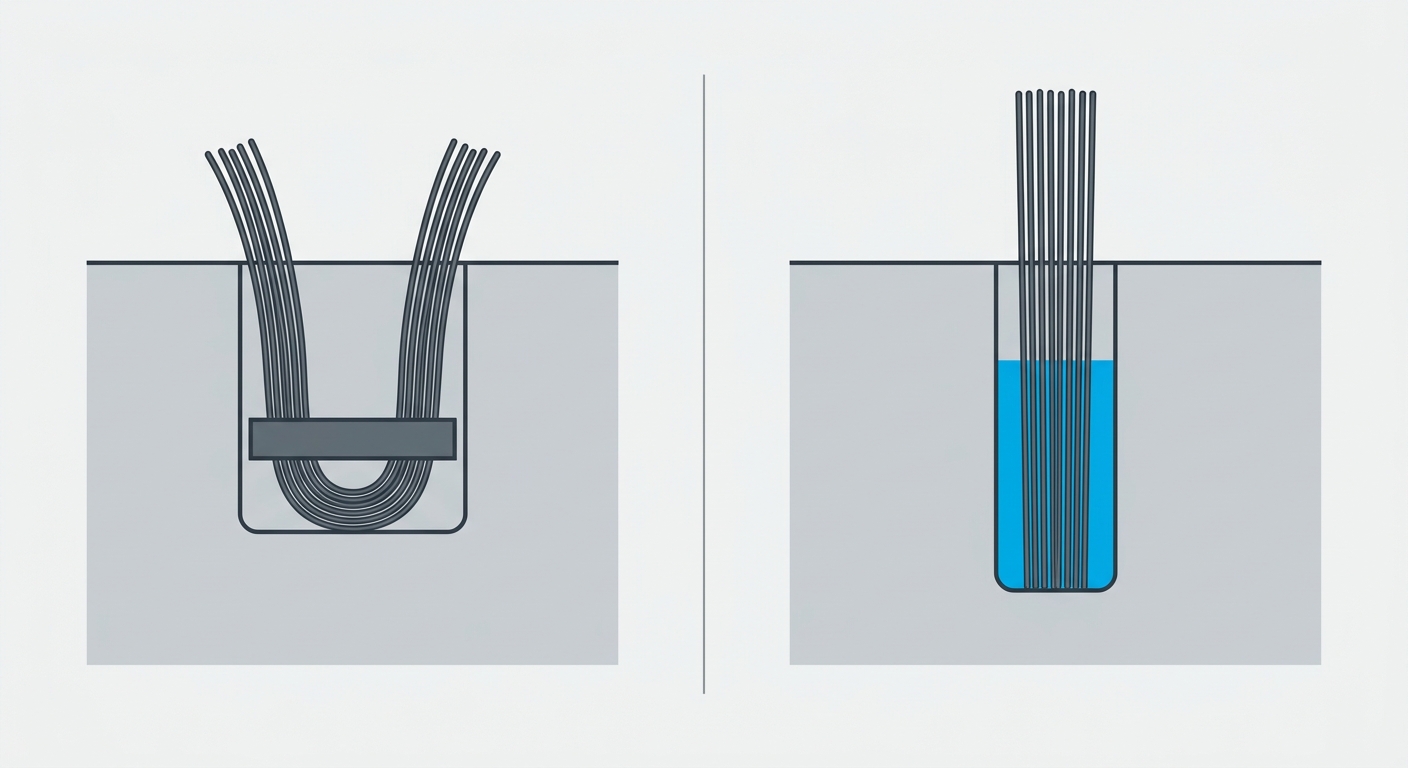
Caption: on the left, mechanical tufting, where the tuft is folded in half and fixed in the hole with a staple; on the right, adhesive fixing, where the whole tuft is coated with adhesive and inserted straight into a deep hole
This approach has its limits, which should be thought through before ordering:
- Temperature: the heat resistance of the adhesive depends on the adhesive type; confirm it first for high-temperature environments
- Solvents and coolants: some adhesives do not resist particular solvents; for wet machining, tell us in advance which liquid is used
- Pull strength: the fixing strength depends on the hole depth, how well the adhesive wraps the filament and how clean the hole is; do not assume it equals mechanical tufting
Whether a tuft is held securely has to be verified with a pull test; for the method see factory acceptance criteria for brush shedding. If the brush block is plate-shaped, the base plate material also affects hole positions and fixing; see the comparison of base plate materials for tufted plate brushes.
How brushes for PCB brushing differ from ordinary deburring brushes
Abrasive filament brushes have a wide range of uses: besides the edges of metal and plastic parts, the material supplier's application list also includes raw wood, plastic parts and circuit board pretreatment (Industrial Brush Company). The "brushing" on a PCB production line, however, uses a different product form.
Where is the difference?
Take the 3M Scotch-Brite PC cleaning brush as an example. It is a brush wheel made by bonding nonwoven fibers and abrasive minerals together with resin, and its purpose is to remove oxide layers, contaminants and residues from the copper surface so that the solder mask adheres better (Prostech). Its construction is not the same as individual abrasive filaments. A small brush head that is hand-held or mounted on a spindle, by contrast, treats local edges on a single part.
Both rely on abrasive to treat a surface, yet the way their specifications are discussed is completely different. For a brush wheel the discussion is about wheel diameter, wheel width and the shaft; for a small brush head it is about hole diameter, tufts and the shape of the handle.
In this section we only point out the difference. The parameters of brush wheels on PCB lines vary from machine to machine, and without actual machine data we will not give recommended values. For how roller-type brushes are made, see the production process of roller brushes.
Choosing between abrasive brushes and bonded abrasives such as grinding wheels
The biggest difference between an abrasive brush and a grinding wheel lies in how the abrasive grains contact the workpiece: abrasive filament brings the grains to the workpiece on a flexible carrier, while a grinding wheel fixes the grains on a rigid body (Products Finishing, 2004). This 1 difference decides the work each of them suits.
| Item compared | Abrasive filament brush | Bonded abrasives such as grinding wheels |
|---|---|---|
| Carrier of the abrasive grains | Flexible nylon filament | Rigid body |
| Effect on edges | Self-limiting after the burr is removed, forming a small radius | Keeps removing material |
| Effect on dimensions | Does not change dimensional tolerances | Changes dimensions; can be used for truing |
| Complex contours | The filament can follow and conform to the contour | Needs a matching wheel profile |
| Large burrs | Low efficiency | Suitable |
The Products Finishing article also explains the reason for the "self-limiting" behavior: when the filament meets a sharp corner carrying a burr, the contact area is small and the cutting pressure is high; once the burr is gone and the corner starts to round, the cutting pressure drops.
What about steel brushes? A wire brush relies on the scraping force of metal wire and is commonly used for rust removal and removing weld slag. It is a different class of tool and is not compared in this table. Its use and limits are explained separately in the complete guide to wire brushes. For the basic properties of nylon-type filament, see the material guide to nylon and synthetic filament.
Handle surface treatment: why the anodizing color should be checked against a color sample first
When an aluminum handle is anodized and dyed, the color should be confirmed before volume production, because there will be color variation between batches. This does not affect the deburring function, but it very often turns into a dispute at delivery.
We once made a double-ended abrasive brush with a hexagonal aluminum bar handle, specified as anodized in red. One of the open items we listed at the time was "confirm whether the red needs a specified color code or color sample". The reason was that the sample was in bare aluminum color, with no anodizing, and the two sides might not picture the same "red".
The approach is simple: provide a color code or a physical color sample first, confirm the acceptable range of color variation, and then go into production. Spending 1 extra confirmation step removes the risk of redoing the whole batch.
FAQ
Are a deburring brush and an abrasive brush the same thing?
In most cases, yes. "Deburring brush" describes the use, while "abrasive brush" describes the construction, a filament that contains abrasive. Typical abrasive filament is about 70% nylon and 30% abrasive, and it removes burrs with the abrasive grains inside the filament. Wire brushes can also deburr, though, so it is best to state the filament material directly when you send an inquiry.
How do I choose the grit number of abrasive filament?
Common grit sizes run from 46 to 500. The smaller the number, the coarser the grain and the stronger the cutting power. The coarser the grit, the more the diameter and stiffness of the filament increase as well, so coarse grit usually goes with thick filament. We suggest a brushing trial with a middle grit first, then adjusting coarser or finer according to how fast the burr is removed and the condition of the surface.
Will a deburring brush scratch the workpiece surface?
An abrasive filament brush acts only on edges. It does not remove significant base material from large surfaces and does not change dimensional tolerances. The edge radius it forms on soft materials such as aluminum is about 0.10–0.20 mm. What to watch for is overheating: if the speed is too high or the penetration too deep, the nylon filament melts and smears on the workpiece surface.
How fast should a deburring brush run?
Faster is not better. Weiler recommends keeping the surface speed below 3,500 SFPM, about 17.8 meters per second. Raising the speed does not increase cutting power; for stronger cutting you should lower the speed and increase the depth of penetration, or switch to a brush with thicker filament and a shorter trim length.
What information should I provide when asking for a quote on a custom deburring brush?
Provide at least 4 items: the workpiece material, the size and position of the burr, the space available for the brush head and how it is held, and whether the machining is dry or wet. For the abrasive, please write the name and the grit number, for example silicon carbide 120 grit, and not just a loose trade name such as "emery". If you have a physical sample or a drawing, the assessment will be faster.
Choosing a deburring brush: first decide what it will not do
When choosing a deburring brush, starting by elimination is the fastest way.
Leave large burrs to the cutting tool and dimensions to machining; the edge finishing that remains is the work of the abrasive filament brush. Next, use filament diameter and trim length to decide cutting power and conformability, use grit size to decide the surface condition, and then confirm whether the fixing method can withstand your temperature and liquids. Adjust the speed last, and usually downward.
This set of criteria has its boundaries too. We have not given a universal answer on which abrasive to choose, and we have not given recommended values for the parameters of PCB brush wheels. Both of these have to go back to the material supplier's technical data and the actual machine, and be settled by brushing trials.
Is your workpiece information ready?
Attach a drawing or a sample and describe the workpiece material and the condition of the burr, and we will assess the quote and lead time against the actual specification. If you would like to see which brush types we can make first, you can also look at our range of services.
→ Fill in an inquiry | Learn about our custom and tufting services
Further reading
- Industrial brush application cases: custom examples from eight industries
- The production process of roller brushes: from core selection to outer covering
- The complete guide to wire brushes: uses, selection and rust removal techniques
- A material guide to nylon brushes, plastic brushes and synthetic filament
- How often to replace brushes: replacement cycles by industry
References
- Abrasive Filament - Industrial Brush Company
- US 8,892,238 B2 Edge break details and processing - Google Patents
- Abrasive Nylon Brushes - Brush Research Manufacturing
- Guidelines for Effective Use of Nylox Brushes (WC445 Rev. 2/15) - Weiler Abrasives
- Brushing Up on Deburring - Products Finishing
- 3M Scotch-Brite High Resolution PC Cleaning Brush - Prostech