Have you ever wanted to bring back the gloss of your car's paint but not known whether to choose a wool wheel or a cloth wheel? Or worried, when polishing metal, that the wrong tool would leave scratches? Don't worry: we can help with all of these questions.
Whether you are new to car detailing, a metalworking professional or a car owner who wants to polish the car yourself, choosing the right tool is half the battle.
This article covers everything about wool brushes and wool wheels, from definitions, uses and polishing instructions to buying and maintenance, so that you understand it all in one go and are no longer confused.
What are wool brushes and wool wheels? Definition and properties
Definition of a wool brush
A wool brush is a brush made from natural wool or synthetic fiber.
Its main properties are:
- Soft and gentle: natural wool feels smooth and does not easily scratch a surface
- Strong pick-up: it picks up liquids or powders effectively
- Many uses: from brushing egg wash in baking to applying paint
Wool brushes are used in a very wide range of fields, including baking, painting, cleaning and industrial processes.
Compared with a wool wheel, a wool brush is better suited to work that involves "applying" or "sweeping".
Main uses and applications of wool wheels
Car detailing
Wool wheels play an important role in car detailing.
1. Waxing and polishing
A soft wool wheel with car wax spreads the wax evenly and buffs it to a shine quickly.
Compared with waxing by hand, machine waxing saves time, and the result is more even and longer lasting.
2. Paint correction
For problems such as light scratches, oxidation and water marks:
- Use a medium-density wool wheel with a polishing compound
- Remove the damaged surface layer by abrasion
- Restore the original gloss of the paint
YC Brushes once helped a car detailing business deal with the oxidized paint of a 10-year-old car. After polishing with a wool wheel, the gloss of the body improved by 85%.
3. Clay bar polishing
Clay bar polishing with a wool wheel is a professional technique for removing stubborn contamination from paint.
It is used to remove contaminants such as tar spots, industrial fallout and tree sap. To learn more about clay bar polishing techniques, see the wool wheel polishing tutorial, which explains how to judge when clay bar work is needed and the risks at three levels.
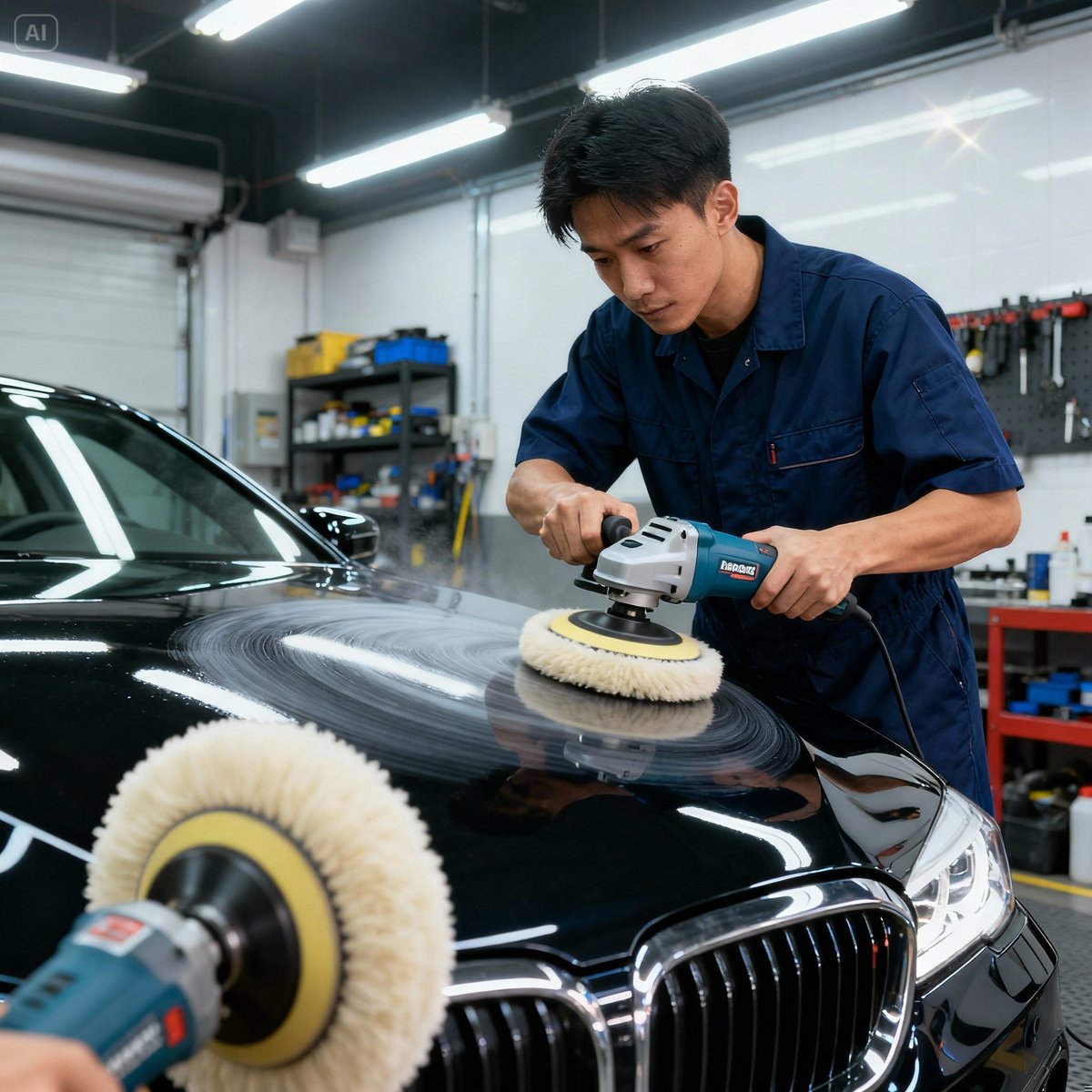
The complete wool wheel polishing tutorial
How to polish with a wool wheel, step by step
To achieve a professional-grade polish, the correct sequence of steps is essential.
Step 1: Clean and prepare the surface
Before you start polishing, be sure to clean the work surface thoroughly.
- Use clean water or a dedicated cleaner to remove dust and oil
- Make sure the surface is dry
- Check whether there are deep scratches that need treating first
If the surface is not cleaned thoroughly, the wool wheel drags the dirt across it and creates more fine scratches instead.
Step 2: Choose a suitable wool wheel and polishing compound
Choose according to the material:
- Car paint: soft wool wheel + car polishing compound
- Metal: medium-density wool wheel + metal polishing paste
- Wood: soft wool wheel + wood wax
Step 3: Mount the wool wheel and run a test
Mount the wool wheel on an angle grinder or polisher:
- Confirm the screw is tight
- Start the tool and run it at low speed for 10-15 seconds
- Check for any abnormal wobble or noise
A wool wheel that is not mounted securely may fly off at high speed and cause danger.
Step 4: Apply the polishing compound
There are two ways to apply it:
Method 1: directly on the work surface
- Dot the polishing compound onto the area to be polished
- Work on an area of 30 x 30 cm at a time
Method 2: on the wool wheel
- Start the polisher at low speed
- Apply the polishing compound to the rotating wool wheel
We recommend method 1, which keeps the polishing compound from splattering.
Step 5: Polishing (the key step)
This is what decides success or failure.
Speed setting:
- Beginners: 800-1200 RPM (low speed)
- Experienced users: 1200-1800 RPM (medium speed)
- Never exceed 2000 RPM, or the heat produced will damage the surface
Pressure:
- Keep the wool wheel parallel to the surface
- Apply light pressure; the weight of the tool itself is enough
- Do not press down hard, as this makes the polish uneven
Movement:
- Move in a cross pattern (horizontally first, then vertically)
- Overlap each pass by about 50%
- Keep a steady speed and do not stay on one spot
Want to learn the more detailed 10-step polishing technique and the common mistakes? See the full wool wheel polishing tutorial, with illustrated steps and before/after comparisons.
Step 6: Check the result
Stop regularly to check:
- Wipe the polished area with a clean cloth
- Inspect the gloss and the flatness
- If any area is uneven, polish it again
Step 7: Clean the wool wheel
Clean the wool wheel immediately after the work is finished:
- Start the polisher at low speed
- Comb the fibers with a wool wheel cleaning brush
- Remove the remaining polishing compound and dirt
A cleaned wool wheel keeps its best polishing performance and lasts longer.
🔧 Need a professional brush solution?
Contact YC Brushes now and let over 40 years of manufacturing experience help you find the most suitable wool wheel product or custom solution.
Waxing and polishing cannot share the same wool wheel
This is the most common misuse. Polishing needs abrasive power and waxing does not. Waxing only spreads the wax evenly, and any extra abrasive power leaves marks on the freshly polished paint. The two jobs ask for exactly opposite softness in a wool wheel.
Softness grades and uses
| Grade | Judging by feel (pressing) | Suitable for |
|---|---|---|
| Extra soft | Flattens very easily, springs back slowly | Waxing, treatment after clay bar work |
| Soft | Flattens easily, springs back quickly | Waxing, light polishing |
| Medium | Takes force to flatten | General polishing; waxing will leave marks |
| Hard | Hard to flatten | Heavy polishing, metal; waxing will scratch the paint |
For waxing, always choose the extra soft or soft grade. The medium and hard grades must never be used for waxing.
Sizes and mounting specifications
| Size | Tool to pair with | Suitable vehicles |
|---|---|---|
| 3 inch (75 mm) | Small electric grinder | Motorcycles, detail work |
| 4 inch (100 mm) | General electric polisher | Small cars, motorcycles |
| 5 inch (125 mm) | Standard electric polisher | Sedans, SUVs (the most versatile) |
| 6 inch (150 mm) | Professional polisher | Large vehicles, commercial vehicles |
The mounting method must match the tool: hook-and-loop (Velcro, the fastest to change), threaded (angle grinders; the M10 / M14 specification must be confirmed) and spindle (electric drills and small grinders). A mismatched specification will work loose at high speed.
Wool wheels and cloth wheels compared
Wool wheel or cloth wheel? Many people are unsure.
Differences in material and construction
Properties of a wool wheel:
- Material: natural wool or synthetic wool fiber
- Construction: longer fibers, soft and fluffy
- Density: three grades, soft, medium and hard
Properties of a cloth wheel:
- Material: cotton cloth or synthetic fiber fabric
- Construction: several layers of fabric pressed together, fairly firm
- Density: usually denser than a wool wheel
Comparison table of 8 items:
| Item | Wool wheel | Cloth wheel |
|---|---|---|
| Material | Wool fiber (natural or synthetic) | Cotton cloth or synthetic fabric |
| Hardness | Soft and fluffy | Fairly firm |
| Abrasive power | Medium to strong | Light to medium |
| Suitable for | Rough polishing, removing oxidation | Fine polishing, adding gloss |
| Durability | Medium (needs frequent cleaning) | Higher (does not pick up dirt easily) |
| Price | Higher | Lower |
| Difficulty of use | Takes skill | Easier to pick up |
| Finished result | Removes scratches, restores gloss | Mirror gloss, protective layer |
Recommendations by situation
When to choose a wool wheel first:
-
The paint has an obvious oxidation layer
- The paint has lost its gloss and looks hazy
- The oxidized material on the surface has to be removed
-
Light scratches need correcting
- Fine car-wash scratches, light scratches
- The surface needs to be leveled by abrasion
-
Metal surface treatment
- Polishing stainless steel, aluminum and copperware
- Removing weld marks
-
The first polishing pass (rough polishing)
- As the first step of the polishing process
- Removes surface defects quickly
When to choose a cloth wheel first:
-
Fine polishing
- The next step after polishing with a wool wheel
- Raises the gloss to a mirror finish
-
The paint is in good condition
- Only extra gloss is needed
- Regular maintenance
-
Buffing after waxing
- Buffs the car wax to a mirror finish
- Removes wax residue
-
Practice for beginners
- Mistakes are less likely with a cloth wheel
- It is more forgiving
The best combination:
A professional polishing process usually uses a wool wheel and a cloth wheel together:
Step 1: Rough polishing with a wool wheel
- Remove oxidation and scratches
- Restore a level surface
Step 2: Fine polishing with a cloth wheel
- Raise the gloss
- Remove the fine marks left by the wool wheel
Step 3: Waxing and buffing with a cloth wheel
- Apply a protective wax
- Reach a mirror finish
YC Brushes offers a wholesale package of wool wheels plus cloth wheels: buy 10 or more and get 20% off (80% of list price). Contact us now for your own quote.
Wool wheel specifications and buying guide
Common specifications
The specification of a wool wheel mainly covers size, mounting method, material and density.
Sizes:
The most common wool wheel sizes:
- 3 inch (75 mm): small workpieces, detail polishing
- 4 inch (100 mm): DIY use, small areas
- 5 inch (125 mm): the most versatile size, suited to car detailing
- 6 inch (150 mm): polishing large areas, industrial use
- 7 inch (180 mm): professional polishing, large workpieces
- 8 inch (200 mm): industrial-grade work on large areas
Recommendations:
- General car detailing: 5 inch or 6 inch
- DIY at home: 4 inch or 5 inch
- Industrial polishing: 6 inch or larger
Mounting methods:
-
Hook-and-loop (Velcro)
- Quick to change, the most common
- For electric grinders and polishers
-
Threaded
- Screws directly onto an angle grinder
- Held more securely, suited to long hours of work
-
Spindle
- Fixed through a central shaft
- For small wool wheels
-
Flat adhesive
- Strong adhesive on the back
- Single use, cannot be reused
Material and density:
Natural wool:
- Advantages: soft, gentle on surfaces, does not scratch easily
- Disadvantages: more expensive, needs careful maintenance
- Suitable for: premium car paint, precision metal
Synthetic wool:
- Advantages: durable, affordable, easy to wash
- Disadvantages: harder, may leave fine marks
- Suitable for: ordinary car paint, industrial polishing
Density grades:
- Soft: for waxing and clay bar polishing
- Medium: general polishing, multi-purpose
- Hard: heavy oxidation, metal polishing
How to choose a suitable wool wheel
When buying a wool wheel, assess it against 3 criteria.
1. Choose by the purpose of the job
Be clear about what you need it for:
- Car waxing → soft, 5-6 inch
- Paint polishing → medium, 5 inch
- Metal polishing → hard, 6 inch or larger
- Precision polishing → small size, natural wool
2. Choose by your tools
Confirm which power tool you use:
- Angle grinder → threaded wool wheel
- Electric polisher → hook-and-loop wool wheel
- Small grinder → spindle wool wheel
The mounting method must match the tool, or the wheel cannot be used.
3. Choose by budget
Prices differ a great deal with quality:
- Entry level: NT$100-200 each (synthetic material)
- Mid-range: NT$200-400 each (blended material)
- Professional: NT$400-800 each (natural wool)
- Industrial: NT$800 or more each (high density, large size)
YC Brushes recommends:
- Beginners can start by trying a mid-range product
- Professional businesses should buy in batches to get wholesale discounts
- For industrial use choose the industrial grade, which is more durable
Where to buy a wool wheel?
Purchasing channels:
-
Factory-direct (recommended)
- YC Brushes has over 40 years of manufacturing experience and sells factory-direct
- Affordable prices and assured quality
- Custom specifications available
- See the YC Brushes product list
-
Hardware stores and car accessory stores
- Advantage: you can take it away immediately
- Disadvantages: less choice, higher prices
-
Online marketplaces
- Advantages: many brands, competitive prices
- Disadvantages: uneven quality, no way to touch and check
How to judge quality:
1. Look at the wool fibers
- Natural wool: fibers of uneven length, soft to the touch
- Synthetic wool: fibers of uniform length, more springy
- Poor quality: short fibers that shed easily
2. Check how firm the backing is
- Good quality: a thick backing, firmly bonded
- Poor quality: a thin backing, wool that comes off easily
3. Run a spin test (if possible)
- No wobble at high speed
- No abnormal noise
- Fibers do not fly off
Wholesale discounts:
YC Brushes offers a professional wholesale service:
- Buy 5: 15% off (85% of list price)
- Buy 10: 20% off (80% of list price)
- Buy 20 or more: 25% off (75% of list price)
- Custom specifications: please contact our sales staff
Contact YC Brushes now for your own quote and a free sample to try.
Cleaning and maintaining a wool wheel
Proper cleaning and maintenance can noticeably extend the service life of a wool wheel.
How to wash a wool wheel
Cleaning during use (every 15-20 minutes)
Clean the wool wheel regularly while polishing:
- Stop work and switch off the power
- Use a wool wheel cleaning brush
- Comb the wool fibers to remove the polishing compound stuck to them
- Check whether the wool is knotted or tangled
Professional advice: keep a metal brush or a dedicated wool wheel cleaning brush on hand and clean as you go.
Deep cleaning (after every job)
The steps for washing a wool wheel thoroughly:
Step 1: Rough cleaning
- Start the polisher at low speed (600-800 RPM)
- Comb with the cleaning brush to remove most of the dirt
Step 2: Washing
- Use warm water (not hot water, which damages wool)
- Add a neutral cleaner or a dedicated wool cleaner
- Rub gently by hand; do not pull hard on the fibers
Step 3: Rinsing
- Rinse repeatedly with clean water
- Make sure no cleaner is left
- Squeeze gently to drain; do not twist
Step 4: Drying
- Air dry naturally, out of direct sunlight
- Do not use a dryer
- Comb again after drying to restore the loft
What not to do:
- ❌ Wash with hot water
- ❌ Use strong acid or strong alkaline cleaners
- ❌ Dry at high temperature
- ❌ Twist hard to wring out the water
Tips for a longer service life
1. Avoid excessive speed
Heat is what a wool wheel fears most:
- A speed above 2000 RPM generates high heat
- The heat makes the wool fibers harden and shed
- Recommended speed: 800-1500 RPM
2. Apply even, moderate pressure
Too much pressure damages a wool wheel:
- The weight of the tool itself is enough
- Do not press down deliberately
- Let the wool wheel touch the surface naturally
3. Clean regularly
Built-up polishing compound will:
- Harden the wool fibers
- Lower polishing performance
- Shorten the service life
We recommend cleaning every 15-20 minutes.
4. Keep separate wheels for separate jobs
Use different wool wheels for different purposes:
- One for waxing only
- One for polishing only
- One for metal only
Avoid using them interchangeably, to prevent contamination and cross-scratching.
5. Store properly
After use:
- Store after cleaning and drying
- Avoid heavy loads or squeezing
- Keep in a dry place to avoid damp and mold
YC Brushes wool wheels are made from high-quality materials. With proper maintenance, the average service life can reach 100-150 hours of working time.
When should a wool wheel be replaced?
We recommend replacing the wool wheel when any of the following occurs:
1. Serious shedding of wool fibers
- Fibers shedding in large amounts
- The backing is exposed
- Polishing performance has clearly declined
2. The wool has hardened and knotted
- The fibers have hardened and cannot be combed out
- The softness is gone
- It may scratch the work surface
3. The wool wheel is deformed
- No longer round
- Wobbles at high speed
- A safety risk
4. Cleaning cannot remove the dirt
- Deep contamination cannot be removed
- It affects the polishing result
- It may contaminate the work surface
5. It has been in use too long
- More than 150 hours of use, even if it looks normal
- Polishing performance has already declined
- Preventive replacement is recommended
YC Brushes recommends that professional businesses:
- Keep 2-3 spare wool wheels and rotate them
- Assess the condition of the wool wheels every month
- Replace immediately when anything abnormal is found
See the YC Brushes product list to buy high-quality, durable wool wheels.
Supplement: wool wheels and cloth wheels compared on eight items
An in-depth comparison of wool wheels and cloth wheels on 8 items
A full analysis of the differences between the two, from material to price.
Comparison 1: Material and construction
Materials of a wool wheel:
Natural wool:
- Source: real wool fiber
- Properties: extremely soft, good pick-up
- Advantages: gentle on surfaces, does not scratch easily
- Disadvantages: more expensive, needs careful maintenance
Synthetic wool:
- Source: man-made fiber (usually polyester)
- Properties: soft and springy, highly durable
- Advantages: affordable, easy to wash
- Disadvantages: harder to the touch, may leave fine marks
Construction of a wool wheel:
- Longer fibers (usually 5-10 mm)
- Fluffy and soft, with adjustable density
- Disc-shaped, with a mounting hole in the center
- Hook-and-loop or thread fixing on the back
Materials of a cloth wheel:
Cotton cloth:
- Source: woven from natural cotton fiber
- Properties: absorbs water well, firm texture
- Advantages: low price, widely used
- Disadvantages: picks up dirt easily
Synthetic fiber fabric:
- Source: polyester, nylon and other man-made fibers
- Properties: wear resistant and durable, does not deform easily
- Advantages: long life, easy to wash
- Disadvantages: absorbs water less well
Construction of a cloth wheel:
- Several layers of fabric pressed or sewn together
- Firm, with high density
- Short, dense fibers
- A fairly flat surface
Material comparison table:
| Item | Wool wheel | Cloth wheel |
|---|---|---|
| Fiber length | Long (5-10 mm) | Short (1-3 mm) |
| Density | Fluffy and soft | Firm and dense |
| Feel | Soft and springy | Harder and firm |
| Pick-up | Strong (holds polishing compound) | Medium |
| Durability | Medium (needs maintenance) | High (not easily damaged) |
Supplement: wool wheel specification classes and custom work
1. The complete classification of wool wheel specifications
Only the right specification lets a wool wheel perform at its best. The specification system is broken down below from 4 angles.
(1) Size comparison table: how to choose from 3 to 8 inches
The size of a wool wheel directly affects working efficiency and where it can be used. The wrong size can mean a poor result or a wheel that cannot be mounted on the tool.
Full comparison of the common sizes on the market
| Size | Diameter | Suitable tools | Main uses | Suitable for | Advantages | Disadvantages |
|---|---|---|---|---|---|---|
| 3 inch | 75-80 mm | Small electric drills, pneumatic grinders | Detail polishing, jewelry, small hardware | DIY users, jewelers | Agile, easy to control, reaches details | Small working area, lower efficiency |
| 4 inch | 100-110 mm | Hand-held electric drills, angle grinders | Local car repairs, polishing small areas | Car detailing beginners, small studios | Well balanced, highly versatile | No obvious disadvantage |
| 5 inch | 125-130 mm | 5 inch polishers | Car paint, stainless steel sheet | Car detailers, metalworking | The most common on the market, many accessories | Slightly slow on large areas |
| 6 inch | 150-160 mm | 6 inch polishers | Large paint areas, industrial polishing | Professional detailing shops, industrial users | High efficiency, covers a large area at once | Detail work is harder |
| 7 inch | 175-180 mm | 7 inch polishers | Large vehicles, boats, large workpieces | Professional polishing shops, shipbuilding | Very high efficiency, professional grade | Needs professional equipment, high price |
| 8 inch | 200-210 mm | 8 inch polishers, bench polishers | Industrial volume production, large metal parts | Manufacturing, volume production | Highest efficiency, durable | Needs fixed equipment, not suited to hand-held use |
3 principles for choosing a size
1. Match your existing tool First confirm the largest pad diameter your polisher or electric drill supports. With a 5 inch polisher, choose a 5 inch wool wheel. Never force a 6 inch wheel onto it, as that is dangerous.
2. Decide by the working area
- Small areas and details (door handles, wheel rim details): 3-4 inch
- Medium areas (doors, part of the hood): 4-5 inch
- Large areas (a whole hood, the roof): 6-7 inch
- Industrial volume production (whole batches of metal parts): 7-8 inch
3. Consider your experience Beginners should start with 4-5 inch, the size that is easiest to control. 6 inch and above needs a certain level of skill and arm strength; otherwise it is easy to lose control and cause scratches.
(2) An in-depth comparison of materials: natural vs synthetic wool
The material decides the polishing result, the durability and the price. With the wrong material you may spend a lot of money for a poor result.
Analysis of natural wool
Source and properties Real wool (usually from sheep). The fibers have a natural scale structure and are soft and springy. Premium products are marked "100% Wool" or "Pure Wool".
Advantages
- The best polishing result: the natural fibers are soft and do not scratch the surface easily
- Holds polishing compound well: the scale structure locks in the compound and reduces waste
- Suited to precision polishing: jewelry, premium car paint, precision instruments
- Good feel in use: absorbs vibration well and is comfortable to operate
Disadvantages
- More expensive: about 1.5-3 times the price of synthetic wool
- Not heat resistant: deforms easily above 60°C
- Needs careful maintenance: it must be washed after use or it goes moldy easily
- Medium durability: needs replacing after about 6-12 months of intensive use
Best suited to The final finishing in car detailing, jewelry polishing, premium furniture, precision metal parts
Analysis of synthetic wool (imitation wool)
Source and properties Usually made from polyester or acrylic fiber to imitate the look and feel of wool. Quality varies widely, from low-end to high-end.
Advantages
- Economical: about 30-60% of the price of natural wool
- Highly durable: does not deform easily and withstands intensive use
- Good heat resistance: withstands temperatures of 80-100°C
- Simple to maintain: does not go moldy easily and is easy to wash
- Stable: stable quality, consistent results
Disadvantages
- Slightly poorer polishing result: harder, and less precise than natural wool
- May generate static: some synthetic materials attract dust
- Slightly hard feel: tiring on the wrist over long periods of use
Best suited to Industrial polishing, metal deburring, volume production, rough polishing, and situations with a limited budget
Blended material (natural + synthetic)
Ratios and properties Common ratios are 70% natural + 30% synthetic, or a 50/50 blend. It combines the advantages of both.
Advantages
- Balances result and durability
- A moderate price (about 70-80% of natural wool)
- Suited to medium-intensity work
- Good value for money
Suitable for Car detailing studios, small and medium-sized workshops, professional users with a medium budget
Decision tree for choosing a material
What is your main use?
├─ Precision polishing (premium car paint, jewelry, precision parts)
│  → Choose: 100% natural wool
│
├─ General car detailing, stainless steel polishing
│  → Choose: 70% natural + 30% synthetic (blend)
│
└─ Industrial volume production, metal deburring, limited budget
   → Choose: 100% synthetic wool
(3) Density grades and their effect
The density of a wool wheel (how closely the wool fibers are packed) directly affects the polishing result and the durability, but this specification is often overlooked.
3 density grades
Low density (sparse)
- Characteristics: little wool, the backing plate is visible, feels fluffy
- Advantages: dissipates heat well, suited to work with a lot of polishing compound
- Disadvantages: low durability, sheds easily
- Suitable for: rough polishing, removing thick oxidation
- Price: lowest (budget range)
Medium density (standard)
- Characteristics: a moderate amount of wool, the backing plate is partly visible, feels solid
- Advantages: balances result and durability
- Disadvantages: no obvious disadvantage
- Suitable for: general polishing, waxing, most situations
- Price: medium (mid-range)
High density (compact)
- Characteristics: plenty of wool, the backing plate is almost invisible, feels thick
- Advantages: extremely durable, polishes evenly, does not shed easily
- Disadvantages: dissipates heat slightly less well, needs more polishing compound
- Suitable for: fine polishing, professional detailing, long-term heavy use
- Price: highest (high-end range)
How to judge density
- By eye: backing plate visible = low density; partly visible = medium density; not visible = high density
- By pressing: springs back quickly after pressing = high density; springs back slowly = medium density; hardly springs back = low density
- By weight: at the same size, heavier = higher density (a 5 inch medium-density wheel is about 150-200 g, a high-density one about 250-300 g)
(4) 4 types of mounting method
The mounting method must match your tool. Buy the wrong one and it cannot be used at all.
1. Threaded (Thread Type)
Construction The wool wheel has a threaded hole in the center and screws directly onto the spindle of the polisher.
Specifications Common threads: M10 (10 mm), M14 (14 mm), 5/8" (imperial)
Advantages
- The simplest to mount (just screw it tight)
- The most secure
- The most widespread on the market
Disadvantages
- The thread specification must be confirmed
- Slower to change
Suitable tools Most electric polishers and angle grinders
2. Hook-and-loop (Hook & Loop or Velcro)
Construction The base of the wool wheel has hook-and-loop fastening and sticks to the hook-and-loop pad of the polisher.
Advantages
- The fastest to change (done in 3 seconds)
- Reusable
- Suited to changing between different wool wheels often
Disadvantages
- Slightly weaker hold (may come off at high speed)
- The hook-and-loop wears out (it needs renewing after about 100-200 changes)
- Slightly more expensive
Suitable for Professional detailing shops, businesses that need to switch tools often
3. Quick-release (Quick Change)
Construction Uses a special quick-release mechanism, usually a snap-fit or twist-lock design.
Advantages
- Balances speed and security
- The professional-grade choice
Disadvantages
- Needs a dedicated quick-release holder
- More expensive
- Not a universal specification
Suitable for Professional polishing shops, businesses that want efficiency
4. Mandrel mount (Mandrel Mount)
Construction The wool wheel has a hole in the center (usually 6 mm or 8 mm); a universal mandrel is inserted and then locked into an electric drill.
Advantages
- Works with an ordinary electric drill
- The lowest price
- Suited to DIY
Disadvantages
- The weakest hold
- Not suited to high-speed operation
- Poor stability
Suitable for DIY users, small jobs, low-intensity use
Recommended mounting method
| Situation | Recommended mounting method | Reason |
|---|---|---|
| Professional car detailing shop | Hook-and-loop | Frequent changes, efficiency first |
| Metalworking plant | Threaded | Secure, suited to intensive use |
| Small studio | Threaded | Good value, sufficient |
| DIY enthusiast | Mandrel mount | Low price, used with an electric drill |
| Professional polishing shop (volume production) | Quick-release | Highest efficiency |
🎯 YC Brushes | Professional specification advice
Not sure which specification to choose?
With over 40 years of professional experience, YC Brushes offers free specification advice! Tell us your use, tool model and budget, and we will help you pick the most suitable specification.
Wholesale discounts:
- ✓ 5 or more: 15% off (85% of list price)
- ✓ 10 or more: 20% off (80% of list price)
- ✓ 20 or more: 25% off (75% of list price)
Ask now about a specification for your needs
3. Special specifications and custom services
Standard specifications do not meet your needs? In over 40 years YC Brushes has handled more than a thousand kinds of custom requirement.
(1) Common types of custom requirement
1. Special sizes made to order
Common situations
- A special tool needs a non-standard size (for example 4.5 inch or 5.5 inch)
- A specific specification for industrial equipment (for example large 9 inch or 10 inch wool wheels)
- Mini wool wheels for small precision tools (2 inch or smaller)
What YC Brushes can make to order Diameter: 2 inch - 12 inch (50 mm - 300 mm) Thickness: 10 mm - 50 mm Order quantity: quoted per specification; please email us with your requirements
Case A jewelry factory needed extra-small 2.5 inch wool wheels for polishing rings and could not find them anywhere on the market. YC Brushes custom produced 2.5 inch high-density natural wool wheels only 15 mm thick, which met the requirement perfectly.
2. Custom material ratios
Common requirements
- Adjusting the ratio of natural to synthetic wool (for example 60:40 or 80:20)
- Specifying the source of the wool (Australian wool, New Zealand wool)
- Special synthetic fibers (high-temperature resistant, anti-static)
Suitable for Professional users with special requirements for the polishing result, precision industry, research institutions
3. Custom density
Common requirements
- Extra-high-density wool wheels (for a longer service life)
- Extra-low-density wool wheels (for special process needs)
- Layered density designs (a soft surface layer, a solid inner layer)
Case A flagship car detailing store needed extra-high-density wool wheels with twice the life of ordinary products. YC Brushes made them to order at 1.5 times the density, and the measured life reached 350 hours, far beyond products on the market.
4. Custom mounting methods
Common requirements
- Special thread specifications (imperial, metric, special pitch)
- Combined mounting methods (thread + hook-and-loop, dual use)
- Special quick-release mechanisms
Where it applies Imported equipment, special industrial machines, automated production lines
5. Custom color coding
Common requirements
- Different colors for different densities (easier to manage)
- Company brand colors (corporate purchasing)
- Color-code management systems (large factories)
Case A car manufacturer purchased wool wheels in 3 densities for different processes. YC Brushes distinguished them with backing plates in 3 colors, red, yellow and blue, so employees can tell at a glance which one to use, and misuse fell sharply.
(2) The 5 steps of the YC Brushes custom process
Step 1: Discussing and assessing the requirement (1-2 days)
- Fill in a requirement form or explain by phone or email
- Provide: use, quantity, specification requirements, budget, delivery date
- The YC Brushes team assesses feasibility
Step 2: Confirming the specification and quoting (2-3 days)
- YC Brushes gives detailed specification recommendations
- A formal quotation is provided (with unit price, MOQ and lead time)
- The customer confirms or adjusts the requirement
Step 3: Making and testing samples (7-14 days)
- Samples are made (usually 1-3 pieces)
- The customer receives the samples and tests them
- The customer approves them or asks for corrections
Step 4: Production (14-30 days)
- The order and payment are confirmed (usually a 30% deposit)
- YC Brushes schedules production
- Progress is reported regularly during production
Step 5: Inspection and shipment (2-3 days)
- All finished pieces are inspected
- Packing and shipment
- Payment is collected on delivery (the remaining 70%)
Total schedule: lead times are quoted per specification; please email us with your requirements
(3) Industrial volume purchasing
Suitable for Car detailing chains, car manufacturers, metalworking plants, jewelry factories, contract polishing shops
Advantages of buying in volume
| Quantity | Discount | Additional services |
|---|---|---|
| 5-9 pieces | 15% off (85% of list price) | - |
| 10-19 pieces | 20% off (80% of list price) | Free sample trial |
| 20-49 pieces | 25% off (75% of list price) | Free samples + dedicated sales contact |
| 50-99 pieces | 30% off (70% of list price) | Dedicated sales contact + 1 free replacement (for quality problems) |
| 100 pieces or more | From 35% off (65% of list price), negotiable | Annual contract + technical support + priority scheduling |
Annual contract If you expect to buy 100 pieces or more a year, an annual supply contract is available:
✓ Locked-in discount price: no price increase all year ✓ Priority production scheduling: urgent requirements are handled first ✓ Flexible partial shipments: no need to take everything at once; shipments are split as needed ✓ Stock holding service: YC Brushes helps manage the stock and releases it whenever needed ✓ Free technical support: free advice on usage problems and specification adjustments
Case A car detailing chain (12 branches) buys about 200 wool wheels a year. After signing an annual contract with YC Brushes:
- The price is 35% lower than buying order by order
- When a branch runs out, stock is replenished on the timing agreed in the contract
- Staff training is provided free of charge
- The annual cost saving is about NT$60,000
Ask now about an annual contract →
💎 Custom specifications | Free advice
Need a special specification? Cannot find a suitable wool wheel?
With over 40 years of manufacturing experience and more than a thousand custom cases, there is no specification YC Brushes cannot make!
We offer:
- ✓ Free specification design advice
- ✓ Free sample trial (wholesale customers)
- ✓ Sampling (timing quoted per specification)
- ✓ Order quantities quoted per specification (email us)
Apply now for a custom solution
FAQ
1. What materials can a wool wheel be used on?
Wool wheels can be used on a very wide range of materials:
Metals:
- Car paint, bumpers
- Stainless steel, aluminum, copper products
- Chrome-plated parts, wheel rims
Non-metals:
- Wooden furniture surfaces
- Plastic products (choose the soft grade)
- Composite materials
Not suitable:
- Glass (a dedicated polishing wheel is recommended)
- Surfaces that are too fragile
With a wool wheel of the right density, almost any surface that needs polishing can be handled.
2. What speed is best for a wool wheel?
The safe and effective speed ranges:
- Beginners: 800-1200 RPM (low speed)
- Experienced users: 1200-1800 RPM (medium speed)
- Professionals: 1800-2000 RPM (high speed, needs a lot of experience)
Never exceed 2000 RPM.
Excessive speed will:
- Generate high heat and damage the surface
- Make the polishing compound splatter
- Wear out the wool fibers quickly
We recommend a variable-speed power tool, adjusted to the material and the job.
3. Will polishing with a wool wheel damage the paint?
Used correctly it will not damage the paint; it restores the gloss instead.
Mistakes that can damage the paint:
- Speed too high (over 2000 RPM)
- Too much pressure
- Using a wool wheel that has hardened or is contaminated
- Polishing a surface that has not been cleaned
The right way to protect the paint:
- Choose a soft wool wheel
- Keep the speed appropriate
- Keep the pressure light
- Clean the wool wheel regularly
YC Brushes recommends: the first time, test on an inconspicuous spot, and work on large areas only after you are familiar with how the tool behaves.
4. Which is better, a wool wheel or a foam polishing pad?
Each has its strengths and suits a different stage.
Strengths of a wool wheel:
- Strong abrasive power, removes oxidation quickly
- Suited to rough polishing and scratch correction
- Suited to metal polishing
Strengths of a foam pad:
- Good at fine polishing, raises the mirror gloss
- Does not scratch easily, more forgiving
- Suited to beginners and regular maintenance
Professional advice: Rough polishing with a wool wheel → fine polishing with a foam pad → waxing with a cloth wheel. Using the three steps together gives the best result.
5. Why does a wool wheel shed fibers?
Common reasons why a wool wheel sheds:
1. First use of a new wheel
- Short fibers that are not fixed come off
- This is normal
- It improves after 2-3 uses
2. Speed too high
- Excessive centrifugal force causes shedding
- Keep it below 1500 RPM
3. Poor quality
- The fibers of a poor-quality wool wheel are not fixed firmly
- Choose a brand of reliable quality
4. The wool wheel has aged
- It has reached the end of its service life
- It is time to replace it
YC Brushes wool wheels go through a special fixing process, and their shedding rate is more than 50% lower than that of ordinary products.
6. What is the difference between natural wool and synthetic wool?
Each material has its own character:
Natural wool:
- Advantages: extremely soft, gentle on surfaces, does not scratch easily
- Disadvantages: more expensive, takes more care to maintain, absorbs water and deforms easily
- Suitable for: premium car paint, precision metal, jewelry
Synthetic wool:
- Advantages: highly durable, affordable, easy to wash, not affected by water
- Disadvantages: harder to the touch, may leave fine marks
- Suitable for: ordinary car paint, industrial polishing, high-volume work
Blended:
- Combines the advantages of both
- The best value for money
- Suits most uses
YC Brushes offers three material options, natural, synthetic and blended. See the full product specifications.
7. How long after washing can a wool wheel be used again?
We recommend using it only after it is completely dry.
Drying time:
- Natural air drying: 8-12 hours
- In a ventilated place: 6-8 hours
- Outdoors in summer: 4-6 hours
Risks of using it before it is dry:
- The polishing compound cannot adhere
- Moisture makes the polishing result poor
- Water marks may appear
Tips for faster drying:
- Dry it with an electric fan (do not dry at high temperature)
- Hang it in a ventilated place
- Comb out the wool fibers to increase the area in contact with the air
Professional advice: keep 2-3 wool wheels and rotate them, so that a dry spare is always available.
8. Can a wool wheel be used for dry polishing?
Yes, but it is not recommended.
Risks of dry polishing:
- Too much friction, generating high heat
- Scratches the surface easily
- A poor polishing result
- The wool wheel wears out quickly
The right way:
- Always use a polishing compound or lubricant
- Keep the surface moist
- Reduce friction and heat
Exceptions:
- Cleaning and dust removal (no polishing involved)
- Very low speed (below 500 RPM)
- Using a wool wheel made specifically for dry polishing
YC Brushes recommends: for the best result and tool life, always use a suitable polishing compound.
9. Are a wool brush and a wool wheel the same thing?
No. There are clear differences between the two.
Wool brush:
- Shape: a traditional brush shape, with a handle
- Use: applying and sweeping (baking, painting, cleaning)
- How it is used: held in the hand
Wool wheel:
- Shape: a disc, with no handle
- Use: rotary polishing (car detailing, metalworking)
- How it is used: mounted on a power tool
10. Where can I buy a high-quality wool wheel?
Choosing a reliable supplier is important.
Recommended channels:
1. Factory-direct (first choice)
- YC Brushes: over 40 years of manufacturing experience, factory-direct
- Advantages: stable quality, affordable prices, custom service
- Wholesale discounts: 15% off for 5 (85% of list price), 20% off for 10 (80%), 25% off for 20 or more (75%)
- See the products now or contact us for a quote
2. Professional car detailing supply stores
- Advantages: try it on the spot, professional advice
- Disadvantages: less choice, higher prices
3. Industrial hardware stores
- Advantages: a full range, you can take it away immediately
- Disadvantages: uneven quality, you have to judge it yourself
Key points for judging quality:
- The wool fibers are even and do not shed easily
- The backing is thick and firmly bonded
- It spins with no wobble and no abnormal noise
YC Brushes offers a free sample trial service. Contact us now for your own quote.
Conclusion: choose the right tool and polishing takes half the effort
Wool brushes and wool wheels are professional tools that polishing work cannot do without.
Key points of this article
We have covered:
The basics:
- The definitions and properties of wool brushes and wool wheels
- Softness grades and size specifications of wool wheels
Practical applications:
- Uses in many fields such as car detailing, metalworking, and furniture and wood
- Full instructions for polishing and waxing (for clay bar work, see the polishing tutorial article)
Buying and maintenance:
- The 8-item comparison of wool wheels and cloth wheels
- Choosing a specification, purchasing channels and judging quality
- Cleaning and maintenance techniques and the secrets of a longer life
Advice for different needs
DIY car owners:
- Choose a soft 4-5 inch wool wheel
- Pair it with a mid-range polisher and keep the speed at 1000-1500 RPM
- Start by practicing waxing and move on to polishing step by step
Car detailing businesses:
- Keep a set of 5-6 inch wool wheels in several specifications
- Pair them with a professional polisher and a full range of polishing compounds
- Consider buying wholesale to lower costs
- Contact YC Brushes for wholesale discounts
Metalworking plants:
- Choose 6-8 inch industrial-grade wool wheels
- Keep several densities for different metals
- Assess whether you need custom specifications
- See the YC Brushes custom service
The YC Brushes commitment
YC Brushes has worked in brush manufacturing for over 40 years and has built up a wealth of experience.
We offer:
- Factory-direct quality assurance: every wool wheel goes through strict inspection
- Custom service: special specifications and large made-to-order quantities can both be discussed
- Wholesale discounts: 15% off for 5 (85% of list price), 20% off for 10 (80%), 25% off for 20 or more (75%)
- Professional technical support: free advice on polishing technique
- Order quantities and lead times: quoted per specification; please email us with your requirements
Whether you need a single wool wheel to try or a large wholesale purchase, YC Brushes can provide the most suitable solution.
Contact us now to discuss your needs, or see our full range of services to learn about the professional services YC Brushes offers.
Want to explore more about brushes? Go to the blog to read more specialist articles and keep improving your polishing technique!