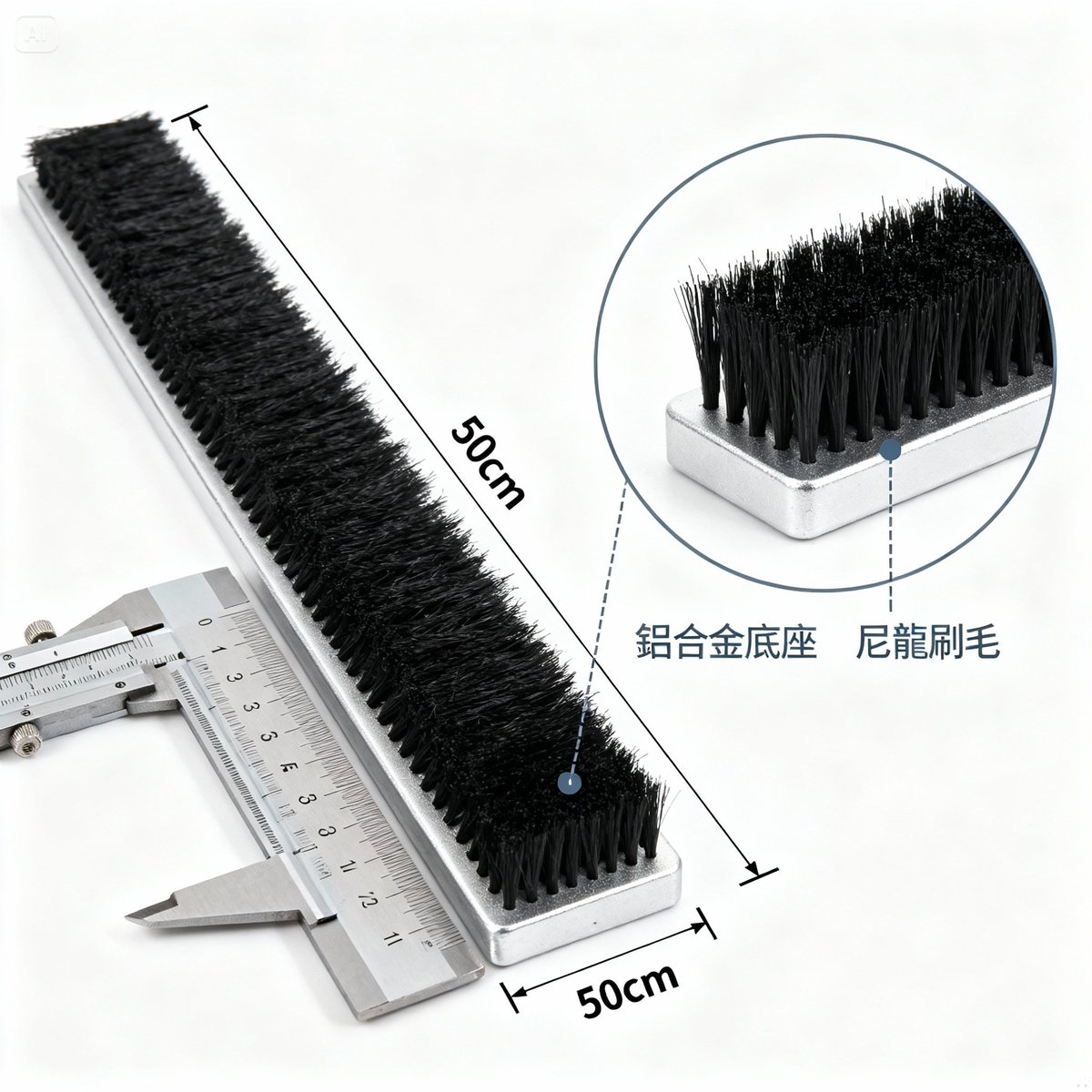
Aluminum doors and windows are common in homes in Taiwan, yet many people do not know that how well those doors and windows block sound and water comes down to the "strip brush". An inexpensive strip brush can improve the sound insulation of your aluminum door by 15-25 dB and cut air-conditioning electricity costs by 12-18%. This article explains in full what to look for when buying strip brushes for aluminum doors and airtight windows, how the specifications differ and how to install them, so that your aluminum doors and windows perform far better.
Why does an aluminum door need a strip brush?
The built-in weakness of aluminum doors and windows
Aluminum doors and windows are durable and good-looking, but they have one fatal weakness: the metal frame expands and contracts a great deal with temperature.
- Summer: the aluminum frame expands with heat and the gap gets smaller
- Winter: the aluminum frame contracts in the cold and the gap gets larger
- Result: cooled or heated air leaks out, noise and dust come in, rainwater seeps in
Traditional rubber seals age and harden easily and cannot adapt to the deformation of the aluminum frame. The soft filament of a strip brush, by contrast:
- Adapts elastically to changes in the gap: thermal expansion and contraction do not affect the seal
- Does not harden or age: stays springy even after long-term use
- Does not hold dust: the filament is smooth and does not collect dust easily
- Is waterproof and does not go moldy: PP material resists water and damp
The three main functions of an aluminum door strip brush
1. Airtightness and sound insulation
- Stops air leaking through the door gap, improving air-conditioning efficiency by 15%
- Reduces street noise by 15-25 dB
- Prevents the loss of cooled and heated indoor air
2. Waterproofing and dust protection
- Stops rainwater seeping in under the door
- Keeps dust and PM2.5 from entering the room
- Keeps the floor dry and clean
3. Keeping out insects and rodents
- Closes the door gap so cockroaches and ants cannot get in
- Stops mosquitoes and other insects flying in through the gap
- Prevents mice from squeezing through the gap
According to actual testing, the airtightness of an aluminum door can improve by 40-60% once a strip brush is fitted, which is equivalent to upgrading an ordinary aluminum door to near airtight-window level. For the data that verifies the effect, see Do Door Gap Strip Brushes Work? Measured Sound Insulation and Insect-Proofing Data.
Special requirements for aluminum door strip brushes
Compared with iron or wooden doors, strip brushes for aluminum doors have stricter specification requirements:
1. It must have an insert-type T-shaped base
Reason: aluminum door frames all have a standard groove design
- Groove width: 4-6mm (precision ±0.3 mm)
- Groove depth: 8-12mm
- Mounting method: inserted directly, with no glue or screws needed
Advantages:
- Fast to install, with no damage to the door frame
- Easy to replace; it can be pulled out and swapped at any time
- A tight fit that does not work loose
- Neat and concealed, with no visible fixing marks
Note: never use an adhesive-backed or screw-mounted type, because it will damage the surface treatment of the aluminum frame.
2. The base dimensions must be precise
Aluminum door groove dimensions are highly standardized, and there is very little margin for error:
| Groove type | Groove width | Recommended base width | Tolerance |
|---|---|---|---|
| Standard aluminum door | 5.0mm | 4.8-5.0mm | ±0.2 mm |
| Airtight window | 4.0mm | 3.8-4.0mm | ±0.2 mm |
| Heavy-duty aluminum door | 6.0mm | 5.8-6.0mm | ±0.2 mm |
| Old-style aluminum window | 4.5mm | 4.3-4.5mm | ±0.2 mm |
Too wide: it will not go in Too narrow: it works loose and falls out easily
Always measure the groove width before buying. For the measuring method, see How to Choose a Strip Brush Size: Complete Measuring Guide and Specification Chart.
3. Filament material requirements
Recommended materials, in order:
-
Nylon - the best choice
- Soft, does not scratch the aluminum frame
- Good weather resistance, does not become brittle easily
- Good recovery, does not deform in long-term use
- Price: mid to high range
-
PP (polypropylene) - economical
- Resistant to water, acids and alkalis
- Medium stiffness, suited to ordinary door gaps
- Good value for money
- Price: budget
-
PBT (polybutylene terephthalate) - the high-end choice
- The strongest recovery
- Resistant to high temperature and aging
- Suited to airtight windows
- Price: high range
Avoid:
- ❌ Horsehair: natural hair absorbs water and is unsuitable for door gaps that stay damp for long periods
- ❌ Hog bristle: goes moldy easily and produces an odor
- ❌ Wire brush: strictly forbidden, it will scratch the aluminum
4. Filament density requirements
The filament density of an aluminum door strip brush needs to be higher than that of an ordinary strip brush:
- Standard density: 30-40 filaments per 10mm
- High density: 50-60 filaments per 10mm (for airtight windows)
Density too low: cannot seal completely, poor results Density too high: high resistance when opening and closing the door, and the filament flattens easily
Aluminum door groove specifications explained
Common aluminum door groove types
1. Standard T-type groove (the most common)
Dimensions: 5mm wide x 10mm deep
Suitable for: ordinary residential aluminum doors, balcony doors
Base specification: T-type 5mm
2. Narrow T-type groove (for airtight windows)
Dimensions: 4mm wide x 8mm deep
Suitable for: airtight windows, aluminum alloy windows
Base specification: T-type 4mm (extra slim)
3. Wide T-type groove (heavy-duty doors)
Dimensions: 6mm wide x 12mm deep
Suitable for: shopfront main doors, office glass doors
Base specification: T-type 6mm
4. F-type groove (uncommon)
Dimensions: 5mm wide x 10mm deep (with a barb)
Suitable for: some old-style aluminum doors
Base specification: F-type 5mm
How do you confirm the groove type in your home?
Method 1: Visual inspection
- Open the door and check the lower edge of the door frame
- The long, narrow channel you see is the groove
- Touch it with a finger to feel the width
Method 2: Measuring with tools
- Use a vernier caliper to measure the groove width
- Measure the groove depth (to make sure the base can be fully inserted)
- Take photos as a record and have the shop confirm when you buy
Method 3: Remove the old strip brush
- If there is already an old strip brush, simply remove it
- Measure the base width
- Take it to a hardware store to compare
💡 Not sure about the groove specification of your aluminum door?
Contact YC Brushes now and send photos of the door frame. Our technical team will help you confirm the specification and recommend a suitable product.
Key points in choosing a strip brush for airtight windows
An airtight window is the high-end version of an aluminum window, and its requirements for strip brushes are stricter:
Airtight windows vs ordinary aluminum windows
| Item | Ordinary aluminum window | Airtight window |
|---|---|---|
| Groove width | 5mm | 4mm |
| Trim length | 15-20mm | 10-15mm |
| Filament material | PP / nylon | PBT / nylon |
| Filament density | 30-40 filaments/cm | 50-60 filaments/cm |
| Price | Budget | Mid to high range |
The three requirements for airtight window strip brushes
1. Extra-slim base (4mm T-type)
The groove of an airtight window is only 4mm wide, so a dedicated extra-slim T-type base must be used. Using the standard 5mm specification means:
- It will not go into the groove at all
- Forcing it in will damage the groove
2. High-density filament (50 filaments/cm or more)
The gap on an airtight window is usually only 1-3mm, so denser filament is needed to seal it completely. Low-density filament will:
- Fail to reach the airtightness standard
- Reduce sound insulation
- Waste the performance of the airtight window
3. Soft material
The surface treatment of an airtight window's aluminum frame is finer, so the filament must be soft enough:
- First choice: PBT or nylon
- Acceptable: soft PP
- Not allowed: hard PP
Where strip brushes are fitted on an airtight window
Airtight windows usually have several lines of sealing. The strip brush positions are:
- The joint between sash and frame: the main sealing position
- The sash track: prevents drafts when sliding
- The outward-facing window frame: the first line of defense against water
Important: on an airtight window, the strip brush cannot be fitted in just one place. "Multiple lines of sealing" are needed to achieve airtightness.
Waterproof and airtightness performance of aluminum door strip brushes
CNS national standard
The airtightness of doors and windows is tested according to CNS 11527 "Method of Test for Air Tightness of Windows and Doors" (CNS is Taiwan's national standard).
Waterproof performance testing
Based on the more than 40 years of experience at YC Brushes, a good aluminum door strip brush should pass the following tests:
1. Static waterproof test
- Test method: pour 50ml of water on the outside of the door gap
- Pass standard: no seepage within 15 minutes
- Excellent standard: no seepage for 30 minutes or more
2. Dynamic waterproof test (simulating heavy rain)
- Test method: aim a shower head at the door gap and spray water for 5 minutes
- Pass standard: no obvious seepage
- Excellent standard: fully sealed, no water on the indoor floor
3. Wind-pressure waterproof test
- Test method: aim a fan at the door gap (wind speed 10m/s) + spray water
- Pass standard: no seepage
- Purpose: simulates conditions on a typhoon day
Measured data:
- Without a strip brush: about 200-500ml of seepage per hour in heavy rain
- With a strip brush: seepage in heavy rain falls to below 10ml (a 95% reduction)
Measured airtightness performance
Test tools: differential pressure gauge + smoke test
Test method:
- Close the doors and windows
- Create negative pressure indoors (-50Pa)
- Measure the air leakage
- Use smoke to check where the air is leaking
Measured results (standard aluminum door):
- Without a strip brush: air leakage about 80 m³/h·m²
- With a strip brush: air leakage falls to 25 m³/h·m²
- Improvement: airtightness improves by about 68%
Want a full assessment of how well strip brushes work? See the detailed test data in Do Door Gap Strip Brushes Work? Measured Sound Insulation and Insect-Proofing Data.
How to install an aluminum door strip brush
Tools to prepare
- Utility knife or scissors (for cutting the strip brush)
- Tape measure (for measuring length)
- Flat-head screwdriver or a plastic card (to help with insertion)
- Cleaning cloth and cleaner (to clean the groove)
Installation steps (insert-type T base)
Step 1: Clean the groove
- Vacuum the dust out of the groove
- Wipe the inside of the groove with a damp cloth
- Let it dry completely (so moisture does not affect the fit)
- Check whether any of the old strip brush remains in the groove
Step 2: Measure and cut
- Measure the total length of the door frame groove
- Cut the strip brush (leaving an extra 5-10mm is recommended)
- Cut at a right angle (no slanted cuts)
- Make sure the cut end is neat and flat
Step 3: Insert the strip brush
- Start inserting from one end of the door frame
- Line the T-shaped base up with the groove opening
- Push it in with your fingers or a plastic card
- Make sure the base is fully seated in the groove (you will hear a "snap")
Step 4: Adjust and check
- Check along the door frame that the whole length is seated
- Pull gently by hand to test that it is held firmly
- Open and close the door to confirm the filament touches the floor
- Trim off any excess length if necessary
Step 5: Functional test
- Seal test: after closing the door, shine a flashlight from outside and check for light leaks
- Open/close test: open and close the door 20 times to confirm it moves smoothly
- Waterproof test: pour a small amount of water outside the door and check for leaks
Time: about 10-15 minutes for a whole door
For complete installation techniques and common mistakes, see Strip Brush Installation Guide: 3 Mounting Methods Illustrated.
Special installation notes for airtight window strip brushes
- Test at several points: the groove on an airtight window is narrower, so cut 20cm first for a trial fit
- Do not force it: a base that is too wide will damage the groove; never press it in by force
- Install in sections: for lengths over 2 meters, insert in sections to avoid twisting
- Corners: cut at 45 degrees and join at the corners to keep the seal continuous
Aluminum door strip brush FAQ: common problems and how to fix them
Problem 1: The strip brush will not go into the groove
Possible causes:
- The base is too wide (the most common)
- Remains of an old strip brush in the groove
- The groove is deformed or has something stuck in it
Solutions:
- Measure the groove width again and confirm the specification is correct
- Clean the inside of the groove thoroughly
- If the groove is badly deformed, have an aluminum door and window contractor repair it
Prevention: always measure the groove width before buying; the deviation must be within ±0.2 mm.
Problem 2: The strip brush falls out easily
Possible causes:
- The base is too narrow
- The wrong T-type base specification (an F-type should have been used)
- The groove has worn and widened with age
Solutions:
- Replace with a strip brush of the correct width
- If the groove has widened, stick waterproof tape on both sides of the base to thicken it
- In serious cases, fix it with silicone sealant (but it will be hard to remove later)
Prevention: choose a good-quality strip brush with precise base dimensions.
Problem 3: The filament is too long and the door sticks
Possible causes:
- The trim length chosen is too long
- The floor is uneven, so the door sticks badly in certain spots
Solutions:
- Trim the filament with scissors (2-3mm at a time is recommended, adjusting over several passes)
- Check whether the floor has raised spots and grind the floor down if needed
- In serious cases, replace with a shorter strip brush
Prevention: measure the door gap at several points and go by the lowest one.
Problem 4: The filament is too short and there is still a gap
Possible causes:
- A measuring error that underestimated the height of the door gap
- An uneven floor, with a large variation in gap height
- The filament has been flattened and shortened
Solutions:
- Replace with a longer strip brush
- Add a shim under the base (a temporary fix)
- Use it together with a threshold strip
Prevention: take the largest value when measuring the door gap, and add a 5-10mm compression allowance to the trim length.
Problem 5: Poor waterproofing; water still seeps in on rainy days
Possible causes:
- Insufficient filament density
- The filament has worn down and shortened
- The door frame is deformed, so the strip brush cannot sit flush
- Incomplete sealing at the corners
Solutions:
- Replace with a high-density strip brush
- Check the corners for gaps and reinforce them with silicone sealant
- If the door frame is badly deformed, have a professional contractor adjust it
Prevention: choose a strip brush with a density of at least 30 filaments/cm, and check and replace it regularly.
Problem 6: The strip brush deforms or flattens
Possible causes:
- Poor filament material with poor recovery
- Long-term compression of more than 70%, beyond the elastic range
- Exposure to high temperature (such as west-facing windows in the afternoon sun)
Solutions:
- Replace with a nylon or PBT strip brush
- Choose a longer filament to lower the compression ratio
- Choose a heat-resistant material for high-temperature environments
Prevention: choose a good-quality filament material and keep the compression between 30-60%.
Buying advice for aluminum door strip brushes
How to judge quality
6 features of a good strip brush:
- Precise base dimensions: deviation ±0.2 mm
- Even filament density: at least 30 filaments per 10mm
- Consistent trim length: deviation within ±1 mm
- A sturdy base material: aluminum alloy > stainless steel > plastic
- Good filament recovery: springs back within 1 second after being pressed down by hand
- No odor: poor-quality plastic has a pungent smell
Price reference
| Specification | Material | Density | Price range | Suitable for |
|---|---|---|---|---|
| T-type 5mm / 20mm | PP | Standard (30 filaments/cm) | Budget | Ordinary aluminum doors |
| T-type 5mm / 20mm | Nylon | High density (40 filaments/cm) | Mid range | Ordinary aluminum doors (high quality) |
| T-type 4mm / 15mm | Nylon | High density (50 filaments/cm) | Mid to high range | Airtight windows |
| T-type 4mm / 15mm | PBT | Extra-high density (60 filaments/cm) | High range | High-end airtight windows |
Note: products priced well below the market rate are usually poor quality, with sparse filament and inaccurate base dimensions.
Recommended places to buy
- Factory-direct: stable quality, custom sizes available, reasonable prices
- Specialist aluminum door and window shops: can give professional advice and install for you
- Large hardware stores: a full range, and you can compare on the spot
- Online shopping platforms: lower prices, but you have to confirm the specification yourself
For a comparison of the pros and cons of each channel, see Where to Buy Door Gap Strip Brushes: Hardware Stores vs Online Prices Compared.
YC Brushes supplies all kinds of strip brushes for aluminum doors and airtight windows, from standard specifications to custom sizes, with over 40 years of manufacturing experience behind its stable quality. See the full product catalog, or contact us for professional buying advice.
FAQ
Do airtight windows have to use a 4mm strip brush? Can a 5mm one be used?
Absolutely not. The groove of an airtight window is only 4mm wide, and a 5mm base will not go in at all. Even if you manage to force it in, it will:
- Damage the groove structure
- Interfere with the other sealing functions of the airtight window
- Stop the window opening and closing properly
Always measure the groove width with a vernier caliper before buying. For the measuring method, see How to Choose a Strip Brush Size: Complete Measuring Guide and Specification Chart.
How often does an aluminum door strip brush need to be replaced?
Normal use: replace every 1.5-2 years High-frequency use (such as a shopfront main door): replace every 1 year Windows that are rarely opened: replace every 3-5 years
Signs that replacement is needed:
- The filament has worn down (20% or more shorter than the original length)
- The filament has flattened and no longer springs back
- The base is loose and falls out easily
- Waterproofing or sound insulation has become noticeably worse
We suggest checking every 6 months so that problems are found early.
Can I install an aluminum door strip brush myself, or do I need a tradesperson?
You can install it yourself. An insert-type T-base strip brush is very simple:
Advantages:
- No specialist tools needed (scissors are enough)
- No drilling or glue needed
- Can be done within 15 minutes
- If you get it wrong, it is easy to remove and refit
When to hire a tradesperson:
- Several doors and windows need replacing at once (more than 5)
- An airtight window needs several lines of sealing adjusted
- The door frame is badly deformed and needs repair at the same time
For a complete DIY installation tutorial, see Strip Brush Installation Guide: 3 Mounting Methods Illustrated.
Is there a big difference between PP and nylon? Do airtight windows have to use nylon?
The difference is indeed clear:
| Property | PP (polypropylene) | Nylon | PBT |
|---|---|---|---|
| Softness | Medium | Soft | Softest |
| Recovery | Medium | Good | Best |
| Weather resistance | Good | Excellent | Excellent |
| Temperature range | -10°C to 80°C | -30°C to 100°C | -30°C to 120°C |
| Service life | 1-2 years | 2-3 years | 3-5 years |
| Price | Low | Medium | High |
Recommendations:
- Ordinary aluminum doors: PP is enough and good value for money
- Airtight windows: nylon or better is recommended in order to reach the airtightness standard
- High-end airtight windows: PBT gives the best results
The material directly affects sealing performance and service life, so choose according to your budget and needs.
Summary: aluminum door strip brush buying checklist
Before buying, confirm the following:
- Groove width measured (with a vernier caliper, accurate to 0.1mm)
- Base type confirmed (T-type, F-type or other)
- Door gap height measured (measure at several points and take the largest value)
- Suitable trim length chosen (door gap height + 5-10mm)
- Filament material confirmed (PP / nylon for ordinary doors, nylon / PBT for airtight windows)
- Filament density confirmed (at least 30 filaments/cm; 50 filaments/cm for airtight windows)
- Total length needed calculated (door frame length + 5-10cm allowance)
- Installation tools ready (scissors, tape measure, cleaning cloth)
Want a full specification chart and buying advice for aluminum door strip brushes? See the combined information in The Complete Guide to Strip Brushes: Door Gap Sealing, Installation, Sizes, Selection and Price Comparison.
YC Brushes specializes in producing all kinds of strip brushes for aluminum doors and airtight windows, with a complete service from measuring advice and specification recommendations to installation guidance. Factory-direct for over 40 years, with stable quality; order quantities and lead times are quoted per specification, so please email us with your requirements. Contact us now for the strip brush solution that suits you best.
Want to learn more about strip brushes and their applications? Go to the blog to explore more specialist articles.