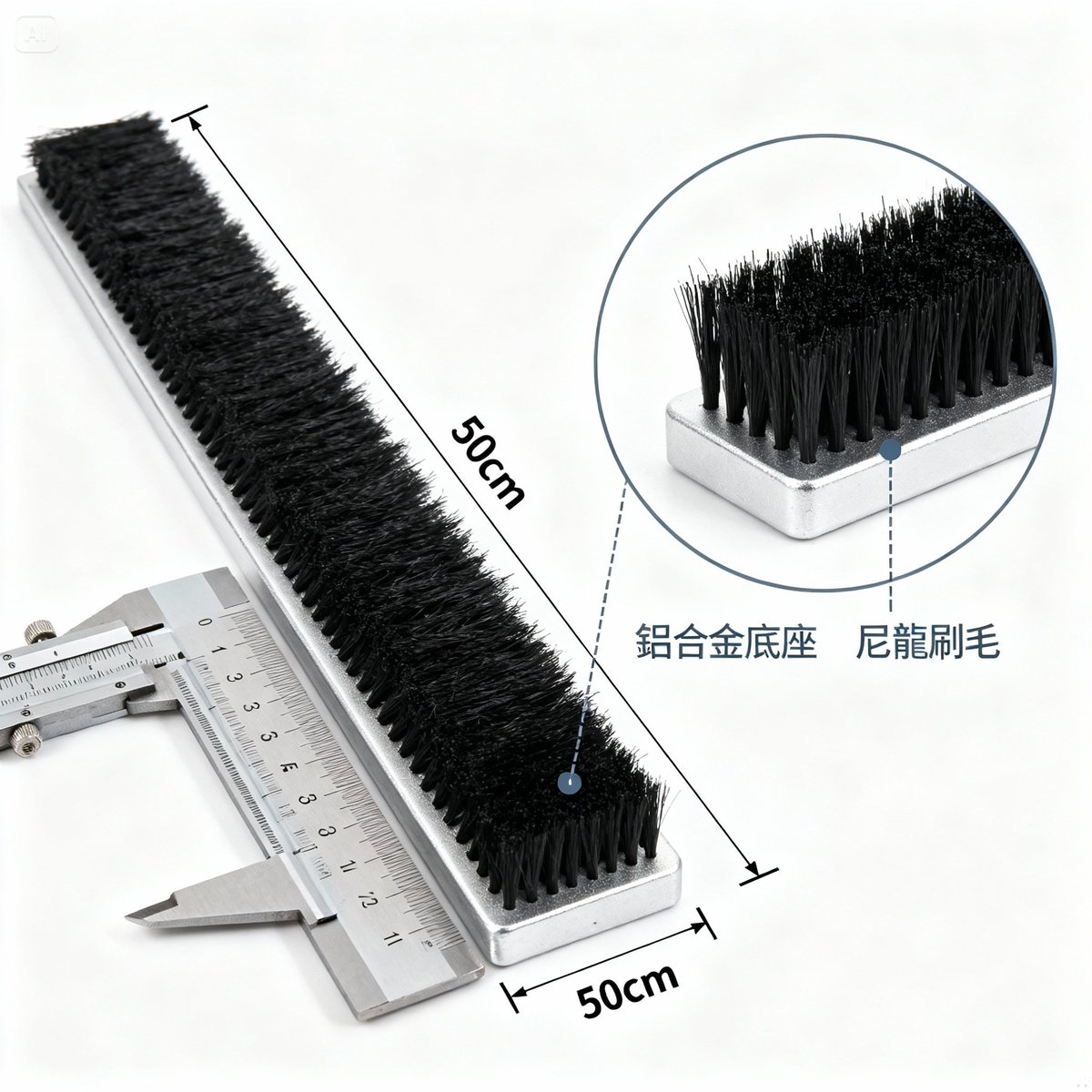
The biggest fear when buying a strip brush is buying the wrong size: too short and it does not block the gap, too long and it will not fit, and the result is wasted money and buying again. Not measuring accurately is the most common mistake for first-time buyers of strip brushes. This article teaches you in full how to measure a door gap correctly, and provides a base specification table and buying advice so that you buy the right one the first time.
Why does strip brush size matter so much?
The size of a strip brush directly affects how well it seals. The wrong size causes the following problems:
- Filament too short: it cannot make full contact with the floor and leaves a gap for dust and insects to get in
- Filament too long: the friction when opening and closing the door is too great, and the filament deforms and breaks easily
- Base too wide: it will not go into the channel in the door frame and cannot be installed
- Base too narrow: it is not held firmly and easily works loose and falls out
Choosing the right size is not only a matter of appearance; it also decides the real functions of sound insulation, dust protection and pest-proofing.
What makes up a strip brush size
A complete strip brush size has three main parts:
1. Base width (W)
The base width decides whether the strip fits into the channel in the door frame. Common specifications are:
- 4 mm: for the narrow channels of aluminum windows and airtight windows
- 5 mm: the most common specification, for standard aluminum doors
- 6 mm: for wider channels, such as some steel doors
- 7-9 mm: special door types or older door frames
2. Base height (H)
The base height affects the stability of the overall filament height:
- 5-7 mm: low base, suited to concealed installation
- 8-10 mm: standard height, balancing stability and appearance
- 12-15 mm: high base, suited to situations that need longer filament
3. Filament length (L)
Filament length is the most critical dimension and decides how well the strip seals. The principle is that the filament should be slightly longer than the door gap, so that when the door closes the filament bends slightly under its own springiness and rests against the floor: too short leaves a gap, while too long makes the door stick when opening and closing and flattens the filament easily.
The actual trim length differs with the door type, the filament material and how flat the floor is. Give us the door gap height and the door type, and YC Brushes will recommend a length based on the on-site dimensions.
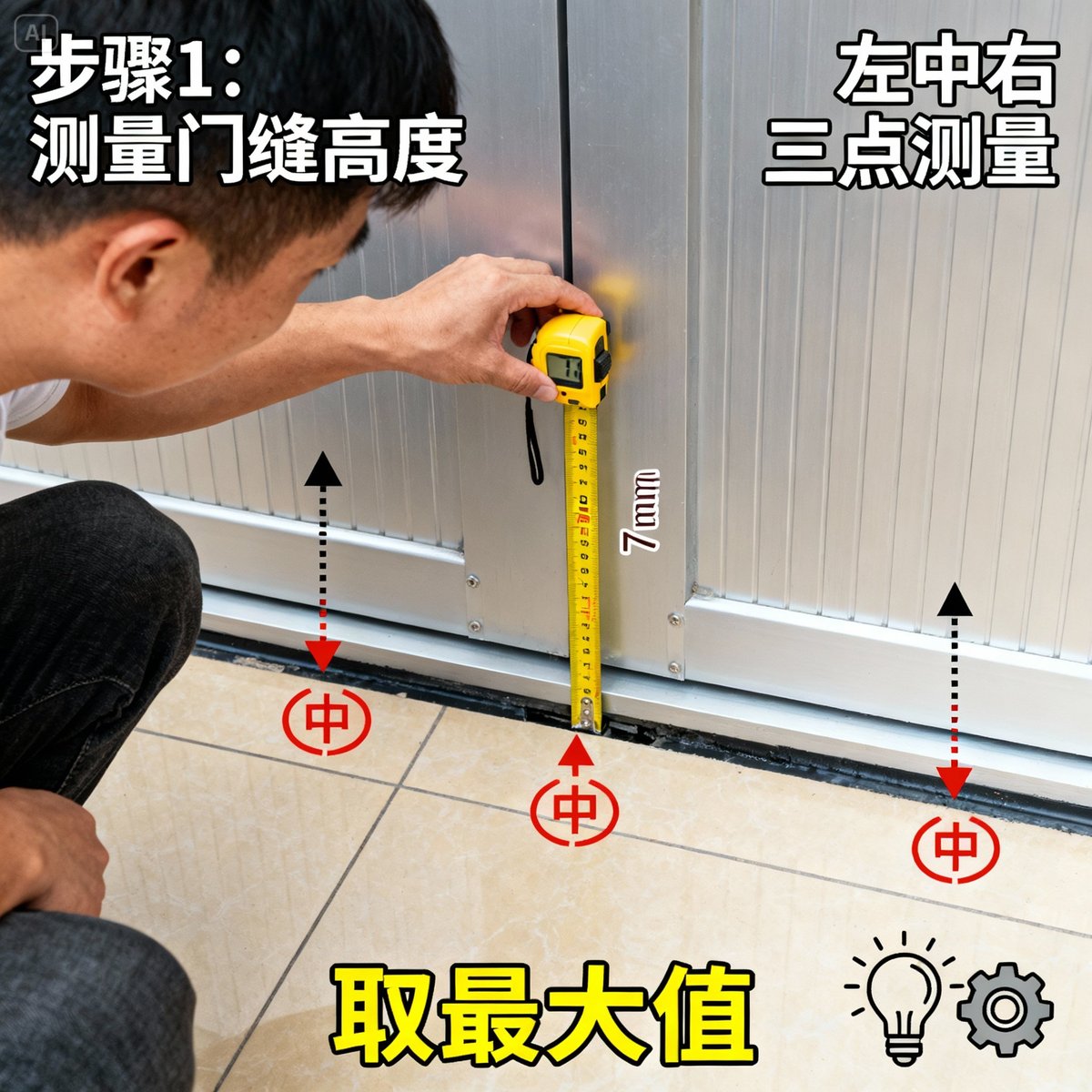
4 steps to measure correctly for a strip brush
Step 1: Measure the door gap height (the most important)
Tools: tape measure or ruler
- Close the door: shut the door completely
- Measure the largest gap: use the tape measure to measure the greatest distance from the bottom of the door to the floor
- Measure at several points: measure at the left, middle and right of the door
- Record the largest value: take the largest of the three measurements
Note: If the floor is uneven, go by the highest point (where the gap is largest).
Step 2: Measure the width of the channel in the door frame
Applies to: slot-in strip brushes
- Find the channel: confirm the position of the mounting channel on the door frame
- Measure the channel width: use a vernier caliper to measure the inside width of the channel
- Measure the channel depth: record the depth of the channel as well, to make sure the base can be inserted fully
Common dimensions:
- Aluminum doors and windows: 4-5 mm wide, 8-10 mm deep
- Steel doors: 5-6 mm wide, 10-12 mm deep
- Airtight windows: 3-4 mm wide, 6-8 mm deep
Step 3: Confirm the thickness of the door leaf
Applies to: adhesive or screw-fixed strip brushes
Measure the thickness of the bottom edge of the door leaf and confirm:
- Whether there is enough space to stick the base on (at least 10 mm)
- Whether screw fixing would go through the door leaf (the door must be more than 20 mm thick)
Step 4: Decide the filament length needed
Principle: the filament should be slightly longer than the largest door gap measured in Step 1, so that it bends slightly when the door closes and rests against the floor under its own springiness; just touching the floor is not enough.
How to decide the actual trim length: send YC Brushes the measurements from Steps 1 to 3, together with the door type (aluminum door, steel door, airtight window, roller shutter door and so on) and photos of the door frame, and we will recommend a suitable filament length and stiffness based on the on-site dimensions.

Strip brush size tables
Filament length: what to prepare before asking for a quote
There is no one-size-fits-all chart for filament length: the same door gap can call for a different recommendation depending on the door type, the material and the condition of the floor. Prepare the following before asking for a quote, and YC Brushes can recommend a length based on the on-site dimensions:
- Door gap height: measured at three points (left, middle and right), with the largest value noted
- Door type and use: aluminum door, steel door, airtight window, glass door, roller shutter door, garage door or warehouse door
- Installation method: slot-in (with the channel width and depth), adhesive or screw-fixed
- Floor condition: whether it is flat, and whether there is a threshold or a step in height
- How often the door is opened and how heavy it is: mention it if the door is opened often or is heavy
- Photos of the door frame and the bottom of the door
Base specification table
| Base type | Width (W) | Height (H) | Door type | Fixing method |
|---|---|---|---|---|
| T-type | 4-5 mm | 8-10 mm | Aluminum doors and windows | Slot-in |
| F-type | 5-6 mm | 10-12 mm | Steel doors | Slot-in |
| Flat-base type | 15-20 mm | 5-8 mm | All door types | Adhesive |
| H-type | 6-8 mm | 12-15 mm | Double-sided sealing | Slot-in |
| Adhesive-strip type | 20-25 mm | 8-10 mm | All door types | Adhesive |
💡 Not sure how to measure or which size to choose?
Contact YC Brushes now with photos of your door type and your measurements, and let a professional team with over 40 years of experience help you choose the strip brush size that suits you best.
Size recommendations for different door types
Aluminum doors (the most common)
Typical door gap: 5-8 mm
Recommended specification:
- Base: 5 mm T-type
- Filament length: slightly longer than the measured door gap; ask YC Brushes for a recommendation based on the on-site dimensions
- Material: nylon or PP (wear and weather resistant)
Installation method: slot-in, inserted into the channel of the aluminum frame
For more on aluminum door strip brush specifications, see The complete guide to aluminum door strip brushes | For waterproof sealing of airtight windows.
Steel doors
Typical door gap: 8-15 mm (old steel doors have larger gaps)
Recommended specification:
- Base: 20 mm flat-base type (adhesive)
- Filament length: slightly longer than the measured door gap; ask YC Brushes for a recommendation based on the on-site dimensions
- Material: PP or horsehair (durable, does not deform easily)
Note: Steel doors are heavier, so a harder filament material must be chosen for the filament not to flatten easily.
Airtight windows
Typical gap: 1-3 mm
Recommended specification:
- Base: 4 mm extra-narrow T-type
- Filament length: slightly longer than the measured door gap; ask YC Brushes for a recommendation based on the on-site dimensions
- Material: soft nylon (to avoid scratching the window frame)
Installation method: slot-in; the channel width must be measured precisely
For the complete guide to choosing strip brushes for airtight windows, see The complete guide to aluminum door strip brushes | For waterproof sealing of airtight windows.
Roller shutter doors
Typical door gap: 10-20 mm (the gap is larger because the ground is uneven)
Recommended specification:
- Base: 25 mm flat-base type
- Filament length: slightly longer than the measured door gap; tell us if the ground is very uneven, and ask YC Brushes for a recommendation based on the on-site dimensions
- Material: hard PP (withstands frequent opening and closing)
Installation method: screw-fixed, the only way to bear the weight of a roller shutter door
For dust protection solutions for roller shutter doors, see Industrial strip brush applications | Dust protection solutions for roller shutter doors and machinery.
Glass doors
Typical door gap: 3-6 mm
Recommended specification:
- Base: 15 mm flat-base type (transparent or silver)
- Filament length: slightly longer than the measured door gap; ask YC Brushes for a recommendation based on the on-site dimensions
- Material: soft nylon (to avoid scratching the glass)
Installation method: adhesive, using strong double-sided tape
Custom size service
When off-the-shelf specifications do not meet the need, you can choose a custom service:
When is custom work needed?
- An exceptionally large door gap: the filament length of standard specifications is not enough
- A special base shape: a channel that is not a standard T-type or F-type
- Special material requirements: special materials such as high-temperature or chemical-resistant ones are needed
- Volume purchases: construction projects or batch replacement that need a uniform specification
The custom process
- Provide the dimensions: detailed measurements and photos
- Confirm the specification: base shape, filament length, material
- Sampling for confirmation: a sample is provided to test the seal
- Formal production: volume production after the sample is confirmed
Order quantities: quoted per specification; please email us with your requirements
YC Brushes provides a complete custom strip brush service, from measuring advice to sampling and production, and our more than 40 years of experience helps you find the most suitable solution. To learn more about the custom process, see the services page.
What if you chose the wrong size? 5 remedies
1. Filament too long
Symptom: the door sticks when opening and closing, and the filament is crushed flat
Remedies:
- Slightly too long (1-3 mm): let the filament wear naturally for a week and it will become shorter
- Clearly too long (more than 5 mm): trim the filament with scissors (a little at a time, several times, is recommended)
- Seriously too long (more than 10 mm): we suggest replacing it with a suitable size
Note: After trimming, the cut ends of the filament are rougher, and the seal will be slightly poorer.
2. Filament too short
Symptom: there is still a gap, and dust and insects get in just the same
Remedies:
- Slightly too short (2-3 mm): add a shim under the base (such as a thin rubber pad)
- Clearly too short (more than 5 mm): the only option is to replace it with a longer strip brush
- Temporary fix: use it together with a door-bottom draft stopper
3. Base too wide
Symptom: it will not go into the channel, or goes in but is too tight
Remedies:
- Slightly too wide: sand both sides of the base lightly with sandpaper (plastic bases only)
- Clearly too wide: replace it with a suitable size, or switch to the adhesive type
Warning: A metal base must not be cut or ground down.
4. Base too narrow
Symptom: it is loose after being inserted into the channel and easily falls out
Remedies:
- Stick waterproof tape on both sides of the base to add thickness
- Fix it with silicone sealant (but it will be hard to remove afterward)
- Replace it with a strip brush of the correct width
5. The whole specification does not fit
Symptom: neither the base nor the filament is suitable
Remedies:
- Replace it with the correct specification (the best choice)
- Switch to an adhesive strip brush (more flexible)
- Consult a specialist manufacturer about custom work
Run into a size problem and not sure how to deal with it? Contact YC Brushes and we will provide a solution based on your actual situation.
How do you confirm that the size you bought is correct?
What to check when the goods arrive
1. Measure the actual dimensions
- Measure the base width with a tape measure or caliper
- Measure the filament length (from the top of the base to the tip of the filament)
- Check against the specification ordered
2. Trial fit
- Cut off 20 cm first for a trial fit
- Confirm that the base slots in or sticks on smoothly
- Check whether the filament makes full contact with the floor
3. Door opening and closing test
- Whether the door closes smoothly
- Whether the filament bends slightly against the floor without being crushed flat
- No abnormal rubbing noise
4. Seal test
- After closing the door, shine a flashlight from outside and check for light leaks
- Test with a slip of paper: it should not slide easily into the door gap
Common measuring errors and their causes
| Error | Possible cause | Solution |
|---|---|---|
| Filament length not enough | The door was not properly closed when measuring | Measure again and make sure the door is completely closed |
| Base will not go in | The channel width was measured wrongly | Measure the inside width of the channel precisely with a caliper |
| Filament too long | The filament length is too far from the door gap | The filament only needs to be slightly longer than the door gap, so that it rests against the floor under its own springiness |
| Length not enough | Only the door width was measured and the threshold was forgotten | Add a margin of 5-10 cm |
Maintenance notes on strip brush size
Regular checks (every 3 months)
- Whether the filament is deformed: long-term compression flattens the filament
- Whether the base is loose: a slot-in strip brush may work loose through thermal expansion and contraction
- Whether the size is still suitable: settlement of the building may change the size of the door gap
Dealing with changes in size
The filament becomes shorter:
- Cause: wear from long-term friction
- Recommendation: replace every 1-2 years
The door gap becomes larger:
- Cause: settlement of the building, deformation of the door frame
- Recommendation: replace with a strip brush with longer filament
The channel becomes wider:
- Cause: aging of a plastic door frame
- Recommendation: switch to an adhesive or H-type strip brush
How do you judge whether a strip brush needs replacing? For the complete checking guide, see The complete guide to strip brushes | Door seal strip brush installation, sizes, selection and price comparison.
5 questions you must ask before buying
Confirm the following with the seller to avoid buying the wrong size:
- Can you provide a dimension drawing? - with detailed markings for the base and the filament
- Does the filament length include the base? - some sellers state the total height
- What is the tolerance? - in general ±0.5 mm is an acceptable range
- Can you provide a sample? - testing first is recommended before buying in volume
- Do you offer a cutting service? - to avoid buying too long and wasting it, or too short and not having enough
Want to know how specification labeling differs between purchasing channels? See the detailed comparison in Where to buy door seal strip brushes | Hardware stores vs online prices compared.
FAQ
Do I have to use a caliper to measure for a strip brush?
Not necessarily. An ordinary tape measure is enough for measuring the door gap height, where a precision of ±1 mm is acceptable. For measuring the channel width, though, if the channel is smaller than 10 mm we suggest using a vernier caliper, which is precise to 0.1 mm. Hardware stores usually offer a free measuring service, and you can bring photos of the door frame to ask for advice.
The filament length is marked as 20 mm, but it measures only 18 mm. Why?
This is normal. Filament length is stated in three ways:
- Total height: base + filament
- Exposed filament length: counted from the top of the base
- Actual filament length: counted from inside the base
Before buying, be sure to ask the seller where the measurement is taken from. All YC Brushes products are marked with the "exposed filament length", in line with the industry standard.
For the same door gap height, why do the filament lengths recommended online all differ?
Because the recommended value also has to take the following factors into account:
- Filament material: hard and soft filaments differ in springiness, so the length needed to rest against the floor differs too
- Frequency of use: for a door that is opened and closed often, slightly longer filament is recommended, to slow the rate of wear
- Flatness of the floor: an uneven floor needs longer filament to cope with the difference in height
- Weight of the door leaf: a heavy door compresses the filament more
The installation method also affects the choice of size; see Strip brush installation guide | 3 fixing methods explained step by step.
How much more do custom sizes cost than standard sizes?
Custom work is usually 20-50% more expensive, and order quantities are quoted per specification (email us with your requirements). Unless one of the following applies, we suggest choosing a standard specification:
- Volume purchases (more than 200 meters)
- A special door type with no standard product available
- A special material or color is needed
For small requirements (under 10 meters), a standard specification is better value. Contact YC Brushes for a custom quotation and advice.
Size selection summary
Choosing the correct strip brush size takes three steps:
- Measure precisely: door gap height, channel width, door leaf thickness
- Match the specification: choose the base from the channel specification table; for the filament length, give YC Brushes the door gap height and door type and we will advise based on the on-site dimensions
- Leave an allowance: the filament should be slightly longer than the door gap and rest against the floor under its own springiness
Remember the principle "better slightly long than too short": filament that is too long can be trimmed, but filament that is too short is of no use at all.
Not sure whether your measurements are correct? Take photos of the door frame, mark the measurements on them, and contact YC Brushes to have a professional team help you confirm. With over 40 years of manufacturing experience, we help you choose the right size and buy the right product.
Want to see more about strip brushes? Go to the blog to explore complete guides to buying, installing and maintaining them.