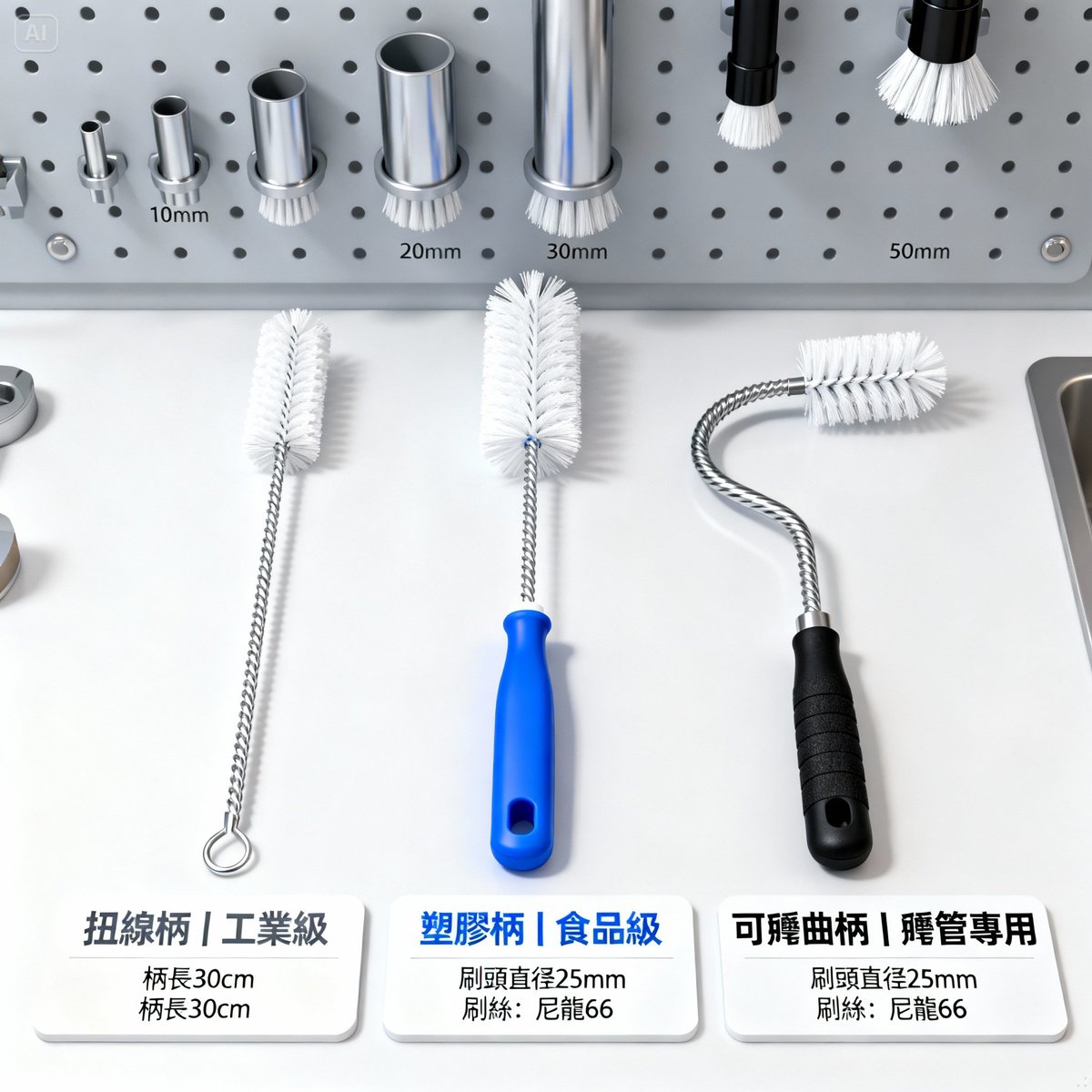
Dry brushing has become very popular in recent years, and the claims made for it online range from "detox" to "removing cellulite". We make brushes, but let us say this up front: most of these claims are not supported by evidence, and dry brushing has only one truly established effect, which is exfoliation, leaving the skin smoother to the touch.
This complete guide takes you step by step through using a bristle brush correctly for body care, from choosing a brush and the brushing route to common mistakes, and explains honestly what dry brushing can and cannot do.
Introduction: why is body care with a bristle brush so popular?
In recent years dry brushing has become a craze in Europe, North America and Asia.
From Hollywood stars to fitness coaches, from beauty bloggers to dermatologists, people are recommending this simple but effective method of body care.
Why is dry brushing so popular?
The answer lies in its several benefits:
- It removes dead skin cells and leaves the skin smoother
- It briefly boosts surface blood circulation, so the skin turns pink and feels warm after use
- It relaxes body and mind, a soothing experience similar to a massage
More importantly, dry brushing needs no expensive equipment or complicated technique. With one good natural bristle brush and 5-10 minutes a day, it is easy to do at home.
This article covers:
- How dry brushing works and the scientific basis for it
- How to choose the most suitable bristle brush for the body
- The correct brushing direction and order
- Cellulite: what dry brushing can and cannot do
- How often to brush and how to avoid common mistakes
- Answers to common questions
Whether you want to exfoliate, want to try this care routine, or simply want to find out first which of the popular claims are true, this guide will help you start correctly.
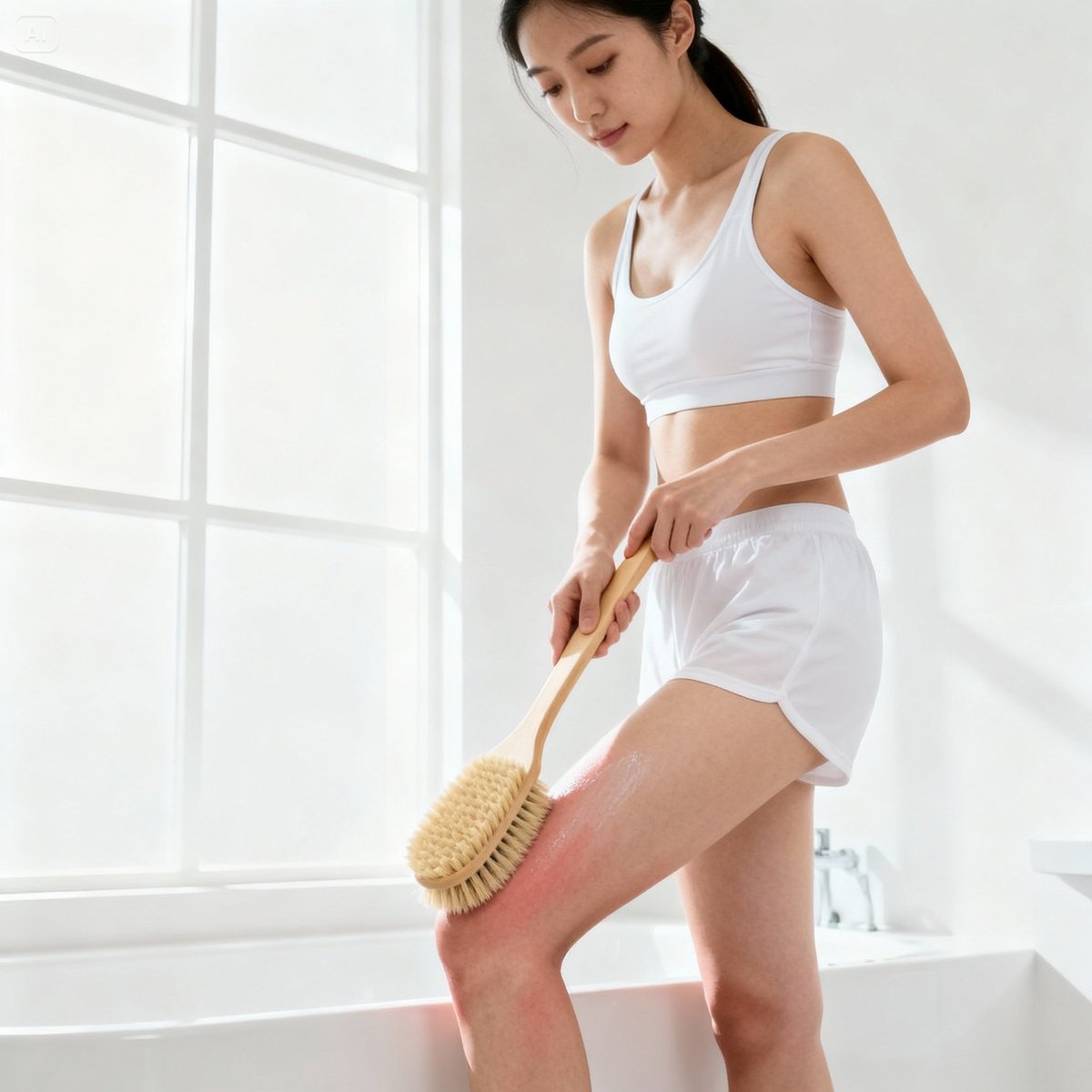
What is dry brushing?
Dry brushing is a long-established body care technique.
Put simply, before bathing you use a dry natural bristle brush to brush the skin of the whole body in a particular direction.
First, to be clear: what dry brushing can and cannot do
There are many claims about dry brushing online, and quite a few of them are not supported by evidence. We make brushes, but we believe that speaking plainly is worth more than overstating the benefits: you buy a brush because it really works, not because of a claim that sounds wonderful.
✅ Effects supported by evidence
1. Removing dead skin cells (this is the best established one)
The medium stiffness of a bristle brush gently takes away the dead cells on the surface of the skin:
- The skin feels clearly smoother after use
- Roughness and dullness caused by a build-up of dead skin improve
- Lotion and body oil applied afterward spread more easily and are absorbed better
2. A brief boost to surface blood circulation
Brushing stimulates the capillaries at the surface of the skin, so the skin turns pink and feels warm. This is a local reaction that is immediate and short-lived, not a rise in metabolism across the whole body.
3. The feeling of massage and relaxation while you brush
The feel of brushing is pleasant in itself, and many people treat it as a ritual to wake up in the morning or to relax before bed. This one is a subjective experience, but it is real: no scientific study is needed to prove that something feels good to you.
❌ Common claims that are not supported by evidence
These claims are very common in marketing copy. We do not make them, because the evidence does not support them:
| Common claim | The actual situation |
|---|---|
| "Promotes lymphatic detox and flushes toxins out of the body" | The skin is a barrier, not a detox organ. No controlled study shows that dry brushing changes lymph flow at a systemic level, and "brushing the toxins out through the skin" has no physiological basis |
| "Improves / removes cellulite" | There is no scientific evidence that dry brushing treats or reduces cellulite. What it can do is make the skin look plumper through a brief rush of blood, so that the dimples are temporarily less visible; the effect usually fades within a few hours |
| "Dry brushing helps you lose weight and burn fat" | No basis at all. Fat is not reduced by brushing from the outside |
| "Strengthens the immune system" | Not supported by research. The lymphatic system is indeed part of the immune system, but that does not mean brushing the skin improves immune function |
So is dry brushing worth doing? Yes, if what you expect is "a pleasant exfoliating habit that leaves the skin smoother to the touch". If what you expect is detox or the removal of cellulite, it cannot do that, and neither can any brush.
The current state of the evidence
- Exfoliation: physical exfoliation effectively removes dead cells from the surface of the skin. This is an established mechanism in the dermatology literature, and it is the only effect of dry brushing that is clearly supported.
- Lymph and "detox": at present no controlled study shows that dry brushing changes lymph flow at a systemic level. The clinical treatment of lymphedema uses a specialized technique, manual lymphatic drainage, carried out by a therapist; it is not the same thing as dry brushing at home.
- Cellulite: the causes of cellulite involve the structure of subcutaneous fat, connective tissue and heredity, and there is no evidence that brushing from the outside changes these structures.
Note: dry brushing is a care habit, not a medical procedure, and it cannot replace professional treatment. If you have lymphedema, a skin disease or any other health concern, please consult a doctor or therapist and do not rely on home care tools.
How to choose a bristle brush for body care
Choosing the right brush is the first step to success.
There are many kinds of bristle brush for body care on the market. Here is how to pick the most suitable one.
Brush shape
Long-handled body brush (most recommended)
- Handle length: 35-45 cm
- Advantage: it reaches the back and covers the whole body
- Suitable for: people who want to dry brush the whole body
- Price: mid-range
Short-handled hand brush
- Handle length: 10-15 cm
- Advantages: comfortable to hold, good control
- Disadvantage: it cannot reach the back
- Suitable for: local areas (arms, legs, abdomen) or use together with a long-handled brush
Double-headed brush (long handle + round brush)
- A long handle at one end and a round grip at the other
- Advantage: it combines the strengths of the long-handled and the hand-held brush
- Suitable for: users who want several functions in one
Massage ball brush
- A ball-shaped design with bristles all the way around
- Advantage: a stronger massage effect
- Suitable for: areas where you want a stronger massage feeling
Bristle material and stiffness
100% natural hog bristle (most recommended)
- Advantages: the most natural feel, gentle and non-irritating, anti-static
- Disadvantages: a higher price, more care needed
- Suitable for: normal skin, and anyone who wants the best experience
Hog bristle + cactus fiber blend
- Advantage: slightly stiffer, with a stronger exfoliating effect
- Disadvantage: rougher, not suitable for sensitive skin
- Suitable for: thicker skin where stronger exfoliation is wanted
Hog bristle + horsehair blend
- Advantage: softer, suitable for sensitive skin
- Disadvantages: a high price, less common
- Suitable for: sensitive skin, a first try
Principles for choosing the stiffness:
- Sensitive skin → choose soft bristles (a horsehair blend or soft hog bristle)
- Normal skin → choose medium stiffness (pure hog bristle)
- Thick skin, a stronger effect wanted → choose stiff bristles (blended with cactus fiber)
How to test: Before buying, brush lightly a few times on the inside of your arm and feel whether the stiffness suits you. The skin should turn slightly pink without hurting; that is the right stiffness.
Bristle density
High density (bristles packed closely)
- Advantage: a stronger massage effect and more noticeable stimulation
- Disadvantage: harder to wash and care for
- Suitable for: those who want stronger exfoliation and a stronger massage feeling
Medium density (moderately spaced)
- Advantages: a balance of cleaning and comfort, easy to care for
- Suitable for: ordinary everyday use
Low density (sparse bristles)
- Advantages: dries quickly, suited to light stimulation
- Disadvantage: a weaker effect
- Suitable for: sensitive skin, beginners
Handle material
Natural wood (recommended)
- Advantages: comfortable to hold, environmentally friendly, good-looking
- Disadvantages: not water resistant, must be kept dry
- Suitable for: use in a dry environment (dry brushing is dry, so this is no problem)
Bamboo
- Advantages: environmentally friendly, more water resistant than wood, light
- Suitable for: users who care about the environment
Plastic
- Advantages: waterproof, durable, low price
- Disadvantages: a poorer grip, not environmentally friendly
- Suitable for: a limited budget
Size and weight
Size of the brush face:
- Large brush face (10-15 cm): covers large areas quickly (legs, back)
- Small brush face (6-8 cm): precise work on local areas (arms, abdomen)
Total weight:
- Ideal weight: 150-250 g
- Too heavy and it is tiring to use; too light and there is not enough stimulation
Quality checkpoints
When buying, please check:
✅ How firmly the bristles are held: pull the bristles gently; they should not come out in large numbers ✅ Bristle color: natural hog bristle is cream or light brown, and the color is even ✅ No odor: there should be no pungent chemical smell ✅ A solid handle: no cracks or wobble ✅ A comfortable feel: the bristle tips should not prick too sharply
Recommended choices
For beginners:
- A long-handled pure hog bristle brush, medium stiffness, medium density
- Price: mid-range
For sensitive skin:
- A hog bristle + horsehair blend, soft bristles, medium density
- Price: mid-high range
For advanced users:
- A double-headed brush (long handle + round brush), pure hog bristle, high density
- Price: mid-high range
Looking for a reliable bristle brush for body care? See the YC Brushes body care range now: over 40 years of manufacturing experience and assured quality.
Complete dry brushing tutorial | The correct steps illustrated
The correct brushing direction and steps are the key to success with dry brushing.
Below is a full explanation of the brushing direction and order.
Preparation before dry brushing
Choosing a time:
- Brushing in the morning: lifts your spirits and starts an energetic day
- Brushing before bed: relaxes body and mind and helps you sleep (the pressure should be gentler)
What to prepare:
- Make sure both your skin and the brush are dry (that is why it is called "dry brushing")
- Do it in the bathroom (you can bathe straight afterward)
- Take off your clothes and brush naked (or in your underwear)
- Have your bath products and body lotion ready
When dry brushing is not suitable:
- Skin with wounds, broken skin or sunburn
- Severe eczema, psoriasis or inflamed acne
- Areas with varicose veins
- During pregnancy (we suggest consulting a doctor first)
- Straight after hair removal or exfoliation (leave an interval of 24 hours)
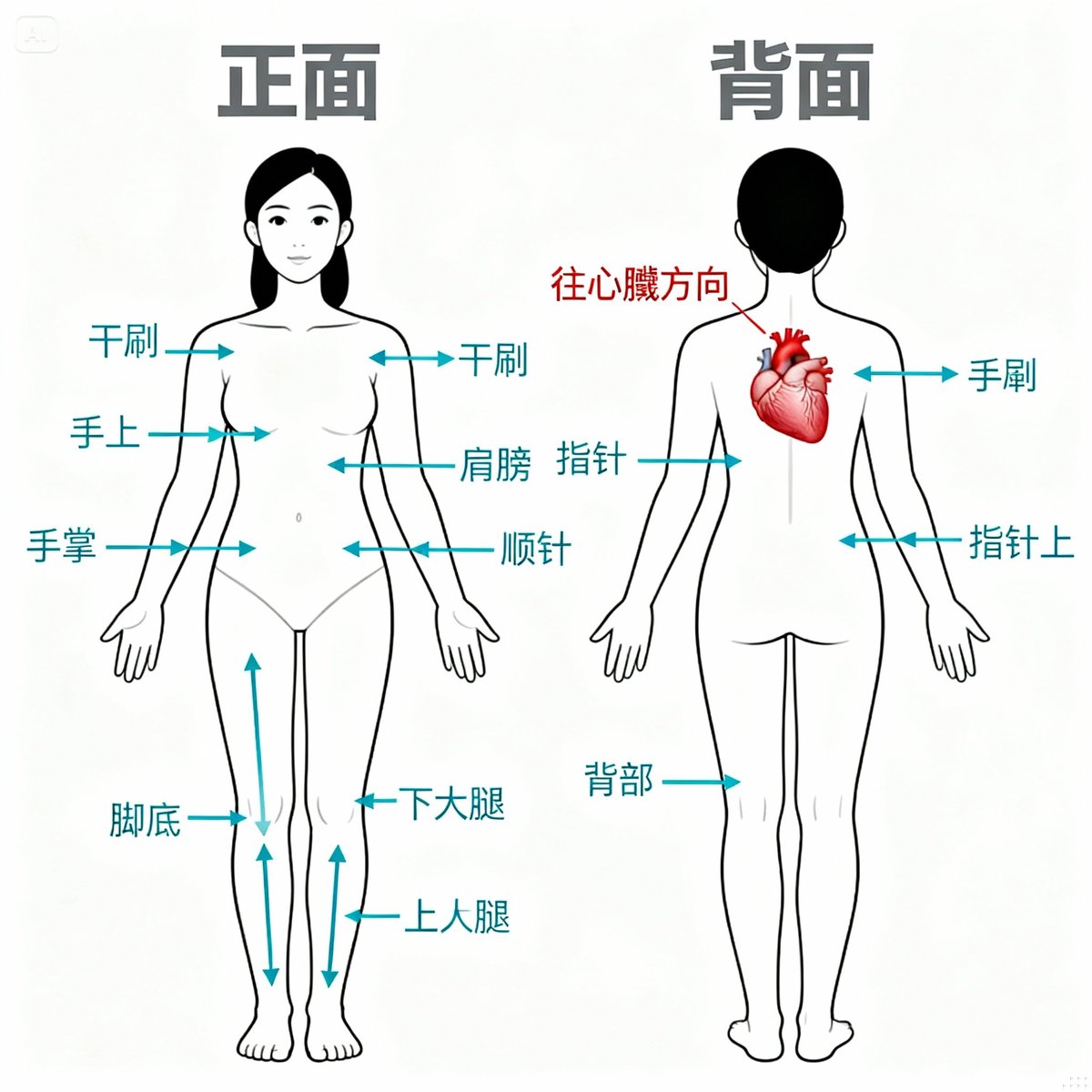
Brushing direction and order | From the ends of the limbs toward the trunk
The core principle: every brushing stroke goes from the ends of the limbs toward the heart. This is the traditional way of doing it and has nothing to do with "promoting lymphatic detox": there is no evidence that brushing from the outside changes lymph circulation.
🚀 Want a more effective body care routine?
The right tool doubles the effect
YC Brushes supplies professional-grade bristle brushes for body care, made of good natural hog bristle with a medium density and a comfortable length, so that you can enjoy a spa-grade dry brushing experience at home.
See the YC Brushes range of bristle brushes for body care now, or contact us for professional advice on choosing a brush!
Cellulite: what dry brushing can do
Cellulite troubles many people.
Can dry brushing really improve cellulite? The honest answer is no. All that dry brushing can do is exfoliate, and make the dimples temporarily less visible through a brief rush of blood. That visual change usually fades within a few hours and is not a structural improvement.
What is cellulite?
Cellulite is an uneven, dimpled appearance of the skin surface that resembles orange peel.
Causes:
- The fat cells under the skin enlarge and push upward
- The connective tissue (fibrous bands) linking the fat and the skin pulls downward
- Together they form an uneven surface of dips and bulges
Where it tends to appear:
- The outside and back of the thighs
- The buttocks
- The abdomen (less often)
- The upper arms (less often)
Contributing factors:
- Heredity
- Sex (after puberty about 80-90% of women have cellulite, compared with fewer than 10% of men) (Cleveland Clinic)
- Hormones (estrogen affects how fat is distributed)
- Age (skin elasticity declines with age)
- Body fat percentage (but slim people may also have cellulite)
- Lifestyle (diet, exercise, stress)
What dry brushing actually does to cellulite
- Brushing stimulates the capillaries at the surface of the skin, causing a brief rush of blood and slightly plumper skin
- When the skin is plumper, the visual contrast of the dimples becomes temporarily smaller
- This effect usually fades within a few hours and is not a structural change
🔴 There is no evidence that dry brushing reduces fat, changes connective tissue or makes cellulite disappear. The causes of cellulite involve the structure of subcutaneous fat, the arrangement of connective tissue and heredity, and brushing from the outside cannot change these.
The only established effect is exfoliation: once the dead cells on the surface are removed, the skin feels smoother. This has nothing to do with the dimpled structure of cellulite.
What you can expect
From the moment of use to a few hours later: the skin turns pink, feels warm and looks plumper. This is a reaction to the rush of blood, and it fades.
After 1-2 weeks of continuous use: skin cell turnover improves, the skin feels smoother and lotion spreads more easily. This comes from exfoliation and is the most tangible benefit.
Cellulite itself: it is not reduced by dry brushing. You may feel it looks a little better right after brushing; that is the temporary effect of the rush of blood.
🔴 We do not give figures of the "so many percent lighter in so many weeks" kind. No reliable research supports that sort of quantified promise, and whenever a claim comes with a specific percentage, it is worth asking "where does the data come from?"
What people commonly combine it with
1. Moisturizing after dry brushing
Dry brushing takes away surface skin cells, so moisturizing afterward is essential. There are products on the market promoted as "firming" or "anti-cellulite", and the ingredients they commonly highlight are listed below. These are the manufacturers' marketing claims, not therapeutic effects that this article can endorse:
- Caffeine: claimed to firm the appearance temporarily
- Vitamin C: common in anti-aging claims
- Retinol: common in claims about improving skin texture
- Seaweed extract: common in firming claims
How to use:
- Bathe immediately after dry brushing
- Dry your body
- Apply a moisturizing product to dry areas or areas you have just brushed
- Massage it in to help absorption
2. Regular exercise
Aerobic exercise (3-4 times a week, 30-45 minutes each time):
- Running, brisk walking, swimming, cycling
- Burns fat and reduces the size of fat cells
Weight training (2-3 times a week):
- Lower-body exercises such as squats, lunges and glute bridges
- Increases muscle mass and firms the skin
- Improves the lines of the legs and buttocks
3. A balanced diet
Eat more:
- Fruit and vegetables (rich in antioxidants)
- Protein (chicken, fish, beans)
- Good fats (avocado, nuts, olive oil)
- Whole grains
Eat less:
- Refined sugar (cakes, sugary drinks)
- Processed food
- High-salt food (causes water retention)
- Trans fats
Drink more water:
- At least 2000 cc a day
- Helps the body clear waste products
- Keeps the skin hydrated
4. Enough sleep
- 7-8 hours a night
- Lack of sleep affects hormones and skin repair
- The skin repairs itself during deep sleep
5. Less stress
- The stress hormone (cortisol) promotes fat storage
- Practice meditation, yoga and deep breathing
- Keep a regular daily routine
An example of building a dry brushing habit
The following is a reference rhythm for bringing dry brushing into your daily life; it is not a course of treatment. Dry brushing will not make cellulite disappear, and the effects of exercise and diet themselves are not to be credited to dry brushing.
Weeks 1-4: build the habit
- Dry brush for 5-10 minutes every day (with extra attention to key areas)
- Apply body lotion after bathing
- Exercise: aerobic 3 times a week
- Diet: cut down on sugar
Weeks 5-8: lengthen the time
- Dry brush for 10-15 minutes every day
- Exercise: aerobic 3 times a week + weight training 2 times a week
- Diet: increase protein intake
Weeks 9-12: maintain
- Keep dry brushing every day
- Exercise becomes a habit
- A light, balanced diet
After 12 weeks: maintenance phase
- Dry brush 4-5 times a week (not necessarily every day)
- Keep up the exercise and healthy diet
- Review regularly and adjust as needed
How often to brush and what to watch out for
Brushing at the right frequency and avoiding the common mistakes gets the most out of dry brushing.
The ideal frequency
General recommendation:
- Frequency: once a day
- Time: morning (to wake up) or before bed (to relax)
- Duration: 5-15 minutes
Adjusting for different skin types:
Normal skin:
- Once a day, 10-15 minutes
- Medium pressure
Sensitive skin:
- 3-4 times a week (not necessarily every day)
- 5-8 minutes
- Gentle pressure
- Choose a soft brush
Oily skin / thick skin:
- 1-2 times a day
- 15 minutes
- Slightly firmer pressure is fine
- A stiff brush can be chosen
Dry skin:
- Once a day, 10 minutes
- Always apply a nourishing lotion after dry brushing
- Avoid over-brushing
When should you stop or brush less often?
Stop immediately:
- The skin is broken or has a wound
- Persistent redness, swelling or stinging
- An allergic reaction appears (rash, itching)
- The skin becomes overly sensitive
Brush less often:
- The skin stays red for more than 1 hour
- The skin feels tight and uncomfortable
- You have just had hair removal, exfoliation or an aesthetic medicine treatment
Suggested adjustments:
- Reduce from once a day to 3-4 times a week
- Shorten the time (from 15 minutes to 5-8 minutes)
- Change to a soft brush
- Use lighter pressure
Common mistakes to avoid
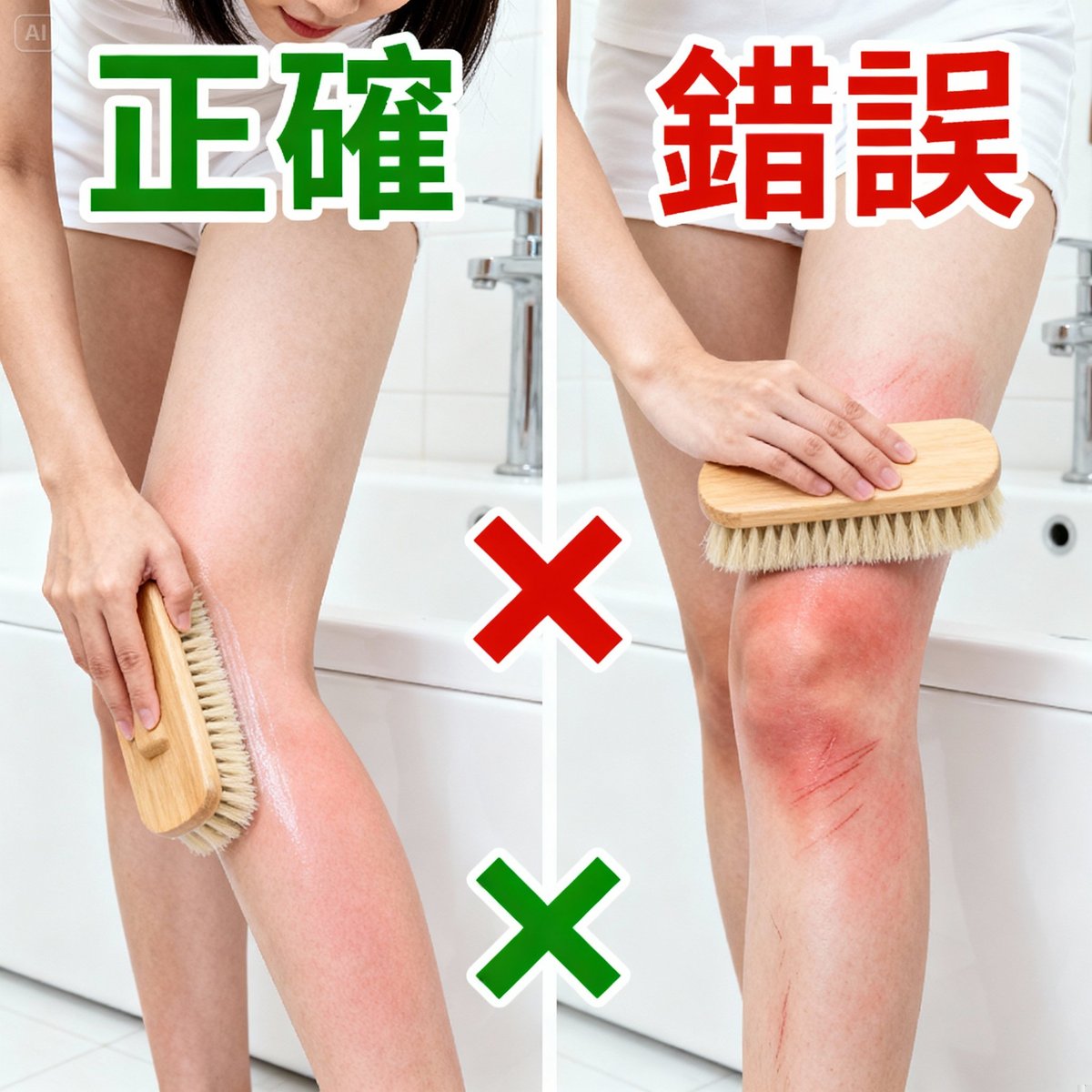
Mistake 1: Too much pressure
- Symptoms: broken skin, persistent stinging, bruises
- What to do instead: use just enough pressure to turn the skin slightly pink without hurting; harder is not more effective
Mistake 2: The wrong direction
- Symptoms: no exfoliating effect, and the skin may even be scratched
- What to do instead: strictly follow the "toward the heart" principle
Mistake 3: Brushing on wet skin
- Symptoms: friction increases and the skin is easily scratched
- What to do instead: make sure both the skin and the brush are dry (that is the essence of dry brushing)
Mistake 4: Brushing the face
- Symptoms: injured facial skin, allergic reactions
- What to do instead: a bristle brush for the body is not suitable for the face, which has its own dedicated cleansing brushes
Mistake 5: Not cleaning the brush
- Symptoms: bacteria build up and cause skin problems
- What to do instead: clean the brush at least once a week
Mistake 6: Expecting immediate results
- Symptoms: disappointment, giving up
- What to do instead: the difference in feel after exfoliation can usually be felt within a few sessions; what dry brushing cannot do will not happen however long you keep at it
Mistake 7: Brushing but not moving (exercise)
- Symptoms: limited results
- What to do instead: it works better combined with exercise and a healthy diet
Mistake 8: Using a poor-quality brush
- Symptoms: bristles falling out, stinging, scratched skin
- What to do instead: choose a reliable natural bristle brush
Notes for special situations
During pregnancy:
- We suggest consulting a doctor first
- Avoid the abdomen, the lower back and the inside of the ankles
- Use very gentle pressure
- Stop immediately if there is any discomfort
During your period:
- You can brush as usual
- Use gentle pressure on the abdomen
- Some people have more sensitive skin during their period; adjust as needed
Skin diseases (eczema, psoriasis and so on):
- Avoid the affected areas
- When it is severe, we suggest pausing
- Consult a dermatologist
Straight after an aesthetic medicine treatment:
- Laser: leave at least 2 weeks
- AHA chemical peel: leave at least 1 week
- Injections (hyaluronic acid, botulinum toxin): leave at least 1 week
How to assess the results
We suggest keeping a record of your progress so that you can assess it objectively:
Day 1:
- Record how the skin feels and how dry it is
Every 2 weeks:
- Record the change in feel again
- Adjust the pressure and frequency
What to assess (only the things dry brushing really can affect):
- Does the skin feel smoother?
- After exfoliation, is there any difference in how well lotion is absorbed?
- Is there any discomfort, stinging or broken skin after brushing?
Want to know more about cleaning and caring for bristle brushes? See The complete guide to caring for and cleaning natural bristle brushes | Tips for a longer service life
FAQ
Here are the common questions about dry brushing for body care:
Does dry brushing have to be done before bathing?
Yes, we strongly recommend doing it before bathing.
Reasons:
- Dry brushing loosens dead skin cells and flakes, which need to be rinsed off right away
- After brushing, the capillaries of the skin are dilated, and bathing at this point feels more comfortable
- Skin care products applied after bathing are absorbed best
Sequence: dry brush (5-15 minutes) → bathe (rinse clean) → dry off → apply body lotion
Can I brush on wet skin?
It is not recommended.
The essence of dry brushing is "dry". Wet skin has more friction and is easily scratched. If you do have to brush on wet skin, we suggest:
- Changing to a brush made for wet brushing (with softer bristles)
- Using very gentle pressure
- Accepting that the effect will not match dry brushing
Will brushing every day over-exfoliate the skin?
Not if it is done correctly.
Reasons:
- The exfoliating effect of a natural bristle brush is gentle
- It removes only skin cells that have already aged
- It is not as strong as chemical exfoliation
Note:
- Use moderate pressure (do not press too hard)
- If the skin becomes sensitive, brush less often
- With sensitive skin, change to 3-4 times a week
Can dry brushing help me lose weight?
No.
Dry brushing does not burn fat and does not bring your weight down: fat is not reduced by brushing from the outside.
Be careful, too, with the popular claim that it "reduces water retention and makes you look slimmer": that is mostly the rush of blood after brushing making the skin look firmer. It is a temporary change in appearance that fades within a few hours, not a change in body composition.
The only thing dry brushing reliably gives you is the smooth feel that follows exfoliation. To change your body shape, the way is exercise and diet, not a brush.
How long does dry brushing take to improve cellulite?
To be honest, cellulite does not improve because of dry brushing.
For a few hours after brushing, dry brushing can make the skin look plumper and the dimples less visible to you; that is a temporary effect caused by the rush of blood. There is no scientific evidence that it reduces or removes cellulite.
The change you really will feel is this: after 1-2 weeks of continuous use, skin cell turnover improves and the skin feels smoother. That is real, but it is a different matter from cellulite.
If cellulite is your main concern, we suggest consulting a dermatologist about the options that actually work, and not putting your budget and your expectations into a care brush.
Can I dry brush during pregnancy?
We suggest consulting a doctor first.
Considerations:
- Dry brushing causes mechanical stimulation of the surface of the skin and a brief rush of blood
- The skin is more sensitive during pregnancy, and there is no research on the safety of dry brushing for pregnant women
- Brushing the abdomen and lower back may not be safe
If the doctor agrees:
- Avoid the abdomen and the lower back
- Avoid the inside of the ankles (to be on the safe side)
- Use very gentle pressure
- Stop immediately if there is any discomfort
Safe alternatives:
- Start after the birth
- During pregnancy, massage with a gentle body lotion instead
Is it normal for the skin to turn red after brushing?
Turning slightly pink is normal; persistent redness and swelling is not.
Normal reaction:
- The skin turns slightly pink (like the glow after exercise)
- It fades within 15-30 minutes
- There is a feeling of warmth
- There is no pain or stinging
Abnormal reaction:
- Redness and swelling that last more than 1 hour
- A rash or itching
- Stinging or a burning feeling
- Broken skin or bruises
What to do if the reaction is abnormal:
- Stop dry brushing immediately
- Soothe the skin with cold water or an ice pack
- Apply a soothing lotion
- See a doctor if it is severe
- Next time, use lighter pressure or change to a soft brush
What is the best time to brush? Morning or evening?
Either is fine; it depends on what you need.
Brushing in the morning:
- Advantage: lifts your spirits and starts the day with energy
- Suitable for: people who need to wake themselves up
- Bathe after brushing and you will feel full of energy
Brushing in the evening:
- Advantage: relaxes body and mind and helps you sleep
- Suitable for: people prone to anxiety or insomnia
- Note: the pressure should be gentler (too much stimulation keeps you awake)
Advice:
- Try both times and find the one that suits you best
- Keep to a fixed time (to form the habit)
Do I need to use essential oil or lotion with it?
Not while dry brushing, but you must apply something afterward.
While dry brushing:
- Do not apply anything (keep the skin dry)
- That is the definition of "dry brushing"
After brushing:
- After bathing, always apply body lotion or oil
- This is when the skin absorbs best
- You can use a product promoted for firming if you like, but do not expect it to change the structure of cellulite
Recommended types of product:
- Body lotion (moisturizing)
- Body oil (more nourishing)
- Serums with firming claims (the effect varies from person to person and is not a guarantee of any therapeutic effect)
How often does the brush need replacing?
With good care it lasts 1-2 years.
Replacement signals:
- Bristles falling out in large numbers
- Bristles badly split or broken
- Bristles out of shape and unable to recover
- A persistent odor (still there after washing)
- A loose or broken handle
Tips for a longer life:
- Clean it once a week
- Dry it with the bristles facing down
- Keep it out of direct sunlight
- Keep it dry and ventilated
- Choose a good-quality brush (a higher investment at the start, but more durable)
Recommended articles
- The complete guide to horsehair brushes
- The complete guide to caring for and cleaning natural bristle brushes
- Hog bristle brush vs horsehair brush vs goat hair brush: a complete comparison
Conclusion: start your new body care habit
Dry brushing is a simple, natural and effective method of body care.
With one good natural bristle brush and 5-15 minutes a day, you can reliably remove dead skin cells and make the skin smoother to the touch. That is what it can do, and it does it very well.
The three keys to success
1. Choose the right tool
- Choose a natural hog bristle brush (not plastic or nylon)
- A long handle (to reach the back)
- Medium stiffness, medium density
- A brand with reliable quality
2. The correct method
- Strictly follow the "toward the heart" brushing direction
- Moderate pressure (the skin turns slightly pink without hurting)
- Brush on dry skin
- Bathe immediately after brushing and apply body lotion
3. Persistence
- Do it every day (at least 4-5 times a week)
- Judge by how the skin feels; there is no need to expect a structural change
- Combine it with exercise and a healthy diet
- Make it a daily habit (just like brushing your teeth)
Take action from today
Week 1: build the habit
- Buy a suitable bristle brush
- Dry brush for 5 minutes every day (to get used to the movements)
- Record how your skin feels at the start (how rough and dry it is)
Weeks 2-4: lengthen the time
- Increase to 10-15 minutes
- Get used to the brushing order from the extremities toward the heart
- Begin to feel the change in how the skin feels
Weeks 5-8: make it a habit
- Keep doing it every day
- The skin stays reliably smooth to the touch
Weeks 9-12: consolidate the results
- Dry brushing has become a habit
- The skin stays smooth to the touch
- Enjoy healthy, beautiful skin
Further reading
Want to learn more about bristle brushes?
- Bristle brush vs horsehair brush: a complete comparison | How to choose the most suitable natural bristle
- Where to buy a bristle brush? 5 purchase channels compared on price and quality
- The complete guide to caring for and cleaning natural bristle brushes | Tips for a longer service life
Choose YC Brushes and start a beautiful new life
YC Brushes was founded in 1985 and has over 40 years of brush manufacturing experience.
Our bristle brushes for body care:
- 100% natural hog bristle, carefully selected for quality
- Medium density, comfortable feel
- A long handle that reaches the back
- Factory-direct at a fair price
- Assured quality, with a defect rate below 1%
Many beauty spas and gyms specify YC Brushes, and you deserve one too!
Contact YC Brushes:
- Phone: +886-2-2988-2721
- Address: 2F-3, No. 14, Lane 609, Sec. 5, Chongxin Rd., Sanchong Dist., New Taipei City, Taiwan
- Website: YC Brushes
- Email: [email protected]
See the range of bristle brushes for body care now, or contact us for advice on choosing a brush!