Is tube and pipe cleaning a constant headache? The nylon tube brush is the professional tool for the job, but the wrong size or the wrong technique can lead to poor cleaning and even damage to the tube wall. This article is written by the professional team at YC Brushes, which has over 40 years of experience. It explains the structure of nylon tube brushes, how to choose the specification, how to use them and how to maintain them, so that you can use tube brushes correctly, extend their service life and get the best cleaning results.
Cleaning and maintaining industrial pipes, laboratory equipment, food processing lines and medical instruments all call for professional tube brushes.
As mentioned in the complete guide to nylon brushes, plastic brushes and synthetic filaments, nylon filament has excellent wear resistance and elasticity, which makes it especially well suited to tube brushes.
This article takes you through choosing and using nylon tube brushes in depth, so you can avoid the common mistakes and clean more efficiently.
What is a nylon tube brush? Structure and uses
Definition of a nylon tube brush
A nylon tube brush is a brush made specifically for cleaning the inner wall of tubes and pipes. It consists of a brush head and a handle:
- Brush head: nylon filament arranged in a ring, forming a cylinder or a cone
- Handle: twisted wire (steel wire), a plastic rod or a flexible rod, used to reach into the tube
Nylon (PA6 or PA66) has good elasticity and wear resistance. It does not scratch the tube wall during cleaning, yet it effectively removes dirt, scale, grease or residue from inside the tube.
How it differs from other tube brush materials
| Filament material | Advantages | Disadvantages | Suitable for |
|---|---|---|---|
| Nylon brush | Does not damage the tube wall, wear resistant, good elasticity | Weaker chemical resistance than PP | General tubes, food lines, medical instruments |
| Wire brush | Extremely strong cleaning power, high-temperature resistant | Scratches the tube wall easily, risk of rust | Heavy soiling, cast iron pipes, removing weld slag |
| PP brush | Resistant to acids and alkalis, strong chemical resistance | Lower hardness, slightly poorer elasticity | Chemical pipes, acid and alkali tanks, electroplating tanks |
| Stainless steel brush | High-temperature resistant, does not rust, high strength | Higher price, damages the tube wall easily | High-temperature pipes, pre-weld preparation |
Recommendation:
- Stainless steel or copper tubes → nylon tube brush (does not scratch)
- PVC or plastic tubes → nylon or PP tube brush (soft, does no damage)
- Chemical pipes → PP or stainless steel tube brush (corrosion resistant)
- Heavy soiling → steel wire tube brush (strong cleaning power, but take care to protect the tube wall)
Common applications
- Food processing lines: beverage filling tubes, milk transfer pipes, beer fermentation pipes (nylon that complies with FDA 21 CFR 177 required)
- Medical instruments: endoscope cleaning, suction tube cleaning, tubing of surgical instruments
- Industrial equipment: cooling water pipes, oil lines, spray gun tubes, compressed air lines
- Household cleaning: drain pipes, drinking straws, baby bottles, water bottle spouts
Types and specifications: twisted-wire, plastic and flexible handles
Classified by handle structure
1. Twisted-wire handle tube brush (Twisted Wire Handle)
Structure: two strands of steel wire twisted together, with the filament held between the wires
Features:
- High strength; more pressure can be applied
- Durable, suited to repeated use
- A rigid handle, suited to cleaning straight tubes
Suitable for:
- Industrial equipment lines (such as compressed air lines and oil lines)
- Straight tubes 10-100 cm long
- Situations that need deep cleaning with force
Specification range:
- Brush head diameter: 5mm - 100mm
- Handle length: 10cm - 200cm
- Filament material: nylon 6, nylon 66, PP, stainless steel
2. Plastic handle tube brush (Plastic Handle)
Structure: a PP or PE plastic rod, with the brush head fixed by tufting or hot-melt
Features:
- Lightweight and easy to handle
- Does not scratch precision tube walls
- A smooth handle that is easy to wash
Suitable for:
- Food-grade lines (materials that comply with FDA 21 CFR 177)
- Cleaning medical instruments
- Tubing of precision instruments
Specification range:
- Brush head diameter: 3mm - 50mm
- Handle length: 5cm - 50cm
- Common colors: white, blue, green (color coding, to avoid cross-contamination)
3. Flexible handle tube brush (Flexible Handle)
Structure: the handle is a flexible steel wire or plastic rod with an outer PVC coating
Features:
- Bends freely to follow turns in the tube
- Cleans bent tubes, U-shaped tubes and S-shaped tubes
- Flexible to handle, reaching into dead corners
Suitable for:
- Drain pipes, U-bends
- Automotive cooling water hoses
- Laboratory coil condensers
Specification range:
- Brush head diameter: 8mm - 50mm
- Handle length: 30cm - 150cm
- Bending angle: up to 90-180°
Classified by brush head shape
- Cylindrical: filament of uniform length, suited to cleaning straight tubes
- Conical: a finer tip, suited to reaching into narrow tubes
- Ball-shaped: a spherical brush head, suited to cleaning tube fittings or flared ends
- Spiral: filament arranged in a spiral, which cleans well when rotated
How to choose the right nylon tube brush: a 4-step method
Step 1: Measure the inner diameter of the tube
Purpose: to make sure the brush head size matches the tube
How to measure:
- Measure the inner diameter (ID, Inner Diameter) of the tube with vernier calipers or a tape measure
- If it cannot be measured directly, check the specification sheet for that pipe material: the nominal size is not the actual inner diameter (for example, a 1/2 inch Sch40 PVC pipe has an average inner diameter of about 15.3mm)
Note:
- The wall thickness must be deducted when measuring
- If the tube is corroded or scaled, first estimate the actual usable inner diameter
Step 2: Work out the right brush head diameter
Sizing formula:
Brush head diameter = tube inner diameter × 1.2 ~ 1.5
Explanation:
- 1.2 times: light cleaning, the filament lightly touches the tube wall (suited to precision tubes)
- 1.3 times: general cleaning, the filament makes moderate contact with the tube wall (the most commonly used)
- 1.5 times: deep cleaning, the filament presses closely against the tube wall (suited to heavy soiling)
Example:
- Tube inner diameter 20mm
- Light cleaning: brush head diameter 20 × 1.2 = 24mm
- General cleaning: brush head diameter 20 × 1.3 = 26mm
- Deep cleaning: brush head diameter 20 × 1.5 = 30mm
💡 Professional advice from YC Brushes: for a first purchase we suggest the 1.3 times size, then adjusting according to the cleaning results after testing.
Step 3: Choose the handle type
Choose according to the tube:
| Tube type | Recommended handle | Reason |
|---|---|---|
| Straight tube (no bends) | Twisted-wire handle | High strength, reaches deep into long tubes |
| Bent tube, U-shaped tube | Flexible handle | Follows the curved path |
| Precision tube | Plastic handle | Does not scratch the tube wall |
Long tube (>1 meter) | Twisted-wire handle (extended type) | Good rigidity, stable to handle |
| Short tube (<30cm) | Plastic handle | Light and easy to handle |
Step 4: Confirm the filament material and stiffness
Choose according to the operating environment:
- Room-temperature tubes → nylon 6 (economical)
- Tubes at higher temperatures → nylon 66 (generally more heat resistant than nylon 6)
- Chemical pipes (acid or alkali environment) → PP filament (good chemical resistance)
- Food lines → nylon or PP that complies with FDA 21 CFR 177 (food safe)
Choosing filament stiffness:
- Soft (0.15-0.25mm): precision tubes, does not scratch
- Medium (0.3-0.5mm): general cleaning, balances dirt removal and protection
- Hard (0.6-1.0mm): heavy soiling, strong cleaning power
For more detail on choosing filament stiffness, see Soft brush recommendations: where to buy? Recommended professional manufacturers and a purchasing guide.
Techniques: straight tubes, bent tubes, high-temperature and chemical pipes
Cleaning straight tubes
Steps:
- Prepare the cleaning agent: choose according to the type of dirt (scale → acidic cleaner, grease → alkaline degreaser)
- Pre-wet the tube: fill it with cleaning agent or clean water to soften the dirt
- Insert the tube brush: slowly insert the brush into the tube from one end
- Rotate and advance: rotate clockwise while pushing forward (a rotation of about 180°)
- Scrub back and forth: after pushing through to the end, pull the brush out while rotating; repeat 3-5 times
- Rinse and check: rinse the tube with clean water and check the cleaning result
Notes:
- ❌ Avoid forcing the brush straight in (this easily damages the filament or the tube wall)
- ✅ Keep the brush rotating (this improves cleaning efficiency)
- ✅ Apply moderate force (do not force the brush forward when you feel resistance)
Cleaning bent tubes
Tool to use: flexible handle tube brush
Steps:
- Pre-shape the handle: bend the handle in advance to match the angle of the bend in the tube
- Probe in slowly: advance in small movements to avoid jamming
- Feel for resistance: at a bend, stop pushing and adjust the angle of the handle
- Clean in sections: divide the tube into several sections and clean them one at a time
- Clean from the other direction: insert the brush from the other end to make sure the dead corners at the bends are cleaned too
Advanced tips:
- If the tube bends by more than 90°, a high-pressure water jet can be used first to loosen the dirt before scrubbing with the tube brush
- For a U-shaped tube, insert a brush from each end and let them meet in the middle
Cleaning high-temperature pipes
Material choice:
- Higher temperatures, but still within what nylon can take → nylon 66 tube brush (generally more heat resistant than nylon 6)
- Beyond what nylon can take → stainless steel tube brush
- The actual temperature limit of each material varies with the formulation; go by the material specification sheet from the supplier
Operating notes:
- Clean after cooling: a high-temperature pipe should first be cooled to below 60°C before cleaning (to avoid burns)
- Use protection: wear heat-insulating gloves
- Work quickly: reduce the time the filament spends in the hot environment
- Replace regularly: high temperatures speed up filament aging, so replacement after 10-15 uses is recommended
Cleaning chemical pipes
Chemical environment: acidic, alkaline, organic solvents
Material choice:
- Acidic environment (
pH < 3) → PP tube brush or stainless steel 316 - Alkaline environment (
pH > 10) → PP tube brush - Organic solvents → PP tube brush (resistant to toluene, acetone and so on)
Safety notes:
- Wear protection: protective gloves, safety goggles, apron
- Ventilated environment: make sure air circulates
- Neutralize and wash: after cleaning, rinse the tube brush thoroughly with clean water or a neutralizing agent
- Separate storage: tube brushes used for chemical pipes should be stored separately to avoid cross-contamination
Care and maintenance: extending the service life of a tube brush
Cleaning after use
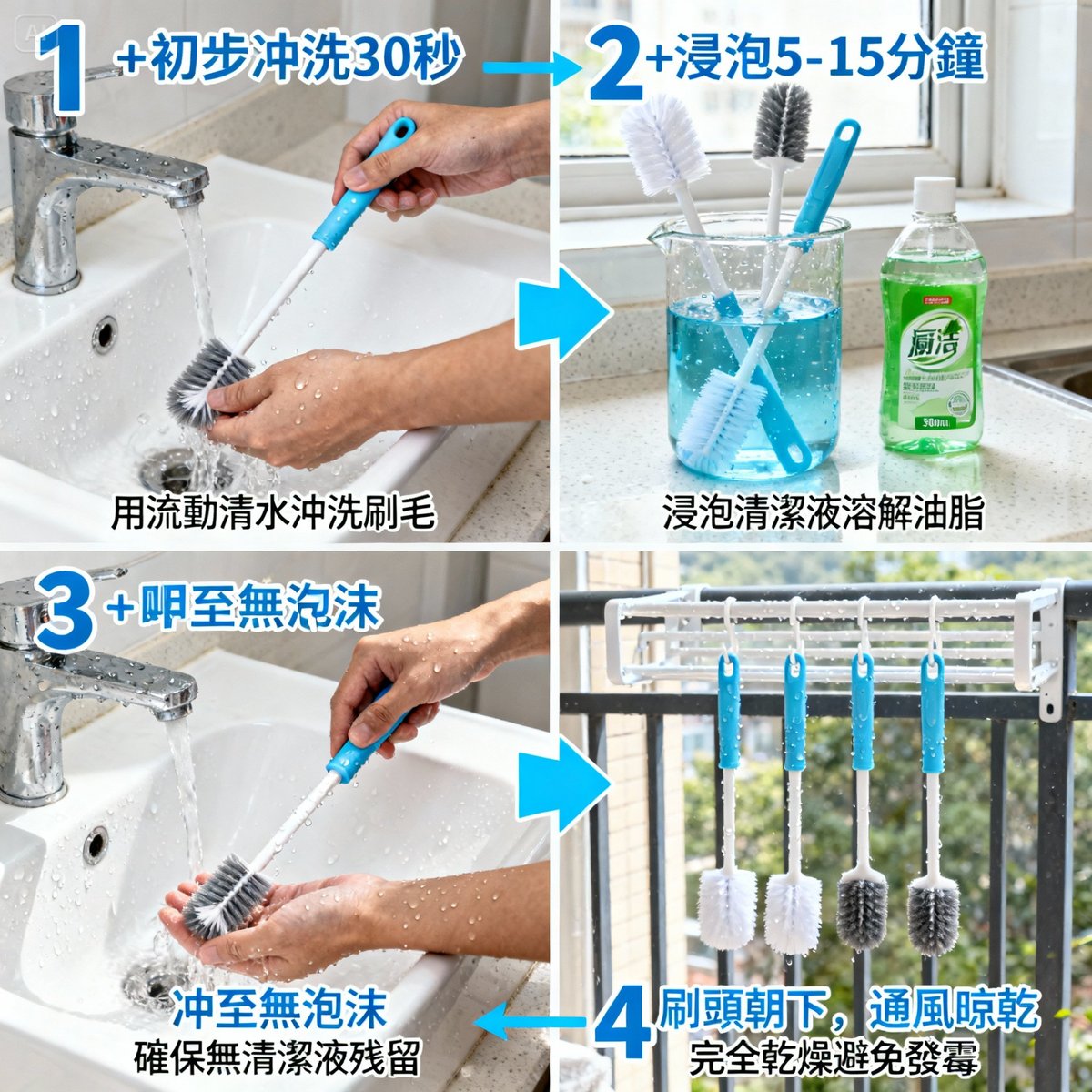
Standard cleaning procedure:
- Rinse immediately: rinse the brush head and handle with clean water straight after use
- Remove residue: if grease or chemical residue remains, wash with the appropriate cleaning agent
- Shake off the water: shake hard to remove excess water
- Air-dry: hang in a ventilated place and let it dry naturally (avoid direct sunlight)
Deep cleaning (after every 10 uses):
- Soak in warm water + neutral detergent for 15-20 minutes
- Comb through the filament with your fingers to remove deep-seated dirt
- Rinse thoroughly with clean water
- Store only after it has dried completely
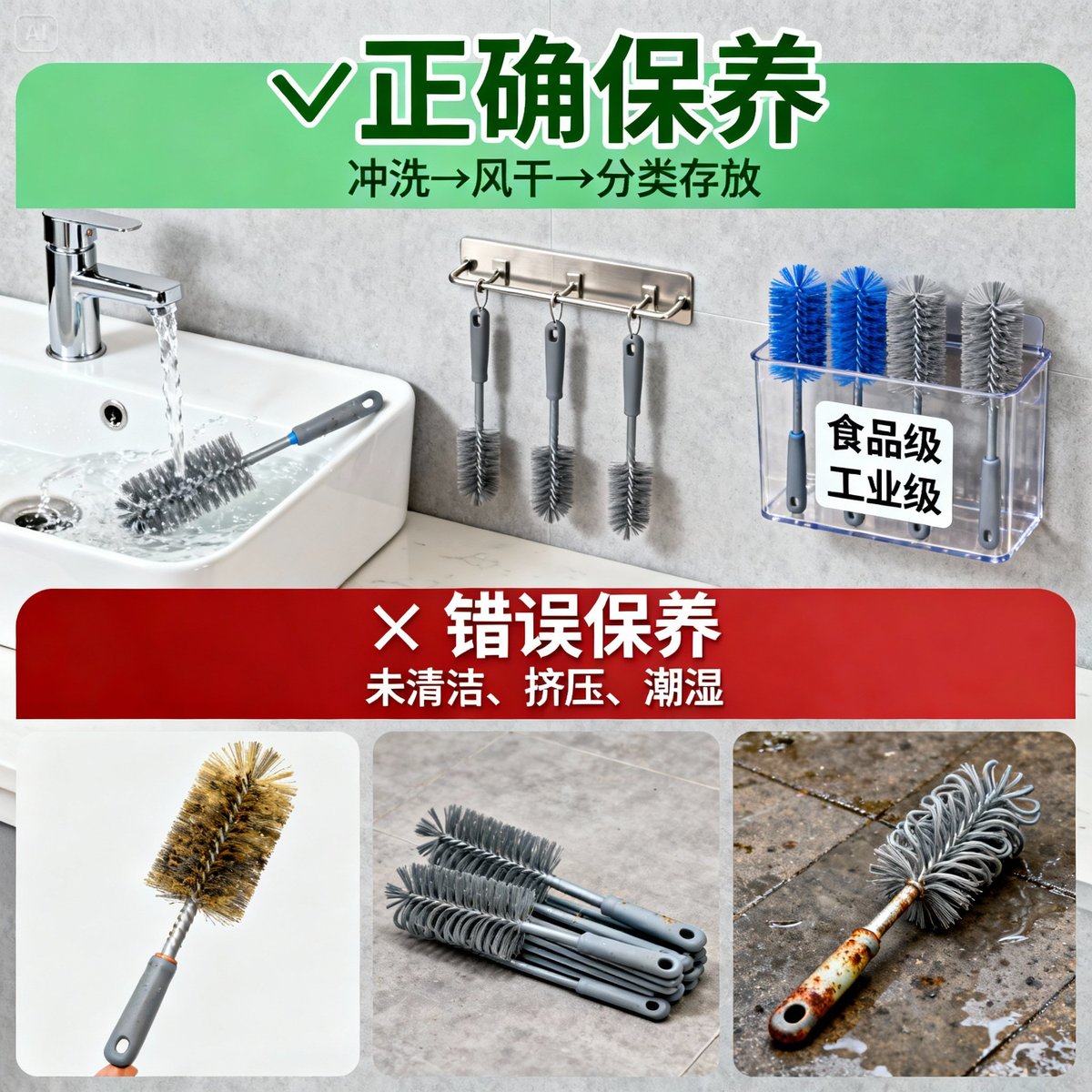
Storage
| Storage condition | Recommended practice | What to avoid |
|---|---|---|
| Environment | Dry, ventilated, room temperature | ❌ Humidity, high temperature, direct sunlight |
| Method | Hung up or laid flat | ❌ Brush head pressed downward |
| Sorting | Stored by purpose | ❌ Food-grade and industrial-grade stored together |
| Isolation | Use a dust bag or storage box | ❌ Exposed to a dusty environment |
Storing food-grade tube brushes:
- Use color coding (for example blue = dairy products, green = fruit and vegetables)
- Store separately to avoid cross-contamination
- Disinfect regularly (for example in a UV disinfection cabinet or by steam)
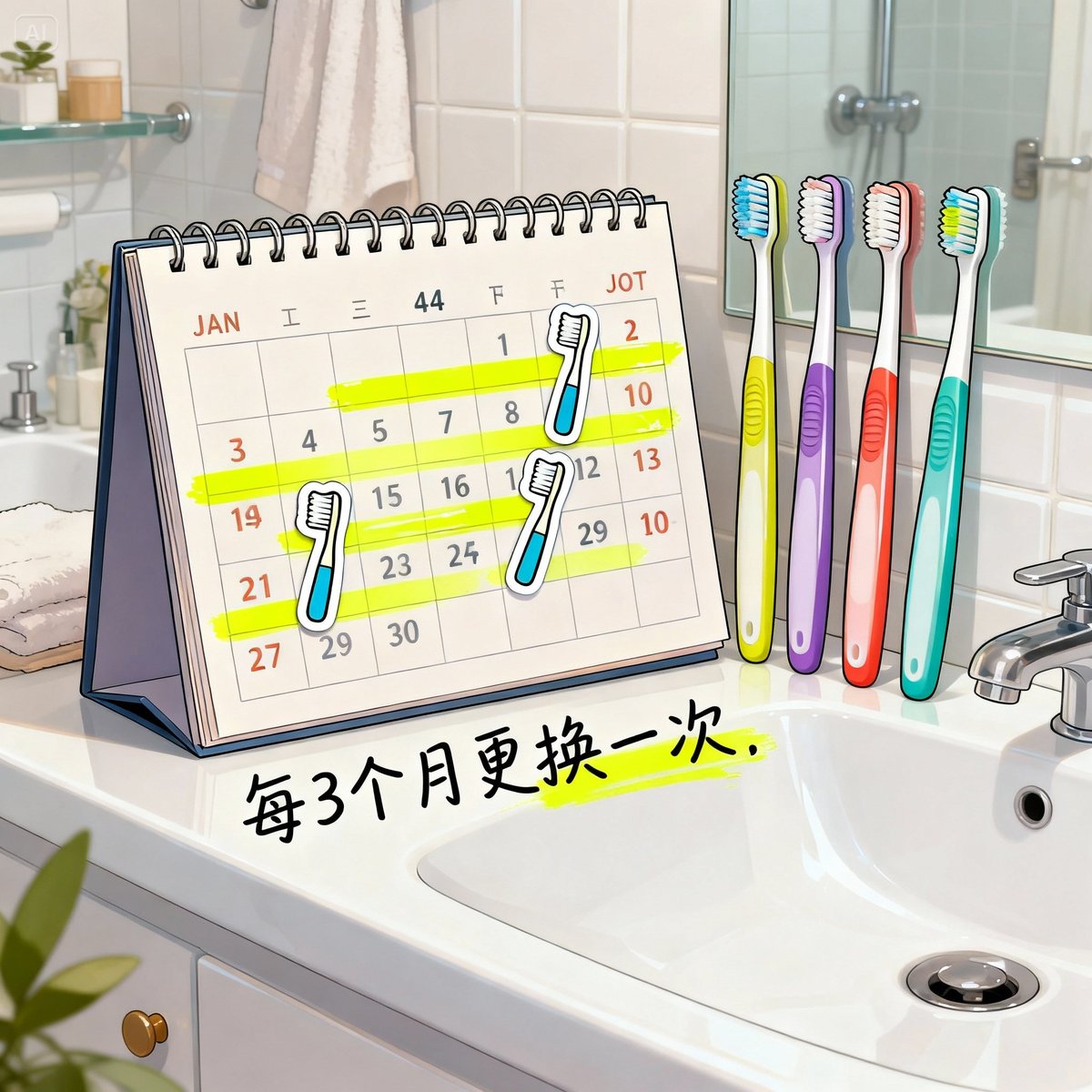
Inspection and when to replace
5 major signs that a replacement is needed:

- Filament shedding: more than
10%of the filament has shed, affecting cleaning performance - Bent filament: the filament is permanently deformed and no longer springs back
- Broken filament: a large amount of the filament has broken
- Loose handle: the twisted-wire handle has loosened, or the plastic handle has cracked
- Poorer cleaning performance: the same technique gives clearly poorer cleaning results
Service life reference:
- Industrial environment: 20-50 uses
- Food environment: 30-80 uses (depending on cleaning frequency)
- Household environment: 50-100 uses
💡 Professional advice from YC Brushes: we suggest keeping a "tube brush usage log" recording the number of uses and the replacement dates, to safeguard cleaning quality.
Common applications and cases
1. Cleaning food processing lines
Equipment:
- Tubing of beverage filling machines
- Dairy transfer pipes
- Discharge pipes of beer fermentation tanks
- Piping of juice concentration equipment
Cleaning requirements:
- Tube brushes made of nylon that complies with FDA 21 CFR 177 must be used
- Compliance with HACCP cleaning rules
- Color coding, to avoid cross-contamination
Procedure:
- CIP pre-wash: initial cleaning with the CIP (clean-in-place) system
- Deep cleaning with a tube brush: use a nylon tube brush to remove residue from the tube wall
- Disinfection: steam disinfection or a chemical disinfectant
- Testing: ATP bioluminescence testing to confirm cleanliness
A YC Brushes case: a juice factory uses food-grade nylon tube brushes from YC Brushes to clean its filling tubes and passed SGS testing, with bacterial residue below 10 CFU/cm².
To learn more about food-grade filament materials, see the complete guide to nylon brushes, plastic brushes and synthetic filaments.
2. Cleaning medical instruments
Equipment:
- Endoscope cleaning (gastroscopes, colonoscopes)
- Suction tube cleaning
- Tubing of surgical instruments
- Cleaning dental instruments
Cleaning requirements:
- Use medical-grade nylon tube brushes
- Compliance with disinfection and sterilization standards
- Single use, or high-temperature sterilization
Procedure:
- Pre-wash: soak in an enzymatic cleaner
- Tube brush cleaning: scrub the lumen with a nylon tube brush
- Ultrasonic cleaning: removes remaining dirt
- High-temperature sterilization: steam sterilization at 121°C for 20 minutes
3. Maintaining industrial equipment
Equipment:
- Cooling water pipes of air compressors
- Oil lines of hydraulic systems
- Heat exchanger tube bundles
- Spray gun tubes of coating equipment
Cleaning intervals:
- Cooling water pipes: 1 time a month
- Oil lines: 1 time a quarter
- Heat exchangers: 1 time every half year
Benefits:
- Heat exchange efficiency improved by 15-25%
- Lower risk of blocked pipes
- Longer equipment service life
A YC Brushes case: a plastic injection molding plant uses nylon tube brushes to clean its cooling water pipes regularly; mold temperature control became more stable and the defect rate fell by 8%.
4. Cleaning household pipes and tubes
Applications:
- Drain pipes (kitchen, bathroom)
- Water dispenser tubing
- Baby bottles, water bottle straws
- Coffee machine steam wands
Sizing advice:
- Drain pipes: flexible handle tube brush, 20-30mm diameter
- Water dispensers: plastic handle tube brush, 8-12mm diameter
- Baby bottle straws: nylon tube brush, 5-8mm diameter
Cleaning frequency:
- Drain pipes: 1 time a month
- Water dispensers: 1 time a quarter
- Baby bottle straws: clean daily
FAQ
Why does the filament shed after the tube brush has been used only a few times?
Analysis of the causes:
- The brush head is too large: friction between the filament and the tube wall is too strong, so the filament breaks and sheds
- Poor material quality: the tensile strength of the filament is insufficient
- A loose twisted-wire handle: the twisted wire holding the filament has come loose
- Incorrect technique: pushing and pulling by force without keeping the brush rotating
Solutions:
- ✅ Measure the inner diameter of the tube again and choose a suitable brush head size (tube diameter × 1.2-1.3)
- ✅ Choose a manufacturer with reliable quality (such as YC Brushes, factory-direct for over 40 years)
- ✅ Check that the twisted wire is tight before use
- ✅ Keep the brush rotating while working and avoid forcing it straight in
Key points when buying:
- For the filament, choose nylon 6 or nylon 66 with a tensile strength
> 60MPa - For the twisted wire, choose galvanized steel wire to avoid rust
- You can ask the manufacturer for a pull test report
To learn more about the material differences between nylon brushes and plastic brushes, see Plastic brush vs nylon brush | 5 key differences and how to choose.
How high a temperature can a nylon tube brush withstand?
Heat resistance of nylon materials:
| Material | Heat resistance (relative) | Recommended application |
|---|---|---|
| Nylon 6 | Medium | Room-temperature tubes, general industry |
| Nylon 66 | Higher than nylon 6 | Pipes at higher temperatures, food processing |
| PP | Lower | Chemical pipes, acid and alkali resistance |
| Stainless steel | Highest | High-temperature pipes, pre-weld preparation |
The actual continuous use temperature and short-term heat resistance vary with the formulation; when buying, ask the supplier for the material specification sheet to confirm.
Notes:
- High-temperature environments speed up the aging of nylon filament
- Replacement after 10-15 uses is recommended
- If the pipe temperature exceeds the upper limit stated on the nylon specification sheet, switch to a stainless steel tube brush
Professional advice from YC Brushes: if the pipe often operates at higher temperatures, we suggest the combination of nylon 66 + stainless steel twisted wire, which is more durable.
Which regulations do food-grade tube brushes need to meet?
It depends on where they are used and sold: food-grade tube brushes must comply with the local regulations on food contact materials:
-
Taiwan: the Sanitation Standard for Food Utensils, Containers and Packages issued by the Ministry of Health and Welfare
-
Exports to the United States: FDA 21 CFR 177 (the U.S. Food and Drug Administration's regulations on food contact materials):
- The filament material complies with FDA 21 CFR 177.1500 (nylon)
- No leaching of harmful substances
-
Exports to the EU: EU 10/2011:
- Complies with the EU regulation on food contact materials
- Passes migration testing
Common voluntary practices (not required by law):
- ISO 22000 (food safety management system): a certification a factory obtains voluntarily, showing that its production process meets food safety management requirements
- Color coding: different colors are used to distinguish purposes (blue = dairy products, green = fruit and vegetables, red = meat), avoiding cross-contamination
The YC Brushes advantage:
- Nylon tube brushes that comply with FDA 21 CFR 177
- Material certificates can be provided on request
- Custom colors supported (order quantities are quoted per specification; please email us with your requirements)
Need a quote for food-grade tube brushes? Contact YC Brushes now. We have been factory-direct for over 40 years and offer selection advice free of charge.
Why choose YC Brushes? Over 40 years of professional manufacturing experience
Professional customization capability
- Custom sizes: brush head diameters from 3mm - 150mm can all be produced
- Custom handles: twisted-wire handle, plastic handle, stainless steel handle, flexible handle
- Filament options: nylon 6, nylon 66, PP, PBT, stainless steel, brass wire
- Color coding: multi-color customization supported (food-grade color coding)
A full set of quality certifications
- ISO 9001 quality management system certification
- Nylon and PP materials that comply with FDA 21 CFR 177 (food grade)
- SGS test reports (material certificates, pull tests)
- Compliant with the EU RoHS / REACH regulations
Flexible ordering
- Flexible order quantities: quoted per specification (typical manufacturers require 500-1000 pieces); please email us with your requirements
- Sampling: samples are available, and sample and production lead times are quoted per specification; please email us
- Free services: free selection advice, free sample testing, free estimates
Transparent, reasonable pricing
- Factory-direct: no middleman's cost, with prices 15-25% lower than retail
- Volume discounts: the larger the order, the better the unit price
- Transparent pricing: a detailed quotation is provided, with no hidden charges
Professional technical support
- Over 40 years of manufacturing experience: a rich store of application cases
- One-to-one consultation: a professional team gives selection advice
- After-sales service: guidance on use and maintenance advice
- Reply within 48 hours: a quote and recommendations are provided within 48 hours of an inquiry
Need nylon tube brushes or other industrial brushes? Contact YC Brushes now. We have been factory-direct for over 40 years and offer professional selection advice and sample testing free of charge.
Contact details:
- 📞 Phone: +886-2-2988-2721
- ✉️ Email: [email protected]
- 🌐 Online form: Fill it in now
Summary: use tube brushes correctly and clean more efficiently
The nylon tube brush is the professional tool for cleaning tubes and pipes. The right specification and the right technique greatly improve cleaning efficiency and extend the life of the equipment.
Key points in review:
- Choose the right size: brush head diameter = tube inner diameter × 1.2-1.5
- Choose the right handle: straight tube → twisted-wire handle, bent tube → flexible handle, precision tube → plastic handle
- Use the right technique: keep the brush rotating and avoid pushing and pulling by force
- Look after it properly: clean immediately after use, air-dry, and store by category
- Replace regularly: after 20-100 uses, depending on the operating environment
With over 40 years of professional manufacturing experience, YC Brushes offers a complete nylon tube brush solution, from selection advice and sample testing to volume production, meeting your needs in one stop.
Still looking for the right tube brush? Browse our full product catalog, or contact us now for free professional advice!
Recommended related articles
- Nylon brushes, plastic brushes and synthetic filaments: the complete guide | Material properties and buying guide
- The complete buying guide to nylon wheel brushes | Specifications, applications and price analysis
- Plastic brush vs nylon brush | 5 key differences and how to choose
- Soft brush recommendations: where to buy? | Recommended professional manufacturers and a purchasing guide
References
- FDA 21 CFR 177.1500 - Specification for nylon resins
- ISO 22000:2018 Food safety management systems
Author: The YC Brushes professional team