Have you ever been woken late at night by noise from the corridor? Is your air-conditioning bill alarmingly high and you cannot find the reason? Or do cockroaches and ants keep creeping into your home through the door gap without anyone noticing? These annoyances all come from one detail that is often overlooked: the door gap. One small strip brush can solve them.
Sealing a door gap looks simple, but it is a key to the quality of a home.
This article gives you the full picture of choosing, installing and using strip brushes, so that a small outlay brings a big improvement in quality of life. YC Brushes has over 40 years of manufacturing experience and supplies hardware stores and building material dealers across Taiwan. This guide shares our expertise to help you make the best choice.

Introduction: why does sealing the door gap matter so much?
Door gap problems are more common than you might think.
The door gaps in a home look tiny, but they are the main route for energy loss, noise and pests.
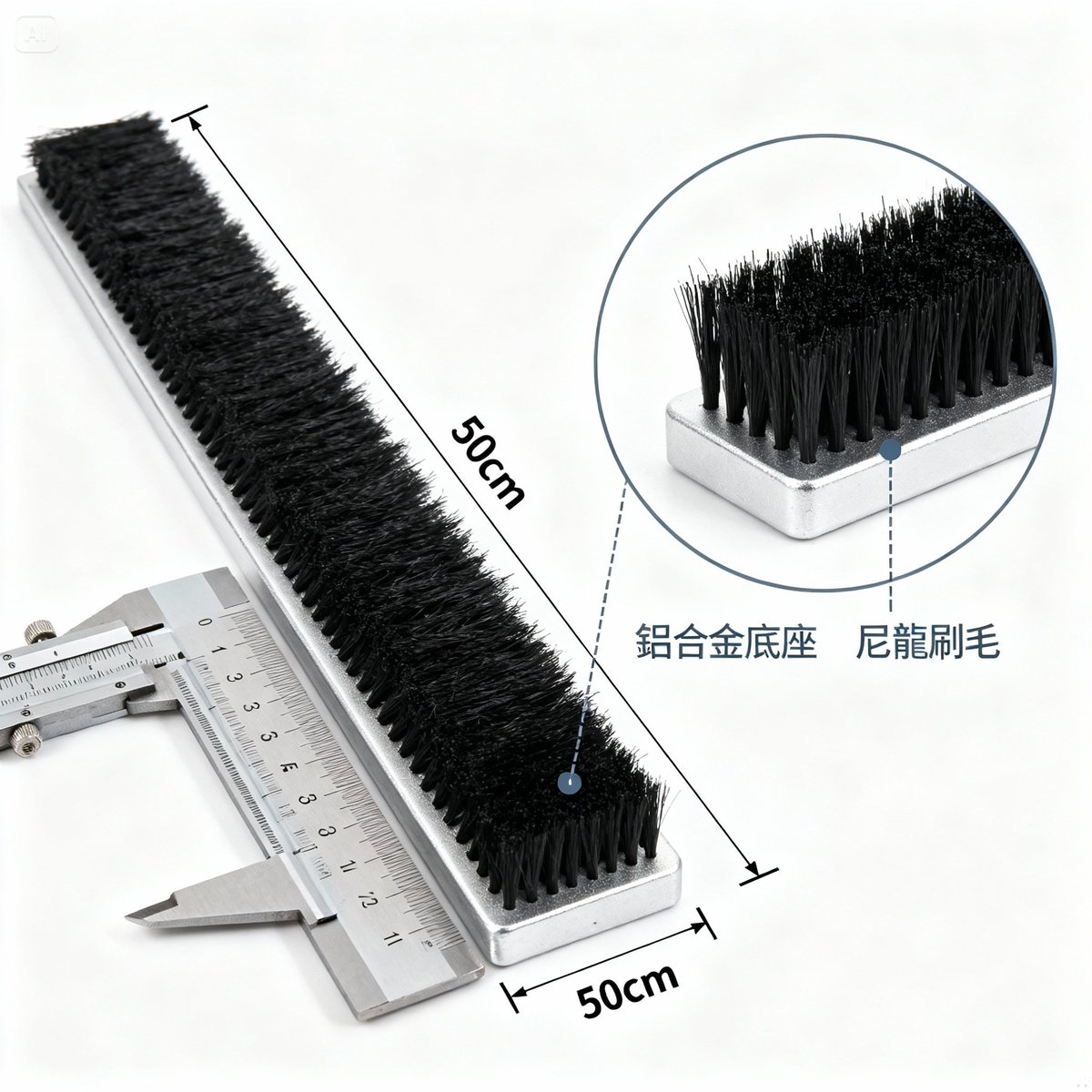
The strip brush (also called a door seal strip brush or sealing brush) is currently the best-value solution for sealing door gaps. It consists of two parts, a base and filament. The base is usually aluminum alloy or plastic, and the filament is available in PP, nylon, natural hair and other materials.
Compared with other sealing materials such as rubber strips and foam strips, the strip brush has these advantages: the filament compresses to fit different gaps, the service life is long (3-5 years indoors), it does not affect how smoothly the door opens and closes, and it is particularly good at keeping pests out.
YC Brushes has focused on industrial-grade brush manufacturing for over 40 years. From household doors and windows to factory equipment, we provide complete strip brush solutions. This guide covers selection, installation, specification comparison and more, to help you find the product that suits you best.
What is a strip brush, and why do you need one?
A strip brush is a sealing material for doors and windows, made up mainly of two parts: a base and filament.
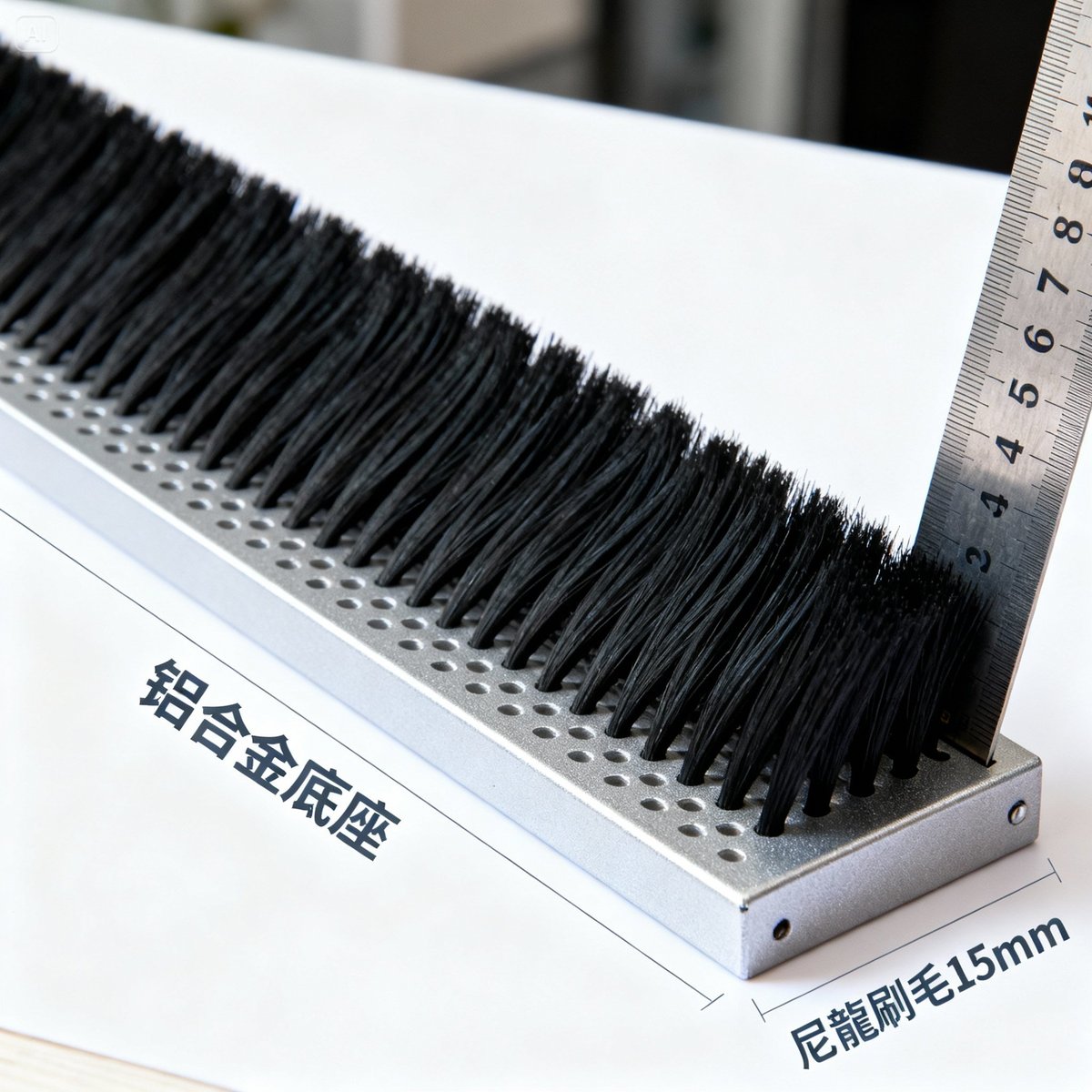
The base usually comes in three materials, aluminum alloy, stainless steel and plastic. The filament depends on the purpose and can be PP plastic filament, nylon filament, horsehair, hog bristle and other materials. The base is fixed to the door frame by adhesive, by slotting in or by screws, and the filament fills the gap and blocks wind, dust and insects.
The four core functions of a strip brush
1. Sealing the door gap against drafts
The door gap is the main channel through which cooled air escapes. The wider the gap and the greater the temperature difference between indoors and outdoors, the more obvious the loss of cooled air. Fitting a strip brush to close the gap reduces that loss, and over time it shows in the electricity bill. The actual saving depends on the size of the gap, usage habits and the air-conditioning settings.
2. Sound insulation and noise reduction
The fiber structure of the filament absorbs sound waves effectively. According to laboratory tests, a good-quality strip brush can cut noise by 15-25 decibels, equivalent to going from road traffic noise (70 dB) down to the volume of a library (45 dB). This is especially important for bedroom and study doors.
3. Keeping out pests and dust
A strip brush has a high filament density and can block more than 90% of common household pests, including cockroaches, ants and geckos. The physical barrier of the filament is more environmentally friendly and longer lasting than chemical repellents. It also effectively keeps dust and pollen from entering the room.
4. Saving energy and keeping the temperature
Heating in winter and cooling in summer both escape through the door gap. A well-sealed door gap keeps the room temperature more stable and shortens the running time of the air-conditioning equipment, which extends the life of the machine and saves energy at the same time.
A wide range of applications
Strip brushes are not only used on household doors and windows. They are also widely used for:
- Slot-in sealing on aluminum doors and windows and airtight windows
- Dust protection on roller shutter doors and warehouse doors
- Protection on machinery and conveyor belts
- Safety cushioning on elevator doors and automatic doors
- Door curtains for cleanrooms and clean areas
The later sections give detailed buying and installation advice for each application.
Types of strip brush and materials compared
There are many kinds of strip brush on the market, and choosing the right type is the key.
Here is a comparison table of the common types:
| Type | Material | Characteristics | Suitable for | Service life | Reference price |
|---|---|---|---|---|---|
| Soft strip brush | PP plastic filament | Soft, pest-proof, quiet | Interior room doors, cabinets | 3-5 years | Low price |
| Hard strip brush | Nylon filament / steel wire | Wear resistant, weather resistant, dust-proof | Aluminum doors and windows, roller shutter doors | 3-7 years | Mid price |
| Sealing pile strip | Wool / horsehair | Premium sound insulation, heat retention | Airtight windows, high-end doors and windows | 5-10 years | Upper-mid to high price |
| H-type brush | Aluminum alloy base | Industrial-grade dust protection, tufted on both sides | Machinery, elevators | 5-10 years | Quoted per custom order |
Filament materials in depth
PP plastic filament: The most economical, very soft, and suited to indoor use. Its disadvantage is that it ages easily outdoors and needs replacing after about 1-2 years.
Nylon filament: Good wear resistance and strong recovery; it is the mainstream of the market. It has good heat and weather resistance and suits both indoor and outdoor use. The price is moderate and the value for money is the best.
Natural hair (wool / horsehair): The best sound insulation and heat retention, with a soft feel, but the price is higher. It needs protection from moths and is not suited to damp environments.
Steel wire: The most wear resistant, suited to industrial environments. It may scratch floors or door frames, though, so the application has to be assessed carefully.
Choosing the base material
The base affects the installation method and the service life.
- Aluminum alloy base: lightweight, rust-free and weather resistant; suits exterior doors and windows and lasts 5-10 years.
- Stainless steel base: the most durable; suits industrial or highly corrosive environments, but the price is higher.
- Plastic base: cheap; suits temporary indoor use, with a service life of about 1-3 years.
When choosing, consider the installation environment, the budget and the expected years of use. For general household use we suggest an aluminum alloy base with nylon filament, which balances performance and cost.
For a closer look at the differences between materials, see our full product catalog.
How do you choose a strip brush size? A complete measuring guide
Choose the wrong size and the installation is wasted.
Many people buy a strip brush and then find the filament is too short to seal, or so long that the door will not close. Choosing the right size involves three elements: the door gap width, the filament length and the base specification.
4 steps for measuring the door gap width
Step 1: Prepare the tools
You need a tape measure or ruler, and paper and pen to record the figures. For an irregular gap, a feeler gauge gives a more precise measurement.
Step 2: Find where the gap is largest
The width of a door gap is usually uneven. Close the door, shine a flashlight from outside and see where the most light leaks through: that is where the gap is largest. Concentrate on measuring this position to make sure the strip brush covers it completely.
Step 3: Measure at several points and take the largest value
Measure at three points, the top, middle and bottom of the door, and go by the largest value. If the difference is more than 5 mm, we suggest choosing longer filament or adding a rubber strip for reinforcement.
Step 4: Record the figures and add a safety margin
If the measured gap is 8 mm, we suggest choosing 10-12 mm filament (a margin of 2-4 mm). Slightly long filament is not a problem because it can be trimmed, but if it is too short there is no remedy.
Filament length selection table
| Door gap width | Recommended filament length | Suitable for |
|---|---|---|
| 0-5 mm | 5-8 mm | New doors that fit the frame closely |
| 5-10 mm | 10-12 mm | Ordinary wooden doors, room doors |
| 10-20 mm | 15-18 mm | Old doors, aluminum doors and windows |
| 20-30 mm | 20-25 mm | Roller shutter doors, warehouse doors |
| Over 30 mm | 25 mm+ or a double-layer strip brush | Special requirements; custom work recommended |
This is general advice; in practice it still needs fine-tuning for the door material and how often the door is opened and closed. For a more precise measuring method, see our dedicated article How to choose a strip brush size: complete measuring guide and specification tables.
Choosing the base specification
The base affects the installation method.
Adhesive base (6-12 mm wide): 3M adhesive on the back; suits renters or anyone who does not want to drill. The disadvantage is that the adhesive may fail in high heat, and the service life is 1-2 years.
Slot-in base (U-type / T-type / F-type): designed for aluminum doors and windows and slotted into the channel in the door frame; the neatest and also the most secure. You need to confirm in advance that the channel specification matches.
Screw-fixed base: screwed to the door frame; the most durable and suited to long-term use. It needs a power drill and is harder to install.
Different door types call for different bases. The installation section later explains each fixing method in detail.
Where to buy door seal strip brushes? Channels and prices compared in full
Buy through the right channel and you save money and time.
There are four main ways to buy strip brushes: hardware stores, chain stores, online platforms and direct from the factory. Each has its advantages and disadvantages. Here is the full comparison (the stores and platforms named are those of the Taiwan market):
| Purchasing channel | Price range | Advantages | Disadvantages | Recommendation rating |
|---|---|---|---|---|
| Hardware stores | Upper-mid price | See the actual product, buy and fit on the same day, ask the owner for advice | Less choice, higher prices | ⭐⭐⭐ |
| TLW / Showba (Taiwanese home improvement and general merchandise chains) | Upper-mid price | Brand assurance, easy returns and exchanges, standard specifications | Fixed specifications, custom work is difficult | ⭐⭐⭐⭐ |
| Shopee / Yahoo Shopping | Low to mid price | A wide variety of choice, easier to compare prices between sellers | Uneven quality, wait for delivery, quality is hard to judge | ⭐⭐⭐ |
| Factory-direct (YC Brushes) | NT$40-80/m | Custom specifications, volume discounts, technical consultation | Requirements must be discussed in advance; quantities and lead times are quoted per specification | ⭐⭐⭐⭐⭐ |
Advice on buying in physical stores
Hardware stores near your home usually sell strip brushes. Bring photos of your door frame and ask the owner to recommend a suitable specification.
Chain stores such as TLW and Showba also sell them, with transparent prices, and suit small purchases.
Points to note on online platforms
Buying online is cheap, but you need to watch the quality.
Tips for choosing:
- Choose sellers with a rating of 4.8 or above and a large shipment volume
- Look carefully at the product photos to confirm the filament density and the base material
- Read the negative reviews and watch for comments such as "sparse filament" or "falls off easily"
- Ask the seller about the filament material (PP / nylon) and the base material (aluminum / plastic)
Shopee, Yahoo Shopping and momo all sell them; search for "door seal strip brush" (in Chinese) to find them.
The advantages of buying factory-direct
If you have any of the following needs, we suggest going straight to a factory:
- Special sizes (extra-long filament, special widths)
- Special colors (other than black and white)
- Volume purchases (housing developments, construction projects, office buildings)
- Technical consultation and custom design
YC Brushes provides a complete custom service, from drawing design to sampling and production, and our more than 40 years of experience can help you find the most suitable solution. You are welcome to contact us to discuss your requirements.
For a more detailed comparison of purchasing channels and a list of physical stores, see our dedicated article Where to buy door seal strip brushes | Hardware stores vs online prices compared.
Strip brush installation guide | The 3 fixing methods explained in full
Only a correct installation gives a good result.
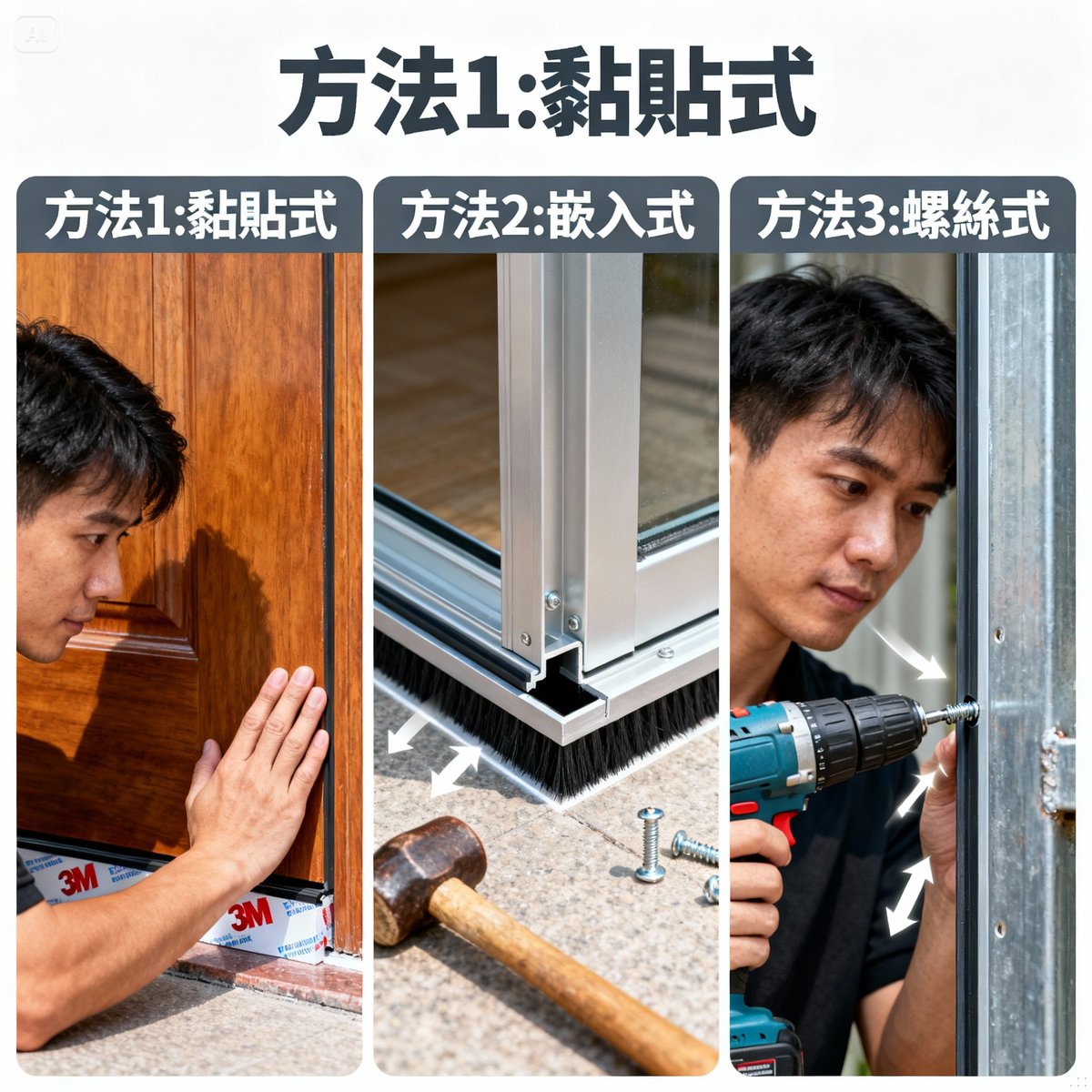
There are three main ways to install a strip brush: adhesive, slot-in and screw-fixed. Which one you choose depends on the structure of your door frame, whether you rent, and how many years you expect to use it.
Method 1: Adhesive strip brush (the simplest DIY)
Suitable for: renters, smooth door frames, anyone who does not want to drill
Time needed: 10-15 minutes
Tools: detergent, alcohol, cloth, tape measure, utility knife
Installation steps:
-
Clean the door frame: Wipe the area to be stuck with detergent to remove grease and dust, then wipe once more with alcohol and make sure it is completely dry. This step is very important and directly affects how firmly the strip sticks.
-
Measure and cut: Measure the length needed and cut the strip brush with a utility knife. We suggest allowing an extra 2 cm, which can be trimmed afterward.
-
Peel off the backing: Slowly peel off the protective paper of the 3M adhesive, and avoid peeling it all at once (it is easy to stick it on crooked). We suggest starting from one end and peeling as you stick.
-
Stick down and press firmly: Starting from one end, press the strip firmly against the bottom of the door frame. Press hard with your palm for 10 seconds to make sure the adhesive is in full contact.
-
Test and adjust: Open and close the door 10 times to confirm that it moves smoothly. If the door catches, adjust the position or trim the filament length.
Things to note:
- Avoid opening and closing the door forcefully within 24 hours of sticking
- The adhesive fails easily in summer heat, so we suggest industrial-grade 3M adhesive
- The service life is about 1-2 years, suited to temporary use
Method 2: Slot-in strip brush (the neatest)
Suitable for: aluminum doors and windows, door frames designed with a groove
Time needed: 20-30 minutes
Tools: rubber mallet, utility knife, tape measure
Installation steps:
-
Confirm the channel specification: Measure the width and depth of the channel in the door frame. Common specifications are U-type (6-8 mm), T-type (5-7 mm) and F-type (10-12 mm).
-
Cut to a suitable length: Measure the dimensions and cut. Make a 45-degree miter cut at corners so that the joint closes tightly.
-
Dry fit to confirm: Without using force yet, place the strip lightly in the channel and confirm that the size is correct and that it can seat fully.
-
Tap it in to fix it: Tap lightly with a rubber mallet until the base of the strip brush is fully seated in the channel. Avoid a steel hammer (it will scratch).
-
Deal with the corners: The corners are where skill is tested most. After the 45-degree miter cut, tap the pieces together carefully with the rubber mallet and make sure there is no gap.
-
Test and adjust: Open and close the door to confirm, and check for any place where the strip lifts or comes out.
Pro tips:
- The miter angle at corners must be precise; practice on an offcut first
- Before slotting in, a small amount of silicone sealant can be applied to the base for extra stability
- Suited to long-term use, with a service life of 5-7 years
Method 3: Screw-fixed (the most secure)
Suitable for: steel doors, wooden doors, long-term use
Time needed: 30-60 minutes
Tools: power drill, screwdriver, screws, spirit level, pencil, tape measure
Installation steps:
-
Mark the screw hole positions: Mark with a pencil; we suggest one screw hole every 15-20 cm. Use the spirit level to confirm that the strip brush is level.
-
Drill the pilot holes: Drill small pilot holes first with a 2-3 mm drill bit, to keep a wooden door from splitting or an aluminum door from stripping its threads.
-
Fix the first screw: Fix the first screw at one end, confirm that the position is correct, then drive the other screws in sequence.
-
Fix in sequence: Drive the screws in order and avoid skipping around (that leaves the strip uneven). Do not overtighten the screws, or the base will deform.
-
Check that it is level and sits flush: When everything is fixed, check with the spirit level and confirm that the strip brush is not tilted or lifting.
Things to note:
- Aluminum doors need self-tapping screws, to avoid stripped threads
- Steel doors may need a suitable drill bit; start with a small bit and then change to a larger one
- Different door materials need different screw specifications; you can ask the owner of a hardware store
For more detailed installation instructions and troubleshooting, see our dedicated article Strip brush installation guide | 3 fixing methods explained step by step.
🚀 Need a professional brush solution?
A correctly installed strip brush handles three things at once: it reduces the noise coming in through the door gap, keeps crawling insects from getting in through the gap, and reduces the loss of cooled air.
How can YC Brushes help you?
✅ Over 40 years of manufacturing experience: we supply hardware stores and building material dealers across Taiwan, with assured quality
✅ A complete range of specifications: from household to industrial grade, soft to hard, black and white to custom colors
✅ Custom service: special sizes, special materials and special base designs to meet your particular needs
✅ Technical consultation: not sure how to choose? Send photos of the site and we will help you assess the best solution
✅ Volume purchase discounts: for housing developments, construction projects and office buildings we offer wholesale prices and invoices with a Unified Business Number (Taiwan's company tax ID)
💡 Why choose YC Brushes?
- Factory-direct: no middleman, so prices are more affordable
- Quality certification: complies with CNS national standards (Taiwan) and has passed SGS testing
- Lead times quoted per order: quantities and lead times for standard and custom products are quoted per specification. Please email us with your requirements
Contact us now for a free specification assessment!
👉 Contact YC Brushes now for professional advice!
Want to look at the product specifications first? You are welcome to see the full product catalog.
5 practical applications of strip brushes
Strip brushes are not only for the bottom of the door.
Many people think a strip brush can only be fitted at the bottom of the front door, but its range of applications is actually very wide. Here are the 5 most practical applications, to help you get the most out of a strip brush.
Application 1: The front door - pest-proofing, sound insulation, energy saving
Pain points: The gap at the front door is large, and corridor noise, dust, cockroaches and ants all come in through it. Cooled air escapes and the electricity bill is alarmingly high.
Solution: Fit a long strip brush of 15-20 mm at the bottom of the door; the filament must make full contact with the floor. If the door gap is especially large (more than 2 cm), add a rubber strip on the side of the door frame to form a double seal.
Actual results:
- Sound insulation improved by 20-25 decibels
- Air-conditioning electricity cost reduced by 12-18%
- Cockroach and ant intrusion reduced by more than 90%
A case: A resident of an apartment in Taipei reported that after installation the noise of the corridor elevator could hardly be heard and the summer electricity bill was also clearly lower, so this small investment paid for itself quickly.
Application 2: Bedroom doors - quiet sleep
Pain points: The sound of doors closing, corridor light coming in, and the sound of family members moving about affect the quality of sleep.
Solution: Choose a soft PP strip brush, with a filament length of the largest gap plus a margin of 2-4 mm, and fit it at the bottom of the room door and on the side of the door frame. A soft brush is quiet to the touch and makes no noise when the door closes.
Actual results:
- The sound of the door closing goes from a "bang" to a "soft touch"
- Corridor light is blocked completely
- The quality of sleep clearly improves
Things to note: Bedroom door frames are usually newer and the gaps are smaller, so the filament does not need to be long. Avoid choosing filament that is too long, so that it does not affect opening and closing the door.
Application 3: Aluminum doors and windows / airtight windows - water and dust protection
Pain points: Water seeping in on typhoon days, dust and fine sand getting in, poor sound insulation, poor retention of cooled air.
Solution: Choose a slot-in hard nylon strip brush, bought to match the channel specification of the aluminum window (U-type / T-type / F-type). A UV-resistant material is recommended, so that it does not age easily outdoors.
Actual results:
- Sound insulation improved by 18-22 decibels
- Dust ingress reduced by more than 85%
Professional advice: Airtight windows usually come with strip brushes from the original manufacturer, but after 5-7 years of use these age and fall out. Fitting new strip brushes restores the performance of the airtight window to like-new.
For the detailed specifications and installation methods of strip brushes for aluminum doors and windows, see our dedicated article The complete guide to aluminum door strip brushes | For waterproof sealing of airtight windows.
Application 4: Roller shutter doors - factory dust protection
Pain points: The gaps around roller shutter doors in factories and warehouses are large; dust flies about, vehicle exhaust seeps in, and noise spreads and affects the surrounding environment.
Solution: Choose an industrial-grade H-type strip brush with a base width of 20-30 mm and a filament length of 25-40 mm. The sides also need to be fitted, to form an all-round seal.
Actual results:
- Dust blocking rate of 80% or more
- Noise reduced by 15-20 decibels
- A better working environment
Material choice: For factory environments choose nylon or steel wire strip brushes, which are wear and weather resistant and last 5-10 years. If anti-static performance is needed (electronics plants), an anti-static strip brush can be chosen.
Application 5: Machinery / conveyor belts - industrial protection
Pain points: When machinery is running, dust, chips and oil spatter and affect precision and safety. Both sides of a conveyor belt need guarding to keep items from falling off.
Solution: A custom H-type strip brush made to the equipment specification. The material depends on the environment: high-temperature nylon filament for high-temperature environments, PP filament for oily environments, and anti-static filament for precision equipment.
Actual results:
- Protects precision instruments and extends their service life
- Improves safety and reduces flying chips
- Improves the working environment and meets occupational safety regulations
For the full range of industrial strip brush applications and custom service, see our dedicated article Industrial strip brush applications | Dust protection solutions for roller shutter doors and machinery.
Every application has different requirements, and only the right specification gives the best result. If you are not sure which strip brush suits your situation, you are welcome to contact us with photos and your requirements, and we will help you assess the best solution.

FAQ
Do door seal strip brushes work? Can they really block noise and pests?
Yes, they work, but the result depends on 3 factors:
- Size of the door gap: The result is best with a gap smaller than 3 cm; above 5 cm other sealing materials (such as a rubber strip) are needed as well.
- Filament quality: A factory-grade strip brush with sufficient density is what works; cheap, poor-quality products have sparse filament and the result is much reduced.
- Correct installation: The filament must make full contact with the floor or the door frame and must not hang in the air, otherwise it is there in name only.
Measured data:
- Sound insulation: a reduction of 15-25 decibels, equivalent to going from road noise (70 dB) down to the volume of a library (45 dB)
- Pest-proofing: blocks 90% of common pests (cockroaches, ants, geckos); the physical barrier of the filament lasts longer than chemical agents
- Energy saving: 10-20% can be saved on the electricity cost of cooling; the small amount invested in fitting strip brushes usually pays for itself in 3-6 months
When do they not work?
- The door frame is badly deformed (a gap of more than 5 cm)
- A cheap, poor-quality product is used (sparse filament that flattens easily)
- The wrong filament length was chosen (too short to reach the gap)
- The installation position is wrong (not lined up with the gap)
For more detailed measured data and user reviews, see our dedicated article Do door seal strip brushes work? | Measured sound insulation and pest-proofing data.
Where can I buy door seal strip brushes? Is online or a hardware store better?
Choose according to your needs (the stores and platforms below are those of the Taiwan market):
🏪 A hardware store / physical store is recommended if you:
- Need to compare against the door gap size on the spot
- Are buying only a small quantity of 1-2 meters
- Want to install on the same day
- Want to ask a professional for advice
Recommended places:
- Hardware stores near your home
- Showba, TLW (chains across Taiwan)
💻 Buying online is recommended if you:
- Need a large quantity (more than 10 meters)
- Are looking for a low price (online is usually cheaper)
- Are willing to wait 2-3 days for delivery
- Have already settled the specification
Recommended platforms: Shopee / Yahoo Shopping / momo; search for "door seal strip brush" (in Chinese) and choose sellers with a rating above 4.8
🏭 Buying factory-direct (YC Brushes) is recommended if you:
- Need a custom specification (special color / length / base design)
- Are buying in volume for a construction project or housing development (more than 50 meters)
- Need technical consultation and professional advice
- Need an invoice issued with a Unified Business Number (Taiwan's company tax ID)
Price reference:
- Hardware stores: upper-mid price
- Online: low to mid price
- Factory: NT$40-80/m (including custom service)
For a more detailed comparison of purchasing channels and a list of stores, see our dedicated article Where to buy door seal strip brushes | Hardware stores vs online prices compared.
How often does a strip brush need replacing? How do I know it is time?
Average service life:
- Indoor use: 3-5 years
- Outdoor use: 1-3 years (sun and rain speed up aging)
- High-frequency use: 1-2 years (commercial spaces, office main doors)
4 signs that it needs replacing:
- ❌ The filament is falling out heavily or lying flat (it does not spring back)
- ❌ The base is cracked / the adhesive has failed (it is starting to come off)
- ❌ The sound of wind / dust is back at the door gap
- ❌ The filament has hardened / lost its resilience (the plastic has aged)
Tips for extending service life:
- Vacuum the dust off the filament every 3 months
- Avoid wiping hard with a wet cloth (the filament flattens easily)
- Choose a UV-resistant material (essential for exterior doors and windows)
- Check regularly whether the fixing has come loose
Will a strip brush affect opening and closing the door? How do I adjust it?
A correct installation will not, but note the following:
Common problems:
- The door feels heavier / is hard to push open: the filament is too long and too hard, so the friction is too great
- The door will not close tightly / springs open: the filament is too thick and the latch bolt cannot engage fully
Solutions:
- Shorten the filament: trim 2-3 mm with scissors (soft filament can be cut; hard filament is more difficult)
- Adjust the position: move it 5 mm inward to reduce the contact area
- Switch to a soft version: use PP plastic filament instead (softer than nylon)
- Install in sections: leave 5 cm free of strip brush at the position of the door lock
Professional advice:
- Wooden doors / lightweight doors → choose a short-filament version of 5-8 mm
- Steel doors / heavy doors → a long-filament version of 10-15 mm can be used
- How to test: after fitting, open and close the door 10 times to confirm that it moves smoothly
How does a 3M strip brush differ from an ordinary strip brush? Is it worth buying?
"3M strip brush" can mean 3M's own self-adhesive door-bottom strip brush, and is also often used for an adhesive strip brush that uses 3M adhesive backing.
Main differences:
| Item | 3M adhesive version | Ordinary adhesive version |
|---|---|---|
| Adhesive strength | ★★★★★ | ★★★ |
| Heat resistance | Better | Softens more easily at high temperatures |
| Water resistance | Excellent (can be used in bathrooms) | Ordinary (comes off easily when wet) |
| Price | Upper-mid price | Low to mid price |
| Adhesive residue | Less residue on removal | Easily leaves adhesive marks |
Is it worth buying?
✅ Recommended for: the front door, commercial spaces, doors opened and closed very often, renters (who will have to remove it when they move)
❌ Not recommended for: storeroom doors that are rarely opened (an ordinary version will do), or a limited budget where you are willing to use screw fixing (the screw-fixed type is more durable)
A buying reminder: There are many "fake 3M" products on the market, so look for the "3M™" trademark on the packaging. You can also buy "an ordinary strip brush + 3M VHB tape bought separately" and stick it on yourself.
Can I install a strip brush myself? Do I need to hire a tradesperson?
In 90% of cases you can do it yourself; only special situations need a tradesperson.
✅ You can fit it yourself:
- Adhesive strip brushes (the simplest, done in 10 minutes)
- Slot-in strip brushes (patience needed, 30 minutes)
- Screw fixing on ordinary wooden doors / aluminum doors (a power drill is all you need)
❌ Hiring a tradesperson is recommended:
- Airtight windows / high-end doors and windows (damage during fitting could affect the warranty)
- When the door frame has to be dismantled / the door leaf adjusted
- Large jobs (more than 10 doors, where an installation crew is more efficient)
- Industrial equipment such as roller shutter doors / automatic doors
DIY tool list:
- Basic: tape measure, utility knife, detergent
- Advanced: power drill, screwdriver, rubber mallet, spirit level
Tradesperson fees for reference:
- Installation on a single door: as quoted by the installation crew, usually including labor and materials
- Doors and windows for a whole home (5 doors): the fee depends on the scale; we suggest asking a tradesperson to quote on site
For the complete DIY installation guide, see our dedicated article Strip brush installation guide | 3 fixing methods explained step by step.
Are strip brushes waterproof? Are they suitable for bathroom and balcony doors?
Partly waterproof, but with limits.
The water resistance of a strip brush:
✅ It can keep out: light rain, moisture, damp, and water seeping into the door gap during mopping
❌ It cannot keep out: standing water from heavy rain, flooding, direct spraying, or sustained water pressure (water seeps through the spaces between the filaments)
Analysis by location:
| Location | Suitability | Recommended solution |
|---|---|---|
| Bathroom door | ⭐⭐⭐ | Usable, but choose a mold-resistant version (PP material + a base designed to drain) |
| Balcony door | ⭐⭐⭐⭐ | Suitable; keeps out rain and wind well |
| Kitchen door | ⭐⭐⭐⭐⭐ | Very suitable; keeps out cooking fumes + cockroaches |
| Basement | ⭐⭐ | Not recommended for areas prone to flooding; use a rubber waterproof strip instead |
Features of a strip brush for bathrooms:
- Choose an antibacterial PP material (does not go moldy easily)
- The base should be designed with drainage holes
- We suggest pairing it with a "threshold water barrier strip" for double protection
- Clean with diluted bleach every month to avoid mold spots
Professional advice: A bathroom with separate wet and dry areas → a strip brush is fine; the glass door of a shower enclosure → use a silicone waterproof strip instead.
Should I choose a black or a white strip brush? Will it be very noticeable?
Choose according to the color of the door frame; with the right match it is almost unnoticeable.
Color selection principles:
- Black strip brush ← dark door frames (black / gray / dark brown / aluminum doors and windows)
- White strip brush ← light door frames (white / beige / natural wood)
- Transparent / gray ← glass doors, modern minimalist style
Visual effect:
- Black hides dirt better, and dust does not show
- White looks better but needs regular cleaning (otherwise it yellows)
- Fitted at the bottom of the door / on the inner side of the door frame, it is usually not noticeable
Custom colors: The factory can supply brown, gray, camel and other colors (suited to housing developments / construction projects). Order quantities and lead times are quoted per specification. Please email us with your requirements.
Tips for a better appearance:
- Choose a version whose "base color" matches the door frame
- Make 45-degree miter joints at corners (like the corners of a picture frame)
- Avoid leaving the adhesive backing or the base screws exposed
How do strip brushes compare with other door gap seals? Which is better?
Each has its advantages and disadvantages; choose according to your needs.
4 door gap sealing materials compared:
| Type | Advantages | Disadvantages | Suitable for | Price |
|---|---|---|---|---|
| Strip brush | Good pest-proofing, durable, compressible | The filament can flatten | Front doors, room doors, aluminum doors and windows | Mid price |
| Rubber sealing strip | The strongest water resistance, a close fit | Ages quickly, sticky underfoot in summer | Bathrooms, balconies, waterproofing needs | Low to mid price |
| Foam tape | More affordable, simple to install | Short service life (half a year to 1 year), easily crushed flat | Temporary use, rented homes | Low price |
| Silicone strip | Excellent weather resistance, long service life | Expensive, needs professional installation | High-end doors and windows, airtight windows | High price |
How to choose?
- 🎯 Mainly pest-proofing → strip brush (the filament brushes insects off)
- 🎯 Mainly waterproofing → rubber strip
- 🎯 Mainly sound insulation → strip brush + rubber strip in two layers
- 🎯 Limited budget → foam tape
- 🎯 Once and for all → silicone strip
Tips for using them in combination: front door (strip brush at the bottom of the door + rubber strip on the door frame), aluminum doors and windows (strip brush slotted into the frame + foam packed into the glass gap), balcony door (strip brush at the bottom of the door + rubber strip on the threshold).
How do factory custom strip brushes differ from off-the-shelf products?
The custom service provided by the YC Brushes factory includes:
Custom options:
- Custom sizes: special length / width / filament height
- Custom materials: specify nylon / PP / horsehair / steel wire
- Custom colors: special color matching
- Base design: a dedicated slot designed to suit the door frame structure
- Special treatments: fire resistant / UV resistant / anti-static / high-temperature resistant
Situations that suit custom work:
✅ Volume requirements for housing developments / construction projects (more than 100 meters) ✅ Dust protection for special equipment (machinery / elevators / cleanrooms) ✅ Non-standard specifications of older doors and windows ✅ Brand owners who want private-label production
The custom process:
- Provide your requirements / photos / drawings
- The factory assesses feasibility and quotes
- Small-quantity sampling for confirmation
- Formal production after confirmation (sampling and production lead times are quoted per specification; please email us with your requirements)
- Shipment / installation guidance
Off-the-shelf vs custom prices:
- Off-the-shelf standard products: mid price
- Custom (small quantity): NT$80-150/m
- Custom (large quantity, more than 100 m): NT$40-80/m
You are welcome to contact us to discuss your requirements, or see our full range of services to learn about the custom process.
Conclusion: the right strip brush is a big upgrade in quality of life
One small strip brush solves annoyances that come up every day.
From the detailed explanations in this article you should now understand: the types and materials of strip brush, how to measure and choose a suitable specification, where to buy for the best value, the steps for the three installation methods, and the actual results in each application.
3 key principles for buying a strip brush
1. Choose the material by application
Soft PP filament for interior room doors, hard nylon filament for aluminum doors and windows, steel wire for industrial environments. Different applications have different requirements, and only the right material gives the best result.
2. Measure accurately before buying
Filament length = largest gap + 2-4 mm. It is better to buy a little long and trim than to buy too short and be unable to seal. Remember to measure at several points and go by the largest value.
3. Install it the right way
The adhesive type needs thorough cleaning, the slot-in type needs to line up with the channel, and the screw-fixed type needs attention to being level. A wrong installation greatly reduces the result, or makes the strip completely ineffective.
Return on investment
Taking an ordinary household as an example:
- Investment cost: a small investment that an ordinary household can afford (5 doors for the whole home)
- Electricity saved: a noticeable drop in the monthly electricity bill (a saving of 12-18%)
- Payback period: 3-6 months
- Additional benefits: sound insulation, pest-proofing, a better quality of life (priceless)
This is a home improvement with extremely good value for money: far cheaper than other renovation work, yet with very noticeable results.
The commitment of YC Brushes
For over 40 years we have focused on brush manufacturing, from household to industrial grade and from standard products to custom work, building up rich experience and expertise. We understand that every customer's needs are different, so we offer a complete choice of specifications and a technical consultation service.
If you are still unsure which strip brush to choose, you are welcome to contact us with photos of your door frame and your requirements, and we will help you find the most suitable solution. If you would like to look at product specifications first, you can also see our full product catalog.
A strip brush is small, but it can greatly improve quality of life. Start now and make your home more comfortable, quieter and more energy efficient!