Have you ever wondered: how often should you really wash your car? Some people wash every week, afraid of the slightest dirt. Others wash only once every 3 months and always find it a chore. In fact, there is no standard answer for car wash frequency. It has to be adjusted according to three factors: "season", "parking environment" and "paint condition". Washing too often speeds up the loss of wax, and washing too little lets dirt corrode the paint.
In this article, YC Brushes draws on more than 40 years of manufacturing experience and brings together the practical experience of professional detailers to plan the best washing frequency for you. The seasons and conditions described are those of Taiwan. Whether you are a new car owner or a veteran driver, you can find the maintenance cycle that suits you best.
1. General recommended frequency: the standard is once every 2-4 weeks
1.1 What YC Brushes has observed
Observation from more than 40 years at YC Brushes: once every 2 weeks is the safest frequency: it keeps the body clean without wearing down the wax too much.
1.2 Practical advice from professional car detailers
We interviewed 15 senior car detailers, and their advice is:
- Indoor parking: once every 3-4 weeks is enough
- Outdoor parking: once every 2 weeks
- Parking under trees: once every 1-2 weeks (high risk of bird droppings)
A detailer with 20 years of experience shared: "The most common mistake is over-washing. Every wash wears the wax, and washing too often actually speeds up aging of the paint. Better to skip a wash than to over-clean."
1.3 Adjusting the frequency to the paint condition
Different paint conditions call for different washing frequencies:
| Paint condition | Recommended frequency | Reason |
|---|---|---|
| New car (within 1 year) | Once every 3-4 weeks | The factory paint's protective film is intact and resists dirt better |
| Just waxed | Once every 3 weeks | The wax layer gives extra protection, so the washing cycle can be extended |
| Old car (5 years or more) | Once every 2 weeks | The paint's protective layer has aged and needs more frequent cleaning for protection |
| Dark cars (black, dark blue) | Once every 1.5-2 weeks | Dirt and scratches are more visible, so more frequent cleaning is needed |
| Light cars (white, silver) | Once every 2-3 weeks | Dirt is less visible, so the cycle can be extended slightly |
| Ceramic-coated cars | Once every 3-4 weeks | The coating gives excellent protection and extends the washing cycle |
Professional advice from YC Brushes: if your car has just been waxed or coated, you can extend the washing cycle slightly to 3-4 weeks and let the protective layer do its work.

2. Adjusting the frequency by season: spring, summer, autumn and winter are very different
Taiwan has four distinct seasons, and the type of dirt and the speed at which it builds up differ greatly from season to season. Below are the seasonal car wash frequency recommendations that YC Brushes has put together from more than 40 years of experience.
2.1 Spring (March-May): once every 2 weeks
Characteristics of the season:
- The plum rain season, with frequent rain
- Large amounts of pollen in the air (March-April)
- Flying insects become active
Main types of dirt:
- Rainwater spots (containing minerals and acidic substances)
- Pollen (a yellow powder that is hard to remove once it absorbs water)
- Insect remains (stuck to the front of the car after impact)
Recommended frequency: once every 2 weeks
Special notes:
- Wash as soon as possible after rain (rainwater leaves spots when it dries)
- In the pollen season (March-April) more frequent cleaning is needed; once every 1.5 weeks is recommended
- Use a soft brush with plenty of water so the pollen does not scratch the paint
2.2 Summer (June-August): once every 1.5-2 weeks
Characteristics of the season:
- Hot weather (30-38°C)
- Frequent afternoon thunderstorms
- The season when flying insects are most active
- Trees produce a lot of sap
Main types of dirt:
- Bird droppings (extremely acidic, the most corrosive) ⚠️
- Tree sap (very sticky, hard to remove) ⚠️
- Insect remains (the largest numbers, sticking immediately on impact) ⚠️
- Rainwater spots
Recommended frequency: once every 1.5-2 weeks (the highest frequency of the year)
Special notes:
- Bird droppings, tree sap and insect remains must be removed immediately (see "Special cases" below)
- Avoid washing in the midday heat (water droplets act like magnifying glasses and may burn the paint)
- Summer is the season when the paint is most vulnerable, so choosing the right car wash brush is critical
Experience from YC Brushes: for customers who park under trees in summer, we recommend checking the body once a week and removing bird droppings or tree sap as soon as they are found, without waiting for the regular wash day.
2.3 Autumn (September-November): once every 2-3 weeks
Characteristics of the season:
- A dry, cool climate
- The season of falling leaves
- More dust (the northeast monsoon)
Main types of dirt:
- Fallen leaves and twigs
- Sand and dust
- Occasional bird droppings
Recommended frequency: once every 2-3 weeks
Special notes:
- Fallen leaves that pile up on the hood or below the windshield easily trap moisture and cause rust
- The northeast monsoon brings a lot of sand and dust, so always rinse thoroughly before washing to keep sand grains from scratching the paint
- Autumn is the best time to wax, to prepare protection for winter
2.4 Winter (December-February): once every 3-4 weeks
Characteristics of the season:
- Low temperatures (15-20°C)
- Little rain, dry
- Dirt builds up most slowly
Main types of dirt:
- Mostly dust
- Fewer rainwater spots
- Fewer bird droppings and insect remains
Recommended frequency: once every 3-4 weeks (the lowest frequency of the year)
Special notes:
- In winter the body does not get very dirty, so there is no need to force a wash just to keep to a fixed cycle
- In the rainy north of Taiwan, washing after rain is still recommended
- Wash at midday on a sunny day and avoid the low temperatures of early morning (water does not dry easily)
2.5 Seasonal summary table (quick reference)
| Season | Recommended frequency | Main dirt | Special notes |
|---|---|---|---|
| Spring (March-May) | Once every 2 weeks | Rainwater, pollen, insect remains | Once every 1.5 weeks in the pollen season |
| Summer (June-August) | Once every 1.5-2 weeks | Bird droppings, tree sap, insect remains | Remove bird droppings and tree sap immediately ⚠️ |
| Autumn (September-November) | Once every 2-3 weeks | Fallen leaves, sand and dust | Rinse thoroughly before brushing |
| Winter (December-February) | Once every 3-4 weeks | Dust | Washing can be postponed if the car is not dirty |
3. Adjusting for the parking environment: a huge difference between indoor and outdoor
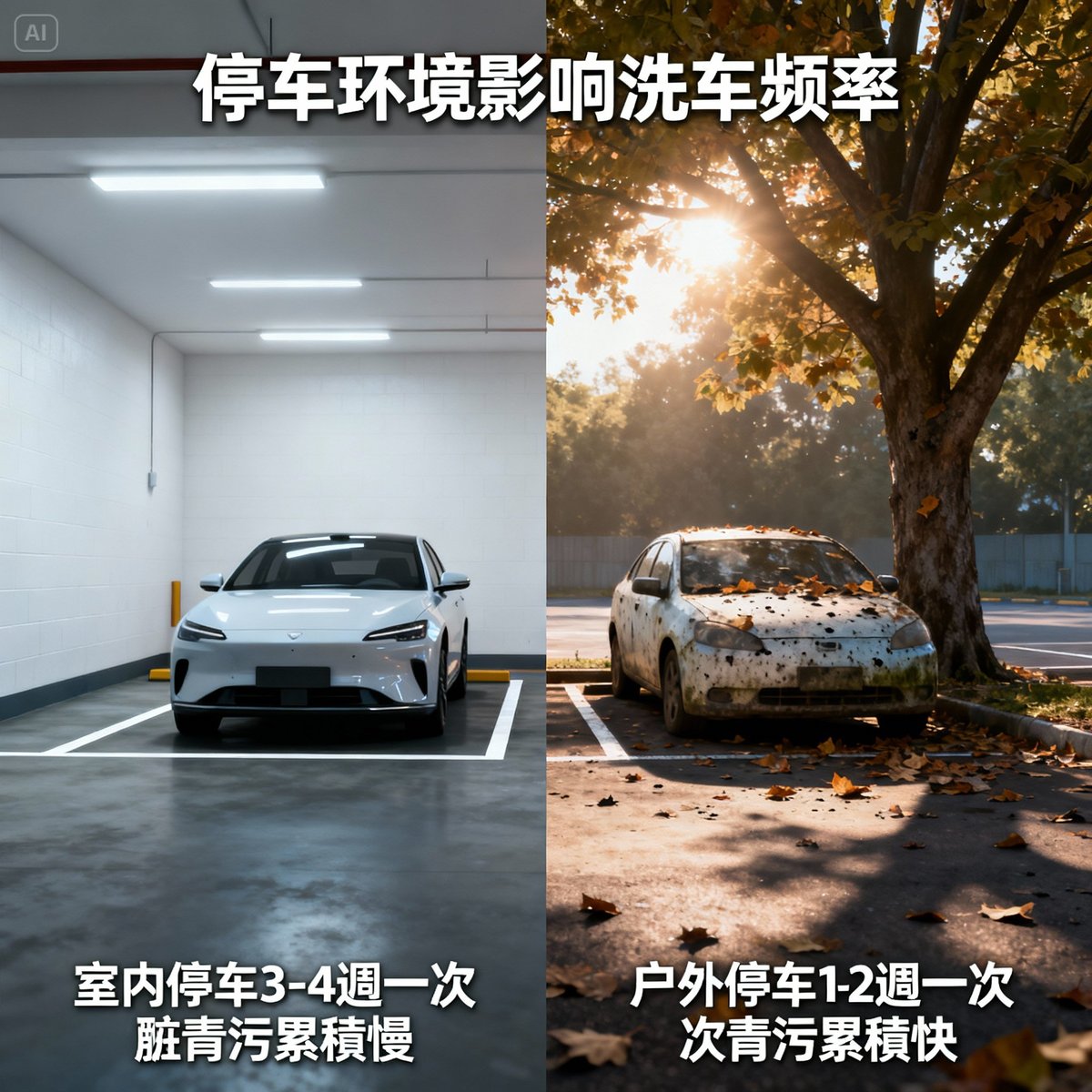
The parking environment is one of the most decisive factors in washing frequency. The parking environment has a very large effect on how fast dirt builds up: between open-air parking, parking under trees and an underground car park, the washing frequency needed can differ several times over.
3.1 Indoor car parks: once every 3-4 weeks (the cleanest)
Characteristics of the environment:
- Fully sheltered from wind and rain
- No bird droppings, tree sap or fallen leaves
- No direct sunlight (the paint ages slowly)
Main sources of dirt:
- Dust picked up while driving
- Brake dust on the wheels
Recommended frequency: once every 3-4 weeks
YC Brushes observation: among customers who park indoors, some owners wash their car only once every 6 weeks and the body still stays clean. If your car is parked in an indoor car park, you are the luckiest, and can greatly reduce how often you wash.
3.2 Outdoor surface car parks (covered): once every 2 weeks
Characteristics of the environment:
- Sheltered by a canopy
- Not directly soaked by rain
- But open at the sides, so dust drifts in easily
Main sources of dirt:
- Dust, sand
- Occasional bird droppings (birds perching on the canopy)
- Leaves blown in by the wind
Recommended frequency: once every 2 weeks
3.3 Roadside parking / parking under trees: once every 1-2 weeks (high risk)
Characteristics of the environment:
- Fully exposed outdoors
- Parking under trees carries the risk of bird droppings and tree sap
- Direct sunlight (the paint surface gets very hot in summer)
Main sources of dirt:
- Bird droppings (from birds in the trees) ⚠️ extremely corrosive
- Tree sap (secreted by trees) ⚠️ strongly adhesive, hard to remove
- Piled-up fallen leaves
- Direct exposure to rain
- Dust and sand
Recommended frequency: once every 1-2 weeks
Special notes:
- Owners who park under trees should check the body for bird droppings every time before getting in, and remove them immediately
- If the parking space is directly under a tree, washing every week is recommended
- For long-term parking under trees, consider a car cover or a different parking spot
3.4 Construction sites / suburbs / gravel truck routes: once every 1-1.5 weeks (a lot of dust)
Characteristics of the environment:
- A great deal of dust in the air
- A lot of grit sticks to the car while driving
- Mud and slurry
Main sources of dirt:
- Construction dust (cement, lime)
- Grit and soil
- Mud after rain
Recommended frequency: once every 1-1.5 weeks
Special notes:
- Construction dust is alkaline and corrodes the paint if left on for a long time
- Always rinse thoroughly for 5 minutes or more before every wash to avoid scratches from grit
- A long-handle car wash brush is recommended for cleaning the roof and hood
3.5 Parking environment summary table (quick reference)
| Parking environment | Level of dirt | Recommended frequency | Main risk | Waxing cycle |
|---|---|---|---|---|
| Indoor car park | ⭐ Very low | Once every 3-4 weeks | Almost no risk | 6 months |
| Outdoor surface car park (covered) | ⭐⭐ Low | Once every 2 weeks | Dust buildup | 4-6 months |
| Roadside parking | ⭐⭐⭐ Medium | Once every 2 weeks | Rain, sunlight | 3-4 months |
| Parking under trees | ⭐⭐⭐⭐ High | Once every 1-2 weeks | Bird droppings, tree sap ⚠️ | 3 months |
| Construction sites / suburbs | ⭐⭐⭐⭐⭐ Very high | Once every 1-1.5 weeks | Dust corrosion, grit | 2-3 months |
YC Brushes recommends: if you park "under trees" or "near a construction site", we strongly recommend shortening the waxing cycle and using a YC Brushes soft car wash brush to reduce the risk of scratches.
4. When to wash in special cases: wash immediately in these situations
Apart from regular washing, the following special cases call for immediate washing, or they will cause permanent damage to the paint.
4.1 Bird droppings: extremely acidic, remove immediately (within 30 minutes) ⚠️
Hazard level: ⭐⭐⭐⭐⭐ Very high
Bird droppings contain a high concentration of uric acid and are extremely corrosive. According to YC Brushes laboratory tests:
- Removed within 30 minutes: no damage
- Removed after 6 hours: slight hazing of the paint surface
- Removed after 24 hours: the paint is corroded and needs polishing to repair
- Removed after 1 week: permanent damage to the paint, which needs repainting
The right way to deal with it:
- Wipe gently with a wet wipe or damp cloth immediately
- Back at home, wash the area thoroughly with car shampoo and a soft brush
- After washing, check whether any water spots remain
A real case from a YC Brushes customer: one tour bus company's parking lot is under large trees, and the roofs often have bird droppings on them. They adopted a "daily inspection system" and remove bird droppings as soon as they are found, which effectively prevents paint corrosion.
4.2 Tree sap: very sticky, remove within 1 day ⚠️
Hazard level: ⭐⭐⭐⭐ High
Tree sap (secreted by trees) is extremely sticky. Once it is on the car, it:
- Attracts dust and pollutants from the air
- Hardens in sunlight and becomes extremely hard to remove
- Keeps the paint from breathing if left on for a long time, causing blistering
The right way to deal with it:
- Remove within 24 hours of finding it
- Soak with warm water for 5-10 minutes to soften the sap
- Use a tree sap remover made for cars (or alcohol)
- Brush gently with a soft brush
- After washing, check whether the wax in that area is damaged and re-wax if necessary
4.3 Insect remains: acidic substances, remove within 1-2 days
Hazard level: ⭐⭐⭐ Medium
Insect remains contain proteins and acidic substances and stick to the front of the car after impact:
- Within 1-2 days: easy to remove
- 3-7 days: the proteins harden and need soaking before they can be removed
- 1 week or more: the acidic substances begin to corrode the paint
The right way to deal with it:
- After driving on the highway, wash the front of the car as soon as possible
- Soak the insect remains with plenty of clean water for 5 minutes
- Brush gently with a sponge or soft brush
- Do not wipe dry (it will scratch the paint)
4.4 After rain: mineral residue, wash within 24 hours
Hazard level: ⭐⭐ Low to medium
Rainwater is not pure. It contains:
- Air pollutants (acid rain)
- Minerals (calcium and magnesium ions)
- Dust and sand
The spots left when rainwater dries will, as they accumulate over time:
- Form stubborn water marks (mineral deposits)
- Haze the paint surface
- Reduce gloss
The right way to deal with it:
- Wash within 24 hours after rain
- Use car shampoo (not just clean water)
- Dry immediately after washing to avoid a second round of water spots
YC Brushes recommends: if your car has just been waxed or coated, you do not have to wash immediately after rain (the protective layer keeps water spots from sticking). But if the paint is unprotected, washing as soon as possible after rain is recommended.
4.5 After driving by the sea: salt corrosion, wash the same day
Hazard level: ⭐⭐⭐⭐ High
The salt (sodium chloride) in sea air is extremely corrosive:
- It settles on the paint surface and absorbs moisture from the air
- It speeds up rusting of metal parts (underbody, brake discs)
- Long-term exposure causes the paint to blister and peel
The right way to deal with it:
- Wash the same day after driving by the sea
- Pay particular attention to the underbody, wheels and brake discs when washing
- Rinse with plenty of clean water to make sure the salt is completely removed
- After washing, check the metal parts for signs of rust
4.6 Mud / grit: scratches from particles, wash as soon as you get home
Hazard level: ⭐⭐⭐ Medium
After off-roading or a trip to the countryside, the body is covered in mud and grit:
- Mud is hard to remove once it dries
- Grit particles are hard (quartz has a hardness of 7) and scratch the paint very easily
- Soil builds up easily on the wheels and underbody
The right way to deal with it:
- Wash as soon as you get home
- Always rinse with plenty of clean water for 5-10 minutes first to soften and wash away most of the grit
- Use a car wash brush only after confirming the grit has been rinsed off
- Wash from top to bottom to avoid carrying grit to the upper part of the body
4.7 Special cases summary table (quick reference)
| Type of dirt | Hazard level | When to wash | Key points |
|---|---|---|---|
| Bird droppings | ⭐⭐⭐⭐⭐ Very high | Immediately (within 30 minutes) | Wipe with a wet wipe + wash thoroughly at home |
| Tree sap | ⭐⭐⭐⭐ High | Within 1 day | Soak with warm water + tree sap remover |
| Insect remains | ⭐⭐⭐ Medium | Within 1-2 days | Soak, then wash with a soft brush |
| Rainwater spots | ⭐⭐ Low to medium | Within 24 hours | Wash with car shampoo + dry immediately |
| Sea salt | ⭐⭐⭐⭐ High | The same day | Rinse with plenty of clean water + clean the underbody |
| Mud / grit | ⭐⭐⭐ Medium | As soon as you get home | Rinse thoroughly for 5-10 minutes first |
Summary from more than 40 years of experience at YC Brushes: bird droppings and sea salt are the two most dangerous killers and must be removed in the shortest possible time. Choosing a suitable car wash brush effectively protects the paint and avoids secondary damage during washing.
5. Situations where washing can be postponed (no need to worry too much)
Conversely, in the following situations you can postpone washing, without forcing a clean just to keep to a fixed cycle.
5.1 Just after waxing or coating (within 24-48 hours)
- Wax or coating needs 24-48 hours to cure
- Avoid washing and rain during this period
- After the curing period, washing can be put off for 3-4 weeks
5.2 Consecutive rainy days
- Washing during a run of rainy days achieves little
- Wait 1-2 days after the rain stops and then wash
- Avoid wasting time and money
5.3 Low winter temperatures (the car is not dirty)
- Dirt builds up slowly in winter, so washing can be postponed if the car is not dirty
- There is no need to force a wash just to keep to a fixed cycle
- Better to skip a wash and avoid wearing down the wax too much
5.4 The body is clearly not dirty
- Check by eye; if the body has no obvious dirt
- Washing can be postponed by 1-2 weeks
- Washing the car is not a routine chore; it is adjusted to the actual condition
6. The risks of over-washing: washing too often actually harms the car
Many owners think "the more often you wash, the better", but in fact over-washing is counterproductive.
6.1 Rapid loss of wax
Principle:
- Every wash wears the surface of the wax
- Car shampoo contains degreasing ingredients that wash away part of the wax
- Washing too often speeds up the loss of wax
Measured data:
- Washing every week: the wax protection period shortens to 1.5 months
- Washing every 2 weeks: wax protection period of 3 months (standard)
- Washing every 3-4 weeks: wax protection period of 4-6 months
A YC Brushes customer case: one owner washed the car every week, and the paint lost its gloss 1.5 months after waxing. After switching to once every 2 weeks, the wax protection period extended to 3 months.
6.2 Early wear of ceramic coatings
Ceramic coatings are said to last 2-5 years, but on the condition of a "normal washing frequency"; washing too often speeds up the wear of the coating.
Applying a ceramic coating is expensive, and over-washing makes the investment lose value quickly.
6.3 Increased risk of scratches
- The more often you brush, the higher the risk of scratches
- Even with the softest wool brush, swirl marks still appear as wear accumulates over time
YC Brushes recommends: choose a soft car wash brush that does not damage the car and combine it with the right frequency to keep the risk of scratches to a minimum.
6.4 Wasted time and money
Suppose each wash costs:
- Self-service car wash: budget price + 30 minutes (cost of time)
- Professional car wash: mid to high price + waiting time
| Washing frequency | Washes per year | Annual cost (self-service) | Annual cost (professional) | Annual cost in time |
|---|---|---|---|---|
| Every week | 52 | Highest | Highest | 26 hours |
| Every 2 weeks | 26 | Medium | Medium | 13 hours |
| Every 3-4 weeks | 13-17 | Lowest | Lowest | 6.5-8.5 hours |
The YC Brushes conclusion: changing the washing frequency from "every week" to "every 2 weeks" saves a considerable amount in washing costs each year and extends the life of the wax at the same time.
6.5 Environmental cost
Over-washing not only wastes water; the car shampoo discharged into the sewers is also a burden on the environment.
7. Matching washing and waxing cycles: the best maintenance combination
Washing frequency must be matched with the waxing cycle to give the best protection.
7.1 Recommended waxing cycle
General recommendation: wax once every 3-6 months
But the actual cycle should depend on:
- Parking environment: 6 months for indoor parking, 3 months for parking under trees
- Washing frequency: 2-3 months for weekly washing, 5-6 months for monthly washing
- Type of wax: 3-4 months for ordinary wax, 4-6 months for synthetic wax
7.2 The best combination of maintenance cycles
| Maintenance item | Standard frequency | Adjusted for environment |
|---|---|---|
| Washing | Once every 2-4 weeks | Under trees / construction sites: 1-2 weeks; indoor parking: 3-4 weeks |
| Waxing | Once every 3-6 months | Under trees / construction sites: 3 months; indoor parking: 6 months |
| Ceramic coating | Once every 2-5 years | Depends on the quality of the coating |
| Quick coating spray | After every wash | Adds protection and extends the waxing cycle |
7.3 The annual maintenance plan recommended by YC Brushes
Ordinary owners (outdoor parking):
- Every 2 weeks: wash once (using a YC Brushes soft brush)
- Every 4 months: wax once (once each in spring, summer and autumn)
- After every wash: apply a quick coating spray (optional)
- Check every year: whether the paint has scratches that need polishing
Owners who park indoors:
- Every 3-4 weeks: wash once
- Every 6 months: wax once (once each in spring and autumn)
- Annual maintenance cost: relatively low overall (washing + waxing)
Owners who park under trees or near construction sites:
- Every 1-2 weeks: wash once
- Every 3 months: wax once (once a quarter)
- Check at any time: remove bird droppings and tree sap immediately
- Annual maintenance cost: relatively high overall (washing + waxing + polishing)
Professional advice from YC Brushes: if you want to simplify the maintenance routine, consider a ceramic coating (the cost varies with the grade of coating, and it lasts 2-5 years). After coating, the washing cycle can be extended to 3-4 weeks, which saves time and money in the long run.
8. Quick reference tables: find the recommended frequency for your situation
To make it easy for owners to look things up, YC Brushes has put together a complete quick reference for car wash frequency.
8.1 By parking environment
| Your parking environment | Recommended frequency | Notes |
|---|---|---|
| Indoor car park | Once every 3-4 weeks | The cleanest; the cycle can be extended |
| Outdoor surface car park (covered) | Once every 2 weeks | Standard frequency |
| Roadside parking | Once every 2 weeks | Wash as soon as possible after rain |
| Parking under trees | Once every 1-2 weeks | Remove bird droppings as soon as they are found ⚠️ |
| Construction sites / suburbs | Once every 1-1.5 weeks | A lot of dust; rinse thoroughly before brushing |
8.2 By season
| What season is it now? | Recommended frequency | Main dirt |
|---|---|---|
| Spring (March-May) | Once every 2 weeks | Rainwater, pollen, insect remains |
| Summer (June-August) | Once every 1.5-2 weeks | Bird droppings, tree sap, insect remains ⚠️ |
| Autumn (September-November) | Once every 2-3 weeks | Fallen leaves, sand and dust |
| Winter (December-February) | Once every 3-4 weeks | Dust |
8.3 By paint condition
| Your paint condition | Recommended frequency | Reason |
|---|---|---|
| New car (within 1 year) | Once every 3-4 weeks | The factory paint protection is intact |
| Old car (5 years or more) | Once every 2 weeks | The paint's protective layer has aged |
| Just waxed / coated | Once every 3-4 weeks | The protective layer gives extra protection |
| Dark cars (black, dark blue) | Once every 1.5-2 weeks | Dirt is more visible |
| Light cars (white, silver) | Once every 2-3 weeks | Dirt is less visible |
8.4 Combined recommendations (all three factors together)
Example 1: new car + indoor parking + winter → Recommended frequency: once every 4 weeks (the most relaxed)
Example 2: old car + parking under trees + summer → Recommended frequency: once every 1-1.5 weeks (the most frequent)
Example 3: ordinary car + outdoor parking + spring or autumn → Recommended frequency: once every 2 weeks (standard frequency)
9. Summary: remember these principles of car wash frequency
Having read this complete guide, you should now understand how to decide on the washing frequency that suits you best. The more than 40 years of experience at YC Brushes come down to the following 5 principles:
🎯 Principle 1: The standard frequency is once every 2-4 weeks
- Ordinary owners: once every 2 weeks is the safest
- Indoor parking: can be extended to 3-4 weeks
- Under trees / construction sites: shorten to 1-2 weeks
🎯 Principle 2: Adjust for season and environment
- Summer (a lot of bird droppings): 1.5-2 weeks
- Winter (not very dirty): 3-4 weeks
- Flexible adjustment is better than a fixed cycle
🎯 Principle 3: Better to wash less than to over-clean
- Washing every week is too often and speeds up the loss of wax
- If the car is not dirty, washing can be postponed by 1-2 weeks
- Washing the car is not a routine chore; it is based on actual need
🎯 Principle 4: Deal with special cases immediately
- Bird droppings: remove immediately (within 30 minutes) ⚠️
- Tree sap: remove within 1 day ⚠️
- Insect remains: remove within 1-2 days
- After rain: wash within 24 hours
- By the sea: wash the same day
🎯 Principle 5: Choosing the right brush matters most
- Even with the right washing frequency, the wrong brush will still scratch the paint
- The YC Brushes soft car wash brush has been refined over more than 40 years. Its filament has a Mohs hardness of 2-3, which effectively prevents scratches
- For detailed buying advice, see: The Complete Car Wash Brush Buying Guide 2026
10. YC Brushes recommends: the paint-protecting car wash brush range
The right washing frequency + a suitable car wash brush = perfect paint protection.
Whichever washing frequency you choose, choosing the right car wash brush is the key to avoiding scratches. YC Brushes has focused on brush manufacturing for more than 40 years and offers a range of paint-protecting car wash brushes:
Recommended products
- YC Brushes Soft Body Brush (NT$350): wool, the gentlest on the car
- YC Brushes Long-Handle Telescopic Brush (NT$680): for SUVs and large vehicles
- YC Brushes Detailing Brush 3-Piece Set (NT$220): for cleaning wheels and interiors
💡 YC Brushes factory-direct offer: 20-40% cheaper than retail prices 📞 Volume purchase discount: 15% off (85% of list price) for 10 pieces or more, 25% off (75% of list price) for 50 pieces or more, 30% off (70% of list price) for 100 pieces or more 🏭 Custom service: filament material, length and brush head size can be customized to your needs
👉 See the YC Brushes car wash brush range now
FAQ
How often should you wash your car?
The standard recommendation is once every 2-4 weeks, but it should be adjusted according to three factors:
- Parking environment: 3-4 weeks for indoor parking, 1-2 weeks for parking under trees
- Season: 1.5-2 weeks in summer, 3-4 weeks in winter
- Paint condition: 3-4 weeks for a new car, 2 weeks for an old car
There is no fixed answer; flexible adjustment matters most.
Is washing every week too often?
Yes. According to data measured by YC Brushes:
- Washing every week speeds up the loss of wax, shortening the protection period from 3 months to 1.5 months
- The more washes, the more scratches accumulate
- Unless your parking environment is extremely harsh (under trees + a construction site), once every 2 weeks is enough
Recommendation: switch to once every 2 weeks, which keeps the car clean and extends the life of the wax.
Can I go 2 months without washing the car in winter?
Not recommended. Although dirt builds up slowly in winter, going more than 2 months without washing means:
- Too much dust builds up and absorbs moisture from the air
- Brake dust builds up on the wheels (iron particles rust)
- The next wash needs harder brushing, which actually increases the risk of scratches
Recommendation: in winter, wash once every 3-4 weeks at the longest, and do not go beyond 2 months.
Do bird droppings really have to be removed immediately?
Yes, it is very important! ⚠️
Bird droppings contain a high concentration of uric acid and are extremely corrosive:
- Removed within 30 minutes: no damage
- Removed after 24 hours: the paint is corroded and needs polishing to repair
- Removed after 1 week: permanent damage to the paint, which needs repainting (at a high cost)
How to deal with it: wipe bird droppings off with a wet wipe as soon as you find them, and wash thoroughly with car shampoo when you get home.
For more detail, see: Do Car Wash Brushes Damage Your Car? 5 Tips to Avoid Scratches
Do I have to wash the car after rain?
Washing is recommended, because:
- Rainwater is not pure and contains acidic substances (acid rain)
- Rainwater leaves mineral spots when it dries, and these haze the paint as they accumulate over time
- After being washed by rain, the wheels and body collect a lot of dirt
Exceptions:
- If your car has just been waxed or coated, the protective layer keeps water spots from sticking, and you can skip the wash
- If it rains for days on end, wait 1-2 days after the rain stops and then wash
Does washing remove the wax?
Yes, but not by much.
Every wash wears the surface of the wax:
- The degreasing ingredients in car shampoo wash away part of the wax
- The brushing action wears the surface of the wax
- Washing every week: wax protection period of 1.5 months
- Washing every 2 weeks: wax protection period of 3 months (standard)
- Washing every 3-4 weeks: wax protection period of 4-6 months
Recommendation: keep the washing frequency at once every 2-4 weeks and re-wax regularly (every 3-6 months).
Do I still need to wash regularly after a ceramic coating?
Yes, but the cycle can be extended.
A ceramic coating gives excellent protection but still needs regular washing:
- Recommended frequency: once every 3-4 weeks (1-2 weeks longer than for an uncoated car)
- Reason: the coating is only a protective layer and cannot stop dirt sticking; if the car goes unwashed for a long time, acidic substances (bird droppings, tree sap) still build up
Note: over-washing shortens the life of the coating, so washing once every 3-4 weeks is enough.
Do car wash brushes damage the car?
Not if you choose the right material.
Whether a car wash brush damages the car comes down to "filament hardness":
- Soft brushes (wool, sponge): soft texture ✅ less likely to damage the car
- Stiff nylon brushes: stiffer filament ❌ may scratch
YC Brushes recommends: choose a soft brush with soft filament and combine it with the right technique (brushing in straight lines, rinsing the brush often), and scratches can be avoided completely.
Detailed analysis: Do Car Wash Brushes Damage Your Car? A Professional Analysis
Which is better, a self-service car wash or a professional car wash?
Each has its pros and cons; choose according to your needs.
| Comparison | Self-service car wash | Professional car wash |
|---|---|---|
| Price | Budget | Mid to high range |
| Time | 30 minutes | Long waiting time |
| Control | Entirely in your hands | Left to others |
| Risk of scratches | Under your own control | Depends on the quality of the shop |
| Suits | Those with time who want value for money | Busy people who want convenience |
YC Brushes recommends: if you have the time, a self-service car wash + a YC Brushes soft brush is the best combination: it saves money and makes sure the paint is not scratched.
Where can I buy a car wash brush that does not damage the car?
YC Brushes sells factory-direct and has over 40 years of professional manufacturing.
- Product range: soft body brushes, long-handle brushes, detailing brushes, alternatives to electric brushes
- Price advantage: 20-40% below retail prices
- Quality assurance: over 40 years of manufacturing experience; specified by many tour bus companies and car washes
- Custom service: filament material, length and brush head size can be customized to your needs
👉 Shop for YC Brushes car wash brushes now | 📞 Contact us for a quote
Further reading
- The Complete Car Wash Brush Buying Guide 2026
- Do Car Wash Brushes Damage Your Car? Professional Analysis + 5 Key Tips to Avoid Scratches
- Car Cleaning Products Buying Guide 2026
- Car Wash Brush Types Compared 2026
- Top 10 Car Wash Brush Recommendations 2026
About YC Brushes
YC Brushes was founded in 1985 and has over 40 years of professional brush manufacturing experience. From traditional hand tufting to modern machine production, we have always held to the principle of "quality first, customers foremost".
Our strengths
- ✅ Over 40 years of manufacturing experience: deep roots in the brush industry, with mature and reliable technology
- ✅ Factory-direct: no middlemen, with prices 20-40% below retail
- ✅ Custom service: filament material, length and brush head size can be made to order
- ✅ Quality assurance: a long-term partner of many tour bus companies and car washes
- ✅ Professional advice: free buying advice on car wash brushes
Contact us
- 📞 Phone: +886-2-2988-2721
- ✉️ Email: [email protected]
- 🌐 Website: ycbrushes.com/en/
- 🏢 Address: 3F, No. 88-8, Sec. 1, Guangfu Rd., Sanchong Dist., New Taipei City, Taiwan
- ⏰ Service hours: Monday to Friday 08:00-17:00, Saturday 08:00-12:00
👉 See our products now | 👉 Contact us | 👉 More articles
YC Brushes | Over 40 years of professional manufacturing, quality you can trust