"Will a car wash brush scratch my paint?" This is the question car owners ask most. The answer is yes, but 70% of the time the cause is grit hidden in the bristles, not the brush itself! Today YC Brushes uses microscope test data to tell you the full story.
Introduction: the myths about car wash brushes damaging cars
Many car owners do not dare to use a car wash brush for fear of scratching the paint.
Some people online say "a car wash brush always damages the car", and others say "it will not damage the car as long as the method is right". Who is right?
YC Brushes has been making brushes for more than 40 years, and we tested the question scientifically: we examined the paint surface under a microscope after washing, recorded the number and depth of the scratches, and identified the real causes of damage.
This article lets the data speak. It clears up the myths about car wash brushes damaging cars and teaches you 5 key tips so that you can wash your car with confidence and without fear of scratches.
Want the full picture on choosing a car wash brush? See The Complete Car Wash Brush Buying Guide 2026 | Types Compared, Recommended Brands, Tips to Avoid Damaging Your Car.
1. The truth about car wash brushes and paint damage
The conclusion first: a car wash brush can damage the car, but this can be avoided.
The science: Mohs hardness
To understand whether a car wash brush will damage the car, you first need to know about Mohs hardness.
Mohs hardness is a standard for measuring how hard a material is. A harder material can scratch a softer one.
Paint hardness vs bristle hardness:
- Mohs hardness of car paint: 3-5 (depending on the model and the protective layer)
- Mohs hardness of grit: 6-7 (much harder than paint!)
- Wool bristles: 2-2.5 (lower than paint, safe)
- Soft nylon filament: 2-3 (lower than or close to paint, relatively safe)
- Hard nylon filament: 3-4 (close to or higher than paint, dangerous!)
Conclusion:
The bristles themselves usually do not scratch paint (as long as you choose the right material). But if grit is hidden in the bristles, that grit, with a hardness of 6-7, turns the brush into sandpaper and scratches the paint!
The three main causes of damage
The YC Brushes laboratory tested 100 car washes, recorded the scratches produced each time and identified the main causes of damage:
Cause 1: Grit hidden in the bristles (70%)
This is the biggest culprit!
A lot of grit and dust clings to the car body. If you scrub without rinsing first, the grit is caught in the bristles and acts like sandpaper, leaving a scratch with every stroke.
YC Brushes tests show:
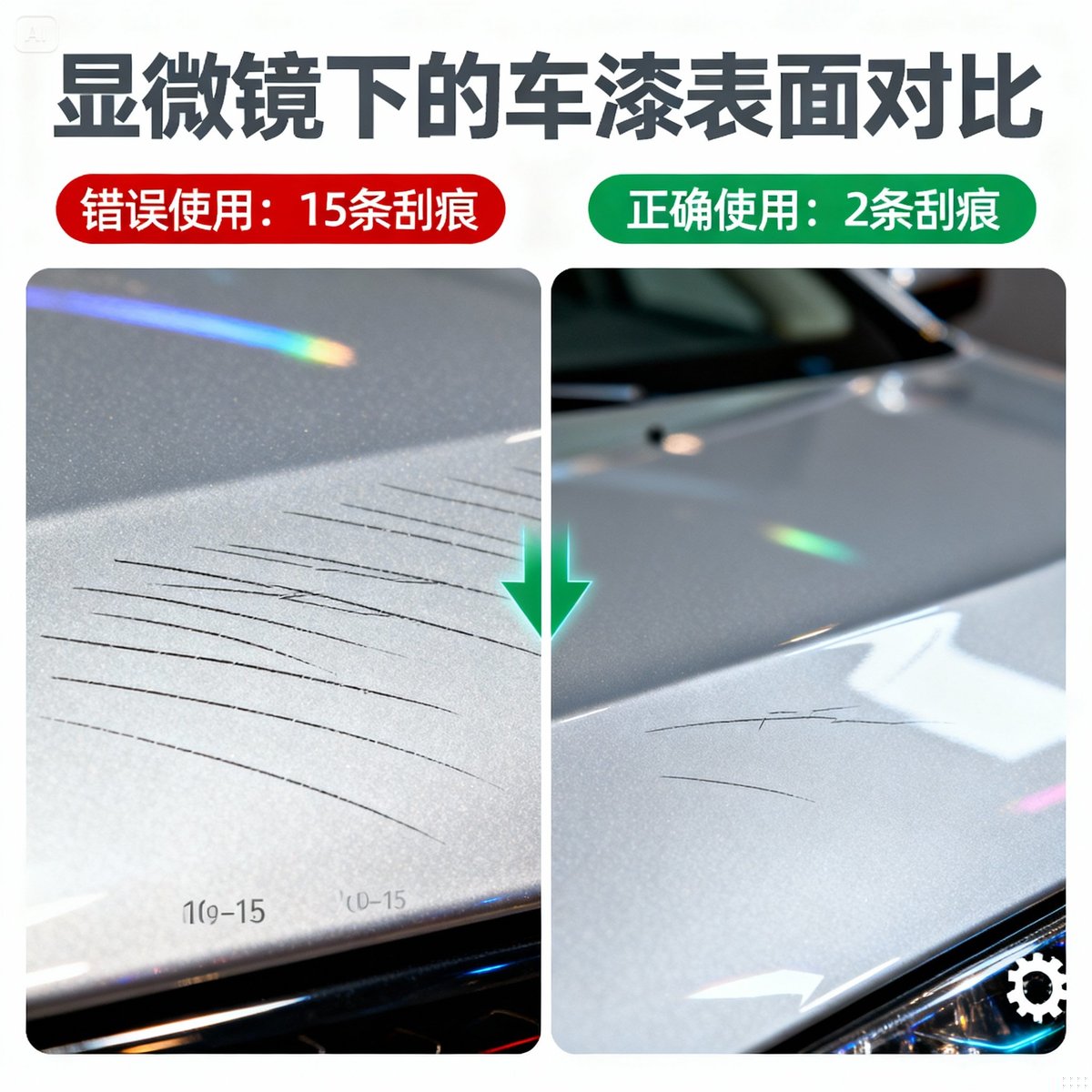
- Without rinsing first: 25-35 scratches on average (per 10cm²)
- With rinsing first: 2-5 scratches on average (per 10cm²)
Rinsing first reduces scratches by 80-90%!
Cause 2: Hard bristles (20%)
Hard nylon brushes and wire brushes have a hardness close to or above that of paint, so they scratch on direct contact.
YC Brushes tests show:
- Hard nylon brush: 15-25 scratches on average
- Soft nylon brush: 5-10 scratches on average
- Wool brush: 2-5 scratches on average
Choosing the right material reduces scratches by 50-70%!
Cause 3: Wrong technique (10%)
Scrubbing too hard, scrubbing in circles and not rinsing the brush all raise the risk of scratches.
Scratches caused by wrong technique:
- Scrubbing too hard: 20-30% more scratches
- Scrubbing in circles: tends to leave swirl marks (circular fine scratches)
- Not rinsing the brush: grit builds up in the bristles and turns them into sandpaper
YC Brushes paint test data
The YC Brushes laboratory examined the paint surface under a microscope after washing and recorded the following data:
Test conditions:
- Test vehicle: a black sedan (shows scratches most easily)
- Test area: 10cm × 10cm
- Microscope magnification: 100x
- Number of tests: 10 tests for each condition, averaged
Test results:
| Test condition | Number of scratches (per 10cm²) | Depth of deepest scratch (microns) | Safety rating |
|---|---|---|---|
| Wool brush + rinsing first + correct technique | 2-5 | 0.5 | ⭐⭐⭐⭐⭐ |
| Soft nylon brush + rinsing first + correct technique | 5-10 | 1.0 | ⭐⭐⭐⭐ |
| Sponge brush + rinsing first + correct technique | 1-3 | 0.3 | ⭐⭐⭐⭐⭐ |
| Wool brush + no rinsing | 25-35 | 3.5 | ⭐⭐ |
| Hard nylon brush + rinsing first | 15-25 | 2.5 | ⭐⭐⭐ |
| Soft nylon brush + no rinsing + hard scrubbing | 30-45 | 4.0 | ⭐ |
Conclusion:
As long as you get "the right material + rinsing first + correct technique", scratches can be kept to a minimum (2-10 per 10cm²), and they are very shallow (0.3-1.0 microns), almost invisible to the naked eye.
But get any one of these wrong and the number of scratches shoots up!
Want to look more closely at the different brush materials? See Car Wash Brush Types Compared 2026 | Soft-Bristle Brush vs Sponge Brush vs Electric Brush: Which Is Better?.

2. 5 key tips to avoid scratches
Now that you know the causes, how do you avoid them?
Tip 1: Choose the right brush material
This is the most basic step and also the most important.
✅ Safe materials (recommended):
- Wool brush: the safest, with a Mohs hardness of 2-2.5; it almost never scratches paint. Suits premium cars and dark-colored cars.
- Soft PBT filament: safe and durable, with a hardness of about 2-3, and the best value for money. Suits ordinary vehicles.
- Sponge brush: extremely soft, with a hardness of about 1-1.5; the safest, but weaker in cleaning power. Suits beginners and owners who worry about scratches.
❌ Dangerous materials (avoid):
- Hard nylon brush: a hardness of 3-4, close to or above that of paint; scratches easily.
- Wire brush: a hardness of 5-6; it will certainly scratch paint and can only be used on wheel rims.
- Coarse sponge: the rough surface traps grit easily.
YC Brushes recommends:
- Premium cars, dark-colored cars: a soft wool brush (NT$350)
- Ordinary cars, value for money: soft PBT filament (NT$300-400)
- Beginners, limited budget: a sponge brush (NT$200-300)
See the YC Brushes safe car wash brush range. Every product has been through a paint test to make sure it is safe and does not harm the car!
Tip 2: Always rinse before washing
This is the most important tip! It reduces scratches by 80-90%.
The correct rinsing steps:
Step 1: Rough rinse (2 minutes)
Rinse the body from top to bottom with a spray gun or hose to wash away large grit, leaves and insect remains.
The water pressure does not need to be very strong; medium pressure is enough. Pressure that is too strong makes the grit bounce and scratch the paint.
Step 2: Fine rinse (2 minutes)
Switch to a fan-shaped spray (or lower the pressure) and carefully rinse away the fine grit.
Pay particular attention to:
- The gaps in the wheel rims (the most grit)
- The door frames
- The underside of the side mirrors
- The base of the wipers
Step 3: Check that it is rinsed clean (30 seconds)
Run your hand over the body to check that no grit is left. If it feels rough, keep rinsing.
Why does this matter so much?
YC Brushes tests show:
- Without rinsing first: 25-35 scratches
- A 2-minute rough rinse: 8-12 scratches (65% fewer)
- Rough rinse + fine rinse for 4 minutes: 2-5 scratches (85% fewer)
Spending 4 more minutes on rinsing reduces scratches by 85%, which is well worth it!
Tip 3: Rinse the brush often (the two-bucket method in detail)
Grit builds up in the bristles and turns them into sandpaper. Rinsing the brush often is the key!
The two-bucket method:
Prepare two buckets:
- Bucket A (car shampoo solution): add car shampoo at a ratio of about 1:100. This bucket is for loading the brush with shampoo.
- Bucket B (clean water): plain clean water. This bucket is for rinsing the brush.
How to use them:
- Dip the brush in the shampoo solution in bucket A
- Scrub one section of the body (about 30cm × 30cm)
- Rinse the brush in bucket B straight away (shake the bristles hard to throw the grit out)
- Dip it in the shampoo solution in bucket A again
- Scrub the next section
- Repeat steps 2-5
Key points:
- Rinse the brush after every section; do not cover a large area before rinsing
- Change the clean water in bucket B every 10-15 minutes (the water gets dirty)
- Shake the brush hard when rinsing it to make sure the grit falls out
Why does this matter so much?
YC Brushes tests show:
- Not rinsing the brush: 30-45 scratches
- Rinsing once every 2-3 sections: 10-15 scratches
- Rinsing once every 1 section: 2-5 scratches (85-90% fewer)
Want the complete car washing process? See The Complete Car Wash Brush Buying Guide 2026 | Types Compared, Recommended Brands, Tips to Avoid Damaging Your Car.
Tip 4: Correct washing technique
With the wrong technique, even the best brush will scratch the paint.
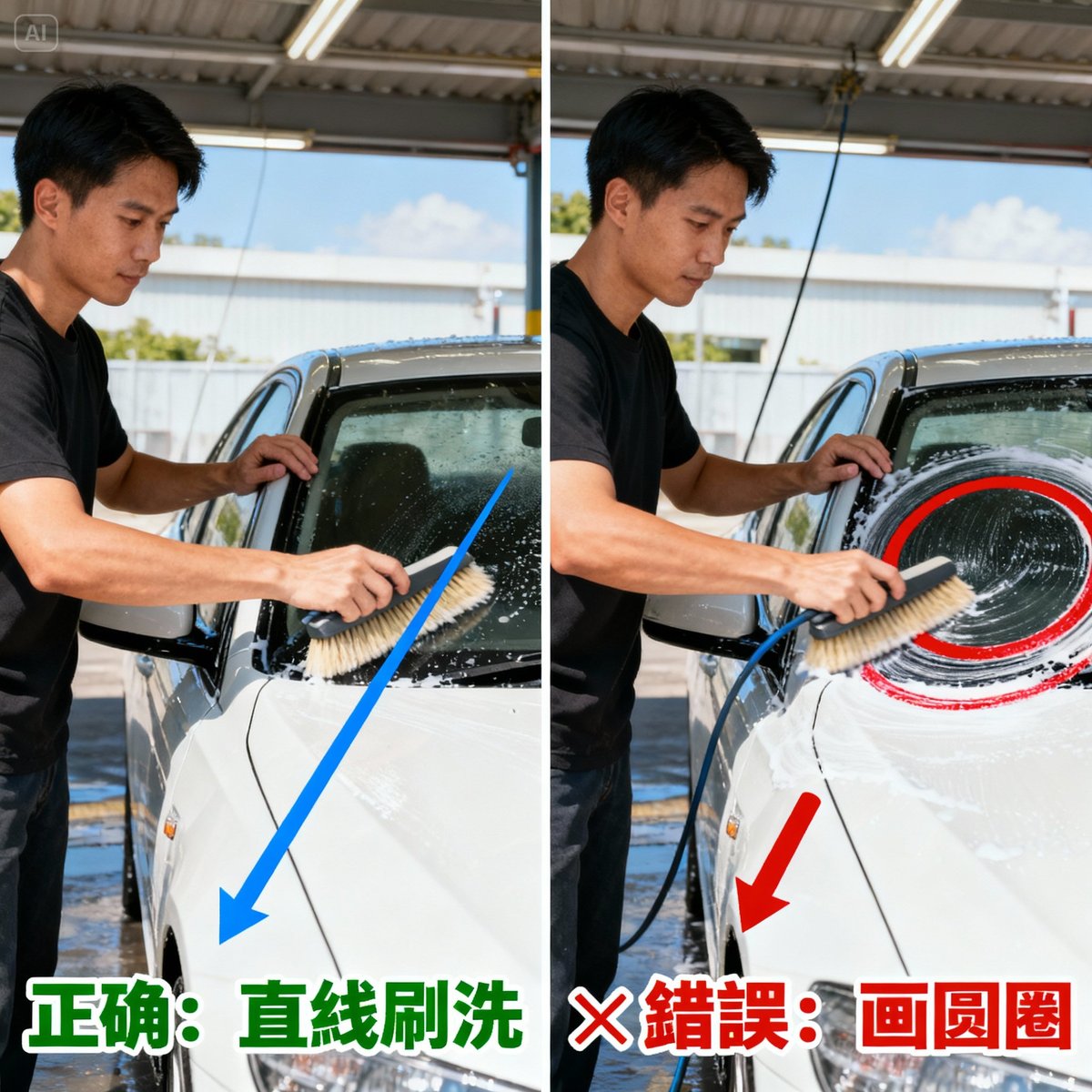
✅ Correct technique: straight-line strokes
- Scrub back and forth in straight lines, not in circles
- Follow the lines of the car body
- Keep each stroke about 30-50cm long, not too long
Why not scrub in circles?
Circular scrubbing leaves swirl marks (circular fine scratches), which are very obvious in sunlight, especially on dark-colored cars.
✅ Correct pressure: gentle contact
- There is no need to scrub hard! The surfactants in the car shampoo break down the dirt, and the brush only assists.
- The bristles only need to touch the body lightly; it should feel like stroking, not scrubbing.
- If you have to press hard to remove the dirt, the shampoo solution is not concentrated enough, or you need a dedicated cleaner.
✅ Correct direction: top to bottom
- Start with the roof, then the hood and the doors, and finish with the wheel rims.
- The lower parts are dirtier. If you wash them first, dirty water runs onto the upper areas you have already cleaned.
✅ Keep everything wet: reload the brush as you go
- Keep both the brush and the car body wet while scrubbing.
- Dry scrubbing increases friction and easily leaves fine scratches.
- Reload the brush with shampoo solution every 1-2 sections.
❌ Wrong technique (avoid):
- ❌ Scrubbing in circles (leaves swirl marks)
- ❌ Scrubbing hard (increases friction)
- ❌ Scrubbing sideways (against the lines of the body)
- ❌ Dry scrubbing (not keeping things wet)
- ❌ Covering too large an area before rinsing the brush
Tip 5: Use different brushes for different parts of the car
The body, the wheel rims and the interior must never share the same brush!
Why keep them separate?
The wheel rims are the dirtiest part:
- Brake dust contains metal particles (high hardness)
- They carry the most grit
- If you use the wheel rim brush on the body, it will scratch the paint
Setups recommended by YC Brushes:
Minimum setup (2 brushes):
- 1 soft-bristle brush (for the body only)
- 1 stiff brush (for the wheel rims only)
Standard setup (3 brushes):
- 1 wool brush or soft nylon brush (for the body only)
- 1 hard nylon brush (for the wheel rims only)
- 1 detail brush (for gaps and the interior only)
Complete setup (5 brushes):
- 1 wool brush (for the body only)
- 1 hard nylon brush (for the wheel rims only)
- 1 detail brush (for gaps only)
- 1 sponge brush (for the windows only)
- 1 stiff brush (for the engine bay only)
YC Brushes offers car wash brush sets, with a discount when you buy several brushes! See the sets.
3. What if the paint is already scratched?
If the paint is already scratched, can anything be done?
Dealing with light scratches
How to judge:
A light scratch is one that:
- Is barely visible to the naked eye (only clear in sunlight)
- Cannot be felt as a groove with a fingernail
A scratch like this has only damaged the clear coat on the surface of the paint, and you can deal with it yourself.
Method 1: Scratch remover
Scratch removers sold at retail contain very fine abrasive particles that level out shallow scratches.
Steps:
- Wash the body and let it dry completely
- Put a suitable amount of scratch remover on a sponge
- Rub the scratched area gently in circles
- Wipe it clean with a clean cloth
- Wax for protection
Recommended product: Meguiar's Ultimate Compound (mid-high price)
Result: improves shallow scratches in the clear coat.
Method 2: Cleaner wax (polishing wax)
Cleaner wax contains mild abrasives and fills in shallow scratches.
Steps:
- Wash the body and let it dry
- Take a suitable amount of cleaner wax
- Apply it in circles
- Wait for it to dry (to a haze)
- Buff it with a dry cloth
Result: temporarily hides light scratches, but needs to be reapplied regularly.
Cost:
- DIY: budget to mid-range (buying scratch remover / cleaner wax)
- Professional: mid-high (waxing service at a detailing shop)
Dealing with deep scratches
How to judge:
A deep scratch is one that:
- Is clearly visible to the naked eye
- Can be felt as a groove with a fingernail
A scratch like this may already go deep into the clear coat. It is not easy to deal with by DIY, and we recommend professional treatment.
Method 1: Professional polishing
A machine polisher levels the surface and removes the scratch.
Suitable for: scratches that are still within the clear coat, with no base color showing
Cost: mid-high (polishing the whole car)
Advantage: the best result, removing scratches within the clear coat
Disadvantage: it thins the clear coat, so the number of times it can be polished is limited
Method 2: Touch-up painting
For a single deep scratch, paint of the same color is applied.
Suitable for: scratches where the base color already shows
Cost: mid-range (a single scratch), high (a large area)
Advantage: repairs a deep scratch completely
Disadvantage: the touched-up area may differ slightly in color
Cost overview:
| Scratch severity | Method | DIY cost | Professional cost |
|---|---|---|---|
| Very light | Cleaner wax | Budget | Mid-range |
| Light | Scratch remover | Mid-range | Mid-high |
| Moderate | Professional polishing | Not possible by DIY | Mid-high |
| Deep | Touch-up painting | Not possible by DIY | High |
Preventive protection
Prevention is better than cure! Good protection lowers the risk of scratches.
Method 1: Regular waxing (once every 3-6 months)
Waxing forms a protective layer on the paint surface and reduces scratches.
Cost:
- DIY: budget (buying wax)
- Professional: mid-high
Method 2: Ceramic coating (once every 2-5 years)
A ceramic coating forms a harder protective layer (manufacturers usually state a pencil hardness of 9H) and lowers the risk of scratches.
Cost: high (depending on the model and brand)
Service life: 2-5 years
Advantages: hard, long-lasting, strongly hydrophobic
Disadvantage: expensive
Method 3: Choose the right washing tools (the most important!)
Choose a safe car wash brush and avoid scratches at the source.
YC Brushes wool brushes and soft PBT filament have been through a paint test to make sure they are safe and do not harm the car. See the safe car wash brush range.
Want to know how often it is best to wash a car? See How Often Should You Wash Your Car? A Complete Guide to Washing Frequency by Season and Environment.
💡 Worried about scratching your paint? Not sure which car wash brush to choose?
Contact YC Brushes and let a professional team with over 40 years of manufacturing experience give you a free consultation and recommend the safest car wash brush solution!
4. Common myths
There are many claims online. Which ones are right?
Myth 1: Is touchless washing the safest?
The claim: "Touchless washing (rinsing with a spray gun only) is the safest and will never scratch the paint."
The answer: partly true, but the cleaning power is limited.
Touchless washing does not scratch the paint, but it relies on water pressure alone, so dirt that clings firmly does not rinse off easily, and stubborn dirt (bird droppings, tree sap, insect remains) even less so.
What is more, dirt that builds up over time corrodes the paint and ends up damaging the car.
YC Brushes recommends:
Touchless washing is fine for everyday cleaning, but give the car a deep clean with a car wash brush once every 1-2 months.
Myth 2: Do automatic car washes damage the car?
The claim: "The brushes in automatic car washes are dirty and are bound to scratch the paint."
The answer: it depends on the quality of the machine.
High-quality machines (such as the automatic car washes at gas stations):
- Use soft brush material (cloth strips, sponge)
- Have their brushes cleaned every day
- Have automatic sensors and good pressure control
- Relatively safe, with a low risk of scratches
Low-quality machines (cheap roadside car washes):
- Use hard bristles
- Rarely have their brushes cleaned (grit builds up)
- Have poor pressure control
- High risk, scratch easily
YC Brushes recommends:
If you use an automatic car wash, choose a branded one with a reasonable price and avoid ultra-cheap options priced clearly below the market.
Myth 3: Is wiping the car with a sponge completely safe?
The claim: "A sponge is the softest, so wiping the car with a sponge will never scratch it."
The answer: wrong! A sponge can scratch paint too.
The surface of a sponge has countless pores that trap grit easily. If you do not rinse the sponge often, the trapped grit acts like sandpaper and scratches the paint.
YC Brushes tests show:
- Sponge + no rinsing first: 20-30 scratches
- Sponge + rinsing first but not rinsing the sponge: 10-15 scratches
- Sponge + rinsing first + rinsing the sponge often: 1-3 scratches
YC Brushes recommends:
A sponge is indeed safer, but you must:
- Rinse the car before washing
- Rinse the sponge often (after every section)
- Rinse the sponge thoroughly after use and let it dry
Myth 4: Is it safe to wash a car with dish soap?
The claim: "Dish soap is mild, does not harm the car, and is cheap."
The answer: wrong! Dish soap strips the wax.
Dish soap degreases very strongly. It strips the wax, leaves the paint without its protective layer and so raises the risk of scratches.
Dish soap is also on the alkaline side (pH 8-10) and may corrode the paint.
YC Brushes recommends:
Use a car shampoo made for cars (pH-neutral, pH 7-8, wax-containing formula).
Want to know how to choose a car shampoo? See Car Cleaner Buying Guide 2026 | Car Shampoo Recommendations, Ingredient Analysis, How to Use.

FAQ
Will a car wash brush damage the car?
Yes, but it can be avoided.
The main cause of damage from a car wash brush is "grit hidden in the bristles" (70%), not the brush itself.
Doing three things reduces scratches by 80-90%:
- Rinse before washing (to remove the grit)
- Choose soft bristles (wool, soft PBT)
- Rinse the brush often (the two-bucket method)
Which car wash brush is least likely to scratch paint?
Wool brush > sponge brush > soft PBT filament.
YC Brushes tests show that, when used correctly:
- Wool brush: 2-5 scratches per 10cm²
- Sponge brush: 1-3 scratches per 10cm²
- Soft PBT: 5-10 scratches per 10cm²
All three are very safe and the differences are small. What matters is how the brush is used, not the material.
Want a detailed comparison of the materials? See Car Wash Brush Types Compared 2026 | Soft-Bristle Brush vs Sponge Brush vs Electric Brush: Which Is Better?.
Are dark-colored cars especially easy to scratch?
They do not scratch more easily; they show scratches more easily.
On dark-colored cars such as black, dark blue and dark red, scratches are especially obvious in sunlight. But the degree of scratching is the same as on a light-colored car.
Advice for dark-colored cars:
- Choose a wool brush first (the safest)
- Always rinse first
- Use the two-bucket method
- Wax or coat the car regularly
Is an electric car wash brush more likely to scratch?
Yes, the risk is higher.
The high-speed rotation of an electric brush tends to leave swirl marks. YC Brushes tests show that an electric brush leaves about 2-3 times as many scratches as a manual brush.
The risk can be lowered by doing the following three things:
- Always rinse before washing
- Choose a soft brush head (sponge or soft bristles)
- Do not press hard; light contact is enough
Want to look more closely at electric brushes? See Is an Electric Car Wash Brush Worth Buying? A Complete Analysis of Pros and Cons.
Can scratches that are already there be repaired?
Light scratches can; deep scratches need professional treatment.
- Light scratches (cannot be felt with a fingernail): use scratch remover or cleaner wax, at a low-to-mid cost
- Deep scratches (can be felt with a fingernail): need professional polishing or touch-up painting, at a mid-high to high cost
Does waxing or coating prevent scratches?
It lowers the risk but cannot prevent them completely.
Waxing or coating forms a protective layer that absorbs part of the friction and lowers the risk of scratches.
The most important thing is still choosing the right car wash brush and using it correctly.
Have YC Brushes car wash brushes been tested?
Yes! Every YC Brushes car wash brush has been through a paint test.
We examine the paint surface under a microscope after washing and record the number and depth of the scratches, to make sure the product is safe and does not harm the car.
The test reports show:
- YC Brushes wool brush: 2-5 scratches per 10cm² (safety rating ⭐⭐⭐⭐⭐)
- YC Brushes soft PBT brush: 5-10 scratches per 10cm² (safety rating ⭐⭐⭐⭐)
See the YC Brushes safe car wash brush range. Every product is strictly tested to ensure quality!
What should I do if I am still not sure?
Contact YC Brushes. We offer a free consultation!
With more than 40 years of brush manufacturing experience, we recommend the car wash brush solution that suits you best, based on your car (premium / ordinary / dark-colored), your budget and how often you wash it.
Contact us for professional advice!
6. Summary and recommendations
A car wash brush can damage the car, but this can be avoided.
Key points
The three main causes of damage from a car wash brush:
- Grit hidden in the bristles (70%) → solution: rinse before washing
- Hard bristles (20%) → solution: choose a soft material (wool, soft PBT)
- Wrong technique (10%) → solution: straight-line strokes, light pressure, rinse the brush often
5 key tips to avoid scratches:
- Choose the right brush material (wool, soft PBT, sponge)
- Always rinse before washing (80-90% fewer scratches)
- Rinse the brush often (the two-bucket method)
- Use correct washing technique (straight lines, gentle, wet)
- Use different brushes for different parts (keep the body and the wheel rims separate)
YC Brushes recommends:
- Premium cars, dark-colored cars: a soft wool brush (NT$350)
- Ordinary cars, value for money: soft PBT filament (NT$300-400)
- Beginners, limited budget: a sponge brush (NT$200-300)
Further reading
Want to learn more about car wash brushes? We recommend:
- The Complete Car Wash Brush Buying Guide 2026 | Types Compared, Recommended Brands, Tips to Avoid Damaging Your Car
- Car Wash Brush Types Compared 2026 | Soft-Bristle Brush vs Sponge Brush vs Electric Brush: Which Is Better?
- Top 10 Car Wash Brush Recommendations 2026 | A Complete Review of YC Brushes, 3M, Chemical Guys and Other Brands
- Is an Electric Car Wash Brush Worth Buying? A Complete Analysis of Pros and Cons
- Car Cleaner Buying Guide 2026 | Car Shampoo Recommendations, Ingredient Analysis, How to Use
Take action now
YC Brushes offers a complete line of safe car wash brushes, and every product has been through a paint test to make sure it is safe and does not harm the car.
See the safe car wash brush range, or contact us for professional advice.
Want to learn more about brushes? Go to the blog to explore more specialist articles.