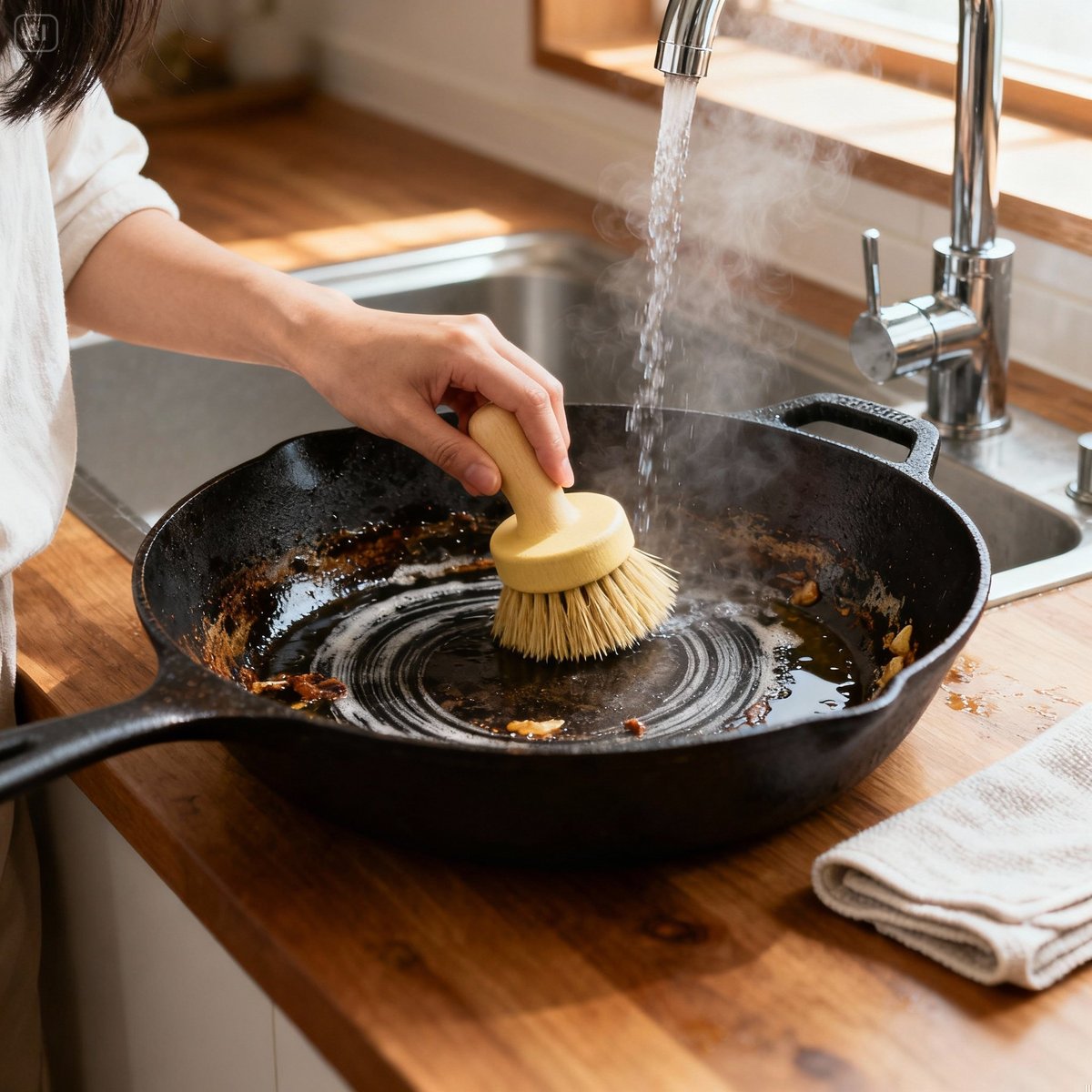
Have you also heard that cast iron cookware must not be washed with dish soap? That you cannot use a scouring pad? That you can only scrub it with hot water?
In fact, a small amount of mild dish soap is fine and will not wash off a well-seasoned layer (according to Lodge). What matters more is choosing the right brush: you need a hog bristle brush.
Many cast iron enthusiasts know that a hog bristle brush is the key tool for protecting the seasoning layer and extending the life of cast iron cookware. Cleaned the right way, your cast iron pan can last a lifetime and even be passed on to the next generation.
This complete guide explains why cast iron cookware has to be cleaned with a bristle brush, how to clean and care for it correctly, and how to avoid the common mistakes, so that your cast iron pan gets better the more you use it.
Introduction: the biggest myth about cleaning cast iron
Cast iron cookware is a favorite of many chefs and home cooks.
It conducts heat evenly, holds heat well, and can go on the stove or in the oven. It is good for searing steak, baking bread and simmering soup. But many people buy a cast iron pan and then do not know how to clean and care for it correctly.
The most common wrong ways to clean it:
- ❌ Scrubbing repeatedly with a lot of dish soap (may wash off the seasoning layer)
- ❌ Scrubbing with a scouring pad or steel wool (scrapes off the oil layer)
- ❌ Soaking in water (causes rust)
- ❌ Putting it in the dishwasher (ruins the pan completely)
- ❌ Not drying it after washing (it rusts quickly)
These mistakes lead to:
- Damage to the seasoning layer you worked hard to build up
- A rusty pan
- Food sticking easily
- Having to season the pan all over again (time-consuming and laborious)
The correct way to clean it is simple: A hog bristle brush + hot water cleans the pan easily and protects the seasoning layer at the same time.
The official care guides of well-known cast iron brands such as Le Creuset, Lodge and Staub all list a brush as a suitable cleaning tool (Lodge suggests a stiff brush; Le Creuset and Staub suggest a soft, non-abrasive brush or sponge).
This article covers:
- What is seasoning, and why does it matter so much?
- Why does cast iron cookware have to be cleaned with a hog bristle brush?
- The 6 steps of daily cleaning (after every use)
- Deep cleaning (dealing with stubborn stains)
- How to choose a bristle brush for cast iron
- Care tips for cast iron cookware
- Answers to common questions
With this knowledge, your cast iron pan will become the most useful partner in your kitchen.
Understanding seasoning (the protective oil layer) on cast iron
To clean cast iron cookware correctly, you first need to understand what seasoning is.
What is seasoning?
Seasoning (in Taiwan the process is also called "raising the pan" or "opening the pan") is a protective film of polymerized oil that forms on the surface of cast iron cookware.
How it forms:
- A thin layer of oil is applied to the cast iron surface (usually flaxseed oil, lard and so on)
- The pan is heated to above the smoke point of the oil (about 200-250°C)
- The oil polymerizes and bonds with the iron molecules
- After cooling, it forms a hard, waterproof, non-stick protective layer
Repeat this process several times and a strong seasoning layer is built up.
The 5 functions of seasoning
1. Protection against rust
- Cast iron oxidizes and rusts easily
- The seasoning layer keeps out air and moisture
- It prevents rust from forming
2. A non-stick surface
- Good seasoning sticks less than a non-stick pan
- A fried egg slides around easily
- Fried fish keeps its skin intact
3. Added flavor
- The oil layer absorbs the aroma of everything cooked in the pan
- It becomes more fragrant with use and develops a flavor of its own
- This is why an old pan works especially well
4. Protecting the iron
- It prevents iron ions from being released into the food
- It avoids a metallic taste
5. A longer life
- Good seasoning can last for decades
- The pan can even be handed down to the next generation
The enemies of seasoning
The following will damage the seasoning:
Chemical damage:
- Using a lot of dish soap (a small amount of mild dish soap does not wash off the seasoning)
- Using strong acids (long contact with vinegar or lemon juice)
- Using strongly alkaline cleaners
Physical damage:
- Scraping hard with a metal spatula
- Scrubbing with steel wool or a scouring pad
- Using rough cleaning tools
Environmental damage:
- Soaking in water for a long time
- Storing in a damp environment
- Not drying immediately after washing
This is why cast iron cookware needs a special way of cleaning, and a hog bristle brush is the ideal tool.
Want to know more about the properties of bristle brushes? See The complete guide to bristle brushes | The properties and many uses of natural hog bristle brushes
Why does cast iron cookware have to be cleaned with a bristle brush?
A hog bristle brush is the best choice for cleaning cast iron, for the following reasons:
The 5 advantages of a hog bristle brush
1. Medium stiffness, no harm to the seasoning
The stiffness of hog bristle lies between a soft sponge and hard steel wool.
- It is stiff enough to remove food residue and burnt-on patches
- But it does not scrape off the precious seasoning layer
- Sponges and steel wool cannot strike this balance
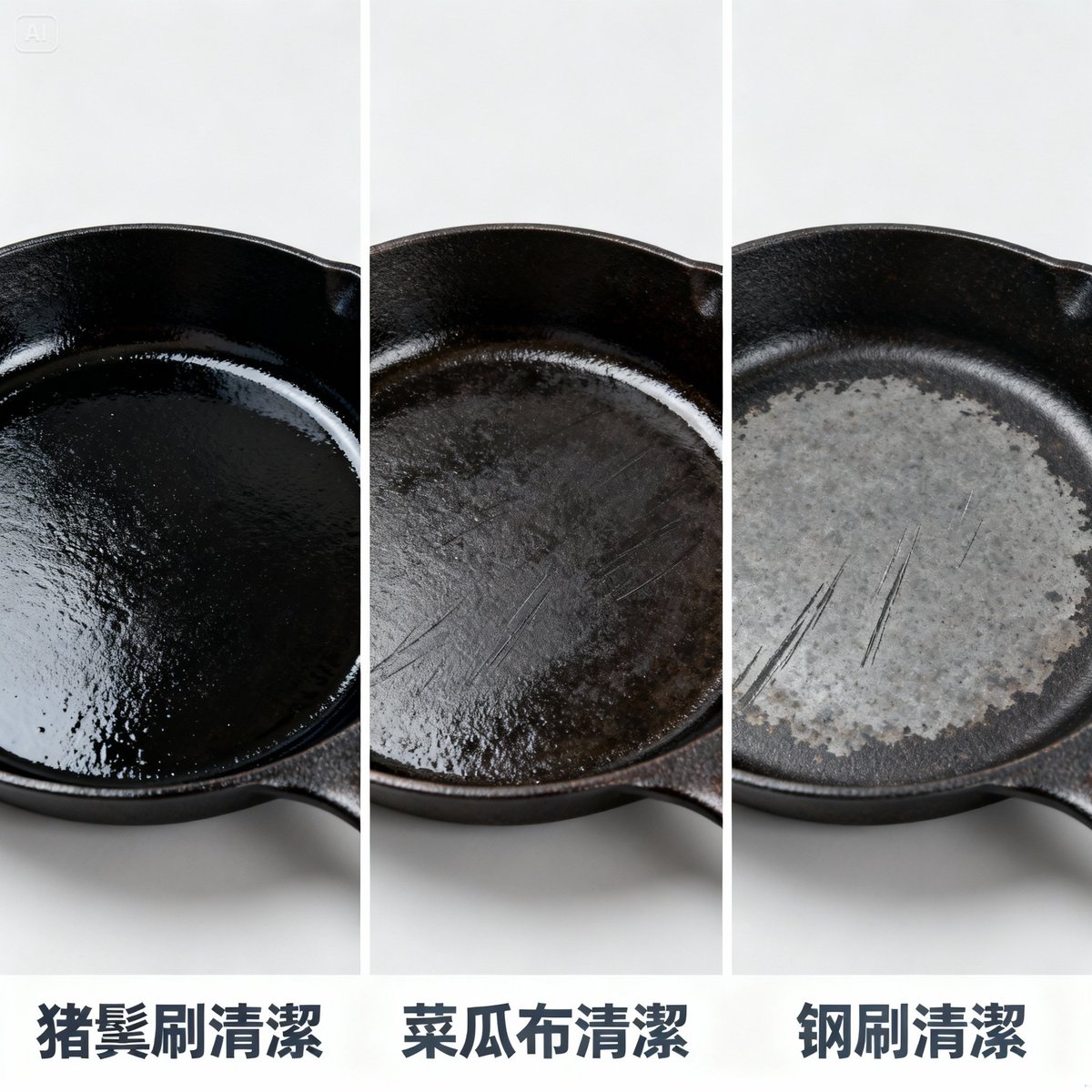
Experimental data: The bristles of a hog bristle brush are softer than steel wool and scouring pads, so they are less likely to scrape off the built-up oil layer (seasoning) when cleaning cast iron. That is why the brush is so often recommended for cast iron care.
2. Heat resistant, so the pan can be cleaned while slightly warm
Natural hog bristle can stand the residual heat of the pan.
Advantages:
- Cast iron is easiest to clean while it is still slightly warm after use (60-80°C)
- At that point the food residue has not fully hardened and comes away more easily
- Some plastic brushes and sponges are less heat resistant and deform easily when hot
When to clean: After using the pan, wait 5-10 minutes. The ideal moment is when it has cooled enough not to burn your hand but still holds some heat.
3. Does not absorb water, drains quickly
Hog bristle does not absorb water the way a sponge or cloth does.
Advantages:
- A shake after scrubbing and it is dry, with no water left behind
- The cast iron pan is not exposed to too much water
- The brush itself does not go moldy easily
4. Reaches into the texture for a more thorough clean
The surface of cast iron cookware has a fine casting texture.
The flexibility of hog bristle lets it:
- Reach into this texture and its grooves
- Remove the dirt hidden inside
- A sponge is too soft to have any force
5. A natural material, safe and environmentally friendly
- It does not release microplastics
- It is biodegradable
- It has a long service life (1-2 years with good care)
Comparison of pot-cleaning tools
| Cleaning tool | Removes dirt | Protects seasoning | Heat resistance | Does not absorb water | Reaches into texture | Rating |
|---|---|---|---|---|---|---|
| Hog bristle brush | ⭐⭐⭐⭐⭐ | ⭐⭐⭐⭐⭐ | ⭐⭐⭐⭐⭐ | ⭐⭐⭐⭐⭐ | ⭐⭐⭐⭐⭐ | ⭐⭐⭐⭐⭐ |
| Plastic brush | ⭐⭐⭐ | ⭐⭐⭐⭐ | ⭐⭐ | ⭐⭐⭐⭐ | ⭐⭐⭐ | ⭐⭐⭐ |
| Sponge | ⭐⭐ | ⭐⭐⭐⭐ | ⭐ | ⭐ | ⭐⭐ | ⭐⭐ |
| Scouring pad | ⭐⭐⭐⭐ | ⭐⭐ | ⭐⭐ | ⭐⭐ | ⭐⭐⭐ | ⭐⭐ |
| Steel wool | ⭐⭐⭐⭐⭐ | ⭐ | ⭐⭐⭐⭐⭐ | ⭐⭐⭐⭐⭐ | ⭐⭐⭐⭐ | ⭐ |
| Dishcloth | ⭐ | ⭐⭐⭐⭐⭐ | ⭐⭐⭐ | ⭐ | ⭐ | ⭐ |
Conclusion: the hog bristle brush performs best in every respect and is the best choice for cleaning cast iron cookware.
What people do in professional kitchens
Cooks who have used cast iron for a long time mostly prefer to clean it with a hog bristle brush: the bristles are stiff enough to scrape off burnt-on residue, but they do not destroy the hard-won oil layer (seasoning) on the pan the way steel wool does.
In communities of cast iron enthusiasts it is also widely held that scrubbing with a hog bristle brush and plain water, drying the pan and then applying a thin coat of oil is the most reliable way to keep a pan in good condition.
The correct steps for cleaning cast iron cookware
Learn the correct steps and cleaning your cast iron pan becomes easy and effective.
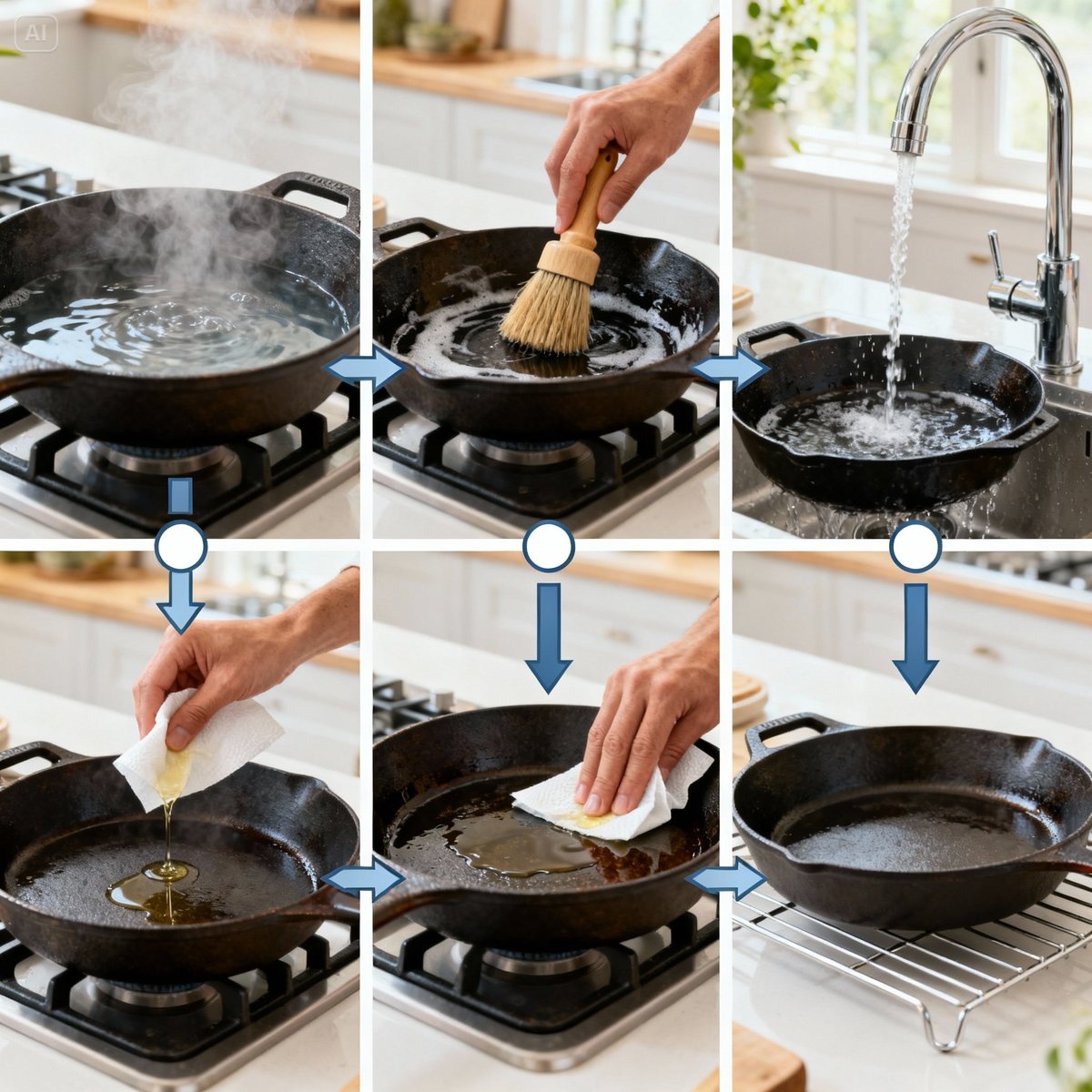
The 6 steps of daily cleaning (after every use)
This is the most commonly used cleaning method, suitable for a pan after ordinary cooking.
Step 1: Add hot water while the pan is still slightly warm
- After using the pan, wait 5-10 minutes until it has cooled enough not to burn your hand (about 60-80°C)
- Add hot water, just enough to cover the bottom of the pan
- Why while it is warm? The food residue has not fully hardened and is easier to remove
Note: do not add water straight away while the pan is scalding hot (too large a temperature difference may warp it)
Step 2: Scrub with a hog bristle brush
- Hold the hog bristle brush and scrub the surface of the pan in circles
- Use moderate force; there is no need to press hard
- Concentrate on the areas with food residue and burnt-on patches
- Scrub the bottom, the sides and the rim
Scrubbing time: about 1-2 minutes for ordinary dirt
Step 3: Pour away the water and rinse with hot water
- Pour away the dirty water
- Rinse the pan once more with hot water
- Make sure all the loosened residue is washed away
Step 4: Dry immediately (important!)
- Dry the pan with kitchen paper or a clean cloth
- Dry it inside and out, leaving no moisture at all
- Why immediately? Cast iron rusts quickly in contact with water
Advanced tip: heat the pan over a low flame for 30 seconds so that any remaining moisture evaporates completely
Step 5: Oil the pan
- Put a small amount of cooking oil on kitchen paper (lard, flaxseed oil and grapeseed oil are all fine)
- Spread it thinly over the inside and outside of the pan
- Wipe off the excess oil with clean kitchen paper (leave only a thin layer)
The purpose of oiling:
- To top up the seasoning layer
- To prevent oxidation and rust
- To keep the surface non-stick
Step 6: Store properly
- Store in a dry, ventilated place
- Do not close the lid tightly (moisture collects)
- You can put a sheet of kitchen paper in the pan to absorb moisture
Time for the whole process: about 5-7 minutes
🚀 The best choice for professional food service
YC Brushes - hog bristle brush for cast iron cookware
Michelin-starred restaurants, hotel kitchens and professional cooking schools all specify the YC Brushes cast iron brush:
- ✅ 100% natural hog bristle, medium stiffness
- ✅ High tuft density, strong cleaning power
- ✅ Round head and short handle, easy to grip and to apply force
- ✅ Factory-direct, with discounts for volume purchases
Volume purchasing for the food service industry: Contact YC Brushes now for a discounted business quote!
Or see the full product range and find the kitchen cleaning brush that suits you best.
How to choose a bristle brush for cast iron cookware
There are many kinds of hog bristle brush on the market. Which is best for cleaning cast iron?
Features of the ideal cast iron brush
Brush shape:
- A round or oval brush head (most recommended)
- Fits the curve of the pan
- Reaches the bottom and sides easily
- A brush head about 6-8 cm in diameter
Handle design:
- A short handle (10-15 cm)
- Easy to apply force
- Comfortable to hold
- Not so long that it becomes hard to apply force
Bristle material:
- 100% natural hog bristle (the best)
- Medium stiffness
- A bristle length of 1-1.5 cm (too long and it has no force, too short and it scrapes the pan)
Bristle density:
- High density
- Stronger cleaning power
- Able to reach into the texture of the cast iron
Handle material:
- Wood or bamboo (recommended)
- Comfortable to hold
- Does not get too hot (when used while the pan is still warm)
Types of brush to avoid
Brushes that are not suitable for cast iron:
- Long-handled brushes (hard to apply force)
- Plastic brushes with poor heat resistance (check the heat rating when buying)
- Steel wool (scrapes off the seasoning)
- Brushes with bristles that are too soft (not enough cleaning power)
- Brushes with bristles that are too stiff (damage the oil layer)
Quality checkpoints
When buying, check that:
- The bristles are firmly fixed and do not come out when pulled gently
- The bristle color is even (cream or light brown)
- There is no pungent chemical smell
- The handle is solid with no cracks
- It is comfortable to hold
Recommended product
YC Brushes - hog bristle brush for cast iron cookware:
- Round brush head, 7 cm in diameter
- Short handle, 12 cm long
- 100% natural hog bristle, high tuft density
- Bamboo handle, environmentally friendly and durable
- Factory-direct at a fair price (NT$250-350)
Want to know how to choose a bristle brush for other purposes? See Bristle brush vs horsehair brush: a complete comparison | How to choose the most suitable natural bristle
Care tips for cast iron cookware
Besides correct cleaning, the following care tips will make your cast iron pan last longer and work better.
Tips for everyday use
1. Fry in oil more, boil in water less
- Frying in oil keeps topping up the seasoning
- Boiling in water may thin the oil layer
- If you do make soup or a stew, be sure to dry and oil the pan afterward
2. Avoid cooking acidic food for a long time
- Acidic ingredients such as tomato sauce, vinegar and lemon juice attack the seasoning
- A short time (within 30 minutes) is no problem
- For long simmering of acidic food we suggest using another pot
3. Use a wooden or silicone spatula
- Do not scrape hard with a metal spatula
- It damages the seasoning
- Wooden or silicone tools are gentler
4. Do not cool the pan rapidly
- Do not run cold water over a hot pan
- Too large a temperature difference causes warping or cracks
- Let it cool naturally or wash it with warm or hot water
Regular care
A deep care session once a month:
- Clean the pan and dry it
- Apply a thin layer of oil inside and out
- Put it in the oven and bake at 200°C for 1 hour
- Let it cool naturally
- Wipe off the excess oil
What this does:
- Strengthens the seasoning layer
- Makes the oil layer more even
- Improves the non-stick performance
Storage tips
The ideal way to store it:
- A dry, ventilated place
- Do not close the lid tightly (put a sheet of kitchen paper under the lid to keep air moving)
- Put a sheet of kitchen paper in the pan to absorb moisture
Avoid:
- Damp environments (it rusts easily)
- Stacking heavy objects on it (the surface may be damaged)
When the pan will not be used for a long time
If the cast iron pan is going into long-term storage (more than one month):
- Wash and dry it thoroughly
- Apply a thicker layer of oil (do not wipe it off)
- Wrap it in newspaper or cloth
- Store it in a dry place
- Before using it again, simply wash and oil it
Dealing with rust spots
If the pan has rusted by accident:
Slight rust spots:
- Rub them off with a hog bristle brush + salt
- Rinse and dry
- Oil the pan
Severe rust:
- Remove the rust with steel wool
- Wash and dry over heat
- Season the pan again
Why frequency of use matters
The more you use it, the better it gets is a characteristic of cast iron cookware:
- Every use tops up the oil layer
- The seasoning becomes thicker and stronger
- The non-stick performance keeps improving
Recommendation:
- Use it at least 2-3 times a week
- Do not leave it idle for long periods
Want to know more about cleaning and caring for bristle brushes? See The complete guide to caring for and cleaning natural bristle brushes | Tips for a longer service life
FAQ
Can I use dish soap on cast iron cookware?
Yes. According to Lodge, today's dish soaps are not strong enough to wash off the seasoning on cast iron, so a small amount of mild soap is fine.
Daily cleaning:
- Hog bristle brush + hot water, with a little dish soap when needed
- Avoid scrubbing repeatedly with a lot of dish soap
When a thorough wash is needed:
- A newly bought pan (the factory oil has to be washed off)
- A pan with an odor (after cooking fish, for example)
- Before re-seasoning (the old oil layer has to be removed completely)
After washing:
- Dry it and apply a thin coat of oil, and that is enough
- After removing the old oil layer completely (such as before re-seasoning), season it once (apply oil → heat)
What should I do if my cast iron pan has rusted?
Do not worry, it can be saved.
Slight rust spots:
- Rub them off with a hog bristle brush + salt
- Rinse and dry
- Oil the pan
Severe rust:
- Remove the rust with steel wool
- Wash with dish soap
- Dry over heat
- Season the pan again (apply oil → bake at 200°C for 1 hour, repeat 3-5 times)
Preventing rust:
- Dry the pan immediately after every use
- Apply a thin layer of oil
- Store it in a dry place
Why does food keep sticking to my cast iron pan?
Possible causes and solutions:
Cause 1: Not enough seasoning
- Solution: season the pan again and build up several more coats of oil
Cause 2: The pan is not hot enough
- Solution: preheat the pan fully before the food goes in (to the point where a drop of water dances the moment it lands)
Cause 3: Not enough oil
- Solution: add enough oil when cooking
Cause 4: The food is turned too early
- Solution: wait patiently and the food will release from the bottom of the pan by itself (especially when frying fish or meat)
Cause 5: The seasoning has been damaged
- Solution: stop using steel wool, avoid soaking, and season the pan again
What can and cannot be cooked in cast iron cookware?
Almost anything can be cooked in it, but a few things need care.
Very suitable:
- Searing steak and pork chops (high-heat searing)
- Frying eggs and fish
- Stir-frying
- Baking bread and cookies (it can go in the oven)
- Short simmering
Take care with:
- Acidic food (tomato sauce, vinegar) → fine for a short time, avoid for a long time
- Steaming (too much moisture) → possible but not ideal
- Boiling in water (thins the oil layer) → possible, but be sure to dry and oil the pan afterward
Not suitable:
- Long simmering of acidic food (meat stewed in tomato for more than 1 hour)
How should I treat a cast iron pan before using it for the first time?
A new pan has to be seasoned first.
Steps:
-
Remove the factory oil:
- Wash thoroughly with dish soap
- Dry
-
First seasoning:
- Apply a thin layer of oil inside and out (flaxseed oil is best)
- Bake in the oven at 200°C for 1 hour
- Let it cool naturally
- Wipe off the excess oil
-
Repeat 3-5 times:
- Apply oil → bake → cool
- The oil layer becomes thicker each time
-
Start using it:
- For the first few uses we suggest frying fatty food (bacon, pork belly)
- This helps build a stronger seasoning
How often does a hog bristle brush need replacing?
With good care it lasts 1-2 years.
Replacement signals:
- Bristles falling out in large numbers
- Bristles out of shape and unable to recover
- A persistent odor
- A loose or broken handle
To make it last longer:
- Rinse it clean after every use
- Dry it with the bristles facing down
- Do not soak it in water
- Store it in a dry, ventilated place
Can I use steel wool on cast iron cookware?
Never for daily cleaning; there is only one exception.
Daily cleaning:
- ❌ Never use steel wool
- It destroys the seasoning completely
The only exception:
- When re-seasoning, to remove the old oil layer
- To remove severe rust
Afterward:
- Always season the pan again
Can cast iron cookware go in the dishwasher?
Absolutely not!
Reasons:
- The strong detergent in a dishwasher destroys the seasoning completely
- Long soaking in water causes rust
- High-temperature drying may also cause warping
The correct way:
- Wash by hand
- Use a hog bristle brush + hot water
- Dry immediately
Can I use a metal spatula on cast iron cookware?
Yes, but be careful.
You can use:
- Metal spatulas and metal tongs are both fine
- Cast iron is very tough and does not mind scraping
But take care:
- Do not scrape hard to remove stuck-on food
- It damages the seasoning
- Turning the food gently is enough
Better still:
- A wooden or silicone spatula
- Gentler on the seasoning
Why do some cast iron pots have an enamel coating?
Enameled cast iron is cared for differently.
Enameled cast iron (such as Le Creuset and Staub):
- The surface has an enamel coating
- It does not need seasoning
- Dish soap can be used
- But a hog bristle brush is still recommended (gentle, does not scratch the enamel)
Traditional cast iron (such as Lodge):
- No coating
- It needs seasoning
- A small amount of mild dish soap can be used (Lodge's official method is to wash with warm soapy water)
- A hog bristle brush is a must
This article is mainly about traditional cast iron, but a hog bristle brush suits both kinds.
Any other questions? You are welcome to contact YC Brushes; we offer professional advice!
Conclusion: one good brush, a pan for life
Cast iron cookware can be used for a lifetime and even handed down to the next generation.
The condition is correct cleaning and care.
Key points in review
Cleaning:
- Use a hog bristle brush + hot water
- Only a little dish soap, no steel wool, no soaking
- Dry immediately and oil the pan
Care:
- Use it often; it gets better with use
- Avoid cooking acidic food for a long time
- Regular deep care (once a month)
- Store in a dry place
Choice of tool:
- A round hog bristle brush with a short handle
- 100% natural hog bristle
- High tuft density
Why choose YC Brushes?
YC Brushes was founded in 1985 and has over 40 years of brush manufacturing experience.
Our cast iron brush:
- 100% natural hog bristle, carefully selected for quality
- High tuft density, strong cleaning power without harming the oil layer
- A round design that fits the curve of the pan perfectly
- A short handle that is easy to grip, so force is applied with little effort
- Factory-direct at a fair price
Customers we serve:
- Michelin-starred restaurant kitchens
- Hotel food and beverage departments
- Cooking schools
- Accessory supply for cast iron cookware brands
- Home users
Volume purchase discounts for the food service industry: Contact us now to discuss and get a discounted business quote!
Individual purchases: See the cast iron brush
Further reading
Want to learn more about bristle brushes?
- The complete guide to bristle brushes | The properties and many uses of natural hog bristle brushes (core page)
- Bristle brush vs horsehair brush: a complete comparison | How to choose the most suitable natural bristle
- Where to buy a bristle brush? 5 purchase channels compared on price and quality
- The complete guide to caring for and cleaning natural bristle brushes | Tips for a longer service life
Start treating your cast iron pan well
Starting today, clean and care for your cast iron pan the right way.
A good hog bristle brush makes your pan better with every use and turns it into the most reliable partner in your kitchen.
Contact YC Brushes:
- Phone: +886-2-2988-2721
- Address: 2F-3, No. 14, Lane 609, Sec. 5, Chongxin Rd., Sanchong Dist., New Taipei City, Taiwan
- Website: YC Brushes
- Email: [email protected]