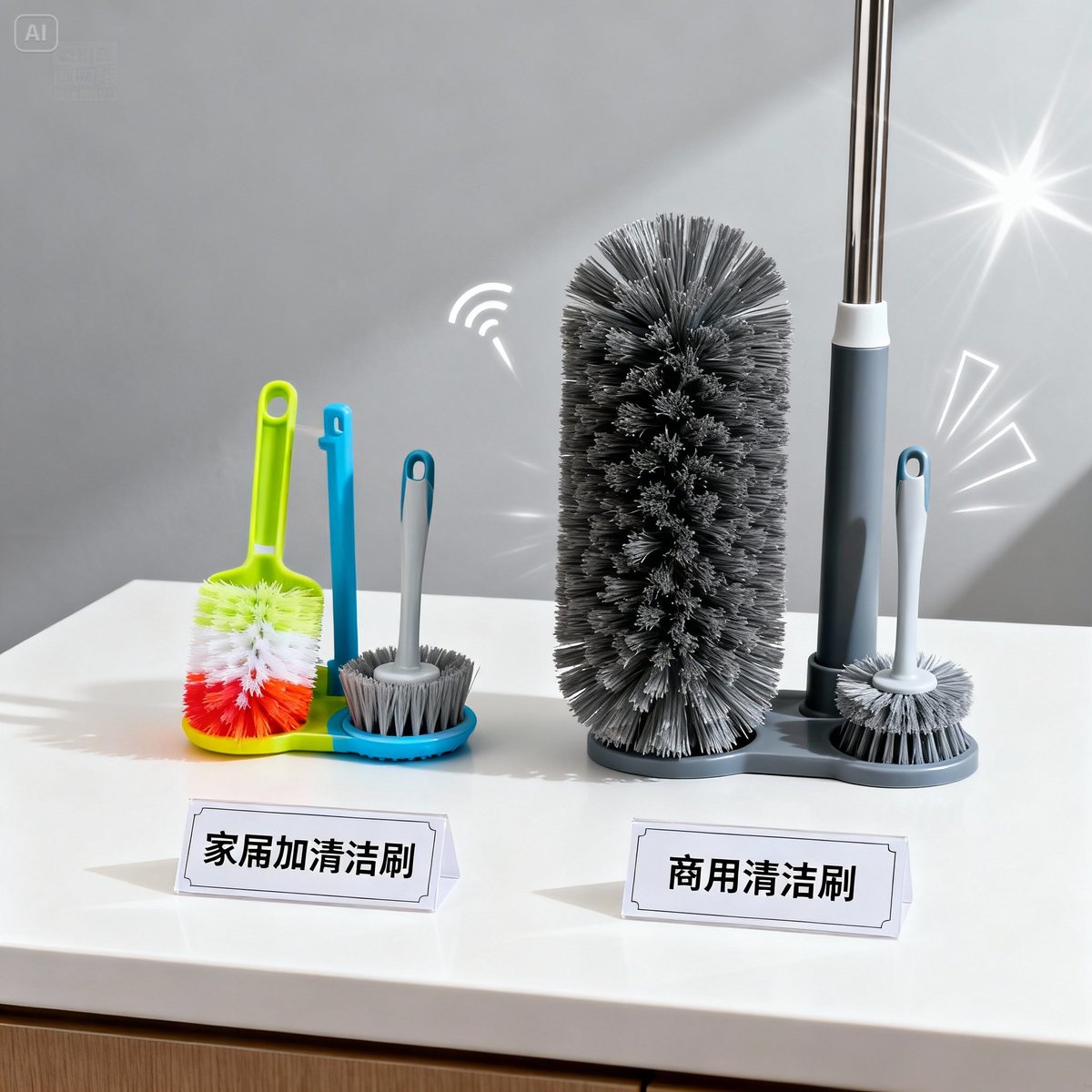
Did you know? The commercial cleaning brushes used in hotels and restaurants differ from ordinary household cleaning brushes far more than you might think.
To save costs, many cleaning companies and commercial premises buy cheap household cleaning brushes, only to have them fail in less than a month, and replacing them so often ends up costing more. Worse, a poor-quality brush may not clean properly, may shed and contaminate, and may even scratch equipment.
Choosing the right cleaning brush is not only a question of clean or not clean; it also affects cost-effectiveness and cleaning efficiency.
This guide explains in full the differences between household and commercial cleaning brushes, what to look for when buying each type of brush, material selection and supplier evaluation, to help you find the cleaning brush solution that suits you best.
Household vs commercial cleaning brushes | 3 core differences
Household and commercial cleaning brushes are designed for completely different goals.
Only by understanding the differences can you make the right choice.
Difference 1: Intensity of use and durability
Household cleaning brushes:
- Intermittent use (a few times a day or a week)
- Short periods of use (a few minutes each time)
- Lighter force in use
- Service life usually 1-3 months
Commercial cleaning brushes:
- High-frequency use (many times a day)
- Long periods of continuous use
- Heavy force in use
- Service life needs to reach 6-12 months or more
A real case: A hotel used household toilet brushes. The filament bent and deformed within a month, and the brushes were replaced 12 times a year. After switching to commercial-grade brushes, each one lasted 6 months and was replaced only 2 times a year, so the total cost was actually lower.
Difference 2: Material standards and quality
Household cleaning brushes:
- Ordinary-grade plastic
- The filament may be made from recycled material
- A simpler fixing process
- Lower consistency of quality
Commercial cleaning brushes:
- Industrial-grade or food-grade materials
- All virgin material, no color fading
- Filament fixed more securely
- High consistency of quality
Material differences:
| Item compared | Household grade | Commercial grade |
|---|---|---|
| Plastic material | Recycled PP | Virgin PP |
| Filament material | PET / nylon | Nylon / hog bristle |
| Chemical resistance | Medium | Strong |
| Fixing method | Hot-melt / glued | Metal fixing / tufting |
| Shedding rate | Higher | Extremely low |
Difference 3: Price and cost-effectiveness
Household cleaning brushes:
- Unit price on the low side
- Need frequent replacement
- Total cost of ownership may be higher
- Suited to low-frequency use
Commercial cleaning brushes:
- Unit price in the mid to upper range
- Long service life
- Lower cost per unit of time
- Suited to high-frequency use
Cost comparison example (toilet brush):
Household brush:
- Lower unit price
- Service life about 1 month
- Replaced 12 times a year
- The total annual spend is not low
Commercial brush:
- Higher unit price
- Service life about 6 months
- Replaced 2 times a year
- The total annual spend may actually be lower
Although a commercial brush has a higher unit price, the total cost is actually lower.
Want the full picture of industrial-grade brushes? See The complete guide to industrial brushes.
Common types of cleaning brush and buying advice
Different cleaning tasks need different brushes.
Below are the most commonly used types of cleaning brush and what to look for when buying them.
Toilet brushes
The most common cleaning brush.
Buying a household toilet brush:
- Filament: nylon or PP, medium hardness
- Brush head: ball-shaped or flat
- Handle: 35-40 cm long
- Holder: ventilated, does not collect water
- Price: low price range
Buying a commercial toilet brush:
- Filament: nylon (durable, does not shed)
- Brush head: denser filament, strong cleaning power
- Handle: thickened to resist breaking
- Holder: corrosion-resistant material
- Price: mid to upper price range
Key points when buying:
- The filament should be dense and should not shed
- The joint with the handle should be secure
- The holder should ventilate and drain
- For commercial premises, replacement every 6 months is recommended
Dish brushes
An essential tool for the food service industry.
Household dish brushes:
- Sponge brush (gentle, non-scratching)
- Steel wire brush (removes stubborn dirt)
- Handheld nylon brush (general washing)
- Price: low price
Commercial dish brushes:
- Long-handled pot brush (for deep pots)
- Heavy-duty steel wire brush (industrial use)
- Food-grade nylon brush (restaurant use)
- Price: mid price
Key points when buying:
- Choose the hardness to suit what is being cleaned
- Food-grade materials are recommended for restaurants
- Avoid shedding that contaminates food
- Replace regularly to keep bacteria from growing
For brush selection in the food service industry, we suggest reading the Food-grade brush buying guide.
Floor brushes
Made for cleaning large areas.
Household floor brushes:
- Soft brush (wooden floors, tiles)
- Hard brush (outdoors, rough surfaces)
- Brush head width: 20-30 cm
- Price: mid price
Commercial floor brushes:
- Industrial-grade hard brush
- Wider brush head (40-60 cm)
- Durable handle
- Can be used with a cleaning machine
- Price: upper-mid to high price
Key points when buying:
- Choose the softness or hardness to suit the floor material
- The width of the brush head affects efficiency
- The handle length should be ergonomic
- For commercial use, a type with a replaceable brush head is recommended
Bottle brushes
Made for long, narrow containers.
Where they are used:
- The inner wall of vacuum flasks
- Washing baby bottles
- The bottom of deep cups
- Cleaning water pipes
What to look for when buying:
- Long enough to reach deep into the container
- Soft filament that does not scratch
- A flexible, tough handle
- Food grade is recommended for baby bottle brushes
Price:
- Household: low price
- Commercial / food grade: mid price
Other special-purpose brushes
Laundry brushes:
- Remove stubborn stains from clothing
- Hard or soft filament as required
- Price: low price
Shoe brushes:
- Clean the uppers and the soles
- Usually double-sided (hard + soft)
- Price: low to mid price
Bathroom brushes:
- Clean the gaps between tiles
- Remove limescale
- Price: low to mid price
See the YC Brushes cleaning brush catalog.
Choosing cleaning brush materials | PP vs nylon vs natural materials
The filament material decides the cleaning result and the durability.
PP (polypropylene)
The most common cleaning brush material.
Advantages:
- Cheap
- Resistant to acids and alkalis
- Does not absorb water
- Easy to clean
Disadvantages:
- Medium wear resistance
- Lower heat resistance (about 90°C)
- Poorer resilience
Suitable for:
- General household cleaning
- Toilet brushes, floor brushes
- Limited budgets
Nylon
The high-durability choice.
Advantages:
- Excellent wear resistance
- Good resilience
- High heat resistance (120°C)
- Long service life
Disadvantages:
- Higher price
- Absorbs water
- Must be kept dry
Suitable for:
- High-frequency commercial cleaning
- Situations that call for durability
- Industrial cleaning
Natural hog bristle
A traditional natural material.
Advantages:
- Soft, non-scratching
- Absorbs water well (car washing, wooden floors)
- Good texture
Disadvantages:
- Expensive
- Goes moldy easily (must be stored dry)
- Shorter service life
Suitable for:
- Cleaning delicate items
- Wooden floor care
- Leather shoe care
Steel wire
Made for heavy-duty cleaning.
Advantages:
- The highest hardness
- Strong cleaning power
- Resistant to high temperatures
Disadvantages:
- Scratches surfaces
- May rust (choose stainless steel)
- Not suited to delicate items
Suitable for:
- Stubborn dirt
- Burnt pots and pans
- Heavy-duty industrial cleaning
Sponge / melamine sponge
The gentle cleaning choice.
Advantages:
- Does not scratch
- Good cleaning power
- Easy to use
Disadvantages:
- Easily damaged
- Short service life
- High cost
Suitable for:
- Delicate tableware
- Smooth surfaces
- Glass cleaning
Want to go deeper into the properties of each filament material? See Brush materials explained in full.
Purchasing channels for commercial cleaning brushes | Retail vs wholesale vs factory-direct
Different purchasing channels have different advantages and disadvantages.
Retail channels (hardware stores, supermarkets)
Advantages:
- Convenient to buy
- Goods available immediately
- Small quantities
Disadvantages:
- Higher price
- Limited choice
- Mostly household grade
Suitable for:
- Household use
- Urgent restocking
- Small shops
Wholesalers (cleaning supplies wholesale)
Advantages:
- Discounted price (about 30% off, that is 70% of the retail price)
- More items
- Small wholesale quantities possible (usually from 10 pieces)
Disadvantages:
- Uneven quality
- May be a distributor taking a margin
- Custom work is difficult
Suitable for:
- Small and medium-sized cleaning companies
- Chain stores
- Community group purchases
Factory-direct
Advantages:
- The best price (about 40-50% off, that is 50-60% of the retail price)
- Stable quality
- Custom work possible
- Technical support
Disadvantages:
- There is usually an MOQ (minimum order quantity)
- Needs planning ahead
- You may need to arrange transport yourself
Suitable for:
- Large cleaning companies
- Hotel groups
- Long-term, stable demand
- Custom requirements
Price comparison example (commercial toilet brush):
- Retail price: the highest
- Wholesale price: in the middle, usually from 10 pieces
- Factory-direct: usually the most competitive price, often from 50 pieces
For the full advantages of buying factory-direct, see The complete guide to buying factory-direct from a brush factory.
Service life of cleaning brushes and when to replace them
Replacing at the right time keeps cleaning effective and hygienic.
Recommended replacement cycle
By frequency of use:
- High-frequency use (many times a day): 1-3 months
- Medium use (once a day): 3-6 months
- Low-frequency use (a few times a week): 6-12 months
By type of premises:
- Restaurant kitchens: 1-3 months
- Hotel guest rooms: 3-6 months
- Offices: 6-12 months
- Homes: 6-12 months
Signs that a brush should be replaced immediately
Situations where the brush must be replaced:
- The filament is clearly worn or deformed
- Heavy shedding
- The handle is broken or loose
- Cleaning performance has clearly dropped
- An odor or mold has appeared
- The filament is badly discolored
Ways to extend service life
Care after use:
- Rinse off residue thoroughly
- Drain the water completely
- Store upright or hanging
- Avoid direct sunlight
Regular cleaning:
- Wash with detergent every week
- Disinfect regularly (diluted bleach)
- Check whether the fixing has come loose
Correct use:
- Do not use too much force
- Choose the right brush for the object being cleaned
- Avoid cleaning substances beyond what the brush can tolerate
💡 Need commercial cleaning brushes in volume?
Contact YC Brushes now for favorable factory-direct prices and custom service for all kinds of cleaning brushes. 📞 +886-2-2988-2721
Recommended cleaning brush brands and supplier evaluation
Choosing a reliable supplier matters.
5 criteria for evaluating a supplier
1. Stable quality
- Consistent quality in every batch
- A quality guarantee is provided
- A return and exchange procedure for defective pieces
2. Reasonable price
- Transparent pricing
- No hidden fees
- Volume discounts
3. Product variety
- A complete range of items
- Many specifications to choose from
- Custom work possible
4. Reliable lead time
- Promised delivery dates are kept
- Ability to handle rush orders
- Ample stock
5. After-sales service
- Fast response
- Professional advice
- Discounts for long-term cooperation
Recommended purchasing strategies
Small requirements (homes, small shops):
- Buy through retail channels
- Choose well-known brands
- Focus on price and convenience
Medium requirements (cleaning companies, chain stores):
- Wholesalers or factory-direct
- Establish regular suppliers
- Negotiate discounts for long-term cooperation
Large requirements (hotels, large companies):
- Factory-direct
- Custom development
- Sign an annual contract
The cleaning brush advantages of YC Brushes
Factory-direct, transparent pricing
- Over 40 years of manufacturing experience
- No middleman taking a margin
- Discounts on volume purchases
Stable quality
- Carefully selected raw materials
- Quality management system
- Warranty on defective pieces
Flexible service
- Standard products supplied from stock
- Custom development
- Order quantities quoted per specification; email us your requirements
Areas of application:
- Hotels and guesthouses
- Cleaning companies
- Food service industry
- Hospitals and clinics
- Schools and government agencies
See YC Brushes cleaning brush products and prices.
Points to note when working with a brush factory in Taichung
Choosing a local factory brings advantages in freight cost and communication. (Taichung is a city in central Taiwan.)
Points to note when working together:
1. Be clear about your needs
- Explain the purpose clearly
- Give a budget range
- State the quantity and frequency
2. Ask for samples
- Test the results in actual use
- Confirm the quality
- Compare different specifications
3. Confirm the details
- Material certification
- Promised lead time
- Payment terms
- Warranty terms
4. Build a long-term relationship
- Steady orders
- Payment on time
- Good communication
5. Evaluate regularly
- Whether the quality is stable
- Whether the price is reasonable
- Whether you are satisfied with the service
If you are in the Taichung area, see Recommended brush factories in Taichung.
FAQ
What is the difference between household and commercial cleaning brushes?
The three core differences:
- Durability: a commercial brush lasts 3-6 times as long as a household brush
- Material: commercial brushes use industrial-grade materials, household brushes ordinary grade
- Price: a commercial brush has a higher unit price, but a lower cost per unit of time
When should you use a commercial brush?
- Used many times a day
- Cleaning companies, hotels, restaurants
- Stable quality is needed over the long term
- Long-term cost-effectiveness is the goal
When is a household brush enough?
- Household use
- Low-frequency cleaning
- Limited budget
- Convenience comes first
How often should a cleaning brush be replaced?
It depends on the frequency of use and the premises.
Recommended replacement cycle:
- Restaurant kitchens: 1-3 months
- Commercial premises: 3-6 months
- Offices: 6-12 months
- Homes: 6-12 months
Signs that it should be replaced immediately:
- The filament is worn or deformed
- Heavy shedding
- Cleaning performance has dropped
- An odor or mold
- The handle is broken
We suggest not waiting until the brush is completely worn out; regular replacement keeps cleaning effective and hygienic.
How do I choose the filament material for a cleaning brush?
Choose according to what is being cleaned and what you need.
Quick selection table:
| What is being cleaned | Recommended material | Reason |
|---|---|---|
| Toilets | Nylon / PP | Durable, chemical resistant |
| Tableware | Sponge / soft nylon | Does not scratch |
| Burnt residue on pots | Steel wire | Strong cleaning power |
| Wooden floors | Hog bristle / soft PP | Gentle, does not scratch |
| Tiles | Nylon | Medium hardness |
| Glass | Sponge | Leaves no scratches |
Selection principles:
- Delicate items → soft materials
- Stubborn dirt → hard materials
- Food contact → food-grade materials
- Chemical environments → chemical-resistant materials
For more on material properties, see Brush materials explained in full.
Where is the cheapest place to buy cleaning brushes in volume?
Factory-direct is usually the cheapest.
Price comparison:
- Retail (hardware stores): 100%
- Wholesalers: about 70%
- Factory-direct: about 50-60%
Advantages of factory-direct:
- The most favorable price
- Custom work possible
- Stable quality
- Technical support
Things to note:
- There is usually an MOQ (minimum order quantity)
- Purchases need to be planned ahead
- We suggest asking for samples to test first
When to go to a factory:
- Long-term, stable demand
- Large monthly usage
- Custom requirements
- The best cost-effectiveness is the goal
To learn about factory-direct purchasing, see The complete guide to buying factory-direct from a brush factory.
How do I care for a cleaning brush so that it lasts longer?
Proper care can extend service life by 1-2 times.
Cleaning after use:
- Rinse clean with water immediately
- Shake off excess water
- Stand upright or hang up to drain
- Avoid damp, enclosed spaces
Regular care:
- Deep clean with detergent every week
- Disinfect every month (soak in diluted bleach)
- Check the handle and the fixing points
- Deal with any looseness promptly
Wrong practice:
- ❌ Not washing after use
- ❌ Storing while damp
- ❌ Using too much force and causing deformation
- ❌ Using beyond what the brush can tolerate
Right practice:
- ✅ Wash immediately after use
- ✅ Store only when completely dry
- ✅ Use appropriate force
- ✅ Choose the right brush for the job
Conclusion: the right cleaning brush raises efficiency and lowers cost
A cleaning brush may look simple, but choosing the right one can greatly improve cleaning efficiency, lower long-term costs and ensure cleaning quality.
Core principles for buying cleaning brushes
Choose the type by need
- Low-frequency household use → household grade
- High-frequency commercial use → commercial grade
- Be clear about what is being cleaned and choose the right brush
Choose the right material
- Choose the hardness by what is being cleaned
- Consider the operating environment
- Balance price and performance
Choose the right supplier
- Small requirements → retail
- Medium requirements → wholesale
- Large requirements → factory-direct
Replace regularly
- Set up a replacement schedule
- Do not wait until the brush fails
- Calculate the total cost of ownership
Recommended further reading
Want to learn more about brushes? Recommended reading:
- The complete guide to buying factory-direct from a brush factory - understand the advantages of factory-direct
- The complete guide to industrial brushes - get to know industrial-grade brush applications
- Brush materials explained in full - go deeper into the properties of each material
If you need commercial cleaning brushes in volume, YC Brushes offers factory-direct prices and over 40 years of manufacturing experience.
Contact us now to discuss your cleaning brush requirements, or see the full product catalog to find the cleaning brush solution that suits you best.