A black suit jacket is covered in dust after one day of wear. Lint and hair show up especially clearly on a dark coat. Wool sweaters pick up fine debris through static. Every time you go out, you have to spend time dealing with dust on your clothes.
You may be wondering: which is better, an anti-static brush or a lint roller? Which brands are recommended? How should different fabrics be cleaned? This article explains the key points in choosing a clothes dust brush, recommends suitable products (MUJI / POYA / professional garment brushes; the stores and prices mentioned describe the Taiwan market), and shares techniques for different fabrics, so that your clothes stay as clean as new.
To see how well anti-static brushes actually work, see Do anti-static brushes work? Test results analyzed, which includes test data on removing dust from clothing. For correct use and care, see How to use and care for dust-removal brushes | 5 secrets to extending the life of an anti-static brush.
Why do clothes need a dedicated dust brush?
3 characteristics of garment fabrics
Characteristic 1: the fibers are fine and fragile
Suits, coats and wool sweaters use natural fibers (wool, cotton, silk) or high-grade man-made fibers. These fibers are only 15-40 microns in diameter, finer than a human hair (about 60-90 microns).
Coarse, stiff bristles (as on an ordinary cleaning brush) damage the fiber structure and cause:
- Broken fibers
- Pilling
- Fuzzing of the fabric
- Dulled color
The bristles of a dedicated clothes brush are finer and softer and do not harm the fibers.
Characteristic 2: static builds up easily
Clothes generate static through friction, and static attracts dust, lint and hair. This is especially obvious on dark clothing: a black suit or a navy coat looks particularly dusty.
An ordinary dust brush has no anti-static effect, so the garment attracts dust again soon after brushing. An anti-static dust brush neutralizes the static and reduces re-attraction.
Characteristic 3: the texture of the fabric needs protecting
Fine suits and coats have a particular fabric texture (such as twill or herringbone). Brushing in the wrong direction damages the texture, leaving the fabric looking hazy and without its sheen.
A dedicated dust brush is designed with protection of the fabric texture in mind.
4 risks of cleaning the wrong way
Risk 1: pilling
When the bristles are too stiff or a roller is pressed too hard, fibers are pulled up and form pills. Wool sweaters and woolen coats pill especially easily.
Pilling badly spoils the appearance. The only fix is a fabric shaver, but that shortens the life of the garment.
Risk 2: scratching the fabric
Some dust-removal tools (such as stiff brushes or rough rollers) scratch the surface of the fabric and leave fine scratches or white marks.
Silk and fine wool are especially easy to scratch. A coat costing more than NT$10,000 could be ruined this way.
Risk 3: damaging the fabric texture
Brushing against the grain, or back and forth repeatedly, disorders the texture of the fabric. A suit that had a sheen turns matte, and the surface of a wool coat becomes fuzzy.
Once the texture of a fabric is damaged, it is hard to restore.
Risk 4: sticky residue
Some adhesive rollers are too sticky and leave adhesive residue behind, which attracts even more dust and is hard to remove.
Residue is left behind even more easily on napped fabrics.
3 advantages of a dedicated dust brush
Advantage 1: soft bristles that do not harm clothes
The bristles of a dedicated clothes brush:
- Material: soft natural hair (such as horsehair or hog bristle) or high-grade anti-static fiber
- Tips: fine
- Softness: as light as a feather
Brushing lightly does not harm the fibers, cause pilling or scratch the fabric.
Advantage 2: a lasting anti-static effect
A good clothes brush has an anti-static function. It neutralizes the static on the garment as you brush and reduces the re-attraction of dust.
The difference:
- Ordinary dust brush: no effect, dust is attracted again at once
- Anti-static dust brush: reduces the re-attraction of dust
Advantage 3: reusable, greener and more economical
Compared with a disposable adhesive roller:
- A brush lasts 2-3 years
- No consumables needed
- Greener
- More economical in the long run
A good clothes brush can be found at anything from budget to mid-to-high prices, but it lasts 2-3 years. An adhesive roller needs refills bought again and again.
Anti-static brush vs lint roller: which suits you better?
5 advantages of the anti-static brush
Advantage 1: gentler, with no damage to the fabric
An anti-static brush removes dust by light brushing and does not pull at the fibers. It suits all fabrics, and fine fabrics in particular (wool, silk, cashmere).
A lint roller works by adhesion. It may pull at the fibers and cause pilling or damage.
Advantage 2: reusable
An anti-static brush can go on being used after cleaning, for 2-3 years, with no consumables to buy.
A lint roller needs refills bought again and again, so the long-term cost is higher.
Advantage 3: a good anti-static effect
A good anti-static brush neutralizes the static on clothes and reduces the re-attraction of dust.
A lint roller has no anti-static effect, so dust is attracted again soon after use.
Advantage 4: suited to fine fabrics
Cashmere sweaters, silk shirts, fine suits: these expensive garments are suited only to an anti-static brush. A roller may cause irreversible damage.
Advantage 5: green, with no waste
An anti-static brush has no consumables and produces no waste, in line with the environmental trend.
Rollers produce large amounts of plastic waste.
3 advantages of the lint roller
Advantage 1: fast and efficient
A lint roller only has to be rolled quickly across the garment. It deals with large areas (such as a coat) quickly.
An anti-static brush needs several light passes and takes more time.
Advantage 2: works well on hair
When pet hair or long hair sticks to clothing, the adhesive of the roller removes it effectively.
An anti-static brush has limited effect on long hair.
Advantage 3: easy to buy and cheap
Lint rollers can be bought at general household stores such as Daiso at budget prices, and they are widely available.
An anti-static brush has to be bought at particular stores.
How to choose: it depends on your needs
5 situations where the anti-static brush is the choice:
- Garments in fine fabrics: wool suits, cashmere coats, silk shirts → anti-static brush
- You care about garment life: you want clothes to last longer → anti-static brush
- You want to be green: you do not want to produce waste → anti-static brush
- Long-term economy: buy once, use for years → anti-static brush
- Serious static problems: clothes that attract dust especially easily → anti-static brush
3 situations where the roller is the choice:
- In a hurry to go out: a quick fix is needed → roller
- Lots of pet hair: cats or dogs at home → roller
- Ordinary inexpensive clothes: T-shirts, jeans and so on → roller
The ideal combination: keep both. Use the anti-static brush for fine garments, and the roller for ordinary clothes or when you are in a hurry.
For more of the basics of anti-static brushes, see The complete guide to anti-static brushes.
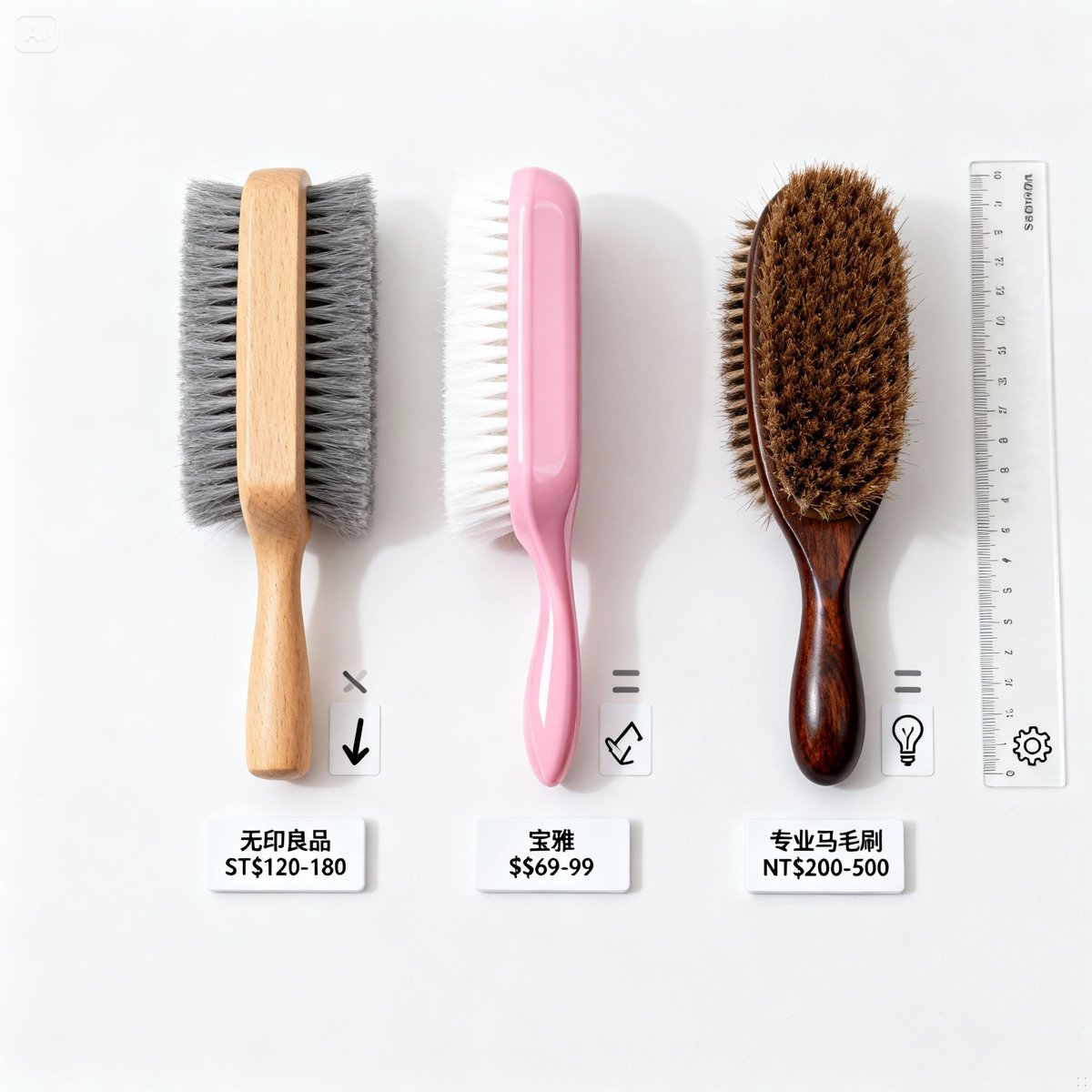
Clothes dust brush recommendations: 3 categories of product
Recommendation 1: the MUJI clothes brush (simple and practical)
Product features:
- Brand: MUJI
- Price: mid-range
- Bristle material: hog bristle
- Handle design: a simple wooden grip
- Size: about 6.5 cm wide × 24 cm long
Where it fits:
- Everyday upkeep of suit jackets
- Removing dust from coats
- Removing lint from sweaters
- Care of clothes worn at home
Advantages:
- Above-average softness that does not harm the fabric
- A simple, attractive design
- Stable quality, with no quality control problems
- A reasonable price
Disadvantages:
- A moderate anti-static effect (not as good as professional brands)
- Average bristle density
- Durability of about 1-2 years
Who is it for?
- Those who like a minimalist look
- A medium budget
- Everyday garment care
- Fans of the MUJI style
Where to buy: MUJI (sold on the Japanese official website; check with a store whether it is stocked in MUJI's Taiwan stores)
Recommendation 2: budget clothes brushes from household goods stores such as POYA (budget entry level)
Product features:
- Brand: depends on what the store has in stock (POYA is a Taiwanese beauty and household goods chain)
- Price: budget
Where it fits:
- Everyday dust removal from clothes
- Simple upkeep of suits
- Cleaning the surface of coats
- Removing dust from fabric sofas
Advantages:
- Cheap
- Convenient to buy (POYA stores across Taiwan)
Disadvantages:
- Quality depends on what the store has in stock; feel how soft the bristles are before buying
- A limited anti-static effect
- Not suited to fine fabrics
Who is it for?
- A limited budget
- Ordinary everyday clothes
- A first try
- Those who need several brushes for different places
Where to buy: POYA stores across Taiwan
For a detailed test of budget dust brushes, see Daiso / Showba anti-static brushes tested.
Recommendation 3: professional garment care brushes (the top choice)
Product features:
- Brand: various professional brands (such as Kent and Ikemoto)
- Price: mid-to-high
- Bristle material: natural horsehair or high-grade hog bristle
- Handle design: a solid wood grip, finely crafted
- Size: large (about 30 cm long)
Why natural hair?
The 3 advantages of natural horsehair:
- Extremely soft: softer than synthetic fiber, and does not harm the fabric at all
- Naturally anti-static: horsehair itself contains oils and is naturally anti-static
- Highly durable: up to 3-5 years in normal use
Where it fits:
- Upkeep of fine suits (NT$10,000 and above)
- Cashmere and wool coats
- Silk garments
- Designer clothing
- Professional laundries / clothing stores
Advantages:
- Extremely soft bristles that do not harm the fabric at all
- The best natural anti-static effect
- Handmade, of excellent quality
- The highest durability (3-5 years)
- A fine appearance and a first-class feel
Disadvantages:
- A higher price
- Fewer places to buy it (specialist stores, online)
- Needs more care (regular cleaning, protection from damp)
Who is it for?
- Owners of fine clothing (suits / cashmere coats)
- Those who want the best quality
- An ample budget
- Clothing store / laundry operators
Where to buy:
- Garment care counters in upmarket department stores
- Professional laundry supply stores
- Online platforms (search for "horsehair clothes brush")
- Direct purchase from Japan
💼 Bulk purchasing program for the clothing trade
If you are:
- A clothing store / boutique: providing customers with garment care tools
- A laundry / dry cleaner: using clothes brushes in large numbers
- In the hotel trade: with garment care needs in the housekeeping department
- A company with uniforms: for the upkeep of staff uniforms
YC Brushes - over 40 years of professional manufacturing experience
- ✅ Custom specifications (horsehair / hog bristle / mixed materials; bristle length / density / stiffness)
- ✅ Order quantities quoted per specification (email us with your requirements), with wholesale discounts on bulk purchases
- ✅ Your company logo can be printed on the brush to strengthen your brand image
- ✅ Factory-direct, with stable quality
Ask for a quote now
- 📞 Phone: +886-2-2988-2721
- 📧 Email: [email protected]
- 🌐 Online form: Contact YC Brushes
Factory-direct × professional custom work × wholesale discounts
Guide to garments and materials
Suit jackets
Recommended tool: a professional horsehair brush or the MUJI brush
How often: after every wear
Where to brush:
- Shoulders (where most dust collects)
- Cuffs and elbows
- Back (where it rubs against chair backs)
- Hem
Points to note:
- Brush along the grain of the fabric (usually top to bottom)
- Use light pressure
- Avoid buttons and trimmings
- Clean the inside of suit pockets with an air blower
Wool suits attract dust especially easily. They should be brushed every time they are worn. This greatly extends the life of the suit and reduces the number of trips to the cleaner.
Coats (wool / cashmere)
Recommended tool: a professional horsehair brush (first choice) or the MUJI brush
How often: after every wear
Where to brush:
- Shoulders and collar
- Sleeves
- Front
- Hem (which touches chairs)
- Around the pockets
Points to note:
- Cashmere coats are especially delicate, so the pressure must be extremely light
- Brush in the direction of the nap (usually top to bottom)
- Avoid brushing back and forth
- Napped coats need an even gentler touch
A coat has a large surface. Dealing with it with an anti-static brush takes 3-5 minutes, but it keeps the coat like new.
Wool sweaters / knitwear
Recommended tool: a horsehair brush or a dedicated soft brush
How often: after every 2-3 wears
Where to brush:
- Front (where it picks up the most)
- Sleeves
- Back
Points to note:
- Wool sweaters pill the most easily
- The pressure must be extremely, extremely light
- Do not brush back and forth (brush lightly in one direction)
- If there are already pills, deal with them with a fabric shaver and then maintain the garment with the brush
Wool sweaters should not be brushed too often. Over-brushing causes fuzzing.
Napped garments (flannel / corduroy)
Recommended tool: a professional soft brush
How often: as needed
Where to brush:
- Brush lightly in the direction of the nap
- Restore the loft of the nap
Points to note:
- Never brush against the nap (it damages the pile)
- Extremely light pressure
- Not suited to a roller (it flattens the pile)
Removing dust from napped garments with an anti-static brush also restores their loft: two benefits at once.
Fabric sofas
Recommended tool: a budget brush from POYA, Daiso or the like (nothing fancy is needed)
How often: once a week
Where to brush:
- Seat cushion surfaces
- Armrests
- Backrest
Points to note:
- Fabric sofas easily hide dust and skin flakes
- Brush along the grain of the fabric
- Can be paired with a small vacuum cleaner
- Keep a worn-out clothes brush specifically for the sofa
A sofa does not need a high-grade brush. A budget product will do.
Reference table by material
| Garment material | Recommended tool | Pressure | Frequency | Points to note |
|---|---|---|---|---|
| Wool suit | Horsehair brush / MUJI | Light | After every wear | Brush along the grain |
| Cashmere coat | Horsehair brush (top grade) | Extremely light | After every wear | Never brush back and forth |
| Wool sweater | Horsehair brush / soft brush | Extremely light | 1 brushing every 2-3 wears | Avoid pilling |
| Flannel | Soft brush | Extremely light | As needed | In the direction of the nap |
| Cotton garments | POYA / MUJI | Medium to light | As needed | Less sensitive |
| Silk | Horsehair brush (top grade) | Extremely, extremely light | As needed | The most delicate fabric |
| Fabric sofa | POYA / Daiso | Normal | Once a week | An old brush will do |
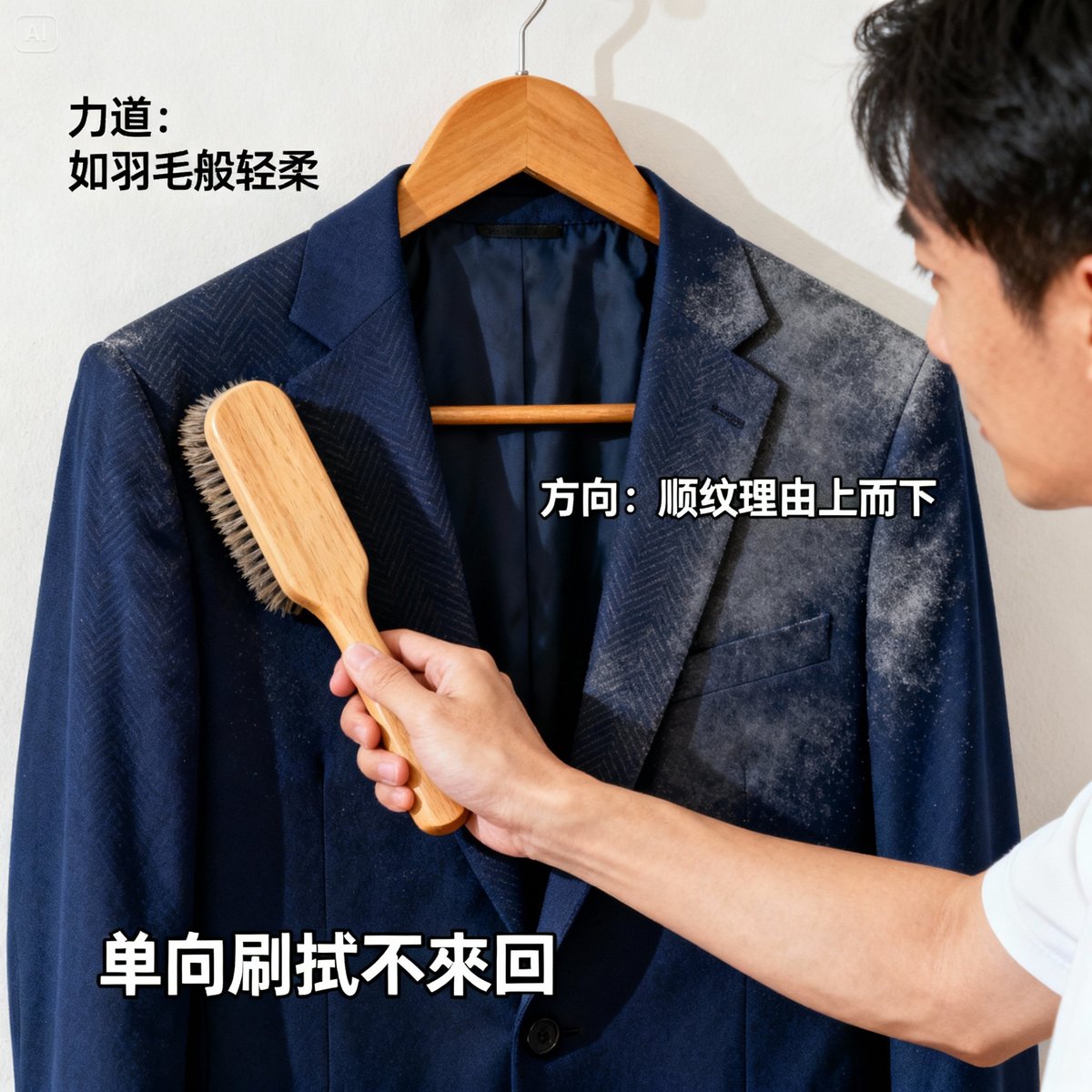
The correct technique for removing dust from clothes
The basic method in 4 steps
Step 1: lay the garment flat or hang it up
Suits / coats / shirts: brush them on a hanger (more convenient) Sweaters / T-shirts: brush them laid flat on a bed or table (to avoid stretching them out of shape)
Step 2: look at the grain of the fabric
Find the direction of the grain. It usually runs vertically downward. Only brushing along the grain keeps the look of the fabric intact.
Step 3: brush lightly in one direction, top to bottom
Start at the shoulders and brush lightly from top to bottom. Do not rub back and forth. 2-3 passes over each area is enough.
The pressure should be as light as a feather. Let only the tips of the bristles touch the fabric.
Step 4: check and finish
Check by eye whether any obvious dust remains. If so, go over those areas again. When you have finished, put the garment away.
Professional techniques for different fabrics
Wool fabrics (suits / coats)
- Brush in the direction of the nap (usually top to bottom)
- 2 one-way passes over each area is enough
- Do not over-brush
- Dust shows especially clearly on dark wool garments, so the before-and-after difference is striking
Napped fabrics (flannel / velvet)
- Always in the direction of the nap
- Never brush against it (this damages the pile structure)
- Use even lighter pressure
- Brushing restores the loft of the nap
Silk / fine fibers
- Use the softest horsehair brush
- Extremely, extremely light pressure
- Brush only the areas with obvious dust
- Avoid over-brushing
Cotton / blends (less sensitive)
- A budget brush will do (POYA / Daiso)
- The pressure can be closer to normal
- Not as sensitive as wool
5 common mistakes
❌ Mistake 1: brushing back and forth repeatedly
Rubbing back and forth will:
- Damage the fabric texture
- Cause fuzzing
- Take the sheen off the fabric
The right way: 2-3 light passes in one direction is enough
❌ Mistake 2: too much pressure
Pressing hard while brushing will:
- Harm the fibers
- Cause pilling
- Make the fabric fuzzy
The right way: as light as a feather
❌ Mistake 3: brushing against the grain
Brushing against the grain will:
- Damage the fabric texture
- Make the fibers stand up
- Make the fabric look matte
The right way: look at the grain and brush with it
❌ Mistake 4: brushing too often
Brushing a wool sweater every day will:
- Speed up fiber wear
- Make pilling more likely
- Shorten the life of the garment
The right frequency: suits after every wear, sweaters after 2-3 wears
❌ Mistake 5: using the same brush for everything
Using one brush for:
- Outdoor clothes (suits)
- The sofa at home
- This leads to cross-contamination
The right way: divide the work. A dedicated brush for fine garments, and an old or budget brush for the sofa.
For detailed technique, see How to use and care for dust-removal brushes.
Care advice for clothes dust brushes
Daily cleaning (after every use)
Step 1: tap the handle
After use, tap the handle lightly 3-5 times so that the lint and hair clinging to it fall off.
Step 2: comb the bristles with your fingers
Comb the bristles gently with your fingers to remove tangled fibers and hair.
Do not pull hard on the bristles.
Step 3: check, then hang it up
Check the condition of the bristles. Hang the brush up for storage so the bristles do not deform.
Deep cleaning (once a month)
Step 1: rinse with clean water
Rinse the bristles with clean water at room temperature. Press gently to squeeze out the dirt.
Do not use detergent (it destroys the anti-static effect).
Step 2: shake dry, then dry in the shade
Shake the water off firmly. Hang the brush in a ventilated place to dry naturally in the shade.
Do not use a hair dryer (heat causes damage).
Special care for horsehair brushes:
Horsehair brushes contain natural oils. Washing with water is not recommended. How to clean them:
- Comb with another brush (brush the two against each other)
- Press lightly with cleaning gel to pick up the dirt
- Wipe gently with a dry cloth
- Every six months, put 1-2 drops of hair oil on the roots of the bristles (to replenish the oils)
3 things never to do in brush care
❌ Never 1: wash with detergent
Detergent destroys the anti-static effect. Use clean water only.
❌ Never 2: dry with heat
Hair dryers and tumble dryers make the bristles stiff and misshapen. Only dry naturally in the shade.
❌ Never 3: lay flat under weight
Bristles that are pressed deform permanently. Always hang the brush up for storage.
Storage environment
Ideal environment:
- Temperature: 15-30°C (room temperature)
- Humidity: 40-70% (neither damp nor dry)
- Away from light: no direct sunlight
- Ventilation: keep it dry
Environments to avoid:
- A damp bathroom (the bristles go moldy)
- Exposure to the sun (the bristles harden)
- A sealed plastic bag (no ventilation)
For more on where to buy anti-static brushes, see Where to buy an anti-static brush? 10 sales channels compared on price, with current offers to find the channel that suits you best.
Conclusion: with the right tool, clothes stay like new
A clothes dust brush is a basic tool of garment care, especially for fine garments. Regular dust removal can:
- Extend the life of a garment by 2-3 years
- Reduce the number of trips to the cleaner (saving money)
- Keep garments looking like new
- Keep them in their best condition at all times
Buying advice:
- Fine garments (suits costing NT$10,000 or more / cashmere coats) → a professional horsehair brush (mid-to-high price)
- Ordinary garments (suits costing a few thousand NT dollars / wool sweaters) → the MUJI brush (mid-range)
- Everyday clothes (cotton / blends) → a budget brush from a household goods store such as POYA (budget)
- Fabric sofas → a budget brush from Daiso / POYA will do
Key points in use:
- Brush along the grain of the fabric
- Brush lightly in one direction, top to bottom
- Pressure as light as a feather
- Do not brush back and forth
- Adjust pressure and frequency to the fabric
Invest in a mid-range clothes dust brush and use it correctly, and your clothes can last several years longer. Set against the value of the clothes and the cost of cleaning, it is a very worthwhile investment.
Need to buy in bulk for a clothing store or laundry? Or need custom clothes brushes with your brand logo? Contact YC Brushes. With over 40 years of manufacturing experience, we supply natural materials such as horsehair and hog bristle, along with custom and wholesale services.
FAQ
How is a clothes dust brush different from an ordinary anti-static brush?
The main difference is the intended use. A clothes dust brush has soft bristles with fine tips (horsehair / hog bristle / high-grade fiber), designed for garment fibers, and does not cause pilling or scratching. An ordinary anti-static brush (such as Tamiya's anti-static brush for models) is designed mainly to remove static and is used on hard objects such as models. The risk of using the wrong tool: if you brush fine garments with an ordinary anti-static brush, its filaments are not designed for fabric, and a clothes brush may not give enough anti-static protection for cleaning a computer. The ideal setup: a dedicated clothes brush for clothes, and a dedicated anti-static brush for models and computers.
Which is better, an anti-static brush or an adhesive lint roller?
Each has its strengths, so choose by need. Strengths of the anti-static brush: (1) gentler, with no damage to the fabric, suited to fine garments; (2) reusable for 2-3 years, green and economical; (3) a good anti-static effect that reduces re-attraction of dust; (4) does not cause pilling. Strengths of the roller: (1) fast, and efficient over large areas; (2) works better on pet hair; (3) cheap and easy to buy. Advice: use the anti-static brush for fine garments (suits / cashmere / silk), the roller for ordinary clothes or when in a hurry, and the roller for pet hair. Best of all is to keep both.
Can a budget Daiso dust brush be used on a suit?
Yes, but it is not recommended for fine suits. The Daiso dust brush has stiffer bristles, with a softness of about 3-4/10, and on a suit costing NT$10,000 there is a risk of scratching or fuzzing. Where it fits: ordinary inexpensive suits (a few thousand NT dollars) / cotton garments / fabric sofas → fine to use; fine wool suits (NT$10,000 and above) / cashmere coats / silk garments → not recommended. Advice: if you only have inexpensive clothes, Daiso will do; if you have fine garments, invest in a mid-range professional clothes brush, which is well worth it relative to the value of the clothes. Having a suit cleaned even once is not cheap, so buying a good brush and using it for 3 years is the better deal.
How often should clothes be brushed?
It depends on the type of garment and how often it is worn. Suit jackets: brush after every wear (3-5 minutes), which removes the dust of the day and greatly extends the life of the suit. Coats: brush after every wear; this matters especially in winter when they are worn often. Wool sweaters: brush 1 time after every 2-3 wears; over-brushing speeds up wear. Flannel / napped garments: as needed, not too often. Cotton T-shirts / shirts: wash them straight after wearing, no brushing needed. How to judge: on dark clothes, brush when dust is visible; on light clothes dust is less visible, but regular brushing is still recommended.
How light should the pressure be when brushing clothes?
Extremely light, like a feather sweeping across. Specifically: (1) only the tips of the bristles touch the fabric, with no pressing down; (2) you cannot feel the weight of the brush; (3) the fabric does not dent under the brush. Pressure by fabric: fine fabrics (cashmere / silk) - extremely, extremely light, almost floating over; wool suits / coats - extremely light, like a feather; cotton / blends - light; it can be closer to normal but should still be gentle. A common mistake is thinking you have to brush hard to get the garment clean. In fact the work is done by the tips of the bristles and the anti-static effect, not by force. Force only harms the fabric. How to practice: start on a garment that does not matter, until you get the feel of "gentle".
Why is my suit dusty again so soon after brushing?
3 possible causes: (1) The brush has no anti-static effect - an ordinary brush only removes surface dust and cannot eliminate static, so the garment soon attracts dust again. Fix: use a dedicated brush with an anti-static function. (2) Too much dust in the environment - when the office or home is dusty, clothes keep attracting it. Fix: keep the environment cleaner and use an air purifier. (3) The garment itself carries too much static - this is especially obvious in dry winter weather. Fix: spray the garment with anti-static spray, or use a humidifier indoors to raise the humidity to 50-60%. Brushing with a good anti-static brush reduces the re-attraction of dust.
How does a horsehair brush differ from ordinary bristles?
Horsehair is the material of top-grade clothes brushes. There are 3 main differences: (1) Softness - horsehair is extremely soft, clearly softer than synthetic fiber, and does not harm garment fibers at all. (2) Naturally anti-static - horsehair contains natural oils, so it is naturally anti-static and the effect lasts. (3) Durability - a horsehair brush lasts 3-5 years in normal use, a synthetic fiber brush 1-2 years. Price: horsehair brushes cost clearly more than synthetic fiber brushes. Where each fits: fine suits of NT$10,000 and above / cashmere coats / silk garments must be brushed with horsehair; synthetic fiber is fine for ordinary clothes. Investment advice: if you own fine garments, a horsehair brush is worth buying; spread over many years of use, the cost per year is not high.
Can a clothes dust brush be used to clean computers or models?
Not recommended. Clothes brushes and computer / model brushes serve different purposes. Clothes brushes: (1) extremely soft bristles, suited to fabric; (2) a looser anti-static standard; (3) not suited to precision items. Computer / model brushes: (1) high filament density and better dust removal; (2) for computers, choose a brush labeled as meeting ESD requirements; (3) designed for hard objects. The risk of using the wrong tool: cleaning a computer with a clothes brush → not enough anti-static protection, with possible ESD damage; brushing fine garments with a computer brush → the filaments may be too stiff and harm the fabric. Advice: divide the work by purpose and buy a dedicated brush for each. The total outlay is not high, and everything is properly protected.
Can a clothes dust brush be used to clean a fabric sofa?
Yes, but a budget brush or an old brush is recommended. Reasons: (1) sofa dust is heavier and more mixed (skin flakes / food crumbs / hair) and dirties the brush quickly; (2) a sofa has a large surface and is cleaned often, so the brush wears fast; (3) sofa fabric is usually not a fine material and does not need a top-grade brush. Recommended tools: budget brushes from Daiso / POYA and the like, or a retired clothes brush. Technique: brush along the grain of the fabric, once a week, and pair it with a small vacuum cleaner for better results. Important: do not use the sofa brush on suits and other clothing, to avoid cross-contamination. Dividing the work is ideal.
Are there discounts when a clothing store or laundry buys clothes brushes in bulk?
Yes! Clothing businesses buying in batches can enjoy factory-direct discounts. YC Brushes offers a professional program: (1) Bulk purchasing - wholesale prices, and the larger the quantity, the bigger the discount; order quantities are quoted per specification, so please email us with your requirements. (2) Custom specifications - you can specify the bristle material (horsehair / hog bristle / mixed), length, density and handle design. (3) Printed company logo - strengthens your brand image and adds to customer service. (4) Stable quality - over 40 years of manufacturing experience and consistent quality from batch to batch. Suitable for: clothing stores / boutiques (providing customers with garment care tools), laundries / dry cleaners (heavy use), the hotel trade (housekeeping departments) and companies with uniforms (upkeep of staff uniforms). Inquiries: phone +886-2-2988-2721 or the online contact form.