"I need a softer brush, please send me a price." In practice this cannot be quoted. That is not the supplier being difficult: the filament diameters that could count as "soft" span an order of magnitude, and diameter decides the material, the process and the tooling, which in turn decide the price.
It is fine if your specification is not complete yet. If you have a physical sample or a drawing, send it first. YC Brushes will assess it and quote from the sample or drawing → Send your inquiry
Why a quote is impossible without enough information
A complete industrial brush specification covers the base material, filament material and diameter, trim length, density, fill pattern, core configuration, rotation speed, contact pressure, heat and chemical resistance requirements, and the surface being treated (Cepillos Regios).
The customer does not have to fill in all of these, but the supplier must be able to derive them, and the starting point for that derivation is the three elements.
Our inquiry process splits the requirements into feel, function and documents because each of the three decides something different: feel decides the diameter and the material family, function decides the special requirements on the material, and documents decide the schedule. If any one is missing, the quote can only be a range, and the back-and-forth to confirm details ends up slower.
Element 1: Feel and stiffness
Stiffness is not an independent parameter. Filament diameter and trim length together determine how stiff the filament is: at the same diameter, the longer the filament, the softer it feels. So "make it soft" is not enough to fix a specification.
The grades used in practice and their typical ranges:
| Stiffness grade | Typical diameter | Common materials | Suitable for |
|---|---|---|---|
| Very soft | Below 0.1 mm | Ultra-fine nylon, goat hair, horsehair | Precision optics, cleaning electronic components |
| Soft to medium | 0.2-0.5 mm | Nylon 66, PP | Plastic deburring, panel conveying, general sealing |
| Hard to very hard | Larger diameters | Silicon carbide abrasive filament, stainless steel wire | Heavy-duty work such as descaling castings |
If you are not sure which grade you need, describing "what has to be cleaned and what must not be damaged" is far more useful than guessing a number.
Another point that is often overlooked is the difference between nylon grades. Nylon comes in Type 6, 6.6 and 6.12. Their wear resistance is similar, but the higher the grade, the lower the water absorption. For applications that need stable dimensions and stable electrical resistance, this difference affects real performance, so writing "nylon" on the specification is not enough: specify the grade.
Element 2: Functional requirements
Function decides which special properties the material must have. Common types of requirement:
| Function | What it affects |
|---|---|
| Anti-static (ESD) / conductive | Decides the resistance grade of the filament and the conductive mechanism (compounded or surface-coated) |
| High-temperature resistance | Decides the upper limit of the material; ordinary nylon and high-temperature grades differ greatly |
| Chemical resistance | Decides the acid and alkali range the material can withstand |
| Food grade | Must comply with the relevant regulations and come with the corresponding documents |
| Medical grade | May also carry sterilization and biocompatibility requirements |
| General cleaning | Fewest restrictions and the most freedom in material choice |
This element also decides the handle material. Take an ESD application: if the filament is anti-static but the handle is not conductive, the whole grounding path is broken. Functional requirements constrain both ends, the filament and the handle.
Element 3: Document requirements
We now ask about this up front, because we have been burned before: the specification had been agreed, and only then did the customer mention that a third-party ESD report was needed. The chosen material had no existing documents that could be reused, so the whole schedule effectively started over. Asking about documents in the first round costs thirty seconds; asking at the end can cost three weeks.
Of the three elements, documents are the easiest to miss and the one that affects lead time the most.
Common requirements include ESD test reports, RoHS / REACH hazardous substance tests and SDS safety data sheets. Food or medical applications may also need FDA or ISO related documents.
The key point: when an existing material source is used, the upstream raw material supplier's existing declarations can usually be reused; introducing a new material means sending it for testing again, and that often takes longer than tooling. If your project schedule is tight, raise the document requirements in the first inquiry instead of adding them after the specification is final.
Describing the environment works better than naming a material
This is the most useful lesson we have learned from our inquiry process: when a customer names the material directly, that material is often not the best fit, because the choice usually comes from an old supplier's specification or from information found online, not from an assessment of the current process. If the customer describes the operating environment instead, the supplier can derive the right answer from the process conditions, and sometimes finds an alternative that is cheaper or has a shorter lead time.
An "anti-static brush" for semiconductor front-end, back-end packaging and testing, a module plant, a PCB plant and an optical lens plant calls for a completely different material in each case. What decides the answer is the process environment, not the words "anti-static".
Environment information worth describing:
- Cleanroom class, or whether it is an ESD-protected area
- Operating temperature and whether there is contact with chemicals
- What material the object being cleaned or treated is made of, and whether its surface has structures
- Machine specifications and installation space limits
- Frequency of use and expected service life
If you have a physical sample, this is the fastest way to provide it
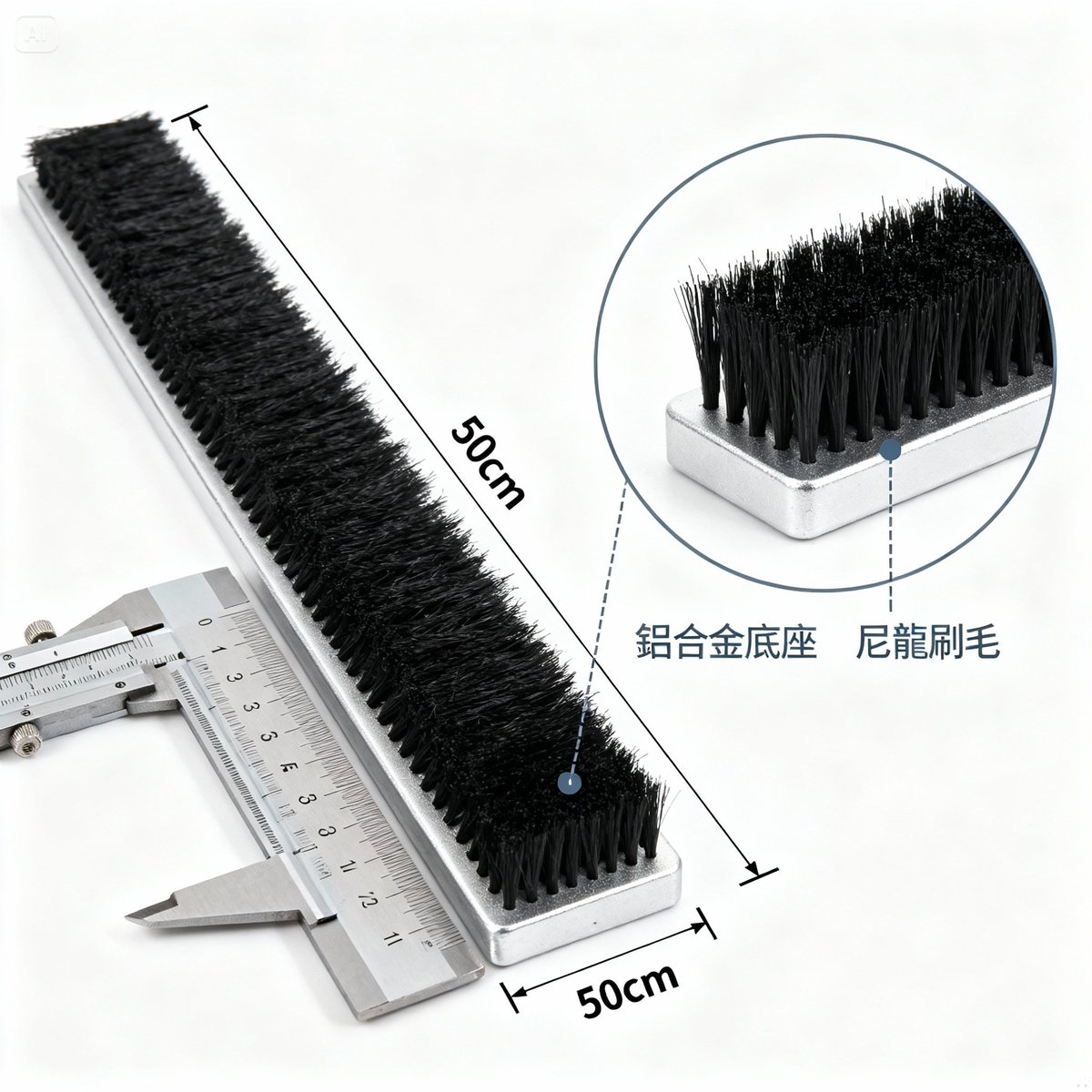
Having an existing brush in hand is the best starting point. Photos plus measurements are more precise than any written description and can go straight into the reverse engineering process.
The basic dimensions to measure:
| Form | Required dimensions |
|---|---|
| All types | Overall length, trim length, base width and thickness |
| Roller brush | Outer diameter, core diameter, effective brush width |
| Disc brush | Outer diameter, center mounting hole diameter |
| Strip brush | Base profile (U type / H type and so on), overall length |
When taking photos, include a scale (place a ruler next to the brush) and take a close-up of the mounting interface. If the mounting method does not match, the brush cannot be installed no matter how correct the other specifications are.
The form of the brush affects the process and the lead time
The form of a brush decides the process route, and therefore the lead time and whether tooling is needed:
| Form | Process characteristics |
|---|---|
| Hand brush | Needs handle tooling or an existing handle; the handle material affects ESD performance and cleanliness |
| Roller brush | Needs a core and end caps, and must match the machine's rotation speed and mounting interface |
| Strip brush | Can be cut and combined, the most flexible, usually no tooling needed |
| Cup brush / fan shape | Special tufting angles that may need dedicated fixtures |
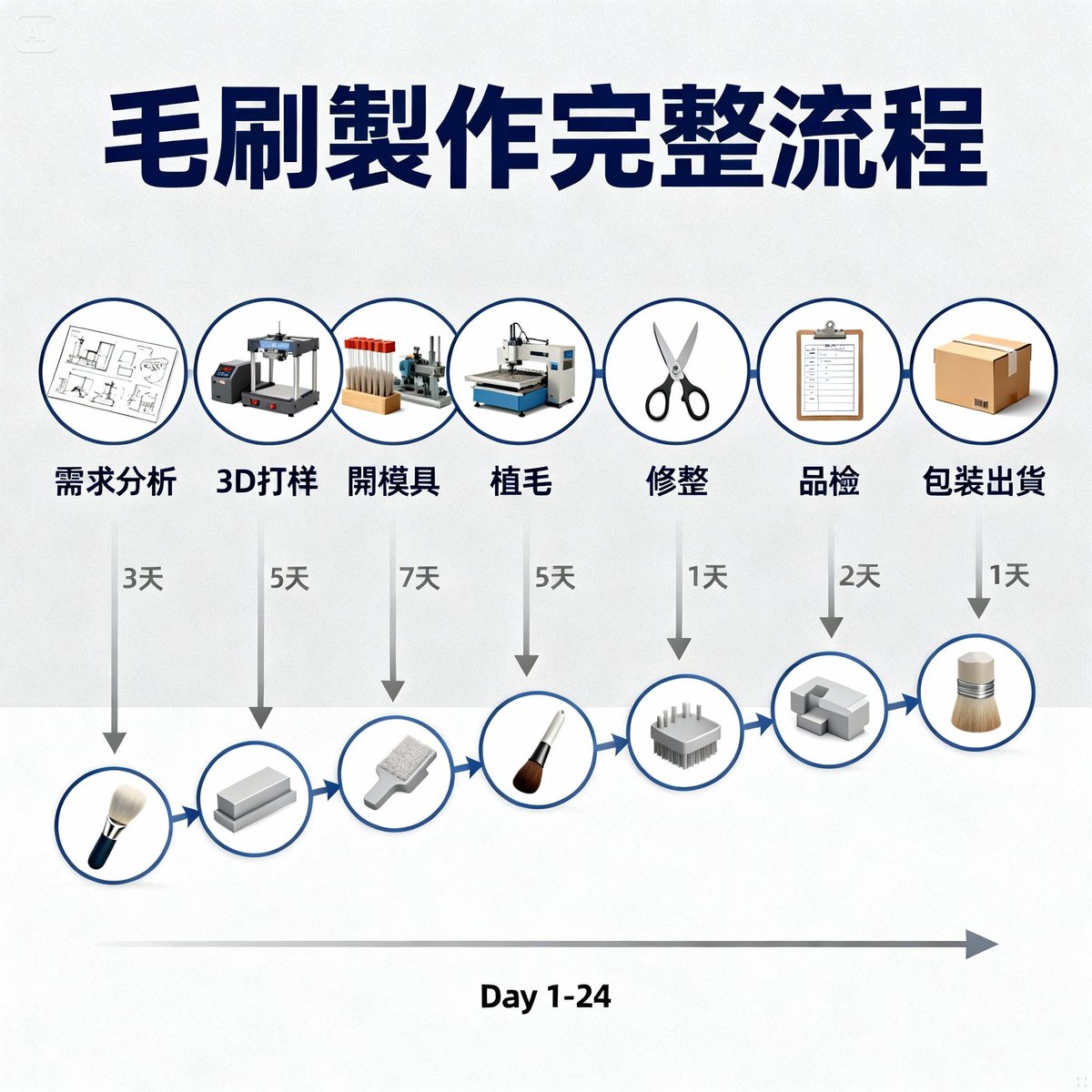
Strip brushes are usually the form with the shortest lead time because they can be cut to length. For forms that need tooling, the tooling time has to be counted into the project schedule.
What happens when information is missing
Explaining the consequences honestly is more useful than pressing customers to fill in a form:
- Only a price range can be given. The supplier has to price in the uncertainty, so the range becomes very wide and is no help when comparing quotes.
- Back-and-forth confirmation lengthens the lead time. Each round of additional information takes several working days, and three rounds often cost two weeks more than providing everything at once.
- The wrong solution may be quoted. If the supplier chooses a material based on incomplete information and the sample turns out to be unsuitable, both the time and the sample fee are wasted.
You do not have to provide a budget range, since it does not affect the technical judgment. If you are willing to share it, though, the supplier can weigh the options more precisely, for example when advising between an existing material source and the theoretically best solution.
FAQ
I do not know how soft it should be. How do I describe it?
Describe "what has to be cleaned and what must not be damaged". That is more useful than guessing a diameter. For example, "cleaning an aluminum surface without leaving scratches" is enough for the supplier to judge which diameter range fits. Stiffness is determined by filament diameter and trim length together, so what the supplier needs is the application conditions, not a single number.
Why is describing the environment better than naming a material?
Because the material a customer names often comes from an old supplier's specification or from online information, and may not be the best fit for the current process. Describing the environment lets the supplier work from the process conditions, and sometimes a cheaper option or one with a shorter lead time turns up. Even for anti-static brushes, the right material differs completely from one industry to another.
Is it enough to write "nylon" on the specification?
No. Nylon comes in Type 6, 6.6 and 6.12 grades. Wear resistance is similar, but water absorption differs clearly: the higher the grade, the lower the absorption. For applications that need stable dimensions or stable resistance, this difference affects real performance. Specify the grade, or describe the operating environment and let the supplier recommend one.
What should I provide if I have a sample?
Photos plus three kinds of measurement: overall length, trim length, and base width and thickness. For roller brushes, also the outer diameter and core diameter. Include a scale in the photos and take a close-up of the mounting interface. A physical sample can go straight into the reverse engineering process, which is far more precise than a written description.
Why should document requirements be raised in the first inquiry?
Because they directly affect the lead time. When an existing material source is used, the upstream declarations can mostly be reused; a new material has to be sent for testing again, which often takes longer than tooling. If documents are only mentioned after the specification is final, the whole solution may have to be redone.
References
- Cepillos Regios - Made to Spec Brush Manufacturing Specifying Guide
- Precision Brush - Commercial Brush Fillings
- Brushcustom - How to Specify a Custom Industrial Brush: Dimensions and Mounting Details
Further reading
- How to submit brushes for testing: four document types and when testing is needed
- How to choose cleanroom brushes: 3 red lines where the class decides the material
- How to choose anti-static brush resistance: a three-grade selection guide
- Compounded or surface-coated conductive fiber? Service life and selection explained
- The complete guide to custom brushes
- The brush manufacturing process explained
- Tufted plate brushes: what to settle first about base material and tolerances