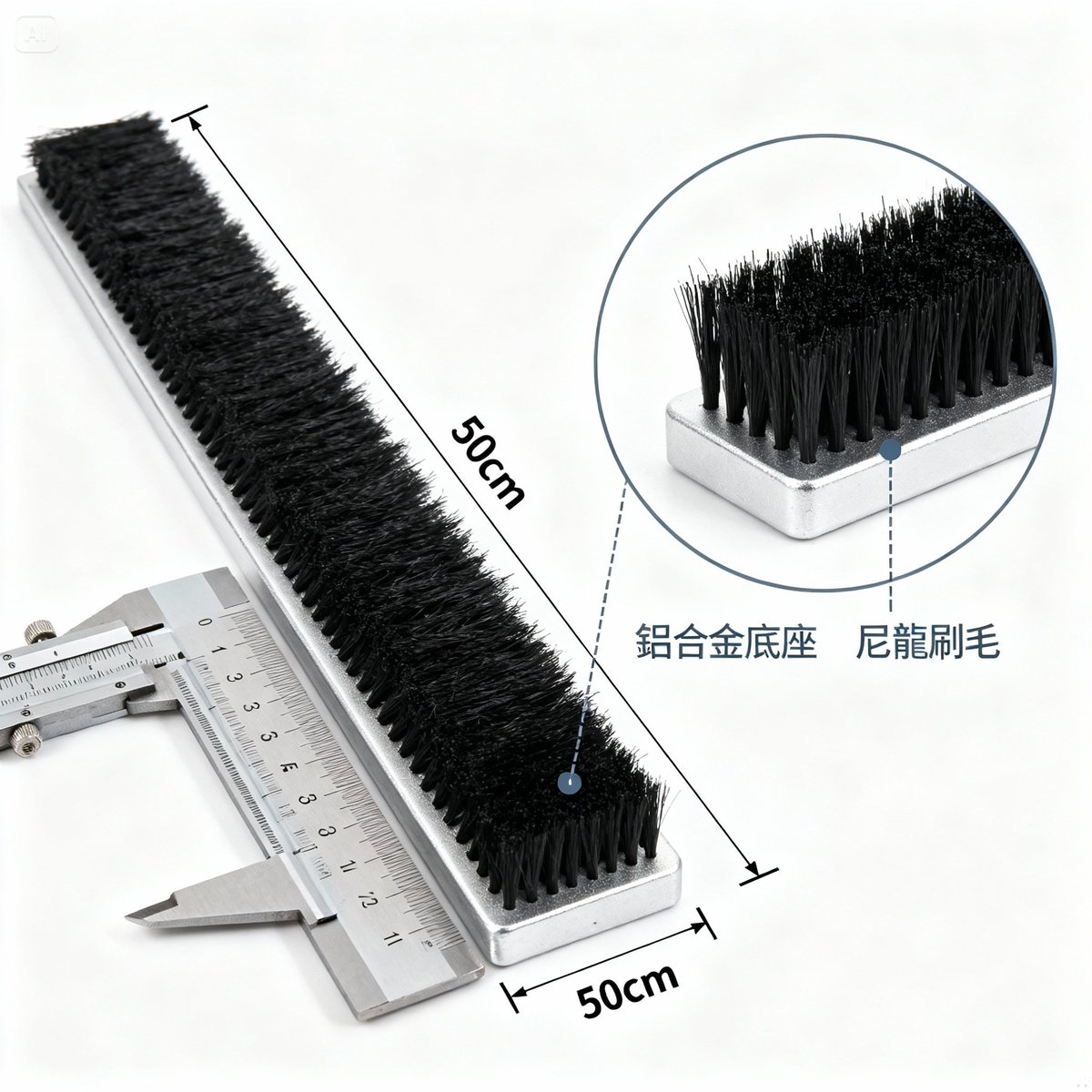
Whether the filament resistance of a brush should be 10⁶ or 10⁹ ohms does not decide whether the brush works well. It decides whether the brush becomes a discharge path in your process. Choose this number wrongly and the brush itself is perfectly normal, yet the components being cleaned may be damaged.
Not sure which resistance grade to choose? Tell YC Brushes about your operating environment and the current situation, and we will help assess it based on over 40 years of manufacturing experience → Fill in an inquiry
The words "anti-static brush" mean three different things on a quotation
In practice, when an inquiry arrives saying "I need an anti-static brush", the customer may have any of three different specifications in mind: a material that inhibits triboelectric charging, a static dissipative material with a resistance of 10⁶–10⁹ Ω, or a conductive material with a resistance below 10⁶ Ω. The three differ in price, lead time and the processes they suit.
In the anti-static brush inquiries we have handled, the most common entry on the requirements form is a single line, "Functional requirement: anti-static (ESD)", with no resistance range after it. That line is not enough to quote from: it can correspond to three materials and a resistance gap of two orders of magnitude. The information that really lets a quote be pinned down is the process environment and what the object being cleaned is.
The divergence comes from a mismatch between the Chinese and English definitions:
| Term | Meaning in international standards (resistance ranges use ANSI/ESD STM7.1 flooring materials as the example) | Common usage in the Taiwanese industry |
|---|---|---|
| Anti-static | A functional description: a material that inhibits triboelectric charging, unrelated to any resistance range | Often used directly for the resistance grade of 10⁶–10⁹ Ω |
| Static Dissipative | Resistance range: >1.0×10⁶ Ω and <1.0×10⁹ Ω | Sometimes called the "anti-static grade" |
| Conductive | Resistance range: ≤1.0×10⁶ Ω | Often called the "static-conductive grade" |
In other words, the "anti-static grade" spoken of in Taiwan corresponds to dissipative in the international definition, while anti-static in the international definition refers to something else. If a purchase order says "anti-static" and the supplier reads it by the international definition, the two sides will be talking about completely different specifications.
Which processes the three resistance classes correspond to
According to the official explanation from the EOS/ESD Association, the resistance to ground of a conductive flooring material is ≤1.0×10⁶ Ω, and that of a static dissipative flooring material is more than 1.0×10⁶ Ω and less than 1.0×10⁹ Ω (EOS/ESD Association). Above these two classes are insulative materials, from which charge cannot be carried away by grounding. These figures are the dividing lines for flooring materials; the ESD Association's ADV1.0 classifies general materials more broadly: a surface or volume resistance below 1.0×10⁴ Ω is conductive, 1.0×10⁴ to below 1.0×10¹¹ Ω is static dissipative, and ≥1.0×10¹¹ Ω is insulative. When choosing a brush, check which standard the customer's process cites.
Where the three classes actually sit:
| Class | Resistance range | How charge flows | Typical use |
|---|---|---|---|
| Conductive | ≤1.0×10⁶ Ω | Flows quickly to ground | Highly sensitive front-end processes, workstations with special grounding requirements |
| Dissipative | >1.0×10⁶ Ω and <1.0×10⁹ Ω | Flows to ground at a controlled, slower rate | EPAs (ESD-protected areas), module packaging, PCBA cleaning |
| Insulative | Above the ranges above | Cannot be carried away by grounding | Not suitable for ESD areas; neutralization by ionization must be used instead |
Most brushes on electronics manufacturing floors fall in the static dissipative class. The reason is that "dissipating", not "conducting", is the behavior wanted here: the charge leaves at a controlled rate instead of flowing away in an instant.
There is a further rule at the system level: ANSI/ESD S20.20 requires that when a person wearing footwear stands on the flooring system, the overall resistance must be below 1.0×10⁹ Ω (EOS/ESD Association). The resistance of the brush has to be looked at as part of this path; it cannot be assessed on its own.
How Taiwan's Chinese-language grades map to international standards
A three-way classification common in Taiwan's plastics and flooring industries is the "static-prevention grade" (fang-jingdian), the "anti-static grade" (kang-jingdian, static dissipative) and the "static-conductive grade" (dao-jingdian), and the resistance ranges stated by different companies are not all the same. Laying it over the international definitions:
- Taiwan's "static-conductive grade" ≈ the international Conductive
- Taiwan's "anti-static grade" ≈ the international Static Dissipative
- Taiwan's "static-prevention grade" sits on the edge of insulative in the international definition, and most EPA specifications do not accept it
The real trap is not in the numbers. It is that the word "anti-static" points to different dimensions in the two systems: the international definition describes behavior (whether triboelectric charging occurs), while the Taiwanese usage describes a resistance range. If a specification that says "anti-static" comes without an ohm value, the supplier has no way of telling which one you want. That is also why our inquiry process always asks for the resistance range or the process environment, instead of quoting straight from the word "anti-static".
Conductive grade is not a higher tier, and choosing in the wrong direction carries risk
"The lower the resistance, the better" is an intuitive but wrong inference. The official article from the EOS/ESD Association questions the line drawn at 1.0×10⁶ Ω between conductive and dissipative (the original asks what is actually special about that value), and explains that when a dissipative floor is combined with low-resistance footwear, overall performance is equivalent to that of a conductive floor; what really decides the outcome is not the material class but how the whole system manages charge decay time and triboelectric charging (EOS/ESD Association).
Applied to brushes, a resistance that is too low is actually a disadvantage in certain situations: when the object being cleaned is itself charged, a conductive-grade brush forms a fast discharge path at the moment of contact, and fast discharge is exactly the mechanism by which components are damaged. The dissipative grade lets the charge leave at a controlled rate, and this "slowness" is the design intent, not a shortfall in performance.
When we made selection recommendations for a memory module packaging process, what we mainly recommended was the static dissipative grade (surface resistance in the 10⁶–10⁸ Ω range) and not the conductive grade, for exactly this reason: what that process needs is for no new discharge event to be introduced during cleaning, not for the charge to be conducted away as fast as possible.
What resistance grading can guarantee, and what it cannot
This is the section most easily skipped during selection. Filament resistance that meets the specification does not mean the static problem on site will disappear.
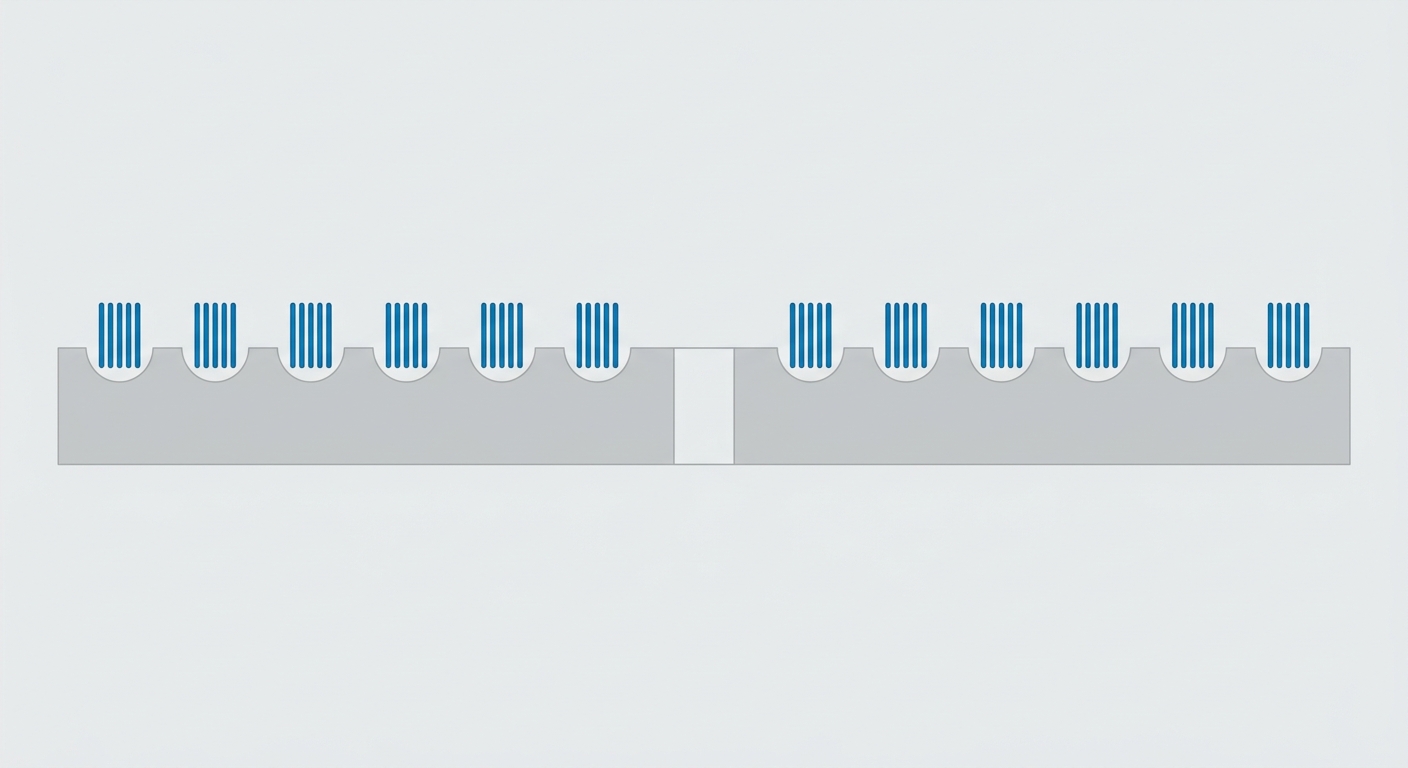
Resistance grading constrains only one section of the whole dissipation path. The actual path starts at the surface of the object being cleaned and runs through the filament tip, the filament root, the brush handle, the operator, the wrist strap and the ground cord, finally reaching the facility grounding point. If any section is broken, the specifications before it will not take effect. Common points of failure include: the bonding layer used in tufting is a high-resistance material, the handle itself is not conductive, the operator is not wearing a wrist strap, or the ground cord is not connected to a qualified ESD grounding point.
Two further variables that resistance grading does not govern:
- Insulating workpieces: with a strong insulator such as PFA, surface charge cannot be carried away through the grounding path. The brush can only remove charge from the very outermost layer, so several passes are needed, or neutralization with an ionizer.
- Relative humidity: when ambient humidity is clearly low, static build-up gets worse, and the half-life of the charge can stretch from the order of seconds to the order of minutes or more. This has nothing to do with the brush specification, but it leads people to believe the brush has failed.
So "buying the right resistance grade" is a necessary condition, not a sufficient one. If you have purchased to specification and there is still no improvement, the problem is usually in another link of the path, not in the filament itself.
What to provide in an inquiry so that the quote is accurate
Writing only "anti-static brush" gets you a price range or a string of questions in return. To get the quote right the first time, provide the following three kinds of information:
| Category | Specifics |
|---|---|
| Process environment | Cleanroom class, whether it is an EPA (ESD-protected area), the controlled range of relative humidity |
| Object being cleaned | Material (metal / plastic / insulator), whether the surface has structures, how sensitive it is to static |
| Specification requirements | Target resistance range (or simply state the internal specification being followed), feel and stiffness, the documents needed |
Document requirements are especially worth making clear first, because they affect the lead time. The three common documents each prove something different:
- ESD test report: a third-party laboratory measures surface resistivity and static decay time, proving the anti-static performance of the filament and the handle.
- SGS report: in practice this mostly means RoHS / REACH hazardous substance testing. RoHS addresses restricted substances and REACH addresses the SVHC list of substances of very high concern; it is standard in the electronics supply chain.
- SDS safety data sheet: a product safety description in a fixed 16-section format. Purely solid articles are low in hazard, and the sheet can be compiled from the upstream raw material supplier's data.
If an existing material source is chosen, the raw material supplier's RoHS / REACH declarations can usually be reused, and the lead times for both sample preparation and volume production are shorter than when a new material is introduced. A new material source has to be sent for testing again, and that often takes longer than tooling. That is also why, when assessing options, we first confirm whether an existing material source can meet the requirement before considering a material that is better in theory.
FAQ
Are "anti-static" brushes and "static-prevention" brushes the same thing?
In everyday usage in Taiwan the two terms (kang-jingdian and fang-jingdian) are often used interchangeably, but they map to different things in international standards. The "anti-static grade" spoken of in Taiwan mostly means static dissipative material, while the "static-prevention grade" sits on the edge of insulative in the international definition, and most EPA specifications do not accept the latter; the resistance ranges stated by different companies are not all the same either. When making an inquiry, we suggest writing the resistance range or the process environment directly, so that the wording does not cause misunderstanding.
The filament resistance meets the specification, so why is the static problem on site still not solved?
Because resistance grading constrains only one section of the whole dissipation path. The full path includes the workpiece surface, the filament, the handle, the operator, the wrist strap and the ground cord through to the facility ground, and a break in any section makes the specification ineffective. The three most common break points are a tufting bonding layer made of a high-resistance material, a handle that is not conductive, and an operator not wearing the wrist strap correctly. We suggest first checking the items that can be confirmed without instruments.
Is a conductive-grade brush a higher tier than a dissipative-grade one?
No. An article from the EOS/ESD Association questions what is special about the dividing line between the two at 1.0×10⁶ Ω, and actual performance depends on the whole system. A resistance that is too low may actually form a fast discharge path when the object being cleaned is charged, and fast discharge is exactly the mechanism by which components are damaged. What most electronics processes need is controlled, slow dissipation, not the fastest conduction.
What documents are needed when purchasing anti-static brushes?
Three are common: an ESD test report (proving resistance and decay performance), an SGS RoHS / REACH report (hazardous substances) and an SDS safety data sheet. Which ones you actually need depends on your customer's and your industry's requirements. If the supplier's existing material source is used, the raw material supplier's existing declarations can usually be reused, which clearly shortens the lead time.
Is an anti-static brush effective on workpieces made of insulating material?
Only to a limited extent. The charge on the surface of a strong insulator cannot be carried away through the grounding path, and the brush can only remove charge from the very outermost layer. Cases like this call for neutralization with an ionizer as well, and in a cleanroom environment a model that meets the cleanliness requirement must be chosen; an ordinary industrial benchtop fan-type ionizing blower cannot be used directly.
Further reading
- Anti-static brush not working? A troubleshooting guide to the seven links of the dissipation path
- Compounded or surface-coated conductive fiber? Service life and selection explained
- How to choose cleanroom brushes: 3 red lines where the class decides the material
- How to submit brushes for testing: four document types and when testing is needed
- Anti-static brushes: a complete explanation
- The complete guide to brush materials