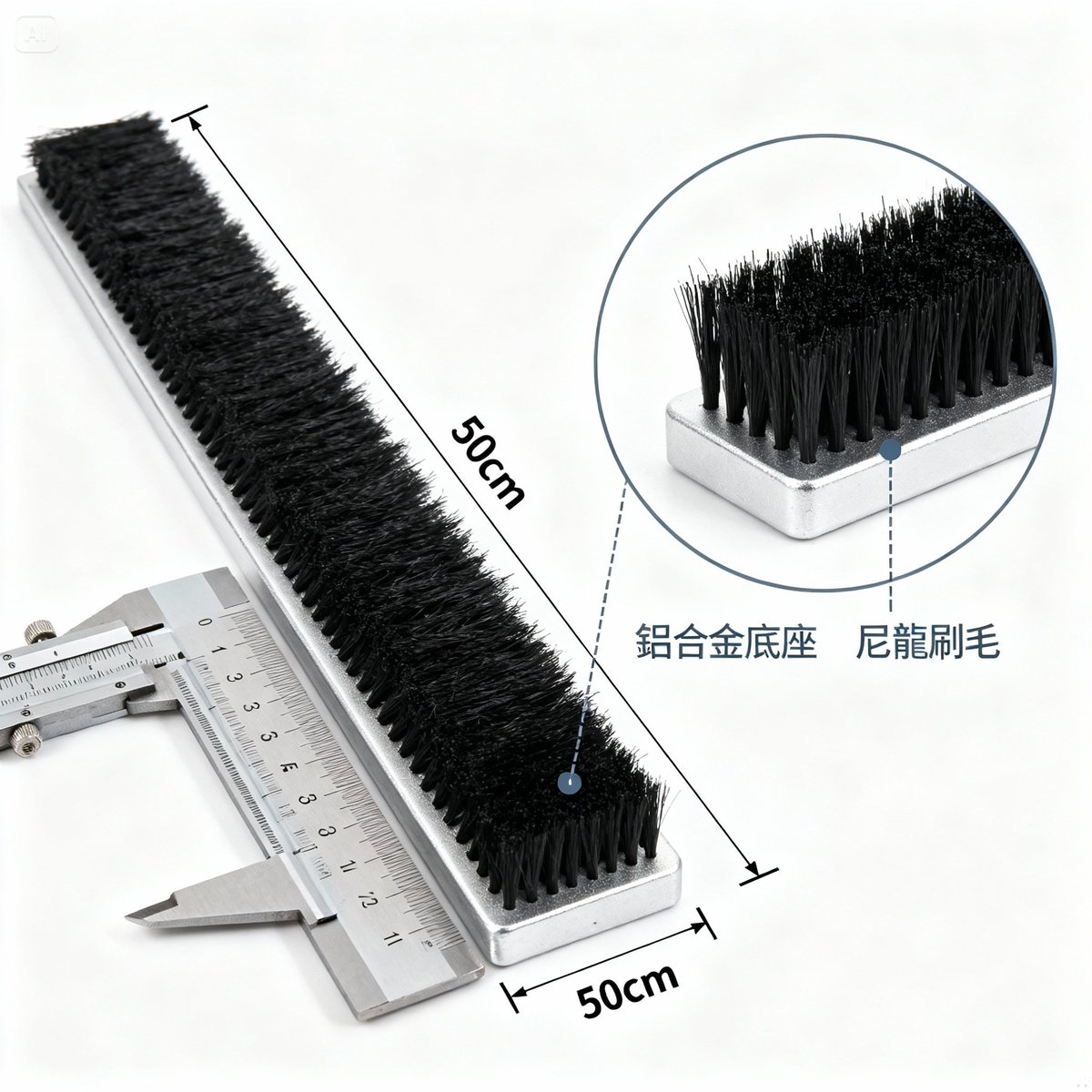
The resistance value on the brush specification sheet meets the requirement completely, yet the static problem on the shop floor has not improved at all. In this situation, switching to a more expensive brush usually does not help, because the problem is almost never in the filament itself: a section of the path downstream of it is broken.
Is your anti-static brush performing below expectations? Tell YC Brushes about your operating environment and your current situation, and we will help you assess it based on over 40 years of manufacturing experience → Send your inquiry
Static dissipation is a series circuit, not a single property of the brush
Whether an anti-static brush can carry charge away depends on whether the whole path is connected, not on how good the filament resistance looks. The full path has seven links, and if any section is high-resistance or open, the whole path fails. This is the basic behavior of a series circuit, yet it is the check most often skipped in practice.
The path looks like this:
Workpiece surface → filament tip → filament root → brush handle → operator's hand → wrist strap → ground cord → facility ground
We once had a customer report that "the anti-static effect has not improved", when the grounding path designed into the brush was in fact very complete. When we reviewed the case, we found the problem at the very top of the path: the workpiece being cleaned was itself a strong insulator, so the charge never flowed into the filament at all. However well the downstream path is designed, it can do little for the charge on that surface. This is a physical fact that we ourselves did not see clearly at first.
Four links you can rule out without any instrument: do these first
The order of troubleshooting should follow "cost of checking", not "how professional it sounds". The four items below need no measuring equipment and can be confirmed just by standing on the shop floor and looking, yet they cover a fairly high proportion of the causes of failure seen in practice.
| Link | What to check | How to judge |
|---|---|---|
| Operator → wrist strap | Is the wrist strap being worn, is it snug against the skin, is the buckle broken | Look on site |
| Wrist strap → ground cord | Is the ground cord really plugged into a qualified ESD grounding point (EBP) | Look on site |
| Handle material | Is the handle an insulating material (wooden handle, untreated plastic handle) | Check the specification |
| Workpiece material | Is the object being cleaned a strong insulator (fluoropolymers, untreated plastic) | Check the specification |
Only after all four have passed is it worth bringing in instruments. Doing it the other way round, renting test equipment first or sending the brush for re-verification first, often means spending money in the least likely place.
Three links that need an instrument to confirm
The remaining three links have to be measured and cannot be judged by eye:
- Filament tip → filament root: whether the actual resistance of the bundled filament falls within the dissipative range. The specification sheet gives the material value; the performance once bundled into tufts has to be measured.
- Filament root → brush handle: whether the bonding layer used for tufting is conductive. This is the most invisible break point: the filament passes, the handle passes, but the adhesive in between is a high-resistance material.
- Grounding point → earth: whether the resistance of the facility grounding point itself is acceptable. This usually has to be confirmed by the facilities department or an auditing body.
Where personnel are grounded with a wrist strap system, a standards expert on the EOS/ESD Association forum explains that under ANSI/ESD S20.20 (details in technical report TR20.20), the upper limit for hand-to-ground resistance is 3.5×10⁷ Ω (35 MΩ); footwear / flooring systems are covered by separate requirements (EOS/ESD Association forum). The actual threshold depends on the version of the ESD standard adopted on site. The EOS/ESD Association recommends that wrist straps used every day be tested daily, or that continuous monitoring be used at the workstation instead (EOS/ESD Association), and the investment in one tester is far lower than the loss of a single batch.
There is a common misunderstanding about gloves: it is not the case that "wearing gloves always breaks the path". Nitrile gloves are mostly dissipative in themselves and do not necessarily block the path. What really affects the overall impedance is whether the gloves are ESD-certified, batch-to-batch variation, and whether they have just been put on and are still dry. Blaming the problem directly on "wearing gloves" and replacing the whole batch of gloves often leaves the real variable unsolved.
Three environmental factors a brush cannot control
Even when all seven links are connected, there are three factors independent of the path that can make it look as if "the brush is not working".
First, an insulating workpiece cannot be discharged by grounding. Fluoropolymers are the typical case: even at 100% relative humidity, the surface resistivity of PTFE is still 3.6×10¹² Ω, making it an excellent insulator (Fluorotherm). Worse, because of the high electronegativity of fluorine, fluorinated materials generate static charge more easily in the first place. The charge on such a surface does not disappear because you have grounded the brush. It needs ionization to neutralize it, which is a non-contact method. The role of the brush here is to remove dust physically, not to eliminate charge.
Second, relative humidity. If the relative humidity of a cleanroom environment sits near the lower limit, static build-up becomes noticeably worse, and the charge half-life can stretch from seconds to minutes or longer. ISO 7 environments in the medical and electronics industries are usually controlled at 45–55% RH, and dissipation in this range is mostly normal; but only the measured value counts, not the design value.
Third, the timing of particle fall-out. If lint or dust lands on the workpiece only after brushing is finished, that is neither a static problem nor a brush problem but a problem of particle fall-out management. It is worth confirming this first, otherwise you will keep changing brushes in the wrong direction.
When an ionizer has to be added, do not compromise on a cleanroom model
Once it is decided that an insulating workpiece must be neutralized by ionization, the choice of equipment is limited by cleanliness. You cannot simply bring an ordinary industrial benchtop ionizing fan into a cleanroom.
Cleanroom-specific models differ in that surfaces such as the fan and the air bearings are made silicone-free at the time of manufacture to avoid contaminating the process, and they must maintain a balanced output of positive and negative ions; the model cited states an ion balance within ±3V (and ±1V with an external feedback system) (Cleanroom Products). There are two main forms of installation: overhead ionizing blowers cover a larger area, while ionizing bars (emitter bars) are mounted on fan filter units, with the laminar flow carrying and distributing the ions.
The ionizer itself also needs maintenance. Impurities from the air build up on the emitter tips, and without regular cleaning this both lowers the neutralization efficiency and becomes a source of particle fall-out.
The three main causes, ranked by how likely they are in practice
Re-ranking the factors above by "how often they are actually encountered", the top three are:
- The object being cleaned is an insulator, so a grounding path cannot help in the first place. This is the easiest one to misjudge, because both the brush and the path checks will pass, while the problem lies at the level of physics.
- No daily measurement of the personnel grounding system. The recommendations of the standards body are perfectly clear, but whether anyone on site really measures every day is another matter. The wrist strap may have come loose, the ground cord may not be plugged in properly, the buckle may already be damaged.
- The actual humidity on site has not been confirmed. Judging by the design value instead of the measured value misses the aggravating effect of low humidity.
This ranking is one we readjusted after real cases. Our initial judgment focused on the brush material and the grounding design, and only later did we confirm that the real prime suspect was the physical nature of the workpiece material. This is also why our inquiry process now asks about the process environment and the object being cleaned first, instead of starting the discussion from the filament specification.
When changing the brush really is no use
Explaining the limits honestly is more useful than a sales pitch. In the following three situations, changing to any brush will not bring an improvement:
- The object being cleaned is a strong insulator, and there is no ionization on site to go with it.
- The personnel grounding system is not connected, or measurement is not actually carried out. In this case the brush is just an isolated good conductor on the path.
- The dust settles only after cleaning, which is a matter of environmental particle fall-out management.
What these three situations need is, respectively, ionization equipment, operating procedures, and cleanroom airflow management, none of which a brush supplier can solve alone. Before switching to a third brush, spend ten minutes completing the four instrument-free checks described above.
FAQ
The resistance specification of the brush is fully met. Why does it still not work?
Because static dissipation is a series path and the filament is only one section of it. There are seven links from the workpiece surface to the facility ground, and if any section is high-resistance or open, the whole path fails. The three most common break points are a tufting bonding layer made of a high-resistance material, a handle that is itself insulating, and an operator not wearing the wrist strap correctly. We suggest doing the four on-site checks that need no instrument first.
Where should troubleshooting start?
Start with the items that need no instrument: is the wrist strap worn properly, is the ground cord plugged into a qualified grounding point, is the handle an insulating material, is the object being cleaned a strong insulator. These four can be confirmed just by standing on the shop floor, and they cover a fairly high proportion of actual causes of failure. Bring in measuring equipment only after all of them have passed.
Does wearing gloves break the grounding path?
Not necessarily. Nitrile gloves are mostly dissipative in themselves and do not always block the path. The real variables are whether the gloves are ESD-certified, batch-to-batch variation, and whether they have just been put on and are still dry. Blaming the problem directly on the gloves and replacing the whole batch often misses the real cause.
Does an anti-static brush work on workpieces made of fluoropolymers?
Only to a limited extent. Even at 100% relative humidity, the surface resistivity of materials such as PTFE is still 3.6×10¹² Ω, so the charge cannot be carried away through a grounding path, and fluorinated materials charge more easily in the first place. This situation needs neutralization by ionization; the role of the brush is to remove dust physically, not to eliminate charge.
Can an ordinary ionizing fan be used directly in a cleanroom?
It is not recommended. Cleanroom-specific models exclude contaminants such as silicone at the time of manufacture and maintain a balanced output of positive and negative ions. Ordinary industrial benchtop fan-type models may introduce particle fall-out and contamination. Note also that impurities build up on the emitter tips, and without regular cleaning this both lowers the neutralization efficiency and becomes a source of particle fall-out.
Further reading
- How to choose anti-static brush resistance: a three-grade selection guide
- How to choose cleanroom brushes: 3 red lines where the class decides the material
- Compounded or surface-coated conductive fiber? Service life and selection explained
- How to submit brushes for testing: four document types and when testing is needed
- Anti-static brushes: a complete explanation
- Industrial brush application cases