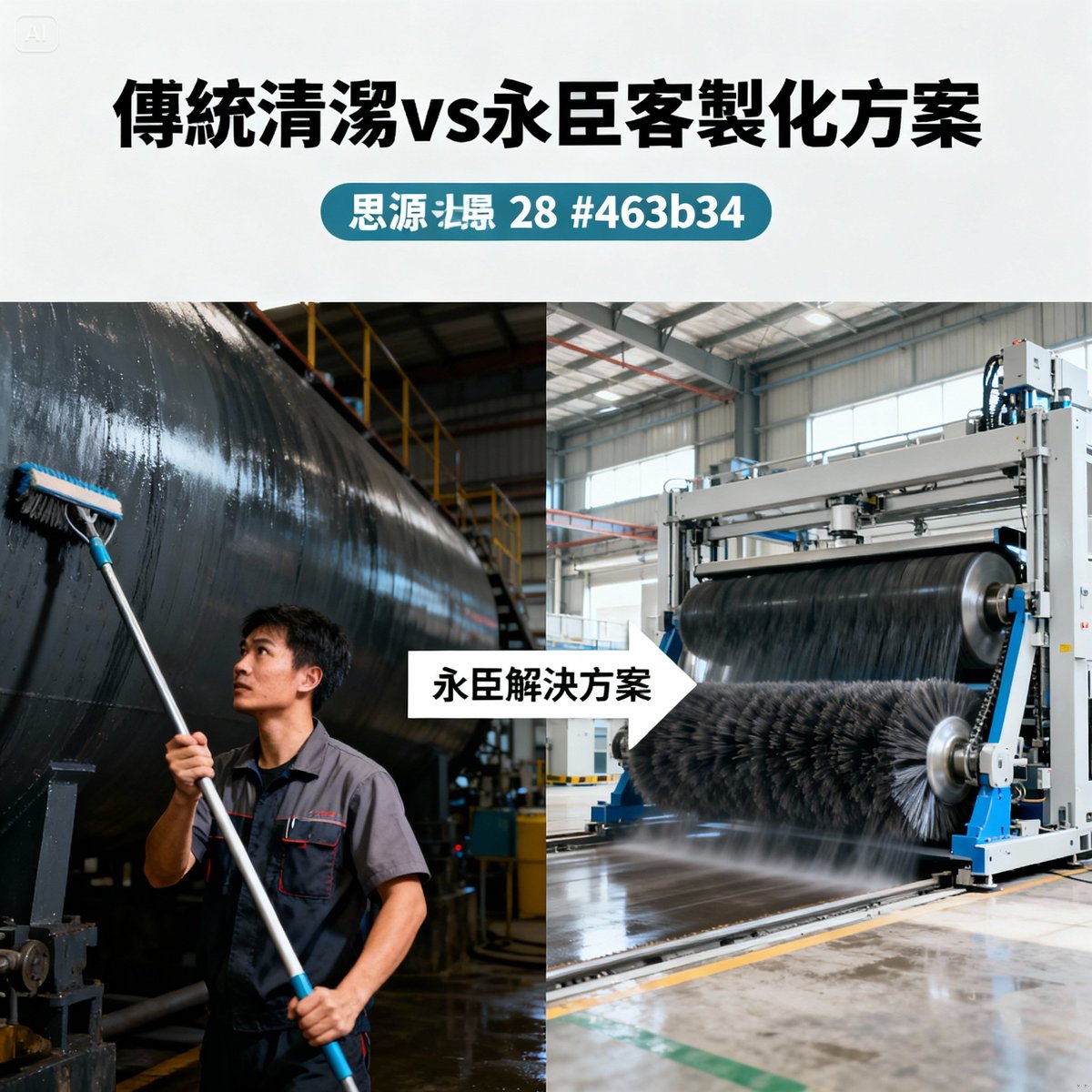
"Our production line needs cleaning equipment, but none of the brushes on the market fit..." This is a request YC Brushes hears every week. Unlike consumer products, industrial brushes have no standard specifications. Every industry, every production line and even every workpiece may need a brush designed specifically for it. A correctly designed industrial brush can raise production efficiency by 50%, lower the defect rate by 30% and extend equipment life 3 times over.
In the more than 40 years since it was founded, YC Brushes has served 500+ business customers and built up more than 2,000 custom cases. From car manufacturing, food processing and electronics to construction, we have seen how industrial brushes solve all kinds of production problems. This article shares real application cases from 8 industries and the custom design thinking behind them, to help you find the most suitable brush solution.
Key point: standard products can meet only 20% of industrial needs; the remaining 80% need custom work. Understanding the design logic of successful cases helps you describe your requirement more precisely, shorten development time and lower the cost of trial and error.
Why do industrial brushes need to be custom made?
Before going into the cases, it helps to understand what makes industrial brushes different.
Industrial brushes vs consumer brushes
| Item | Consumer brushes | Industrial brushes |
|---|---|---|
| Frequency of use | Low (a few times a day) | Extremely high (24 hours continuous) |
| Required service life | Several months to 1 year | Several months to several years |
| Standardization of specifications | High (80% are standard products) | Low (80% need custom work) |
| Filament material | Limited (mainly nylon and plastic) | Varied (steel wire, brass wire, nylon, natural bristle, special fibers) |
| Dimensions | Fixed (such as a 10-15 cm hand brush) | Custom (from a few centimeters to several meters) |
| Cost consideration | Price first | Benefit first (the cost of downtime is far higher than the cost of the brush) |
| Technical threshold | Low | High (requires knowledge of the process, materials and equipment) |
The 3 main custom requirements for industrial brushes
-
Custom dimensions
- To match the equipment: roller diameter, brush face width, overall length
- To match the workpiece: trim length, brush head shape
- To match the mounting method: center bore diameter, position of fixing screws
-
Custom filament material
- To match the workpiece material: avoiding scratches or a failure to clean
- To match the working environment: resistance to heat, acids and alkalis, and wear
- To match the cleaning goal: rust removal, dust removal, polishing, guiding
-
Custom structural design
- To match the process speed: filament density, fill pattern
- To match the service life: core material, fixing method
- To match special requirements: anti-static, food grade, explosion-proof
💡 What YC Brushes has observed: 80% of industrial customers choose a "similar standard product" on their first purchase, find after using it that the result is not good enough, and only then come back for custom work. But the cost of that trial and error is often 3-5 times the cost of the custom work.
Case 1: Car manufacturing | Wheel brush for polishing rims
Customer background
Industry: an auto parts manufacturer Requirement: polishing aluminum alloy rims Problem: the imported polishing wheels in use were expensive (NT$2,500 each), had a long lead time (3 months) and wore out quickly (they had to be replaced after 500 rims on average)
Requirements analysis
- Workpiece material: aluminum alloy (softer, scratches easily)
- Machining goal: remove casting burrs and polish the surface to a mirror finish
- Equipment: an automated polishing machine running at 3,000 RPM
- Output: 200 rims a day
- Quality requirement: no scratches, surface roughness Ra below 0.4 μm
The YC Brushes solution
Wheel brush specification:
- Diameter: 300 mm (to match the equipment)
- Brush face width: 50 mm
- Center bore: 32 mm
- Filament material: abrasive nylon filament (SiC silicon carbide blended into nylon fiber)
- Stiffness: medium-hard (to avoid scratching the aluminum)
- Abrasive grit: #400 (polishing grade)
- Trim length: 40 mm
- Filament density: high density (80% fill rate)
- Core material: glass-fiber-reinforced plastic (resists high temperatures, does not deform)
Design considerations:
- Abrasive nylon filament instead of steel wire: aluminum is soft, and steel wire would scratch it
- #400 abrasive grit: achieves a mirror polish
- High-density filament: increases the contact area and polishes more evenly
- Glass fiber core: does not deform at high speed and has a long service life
Results
Performance in use:
- ✅ Polishing quality: a mirror finish, with surface roughness Ra below 0.3 μm (better than required)
- ✅ Service life: replacement needed only after 1,200 rims on average (an improvement of 140%)
- ✅ Cost: NT$1,200 each (52% lower)
- ✅ Lead time: 7-10 days (much shorter)
Annual benefit calculation:
- Annual output: 200 rims/day × 250 days = 50,000 rims
- Wheel brushes used: 50,000 ÷ 1,200 = 42
- Annual wheel brush cost: 42 × NT$1,200 = NT$50,400
- vs the cost of the original imported wheels: 50,000 ÷ 500 × NT$2,500 = NT$250,000
- Annual saving: NT$199,600 (an 80% cost saving)
Customer testimonial:
"The custom polishing wheel brush from YC Brushes not only cut the cost in half but also lasts longer. Most important of all is the local service: when there is a problem we get in touch right away, and replacements arrive within a week, so we no longer have to worry about stopping work to wait for parts." - Production manager at an auto parts plant
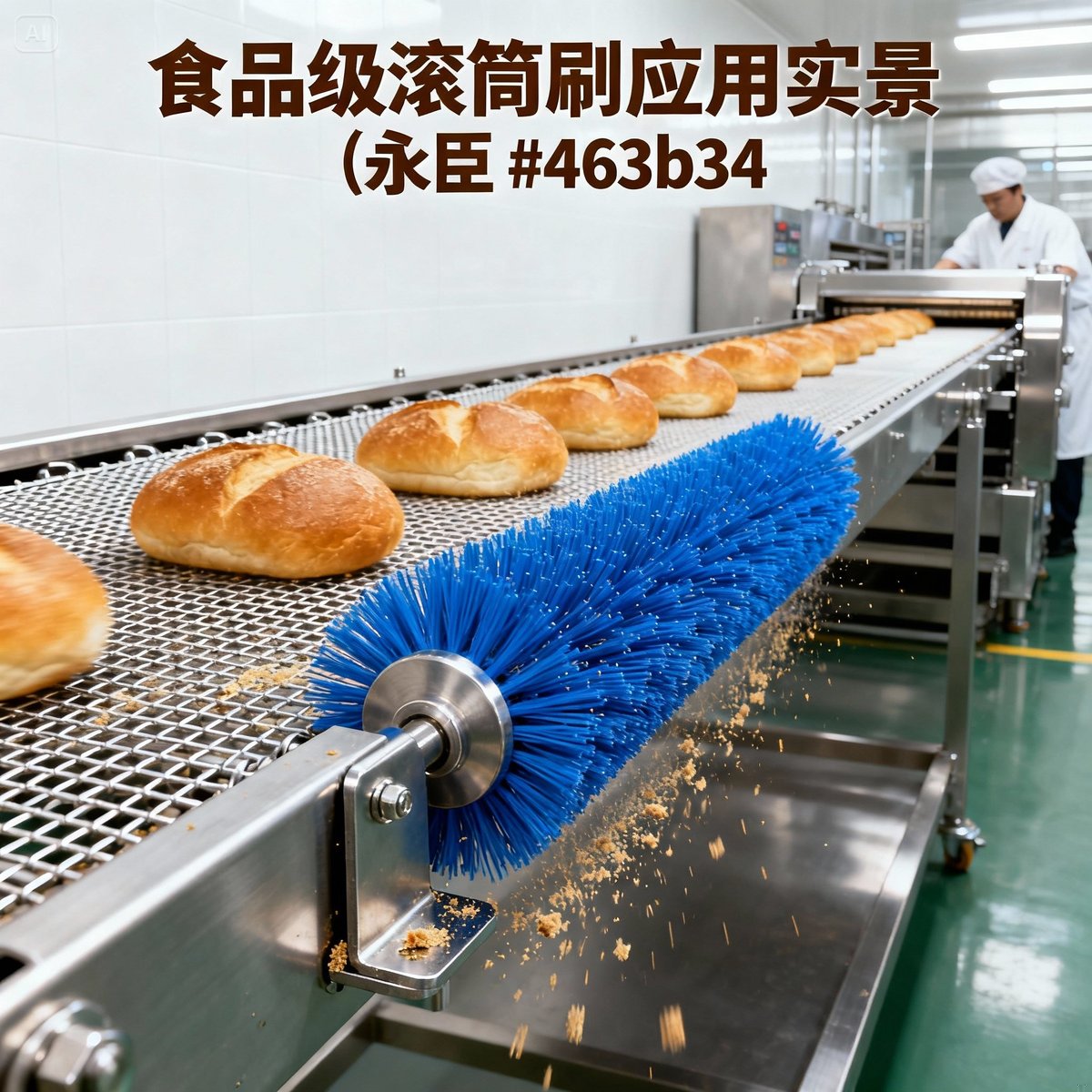
Case 2: Food processing | Conveyor belt cleaning brush
Customer background
Industry: a bakery products factory Requirement: cleaning breadcrumbs off the conveyor belt after baking Problem: cleaning was done by hand, which was slow and laborious, did not clean thoroughly and affected the quality of the next batch of product
Requirements analysis
- Object to be cleaned: a stainless steel mesh conveyor belt with a 2mm×2mm mesh
- Type of dirt: burnt breadcrumbs, grease
- Working environment: high temperature (belt temperature about 80-100°C), food-grade requirements
- Equipment constraint: it had to be installed under the existing conveyor belt, where the clearance was only 10 cm high
- Cleaning standard: no breadcrumbs left behind, no damage to the belt, compliance with food hygiene standards
The YC Brushes solution
Brush design:
- Type: roller brush (turns as the conveyor belt turns)
- Length: 600 mm (to match the belt width)
- Diameter: 80 mm (to fit the space constraint)
- Filament material: food-grade high-temperature nylon filament (PA612)
- Heat resistance: continuous use at 120°C
- Food grade: meets FDA standards and Taiwan's CNS standards for food containers
- Color: blue (the food industry standard, which makes contamination easy to spot)
- Filament diameter: 0.6 mm (thicker, with enough rigidity)
- Trim length: 30 mm
- Fill pattern: spiral (increases cleaning coverage and avoids vibration)
- Core material: food-grade stainless steel tube (SUS304)
- Bearings: food-grade plastic bearings (need no lubrication and meet hygiene standards)
Design considerations:
- Food-grade materials: every part that touches food meets food safety standards
- High-temperature nylon filament: does not deform under long-term contact at 80-100°C
- Blue filament: the standard color in the food industry; if a filament breaks and falls into the product, it is easy to find
- Spiral fill pattern: cleans well and runs smoothly
- Lubrication-free bearings: prevent lubricant from contaminating the food
Installation: The brush is installed under the conveyor belt with the filament facing up against the mesh. It is turned passively by the running belt and brushes off the breadcrumbs.
Results
Performance in use:
- ✅ Cleaning efficiency: cleaning is automated, saving 2 workers
- ✅ Cleaning quality: breadcrumb removal rate above 95% (manual cleaning achieves only 70-80%)
- ✅ Hygiene standard: passed inspection by the Taiwan Food and Drug Administration
- ✅ Service life: 6 months (running 10 hours a day)
Annual benefit calculation:
- Labor saved: 2 people × NT$30,000/month × 12 months = NT$720,000
- Brush cost: NT$8,000 each × 2 a year = NT$16,000
- Annual net saving: NT$704,000
Customer testimonial:
"Conveyor belt cleaning used to be our biggest headache: manual cleaning was inefficient and raised hygiene concerns. The roller brush designed by YC Brushes is fully automatic, passed inspection by the Taiwan Food and Drug Administration, and saves a great deal in labor costs." - QA manager at a bakery products factory
Case 3: Electronics manufacturing | PCB dust-removal brush
Customer background
Industry: a printed circuit board (PCB) manufacturer Requirement: removing dust from circuit boards after drilling Problem: residual dust caused poor plating and short circuits later in the process, with a defect rate of 5%
Requirements analysis
- Workpiece: PCBs, 1.6 mm thick, in various sizes
- Source of dust: glass fiber dust and copper powder produced by CNC drilling
- Cleaning requirement: dust removal rate above 99%, no scratching of the board surface, no static generated (to avoid damaging electronic components)
- Equipment: a conveyor-type dust-removal machine, with boards passing through at 15 m/min
- Environment: a cleanroom, where the amount of falling dust has to be controlled
The YC Brushes solution
Brush design:
- Type: a double-row roller brush set (one row above and one below, cleaning the board between them)
- Roller diameter: 100 mm
- Filament material: anti-static nylon filament (with conductive carbon fiber added)
- Surface resistance: 10⁶-10⁹ Ω (meets anti-static standards)
- Color: black (conductive carbon fiber)
- Filament diameter: 0.15 mm (extremely fine, soft, does not scratch)
- Trim length: 25 mm
- Filament density: extremely high density (90% fill rate)
- Fill pattern: dense spiral
Supporting system:
- Paired with a dust extraction system, so dust is drawn away as it is brushed off
- Anti-static grounding design
Design considerations:
- Anti-static nylon filament: prevents static from damaging electronic components
- Extremely fine filament (0.15 mm): soft, does not scratch precision circuit boards
- Extremely high density: ensures the dust removal rate
- Double-row cleaning: the top and bottom surfaces are cleaned at the same time
Results
Performance in use:
- ✅ Dust removal rate: above 99.5% (measured)
- ✅ Defect rate: down from 5% to 0.3% (a reduction of 94%)
- ✅ Anti-static: meets the IEC 61340 standard
- ✅ Service life: 3 months (running 16 hours a day)
Annual benefit calculation:
- Annual output: 100,000 PCBs
- Loss at the original defect rate: 100,000 × 5% × NT$150 (cost per board) = NT$750,000
- Loss at the new defect rate: 100,000 × 0.3% × NT$150 = NT$45,000
- Brush cost: NT$12,000 per set × 4 sets a year = NT$48,000
- Annual net saving: NT$750,000 - NT$45,000 - NT$48,000 = NT$657,000
Customer testimonial:
"Removing dust after PCB drilling had always been a pain point for us. We tried many methods and none worked well. The anti-static dust-removal brush from YC Brushes brought the defect rate down from 5% to 0.3% and saved us more than NT$600,000 in one year. It was well worth it!" - Plant manager at a PCB manufacturer
Case 4: Construction | Wire wheel brush for removing rust from structural steel
Customer background
Industry: a structural steel engineering company Requirement: rust removal on steel (structural steel for bridges and buildings) Problem: removing rust with hand-held angle grinders was inefficient, labor costs were high, and uneven rust removal affected the adhesion of the anti-rust paint
Requirements analysis
- Workpiece: H-beams, I-beams and steel plate, with red rust and black rust on the surface
- Rust removal grade: Sa 2.5 (a near-white metal surface)
- Equipment: hand-held angle grinders (4.5-inch, 7-inch), an automated shot-blasting rust-removal machine
- Capacity required: 50 tons of steel a day
- Cost pressure: manual rust removal is expensive, so efficiency had to improve
The YC Brushes solution
Option A: wire wheel brushes for hand-held angle grinders
- Diameter: 100 mm (4-inch), 125 mm (5-inch), 180 mm (7-inch)
- Filament material: knotted carbon steel wire (0.50 mm)
- Knotted design: extremely strong rust removal
- Carbon steel wire: high hardness, economical
- Maximum speed: 12,000 RPM
- Use: local rust removal, cleaning weld beads, working in corners
Option B: roller brush for the automated rust-removal machine
- Diameter: 300 mm
- Length: 1,200 mm (to match the width of the steel)
- Filament material: carbon steel wire (0.60 mm)
- Fill pattern: high-density spiral
- Use: automated rust removal on large areas of steel plate
Design considerations:
- Knotted design: removes rust 3 times as strongly as an ordinary wire brush
- Carbon steel wire: suited to heavy rust removal and economical in cost
- Several sizes: to match different equipment and workpieces
Results
Performance in use (for hand-held angle grinders):
- ✅ Rust removal efficiency: 40% faster than an ordinary wire wheel brush
- ✅ Rust removal grade: reaches the Sa 2.5 standard
- ✅ Service life: replacement needed only after 10 m² of rust removal on average (previously 5 m²)
- ✅ Cost: NT$150 each (60% cheaper than the imported product)
Performance in use (automated roller brush):
- ✅ Rust removal efficiency: 5 tons of steel per hour (only 0.5 tons by hand)
- ✅ Evenness: automated rust removal gives stable quality
- ✅ Service life: 6 months (running 8 hours a day)
Annual benefit calculation (for hand-held angle grinders):
- Annual rust removal area: about 10,000 m²
- Wheel brushes used: 10,000 ÷ 10 = 1,000
- Annual wheel brush cost: 1,000 × NT$150 = NT$150,000
- vs the cost of the original imported wheel brushes: 10,000 ÷ 5 × NT$380 = NT$760,000
- Annual saving: NT$610,000 (an 80% cost saving)
Customer testimonial:
"Cost competition in construction is fierce. The knotted wire wheel brushes from YC Brushes are not only affordable but also remove rust better and last longer than the imported product, which has greatly lowered our project costs." - Head of a structural steel engineering company
🔧 Need a custom industrial brush solution?
When the brush specification does not match the process, you often pay three prices at once: lower efficiency, a higher defect rate and faster brush consumption. Most businesses know the problem exists but do not know where to start with custom work.
How can YC Brushes help you?
✅ Over 40 years of industrial brush experience: 500+ business customers and 2,000+ custom cases ✅ Specialized in 8 industries: automotive, food, electronics, construction, textiles, printing, metalworking, semiconductors ✅ Free requirements analysis: a professional team visits your plant to assess the process and propose the best brush solution ✅ Fast sampling: 3D-printed samples or physical samples for validation; sample lead times are quoted per specification, so please email us ✅ Flexible MOQ: order quantities for trial runs and volume production are quoted per specification; please email us with your requirements ✅ Quality assurance: every batch is strictly inspected, and defective pieces are refunded or replaced in full
💡 The YC Brushes custom process (lead times quoted per specification)
- Requirements discussion (1-2 days): understanding the process, workpiece, equipment and problem points
- Solution design (3-5 days): 2-3 design options with quotes
- Sample validation (7-15 days): samples are made for the customer to test
- Volume production (15-30 days): formal volume production once the specification is confirmed
🎯 When to come to YC Brushes for custom work
- ✅ Standard products on the market cannot meet the need
- ✅ The production line has special cleaning, polishing or guiding requirements
- ✅ Existing brushes wear out too quickly or cost too much
- ✅ A new production line is being planned and professional brush advice is needed
- ✅ You want to lower the cost of imported brushes and shorten the lead time
Contact us now for a free on-site requirements analysis and brush selection advice!
👉 Click to contact YC Brushes now, and let a professional team with over 40 years of experience help you find the best brush solution!
Case 5: Textiles | Stenter brush roller
Customer background
Industry: a textile dyeing and finishing plant Requirement: guiding fabric and removing dust on the stenter Problem: rubber rollers had been used for guiding, but they slipped easily, and skewed fabric led to defective finished goods
Requirements analysis
- Workpiece: all kinds of fabric (cotton, polyester, blends)
- Temperature: stenter temperature of 150-180°C
- Function required: guide the fabric and remove dust at the same time
- No damage allowed: no scratches or pulled threads on the fabric surface
- Service life: a continuous high-temperature environment, so durability requirements are high
The YC Brushes solution
Brush roller design:
- Diameter: 150 mm
- Length: 1,800 mm (to match the fabric width)
- Filament material: high-temperature nylon filament (PA66)
- Heat resistance: continuous use at 180°C, short-term at 220°C
- Stiffness: medium-soft (does not damage fabric)
- Filament diameter: 0.4 mm
- Trim length: 50 mm
- Fill pattern: spiral (guides well)
- Core material: stainless steel tube (SUS304, resists high temperatures)
Design considerations:
- High-temperature nylon filament: does not deform or become brittle in long-term use at 150-180°C
- Spiral fill pattern: the fabric is guided to the center automatically as it passes
- Medium-soft stiffness: guides the fabric without damaging the fibers
Results
Performance in use:
- ✅ Guiding accuracy: the fabric skew rate fell from 8% to below 1%
- ✅ Fabric defect rate: down from 3% to 0.5%
- ✅ Dust removal: loose dust on the fabric surface is removed at the same time
- ✅ Service life: 12 months (running continuously 24 hours a day)
Annual benefit calculation:
- Annual output: 5,000,000 yards of fabric
- Loss at the original defect rate: 5,000,000 × 3% × NT$15 (cost per yard) = NT$2,250,000
- Loss at the new defect rate: 5,000,000 × 0.5% × NT$15 = NT$375,000
- Brush roller cost: NT$25,000 per set
- Annual net saving: NT$2,250,000 - NT$375,000 - NT$25,000 = NT$1,850,000
Customer testimonial:
"Skewed fabric on the stenter had troubled us for a long time. After we switched to the high-temperature guiding brush roller from YC Brushes, the defect rate dropped sharply and we save nearly NT$2,000,000 a year!" - Plant manager at a textile dyeing and finishing plant
Case 6: Printing | Static-elimination brush for printing presses
Customer background
Industry: a commercial printing plant Requirement: removing static from printing paper Problem: static made sheets stick together, feed poorly and print badly, with a high paper jam rate
Requirements analysis
- Workpiece: all kinds of printing paper (80-300 lb)
- Problem: friction between sheets generates static, and they stick together in a stack
- Equipment: an offset press, with a feed speed of 8,000 sheets/hour
- Static elimination required: reduce surface static to a safe range
- No contamination allowed: filaments must not fall out and contaminate the printed matter
The YC Brushes solution
Brush design:
- Type: roller-type static-elimination brush
- Length: 1,000 mm (to match the paper width)
- Diameter: 60 mm
- Filament material: anti-static carbon fiber filament
- Surface resistance: 10⁴-10⁶ Ω (excellent conductivity)
- Color: black
- Filament diameter: 0.2 mm
- Trim length: 30 mm
- Filament density: high density (85% fill rate)
Supporting design:
- The brush roller is connected to a ground wire, so static is conducted to earth
- Position: in the feed area, so static is removed before the paper enters the press
Design considerations:
- Conductive carbon fiber filament: eliminates static on the paper quickly
- High-density filament: makes sure every sheet touches the filament
- Extremely fine diameter: soft, does not damage the paper
Results
Performance in use:
- ✅ Static elimination rate: above 95%
- ✅ Paper jam rate: down from 15% to below 2%
- ✅ Print quality: the sticking problem was solved completely
- ✅ Production efficiency: less downtime spent clearing jams, with efficiency up 20%
Annual benefit calculation:
- Annual print volume: 10,000,000 sheets
- Original loss from paper jams: 10,000,000 × 15% × NT$2 (cost per sheet + labor) = NT$3,000,000
- New loss from paper jams: 10,000,000 × 2% × NT$2 = NT$400,000
- Brush cost: NT$8,000
- Annual net saving: NT$3,000,000 - NT$400,000 - NT$8,000 = NT$2,592,000
Customer testimonial:
"Static is what a printing plant fears most. We used to stop the press every day to deal with paper jams. Since installing the static-elimination brush from YC Brushes, the jam rate has fallen below 2% and production runs much more smoothly!" - Plant manager at a printing plant
Case 7: Semiconductors | Wafer cleaning brush
Customer background
Industry: a semiconductor equipment maker Requirement: brush rollers for wafer cleaning equipment Problem: particle contamination on the wafer surface affects yield, so extremely precise cleaning is needed
Requirements analysis
- Workpiece: silicon wafers, 8-inch and 12-inch in diameter
- Cleaning goal: remove surface particles (below 0.1 μm)
- Quality requirement: no scratching of the wafer surface (scratch depth below 10 nm)
- Environment: a Class 10 cleanroom (fewer than 10 particles of ≥0.5 μm per cubic foot of air)
- Material constraint: the brush material must not shed and must not release particles
The YC Brushes solution
Brush roller design:
- Diameter: 80 mm
- Brush material: PVA sponge (a special hydrophilic foam material)
- Pore size: ultra-fine pores (below 50 μm)
- Properties: extremely soft, highly absorbent, releases no particles
- Fixing method: ultrasonic welding (no glue, to avoid contamination)
- Core material: PPS engineering plastic (chemical resistant, cleanroom grade)
Supporting system:
- Paired with a cleaning system using ultrapure water and chemical solvents
- Brush roller speed: 100-300 RPM (low speed, gentle)
Design considerations:
- PVA sponge: extremely soft, does not scratch the wafer
- Ultrasonic welding: avoids glue contamination
- Cleanroom-grade materials: release no particles
Results
Performance in use:
- ✅ Particle removal rate: above 99% (particles below 0.1 μm)
- ✅ Wafer scratch rate: 0% (no scratches measured)
- ✅ Cleanliness: meets the Class 10 cleanroom standard
- ✅ Service life: 3 months (cleaning 1,000 wafers a day)
Customer testimonial:
"Wafer cleaning in semiconductors leaves no room for the slightest error. The PVA sponge brush roller from YC Brushes fully meets our strict requirements and has become a standard part of our equipment." - R&D manager at a semiconductor equipment maker
Case 8: Metalworking | Deburring brush
Customer background
Industry: a precision metalworking plant Requirement: deburring workpieces after CNC machining Problem: manual deburring was inefficient, quality was unstable and labor costs were high
Requirements analysis
- Workpiece: aluminum alloy parts (mobile phone housings, laptop housings)
- Type of burr: tiny burrs left by CNC milling (0.1-0.3 mm)
- Quality requirement: burrs completely removed, no scratching of the workpiece surface, edges radiused to R0.2 mm
- Output: 5,000 parts a day
- Automation required: it had to work with an automated production line
The YC Brushes solution
Brush design:
- Type: cup brush (can reach into recesses)
- Diameter: 100 mm
- Filament material: abrasive nylon filament (aluminum oxide blended into nylon)
- Abrasive grit: #320 (deburring + edge radiusing)
- Stiffness: medium-hard
- Filament diameter: 0.8 mm
- Trim length: 35 mm
- Equipment used: a CNC machining center running at 6,000 RPM
Design considerations:
- Abrasive nylon filament: deburrs and radiuses the edge in a single pass
- #320 abrasive: deburrs well without over-grinding
- Cup design: can reach into the recesses and holes of the part
Results
Performance in use:
- ✅ Deburring efficiency: from 30 seconds per piece by hand to 5 seconds per piece automated (an improvement of 500%)
- ✅ Stable quality: 100% burr removal, consistent edge radius
- ✅ Labor saved: 5 deburring workers were needed before; now the operation is unmanned
- ✅ Service life: replacement needed only after 5,000 parts on average
Annual benefit calculation:
- Annual output: 5,000 parts/day × 250 days = 1,250,000 parts
- Labor saved: 5 people × NT$35,000/month × 12 months = NT$2,100,000
- Brush cost: 1,250,000 ÷ 5,000 × NT$800 = NT$200,000
- Annual net saving: NT$1,900,000
Customer testimonial:
"Deburring precision parts is the most labor-intensive process. The abrasive nylon brush from YC Brushes let us automate it, quality is more stable, and we save NT$2,000,000 a year in labor costs!" - General manager of a precision metalworking plant
Key elements of custom industrial brushes
From the 8 cases above, we can draw out the key elements of custom industrial brush work.
5 considerations in custom design
-
Workpiece material and properties
- Hardness: decides the filament material and diameter
- Surface condition: decides the filament stiffness and density
- Shape: decides the brush type (flat brush, roller brush, cup brush)
- Dimensions: decide the brush specification
-
Working environment
- Temperature: decides the temperature rating of the filament (such as high-temperature nylon, PPS)
- Chemicals: decide the chemical resistance of the filament (such as PP, PBT)
- Cleanliness: decides the material grade (such as food grade, cleanroom grade)
- Humidity: decides the core material (such as stainless steel, plastic)
-
Functional requirements
- Cleaning: removing dust, rust, burrs and oxide layers
- Polishing: surface polishing, mirror polishing
- Guiding: guiding fabric, guiding paper
- Static removal: eliminating static
- Coating: applying oil, applying glue
-
Integration with equipment
- Mounting method: center bore diameter, thread specification, fixing method
- Speed: decides the strength of the core and how the filament is fixed
- Space constraints: decide the brush dimensions
- Degree of automation: decides the durability required
-
Cost and benefit
- Service life: decides the material grade
- Replacement frequency: decides the maintenance cost
- Production efficiency: decides the return on investment
- Quality improvement: decides the added value
The YC Brushes custom design process
-
Requirements interview
- Understanding the workpiece, process, equipment and problem points
- On-site visit (for large projects)
-
Solution design
- 2-3 design options are provided
- The pros, cons and cost differences of each option are explained
- Presented with 3D drawings
-
Sample validation
- Samples are made (3D printed or physical)
- The customer tests them on site
- Feedback is collected and the design is adjusted
-
Volume production
- The final specification is confirmed
- Tooling is made (if needed)
- Volume production and shipment
-
After-sales follow-up
- Following up on how the brush performs in use
- Assessing the benefit
- Suggestions for optimization
How do you choose an industrial brush supplier?
There are many industrial brush suppliers on the market. How do you choose the right partner?
7 indicators for evaluating a supplier
-
Industry experience
- Does it have successful cases in the same industry?
- Does it understand your process and needs?
- The YC Brushes advantage: over 40 years of experience, 8 industries, 2,000+ cases
-
Custom capability
- Can it design a dedicated solution?
- Can it sample and validate quickly?
- The YC Brushes advantage: fast validation with 3D-printed samples (sample lead times quoted per specification)
-
Quality stability
- Does it have a quality management system (such as ISO 9001)?
- Does it provide inspection reports?
- The YC Brushes advantage: strict inspection of every batch, traceable quality
-
Technical support
- Does it offer free consultation?
- Can it assess on site?
- Is it able to troubleshoot problems?
- The YC Brushes advantage: free on-site assessment, technical support
-
Stable lead times
- How long is the lead time for samples?
- How long is the lead time for volume production?
- Does it keep spare stock?
- The YC Brushes advantage: lead times for samples and volume production are quoted per specification; please email us with your requirements
-
Reasonable cost
- Is the price reasonable?
- Are there hidden costs?
- What are the service life and the total cost?
- The YC Brushes advantage: factory-direct, transparent prices
-
After-sales service
- What are the warranty terms?
- How are defective pieces handled?
- Does it follow up on use?
- The YC Brushes advantage: full refund or replacement of defective pieces, follow-up on use
What sets YC Brushes apart
| Item | Typical supplier | YC Brushes |
|---|---|---|
| Years of experience | 5-15 years | Over 40 years |
| Number of cases | Several hundred | 2,000+ |
| Industry specialization | 1-3 industries | 8 industries |
| Sampling speed | 2-4 weeks | Quoted per specification; email us |
| MOQ | 500-1,000 pieces | Quoted per specification; email us |
| Technical support | Phone consultation | Free on-site assessment |
| Quality traceability | Limited | Full batch number traceability |
| After-sales service | Basic warranty | Follow-up on use + suggestions for optimization |
FAQ
Q1: Do industrial brushes have to be custom made? Can standard products not be used?
A: It depends on the need. Simple applications can use standard products; for complex applications we recommend custom work.
When a standard product is suitable:
- General cleaning and dust removal (no precision requirement)
- Infrequent use (less than 2 hours a day)
- Non-critical processes (a defect does not affect product quality)
- A very limited budget
- An urgent need (no time to wait for custom work)
When custom work is recommended:
- Precision cleaning and polishing (such as electronics and semiconductors)
- Intensive use (running continuously 24 hours a day)
- Critical processes (affecting product quality or safety)
- Special environments (high temperature, food grade, anti-static)
- Standard products wear out too quickly or cost too much
- Standard products perform poorly and affect production efficiency
YC Brushes recommends: You can try a standard product the first time, and look for custom work if the result is not good enough. YC Brushes offers free consultation to help you assess whether custom work is needed.
Q2: What is the MOQ (minimum order quantity) for custom industrial brushes?
A: It depends on the brush type. The MOQ at YC Brushes is relatively flexible.
YC Brushes MOQ:
- Hand-held wire brushes, wire wheel brushes for angle grinders, roller brushes and special custom products: Order quantities and lead times are quoted per specification. Please email us with your requirements.
Why is there an MOQ?
- The cost of tooling has to be spread
- Raw material purchases have minimum quantities
- The cost of adjusting the production line
Flexible options at YC Brushes:
- Small trial runs: quantities below the MOQ can be accepted, but at a higher unit price
- Volume orders: at or above the MOQ, with preferential prices
- Long-term cooperation: with an annual contract, the MOQ for each order can be lowered
Q3: How long does it take to develop a custom industrial brush?
A: It depends on complexity. Development time and lead times are quoted per specification; please email us with your requirements. A simple adjustment that needs no tooling is faster than standard custom work that needs tooling.
YC Brushes development schedule:
-
Simple custom work
- Adjusting the specification of an existing product (such as changing the trim length or diameter)
- No new tooling needed
- Example: changing a standard 100 mm wheel brush to 120 mm
-
Medium custom work
- A new brush head shape has to be designed
- Simple tooling may be needed
- Sample validation is needed
- Example: custom cup brushes, special fill patterns
-
Complex custom work
- An all-new design
- Precision tooling is needed
- Several rounds of sampling and revision are needed
- Trial production may be needed for validation
- Example: PVA brush rollers for semiconductor cleanrooms
Ways to speed up development:
- Provide detailed specifications and drawings
- Provide a sample of the existing brush
- Give feedback on samples quickly
- Accept 3D-printed samples (saves 7-10 days)
Q4: How much more does a custom industrial brush cost than a standard product?
A: It depends on the order quantity. The gap ranges from 10%-100%.
Cost structure:
- Design fee: NT$3,000-10,000 (depending on complexity)
- Sampling fee: NT$2,000-15,000 (depending on complexity)
- Tooling fee: NT$15,000-80,000 (if tooling is needed)
- Unit cost: 10-50% more than a standard product (small quantities), 10-20% more (large quantities)
Example 1: simple custom work (adjusting dimensions)
- Standard product price: NT$200 each
- Custom price (order of 200 pieces): NT$250 each (+25%)
- Custom price (order of 1,000 pieces): NT$220 each (+10%)
Example 2: complex custom work (all-new design)
- Development cost: design fee NT$5,000 + sampling fee NT$10,000 + tooling fee NT$40,000 = NT$55,000
- Order of 500 pieces at a unit price of NT$600 each
- Total cost: NT$55,000 + (500 × NT$600) = NT$355,000
- Average unit price: NT$710 each
But the benefit has to be considered: Custom work costs more at the start, but if it can:
- Raise production efficiency by 50% → saves NT$500,000 a year
- Lower the defect rate by 30% → saves NT$300,000 a year
- Extend service life 3 times over → saves NT$100,000 a year
The investment usually pays for itself within 3-12 months.
Q5: How is the quality of custom industrial brushes ensured?
A: YC Brushes uses a strict quality management process.
Quality management at YC Brushes:
-
Design stage
- Confirmation of 3D drawings
- Confirmation of material specifications
- Assessment of process capability
-
Sampling stage
- Dimensional inspection of samples
- On-site testing by the customer
- Confirmation of results
-
Volume production stage
- First article inspection (FAI)
- In-process sampling inspection (IPQC)
- 100% inspection before shipment (FQC)
-
After shipment
- Follow-up on use
- Collection of customer feedback
- Suggestions for improvement
Inspection items:
- Dimensions: diameter, length, trim length (
±0.5mm) - Filament: material, diameter, density
- Core: material, center bore diameter, balance
- Appearance: fill pattern, how securely the filament is fixed
- Performance: speed test, endurance test
Quality assurance:
- Full refund or replacement of defective pieces
- Batch number traceability system
- ISO 9001 quality management certification
Q6: How can the service life of an industrial brush be extended?
A: Correct use and maintenance can extend service life 2-3 times.
8 ways to extend service life:
-
Install correctly
- Make sure the brush is fixed securely
- Check the fit between the center bore and the shaft diameter
- Confirm the balance (for high-speed rotation)
-
Use an appropriate speed
- Do not exceed the maximum permitted speed
- Avoid too low a speed (poor cleaning, and filaments bend and deform easily)
-
Apply moderate force
- Avoid pressing too hard
- Let the filament touch the workpiece naturally
-
Clean regularly
- Remove residue after use
- Keep dirt from hardening and clogging the filament
-
Use in a suitable environment
- Avoid use above the rated temperature (nylon filament softens when overheated)
- Avoid chemicals it is not suited to
-
Inspect regularly
- Check the wear of the filament
- Check whether the core is loose or deformed
- Replace when filament wear exceeds 50%
-
Rotate spares
- Keep 2-3 brushes and use them in rotation
- Avoid overusing a single brush
-
Store correctly
- Avoid heavy pressure (filament deforms)
- Avoid damp (metal filament rusts)
- Avoid direct sunlight (plastic ages)
Technical support from YC Brushes: If you run into any problem in use, contact YC Brushes at any time. We provide free advice on use and troubleshooting.
Conclusion: the right brush partner gets twice the result for half the effort
An industrial brush may not look like much, but it is an indispensable key part on the production line. A correctly designed brush can solve long-standing production problems, raise efficiency, lower costs and improve quality. But because industrial brushes are so highly customized, many businesses do not know where to start.
The core values of YC Brushes after over 40 years
- Deep industry experience: having served 500+ businesses in 8 industries with 2,000+ cases, we have seen all kinds of production problems
- Custom expertise: professional support all the way from requirements analysis, solution design and sample validation to volume production
- Fast response: lead times for sampling and volume production are quoted per specification, so please email us with your requirements
- Quality assurance: strict inspection, batch number traceability, full refund or replacement of defective pieces
- Benefit-driven: what we care about is not just selling brushes but helping you solve problems and create value
Overview of successful cases in 8 industries
| Industry | Application | Benefit |
|---|---|---|
| Car manufacturing | Rim polishing | Cost down 80%, service life up 140% |
| Food processing | Conveyor belt cleaning | NT$700,000 a year saved in labor |
| Electronics manufacturing | PCB dust removal | Defect rate down 94%, NT$650,000 a year saved |
| Construction | Rust removal on structural steel | Cost down 80%, efficiency up 40% |
| Textiles | Fabric guiding | Defect rate down 83%, NT$1,850,000 a year saved |
| Printing | Static elimination | Paper jam rate down 87%, NT$2,590,000 a year saved |
| Semiconductors | Wafer cleaning | Higher yield, zero scratches |
| Metalworking | Deburring | Efficiency up 500%, NT$1,900,000 a year saved |
These are more than numbers. Each one is the real story of a business transforming and upgrading.
Ready to start your custom brush project?
Whatever production problem you face, whether it is cleaning, polishing, guiding, dust removal or deburring, YC Brushes is ready to be your solution partner.
🎯 Contact YC Brushes now to book a free on-site requirements assessment, and let a professional team with over 40 years of experience help you find the best brush solution!
Your production problem is our challenge. Let us build a more efficient, lower-cost and higher-quality production line together!
📚 Further reading
To learn more about industrial brushes, read the other articles in our series:
- The complete guide to wire brushes | Uses, buying, rust removal techniques and industrial applications
- Steel brush vs brass brush: the ultimate guide to choosing the material | Material differences and application scenarios in one read
- Guide to using angle grinder wire brushes safely | 10 key points for avoiding workplace accidents
- Choosing brushes for cleaning stainless steel | The right way to avoid free iron contamination
- Buying guide to long-handled wire brushes | An essential tool for cleaning rims
- How to make wire-brushed wood grain boards | The complete guide to wood brushing techniques
- Selection criteria for abrasive filament in deburring brushes
- See detailed product information
References
Content reviewed by: the YC Brushes R&D team (over 40 years of industrial brush experience, serving 500+ business customers) Want to know how YC Brushes can solve your production problem? Contact YC Brushes and we will be glad to help!
About the cases: the application cases and customer feedback quoted in this article are a consolidated summary of practical experience, with identifiable customer information removed. The figures in the article are results from individual cases; actual benefits vary with the industry, process conditions and manner of use, and they do not constitute a guarantee of results.