When a company buys brushes, it faces two channels, factory-direct and distributor, and often does not know which to choose. Choosing the right channel not only saves 30-50% of the cost but also brings better technical support and custom service. This article compares the strengths and weaknesses of factory-direct and distributor purchasing in depth, to help you find the purchasing strategy that suits you best and get full value from every brush purchase.
What is factory-direct? What is a distributor?
Factory-direct means placing the order directly with the factory that makes the brushes. The factory has its own production equipment, technical team and process control, and can manage everything from raw material purchasing to shipment of the finished goods.
A distributor is a middleman that buys brushes from one factory or several and resells them to end customers. A distributor has no production capability and mainly offers product choice, inventory management and channel service.
YC Brushes is a typical factory-direct operation, with over 40 years of manufacturing experience and a complete production line. From the first discussion of the customer's requirements to delivery of the finished goods, service comes directly from the factory.
The biggest difference between the two: factory-direct offers professional service from "the maker's point of view", while a distributor offers convenience from "the seller's point of view". Which you choose depends on your purchasing needs and priorities.
The most obvious difference between factory-direct and distributor purchasing is the price structure. Below we look closely at why factory-direct can offer better prices.
A closer look at the price gap | Why is factory-direct 30-50% cheaper?
Factory-direct is cheaper than a distributor mainly because of the difference in cost structure.
First, factory-direct removes the middleman's profit. A distributor usually marks up the ex-factory price by 30-50% as gross margin, which covers warehousing, staff, marketing and profit. If the product passes through several layers of distributors, the price is pushed up further.
Second, factory-direct carries no inventory cost pressure. A distributor has to buy stock from the factory in advance, and the cost of that capital and of warehousing is ultimately reflected in the selling price. A factory works on a "produce after the order is received" model and can quote on a more precise cost calculation.
Third, factory-direct can adjust the specification flexibly. If you are willing to make small adjustments to the material, dimensions or process, the factory can choose a more economical solution. A distributor cannot offer this flexibility. It can only sell products in existing specifications and has no room to lower the cost through custom work.
Take one industrial roller brush as an example: the factory-direct price is about NT$800 and the distributor's selling price is about NT$1,200, a price difference of 50%. For large purchases, this difference becomes even more significant.
Finally, the quote structure of factory-direct is more transparent. You can see clearly the material cost, the processing fee and a reasonable profit, while a distributor's quote is often "one fixed price" without a transparent cost breakdown.
Want to know how brush prices are calculated? Find out more → Brush prices explained | Cost factors, market prices and negotiation tips
Factory-direct vs distributor: a full comparison
To help you see the differences between the two purchasing channels more clearly, here is a complete comparison table:
| Item | Factory-direct | Distributor | Suggested choice |
|---|---|---|---|
| Price | ★★★★★ Ex-factory price, 30-50% cheaper | ★★☆☆☆ Sold at a markup, higher cost | Long-term, large volume → factory |
| MOQ (minimum order quantity) | ★★★☆☆ Orders usually start at 300-1,000 pieces | ★★★★☆ Small quantities possible, even from 1 piece | Small rush orders → distributor |
| Custom capability | ★★★★★ Full customization, from design to volume production | ★☆☆☆☆ Existing specifications only, no custom work | Custom needs → factory |
| Lead time | ★★★☆☆ Custom production; lead times are quoted per specification | ★★★★★ Ships immediately from stock | Urgent needs → distributor |
| Technical support | ★★★★★ Professional engineers advise on material selection | ★★☆☆☆ Sales staff, limited technical depth | Specialist needs → factory |
| Quality control | ★★★★★ Controls the whole process, stable quality | ★★★☆☆ Depends on the factory's quality, cannot intervene in the process | High quality requirements → factory |
| Product choice | ★★★☆☆ Specializes in particular types of brush | ★★★★☆ Represents several brands, a wide range of items | Varied needs → distributor |
| Convenience | ★★★☆☆ A clear specification is required | ★★★★☆ One-stop shopping, saves time and effort | Unfamiliar with specifications → distributor |
| Long-term cooperation | ★★★★★ A stable supply chain, costs improve continuously | ★★★☆☆ Limited price flexibility | Long-term cooperation → factory |
| After-sales service | ★★★★☆ Can trace problems to their root and fix them | ★★★☆☆ Helps contact the factory to deal with them | Complex problems → factory |
The table shows that factory-direct has a decisive advantage in price, custom work, technical support and long-term cooperation. Distributors do better on small-quantity purchases, lead time flexibility and product variety.
YC Brushes has been factory-direct for over 40 years and has earned the trust of several hundred corporate customers, precisely because we can provide a complete service of transparent prices, custom flexibility and professional technical support.
Are you evaluating brush purchasing channels? Contact YC Brushes now for a factory-direct quote. Our professional team will help you work out the purchasing plan that suits you best. 📞 +886-2-2988-2721
Whether to choose factory-direct or a distributor depends on your purchasing needs and priorities. Below we look at the best choice in different situations.
When is factory-direct the right choice?
In the following 5 situations, factory-direct delivers the greatest benefit:
1. Stable long-term demand
If your company needs to buy brushes regularly every month or every quarter, building a factory-direct supply relationship is the most economical choice. Long-term cooperation not only wins you better prices; the factory will also give your orders priority, which keeps lead times stable.
Among the long-term customers of YC Brushes is a food plant that buys conveyor cleaning brushes every month. The two sides have worked together for more than 10 years. The price is favorable, and the factory also prepares materials in advance to make sure supply is never interrupted.
2. A custom design is needed
When brushes in standard specifications cannot meet your needs, factory-direct is the only option. A distributor can only supply existing products and cannot do custom design or tooling.
For example, a printing equipment maker needed a roller brush with a special shape. The YC Brushes factory helped with everything from 3D design and sample making to tooling development and completed a fully custom project, something a distributor cannot do.
3. Large purchase quantities
When the purchase quantity reaches the factory's MOQ (usually 300-1,000 pieces), the unit price advantage of factory-direct is very clear. The larger the quantity, the bigger the drop in unit price, and it is even possible to negotiate a price 40-50% below the market price.
A cleaning company chain bought 5,000 floor brushes at one time. The price it obtained factory-direct saved more than NT$150,000 compared with the distributor's quote.
4. High quality standards
If your industry has strict quality requirements (such as food, medical or semiconductors), factory-direct can provide a complete quality history and a transparent process. You can visit the factory, learn where the raw materials come from and review the quality control process. A distributor can offer none of these.
Food-grade customers of YC Brushes come to the factory regularly to review the material documents showing compliance with the FDA food contact material regulations (21 CFR 177) and the SGS test reports, to make sure the products meet food safety standards.
5. Technical advice is needed
When you are not sure which material, specification or process to choose, the factory's professional engineers can give the most precise advice. A distributor's sales staff usually know only the product specifications and cannot analyze the application and the material properties in depth.
The technical team at YC Brushes once helped an electronics plant solve a material selection problem for anti-static brushes, providing a complete technical analysis report covering the heat resistance of the material, its conductivity and the filament density.
Want to know how custom brushes are made? Further reading → The complete guide to custom brushes | Process, costs and what to watch for
When is a distributor the right choice?
Although the advantages of factory-direct are clear, a distributor is the better fit in the following 5 situations:
1. Small quantities of many kinds
If you need only a few brushes (from a handful to a few dozen) in several specifications, a distributor is the best choice. Factory-direct usually comes with an MOQ, and small purchases are not cost-effective.
A restaurant buying various cleaning brushes, for example, may need only 2-5 of each. Going to a distributor gets everything in one place and saves time and effort.
2. Urgent needs
When you need brushes immediately and cannot wait for the factory's custom production (lead times are quoted per specification), the distributor's stock comes into its own. If the item is in stock it can ship the same day or the next day, solving the emergency.
When the conveyor brush at one factory suddenly failed and affected the production line, a replacement was obtained from a distributor the same day, avoiding the loss of a stoppage.
3. Unsure of the specification and want to try first
If you are buying brushes for the first time and are not sure which specification fits best, a distributor can supply several samples for you to test. Once testing has confirmed the choice, buying in volume factory-direct is a smart strategy.
A start-up developing cleaning equipment bought brushes in 10 different specifications through a distributor for testing in the early stage. After confirming the best specification, it signed a long-term supply contract with a factory.
4. A first purchase in an unfamiliar industry
A distributor's sales staff are usually good at guiding first-time buyers and offer ready-made product recommendations. If you are not familiar with the brush industry, a distributor lowers the barrier to buying.
Factory-direct requires the customer to provide clear specification requirements, which can be more of a challenge for a beginner.
5. One-stop service is needed
If you need brushes, brush handle accessories, cleaning agents and other products at the same time, a distributor usually represents several brands and offers the convenience of one-stop shopping. A factory specializes in particular products and cannot supply across categories.
A property management company buys cleaning supplies every month and gets all the items in a single order through a distributor, which simplifies its purchasing process.
Purchasing decision flow | 4 steps to the best channel
Not sure whether to choose a factory or a distributor? Follow the 4-step decision flow below to find the purchasing channel that suits you best:
Step 1: Assess the purchase quantity
Ask yourself: "Does my purchase quantity reach the factory's MOQ (usually 300-1,000 pieces)?"
- Yes → go on to Step 2
- No → a distributor is recommended (unless you are willing to accept a higher unit price and negotiate a small production run with the factory)
Step 2: Confirm whether custom work is needed
Ask yourself: "Can a brush in a standard specification meet my needs?"
- A standard specification is enough → go on to Step 3
- Custom work is needed → factory-direct is recommended (a distributor cannot customize)
Step 3: Assess how urgent the lead time is
Ask yourself: "Can I wait for the lead time of custom production (quoted per specification)?"
- I can wait → go on to Step 4
- I need it immediately → a distributor is recommended (unless the factory happens to have stock)
Step 4: Assess whether it is a long-term need
Ask yourself: "Will I keep buying the same or similar brushes in the future?"
- Yes, a long-term need → factory-direct is recommended (build a long-term supply chain, with the best price and quality)
- No, a one-off purchase → a distributor is recommended (very convenient, no need to build a long-term relationship)
With these 4 steps, 90% of purchasing situations can find the channel that fits best. If your situation is more complicated, you are welcome to consult the professional team at YC Brushes directly, and we will give the most suitable advice based on your needs.
Want the full guide to choosing a brush factory? Go back to the core article → The complete guide to buying factory-direct from a brush factory | Over 40 years of manufacturing experience, transparent prices, custom service
A mixed strategy | The best answer for smart purchasing
In fact, factory-direct and distributor are not an either-or choice. Smart buyers use a "mixed strategy".
Strategy 1: Test with a distributor, produce in volume at a factory
In the early stage, buy a small quantity through a distributor for testing. After confirming the specification and quality, buy in volume from a factory. This lowers the cost of trial and error and still gives you the price advantage of factory-direct.
One equipment maker did exactly this: it first bought 50 test brushes from a distributor, confirmed that the specification was suitable, and then ordered 3,000 pieces from the YC Brushes factory, saving 45% on the unit price.
Strategy 2: Regular items from the factory, special items from a distributor
Give the regular items that you buy frequently and in volume to a factory, and build a stable supply chain. For special specifications or small quantities that are needed only occasionally, buy flexibly through a distributor.
A food plant orders its conveyor cleaning brushes from the YC Brushes factory every month, but buys the special hand brushes it needs occasionally in small quantities from a distributor, balancing cost with flexibility.
Strategy 3: Rush orders to a distributor, planned orders to the factory
Give predictable, planned purchases to the factory and order in advance to enjoy favorable prices. Meet sudden urgent needs from a distributor's stock, so that the production line is not affected.
A machinery plant orders the next quarter's brush usage from the factory every quarter, but keeps 10% of the budget for a distributor to handle unplanned needs, making sure the supply chain is never interrupted.
Strategy 4: Set up two suppliers
Build a relationship with both a factory and a distributor so that each backs up the other. When one side is late or out of stock, the other can fill the gap in time, lowering the risk of running out of material.
This strategy suits industries that depend heavily on brushes, such as automated production lines and food processing, and keeps the supply chain resilient.
The heart of a mixed strategy is "choosing the channel that best fits the need", not rigidly using a single channel.
How do you evaluate the reliability of a factory or a distributor?
Whichever channel you choose, evaluating the reliability of the supplier is important. Here are specific items to check:
Evaluating the reliability of a factory:
- Verify the manufacturing capability: Ask to visit the factory and confirm that it really has production equipment and technical staff, to avoid a "fake factory" that has no production line and is really a trading company.
- Look at customer cases: Ask whether it has well-known long-term customers, which is indirect evidence of the factory's quality and reputation.
- Ask for certification documents: Such as ISO certification, a declaration of compliance with FDA regulations and SGS test reports, to confirm that the quality management system is sound.
- Test the technical capability: Describe your application and your problem, and see whether the factory can offer professional technical analysis and a solution.
- Confirm the lead time and quality warranty: Agree the lead time and quality standard clearly, and ask for them to be written into the contract to protect your rights.
Evaluating the reliability of a distributor:
- Confirm that it is an authorized agent: Ask whether it is a distributor authorized by the factory, and whether it can provide the original manufacturer's warranty and technical support.
- Look at its inventory management: Find out whether it has stable stock and a replenishment mechanism, to avoid a shortage after you order.
- Compare how reasonable the quotes are: Compare quotes from several distributors to avoid being overcharged.
- Assess the after-sales service: Ask about the return and exchange policy, the product warranty and the complaint handling process.
- Confirm the lead time commitment: A distributor's main advantage is fast delivery, so be sure to confirm that it can keep its promise.
YC Brushes has been factory-direct for over 40 years; our food-grade products comply with the FDA food contact material regulations (21 CFR 177) and have SGS test reports. Customers are welcome to book a factory visit and see our manufacturing capability and quality control process on site.
YC Brushes | The professional advantages of factory-direct
YC Brushes was founded in 1985. It is a professional brush manufacturer in Taiwan and has always served its customers factory-direct.
Our core advantages include:
Over 40 years of manufacturing experience: We have built up experience in developing more than a thousand kinds of brush. From industrial brushes and food-grade brushes to special custom brushes, we can give professional advice.
Open, transparent prices: There is no middleman taking a margin. Every quote clearly breaks down the material cost, the processing fee and a reasonable profit, so you can buy with confidence.
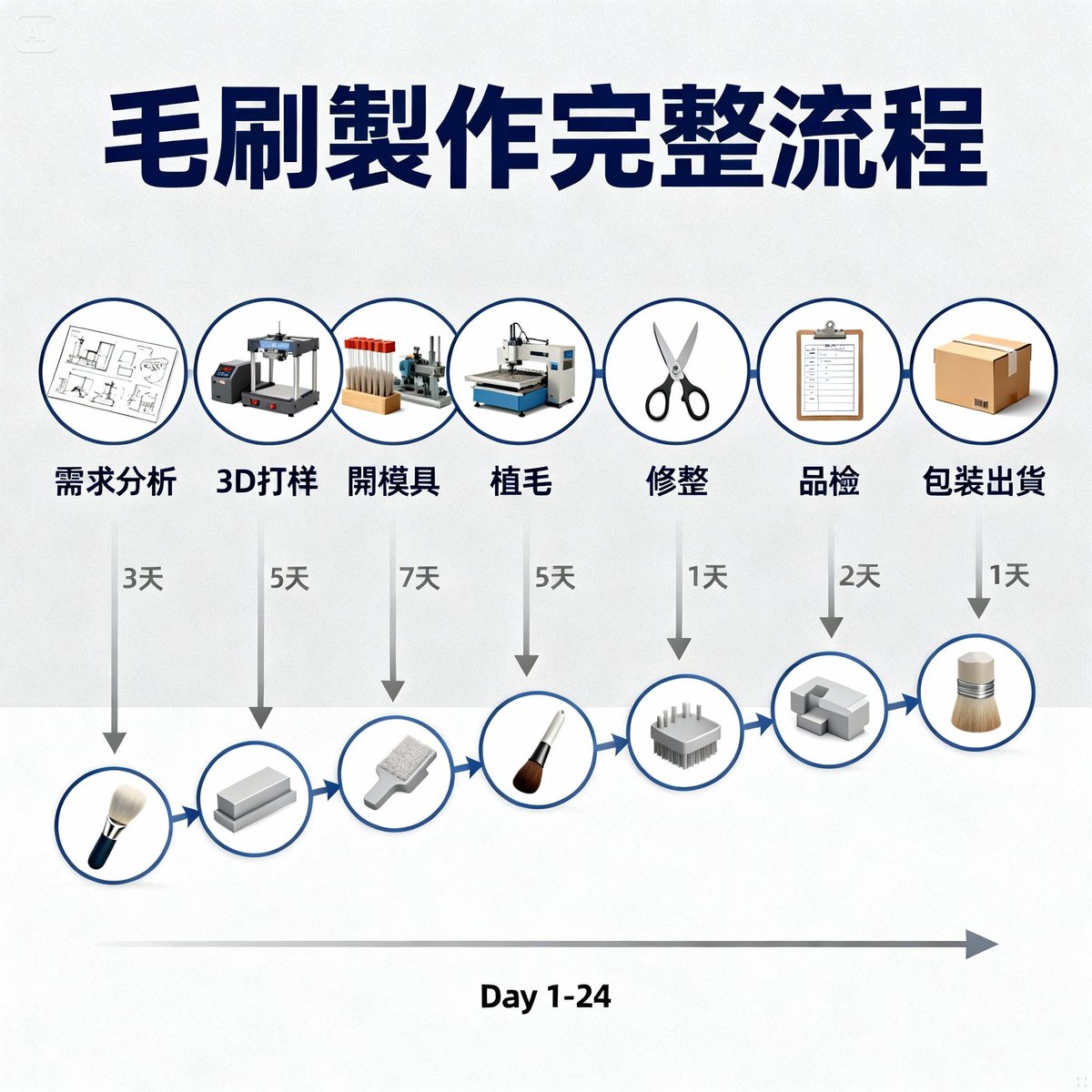
One-stop custom service: From the requirements consultation, 3D design and sample making to tooling and volume production, the factory team serves you all the way, ensuring quality and lead time.
Delivery throughout Taiwan: Although the factory is in New Taipei, we deliver throughout Taiwan. Whether you are in Taipei, Taichung, Tainan or Kaohsiung, you can enjoy quality factory-direct service.
Technical team support: We have a team of professional engineers who can offer material choices, specification advice and quality improvement plans for your application.
Complete quality certification: We have passed ISO quality management certification, and our food-grade products comply with the FDA food contact material regulations (21 CFR 177) and have SGS test reports, in line with international standards.
Several hundred companies have already chosen YC Brushes as their long-term brush supplier, including food plants, machinery plants, electronics plants and cleaning companies. With over 40 years of expertise and integrity, we provide every customer with the brush solution that suits them best.
Evaluating brush suppliers? Contact YC Brushes factory-direct now. Our professional team will provide a free requirements assessment and a transparent quote, so your purchasing decision is more precise. 📞 +886-2-2988-2721
FAQ
Is factory-direct always cheaper than a distributor?
In most cases, yes: factory-direct can save 30-50% of the cost. But if your purchase quantity is very small (below the factory's MOQ), the factory may charge a higher sampling fee or a small-quantity surcharge, and in that case a distributor is actually the better deal. We suggest asking the factory about its MOQ and pricing method first and then comparing.
Are the brushes sold by distributors of poorer quality?
Not necessarily. A distributor's quality depends on the standard of the factories it works with. A good distributor carefully selects reliable factories to supply it, and the quality is not necessarily worse than factory-direct. The difference is that a distributor cannot step in to improve the process, so if there is a quality problem it is handled more slowly. A factory can trace the problem immediately and improve the process.
How can I tell whether the other party is a real factory or a fake one?
The most direct way is to ask to visit the factory. A real factory has production equipment, a raw material warehouse, technical staff and a quality control process. A fake factory (in fact a trading company or middleman with no production line) will usually find all sorts of reasons to refuse a visit. You can also look at the factory address in Google Maps Street View, or ask for proof of company registration to confirm its registered business activities.
Is the lead time for factory-direct really longer?
Yes, because a factory produces after the order is received. For custom brushes, order quantities and lead times are quoted per specification; please email us with your requirements. But long-term customers can order in advance, and the factory will schedule them first to ensure the lead time. If the factory happens to have stock or a gap on the production line, the lead time may also be shortened. For urgent needs, we suggest talking to the factory early to assess whether expedited production is feasible.
Can I buy from a distributor first and then have a factory produce once I am satisfied?
Yes, and it is a very smart mixed strategy. Test in small quantities through a distributor first, confirm the specification and quality, and then buy in volume from a factory. This lowers the cost of trial and error and still gives you the price advantage of factory-direct. Note, however, that the specification of a distributor's product is not necessarily identical to the factory's, so before ordering be sure to confirm that details such as material and dimensions match.
Conclusion
Factory-direct and distributors each have their strengths, and which you choose depends on your purchasing needs.
If you value price, custom work, technical support and long-term cooperation, factory-direct is the best choice: it can save 30-50% of the cost and also gives you professional process transparency and quality assurance. If you need small, varied or urgent purchases, the convenience and flexibility of a distributor suit you better.
The smart purchasing strategy is a mixed model: give regular items to a factory and special items and urgent needs to a distributor, balancing cost with flexibility.
YC Brushes has been factory-direct for over 40 years, has earned the trust of several hundred corporate customers, and provides a complete service of transparent prices, custom flexibility and professional technical support. Whether you are buying for the first time or looking for a long-term supplier, we can provide the brush solution that suits you best. Contact us now to make your purchasing decision more precise and to spend every part of your budget where it counts.
Further reading: Want to learn more about buying brushes? We recommend → The complete guide to buying factory-direct from a brush factory and Brush prices explained
References
-
ISO 9001 quality management system standard
-
YC Brushes - Factory-direct service
Disclaimer: The price difference (30-50%) given in this article is a general industry reference. The actual difference varies with product specification, quantity and supplier. Before purchasing, always confirm the detailed quote and terms with the supplier.
Contact YC Brushes:
- Phone: +886-2-2988-2721
- Email: [email protected]
- Website: ycbrushes.com/en/
- Online inquiry: Contact us