When buying brushes, price is often the first concern. But brush prices cover a wide range, from a few dozen NT dollars to more than a thousand. How is a fair price worked out? This article explains the 5 key factors that affect brush prices, gives a reference for 2025 market rates, takes apart the common quotation traps and shares practical negotiation tips, so that you have a firm grip on cost in every purchase and no longer worry about being overcharged.
Overview of brush price ranges (2025 reference prices)
Brush prices vary a great deal with type, material, specification and quantity. Here is a price reference for the Taiwan market in 2025:
Price table by product type
| Brush type | Basic specification | Mid-range specification | High-end specification | Notes |
|---|---|---|---|---|
| Hand cleaning brush | Budget | Mid-range | Upper mid-range | Material and filament density affect the price |
| Industrial roller brush | Mid-range | Upper mid-range | High | Size and filament material are the main variables |
| Strip brush | Budget, per meter | Mid-range, per meter | Upper mid-range, per meter | Priced by length; density affects the price |
| Disc brush | Mid-range | Upper mid-range | High | Diameter and filament material decide the price |
| Food-grade brush | Mid-range | Upper mid-range | High | Must meet the Sanitation Standard for Food Utensils, Containers and Packages with a test report (exports to the US must also meet FDA 21 CFR 177), so the price is higher |
| Special custom brush | Upper mid-range | High | Above the high range | Includes sampling and tooling fees |
Important reminder: The prices above are "volume production prices" for reference, which usually require a purchase of 300 pieces or more. For small purchases (below the MOQ) the price may be 30-50% higher.
Price trend analysis
Over the past 3 years brush prices have risen slightly, mainly because of the following factors:
Rising raw material costs: The prices of petrochemical raw materials such as nylon and PP move with the oil price.
Higher labor costs: Taiwan's minimum wage (formerly called the basic wage) has been raised year after year, so labor costs such as tufting account for a larger share.
Quality certification requirements: Demand for high-standard certification such as food grade and medical grade has grown, pulling up the average price.
A higher share of custom work: More and more companies need custom brushes, and custom prices are higher than those of standard products to begin with.
Even so, a competitive price can still be obtained by buying factory-direct and negotiating sensibly. The key is to understand the price structure and the factors behind it.
The 5 key factors that affect brush prices
Brush prices are not called out at random. The following 5 factors decide 90% of the price difference:
Factor 1: Filament material
Material is the variable with the greatest effect on price. The cost of different materials can differ markedly.
Natural hog bristle: Output is limited and the raw material price moves with the market. Suited to polishing and cleaning applications.
Nylon: The most common synthetic fiber, with good wear resistance. A low-to-mid-priced raw material with the widest range of applications.
PP (polypropylene): An economical raw material, resistant to acids and alkalis, often used in the chemical and food industries.
PBT (polybutylene terephthalate): A high-end synthetic fiber with good resilience and strong recovery. The raw material price is on the high side.
Steel wire: A metal material, durable but with a raw material price on the high side. Used for heavy rust removal and abrasive work.
Stainless steel wire: The material with the highest raw material cost. Resistant to corrosion and high temperatures, used in the food and chemical industries.
Take a 30 cm industrial roller brush as an example: the version with PP filament is lower in price, the nylon version is in the middle, and the stainless steel version is clearly higher. The price difference between materials can be several times or more.
Want a closer look at material properties? Recommended reading → Brush materials explained | Hog bristle vs nylon vs steel wire compared
Factor 2: Size and specification
The larger the size, the more material is used and the higher the price. It is a simple proportional relationship.
Trim length: The longer the filament, the higher the material cost and the harder the tufting. For example, on roller brushes of the same diameter, increasing the trim length from 5mm to 20mm may raise the price noticeably.
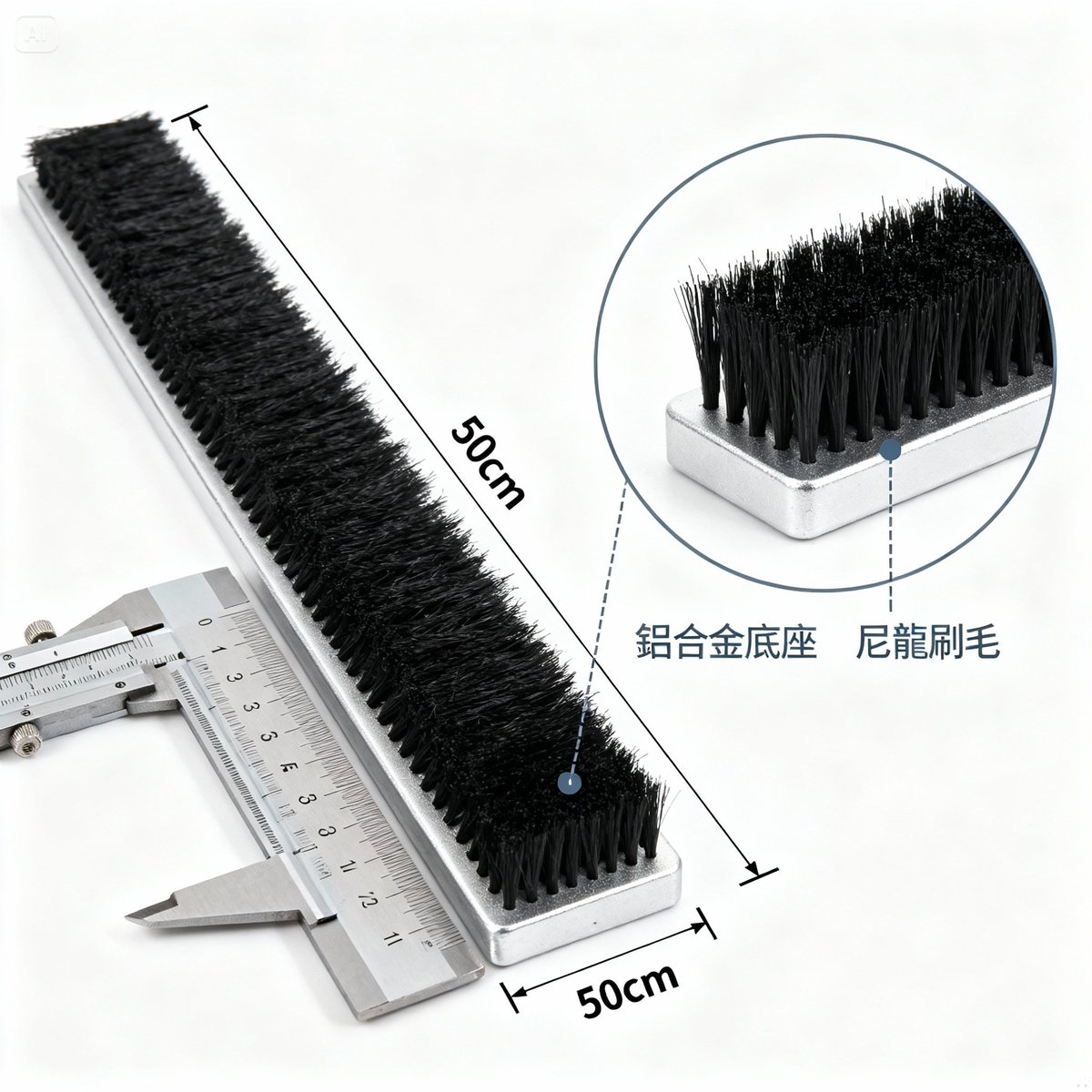
Handle / brush body size: The larger the brush body, the higher the tooling cost and the material cost. A 50cm roller brush is usually clearly more expensive than the 25cm version.
Filament density: The higher the density, the longer the tufting time and the higher the price. A high-density brush (100 filaments or more per square centimeter) is clearly more expensive than a normal-density brush (50-80 filaments).
Overall weight: Weight directly reflects the material cost and also affects the logistics cost.
Take a strip brush as an example: a strip brush 5cm wide with a trim length of 10mm is lower in price. If the trim length is increased to 30mm, the price may rise noticeably, roughly in multiples.
Factor 3: Manufacturing process
Different tufting processes and degrees of machining complexity have a significant effect on price.
Tufting method:
- Machine tufting (the ordinary process): the lowest cost, suited to volume production of standard specifications
- Hand tufting: long working hours and high cost, used for special shapes or small custom quantities
- Mixed tufting (several materials): has to be tufted in several passes, adding 30-50% to the working hours
Special processing:
- Trimming the filament to shape: an extra operation, adding 10-20% to the cost
- Tapering the filament tips: used for precision cleaning, adding 15-25% to the cost
- Anti-static treatment: conductive material is added, adding 20-30% to the cost
- Antibacterial treatment: an antibacterial additive is used, adding 15-20% to the cost
Tooling complexity: Shared standard tooling costs little, while custom tooling means the tooling fee has to be amortized, so the price of the first batch is higher.
YC Brushes has over 40 years of manufacturing experience and can suggest the most cost-effective process for your needs, striking the best balance between quality and price.
Factor 4: Order quantity
Quantity is the factor that affects the unit price most directly, and the tiered price reductions are very clear.
MOQ (minimum order quantity): Factories usually set an MOQ of 300-1,000 pieces. Below the MOQ, a small-quantity surcharge or a sampling fee is charged.
Price tier reference (taking a standard nylon industrial brush as an example):
- 300-500 pieces: the unit price is on the high side
- 501-1,000 pieces: the unit price starts to fall
- 1,001-3,000 pieces: the unit price falls clearly
- 3,001-5,000 pieces: the unit price is lower still
- 5,001 pieces or more: the lowest unit price
Why is buying in volume cheaper? Because tooling amortization, machine setup and inspection costs can be spread over more products, so the unit cost naturally falls.
Long-term customers of YC Brushes have built up quantity through regular purchases and already obtain favorable prices clearly below the market price.
Factor 5: Degree of customization
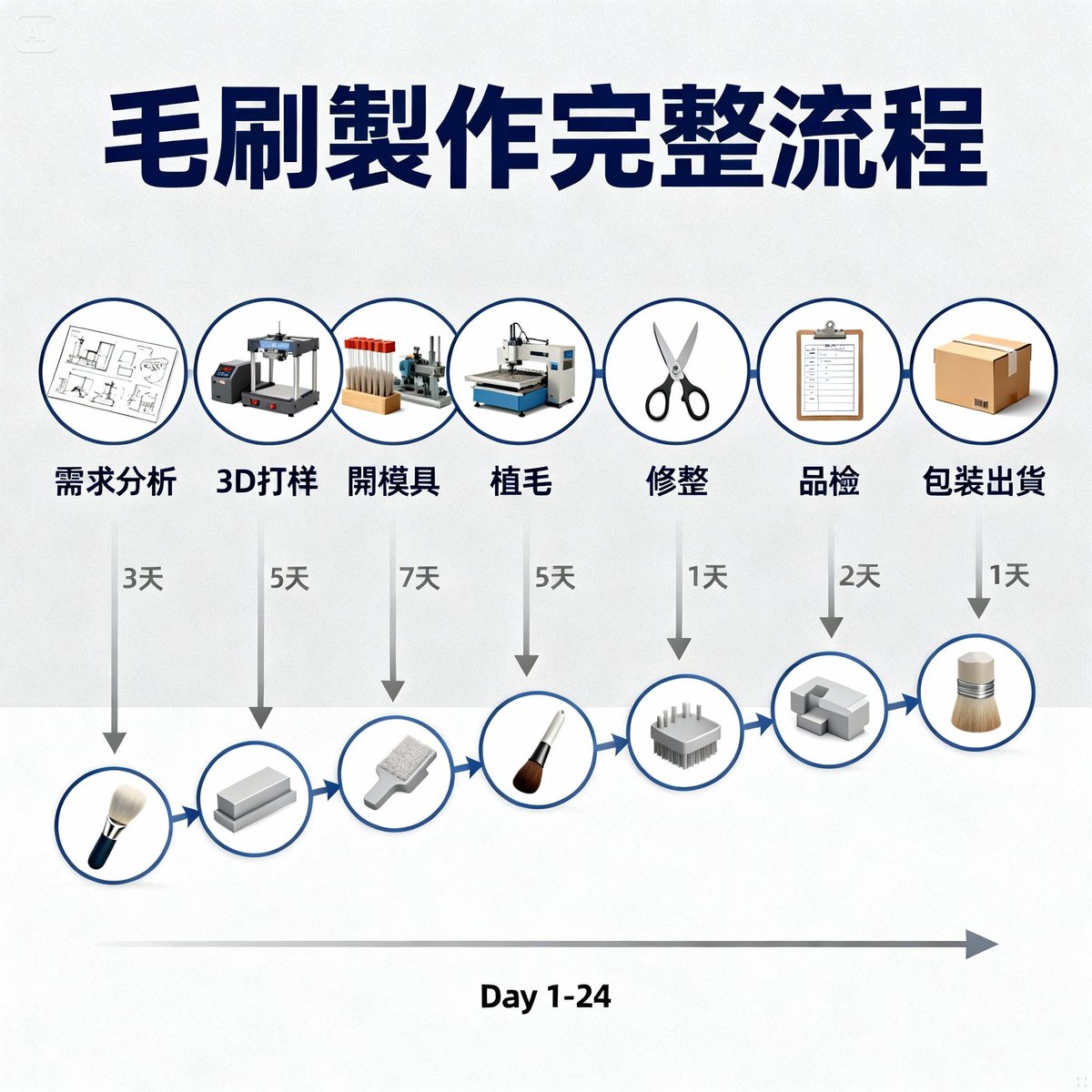
The higher the degree of customization, the higher the price, because extra investment in design, sampling and tooling is needed.
Standard product (the cheapest): uses existing tooling and specifications, the lowest cost.
Adjusted standard product (+5-15%): small modifications to a standard product, such as trim length or material, with no tooling needed.
Semi-custom (+20-40%): a standard brush body with a custom filament configuration, or standard filament with a custom brush body shape.
Fully custom (+50-100% or more): everything from the design to the tooling is custom, and the design fee, sampling fee and tooling fee have to be amortized.
Breakdown of the extra costs of customization:
- 3D design drawings: NT$3,000-8,000 (depending on complexity)
- Sampling fee: NT$2,000-5,000 per round (2-3 rounds of revision may be needed)
- Tooling fee: NT$15,000-80,000 (depending on size and complexity)
- Logo printing: NT$0.5-3 per piece (depending on the printing method)
Although the initial cost of customization is higher, if the purchase quantity is large the unit price can still be kept within a reasonable range once the tooling fee is amortized. YC Brushes offers free design consultation to help you assess the feasibility and cost-effectiveness of customization.
Want to know about the custom process and its costs? Further reading → The complete guide to custom brushes | Process, costs and what to watch for
Ready to buy brushes? Contact YC Brushes now for a transparent quote. We will provide a detailed cost breakdown and recommend the best solution for your needs. 📞 +886-2-2988-2721
Price comparison of brushes in different materials
Taking a 30cm industrial roller brush of the same specification as an example, here is how the price differs by material (quantity 1,000 pieces):
| Material | Unit price | Durability | Suitable for | Value for money |
|---|---|---|---|---|
| PP | Budget | ★★★☆☆ | Chemical industry, cleaning food conveyors | ★★★★★ |
| Nylon (Nylon 6) | Mid-range | ★★★★☆ | General industrial cleaning, abrasive work | ★★★★☆ |
| Nylon (Nylon 612) | Mid-range | ★★★★★ | High-frequency use, wear-resistant applications | ★★★★☆ |
| PBT | Upper mid-range | ★★★★★ | Precision cleaning, high-temperature environments | ★★★☆☆ |
| Natural hog bristle | Mid-range | ★★★☆☆ | Polishing, gentle cleaning | ★★★☆☆ |
| Steel wire | Upper mid-range | ★★★★★ | Rust removal, heavy abrasive work | ★★★☆☆ |
| Stainless steel wire | High | ★★★★★ | Food grade, highly corrosive environments | ★★☆☆☆ |
How to choose:
- Limited budget and no need for extreme durability → choose PP or Nylon 6
- A balance of price and quality → choose Nylon 612
- High quality standards → choose PBT or stainless steel wire
- Special applications (polishing, rust removal) → choose hog bristle or steel wire
YC Brushes can recommend the most cost-effective material for your frequency of use, environmental conditions and budget, so you do not waste budget on a specification far beyond what the job needs.
Volume production vs small batches: the price difference
Purchase quantity is the key to the unit price. Below we look at the price difference at different quantity levels.
Small purchases (below 300 pieces):
- The highest unit price, usually clearly above the volume price
- A sampling fee or small-quantity surcharge has to be paid
- Suited to testing, trial use or one-off needs
- A distributor is recommended; factories usually do not take such orders
Medium purchases (300-1,000 pieces):
- Reaches the factory's MOQ, so a normal quote can be obtained
- The unit price is clearly lower than for small purchases
- The tooling fee can start to be amortized
- A good starting point for building a supply chain
Large purchases (1,000-5,000 pieces):
- The unit price enters the discounted tiers
- Lower than the MOQ price
- More room for negotiation
- Suited to long-term customers
Very large purchases (5,000 pieces or more):
- The most favorable price
- Custom packaging and logistics plans are possible
- The factory gives production priority
- Suited to customers with an annual contract
A real case: a food plant buying conveyor cleaning brushes
- Test stage: 50 pieces, a small trial, a higher unit price (bought from a distributor)
- First volume production: 500 pieces, reaching the basic threshold for volume production, with a clear drop in unit price (ordered from the factory)
- Long-term contract: 2,000 pieces per quarter; the scale grew and a long-term contract was signed, and the unit price fell further (quarterly contract price)
- Over the long run, the accumulated cost savings are considerable
The case shows that building a long-term supply relationship and keeping the purchase quantity stable is the best strategy for lowering costs.
Want to know about the price advantage of factory-direct? Read → Factory-direct vs distributor | Pros and cons of each purchasing channel
Breakdown of the extra costs of custom brushes
The price of a custom brush is made up of the "basic manufacturing cost" + the "extra costs of customization".
Design fee (NT$3,000-8,000)
What it includes:
- Requirements interview and functional analysis
- 3D modeling and engineering drawings
- Advice on material selection
- Process feasibility assessment
Fee scale:
- Simple modification (adjusting an existing design): NT$3,000-5,000
- Medium complexity (a new shape design): NT$5,000-8,000
- High complexity (an assembly of several parts): NT$8,000 or more
YC Brushes offers a free preliminary design consultation. The design fee is charged only once the project is confirmed to enter the formal development stage.
Sampling fee (NT$2,000-5,000 per round)
What it includes:
- Making samples with simple tooling or 3D printing
- Making 1-5 samples for testing
- Revising the design according to the test results
Fee scale:
- Sampling with existing tooling: NT$2,000-3,000
- 3D-printed sample: NT$3,000-4,000
- Sampling with simple new tooling: NT$4,000-5,000
Note: It usually takes 2-3 rounds of sampling to finalize the design, for a total sampling fee of about NT$6,000-15,000. The practice at YC Brushes is that if a formal order follows, the sampling fee can be credited against part of the tooling fee.
Tooling fee (NT$15,000-80,000)
Fee scale:
- Simple brush handle tooling: NT$15,000-25,000
- Medium-complexity tooling: NT$25,000-50,000
- Large or high-precision tooling: NT$50,000-80,000
- Multi-cavity tooling (several pieces per cycle): from NT$40,000
Calculating tooling amortization: Suppose the tooling fee is NT$30,000 and the purchase quantity is 3,000 pieces. The amortized cost = 30,000 ÷ 3,000 = NT$10 per piece.
If the purchase quantity is large enough, the tooling fee has little effect on the unit price once it is amortized. YC Brushes will negotiate a plan with long-term customers for sharing the tooling fee, to ease the pressure of the initial investment.
Logo printing fee (NT$0.5-3 per piece)
Fee scale:
- Laser engraving: NT$2-3 per piece (permanent, does not fade, the highest cost)
- Screen printing: NT$1-2 per piece (suited to volume production)
- Heat transfer: NT$0.5-1 per piece (the lowest cost, medium durability)
Plate fee: Making the plate for the first time costs NT$1,500-3,000. No plate fee is charged for repeat orders.
Summary: The initial investment for a fully custom project is about NT$30,000-80,000 (design + sampling + tooling + plate fee), but the increase in the unit price in later volume production is usually only 10-20%. If your annual demand exceeds 3,000 pieces, customization is very cost-effective.
Evaluating a custom project? Contact YC Brushes now. We provide a free cost-benefit analysis to help you make the best decision. 📞 +886-2-2988-2721
How to avoid brush quotation traps: 5 common ones
When buying brushes, some suppliers use sales talk or hidden costs to raise the price. Here are 5 common traps:
Trap 1: An "ultra-low" quote followed by a stream of extra charges
The tactic: An ultra-low initial quote attracts the order, and charges are then added under names such as "rush fee", "special handling fee" and "packaging fee".
How to counter it: Ask for a complete quote breakdown, confirm "whether freight, packaging and tax are included", and ask for it to be written into the contract.
Trap 2: Confusing the "distributor price" with the "factory price"
The tactic: A distributor claims to be factory-direct but is actually a middleman, with prices 30-50% higher than a real factory.
How to counter it: Ask for the factory address and book a visit. A real factory will not refuse a customer visit. You can use Google Maps Street View to confirm whether it is a factory.
Trap 3: Opaque pricing by "quantity tier"
The tactic: The supplier promises "a discounted unit price for large orders", but only at delivery says "this batch is not large enough for the discount, so the unit price has to go up".
How to counter it: Ask for the complete tiered price list, with the unit price for each quantity tier stated clearly, and ask for it to be written into the quotation.
Trap 4: The material is downgraded but the price stays the same
The tactic: The quote says "Nylon 612", but what is actually delivered is the cheaper "Nylon 6", with no reduction in price.
How to counter it: State the material specification clearly in the contract (such as Nylon 612, PP or PBT), and ask for a material test report or SGS certificate.
Trap 5: A padded "tooling fee"
The tactic: The tooling fee quoted for a custom item is far above the market rate, as a chance to make an excessive profit.
How to counter it: Ask 2-3 more factories and compare their tooling fee quotes. For ordinary simple tooling, a low-to-mid price is the reasonable range. If the quote is clearly on the high side, confirm the complexity in detail.
YC Brushes insists on transparent quotes. Every charge is listed clearly on the quotation and no hidden fees are charged, so you can buy without worry.
The questions you must ask when requesting a brush quote
When you ask a supplier for a quote, asking the right questions is the only way to get complete information and avoid misunderstandings:
About price:
- "Does this quote include freight, packaging and tax?"
- "What are the tiered prices for different quantity levels?"
- "Is there a favorable price for long-term cooperation?"
- "What are the payment terms? (deposit percentage, timing of the balance)"
About specification: 5. "What is the specific grade of the filament material? (such as Nylon 6/612/66)" 6. "What is the filament density? (how many filaments per square centimeter)" 7. "What are the handle material and the hardness standard?" 8. "Can you provide a material test report or SGS certificate?"
About lead time and MOQ: 9. "What is the minimum order quantity (MOQ)?" 10. "What is the normal lead time? Can it be expedited? How much is the rush fee?" 11. "Can you deliver in batches? Does that affect the price?"
About customization (if applicable): 12. "How much are the design fee, sampling fee and tooling fee respectively?" 13. "Who owns the tooling? Is a tooling fee still needed for repeat orders?" 14. "How many rounds of sampling are needed? How much is each round?"
About quality assurance: 15. "Is there a quality warranty? How long is the warranty period?" 16. "If the product is defective, what is the return and exchange policy?" 17. "Can you provide samples for testing? What does it cost?"
About the supplier's background: 18. "Are you factory-direct or a distributor?" 19. "Can I visit the factory?" 20. "Do you have cases of long-term customers you can share?"
Print out these 20 questions and go through them one by one every time you ask for a quote. You will get complete and accurate quotation information and avoid disputes later.
3 techniques for negotiating brush prices
With the following 3 negotiation techniques, you can win a better price within a reasonable range:
Technique 1: The combination of "volume + long-term cooperation"
Do not talk only about a single purchase. Tell the supplier that you intend to cooperate long term, and give an estimate of your annual or quarterly demand.
Example wording: "We expect to buy 2,000 pieces a quarter, 8,000 pieces a year. If we are satisfied with the quality and service, we will set up a long-term supply relationship. Do you have a favorable price for an annual contract?"
Factories like stable orders best. Long-term cooperation lets them plan the production line and materials more efficiently, so they are usually willing to give 5-15% of room on price.
Technique 2: "Compare several suppliers", but do not talk only about price
After getting quotes from 2-3 suppliers, do not compare price alone. Compare quality, lead time, service and technical capability together.
Example wording: "We have received 3 quotes. Factory A has the lowest price but a longer lead time, and Factory B has a mid-range price but materials that comply with FDA 21 CFR 177. What advantages does your company have in price and quality?"
Asking in this way tells the supplier that you are not a buyer who looks only at price, but one who values the overall package. A good supplier will be willing to adjust its quote within a reasonable range to show its overall competitiveness.
Technique 3: "Flexible specifications" in exchange for a better price
If you have some flexibility on certain specification details, you can ask the supplier "whether adjusting the specification slightly would lower the cost".
Example wording: "If we change the trim length from 25mm to 20mm, or accept production in a mixed batch, how much can the unit price come down?"
Some small adjustments (such as trim length, a substitute material or accepting a mixed batch) help the factory save costs or improve line efficiency, and those savings can be turned into a better price.
What not to do when negotiating:
- ❌ Do not slash the price maliciously (such as demanding a 50% reduction outright)
- ❌ Do not deceive the supplier by misreporting other quotes
- ❌ Do not talk only about price and ignore quality and service
- ❌ Do not promise a large purchase and then fail to follow through
Reasonable, honest negotiation builds a long-term supply relationship of mutual trust, which is worth more than a short-term saving.
Ready to negotiate? Contact YC Brushes now for a transparent quote. We value long-term cooperation and are willing to give serious customers our most sincere quote. 📞 +886-2-2988-2721
The price advantage and transparent quotes of YC Brushes
YC Brushes was founded in 1985, and for over 40 years has held to the principles of factory-direct service and transparent quotes.
Price advantages:
Factory-direct, no middleman: With no distributor markup, prices are clearly below the market average.
A transparent cost breakdown: Every quote clearly lists the material cost, processing fee, tooling fee and a reasonable profit, so your purchase has a sound basis.
Clear volume discounts: We provide a clear tiered price list. The larger the quantity, the bigger the discount, with no word games.
Long-term contract discounts: Sign an annual or quarterly supply contract with us and enjoy an extra 5-10% discount.
No hidden fees: The quoted price is the final price. We do not charge vague "special handling fees" or "processing fees".
Service commitments:
Free requirements consultation: Professional engineers help analyze your application and recommend the most cost-effective solution.
Free sample testing (some products): Long-term customers or large purchases can apply for free sample testing.
Tooling fee discount: For custom projects, if a formal order follows, the sampling fee can be credited against the tooling fee.
Flexible payment terms: Long-term customers can negotiate monthly settlement or payment by installments.
Quality warranty: Products carry a 6-month warranty. If there is a quality problem, returns and exchanges are unconditional.
YC Brushes has earned the trust of several hundred corporate customers precisely because we insist on honest quotes, quality assurance and professional service.
See YC Brushes products and reference quotes | Contact us now for your own quote
FAQ
Why do different suppliers quote such different prices for brushes of the same specification?
The price difference comes mainly from 3 causes: 1) different material grades (such as Nylon 6 vs Nylon 612), 2) differences in the manufacturing process (machine tufting vs hand tufting), 3) the level in the supply chain (factory-direct vs distributor). We suggest asking for a detailed specification breakdown to compare, and not looking only at the price figure.
Is there a way to get a reasonable price on a small purchase (below the MOQ)?
You can consider the following: 1) buy stock items from a distributor, 2) ask whether the factory accepts "combined production" (sharing a production run with other customers), 3) test in a small quantity first and then buy in volume once confirmed, to even out the cost, 4) several small companies combine their purchases to reach the MOQ.
Can the tooling fee for a custom brush be refunded or credited?
Generally speaking, the tooling fee is a one-off investment and is not refunded. But some factories (including YC Brushes) offer the following: 1) the sampling fee is credited against part of the tooling fee, 2) for later volume purchases the tooling fee is amortized into the unit price, 3) long-term customers can negotiate payment of the tooling fee in installments. Ownership of the tooling usually belongs to the customer, who can take it along when changing supplier.
Can I refuse to pay later for charges that were not clearly written on the quotation?
In principle, yes. Charges that are not clearly listed in the quotation or contract fall outside what the two parties agreed, so the buyer can rely on this to refuse payment. Before ordering, we suggest asking the supplier for a complete quote with "the total price including tax, freight and packaging", and having it written into the purchase order or contract. If charges are added afterward, you can rely on this to refuse payment.
How can I judge whether a quote is reasonable? Is there a reference standard?
You can refer to the following: 1) ask 2-3 more suppliers and compare their quotes, 2) refer to the market rate table in this article, 3) calculate the material cost (raw material prices can be looked up) + a reasonable processing fee (about 80-150% of the material cost) + profit (about 15-25% of the total cost). If the quote is far beyond this range, it may be unreasonable. YC Brushes offers free quotation advice, and you are welcome to check market rates with us.
Conclusion
Brush prices are affected by 5 major factors: material, specification, process, quantity and degree of customization. Prices run from entry-level products to high-end custom work, and the range is quite wide.
Through this article you have learned how to read the price structure, avoid quotation traps and use negotiation techniques, and how prices differ between factory-direct and a distributor. Remember, the cheapest is not necessarily the best deal. Choosing a supplier that offers transparent quotes, professional service and quality assurance is the key to lowering costs over the long term.
YC Brushes has been factory-direct for over 40 years, insists on transparent quotes and honest business, and has earned the trust of several hundred corporate customers. Whether you need standard products or custom brushes, we can provide the most cost-effective solution. Contact us now for a professional cost analysis and a transparent quote, and spend every part of your purchasing budget where it counts.
Further reading: Want a deeper understanding of brush purchasing? Recommended reading → The complete guide to buying factory-direct from a brush factory, Factory-direct vs distributor compared and Brush materials explained
References
- YC Brushes - Product prices and specifications
- YC Brushes - Custom service and quotation process
Disclaimer: The prices given in this article are a market reference as of January 2025. Actual prices vary with product specification, quantity, material and supplier. Before purchasing, always confirm the latest quote with the supplier.
Contact YC Brushes:
- Phone: +886-2-2988-2721
- Email: [email protected]
- Website: ycbrushes.com/en/
- Online inquiry: Contact us