Do you use a soft-bristle toothbrush and always feel that your teeth are not clean?
You brush for 3 minutes and your teeth still feel coated; at your dental cleaning, the dentist says your brushing method is wrong; you even wonder whether you should go back to a hard-bristle toothbrush.
The problem is actually not how soft or hard the bristles are but how you brush. With the wrong method, even the best toothbrush will not get the teeth clean. This article teaches the correct Bass technique, point out 5 common mistakes and give 3 tips for a better cleaning result, so that a soft-bristle toothbrush cleans just as well!
Why does a soft-bristle toothbrush seem not to clean well? (4 causes)
First find the root of the problem.
For most people who feel that soft bristles do not clean well, it comes down to these 4 causes.
Cause 1: Incorrect brushing method
This is the most common problem.
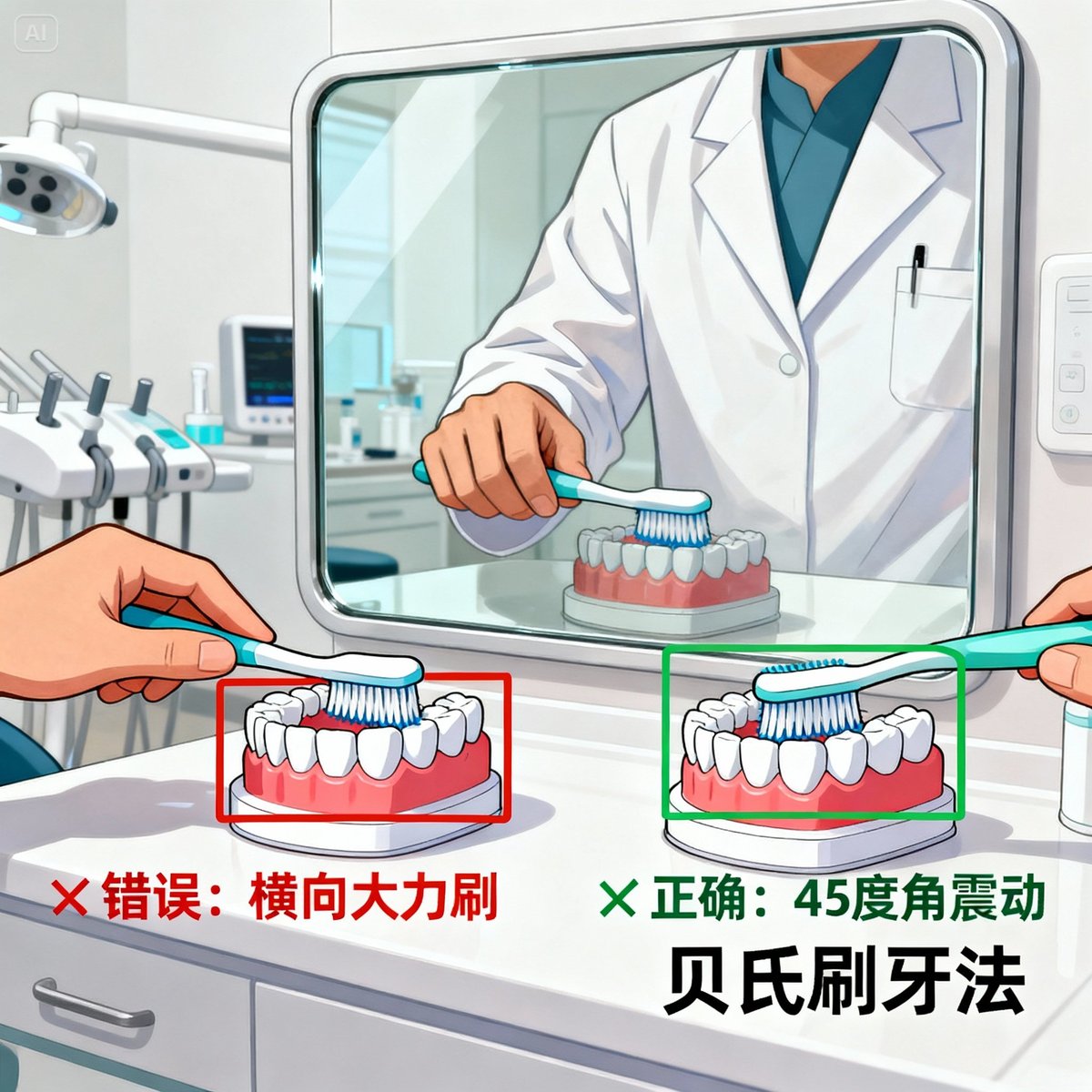
Wrong way: scrubbing hard from side to side (like sawing wood)
- Scrubbing back and forth horizontally
- A lot of pressure
- Very fast
Why does it not clean well?
- The bristles cannot reach into the gingival sulcus
- Only the surface is cleaned; the gaps between teeth are missed
- The soft bristles are flattened and lose their cleaning power
Right way: small vibrations at a 45-degree angle (the Bass technique)
- Bristles pointed toward the gingival sulcus
- Small vibrations
- 2-3 teeth at a time
Difference in cleaning result:
- Wrong way: plaque in the gingival sulcus is easily missed
- Right way: removes plaque from the gingival sulcus more effectively
Cause 2: Brushing time too short
Most people brush for less than 1 minute.
The current situation:
- Average brushing time in Taiwan: 45-60 seconds
- Internationally recommended time: 2-3 minutes
- Gap: too short by a factor of 1.5 or more
Why does time matter?
- An adult has 28-32 teeth
- Each tooth has 3 surfaces to brush (outer, inner, chewing)
- About 84-96 surfaces in total
- Each surface needs at least 2-3 seconds
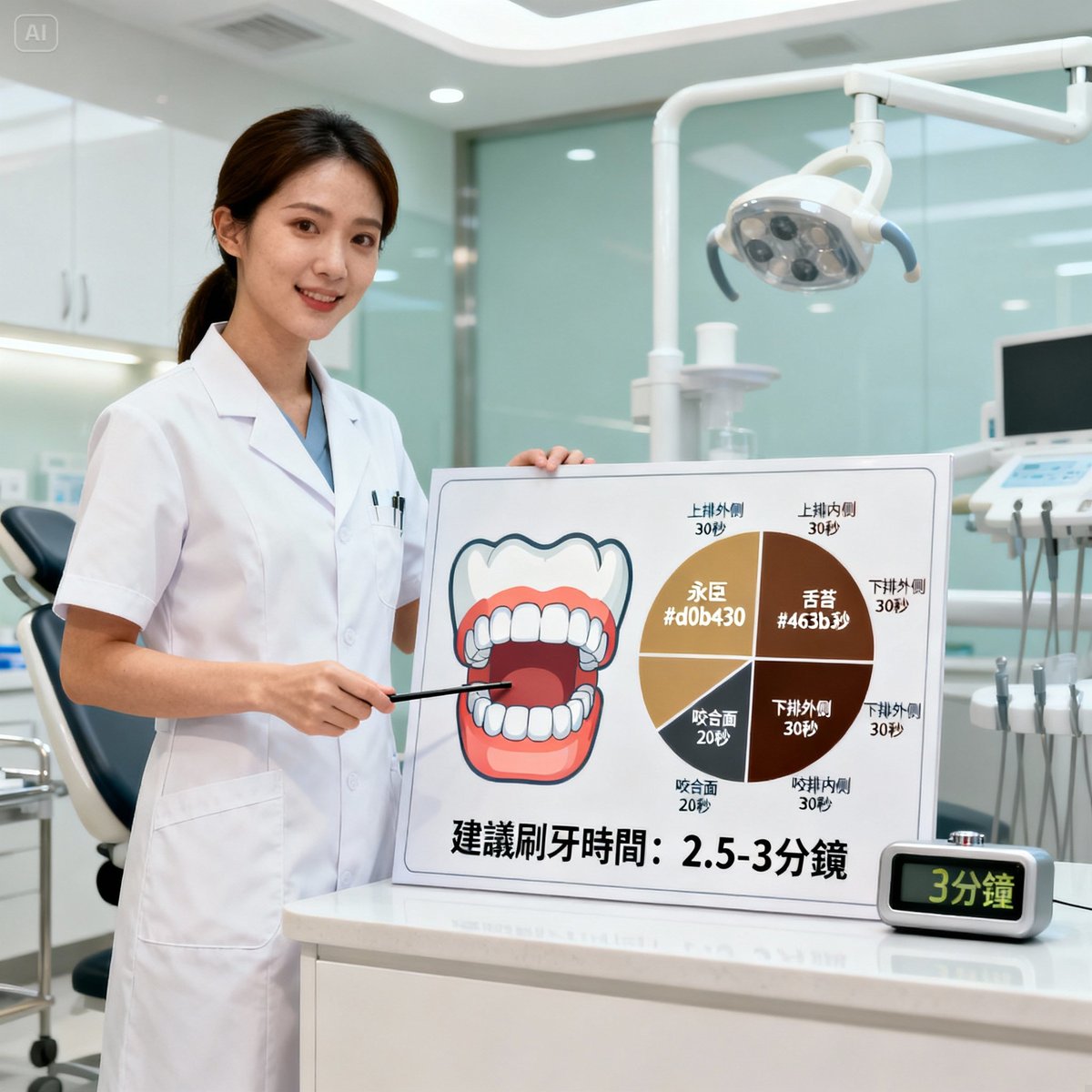
Correct allocation of time:
- Outer side of the upper teeth: 30 seconds
- Inner side of the upper teeth: 30 seconds
- Outer side of the lower teeth: 30 seconds
- Inner side of the lower teeth: 30 seconds
- Upper and lower chewing surfaces: 20 seconds
- Tongue cleaning: 10-20 seconds
- Total: 2.5-3 minutes
Suggested approach:
- Use a timer or the timer on your phone
- Brush for the length of one song (about 3 minutes)
- Electric toothbrushes have a 2-minute reminder
Cause 3: Poor control of pressure
Too light and too heavy are both bad.
Too light:
- The bristles cannot reach into the gaps between teeth
- Plaque is not removed completely
- The teeth do not feel clean
Too heavy:
- The soft bristles bend too far
- The cleaning effect of the vibration is lost
- Enamel may be worn
Correct pressure: 150-200 grams
How do you judge it?
- About the pressure at which pressing with a finger does not hurt
- The bristles bend slightly but do not lie flat
- You can feel it on the gums, but it does not hurt
A simple test:
- Press the toothbrush on an electronic scale
- Notice what 150-200 grams feels like
- Remember that pressure
Dentists' advice: Better a slightly lighter pressure and a longer time than brushing too hard.
Cause 4: Old bristles or an unsuitable specification
The tool matters too.
Situations that call for immediate replacement:
- Splayed bristles: cleaning power drops noticeably
- Discolored bristles: possibly mold or a build-up of dirt
- Used for more than 3 months: bacterial growth
Unsuitable bristle specification:
Too soft (diameter below 0.12 mm):
- Suits people with extremely sensitive gums
- Most people may find the cleaning power insufficient
- Advice: switch to standard soft bristles (0.15-0.18 mm)
Brush head too large:
- Cannot reach the back teeth
- Hard to clean around the wisdom teeth
- Advice: an adult brush head of 2.5-3 cm
Specification recommended by YC Brushes:
- Bristle diameter: 0.15-0.18 mm (standard soft)
- Brush head size: 2.5-3 cm
- Bristle arrangement: 3-4 rows
- A balance of cleaning power and protection
The Bass technique | The correct way to brush, as recommended by dentists
The brushing method that dentists worldwide recognize as the most effective.
What is the Bass technique?
It was put forward by the American physician Charles C. Bass between the late 1940s and the 1950s (published in 1948 and 1954).
Why does it work?
- The bristles can reach into the gingival sulcus (where plaque mainly hides)
- The vibration effectively dislodges plaque
- It suits everyone, including people with periodontal disease
Cleaning result:
- Ordinary brushing: plaque in the gingival sulcus is easily missed
- The Bass technique: removes plaque from the gingival sulcus more effectively
- With dental floss: also covers the gaps between teeth that a toothbrush cannot reach
The Bass technique in 5 steps
Step 1: Hold the bristles at a 45-degree angle to the teeth
- Bristles pointed toward the gingival sulcus
- Lightly touching where the gum meets the tooth
- Half of the bristles on the gum, half on the tooth
Step 2: Brush 2-3 teeth at a time
- Do not brush too many teeth at once
- Clean a small area before moving on
- Do not miss any tooth
Step 3: Small vibrations (1-2 mm)
- Not broad side-to-side strokes
- But small vibrations on the spot
- It should feel like massaging the gums
Step 4: Vibrate 10-15 times at each position
- At least 10 times at each spot
- Rhythm: 2-3 times per second
- About 5 seconds in total
Step 5: Work through all the teeth in order
Suggested brushing order:
- Outer side of the upper teeth (from the back right to the back left)
- Inner side of the upper teeth (from the back left to the back right)
- Outer side of the lower teeth (from the back left to the back right)
- Inner side of the lower teeth (from the back right to the back left)
- Upper and lower chewing surfaces
- Tongue cleaning (brush from the back toward the front)
Pay special attention to:
- Inner side of the front teeth: hold the toothbrush upright and brush vertically
- The last molars: push the brush head well in and clean thoroughly
- The gingival sulcus: brush the sulcus of every tooth
Learning from video: Search for videos of the "Bass technique" and practice along with them for 1-2 weeks, and the habit will form.
🦷 Still not sure whether to choose a soft-bristle or hard-bristle toothbrush?
See the full comparison and find the bristle hardness that suits you best!
Soft vs hard bristles: the full comparisonTips for a better cleaning result with a soft-bristle toothbrush (3 tips)
Master these 3 tips and the cleaning result doubles.
Tip 1: Use dental floss or an interdental brush as well
A toothbrush cannot fully clean the gaps between teeth.
Why is it needed?
- A toothbrush can only clean 3 surfaces (outer, inner, chewing)
- A tooth has 5 surfaces, and the other 2 are in the gaps between teeth
- The gaps between teeth are where decay most often occurs
American Dental Association (ADA) recommendation: Use dental floss at least once a day.
When to use it:
- Before bed (the most important)
- Or after every brushing
How to use dental floss correctly:
Step 1: Take about 45 cm of floss
- Wind it around the middle fingers of both hands
- Leave 10-15 cm to work with
Step 2: Hold the floss taut and slide it gently into the gap
- Do not "saw" it in with force
- Avoid hurting the gums
Step 3: Wrap it around the tooth in a C shape
- Keep it tight against the side of the tooth
- Scrape gently up and down
Step 4: Clean both sides
- Each gap has 2 tooth sides
- Clean them separately
Interdental brush vs dental floss:
- Dental floss: suits people with normal gaps between teeth
- Interdental brush: suits people with larger gaps, periodontal disease or braces
For example: Even if you brush carefully for 3 minutes every day, if you never use floss, decay can still develop between the teeth.
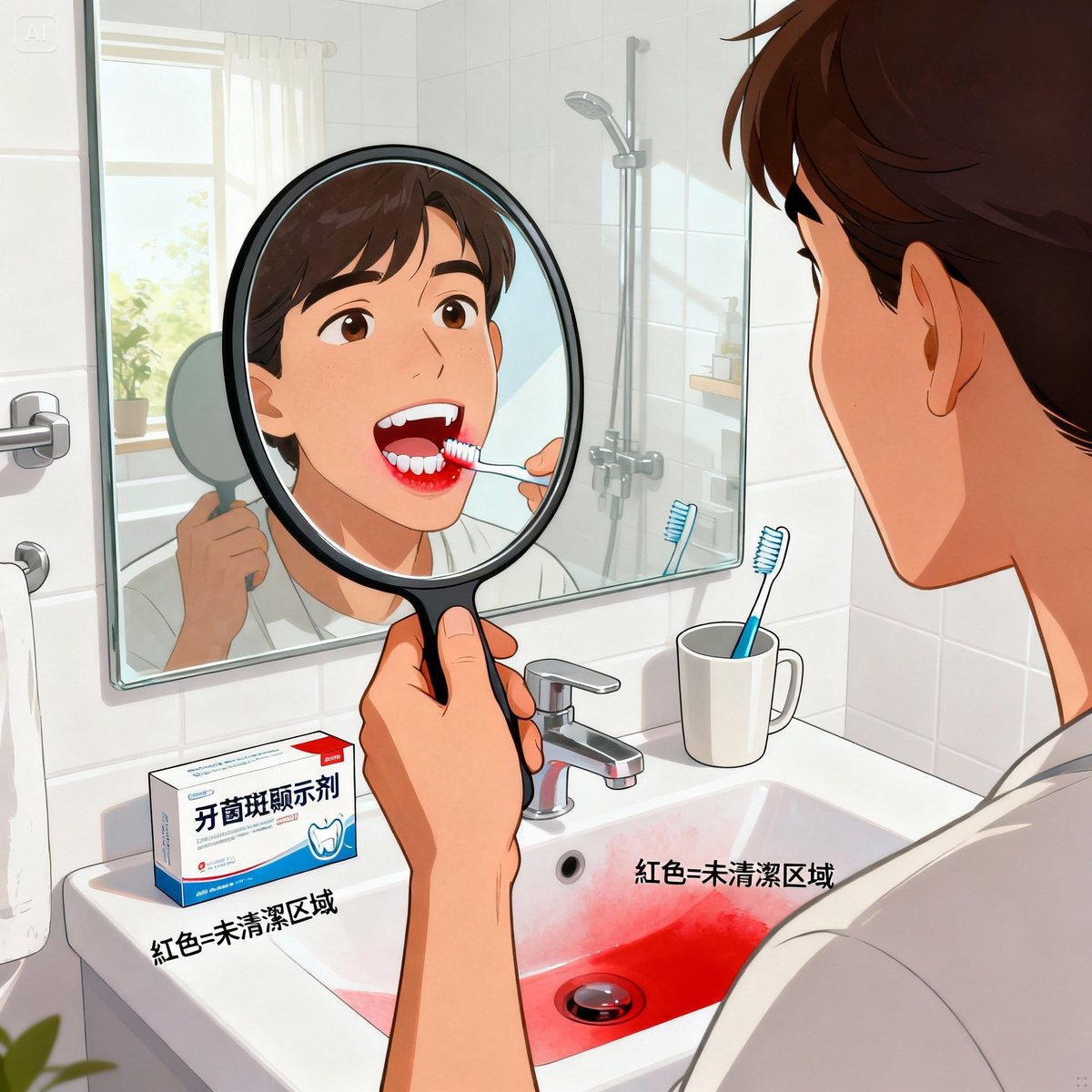
Tip 2: Check the result with a plaque disclosing agent
Only when you can see it do you know whether the teeth are clean.
What is a plaque disclosing agent?
- A harmless food dye
- It shows remaining plaque in red or blue
- Available from pharmacies or online
How to use it
Step 1: Brush normally for 3 minutes
Step 2: Rinse the mouth with the plaque disclosing agent
- Follow the instructions (usually 30 seconds to 1 minute)
- Spit it out and rinse
Step 3: Check in a mirror
- Colored areas = not brushed clean
- Most common places: the gingival sulcus, the gaps between teeth, the inner side of the back teeth
Step 4: Clean the stained areas again
Step 5: Repeat the test
- Confirm that the teeth are completely clean
Recommended frequency:
- At first: 1-2 times a week
- Once practiced: once a month
Benefits:
- You learn where your own blind spots are
- You check whether your brushing technique is correct
- You build correct brushing habits
Children's dental care: It is also well suited to teaching children to brush. Seeing the plaque gives them more motivation to brush carefully.
Tip 3: Choose a suitable soft-bristle toothbrush
Not all soft bristles are the same.
Recommended bristle diameter:
| Who | Recommended diameter | Characteristics |
|---|---|---|
| Most adults | 0.15-0.18 mm | Standard soft bristles, a balance of cleaning and protection |
| Sensitive gums | 0.12-0.15 mm | Very fine soft bristles, gentle and non-irritating |
| People with periodontal disease | 0.12-0.14 mm | Ultra-fine soft bristles that reach into periodontal pockets |
Recommended brush head size:
- Adults: 2.5-3 cm
- Children: 1.5-2 cm
- Too large a head cannot reach the back teeth
Choice of bristle material:
- Nylon bristles: the most common, durable, with good resilience
- PBT bristles: antibacterial, finer, a premium choice
- Natural bristles: not recommended (they harbor bacteria easily and clean less well)
Model recommended by YC Brushes:
- Bristle diameter: 0.15 mm (standard soft)
- Bristle material: high-quality nylon PA612
- Brush head size: 2.8 cm
- Bristle arrangement: wave or flat profile available
Wholesale purchasing: For employee benefits or hotel supplies, you are welcome to contact YC Brushes for factory-direct wholesale.
Common brushing mistakes | How many do you make? (5 mistakes)
Avoid these mistakes and the cleaning result improves.
Mistake 1: The harder you brush, the cleaner the teeth ❌
The misconception: You have to brush hard to remove plaque.
The truth:
- Plaque is a biofilm. It needs to be dislodged by vibration, not scraped off by brute force
- Brushing too hard wears the enamel
- Over time it may lead to gum recession and dentin sensitivity
The right way: Use a pressure of 150-200 grams with the correct vibrating motion.
Mistake 2: Rinsing right after brushing ❌
The misconception: After brushing, you must rinse with plenty of water to be clean.
The truth:
- Toothpaste contains fluoride, which strengthens enamel
- Rinsing right away washes the fluoride off
- It reduces the protection against decay
What to do instead: After brushing, just spit out the foam. Do not rinse with water.
If you really want to rinse:
- Rinse only once
- Use a small amount of water
- Keep some of the fluoride in the mouth
Note for children: Children under 6 may rinse lightly after brushing, to avoid swallowing too much toothpaste.
Mistake 3: Brushing only the outer side of the teeth ❌
The misconception: Brushing the outer side clean is enough; the inner side cannot be seen, so it does not matter.
The truth:
- Plaque builds up more easily on the inner side of the teeth
- The gingival sulcus on the tongue side is where periodontal disease often starts
- Decay on the inner side is often more serious (already deep by the time it is found)
Areas that are often overlooked:
- Inner side of the lower front teeth (where tartar forms most easily)
- Inner side of the upper back teeth (hard to reach)
- The grooves of the chewing surfaces
The right way: Follow the order "outer side → inner side → chewing surface" and brush every area carefully.
Mistake 4: Brushing in the morning is enough ❌
The misconception: Brushing after getting up in the morning to keep the breath fresh is enough.
The truth:
- Brushing before bed is more important!
- During sleep, less saliva is produced and bacteria multiply in large numbers
- Going to sleep without brushing gives the bacteria 8 hours to party
Peak hours for tooth decay: From 10 pm to 6 am. If you have not brushed before bed, the risk of decay rises sharply.
The right way:
- Always brush before bed (the most important)
- Brush in the morning (for fresh breath)
- Brush after lunch as well if you can (or at least rinse)
Mistake 5: An electric toothbrush needs no technique ❌
The misconception: An electric toothbrush moves by itself, so you only have to hold it against the teeth.
The truth:
- An electric toothbrush still needs the correct angle
- You still have to make sure every tooth is brushed
- Control of pressure is still important
Using an electric toothbrush correctly:
- Also at a 45-degree angle
- Stay on each tooth for 2-3 seconds
- Do not press hard
- Let the brush head vibrate by itself
Electric vs manual: When the correct technique is used:
- An electric toothbrush cleans slightly better
- But used wrongly, the result is actually worse
- A manual toothbrush with the correct technique is just as effective
YC Brushes advice: Whether manual or electric, mastering the correct technique matters most.
Summary | A soft-bristle toothbrush cleans just as well
When a soft-bristle toothbrush does not get the teeth clean, the problem is not the bristles but the method.
4 common causes:
- Incorrect brushing method (scrubbing hard from side to side vs vibrating at a 45-degree angle)
- Brushing time too short (less than 1 minute vs the recommended 2-3 minutes)
- Poor control of pressure (too light or too heavy vs the correct 150-200 grams)
- Old bristles or an unsuitable specification (not replaced for 3 months, splayed bristles)
The Bass technique in 5 steps:
- Hold the bristles at a 45-degree angle to the teeth, pointed toward the gingival sulcus
- Brush 2-3 teeth at a time
- Small vibrations of 1-2 mm
- Vibrate 10-15 times at each position
- Work through all the teeth in order (outer side, inner side, chewing surface, tongue)
3 tips for a better cleaning result:
- Use dental floss or an interdental brush as well (a must before bed)
- Check the result with a plaque disclosing agent (see your blind spots)
- Choose a suitable soft-bristle toothbrush (0.15-0.18 mm standard soft bristles)
5 common mistakes to avoid:
- ❌ The harder you brush, the cleaner the teeth
- ❌ Rinsing with plenty of water right after brushing
- ❌ Brushing only the outer side of the teeth
- ❌ Brushing in the morning is enough (before bed is more important!)
- ❌ An electric toothbrush needs no technique
What to do:
- Start practicing the Bass technique tonight
- Have a timer ready and make sure you brush for a full 3 minutes
- Buy a plaque disclosing agent and check the cleaning result
- Use dental floss at least once a day
- Check the condition of your toothbrush bristles and replace the brush when due (once every 3 months)
Advantages of a soft-bristle toothbrush:
- Protects the gums and is unlikely to cause recession
- Suits most people (sensitive gums, normal gums, periodontal disease)
- With the correct technique, it cleans just as well
Both the American Dental Association and the Taiwan Dental Association recommend using a soft-bristle toothbrush.
The key is not how soft or hard the bristles are, but whether the method is correct.
Start changing tonight and get the best cleaning result from your soft-bristle toothbrush!
See the full comparison of soft vs hard bristles | Learn how often to replace a toothbrush
FAQ
Can a soft-bristle toothbrush really get the teeth clean?
Yes, provided the correct method is used.
What makes the difference:
- The Bass technique (45-degree angle, small vibrations)
- Dental floss to clean between the teeth
Advantages of soft bristles:
- Protect the gums and reduce the risk of recession
- Suitable for long-term use
- Generally recommended by dentists
Do I have to brush for 3 minutes? Can it be shorter?
At least 2 minutes is recommended; 2.5-3 minutes is ideal.
Why does it take so long?
- 28-32 teeth with 3 surfaces each = about 90 surfaces to clean
- Each surface needs 2-3 seconds = 180-270 seconds in total (3-4.5 minutes)
- Allowing for how brushing works in practice, 2.5-3 minutes is a reasonable time
What if I cannot manage 3 minutes?
- Brush for at least a full 2 minutes
- Use an electric toothbrush (more efficient)
- Use dental floss as well to make sure the gaps between teeth are clean
I brush twice a day. Why do I still get tooth decay?
There are 3 possible causes.
Cause 1: Incorrect brushing method
- Brushing only the outer side and neglecting the inner side and the gaps between teeth
- Advice: learn the Bass technique and use dental floss
Cause 2: Eating habits
- Frequently eating sweets or drinking sugary drinks
- Advice: cut down on sugar, and wait 30 minutes after sour or sweet food before brushing
Cause 3: Individual constitution
- Low saliva flow, or a mouth pH on the acidic side
- Advice: use fluoride toothpaste, have fluoride applied regularly and drink more water
The complete approach to preventing decay:
- Brush correctly (the Bass technique for 3 minutes)
- Use dental floss every day
- Use fluoride toothpaste
- Cut down on sugar
- Regular dental cleaning and check-ups (once every six months)
Electric or manual toothbrush: which is better?
Used correctly, electric is slightly better; used wrongly, neither works.
Advantages of an electric toothbrush:
- A high vibration frequency (tens of thousands of times per minute)
- A timer reminder
- More consistent pressure
- Suits people with limited hand dexterity
Advantages of a manual toothbrush:
- Low price
- Easy to carry
- Finer control of pressure
- Low replacement cost
Cleaning result: An electric toothbrush cleans slightly better, but it must be used correctly.
YC Brushes advice:
- Ample budget and a wish for efficiency → electric toothbrush
- Limited budget and good technique → a manual toothbrush is just as effective
- What matters most is the correct brushing method
How do dental floss and interdental brushes differ? Which should I use?
Dental floss for normal gaps; an interdental brush for large gaps or periodontal disease.
Dental floss:
- Suits: people with normal gaps between teeth and healthy gums
- Advantages: reaches into narrow gaps, cleans well
- Disadvantages: takes practice; beginners may find it awkward
Interdental brush:
- Suits: people with larger gaps, periodontal disease or braces
- Advantages: simple to use, cleans a large area
- Disadvantages: cannot clean narrow gaps
How do I choose the size?
- Interdental brushes come in sizes 0 to 5 (different thicknesses)
- Start by trying a small size
- The size that passes through the gap easily but still makes contact is the most suitable
Dentists' advice: Keep both. Use dental floss where the gaps are normal and an interdental brush where they are larger.
My gums bleed when I brush. Is that normal?
No! The gums may be inflamed.
Causes of bleeding:
- Gingivitis (the most common): a build-up of plaque irritates the gums
- Brushing too hard: the gums are injured
- Periodontal disease: a more serious gum problem
- Systemic disease: diabetes, blood disorders (uncommon)
How can it be improved?
Mild gingivitis (occasional bleeding when brushing):
- Clean the gingival sulcus thoroughly
- Use dental floss
- Keep it up for 1-2 weeks and most cases improve
Persistent bleeding (bleeding every time, or spontaneous bleeding):
- See a dentist immediately
- Dental cleaning or periodontal treatment may be needed
Adjusting your brushing technique:
- Make sure the pressure is not too great
- Use a soft-bristle toothbrush
- The Bass technique cleans the gingival sulcus effectively
Should I floss before brushing or brush first?
Recommended: floss first, then brush.
Why?
- Floss removes food debris and plaque from the gaps between teeth
- Toothpaste can then reach the gaps during brushing
- Fluoride can get into the gaps and strengthen the enamel
The complete routine:
- Clean the gaps between teeth with dental floss
- Brush (the Bass technique for 3 minutes)
- Spit out the foam; do not rinse with plenty of water
If you are used to brushing first: That is fine too. What matters most is doing both.
Will a plaque disclosing agent harm my teeth?
No. It is a safe food dye.
Ingredients:
- Usually Red No. 6 or Blue No. 1 food coloring
- The same as the colorings used in food
- Harmless to the teeth and gums
Frequency of use:
- 1-2 times a week (while learning)
- Once a month is enough when you are practiced
- Daily use is not recommended (it is unnecessary)
Things to note:
- The teeth and tongue are temporarily stained after use
- The color usually fades in 2-3 hours
- Avoid using it before an important occasion
Where to buy it
- Pharmacies
- Online shopping platforms
- Some dental clinics
It is inexpensive and can be used dozens of times, so it is very economical.
Ready to improve your brushing technique?
Browse the YC Brushes soft-bristle toothbrush range | Contact us for wholesale inquiries | Back to the blog home page