How long have you been using your toothbrush?
Many people only replace it once the bristles are completely splayed, or even only every six months or once a year. But the bristles of a toothbrush used for a long time wear down, its cleaning performance drops with them, and the bristles also carry bacteria.
A toothbrush should be replaced regularly, and immediately when the bristles splay. This article explains the correct replacement frequency, 4 situations that call for early replacement, 5 care tips that extend service life, and the warning signs of bacterial growth, to help you protect your oral health.
Recommended toothbrush replacement frequency (American Dental Association recommendation)
The American Dental Association (ADA) gives a clear recommendation.
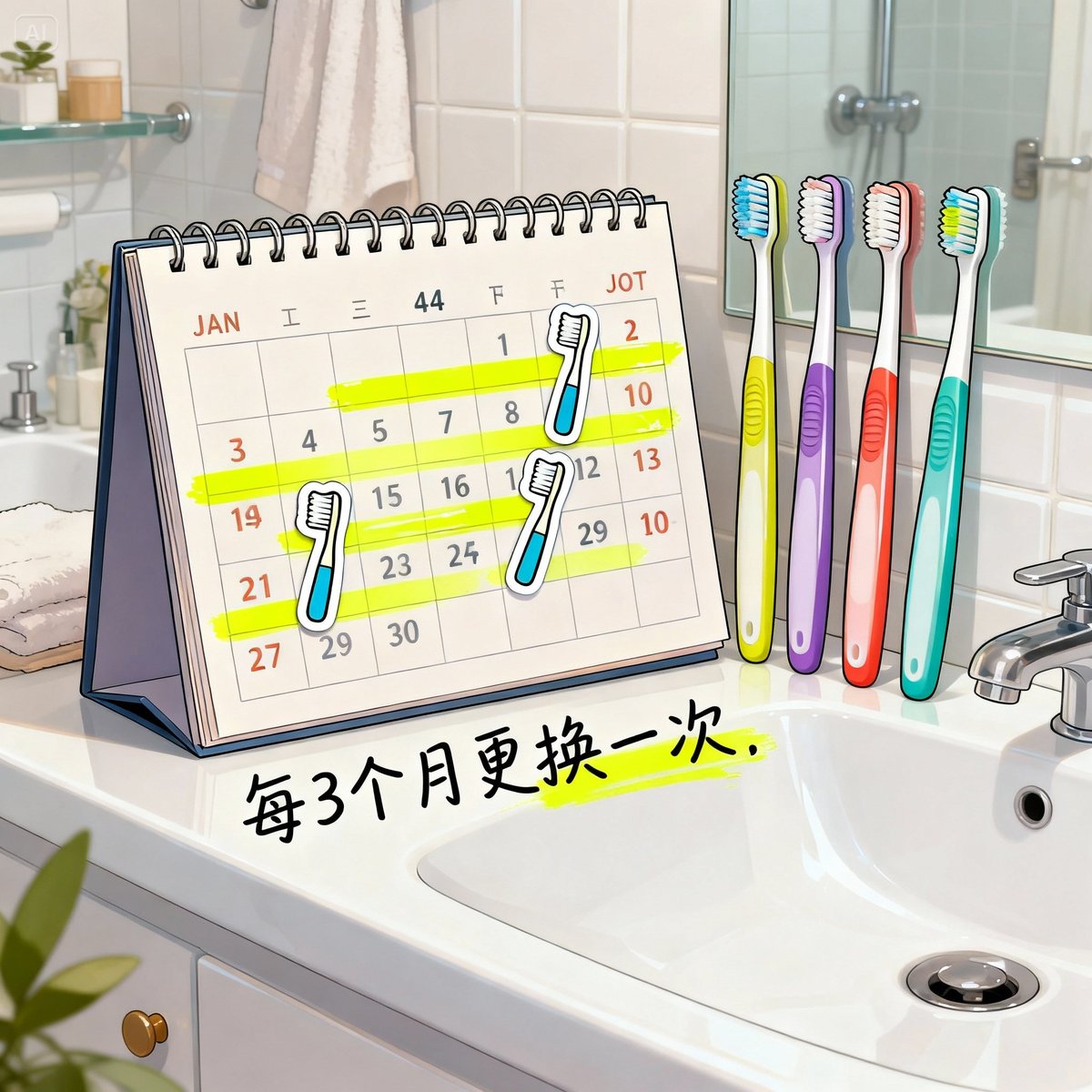
Recommended replacement frequency: every 3-4 months
The American Dental Association (ADA) recommends:
- Replace a toothbrush about every 3-4 months
- Replace it sooner when the bristles are visibly frayed or flattened
Why replace it regularly?
There are 2 main reasons.
Reason 1: Bristle wear reduces cleaning performance
The ADA notes that once the bristles wear, the toothbrush cleans less effectively.
Causes of wear:
- Bristle tips split
- Bristles lose their resilience
- Bristles splay and deform
How reduced cleaning power shows:
- Plaque cannot be removed effectively
- The gaps between teeth are not cleaned deeply
- Brushing takes longer
Reason 2: A toothbrush carries bacteria
The ADA notes that a toothbrush carries bacteria, which come from the mouth itself, from hand contact, and from fecal coliform bacteria released into the air when a toilet is flushed. However, there is currently no evidence that these bacteria cause harm to health.
Keeping the toothbrush dry, not sharing it and replacing it regularly are the most basic ways to keep it hygienic.
The cost myth:
- A toothbrush is generally a low-priced consumer item
- At a replacement frequency of every 3-4 months, the spending over a whole year is quite limited
- The average cost per day is almost negligible
- Oral health can be protected at a very low cost!
4 situations that call for replacing a toothbrush early
You do not always have to wait 3-4 months.
In these 4 situations, replace it immediately!
Situation 1: Bristles splayed or deformed (replace immediately)
The most obvious signal to replace.
How do you recognize it?
- Seen from the side: the bristles spread outward
- Split tips: the ends of the bristles split into several strands
- Uneven length: the bristles are no longer the same length
Causes:
- Brushing too hard
- Poorer bristle quality
- Used for too long
Why must it be replaced immediately?
- Cleaning performance drops noticeably
- It cannot reach into the gaps between teeth
- It may scratch the gums
- Splayed bristles may harbor more bacteria
Normal vs splayed:
- Normal: bristles are neat, with the tips aligned
- Splayed: bristles look like an open flower, in complete disorder
Situation 2: After a cold or an oral disease (replace as soon as you recover)
A simple hygiene step that brings peace of mind.
When replacement is recommended:
- A cold or influenza
- Mouth ulcers
- Inflamed gums
- Gastroenteritis
- Oral candidiasis
Why replace?
- While you are ill, germs may get onto the toothbrush
- There is currently no evidence that bacteria on a toothbrush cause harm to health, but a new toothbrush after you recover costs little and gives peace of mind
Recommended approach:
- Best: replace with a new toothbrush as soon as you recover
- Second choice: disinfect by soaking in hot water (70-80°C, 10 minutes)
- Or: ultraviolet disinfection
When the family shares a bathroom:
- Keep toothbrushes apart
- Do not let the brush heads touch each other
- Keep bacteria from passing between brushes
Situation 3: Clear change in bristle color (possible mold)
Color is a health warning.
Signs that call for replacement:
Black or green spots:
- May be mold
- Often appear at the base of the bristles
- A damp bathroom is the main cause
Overall yellowing or darkening:
- Build-up of dirt
- Toothpaste residue
- Limescale deposits
An unpleasant smell:
- Bacterial decay
- A moldy smell
- An abnormal sour smell
Why does mold grow?
- The bathroom is damp
- The base of the bristles is hard to clean
- Used for too long
- Not dried sufficiently
Why replace?
- Mold means the toothbrush has been kept in a damp environment for a long time
- Moldy bristles should not go back into your mouth
Replace immediately!
Situation 4: Dropped on the floor or exposed to a source of contamination
Stay alert to environmental contamination.
Situations that call for replacement:
- Dropped into the toilet (must replace!)
- Dropped on the bathroom floor
- Used by someone else by mistake
- Dropped in a public place
Why replace?
- The bathroom floor carries large numbers of bacteria (especially near the toilet)
- Toilet water contains pathogens such as E. coli
- Washing cannot remove them completely
If the toothbrush is kept near the toilet, it may pick up fecal bacteria.
Advice:
- Simply replace it; do not take the risk
- Keep the toothbrush as far from the toilet as you can
- Add a toothbrush cover for protection (but make sure the brush can still dry)
💡 Is it time for a new toothbrush?
YC Brushes sells factory-direct and supplies good-quality toothbrushes, with favorable prices for both wholesale and retail!
See our toothbrushes5 factors that affect toothbrush service life
Why is one person's toothbrush still intact after 3 months while another's splays after 1 month?
Factor 1: Brushing pressure
The harder you brush, the faster the wear.
Consequences of brushing too hard:
- Bristles splay after just 1 month
- The handle may break
- The brush head deforms
Correct pressure: 150-200 grams
- The bristles should bend only slightly
- No need to press hard
How to extend service life: Control the pressure and brush gently.
Factor 2: Brushing frequency
The more you brush, the shorter the life.
The more times a day you brush, the more friction the bristles take and the faster they wear.
Advice: If you brush often, you can:
- Shorten the replacement cycle to 2 months
- Or keep 2 toothbrushes and alternate them
Factor 3: Bristle quality
Quality decides durability.
High-quality bristles (nylon PA612):
- Good resilience, do not splay easily
- Antibacterial treatment
- Life of 3 months or more
Poor-quality bristles:
- May splay after just 1 month
- Bristles break easily
- Poor cleaning performance
How do you recognize quality?
- How neat the bristles are
- Tip finish (end-rounded)
- Resilience test (springs back after being pressed)
The YC Brushes toothbrush commitment:
- High-quality nylon PA612
- End-rounded bristles
- Quality backed by over 40 years of brush-making experience
Factor 4: How it is cared for
Correct care extends service life.
Good care (thorough rinsing + drying upright):
- Bristles are dry
- Few bacteria
- Normal service life
Poor care (laid flat or head down):
- Water collects at the base of the bristles
- Bacteria grow
- Mold forms at the base of the bristles
- Early replacement
Factor 5: Storage environment
The environment has a large effect.
Good environment (ventilated and dry):
- Bristles dry quickly
- Bacteria do not grow easily
Poor environment (damp and enclosed):
- Bristles stay damp for a long time
- Mold grows
- Bristles deteriorate
Worst environments:
- A closed cup
- Inside a bathroom cabinet
- Close to the toilet
Ideal environment:
- A ventilated spot
- Brush head up
- As far from the toilet as you can
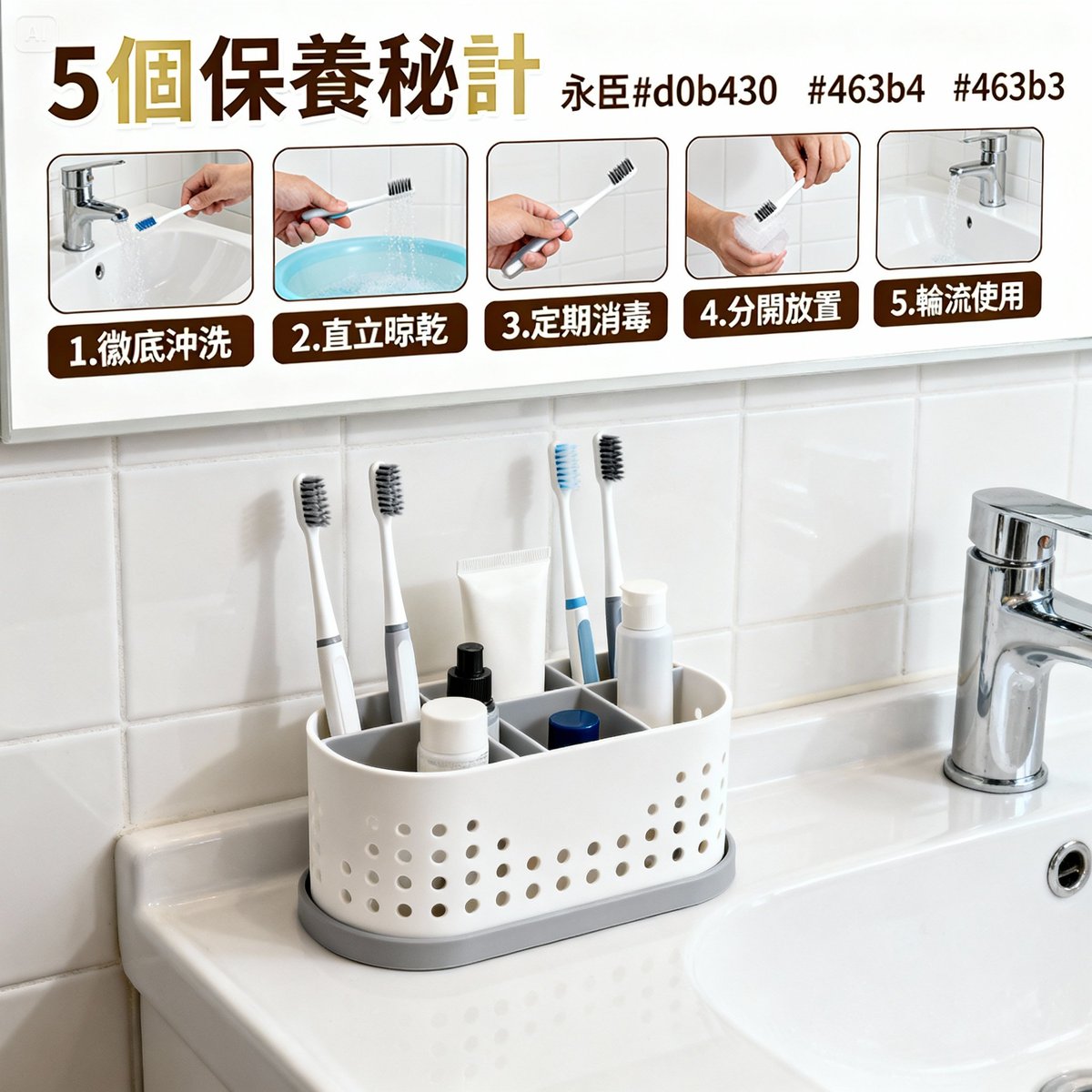
Care tips to extend toothbrush service life (5 tips)
With correct care, a toothbrush serves well for the full 3-4 months.
Tip 1: Rinse thoroughly after every use
The most basic and the most important.
Correct rinsing steps:
Step 1: Turn on running water
Step 2: Rinse the bristles for 10-15 seconds
- Rinse both the front and the back
- Flick the bristles with your fingers
- Make sure the toothpaste is rinsed off completely
Step 3: Rinse where the handle meets the brush head
- Dirt collects here easily
- Do not overlook it
Step 4: Shake off the water firmly
- Shake 3-5 times
- This reduces the water left behind
Mistakes:
- ❌ Only a quick rinse
- ❌ Putting it back without rinsing
- ❌ Bristles not rinsed clean
Benefits:
- Removes food debris and toothpaste
- Reduces bacterial growth
- Extends service life
Tip 2: Dry upright and avoid damp
Dryness is the key.
The right way:
- Stand it upright with the brush head up
- Use a toothbrush holder with holes
- Keep it as far from the toilet as you can
- Make sure there is ventilation
Why brush head up?
- Water runs downward
- Bristles dry quickly
- No water collects at the base of the bristles
Mistakes:
- ❌ Brush head down (water collects at the base of the bristles)
- ❌ Kept in a closed cup (no ventilation)
- ❌ Pressed against other people's toothbrushes (bacteria pass between them)
- ❌ Laid flat (bristles touch the countertop)
Choosing a toothbrush holder:
- Has holes for drainage
- Divided design (prevents contact)
- Easy-to-clean material
Drying time: Ideally fully dry in 4-6 hours.
Tip 3: Disinfect regularly (once a week)
Step up the sterilization.
Method 1: Hot water soak
- Temperature: 70-80°C
- Time: 5-10 minutes
- Kills most bacteria
Note:
- Do not use boiling water (it may damage the bristles)
- Dry after soaking
Method 2: Ultraviolet disinfection
- Use a UV sanitizer
- Time: as the device instructs (usually 5-10 minutes)
Method 3: Mouthwash soak
- Use a mouthwash with antibacterial ingredients
- Soak for 30 minutes
- Rinse clean before use
Never use:
- ❌ A microwave oven (may cause damage or fire)
- ❌ A dishwasher (the temperature is too high)
- ❌ An alcohol soak (damages the bristle material)
Recommended frequency:
- Most people: once a week
- People with weak immunity: 2-3 times a week
- During a cold: once a day
Tip 4: Do not share, and do not let brush heads touch
Keep your hygiene personal.
The problem with sharing:
- You exchange body fluids and microorganisms with each other
American Dental Association recommendation: Toothbrushes should not be shared, not even among family members.
The problem with brush heads touching: If several toothbrushes are kept in the same cup:
- The brush heads touch each other
- Bacteria pass from one to another
The right way:
- One toothbrush per person
- Brush heads kept apart
- Use different colors to tell them apart (within the family)
Special care with children:
- Teach them not to share
- Mark by color (so they do not take the wrong one)
- Check regularly
Tip 5: Alternate between two toothbrushes
A smart way to extend service life.
How:
- Keep 2 toothbrushes of the same specification
- Use A in the morning and B in the evening
- Or A today and B tomorrow
Why does it work?
- Each toothbrush has 24 hours to dry
- The bristles dry completely
- Bacteria do not grow easily
Benefits:
- Each toothbrush has enough time to dry
- Less bacterial growth caused by damp
- Both toothbrushes are still replaced every 3-4 months
Suitable for:
- People who brush often (3 times a day or more)
- Damp bathrooms (where drying is difficult)
- People who care about hygiene
Warning signs of bacterial growth on a toothbrush | When to replace it immediately
Bacteria cannot be seen, but they leave traces.
Where the bacteria on a toothbrush come from
The ADA notes that a toothbrush carries bacteria, which come from the mouth itself, from picking up the toothbrush after touching dirty surfaces, and from fecal coliform bacteria released into the air when a toilet is flushed.
However, there is currently no evidence that these bacteria on a toothbrush cause harm to health. Rather than worrying about bacteria counts, it is more practical to keep up daily care:
- Rinse thoroughly after every use
- Stand it upright and let it air-dry; do not put a wet toothbrush into a closed container
- Do not share it with others
- Replace it every 3-4 months or when the bristles fray
Warning signs of bacterial growth
Warning sign 1: Discoloration at the base of the bristles
- Black, green or yellow spots appear
- May be mold
Warning sign 2: An unpleasant smell
- An abnormal sour smell
- A moldy smell
- Shows that bacteria are multiplying in large numbers
Warning sign 3: The mouth does not feel fresh after brushing
- The mouth still has an odor
- It feels as if brushing does not get the teeth clean
- The toothbrush itself may be too dirty
Warning sign 4: Gums bleed often
- First check whether the bristles have frayed and stiffened, and whether you brush too hard
- If the bristles are deformed, replace the toothbrush; if the bleeding continues, see a dentist
If any one of these signs appears, replace immediately!
Wholesale purchasing advice | Toothbrush purchasing strategies for companies and brand owners
Have toothbrushes ready for your employees and customers.
Purchasing for employee benefits
New toothbrushes handed out every quarter
In line with the 3-4 month replacement recommendation:
- 4 times a year (January, April, July, October)
- New toothbrushes handed out each time
- An employee benefit + care for health
Estimating the quantity:
- Number of employees × 4 times/year
- Example: a company of 100 people = 400 pieces/year
Wholesale offer:
- YC Brushes offers wholesale prices for companies
- The company logo can be custom printed
- Presents the corporate image
Hotel and guesthouse supplies
Demand for disposable toothbrushes
Eco-friendly choices:
- Bamboo-handle toothbrushes (degradable)
- Eco-friendly packaging
- In line with the ESG trend
Purchasing advice:
- Estimate from the number of rooms and the occupancy rate
- We suggest keeping 1-2 months of stock
The YC Brushes advantage:
- Factory-direct, affordable prices
- Custom packaging available
- Fast shipment
Private-label products for brand owners
Create a toothbrush under your own brand
ODM/OEM service:
- Custom brush body design
- Brand logo printing
- Exclusive packaging design
Order quantities:
- Order quantities and lead times are quoted per specification. Please email us with your requirements.
What YC Brushes provides:
- Over 40 years of professional brush-making experience
- One-stop service from design to production
- Stable quality, accurate lead times
Suitable brands:
- Pharmacy private labels
- Hotel chains
- Health product brands
- Corporate gifts
Wholesale offers from YC Brushes
Factory-direct advantages:
- No middleman's margin
- Transparent, affordable prices
- Quality controlled directly
Discounts for volume:
- The larger the order, the lower the unit price
- Special discounts for long-term cooperation
A reputation of over 40 years:
- Has served more than 1,000 companies
- Stable, reliable quality
- On-time delivery
Contact:
- Phone: +886-2-2988-2721
- Email: [email protected]
- Online form: Contact us
📦 Wholesale toothbrush purchasing for companies
YC Brushes offers custom service and favorable quotes, suitable for employee benefits, hotel supplies and branded products!
Ask for a quote nowOr call +886-2-2988-2721 to speak to our staff
Summary | Replace your toothbrush regularly to protect your oral health
The toothbrush is the gatekeeper of oral health.
Recommended replacement frequency:
- ADA recommendation: replace every 3-4 months
- Basis: once the bristles wear, cleaning performance drops, and a toothbrush also carries bacteria
4 situations for early replacement:
- Bristles splayed or deformed → replace immediately
- After a cold or an oral disease → replace as soon as you recover
- Change in bristle color (mold) → replace immediately
- Dropped on the floor or contaminated → replace immediately
5 factors that affect service life:
- Brushing pressure (the harder you brush, the faster the wear)
- Brushing frequency (the more you brush, the faster the wear)
- Bristle quality (high-quality nylon PA612 is more durable)
- How it is cared for (thorough rinsing + drying upright)
- Storage environment (ventilated and dry vs damp and enclosed)
5 care tips:
- Rinse thoroughly for 10-15 seconds after every use
- Dry upright, brush head up, away from the toilet
- Disinfect regularly (hot water, UV or mouthwash, once a week)
- Do not share, and do not let brush heads touch
- Alternate between two toothbrushes (lets the bristles dry fully)
Warning signs of bacterial growth:
- Discoloration at the base of the bristles
- An unpleasant smell
- The mouth does not feel fresh after brushing
- Gums bleed often
What to do:
- Check your toothbrush right now: how long has it been in use? Are the bristles splayed?
- Set a reminder: a calendar reminder on your phone to replace it every 3 months (January, April, July, October)
- Choose a good-quality toothbrush: with high-quality bristles, it lasts 3 months in normal use
- Build care habits: rinse thoroughly every time, dry upright, disinfect regularly
An investment in health:
- A toothbrush is a low-priced consumer item
- At a replacement frequency of every 3-4 months, the spending over a whole year is quite limited
- The average cost per day is almost negligible
- The smallest investment that protects your oral health!
A toothbrush should be replaced every 3-4 months, and sooner if the bristles fray.
Check your toothbrush today and replace it if it is due. Do not let bacteria live on your toothbrush!
See YC Brushes toothbrush products | Learn the correct brushing technique | How to choose the right toothbrush
FAQ
Do electric toothbrush heads also need replacing every 3-4 months?
Yes, replacement every 3-4 months is recommended for them too.
Electric toothbrush heads:
- The bristles wear in the same way
- They carry bacteria in the same way
- The replacement standard is the same as for a manual toothbrush
Some electric toothbrush heads have "indicator bristles":
- Faded color = time to replace
- Usually about 3 months
Replacement cost:
- Electric brush heads: a higher unit price than an ordinary manual toothbrush
- Slightly more expensive, but the cleaning performance is good
- Worth it as a long-term investment
Do children's toothbrushes also need replacing every 3-4 months?
More often is recommended, about every 2-2.5 months.
Why?
- Children's brushing pressure is less steady
- The bristles are easily damaged
- Children have lower immunity, so hygiene needs more attention
Advice:
- Check every 2 months
- Replace immediately if the bristles splay
- Teach children the correct brushing pressure
What to look for in a children's toothbrush:
- A smaller brush head (1.5-2 cm)
- Soft bristles (to protect the gums)
- A handle that is easy to grip
- Cute designs (to make children more willing to brush)
The bristles have not splayed, but I have used the brush for 6 months. Do I still need to replace it?
Yes! Even if it looks normal, the bristles have already worn.
The American Dental Association recommends replacing a toothbrush every 3-4 months, and sooner when the bristles fray; a toothbrush used for 6 months is already past the recommended cycle.
High-quality bristles:
- May not have splayed after 3 months
- But the bristles still wear down gradually
- Should still be replaced regularly
Advice: Replace every 3-4 months even if it looks normal. Health comes first.
Can I extend the life of a toothbrush by disinfecting it in boiling water?
Boiling is not recommended; it may damage the bristles.
The problems with boiling:
- The temperature is too high (100°C)
- It may damage the bristle material
- The bristles deform and lose their resilience
Better ways to disinfect:
- Hot water soak: 70-80°C, 5-10 minutes
- UV disinfection: a dedicated sanitizer
- Mouthwash soak: 30 minutes
However:
- Disinfection only reduces bacteria
- It cannot restore worn bristles
- The brush should still be replaced every 3-4 months
The right idea: Regular replacement matters more than disinfection.
A toothbrush kept in the bathroom picks up toilet bacteria. What can I do?
Keep it away from the toilet + flush with the lid closed + protect it properly.
Protective measures:
Method 1: Flush with the lid closed
- Close the toilet lid before flushing
- Reduces the spray of droplets when flushing
Method 2: Keep away from the toilet
- Keep the toothbrush as far from the toilet as you can
- Put it on the far side of the washbasin
Method 3: Use a toothbrush cover
- Protects the brush head
- But note:
- It must have ventilation holes
- Avoid a fully sealed cover (the bristles cannot dry)
- Wash the cover regularly
Method 4: Separate storage
- Keep it inside a bathroom cabinet
- Or use a separate toothbrush case
Best practice: Flush with the lid closed + keep away from the toilet + dry upright.
Should I bring my own toothbrush when staying at a hotel or away from home?
Bringing your own toothbrush is recommended; it is more hygienic.
Why?
- The quality of disposable hotel toothbrushes varies widely
- The bristles may be too hard
- Environmental considerations
Advice for carrying it:
- Use a toothbrush travel case
- Make sure it is ventilated (not sealed)
- Wash and dry it thoroughly after the trip
If you use the hotel toothbrush:
- Choose one that is individually wrapped
- Check the quality
- Throw it away after use
Eco-friendly alternatives: A folding toothbrush or a travel electric toothbrush.
My toothbrush bristles have become hard. Is that normal?
No. It may be a quality problem or incorrect care.
Causes of hardening:
Cause 1: Poor quality
- Poor bristle material
- Resilience lost after use
Cause 2: Water quality
- Mineral deposits from hard water
- The bristles become hard
Cause 3: Toothpaste residue
- Not rinsed thoroughly
- Toothpaste sets on the bristles
Cause 4: Heat and sun exposure
- Direct sunlight
- The material ages
Solutions:
- Replace immediately
- Choose a good-quality toothbrush
- Rinse thoroughly
- Avoid direct sunlight
YC Brushes toothbrushes: Made with high-quality nylon PA612, which does not harden in normal use.
I have many old toothbrushes at home. What can I do with them?
Old toothbrushes can be reused in many ways!
Cleaning uses:
- Cleaning the gaps around taps
- Brushing keyboards
- Cleaning the edges of shoes
- Scrubbing tile grout
- Cleaning jewelry
- Washing the bottoms of cups
- Clearing drain holes
Other uses:
- Grooming pet hair
- Gardening (removing dust from leaves)
- Nail care tool (cleaning under the nails)
Note:
- Mark them clearly (so they are not used for brushing teeth by mistake)
- Wash and disinfect thoroughly before reuse
- Store them separately
Environmental advice:
- Choose toothbrushes made of recyclable materials
- Or bamboo-handle toothbrushes (degradable)
Do not throw old toothbrushes away. Be creative and reuse them!
Start the good habit of replacing your toothbrush regularly today!
Shop YC Brushes toothbrushes now | Wholesale inquiries for companies | Back to the blog home page