Introduction: angle grinder wire brush accidents keep happening, and safety cannot be ignored
When you remove rust with an angle grinder fitted with a wire wheel brush, if the speed of the angle grinder exceeds the maximum speed marked on the wire wheel brush and the operator is not wearing safety goggles, then once the brush breaks apart and flies off, a fragment may strike the eye and cause permanent loss of vision.
Excessive speed and missing protective equipment are the two most common factors shared by accidents of this kind. Most accidents can be prevented; the key is to understand the risks, follow the rules and put protection into practice. (In Taiwan, the Occupational Safety and Health Administration of the Ministry of Labor has a "guidelines" section on its official website and publishes a reference manual on standards for safe machinery operation; you can look up the latest edition yourself.)
In this article, YC Brushes draws on over 40 years of manufacturing experience to explain in full the potential hazards of angle grinder wire brushes, 10 points for safe use, a complete guide to protective equipment, and advice on safety management for businesses, to help you avoid workplace accidents altogether.
If you would like to learn the basics of angle grinder wire brushes and what to look for when buying, see: The complete guide to wire brushes

The potential hazards of angle grinder wire brushes
An angle grinder fitted with a wire wheel brush is a highly efficient tool for industrial rust removal, but it is also high-risk work, and the potential hazards must be fully understood.
The three main risks
1. Wire brush breaking and flying off
Causes
- Speed above the maximum speed marked on the wire wheel brush
- Sideways force (an improper operating angle)
- Aging of the wire wheel brush, fatigue fracture
- A poor-quality wire wheel brush
Danger
- Broken wires fly off at high speed
- They can pierce the skin and cause deep lacerations
- A hit to the eye can cause blindness
2. Flying metal particles
Causes
- Rust removal itself produces large amounts of metal particles
- The particles are thrown off at high speed (in line with the speed of the angle grinder)
Danger
- Eye injuries (the most common)
- Skin punctures and burns (the particles may be hot from friction)
- A health hazard if inhaled into the airways
3. Kickback and loss of control
Causes
- An improper operating angle
- Too much pressure
- A workpiece that is not held securely
Danger
- A kicking angle grinder can injure the operator or bystanders
- Loss of control can damage the workpiece
Common accident scenarios
Scenario 1: not wearing safety goggles
- Situation: removing rust with an angle grinder wire brush without safety goggles
- Possible consequence: flying metal particles strike the eyeball, and in serious cases this can cause blindness
- Cause: the importance of protective equipment was underestimated
Scenario 2: a speed mismatch
- Situation: the angle grinder runs at 12,000 RPM, and the wire wheel brush is marked for a maximum of 8,500 RPM
- Possible consequence: the wire wheel brush breaks apart and flies off, injuring the operator or bystanders
- Cause: the speed marking was not checked, and a mismatched wire wheel brush was used
Scenario 3: sideways force
- Situation: applying force to the wire wheel brush at a sideways angle
- Possible consequence: the wire wheel brush breaks, and fragments cut the face
- Cause: the wrong operating method
Reminder: all of these scenarios can be avoided by strictly following the safety rules.
10 points for safe use
Following these 10 points effectively lowers the risk of an angle grinder wire brush accident.
Point 1: confirm that the speeds match (the most important)
Why is it the most important? A speed mismatch is the leading cause of wire wheel brush breakage.
How to check
Step 1: look at the marking on the wire wheel brush
- Every wire wheel brush should carry a clear maximum speed marking (RPM)
- Where it is marked: usually at the center of the wheel or on the packaging
- Example: "Max RPM: 8,500" or "Maximum speed: 8,500 rpm"
Step 2: look at the speed of the angle grinder
- The speed of an angle grinder is marked on its body
- Common speeds: 10,000-12,000 RPM (4-5 inch machines); go by the speed marked on the machine body
- Some angle grinders have variable speed and can be adjusted
Step 3: compare and confirm
- Angle grinder speed ≤ maximum speed of the wire wheel brush → ✅ safe, can be used
- Angle grinder speed > maximum speed of the wire wheel brush → ❌ dangerous, must never be used
Example
- Angle grinder: 12,000 RPM
- Wire wheel brush: Max 10,000 RPM
- Conclusion: ❌ must not be used (the angle grinder speed is too high)
Solutions
- Change to a wire wheel brush with a higher speed rating (such as Max 12,000 RPM or more)
- Use a variable-speed angle grinder and turn it down to 10,000 RPM or less
- Change to an angle grinder with a lower speed
Important reminder: never take a chance on this. A speed mismatch is a serious safety risk.
Point 2: wear full protective equipment (mandatory)
Essential protective equipment
1. Safety goggles or a face shield
- Importance: metal particles and broken wires injure the eyes most easily
- Choices:
- Safety glasses (the basic option; they must have side protection)
- Full face shield (safer, recommended)
- Standard: meets CNS (Taiwan's national standards) or ANSI Z87.1
2. Dust mask or respiratory protection
- Importance: avoids inhaling metal dust
- Choices:
- N95 mask (basic protection)
- Half-mask respirator (for long periods of work)
- Standard: meets CNS 14755
3. Work gloves
- Importance: protect the hands from cuts and burns
- Choices:
- Wear-resistant work gloves (fabric or leather)
- Avoid gloves so thick and heavy that they affect your grip
- Avoid cotton gloves (easily caught and pulled in)
4. Work clothes or an apron
- Importance: keep metal particles from cutting or burning the skin
- Choices:
- Long-sleeved work clothes (wear-resistant, flame-retardant material)
- Leather apron (extra protection)
Optional protection
- Ear muffs (for long periods of work)
- Safety shoes (in a factory environment)
The wrong way: wearing gloves but no safety goggles → the most common mistake
Point 3: check the condition of the wire wheel brush before use
Inspection SOP
Visual inspection
- ✅ Check for cracks and deformation
- ✅ Check whether the wire is badly worn (less than 50% remaining)
- ✅ Check whether the center bore is deformed or damaged
- ✅ Check for rust (which affects structural strength)
Speed marking check
- ✅ The marking is clearly visible
- ✅ The speed value suits the angle grinder
Test run
- After mounting, run it with no load for 10-15 seconds
- Listen for abnormal noise (vibration, rubbing)
- Watch for obvious wobble
Replace immediately if it fails
- If it fails any one of the checks, replace it immediately
- Do not take chances
Point 4: mount the wire wheel brush correctly
Mounting steps
1. Confirm the power is off
- Unplug the angle grinder
- Make sure the switch is in the off position
2. Clean the spindle
- Remove dust and oil from the spindle
- Make sure the contact surfaces are clean
3. Fit the wire wheel brush
- Confirm that the center bore matches the size of the spindle
- Put the wire wheel brush on and make sure it sits flat
4. Tighten the retaining nut
- Tighten it with the dedicated wrench
- Do not use excessive force (it may deform)
- Confirm that it is tight (it must not be loose)
5. Fit the guard
- The angle grinder guard must be fitted
- Adjust the angle of the guard to shield the direction in which debris is thrown
6. Confirm with a test run
- Plug in and run with no load
- Confirm there is no abnormal noise and no wobble
Point 5: correct operating posture and angle
How to hold it
- Hold the angle grinder with both hands (main handle + auxiliary handle)
- Stand with a stable center of gravity and your body turned to the side (not facing the direction in which debris is thrown)
- Keep a firm hold and avoid one-handed operation
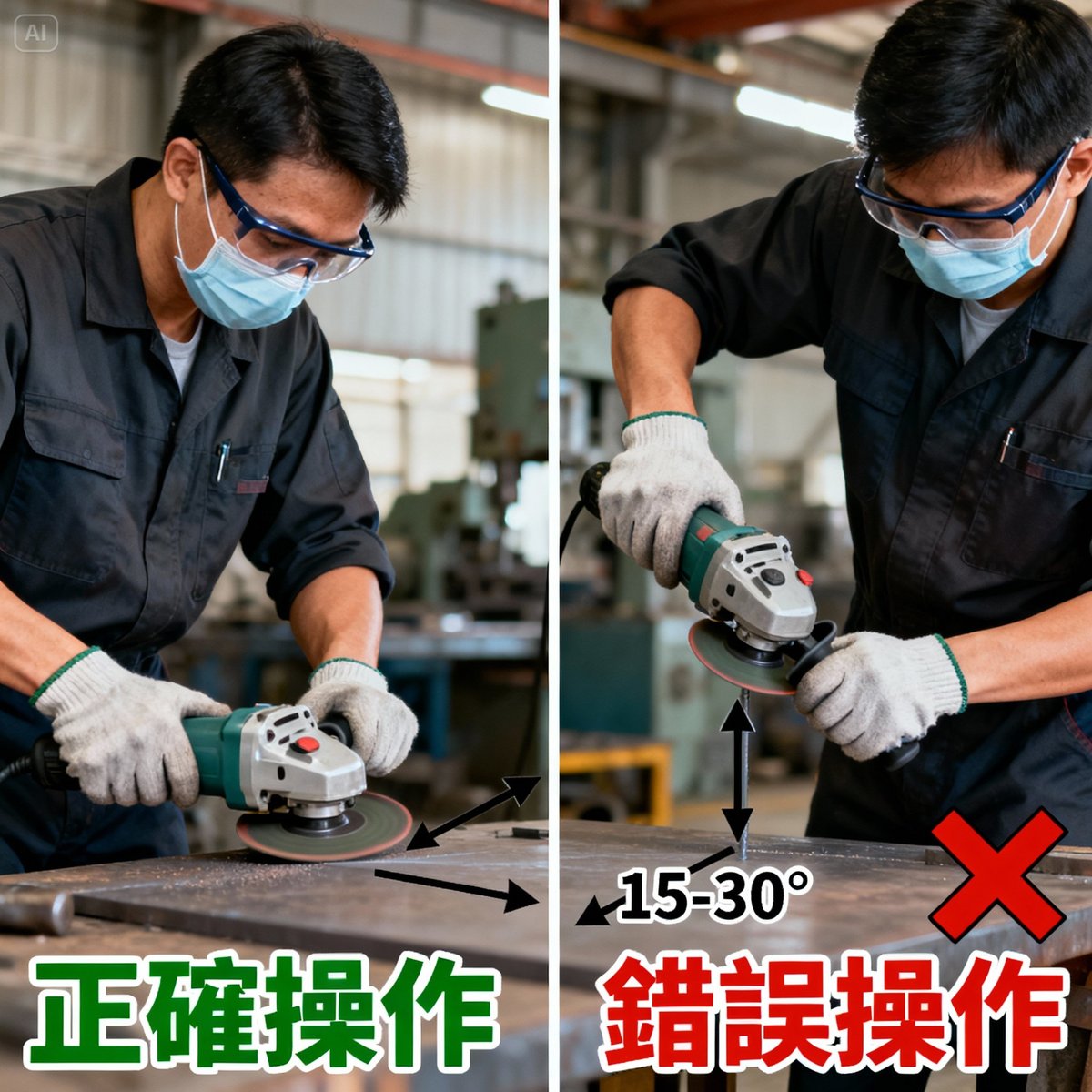
Working angle
- Correct angle: tilted at 15-30 degrees
- Wrong angles:
- ❌ Pressing straight down at 90 degrees (easily causes kickback)
- ❌ Pushing sideways in parallel (sideways force, easily causes breakage)
How to apply force
- Light pressure is enough; let the speed remove the rust
- Avoid too much pressure (it speeds up wear and raises the risk of breakage)
- Move evenly and do not stay on one spot
How to move
- Move steadily and evenly
- Avoid sudden changes of direction
- Avoid rocking from side to side
Point 6: manage the safety of the environment
Choosing the working environment
- Well ventilated (to avoid a build-up of dust)
- Well lit (so the work area is clearly visible)
- A level, dry floor (to avoid slipping)
Clear the surroundings
- No other people within 3 meters
- Remove flammable items (metal friction can produce sparks)
- Avoid working where people are crowded together
Securing the workpiece
- Hold the workpiece with a vise or clamps
- Avoid working on a workpiece held in the hand (extremely dangerous)
Ventilation and dust control
- Work outdoors or turn on the ventilation equipment
- Use dust collection equipment for large amounts of work
- Clear dust from the work area regularly
Point 7: replace the wire wheel brush regularly
Judging when to replace
Replace immediately
- Less than 50% of the original wire length remains
- Cracks or deformation appear
- The wire density has clearly fallen (the wire is sparse)
- There is abnormal noise or vibration in use
Replace on a schedule
- Intensive use: every 30-50 hours
- Moderate use: every 80-120 hours
- Light use: every 150-200 hours
Do not overuse it
- A worn wire wheel brush is inefficient and high-risk
- Replacing it in time is what really saves money
Point 8: avoid common operating mistakes
Mistake 1: speed too high
- Consequence: the wire wheel brush breaks and flies off
- Prevention: always check that the speeds match before use
Mistake 2: sideways force
- Consequence: the wire wheel brush breaks under the sideways force
- Prevention: keep the correct operating angle
Mistake 3: no safety goggles
- Consequence: flying metal particles injure the eyes
- Prevention: safety goggles are essential, not optional
Mistake 4: one-handed operation
- Consequence: an unsteady hold and easy loss of control
- Prevention: hold with both hands and stand with a stable center of gravity
Mistake 5: using a worn wire wheel brush
- Consequence: low efficiency, high risk
- Prevention: replace it in time
Mistake 6: working where people are crowded together
- Consequence: flying debris injures others
- Prevention: clear an area of 3 meters
Point 9: know the emergency response
When a wire brush breaks and flies off
- Switch off the angle grinder immediately
- Check whether anyone is injured
- Clear up the broken fragments (to avoid secondary injury)
- Analyze the cause so it does not happen again
When metal particles get into an eye
- Do not rub the eye
- Rinse immediately with clean water
- Seek medical attention as soon as possible (ophthalmology)
When the skin is cut
- Rinse the wound with clean water
- Disinfect and dress it
- Seek medical attention immediately if the wound is deep
When sparks start a fire
- Switch off the angle grinder immediately
- Use a fire extinguisher (dry powder or carbon dioxide)
- Evacuate people
Point 10: buy quality-certified wire wheel brushes
Why quality certification matters
- Certified products have been tested and are more consistent in quality
- Their speed markings are more accurate
- Their manufacturing is more reliable
Recommended certifications
- ISO 9001 (quality management)
- CNS national standards (Taiwan)
- CE marking (European Union standards)
Avoid products of unknown origin
- Wire wheel brushes with no brand and no markings are high-risk
- The quality of products that are too cheap is questionable
- Choose a manufacturer with a good reputation (such as YC Brushes)
See the high-quality wire wheel brush products from YC Brushes: over 40 years of manufacturing experience and ISO-certified quality assurance.
The complete guide to protective equipment
The right protective equipment is the last line of defense for safety.
Choosing and using safety goggles
Choosing the type
Safety glasses
- Pros: light, comfortable
- Cons: limited side protection
- Suited to: short periods of work
- Standard: must have side shields
Full face shield
- Pros: protects the whole face and the eyes
- Cons: heavier, field of view slightly restricted
- Suited to: long periods of work, high-risk work
- Standard: impact resistant, splash resistant
What to look for when buying
- ✅ Meets CNS or ANSI Z87.1
- ✅ Lens material: polycarbonate (PC) or a similar material (impact resistant)
- ✅ Anti-fog treatment (does not fog up when worn for a long time)
- ✅ Fits the face comfortably
- ✅ A clear field of view
Notes on use
- Replace when the lens is badly scratched
- Check for cracks before use
- Keep them clean (for a clear view)
Masks and respiratory protection
The hazard of dust
- Long-term inhalation of metal dust affects the respiratory system
- Rust dust may contain harmful substances
Recommendations
Short periods of work (less than 1 hour)
- N95 mask or equivalent
- Single use
Long periods of work (more than 1 hour) or large amounts of dust
- Half-mask respirator
- With P2 or P3 filters
- Reusable
Special environments
- Confined spaces, poor ventilation: use a supplied-air respirator
Notes on use
- Make sure it fits the face with no leaks
- Replace the filters regularly
- Replace the mask immediately if it is damp or damaged
Choosing gloves
Choosing the material
Wear-resistant fabric gloves
- Pros: flexible, breathable
- Cons: lower protection
- Suited to: light work
Leather work gloves
- Pros: wear resistant, cut resistant, protect against burns
- Cons: less breathable
- Suited to: heavy work
Avoid
- ❌ Cotton gloves (easily caught and pulled into rotating parts)
- ❌ Gloves that are too thick and heavy (they affect your grip)
Notes on use
- Replace gloves immediately if they are damaged
- Keep them dry (wet gloves slip off easily)
- Choose the right size (too large and they come off easily; too small and they limit dexterity)
Work clothes and aprons
Choosing work clothes
- Long sleeves, long trousers (avoid exposed skin)
- Material: wear resistant, flame retardant
- Avoid loose clothing (easily caught and pulled in)
Leather apron
- Extra protection for the chest and abdomen
- Suited to long periods of heavy work
Other protection
Ear muffs
- Angle grinders are loud when running
- Recommended for long periods of work
- Meet CNS or EN 352
Safety shoes
- Steel-toe safety shoes (protection against falling objects)
- Puncture-resistant soles (protection against nails)
- Non-slip soles
🛡️ Does your business need professional help with safety management?
Setting clear operating rules and a regular inspection routine is the most basic and most effective step in lowering workplace safety risk; but many small and medium-sized businesses lack the professional resources to set up an SOP.
How can YC Brushes help with safety management in your business?
✅ Safety training: training courses on the safe use of angle grinder wire brushes ✅ Advice on setting up SOPs: help with establishing a safety inspection SOP for angle grinder work ✅ Product safety certification: high-quality wire wheel brushes that meet the standards, lowering product risk ✅ Guidance on use: complete guidance on use and maintenance advice, free of charge ✅ Accident analysis: help with analyzing the cause of an accident and proposing improvements
💡 Why choose YC Brushes?
- Over 40 years of manufacturing experience: a thorough understanding of the safety points of wire wheel brushes
- ISO 9001 certification: strict quality management, safe and reliable products
- Complete technical support: we do not just sell products; we care about customer safety
Free service: contact us for a free safety consultation and an SOP template!
👉 Contact YC Brushes now and let a professional team help you build a safe working environment!
Safety points when buying angle grinder wire brushes
Safety has to be considered at the time of purchase, so that risk is lowered at the source.
The speed marking must be clear
What to check
- The wire wheel brush carries a clear maximum speed marking (RPM)
- Where it is marked: near the center bore or on the side
- The figures are clearly visible and do not wear off easily
Unacceptable products
- No speed marking
- A blurred, unclear marking
- A marking placed where it wears off easily
Advice: always confirm the speed marking when buying, and do not buy products without one.
Checking quality certification
Recommended certifications
- ISO 9001 quality management certification
- CNS national standards (Taiwan)
- CE marking
Manufacturer's reputation
- Choose a reputable brand or manufacturer
- YC Brushes has over 40 years of manufacturing experience and is ISO certified
- Avoid low-priced goods of unknown origin
Avoid products of unknown origin
Risks
- A false speed marking (extremely dangerous)
- Poor manufacturing (breaks easily)
- Poor wire quality (breaks easily, comes loose easily)
How to identify them
- An abnormally low price (50% or more below the market average)
- No brand, no markings
- Crude packaging, incomplete information
- No manufacturer's information can be provided
Advice: safety is priceless; do not take a big risk to save a little money. Want to know the reasonable price range and buying tips? See: Wire brush price comparison - 2026 latest quotes and purchasing guide
See the quality-certified wire wheel brush products from YC Brushes for assured safety.
Advice on safety management for businesses
A business should establish a sound safety management system to protect its employees.
Establish a safe operation SOP
What the SOP should include
1. Checks before use
- Check the condition of the angle grinder
- Check the condition of the wire wheel brush
- Check that the speeds match
- Check the protective equipment
2. Safe operating procedure
- Correct mounting steps
- Operating posture and angle
- How to apply force
- Safety requirements for the environment
3. Rules on protective equipment
- List of essential protective equipment
- Inspection standards for protective equipment
- When to replace it
4. Emergency response
- Accident handling procedure
- First aid measures
- Reporting mechanism
Putting the SOP into practice
- Post it in the work area
- Hold regular drills
- Include it in training for new employees
YC Brushes can help your business establish an SOP for angle grinder work. Contact us now for advice.
Training plan
Training for new employees
- Safety knowledge for angle grinder wire brushes
- Demonstration of actual operation
- Work may begin only after passing an assessment
Regular refresher training
- Refresher training once every six months or once a year
- Reinforce safety awareness
- Update on the latest safety rules
Training content
- Recognizing the potential hazards
- Key points of safe operation
- Use of protective equipment
- Emergency response
Requirements of Taiwan's Occupational Safety and Health Act
The legal responsibilities of a business
- Provide a safe working environment
- Provide the necessary protective equipment
- Carry out safety and health education and training
- Establish operating safety standards
Penalties for violations
- Failing to provide protective equipment: a fine of NT$50,000-3,000,000 (Article 43 of the Occupational Safety and Health Act)
- Failing to carry out education and training: if not corrected by the deadline after notice is given, a fine of NT$30,000-750,000 (Article 45 of the same Act)
- Causing a major occupational accident: the person in charge may face criminal liability
Employees' obligations
- Follow the safe operating rules
- Use protective equipment correctly
- Report any danger immediately
Common operating mistakes and how to correct them
Only by knowing the common mistakes can you avoid them effectively.
Mistake 1: running over speed
Situation
- The angle grinder runs at 12,000 RPM, and the wire wheel brush is marked Max 8,500 RPM
- The operator thinks "close enough is fine"
Consequence
- The wire wheel brush is subjected to excessive centrifugal force
- The risk of breakage is extremely high
Correction
- Always check the speed before use
- Never compromise, never take a chance
- Change to a matching wire wheel brush or angle grinder
Mistake 2: sideways force
Situation
- The operator applies force at a sideways angle
- Tries to "push" the rust off
Consequence
- The wire wheel brush is subjected to sideways shear force
- It breaks very easily
Correction
- Keep a tilt of 15-30 degrees
- Light pressure is enough; let the speed do the work
- Do not push sideways
Mistake 3: not wearing protective equipment
Situation
- "I am only using it for a moment"
- "I am very careful, nothing will happen"
Consequence
- Flying metal particles injure the eyes
- It is often in that "moment" that the accident happens
Correction
- Protective equipment is essential, not optional
- Wear it however short the job is
- Build a culture of "no protection, no operation"
Mistake 4: using a worn wire wheel brush
Situation
- The wire wheel brush is already badly worn
- "I will use it a little longer and change it when it is finished"
Consequence
- Low efficiency, high risk
- A worn wire wheel brush breaks more easily
Correction
- Replace immediately when 50% of the wire remains
- Stop using it immediately if there is abnormal noise or vibration
- Inspect regularly and replace in time
To learn more about wire brush maintenance and when to replace, see: The complete guide to wire brushes
FAQ
Why do angle grinder wire brushes break and fly off?
The main reasons a wire wheel brush breaks and flies off are:
1. Speed above the maximum limit (the most common)
- Angle grinder speed > the Max RPM marked on the wire wheel brush
- Excessive centrifugal force causes breakage
2. Sideways force
- An improper operating angle applies sideways shear force
- The wire wheel brush cannot withstand sideways force
3. Aging and fatigue of the wire wheel brush
- Long-term use leads to material fatigue
- It was not replaced in time
4. Poor quality
- Poor manufacturing
- Poor wire quality
- Wire not fixed securely
How to prevent it
- ✅ Check that the speeds match before use
- ✅ Keep the correct operating angle
- ✅ Replace the wire wheel brush regularly
- ✅ Buy quality-certified products
How do I judge whether the speeds match?
3 simple steps
Step 1: find the Max RPM of the wire wheel brush
- Where it is marked: the center of the wire wheel brush or the packaging
- Example: "Max RPM: 10,000"
Step 2: find the speed of the angle grinder
- Where it is marked: the body of the angle grinder
- Example: "12,000 RPM"
Step 3: compare
- Angle grinder speed ≤ Max RPM of the wire wheel brush → ✅ can be used
- Angle grinder speed > Max RPM of the wire wheel brush → ❌ cannot be used
Worked examples
Example 1
- Angle grinder: 10,000 RPM
- Wire wheel brush: Max 10,000 RPM
- Conclusion: ✅ just within the limit, can be used
Example 2
- Angle grinder: 12,000 RPM
- Wire wheel brush: Max 8,500 RPM
- Conclusion: ❌ the angle grinder speed is too high; must never be used
Important reminders
- Better to be conservative than to take a risk
- Do not use a wire wheel brush with no marking
- Do not use one with a blurred, unclear marking either
How long does an angle grinder wire brush last?
The service life of a wire wheel brush depends on several factors:
Factors
1. Frequency and intensity of use
- Intensive heavy use: 30-50 hours
- Moderate general use: 80-120 hours
- Occasional light use: 150-200 hours
2. How it is operated
- Correct operation: longer life
- Too much pressure, the wrong angle: faster wear
3. Quality of the wire wheel brush
- High-quality products: longer life
- Low-quality products: shorter life
Judging when to replace
Replace immediately
- Less than 50% of the wire length remains
- Cracks or deformation appear
- There is abnormal noise or vibration in use
- The wire is clearly sparse
Replace on a schedule
- Even if the criteria above have not been reached, we recommend:
- Intensive use: every 3 months
- Moderate use: every 6 months
- Light use: every year
The right mindset
- Do not wait until it is "completely worn out" to replace it
- A worn wire wheel brush is inefficient and high-risk
- Replacing it in time is the safe way
Emergency steps when an accident happens
Scenario 1: a wire brush breaks and flies off
Immediate action
- Switch off the angle grinder
- Check whether anyone is injured
- Give first aid to the injured immediately or send them to hospital
- Clear the scene to avoid secondary injury
Follow-up
- Clear up the broken fragments
- Analyze the cause of the accident
- Report to the supervisor and the safety department
- Record what happened
- Review and improve the measures in place
Scenario 2: metal particles in an eye
The right response
- ❌ Do not rub the eye (it may make the injury worse)
- ✅ Rinse the eye immediately with clean water (for 15 minutes or more)
- ✅ Close the eye and do not move the eyeball
- ✅ Seek medical attention as soon as possible (ophthalmic emergency)
The wrong response
- ❌ Wiping with a hand or a tissue
- ❌ Trying to remove the foreign body yourself
- ❌ Using eye drops (without a doctor's instruction)
Scenario 3: a cut to the skin
Minor cut
- Rinse the wound with clean water
- Disinfect (iodine or alcohol)
- Apply an adhesive bandage or a dressing
Deeper cut
- Stop the bleeding (by applying pressure)
- Rinse with clean water
- Seek medical attention immediately
Scenario 4: sparks start a fire
Immediate action
- Switch off the angle grinder
- Use a fire extinguisher (dry powder or CO2)
- Never use water (metal dust can become more dangerous in contact with water)
- Evacuate people
Prevention
- Remove flammable materials before working
- Have a fire extinguisher ready
- Keep the area ventilated
Conclusion: safety always comes first
An angle grinder wire brush is a highly efficient rust removal tool, but it is also high-risk work. The workplace accidents that happen every year are a reminder that safety cannot be ignored.
Summary of the safety points
Before use
- ✅ Check that the speeds match
- ✅ Check the condition of the wire wheel brush
- ✅ Wear full protective equipment
During use
- ✅ Keep the correct operating angle (15-30 degrees)
- ✅ Hold with both hands and stand with a stable center of gravity
- ✅ Light pressure is enough; let the speed remove the rust
- ✅ Keep the environment safe
After use
- ✅ Clean and maintain
- ✅ Inspect regularly
- ✅ Replace in time
Building a safety culture
For the individual
- Take safety seriously in every job
- Do not take chances
- Report any danger immediately
For the business
- Establish a sound safety SOP
- Train regularly
- Provide enough protective equipment
- Foster a safety-first culture
YC Brushes: your safety partner
YC Brushes not only supplies high-quality wire wheel brush products but also cares about the safety of the customers who use them:
Quality assurance
- ISO 9001 certification
- A strict quality control process
- Clear speed markings
- Over 40 years of manufacturing experience
Safety support
- Complete guidance on use
- Free safety consultation
- Help with setting up an SOP
- Support for training
If you need professional wire wheel brush products and safety advice, contact YC Brushes now. We provide:
- Free consultation on safe use
- Advice on safety management for businesses
- SOP templates
- Product safety certification documents
Or see the full range of wire wheel brush products and choose a safe, reliable product.
📚 Further reading
Want to learn more about wire brushes? We recommend:
- Steel brush vs brass brush: the ultimate guide to choosing the material - the properties of different materials and where each is safe to use
- Choosing brushes for cleaning stainless steel - safety notes for cleaning special materials
Want to learn more about brushes? Visit the blog to explore more specialist articles.
Remember: safety is priceless, and a life cannot be lived again. In every job, put safety first.
References
- ANSI B7.1-2017, Safety Requirements for the Use, Care and Protection of Abrasive Wheels