Introduction: why wire brushes matter and where they are used
Did you know? The right wire brush can raise rust removal efficiency considerably. The wrong one not only wastes time, it may also damage the surface of the workpiece.
The wire brush is an indispensable tool in industrial manufacturing and everyday maintenance. From factory rust removal and metal surface treatment to car maintenance and household cleaning, its range of applications is extremely wide. Yet there are many kinds of wire brush on the market, with different materials, specifications and uses, and choosing one is often confusing.
In this article YC Brushes draws on over 40 years of manufacturing experience to explain the key points of selecting a wire brush, techniques for using it, safety precautions and best practice for each application, so that you can quickly get a professional grasp of wire brushes.
What is a wire brush? Definition and basics
A wire brush is a cleaning and surface treatment tool that uses steel wire as its fill. Steel wire is hard and wear resistant, so it effectively removes rust, oxide layers, old paint and other stubborn deposits from metal surfaces.
Construction and materials of a wire brush
A standard wire brush usually consists of three main parts:
1. Fill (steel wire)
- Carbon steel wire: the most common; high hardness, suited to heavy rust removal, but it oxidizes and rusts easily
- Stainless steel wire: good corrosion resistance, suited to food-grade or medical-grade applications, higher price
- Galvanized steel wire: zinc-coated to resist rust, combining hardness with rust resistance
2. Brush body (base)
- Wooden handle, plastic handle, metal handle
- The body material affects grip comfort and durability
3. Fixing structure
- Tufted: the wire is tufted directly into the brush body; secure and durable
- Clamped: a metal strip clamps the wire; suited to roller brushes
- Twisted-in-wire: the wire is fixed by twisting; common in tube brushes
A complete classification of wire brush types
By shape and use, wire brushes fall into the following types:
Hand wire brush
- The most basic style, suited to cleaning small areas and removing rust by hand
- Brush face options: straight face, curved face
Angle grinder wire wheel
- A round wire wheel used on an angle grinder
- Types: bowl-type wheel, dish-type wheel, cup-type wheel
- Suited to rust removal and surface treatment over large areas
Long-handle wire brush
- An extended handle, suited to cleaning hard-to-reach areas
- Commonly used for: cleaning wheel rims, removing rust from floors, equipment maintenance
Wire roller brush
- Cylindrical, operated by rotation
- Suited to: large-area rust removal, conveyor belt cleaning, wire-brushing wood grain
Tube wire brush
- Twisted-in-wire construction with a small, dense brush head
- Used specifically for: tube cleaning, rust removal in holes
Wire strip brush
- A long strip that can be cut to length
- Suited to: sealing door gaps, dust strips
See the YC Brushes wire brush product range for full specifications and applications.
What are wire brushes called in English?
- Wire brush: Wire Brush / Steel Wire Brush
- Wire wheel: Wire Wheel / Wire Brush Wheel
- Angle grinder wire brush: Angle Grinder Wire Brush
- Hand wire brush: Hand Wire Brush
- Wire roller brush: Wire Brush Roller
Main uses and application scenarios of wire brushes
Wire brushes are used extremely widely, and play an important role everywhere from professional industry to everyday household use.
Industrial applications
Rust removal on metal surfaces
- Rust removal on steel, cast iron, aluminum alloy and other metal surfaces
- Removal of oxide layers and rust spots
- Suited to rust removal over large areas and on thick layers of rust
Treatment before and after welding
- Before welding: cleaning the weld surface to remove oil and oxide layers
- After welding: removing slag and leveling the weld bead
Pre-paint preparation
- Removing old paint and powder coating
- Roughening the surface to improve paint adhesion
Machinery and equipment maintenance
- Cleaning conveyor belts and roller surfaces
- Removing oil and rust from machine parts
- Routine equipment servicing
YC Brushes has built up over 40 years of experience in the industrial field. For a closer look, see Industrial brush application cases | Over 40 years of custom experience at YC Brushes
Household cleaning
Car maintenance
- Rust removal and cleaning of wheel rims
- Removing oil and grime from the engine bay
- Treating rust spots on the body
Garden tool maintenance
- Removing rust from shovels and hoes
- Cleaning garden shears
- Caring for tool surfaces
Home repairs
- Removing rust from window grilles and railings
- Cleaning faucets and hardware
- Wire-brushing wood grain in DIY woodworking
Other specialist applications
Wire-brushing wood grain
- Making wire-brushed wood-grain panels
- Distressing wood surfaces
- Bringing out the relief of the grain
Want to know how to make textured wood-grain panels? See Tutorial: making wire-brushed wood-grain panels
Restoration of artifacts
- Rust removal on metal artifacts (a soft brass brush is required)
- Cleaning stone surfaces
- Restoring antique tools
Food processing
- Cleaning stainless steel equipment (a stainless steel wire brush must be used)
- Removing burnt residue from ovens and grills
- Servicing food machinery
Steel brush vs brass brush: the complete guide to choosing a material
When buying a brush, many people wonder: should I choose a steel brush or a brass brush? What is the difference between the two?
Characteristics of steel brushes and where they fit
Strengths
- High hardness: Mohs hardness of about 5.5-6.5, excellent rust removal efficiency
- Strong wear resistance: long service life, suited to heavy-duty work
- Affordable: lower cost, suited to use in large quantities
Limitations
- Oxidizes easily: a carbon steel brush itself rusts and must be stored properly
- May contaminate: a carbon steel brush used on stainless steel causes free iron contamination
- Surface scratches: the high hardness may scratch soft materials
Where they fit
- Rust removal on steel and cast iron
- Removing heavy weld slag
- Treating rough surfaces
- Pre-paint preparation
Learn more about YC Brushes steel brush specifications
Characteristics of brass brushes and where they fit
Strengths
- Less prone to sparking: a spark-resistant (low-spark) material commonly used in flammable environments, though sparks cannot be ruled out completely
- Softer: unlikely to scratch precision surfaces
- Good electrical conductivity: suited to cleaning electrical equipment
- Good rust resistance: copper itself does not oxidize easily
Limitations
- Higher price: the cost of copper is clearly higher than that of steel
- Lower rust removal efficiency: lower hardness than a steel brush
- Wears quickly: a relatively short service life
Where they fit
- Cleaning stainless steel surfaces
- Work in flammable environments (gas stations, chemical plants)
- Removing dirt from precision parts
- Maintaining electrical equipment
For an in-depth comparison, see Steel brush vs brass brush: the ultimate guide to choosing a material
How to choose? A decision flowchart
Step 1: Confirm the workpiece material
- Carbon steel, cast iron → a steel brush can be used
- Stainless steel → a stainless steel wire brush or a brass brush must be used
- Aluminum, copper → a brass brush or nylon brush is recommended
- Wood → a steel brush (for wire-brushing the grain)
Step 2: Assess the working environment
- Ordinary environment → a steel brush is enough
- Flammable environment → use a brush made of a spark-resistant material, such as a brass brush
- Food-grade environment → a stainless steel wire brush
Step 3: Weigh budget and frequency of use
- Heavy use, limited budget → steel brush
- Precision work, ample budget → brass brush
- Long-term use, high quality requirements → stainless steel wire brush
Finding it hard to choose? Contact YC Brushes now; we offer free selection advice.
Angle grinder wire brushes: selection and use
An angle grinder fitted with a wire wheel is the most common combination for industrial rust removal. It is highly efficient, but it also carries a higher safety risk.
Types of angle grinder wire brush
Bowl-type wire wheel (Cup Brush)
- The wire is perpendicular to the plane of rotation
- Suited to: rust removal on flat surfaces, large-area cleaning
- Size: 4 inch and 6 inch are common
Dish-type wire wheel (Disc Brush)
- The wire is arranged radially
- Suited to: cleaning weld beads, rust removal on edges
- Size: 4 inch, 5 inch and 6 inch are common
Cup-type wire wheel (Wheel Brush)
- The wire is parallel to the axis of rotation
- Suited to: inner walls of pipes, cleaning holes
- Size: chosen according to the pipe diameter
Safety rules for angle grinder wire brushes
1. Matching the speed
- Check the maximum speed (RPM) marked on the wire wheel
- The angle grinder speed must not exceed the maximum speed of the wire wheel
- Common angle grinder speeds: 10,000-12,000 RPM
2. Checks at installation
- Confirm that the bore of the wire wheel matches the spindle diameter of the angle grinder
- Check the wire wheel for damage or deformation
- Tighten the locking nut securely
3. Key points in operation
- Hold the tool firmly, with both hands
- Avoid side loading
- Do not work where people are crowded together
- Check the wear of the wire regularly
Safe use of angle grinder wire brushes is critical. For a detailed safety guide, see Angle grinder wire brush safety guide
Tips for getting more out of an angle grinder wire brush
Raising rust removal efficiency
- Choose a suitable wire thickness (coarse wire removes rust quickly, fine wire leaves a better surface)
- Keep a suitable contact angle (15-30 degrees)
- Move at a steady speed and avoid dwelling in one place, which causes over-grinding
Extending service life
- Avoid excessive pressure
- Regularly clear metal chips caught in the wire
- Clean after use and store properly
Reducing safety risks
- Wear safety goggles, a mask and gloves
- Work in a well-ventilated place
- Replace worn wire wheels regularly
How to buy a wire brush: a professional purchasing guide
Choosing the right wire brush not only raises working efficiency, it also saves cost and time.
5 points to assess before buying
1. Confirm the job requirement
- Rust removal? Cleaning? Surface treatment?
- How large is the working area?
- What is the material and hardness of the workpiece?
2. Choose the right type
- Small area, manual work → hand wire brush
- Large area, fast rust removal → angle grinder wire wheel
- Hard-to-reach areas → long-handle wire brush
- Tube cleaning → tube wire brush
3. Assess the wire material
- General rust removal → carbon steel wire
- Cleaning stainless steel → stainless steel wire brush
- Flammable environment → brass brush
- Precision cleaning → soft brass brush or nylon brush
4. Confirm the specifications and dimensions
- Angle grinder wire brush: bore, outer diameter, maximum speed
- Hand wire brush: brush face width, handle length
- Wire roller brush: diameter, width
5. Weigh quality against price
- Check that the wire is held securely (it should not come out when pulled lightly)
- Confirm the body material and workmanship
- Compare value for money: unit price against service life
Have questions before buying? YC Brushes offers free selection advice, so that over 40 years of experience can help you make the best choice.
Recommended setups for different scenarios
Car repair and maintenance
- Long-handle wire brush (cleaning wheel rims)
- Hand wire brush (removing grime from the engine bay)
- Small angle grinder wire brush (treating rust spots on the body)
Factory rust removal
- Angle grinder wire wheel, 4-6 inch (large-area rust removal)
- Hand wire brush (detail work)
- Wire roller brush (conveyor belt cleaning)
Home DIY
- Hand wire brush (garden tool care)
- Long-handle wire brush (removing rust from window grilles and railings)
Wire-brushing wood grain
- Wire roller brush (wire-brushing large areas of wood)
- Angle grinder bowl-type wire brush (fast wire-brushing)
Where to buy a wire brush: purchasing channels compared
Hardware stores
- Pros: choose in person, take it away immediately
- Cons: higher prices, limited choice of specifications
E-commerce platforms
- Pros: transparent prices, wide choice
- Cons: quality cannot be inspected in person, shipping costs
Specialist tool stores
- Pros: professional advice, assured quality
- Cons: prices on the high side
Factory-direct (YC Brushes)
- Pros: affordable prices, stable quality, customization available
- Cons: you need to get in touch in advance, and there may be a minimum order quantity
Need a special specification? See the custom service at YC Brushes, a one-stop service from design to volume production.
Rust removal techniques and best practice with wire brushes
Rust removal is the most common use of a wire brush, and the right technique multiplies efficiency.
Preparation before removing rust
1. Clean the workpiece surface
- Remove oil and dust (a degreaser or soapy water can be used)
- Dry the surface (so that moisture does not affect the result)
2. Choose the right tool
- Light rust → hand wire brush
- Moderate rust → angle grinder wire brush
- Heavy rust → coarse-wire steel brush + chemical rust remover as an aid
3. Prepare protective equipment
- Safety goggles (against flying iron chips)
- Mask (to avoid inhaling rust dust)
- Gloves (to protect the hands)
- Work clothes (to keep clothing from being soiled)
4. Plan the work area
- A well-ventilated space
- Lay a dust sheet (to collect iron chips)
- Keep away from flammable items
How to treat different degrees of rust
Light rust (surface rust)
- Use: hand wire brush
- Method: brush along the grain of the metal with moderate force
- Time: about 5-10 minutes for a small area
Moderate rust (a thicker rust layer)
- Use: angle grinder wire wheel
- Method: hold at an angle of 15-30 degrees and move evenly
- Combine with: soaking in rust remover before brushing
Heavy rust (deep rust)
- Use: coarse-wire steel brush + chemical rust removal
- Method:
- First soak with rust remover for 20-30 minutes to soften the rust layer
- Remove most of the rust with a coarse-wire steel brush on an angle grinder
- Finish the surface with a fine-wire steel brush
- Sand smooth with sandpaper
🔧 Need a professional wire brush solution?
Choose the wrong wire material, wire diameter or hardness and the result ranges from poor rust removal efficiency to a scratched workpiece. This is the selection mistake we are asked about most often, and the one we see most often.
How can YC Brushes help you?
✅ Over 40 years of manufacturing experience: 500+ business customers served, with a deep understanding of what each industry needs ✅ A complete product line: hand-held, long-handle, angle grinder wire wheels and custom specifications, all available ✅ Free selection advice: our professional team helps you choose the most suitable wire brush ✅ The factory-direct advantage: no distributor markup, stable quality and affordable prices ✅ Flexible order quantities: order quantities and lead times are quoted per specification; email us with your requirements
💡 Why choose YC Brushes?
- 3D-printed sampling: the design is confirmed quickly, lowering the risk of tooling
- Quality certification: ISO 9001 quality management, with every batch strictly inspected
- Technical support: complete guidance on use and advice on maintenance
Contact us now for a free requirements analysis and selection advice!
👉 Click to contact YC Brushes now and let our professional team help you find the most suitable wire brush solution!
Safety precautions when using wire brushes
The wire brush is a common tool, but improper use can cause injury, and the safety rules must be taken seriously.
Personal protective equipment (PPE)
Essential protection
- Safety goggles: prevent metal chips and flying wire from injuring the eyes (the most important item)
- Mask: avoids inhaling metal dust and rust particles
- Gloves: wear-resistant work gloves to protect the hands
- Work clothes: long sleeves, so that skin does not come into contact with flying debris
Optional protection
- Face shield: recommended when using an angle grinder
- Ear muffs: reduce noise damage during long periods of work
- Safety shoes: in areas where heavy objects are handled
Safe operating rules
Using an angle grinder wire brush
- Check that the speed matches
- Hold with both hands and keep steady
- Avoid side loading (it easily causes the wire brush to break and fly off)
- Do not work where people are crowded together
- Check the wear of the wire brush regularly
Using a hand wire brush
- Avoid excessive force (it easily causes wire loss or hand fatigue)
- Mind the direction of the wire (brush away from yourself to avoid being pricked)
- Check that the handle is secure
Environmental safety
- Good ventilation, to keep dust from building up
- Keep away from flammable items (metal friction may produce sparks)
- Keep the work area clear to avoid slipping
Common hazards and how to prevent them
Wire brush breaking and flying off
- Causes: excessive speed, side loading, an aged wire brush
- Prevention: check the speed, operate correctly, replace regularly
Metal chips injuring the eyes
- Causes: no safety goggles, an unsuitable working angle
- Prevention: always wear safety goggles, adjust the working angle
Inhaling dust
- Causes: poor ventilation, no mask
- Prevention: work outdoors or turn on ventilation, wear a mask
Hand injuries
- Causes: an unsteady grip, being pricked by the wire
- Prevention: wear gloves, hold firmly
Care and maintenance of wire brushes
Looking after a wire brush properly extends its service life and keeps it working efficiently.
Everyday care
Cleaning after use
- Clear metal chips and wood chips caught in the wire
- An old toothbrush or an air gun can be used
- Wipe a carbon steel brush dry after use, so that it does not rust from damp
Correct storage
- Keep in a dry environment
- Avoid heavy pressure that deforms it
- Place with the wire facing up (hand wire brushes)
Regular checks
- Check whether the wire is coming loose
- Check whether the handle is damaged
- For an angle grinder wire brush, check whether the center bore is deformed
Judging service life and when to replace
Hand wire brush
- Less than 1/3 of the wire length remains
- The wire is shedding heavily
- The handle is damaged or loose
Angle grinder wire wheel
- The wire length is less than 50% of the original length
- The wire is sparse and rust removal efficiency has clearly dropped
- The wheel is deformed or cracked
Wire roller brush
- The wire height is uneven
- The roller does not turn smoothly
- The wire density is clearly lower
Tips for a longer service life
Avoid excessive pressure
- Let the tool do the work; do not force it
- An angle grinder removes rust by speed and does not need to be pressed hard
Rest appropriately
- Rest the angle grinder after 15-20 minutes of continuous use
- Avoid overheating, which affects the hardness of the wire
One brush for one job
- Do not use a brush reserved for stainless steel on carbon steel (to avoid cross-contamination)
- Do not use a brass brush for heavy rust removal (it wears quickly)
The right angle
- Keep an angle grinder wire brush at an angle of 15-30 degrees
- Brush along the grain with a hand wire brush
Questions about maintenance? YC Brushes offers free advice, and our professional team will help you.
Supplement: wire materials of long-handle steel brushes and precautions for use
Wire materials of long-handle steel brushes
The "steel" in steel brush is not all the same material.
Different metal wires suit different scenarios, and the wrong material may have the opposite effect.
Carbon steel wire brush (the most common)
Material properties
- Composition: carbon steel
- Hardness: high
- Toughness: medium
- Cost: the lowest
Advantages
- ✅ Strong cleaning power
- ✅ Affordable
- ✅ A wide range of applications
- ✅ Easy to buy
Disadvantages
- ❌ Rusts easily (must be wiped dry immediately after use)
- ❌ Does not withstand corrosive environments
- ❌ Leaves iron particles on stainless steel surfaces (which leads to rust)
Best applications
- Rust removal on carbon steel and cast iron surfaces
- Removing weld slag after welding
- Cleaning concrete and stone
- General cleaning in metalworking
Where it should not be used
- ✗ Stainless steel surfaces (it contaminates them)
- ✗ The food industry (it rusts)
- ✗ Long-term use in damp environments
Stainless steel wire brush
Material properties
- Composition: stainless steel with at least 10.5% chromium (304 and 316 are commonly used)
- Hardness: high (similar to or slightly lower than carbon steel wire)
- Toughness: high
- Cost: 3-5 times that of carbon steel wire
Advantages
- ✅ Resistant to rust
- ✅ Corrosion resistant (resists acids, alkalis and high temperatures)
- ✅ Does not contaminate stainless steel surfaces
- ✅ Long service life
Disadvantages
- ❌ High price
- ❌ Cleaning power slightly lower than carbon steel wire
Best applications
- Cleaning stainless steel equipment (leaves no iron particles)
- The food industry (meets hygiene standards)
- Chemical plants (corrosive environments)
- Long-term use in damp environments
Special requirement
In environments such as the food industry, pharmaceutical plants and chemical plants, a stainless steel wire brush must be used, to avoid contamination and corrosion problems.
YC Brushes offers a food-grade brush manufacturing service that complies with FDA and HACCP standards.
Brass wire brush
Material properties
- Composition: brass (a copper-zinc alloy) or red copper
- Hardness: lower than steel wire
- Toughness: high
- Cost: 2-4 times that of carbon steel wire
Advantages
- ✅ Less prone to sparking (a spark-resistant / low-spark material commonly used in explosion-proof environments)
- ✅ Does not scratch softer metals (such as aluminum and copper)
- ✅ Strong cleaning power without damaging the base material
- ✅ Good electrical conductivity (can be used to clean electronic equipment)
Disadvantages
- ❌ Higher price
- ❌ Lower hardness than steel wire (slightly weaker rust removal)
Best applications
- Cleaning in explosion-proof areas (petrochemical plants, coal mines, dusty environments)
- Cleaning aluminum alloy surfaces (does not scratch)
- Rust removal on copper alloys
- Maintaining electronic equipment
Safety advantage
In flammable and explosive environments, friction from a steel brush may produce sparks and cause a disaster. A brass wire brush is a spark-resistant (low-spark) material that greatly reduces the risk of sparks, making it one of the common choices for explosion-proof environments, though it must still be assessed against the explosion-protection rules on site.
Galvanized steel wire brush
Material properties
- Composition: carbon steel wire with a zinc coating
- Hardness: the same as carbon steel wire
- Rust resistance: medium (better than carbon steel wire, lower than stainless steel wire)
- Cost: 1.5-2 times that of carbon steel wire
Advantages
- ✅ More rust resistant than carbon steel wire
- ✅ Cheaper than stainless steel wire
- ✅ The same cleaning power as carbon steel wire
Disadvantages
- ❌ The zinc coating wears and flakes off
- ❌ Still rusts with long-term use
Best applications
- Outdoor use (construction sites, shipyards)
- A limited budget where some rust resistance is still needed
- Short-term use in damp environments
Material selection chart
| Material | Hardness | Rust resistance | Price | Rust removal power | Best applications | Do not use for |
|---|---|---|---|---|---|---|
| Carbon steel wire | ★★★★★ | ★☆☆☆☆ | $ | ★★★★★ | General metal rust removal, weld slag removal | Stainless steel surfaces, the food industry |
| Stainless steel wire | ★★★★☆ | ★★★★★ | $$$$$ | ★★★★☆ | Stainless steel cleaning, the food industry, chemical plants | Extremely limited budgets |
| Brass wire | ★★★☆☆ | ★★★★☆ | $$$$ | ★★★☆☆ | Explosion-proof environments, aluminum cleaning | Heavy rust removal |
| Galvanized steel wire | ★★★★★ | ★★★☆☆ | $$ | ★★★★★ | Outdoor environments, construction sites | The food industry |
See the full specifications of the steel brush product range
Precautions when using a long-handle steel brush
The aggressive nature of a steel brush also brings safety risks, and it must be used with care.
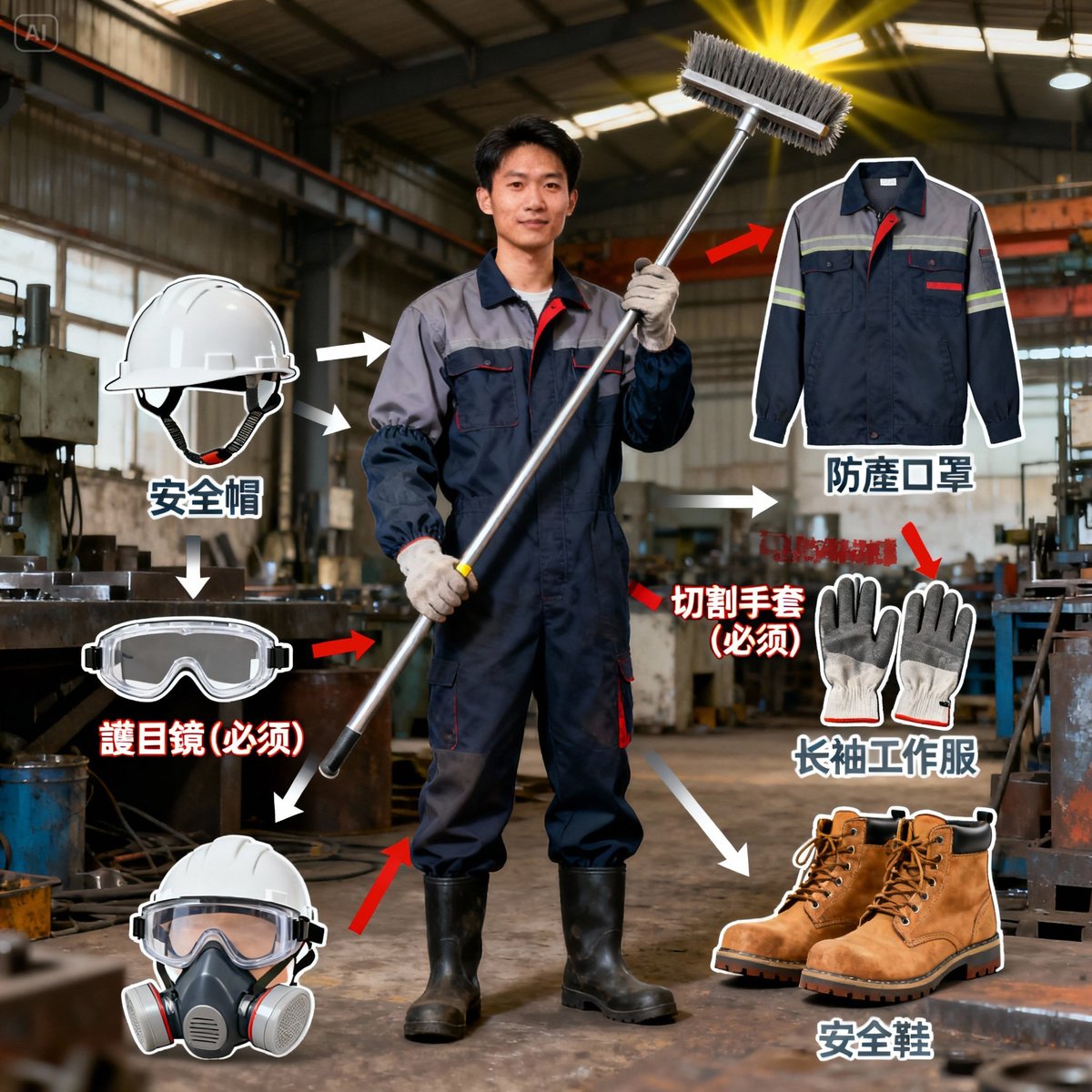
Safety protection (absolutely essential)
Essential protective equipment
Safety goggles (mandatory)
- Broken wire may fly off
- Metal fragments may be thrown into the eyes
- Choose wraparound goggles
Work gloves (mandatory)
- Protect the hands from scratches
- Choose cut-resistant gloves
- Leather gloves or puncture-resistant gloves
Dust mask (recommended)
- Metal dust may be inhaled
- N95 grade or higher
Long-sleeved work clothes (recommended)
- Protect the arms from scratches
- Keep metal fragments away from the skin
Safety shoes (mandatory in industrial environments)
- Steel-toe shoes protect the toes
- Non-slip soles
Techniques for use
The correct grip
- Hold the handle with both hands
- One hand on the grip, the other on the middle of the handle
- Keep a stable posture, with feet shoulder-width apart
The correct brushing direction
Brush along the grain
- Follow the direction of the metal grain
- Reduces the depth of scratches
- Improves rust removal efficiency
Avoid circular strokes
- Circular brush marks are the most visible
- Brush back and forth in straight lines
Controlling the force
Do not use excessive force
- Let the wire touch the surface naturally
- Excessive force causes the wire to break
- It increases the safety risk
Keep a steady rhythm
- Do not alternate between fast and slow
- Apply force evenly
Care after use
Clean immediately
- Rinse the wire with clean water
- Remove metal fragments
- Check the wire for breakage
Rust prevention (carbon steel wire brushes)
- Wipe completely dry
- Spray with rust-preventive oil
- Store in a dry place
Regular checks
- Check the rate of wire loss
- Replace when loss is more than 30%
- Check how securely the brush head is fixed
What not to do
Strictly forbidden
- ❌ Using it without safety goggles
- ❌ Using it on unsuitable materials (baked paint finishes, plastic and so on)
- ❌ Using it for long periods in a confined space (metal dust hazard)
- ❌ Using it facing people or flammable items
Take care
- ⚠️ Avoid using it on wet floors (risk of slipping)
- ⚠️ Mind the safety of people nearby
- ⚠️ Replace the brush head regularly
- ⚠️ Store it properly when not in use
Supplement: choosing the handle length of a long-handle wire brush, care and service life
Buying point 1: how to choose the handle length
Handle length is the most critical specification of a long-handle wire brush. The principle is: when working standing up and holding the end of the handle, the brush head should comfortably reach the area to be cleaned.
Handle length formula
Recommended handle length = body height - height of the area to be cleaned - 50 cm
(50 cm is the distance from the hand to the ground when the arm hangs naturally)
Worked examples
Example 1: cleaning car wheel rims
- Height of the area to be cleaned: 20 cm (height of the rim center)
- User's height: 170 cm
- Recommended handle length: 170 - 20 - 50 = 100 cm
- Actual choice: 80-100 cm (adjust to personal habit)
Example 2: removing paint from a factory floor
- Height of the area to be cleaned: 0 cm (the floor)
- User's height: 175 cm
- Recommended handle length: 175 - 0 - 50 = 125 cm
- Actual choice: 120-150 cm
Example 3: cleaning the underside of equipment
- Height of the area to be cleaned: 30 cm (the gap under the equipment)
- User's height: 165 cm
- Recommended handle length: 165 - 30 - 50 = 85 cm
- Actual choice: 80-100 cm
Special considerations
- Shared by several people: choose a telescopic design, adjustable from 50-150 cm
- Used in several scenarios: keep 2-3 brushes with different handle lengths
- Force required: when hard scrubbing is needed, the handle should not exceed 100 cm (too long makes it hard to apply force)
- Fine work: when precise control is needed, choose a shorter handle (50-70 cm)
Common mistakes
❌ Handle too short: you still have to bend over, losing the advantage of a long handle ❌ Handle too long: hard to apply force, hard to control, tiring ❌ Ignoring storage: an overly long brush is hard to store and inconvenient to transport
💡 YC Brushes recommends: if you are buying a long-handle wire brush for the first time, choose a medium handle length of 70-80 cm. It is the most adaptable and suits 80% of cleaning scenarios.
Care and service life of a long-handle wire brush
Correct care can extend the service life of a long-handle wire brush by 2-3 times.
Cleaning and care after use
-
Rinse immediately
- Rinse the wire with clean water to remove leftover rust particles, oil and chemicals
- If there is oil, a neutral detergent can be used to help
-
Shake off the water
- Shake the brush hard to drive out the water trapped between the wires
- Do not leave the wire wet for long (it easily rusts or deforms)
-
Hang to dry
- Hang with the brush head down so that the water drains naturally
- Avoid laying it flat (water collects at the root of the wire and speeds up rusting)
- Dry in a ventilated place, out of direct sunlight (plastic handles age easily)
-
Regular rust treatment (carbon steel wire)
- Once a month, spray the wire with rust-preventive oil or WD-40
- Leave for 10 minutes after spraying, then wipe off the excess oil with a cloth
Storage
- Hanging: drill a hole in the end of the handle and hang it on a hook (the best method)
- Upright: place it in a tool rack with the brush head up (to keep the wire from deforming)
- Avoid: laying it with the brush head down (wire under pressure for a long time deforms)
Service life reference
| Frequency of use | Wooden handle | Plastic handle | Metal handle | Fiberglass handle |
|---|---|---|---|---|
| Low (1-2 times a week) | 1-2 years | 2-3 years | 5 years or more | 5 years or more |
| Medium (1-2 times a day) | 6-12 months | 1-2 years | 3-5 years | 5 years or more |
| High (5 or more times a day) | 3-6 months | 6-12 months | 2-3 years | 3-5 years |
Wire life: usually shorter than that of the handle, depending on how heavy the cleaning is
- Light cleaning (dust, surface rust): the wire lasts 6-12 months
- Heavy cleaning (thick rust, paint): the wire lasts 3-6 months
When should it be replaced?
- More than 30% of the wire is broken: cleaning efficiency drops clearly
- The wire is badly rusted: rusted carbon steel wire contaminates the workpiece
- The wire is deformed: it has bent over and cannot recover its spring
- The handle is damaged: a cracked wooden handle, a broken plastic handle, a bent metal handle
- The joint between brush head and handle is loose: there is a risk of the head coming off
💰 A cost-saving tip: some brands of long-handle wire brush use a replaceable brush head, so the handle can be reused and only the head needs replacing. This suits businesses with high-frequency use and can save 40% of the cost in the long run.
FAQ
How much does a wire brush cost? A price reference guide
Wire brush prices vary greatly by type, material and brand:
Hand wire brushes
- Ordinary carbon steel wire brush: budget
- Stainless steel wire brush: mid-range
- Brass brush: mid-to-high range
Angle grinder wire wheels
- Bowl-type wire brush (4 inch): mid-range
- Dish-type wire brush (4-6 inch): budget to mid-range
- Stainless steel wire wheel: mid-to-high range
Long-handle wire brushes
- Ordinary model: mid-range
- Professional model: mid-to-high range
Custom wire brushes
- Quoted according to specification and quantity
- Order quantities are quoted per specification; email us for a quote
Want a detailed price comparison and purchasing advice? Further reading: Wire brush price comparison | the latest 2026 prices and purchasing guide
Which wire brush is recommended? Buying advice
Choose according to your need:
Home DIY / light rust removal → Hand carbon steel wire brush (economical)
Car maintenance / cleaning wheel rims → Long-handle wire brush (reaches deep areas)
Factory rust removal / large-area work → Angle grinder bowl-type wire wheel (the most efficient)
Cleaning stainless steel equipment → Stainless steel wire brush (avoids contamination)
Work in flammable environments → Brass brush (less prone to sparking)
Wire-brushing wood grain → Wire roller brush or angle grinder wire brush
Can stainless steel be brushed with a wire brush?
Answer: a carbon steel brush is not recommended; a stainless steel wire brush or a brass brush must be used.
Reason: free iron contamination
- When a carbon steel brush is used on stainless steel, carbon steel particles become embedded in the stainless steel surface
- These iron particles oxidize and rust, causing rust on the stainless steel surface
- This seriously affects rust resistance, especially on food-grade and medical-grade stainless steel
The right choice
- 304/316 stainless steel wire brush (best)
- Brass brush or red copper brush (second choice)
- Nylon brush (light cleaning)
Learn more: Choosing brushes for cleaning stainless steel
What is the difference between a steel brush and a brass brush? A full comparison
| Item | Steel brush | Brass brush |
|---|---|---|
| Hardness | High (Mohs hardness about 5.5-6.5) | Lower (Mohs hardness 3-4) |
| Rust removal efficiency | High | Medium |
| Price | Low | High |
| Service life | Long | Shorter |
| Suitable materials | Carbon steel, cast iron | Stainless steel, aluminum, copper |
| Sparks | May be produced | Less likely (low-spark) |
| Rust resistance | Carbon steel rusts easily | Copper does not rust easily |
| Fineness | Rougher | Fine |
Recommendation
- General rust removal → steel brush (economical)
- Cleaning stainless steel → brass brush or stainless steel wire brush
- Flammable environments → brass brush (less prone to sparking)
Is an angle grinder wire brush safe? A guide to preventing risks
An angle grinder wire brush is a highly efficient tool, but also a high-risk one, and the safety rules must be strictly followed.
Main risks
- The wire brush breaking and flying off (may cause serious injury)
- Metal chips injuring the eyes
- Inhaling dust
- Noise damage
Key points for safe use
- ✅ Check that the speed matches (the most important point)
- ✅ Wear safety goggles, a mask and gloves
- ✅ Hold firmly with both hands
- ✅ Avoid side loading
- ✅ Check the condition of the wire brush regularly
- ✅ Keep away from flammable items
- ✅ Work in a ventilated place
Confirm when buying
- The wire wheel is clearly marked with its maximum speed
- Choose a product with quality certification
- Avoid cheap goods of unknown origin
For a detailed safety guide and SOP checklist, see Angle grinder wire brush safety guide
What are wire brushes used for? A complete list of applications
Wire brushes are used very widely, mainly in:
Metalworking
- Removing rust and oxide layers
- Treatment before and after welding
- Surface roughening
- Removing old paint
Machinery maintenance
- Cleaning equipment
- Removing dirt from parts
- Cleaning conveyor belts
- Servicing rollers
Car maintenance
- Rust removal and cleaning of wheel rims
- Removing grime from the engine bay
- Treating rust spots on the body
- Cleaning exhaust pipes
Woodworking
- Wire-brushing wood grain
- Distressing surfaces
- Removing wood fuzz and splinters
- Bringing out the relief of the grain
Household cleaning
- Removing rust from garden tools
- Cleaning window grilles and railings
- Caring for hardware
- Removing burnt residue from BBQ grills
Industrial applications
- Cleaning food equipment (stainless steel wire brush)
- Maintaining chemical equipment
- Cleaning printing rollers
- Servicing textile machinery
What can a wire brush be used on? Material compatibility chart
| Workpiece material | Recommended brush | Suitability | Notes |
|---|---|---|---|
| Carbon steel / cast iron | Carbon steel wire brush | ⭐⭐⭐⭐⭐ | The best combination |
| Stainless steel | Stainless steel wire brush / brass brush | ⭐⭐⭐⭐⭐ | Carbon steel brushes forbidden |
| Aluminum | Brass brush / nylon brush | ⭐⭐⭐⭐ | Steel brushes scratch easily |
| Copper | Brass brush / nylon brush | ⭐⭐⭐⭐ | Avoid hard steel brushes |
| Wood | Wire brush | ⭐⭐⭐⭐⭐ | Used for wire-brushing the grain |
| Plastic | Nylon brush | ⭐⭐⭐ | Metal brushes forbidden |
| Glass | Not recommended | ❌ | Scratches easily |
| Ceramic | Brass brush / nylon brush | ⭐⭐ | Test with care |
How to choose a wire wheel size? Specification chart
Angle grinder wire wheel sizes
| Wheel diameter | Suitable angle grinder | Suitable for | Speed range |
|---|---|---|---|
| 4 inch (100mm) | 4 inch angle grinder | Small areas, fine work | 10,000-15,000 RPM |
| 5 inch (125mm) | 5 inch angle grinder | Medium areas, general work | 8,000-12,000 RPM |
| 6 inch (150mm) | 6 inch angle grinder | Large areas, heavy-duty work | 6,000-10,000 RPM |
| 7 inch (180mm) | 7 inch angle grinder | Industrial-grade large areas | About 8,500 RPM |
Bore specifications
- Ordinary angle grinders: 16mm or 22.23mm
- Be sure to confirm the spindle diameter of the angle grinder before buying
Recommendation
- Home DIY → 4 inch
- Car repair → 4-5 inch
- Factory rust removal → 5-6 inch
- Heavy-duty industrial work → 6-7 inch
What scenarios suit a long-handle wire brush?
Because of its extended handle, a long-handle wire brush is especially suited to the following scenarios:
Car maintenance
- Cleaning deep inside wheel rims (the most common use)
- Removing grime in the narrow spaces of the engine bay
- Removing rust from the chassis
Equipment maintenance
- Cleaning the inside of machinery
- Removing rust from the inner walls of pipes
- Cleaning railings at height
Floor cleaning
- Removing rust from large floor areas
- Removing oil from factory floors
- Working without bending over
Construction
- Removing rust from scaffolding
- Surface treatment of steel structures
- Work at height
Choosing the handle length
- 30-40cm: suited to ordinary wheel rims and small spaces
- 50-80cm: suited to floors and deeper spaces
- 100cm or more: work at height, large floor areas
How can the service life of a wire brush be extended?
Correct use
- Avoid excessive pressure (let the tool do the work)
- Keep a suitable angle (15-30 degrees with an angle grinder)
- One brush for one job (to avoid cross-contamination and excessive wear)
Care after use
- Clear debris caught in the wire
- Wipe carbon steel brushes dry to prevent rust
- Check for looseness or deformation
Correct storage
- Keep in a dry environment
- Avoid heavy pressure that deforms it
- Place with the wire facing up
Regular checks
- Check the length and density of the wire
- Check that the handle or brush body is secure
- For an angle grinder wire brush, check the center bore
Replace in good time
- Do not wait until it is completely worn out before replacing it
- When 50% of the wire remains, efficiency has already dropped clearly
- Replacing it with a new brush is actually more economical
Questions about extending service life? YC Brushes offers free advice, and our professional team will answer them for you.
Conclusion: choose the right wire brush and get twice the result for half the effort
A wire brush looks simple, but choosing the right tool and using the right method raises working efficiency a great deal.
Key points in review
Confirm before buying
- The job requirement (rust removal, cleaning, wire-brushing wood grain)
- The workpiece material (carbon steel, stainless steel, wood)
- The working environment (ordinary, flammable, food-grade)
Safety always comes first
- Wear safety goggles, a mask and gloves
- Check that the speed matches (angle grinder wire brushes)
- Check the condition of the tool regularly
Correct use extends service life
- Avoid excessive pressure
- Clean and care for it after use
- Keep to one brush for one job
YC Brushes: over 40 years of professional manufacturing experience
YC Brushes has specialized in industrial brush manufacturing for over 40 years and offers:
A complete product line
- Hand wire brushes, long-handle wire brushes
- Angle grinder wire wheels (in all specifications)
- Wire roller brushes, tube wire brushes
- Stainless steel wire brushes, brass brushes
Custom service
- Development of special specifications
- 3D-printed sampling
- Order quantities quoted per specification (email us)
- Complete technical support
Quality assurance
- Factory-direct, stable quality
- A strict quality control process
- Over 40 years of manufacturing experience
- More than 100 long-term customers


Further reading
References
- ISO 9001 quality management system standard