Introduction: one mistake, and a whole batch of equipment is scrapped
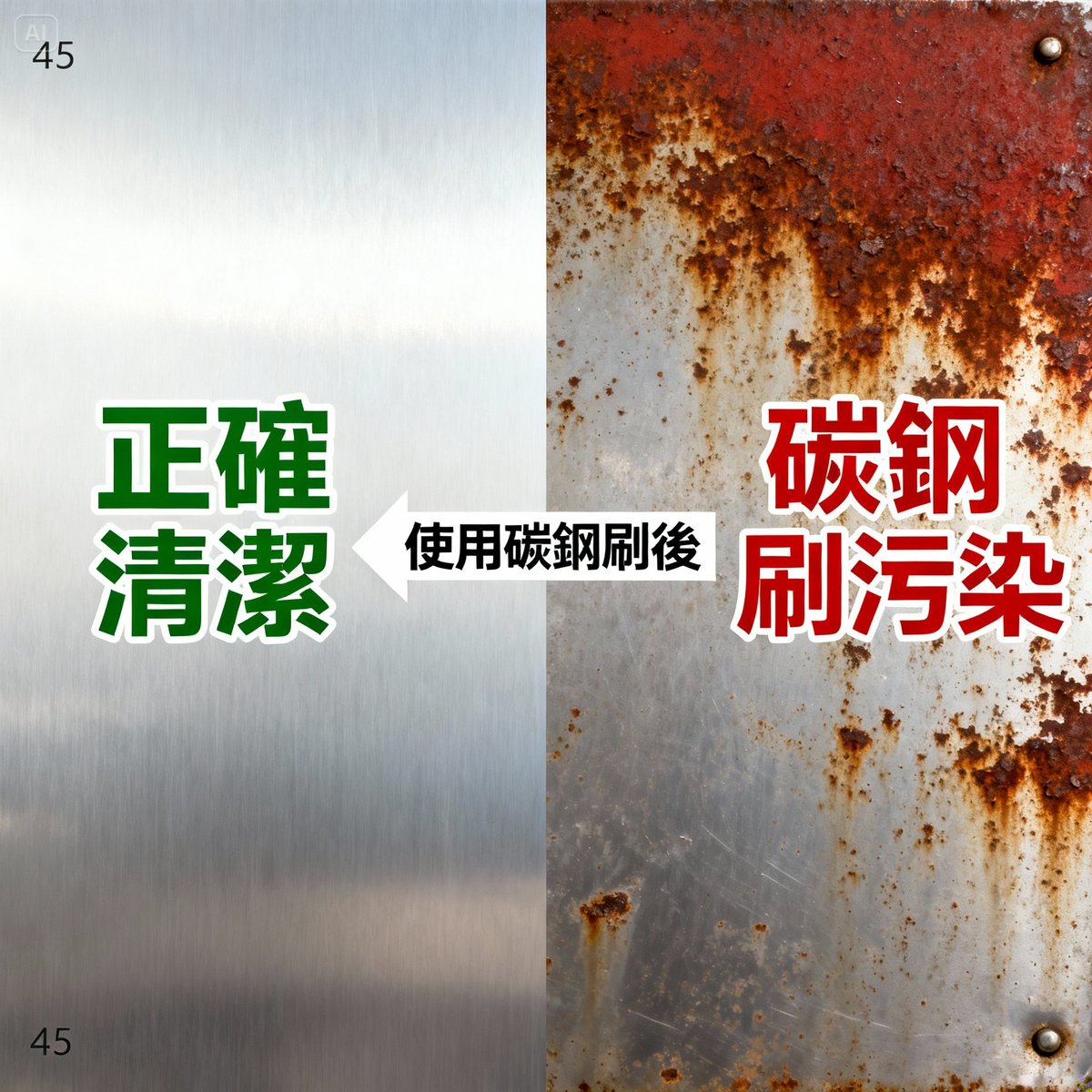
A newly hired technician at a food processing plant cleaned a stainless steel conveyor belt with a carbon steel brush, thinking that "they are all metal brushes, so it should make no difference". A week later, large numbers of reddish-brown rust spots appeared on the surface of the belt, and inspection found serious free iron contamination. The whole belt had to be passivated again, and the downtime loss plus the treatment cost came to more than NT$800,000.
This is not an isolated case. Many people do not know that iron particles from a carbon steel brush embed themselves in the stainless steel surface, damage the protective film and cause rust. In food-grade and medical-grade applications in particular, free iron contamination not only affects the equipment but may also violate hygiene regulations, with serious consequences.
In this article, YC Brushes draws on over 40 years of manufacturing experience to explain in full why stainless steel must not be cleaned with a carbon steel brush, the mechanism and hazards of free iron contamination, the correct choices for cleaning stainless steel, the differences between 304 and 316 stainless steel brushes, and an application guide for each industry, to help you avoid stainless steel contamination problems altogether.
If you would like to understand the basic differences between steel brushes and brass brushes first, see: Steel brush vs brass brush: the ultimate guide to choosing the material
Why can stainless steel not be cleaned with a carbon steel brush?
This is the most frequently asked question, and also important knowledge that is most easily overlooked.
The mechanism of free iron contamination
What is free iron contamination (Free Iron Contamination)?
When a carbon steel brush is used on stainless steel, the following happens:
Step 1: iron particles become embedded
- Fragments of steel wire come off the carbon steel brush
- The fragments embed themselves in the tiny pores of the stainless steel surface
- They are hard to see with the naked eye
Step 2: a potential difference arises
- Carbon steel (iron) and stainless steel (an iron-chromium alloy) form a potential difference
- Carbon steel has the lower potential (it is more active)
- A micro-battery effect is formed
Step 3: preferential corrosion
- The carbon steel fragments oxidize first
- Reddish-brown rust (Fe₂O₃) is produced
- The rust spreads to the surrounding area
Step 4: the protective film is damaged
- The rust prevents the passive film on the stainless steel surface from repairing itself
- The stainless steel loses its protective film
- It begins to corrode and rust
Step 5: the damage keeps spreading
- The corrosion spots keep growing
- Obvious rust spots form
- In serious cases this can lead to pitting corrosion
The chemistry
The rust resistance of stainless steel comes from the passive film (Passive Film) on its surface:
- Main component: chromium oxide (Cr₂O₃)
- Thickness: about 1-3 nanometers
- Function: keeps out oxygen and moisture and prevents oxidation
When carbon steel fragments are embedded, iron oxidizes far faster than chromium. This damages the protective film, and the stainless steel loses its rust resistance.
The serious consequences of contamination
For the equipment
Damaged appearance
- Reddish-brown rust spots appear on the surface
- Appearance and brand image suffer
- Customer complaints and loss of goodwill
Impaired function
- Surface roughness increases
- Fluid transfer is affected (as in pipes)
- Sealing performance is affected
Shortened service life
- Continued corrosion leads to perforation
- The equipment is scrapped early
- Replacement is expensive
For safety
Food safety
- Rust contaminates food
- Food hygiene regulations are violated
- Food may be pulled from the shelves and fines imposed
Medical safety
- Medical devices rust
- The effectiveness of disinfection is affected
- A risk of infection may result
Chemical plant safety
- Corroded equipment may leak
- Chemicals pollute the environment
- Risk of safety incidents
For costs
Direct costs
- Repairing or replacing equipment
- Downtime losses
- Labor costs
Indirect costs
- Loss of goodwill
- Customer claims
- Legal fines
Case: loss figures for a food plant
- Re-treating the conveyor belt: NT$200,000
- Downtime loss (3 days): NT$450,000
- Scrapped food: NT$150,000
- Total loss: NT$800,000
Real cases
Case 1: conveyor belt contamination at a food processing plant
Background
- A new employee did not know the rules
- A carbon steel brush was used to clean a stainless steel conveyor belt
Result
- Large numbers of rust spots appeared a week later
- The whole belt had to be passivated again
- 3 days of downtime and a loss of NT$800,000
Case 2: a cleaning mistake with medical devices
Background
- Outsourced cleaning staff used a carbon steel brush
- They cleaned stainless steel surgical instrument trays
Result
- The trays rusted
- The quality management department found it
- The whole batch of instruments had to be reprocessed
Case 3: pipe corrosion at a chemical plant
Background
- Maintenance staff used a carbon steel brush to clean the inner wall of a stainless steel pipe
- They did not follow the SOP
Result
- Corrosion of the pipe accelerated
- Seepage appeared after 3 months
- The pipe had to be replaced urgently, at heavy cost
How to test for contamination
Visual inspection
- Look for reddish-brown rust spots
- Simple, but cannot detect contamination at an early stage
Free iron test (Free Iron Test)
Method 1: potassium ferricyanide test
- Apply potassium ferricyanide solution
- It turns blue where free iron is present
- Highly sensitive; can detect trace contamination
Method 2: copper reagent test
- Apply copper sulfate solution (CuSO₄)
- No copper should deposit on a stainless steel surface
- Free iron speeds up the deposition of copper
Professional testing
- X-ray fluorescence spectrometer (XRF)
- Measures the iron content of the surface precisely
- Higher cost, suited to large projects
Prevention is better than cure: use the right brush and avoid contamination at the source.
3 correct choices for cleaning stainless steel
Only by knowing the right cleaning tools can you protect stainless steel equipment.
Choice 1: stainless steel wire brush (the best choice)
Why is it the best choice?
- The same material does not cause free iron contamination
- It cleans well
- It meets food-grade and medical-grade requirements
Advantages of stainless steel wire brushes
- ✅ Do not contaminate the stainless steel surface
- ✅ Corrosion resistant, suited to damp environments
- ✅ Moderate hardness, good cleaning efficiency
- ✅ Meet the requirements of hygiene regulations
Types of stainless steel wire brush
304 stainless steel brush
- Composition: 18% chromium + 8% nickel
- Corrosion resistance: good
- Magnetism: weakly magnetic or non-magnetic
- Suited to: general food-grade and medical-grade applications
- Price: more economical
316 stainless steel brush
- Composition: 18% chromium + 10% nickel + 2-3% molybdenum
- Corrosion resistance: excellent (especially against chloride ions)
- Magnetism: usually non-magnetic
- Suited to: marine environments, chemical plants, high-standard food-grade use
- Price: higher (about 1.3-1.5 times that of 304)
How to choose?
- General applications → 304 stainless steel brush
- Marine environments, chemical plants, high-salt environments → 316 stainless steel brush
- Limited budget → 304 is enough
See the 304 and 316 stainless steel brush products from YC Brushes
Choice 2: brass brush (the second choice)
When should you choose a brass brush?
- The budget is limited and a stainless steel brush is out of reach
- The cleaning intensity required is not high
- The application is not food grade or medical grade
Advantages of brass brushes
- ✅ Do not cause free iron contamination
- ✅ Cheaper than stainless steel brushes
- ✅ Softer, less likely to scratch stainless steel
Limitations of brass brushes
- ⚠️ Cleaning efficiency slightly lower than a stainless steel brush
- ⚠️ Shorter service life
- ⚠️ Brass particles may be left behind (thorough cleaning is needed)
Advice for use
- Suited to light dirt removal
- Always rinse clean after cleaning
- The brass brush itself must be kept clean (to avoid contamination by iron particles)
Choice 3: nylon brush (light cleaning)
When should you choose a nylon brush?
- Light cleaning and polishing
- When no metal particles of any kind are wanted
- Treatment of precision surfaces
Advantages of nylon brushes
- ✅ Do not damage the surface at all
- ✅ No risk of metal contamination
- ✅ The lowest price
Limitations of nylon brushes
- ❌ Poor at heavy rust removal
- ❌ Cannot deal with stubborn dirt
- ❌ Shorter service life
Advice for use
- Suited to routine maintenance cleaning
- Use with a cleaning agent
- Replace regularly
Comparison table of the three brushes
| Brush type | Dirt removal | Gentle on the surface | No contamination risk | Price | Suitable scenarios |
|---|---|---|---|---|---|
| 304 stainless steel brush | ★★★★☆ | ★★★★☆ | ★★★★★ | $$$ | Food grade, medical grade, general industry |
| 316 stainless steel brush | ★★★★☆ | ★★★★☆ | ★★★★★ | $$$$ | Chemical plants, marine environments, high standards |
| Brass brush | ★★★☆☆ | ★★★★★ | ★★★★★ | $$ | Limited budget, light cleaning |
| Nylon brush | ★★☆☆☆ | ★★★★★ | ★★★★★ | $ | Light cleaning, maintenance cleaning |
The complete guide to stainless steel wire brushes
A closer look at how to buy and use stainless steel wire brushes.
Choosing between 304 and 316 stainless steel brushes
304 stainless steel brush
Composition and properties
- 18% chromium (Cr) + 8% nickel (Ni)
- Good corrosion resistance
- Suited to general environments
Suitable scenarios
- Food processing equipment (general)
- Medical devices (general)
- Architectural and decorative stainless steel
- General industrial equipment
Price
- Hand brush: NT$180-350
- Wheel brush for an angle grinder: NT$300-500
316 stainless steel brush
Composition and properties
- 18% chromium (Cr) + 10% nickel (Ni) + 2-3% molybdenum (Mo)
- Excellent corrosion resistance (especially against chloride ions)
- Suited to harsh environments
Suitable scenarios
- Equipment in marine environments
- Pipes and vessels in chemical plants
- High-salt environments
- High-standard food-grade use (such as pharmaceuticals)
- Machining of medical implants
Price
- Hand brush: NT$250-450
- Wheel brush for an angle grinder: NT$400-650
How to decide?
When to choose 304
- General food processing
- Indoor environments
- Limited budget
- It is enough for most applications
When to choose 316
- Seaside and port equipment
- Chemical plants (especially chlorine-containing environments)
- Swimming pool equipment
- Pharmaceuticals, high-standard medical use
- Ample budget, wanting the best rust protection
How to tell real from fake
Some cheap "stainless steel brushes" on the market are in fact plated iron brushes, so careful identification is needed.
Method 1: magnet test
Real stainless steel brush (304/316)
- 304: weakly magnetic or non-magnetic
- 316: usually non-magnetic
Fake stainless steel brush (plated iron brush)
- Strongly magnetic (attracted by a magnet)
Note: the magnet test is not 100% accurate (304 can become magnetic after working), but strong magnetism usually means a fake.
Method 2: judging by price
Reasonable prices
- 304 hand brush: NT$180-350
- 316 hand brush: NT$250-450
- Be cautious with anything below these prices
Suspicious prices
- Hand brush below NT$150 → highly suspect
- Labeled stainless steel but priced close to a carbon steel brush → may be a fake
Method 3: check the labeling
Legitimate products
- Clearly labeled "304" or "316" or "SUS304"
- Carry the manufacturer's information
- Properly packaged
Suspicious products
- Say only "stainless steel" without stating the grade
- No manufacturer's information
- Crude packaging
Method 4: look at the surface
Real stainless steel brush
- Silvery-white luster
- Uniform surface
- Does not rust easily
Fake stainless steel brush
- The plating may be peeling
- Uneven surface
- May rust after use
Method 5: choose a reputable manufacturer
The safest way is to choose a manufacturer with a good reputation, such as:
- YC Brushes (over 40 years of manufacturing experience, ISO certified)
- Internationally known brands
- Manufacturers with complete product certification
Quality assurance for YC Brushes stainless steel brushes
Analysis of the price difference
Why are stainless steel brushes more expensive than carbon steel brushes?
Raw material cost
- Stainless steel raw material costs about 3-4 times as much as carbon steel
- 304 costs less than 316 (molybdenum is more expensive)
Difficulty of processing
- Stainless steel is harder to process
- It needs better equipment and skills
- The defect rate is higher
Quality control
- Material purity has to be ensured
- A strict quality control process
- Certification costs
Price comparison (hand brushes)
| Type | Price range | Relative multiple |
|---|---|---|
| Carbon steel brush | NT$60-120 | 1.0x (baseline) |
| 304 stainless steel brush | NT$180-350 | 2.5-3x |
| 316 stainless steel brush | NT$250-450 | 3.5-4x |
| Brass brush | NT$250-500 | 3-4x |
Is it worth it?
Considering the risk and cost of contamination, a stainless steel brush is absolutely worth it:
- It avoids free iron contamination (losses can run to hundreds of thousands of NT dollars)
- It meets regulatory requirements
- It protects the service life of the equipment
Ways to save money
- Buy factory-direct (for example from YC Brushes)
- Get a discount for buying in quantity
- Use the brush correctly to extend its life
🏭 A must-read for food and chemical plants! Stainless steel cleaning solutions
Regulatory warning: cleaning food-contact equipment with the wrong brush may violate the relevant provisions of Taiwan's Act Governing Food Safety and Sanitation, and the competent authority may impose a fine depending on the circumstances of the violation.
How can YC Brushes help your business?
✅ Products that meet the regulations: certified 304/316 stainless steel brushes that meet food-grade and medical-grade requirements ✅ Professional selection advice: we recommend the most suitable brush for your equipment material and operating environment ✅ Complete training: staff training materials are provided to prevent misuse ✅ Help with setting up SOPs: we help you establish a standard operating procedure for cleaning stainless steel ✅ Long-term technical support: questions about cleaning and maintenance answered at any time
💡 Why choose YC Brushes?
- Over 40 years of manufacturing experience: a thorough understanding of the professional requirements of stainless steel cleaning
- ISO-certified quality: strict quality control on every batch, with complete material certification
- Professional consulting service: we do not just sell products; we care that customers use them correctly
Limited-time service: get a free stainless steel cleaning SOP template when you consult us!
👉 Contact YC Brushes now and avoid the risk of free iron contamination!
Cleaning requirements for different grades of stainless steel use
Different application scenarios place different demands on stainless steel cleaning.
Food-grade cleaning requirements
Regulatory requirements
- Act Governing Food Safety and Sanitation (Taiwan), Article 8: the hygiene management of workplaces and facilities must comply with the Regulations on Good Hygiene Practice for Food
- GMP requirements: cleaning tools must meet material requirements
- HACCP: a cleaning SOP must be established
Cleaning requirements
Must use
- 304 or 316 stainless steel brushes (first choice)
- Food-grade brass brushes (second choice, in specific scenarios)
- Food-grade nylon brushes (light cleaning)
Strictly prohibited
- ❌ Carbon steel brushes (free iron contamination)
- ❌ "Stainless steel brushes" of unknown origin
Cleaning procedure
Step 1: remove large deposits
- Use a scraper or rinse with high-pressure water
Step 2: brush cleaning
- Use a stainless steel brush with a cleaning agent
- Brush along the grain of the metal
Step 3: rinse
- Rinse thoroughly with clean water
- Make sure no cleaning agent remains
Step 4: disinfect
- Disinfect as the rules require
- Air dry or oven dry
Step 5: inspect
- Visual check that there are no stains
- Carry out a free iron test regularly
Medical-grade cleaning requirements
Regulatory requirements
- Medical Devices Act (Taiwan)
- Sterilization operating standards
- Infection control standards for medical institutions
Cleaning requirements
Cleaning devices
- 304 or 316 stainless steel brushes must be used
- Brushes must be replaced regularly
- A dedicated-brush system must be established
Disinfection and sterilization
- High-pressure steam sterilization after cleaning
- Make sure no contamination of any kind remains
Quality inspection
- Test surface cleanliness regularly
- Free iron test
- Microbiological testing
Cleaning requirements for architectural and decorative use
Purpose of cleaning
- Maintaining appearance
- Preventing surface rust
- Extending service life
Cleaning requirements
General maintenance
- A 304 stainless steel brush can be used
- For light cleaning, a brass brush or nylon brush can be used
Rust removal
- Chemical rust removers come first
- Combined with a 304 stainless steel brush
- Avoid over-brushing (to prevent scratches)
Maintenance frequency
- Indoors: once a quarter
- Outdoors: once a month
- Seaside environments: once a week
Cleaning requirements for industrial use
Application scenarios
- Chemical equipment
- Pharmaceutical equipment
- Food machinery
- Conveying systems
Cleaning requirements
Chemical equipment
- 316 stainless steel brushes (preferred)
- Consider how corrosive the chemicals are
- Check the condition of the brushes regularly
Pharmaceutical equipment
- Comply with GMP
- Use certified stainless steel brushes
- Strict cleaning validation
Conveying systems
- Choose the brush according to the substance in contact
- Food contact: a stainless steel brush must be used
- Non-food contact: a brass brush can be used
Professional guide to cleaning stainless steel welds
Welding places special demands on stainless steel cleaning.
Cleaning before welding
Why does it matter?
- It ensures weld quality
- It avoids weld defects
- It prevents contamination from being embedded
Key points
Remove oil and grease
- Use a degreaser or acetone
- Wipe clean
Remove the oxide layer
- Brush lightly with a stainless steel brush
- Along the grain of the metal
- Do not apply too much pressure
Confirm it is clean
- The surface shows a metallic luster
- No oil, no oxide layer
Cleaning the weld bead
Clean immediately after welding
- Remove slag
- Remove the heat discoloration (discolored layer)
- Restore rust resistance
Cleaning methods
Mechanical cleaning
- Use a stainless steel brush (it must be 304 or 316)
- Brush off the slag and the discolored layer
- Brush along the direction of the weld bead
Chemical cleaning
- Use stainless steel pickling paste
- Removes stubborn oxide layers
- Rinse clean after cleaning
Electropolishing
- Can be used where the standard is high
- Restores the passive film
- Higher cost
Strictly prohibited
- ❌ Carbon steel brushes (cause serious contamination)
- ❌ Ordinary grinding discs (contain iron)
- ❌ Ordinary steel wire wheels (contain iron)
Dealing with the welding oxide layer
What is the welding oxide layer (Heat Tint)?
- Discoloration caused by the high temperature of welding
- Colors: golden yellow, blue, black
- Effect: damages the passive film and reduces rust resistance
How to remove it
Light oxidation (golden yellow)
- A stainless steel brush with a cleaning agent
- Brushing it off is enough
Medium oxidation (blue, purple)
- Stainless steel pickling paste
- Leave it for 10-20 minutes
- Brush off, then rinse
Heavy oxidation (black)
- Professional pickling
- Or use a stainless steel polishing machine
- Outsourcing the treatment is recommended
Preventing secondary contamination
The dedicated-brush principle
- A brush reserved for stainless steel must not be used on carbon steel
- Avoid cross-contamination
Tool cleanliness
- Before use, check that the brush carries no iron particles
- Clean the brushes regularly
- Keep them separate in storage
Working environment
- Keep iron particles from spattering in the welding area
- Clear the workbench surface
- Use a workbench reserved for stainless steel
Using and maintaining the brushes
Correct use and maintenance extend brush life and ensure cleaning quality.
The dedicated-brush principle
Why dedicate brushes to one material?
To avoid cross-contamination
- A brush that has been used on carbon steel carries iron particles
- Using it on stainless steel afterward causes contamination
To maintain cleaning results
- Dedicated brushes perform consistently
- They clean better
To meet the rules
- Mandatory for food-grade and medical-grade use
- A necessary condition for passing audits
How to put it into practice?
Label to distinguish
- Brushes for stainless steel only: blue label
- Brushes for carbon steel only: gray label
- Brushes for copper materials only: yellow label
Store by zone
- Store different brushes separately
- Avoid mix-ups
Check regularly
- Confirm that the labels are clear
- Check for misuse
Checks before use
What to check
Confirm the label
- Confirm that it is a stainless steel brush (304 or 316)
- Check that the label has not come off
Appearance
- The wire is not badly worn
- No deformation or damage
Cleanliness
- No iron particles or dirt on the wire
- Clean the brush first if necessary
Maintenance after use
Clean immediately
- Rinse the brush with clean water
- Remove the dirt clinging to it
- Use a cleaning agent if necessary
Dry it
- Shake off the water
- Air dry or oven dry
- Avoid damp environments (to prevent rust)
Check regularly
- Check the condition of the wire every week
- Replace immediately at 50% wear
- Record the date of replacement
Storage and separation
Storage principles
A dry environment
- Avoid damp
- Good ventilation
Separate storage
- Keep apart from carbon steel brushes
- Avoid cross-contamination
Clear labeling
- Label the storage cabinet "stainless steel only"
- Prevents the wrong brush from being taken
When to replace
Replace immediately
- Less than 50% of the wire length remains
- Deformation or breakage appears
- Contamination by iron particles is found
Replace on a schedule
- Food-grade applications: every 3 months
- Medical-grade applications: every 2 months
- General industry: according to wear
Replacement records
- Keep a replacement record sheet
- Track service life
- Optimize the purchasing plan
Application guide by industry
Professional advice for different industries.
Food processing
Common equipment
- Stainless steel conveyor belts
- Mixing equipment
- Storage tanks, pipes
- Work surfaces
Cleaning requirements
- 304 or 316 stainless steel brushes must be used
- Comply with food hygiene regulations
- Establish a cleaning SOP
YC Brushes recommends
- Buy 304 stainless steel brushes (good value for money)
- Establish a dedicated-brush system
- Carry out free iron tests regularly
- Train employees
Medical devices
Common applications
- Surgical instrument trays
- Medical carts
- Housings of medical equipment
- Disinfection equipment
Cleaning requirements
- Stainless steel brushes must be used
- Comply with the Medical Devices Act (Taiwan)
- High-standard cleaning validation
YC Brushes recommends
- Buy 316 stainless steel brushes (high standard)
- Enforce the dedicated-brush rule strictly
- Sterilize the brushes regularly
- Establish a cleaning validation procedure
Chemical equipment
Common equipment
- Reactors
- Stainless steel pipes
- Storage tanks
- Heat exchangers
Cleaning requirements
- Consider how corrosive the chemicals are
- Use 316 stainless steel brushes in preference
- Check the condition of the equipment regularly
YC Brushes recommends
- Buy 316 stainless steel brushes (corrosion resistant)
- Assess chemical compatibility
- Replace brushes regularly
- Safe operation training
Architecture and decoration
Common applications
- Stainless steel handrails
- Elevator decorative panels
- Stainless steel doors and windows
- Exterior wall decoration
Cleaning requirements
- Maintain appearance
- Prevent scratches
- Maintain regularly
YC Brushes recommends
- Everyday cleaning: nylon brush or brass brush
- Rust removal: 304 stainless steel brush
- Avoid over-brushing
- Wipe and treat after cleaning
See more industry application cases: Industrial applications shared by YC Brushes
FAQ
Can stainless steel that has been brushed with a carbon steel brush still be saved?
Yes, but it needs professional treatment.
Light contamination (early stage)
Treatment
- Brush again immediately with a stainless steel brush
- Use a stainless steel cleaner with it
- Rinse thoroughly
- Check whether any rust spots remain
Success rate
- The sooner it is dealt with, the easier it is to restore, so remove the contamination as soon as it is found
Medium contamination (rust spots have appeared)
Treatment
- Use stainless steel pickling paste
- Apply it to the rust spots and leave for 15-30 minutes
- Brush off with a stainless steel brush
- Rinse with clean water
- Repeat 2-3 times if necessary
Success rate
- Surface rust spots: relatively easy to deal with
- Deep rust: harder to restore completely
Heavy contamination (deep rust)
Treatment
- Professional pickling
- Electropolishing
- Passivation
Success rate
- Depends on the depth of the rust
- The equipment may need to be replaced
Prevention is better than cure
- Use the right brush from the start
- Keep contamination from happening
What is the difference between 304 and 316 stainless steel brushes?
The main differences between the two are material composition and corrosion resistance.
Difference in composition
304 stainless steel
- Chromium (Cr): 18%
- Nickel (Ni): 8%
- No molybdenum (Mo)
316 stainless steel
- Chromium (Cr): 18%
- Nickel (Ni): 10%
- Molybdenum (Mo): 2-3%
The key difference: molybdenum
- 316 contains molybdenum
- Molybdenum greatly improves resistance to chloride ion corrosion
- Better suited to harsh environments
Difference in performance
| Property | 304 | 316 |
|---|---|---|
| General corrosion resistance | Good | Excellent |
| Resistance to chloride ions | Average | Excellent |
| Marine environments | Will rust | Good |
| Chemical environments | Depends on the case | Better |
| Price | Lower | Higher (+30-50%) |
How to choose?
When to choose 304
- General indoor environments
- General food processing
- Limited budget
- It is enough for most applications
When to choose 316
- Seaside and port equipment
- Swimming pool equipment
- Chemical plants (especially with chlorine)
- Pharmaceuticals, high-standard medical use
- Ample budget
A simple rule
- Seawater, pool water or chemicals present → 316
- General environments → 304
Why are stainless steel brushes more expensive?
There are sound reasons for the higher price of stainless steel brushes.
High raw material cost
- Stainless steel raw material costs 3-4 times as much as carbon steel
- Chromium and nickel are expensive
- 316 contains molybdenum and costs even more
Difficult to process
- Stainless steel is hard and difficult to process
- It needs better equipment
- Processing is slower
- Cutting tools wear quickly
Strict quality control
- Material purity has to be ensured
- 304/316 composition testing
- A strict quality control process
- High certification costs
Small market supply
- Demand is lower than for carbon steel brushes
- Economies of scale are smaller
- Supply chain costs are higher
Price comparison (hand brushes)
- Carbon steel brush: NT$60-120
- 304 stainless steel brush: NT$180-350 (3 times)
- 316 stainless steel brush: NT$250-450 (4 times)
Is it worth it? Absolutely!
Considering the risk of free iron contamination:
- Contamination loss at a food plant: NT$500,000-1,000,000
- Cost of a stainless steel brush: a few hundred NT dollars
- Return on investment: extremely high
Ways to save money
- Buy factory-direct (YC Brushes)
- Get a discount for buying in quantity
- Use the brush correctly to extend its life
- But never economize where you should not
How can I be sure of buying a genuine stainless steel wire brush?
Ways to avoid buying a fake.
Method 1: choose a reputable manufacturer
Recommended
- YC Brushes (over 40 years of experience, ISO certified)
- Well-known brands
- Manufacturers with complete certification
Avoid
- Low-priced goods of unknown origin
- No manufacturer's information
- Online sellers (verification needed)
Method 2: check the certification and labeling
Legitimate products
- Labeled "304" or "316" or "SUS304/316"
- Carry the manufacturer's information
- Have material certification documents (can be requested for large purchases)
Suspicious products
- Say only "stainless steel" without stating the grade
- No manufacturer's information
Method 3: judging by price
Reasonable prices
- 304 hand brush: NT$180-350
- 316 hand brush: NT$250-450
Suspicious prices
- Hand brush below NT$150 → highly suspect
- Clearly below the market price → may be a fake
Method 4: magnet test (for reference)
- Real 304/316: weakly magnetic or non-magnetic
- Carbon steel brush: strongly magnetic
- Note: not 100% accurate
Method 5: ask for a material certificate
- Ask for a material certificate when buying in quantity
- 304/316 composition test report
- A legitimate manufacturer can provide one
The YC Brushes guarantee
- All our stainless steel brushes are made of the genuine material
- A material certificate can be provided
- Backed by over 40 years of reputation
See certified stainless steel brushes from YC Brushes
Conclusion: clean correctly, protect the equipment, meet the regulations
Cleaning stainless steel looks simple, but a great deal depends on it.
Summary of the key points
Strictly prohibited
- ❌ Do not clean stainless steel with a carbon steel brush
- ❌ Do not use "stainless steel brushes" of unknown origin
- ❌ Do not mix brushes between materials (cross-contamination)
The right choices
- ✅ Use 304 or 316 stainless steel brushes
- ✅ On a limited budget, a brass brush can be used (second choice)
- ✅ For light cleaning, a nylon brush can be used
Professional management
- ✅ Establish a dedicated-brush system
- ✅ Inspect and replace regularly
- ✅ Train employees
- ✅ Meet the regulatory requirements of your industry
YC Brushes: specialists in stainless steel cleaning
YC Brushes has been making industrial brushes for over 40 years and offers:
Certified products
- 304/316 stainless steel brushes
- Complete material certification
- Compliance with food-grade and medical-grade requirements
Professional services
- Free selection advice
- Help with setting up a cleaning SOP
- Support for staff training
- Long-term technical support
Quality assurance
- ISO 9001 certification
- A strict quality control process
- Over 40 years of manufacturing experience
- Factory-direct prices
If you need a professional stainless steel cleaning solution, contact YC Brushes now. We provide:
- A free assessment of free iron contamination risk
- A stainless steel cleaning SOP template
- Material certification documents for our products
- The best factory-direct prices
Or see the full range of stainless steel brush products and choose the brush that suits you best.
📚 Further reading
Want to learn more about wire brushes? We recommend:
- The complete guide to wire brushes - the types and applications of wire brushes
- Wire brush price comparison | 2026 latest quotes and purchasing guide - price analysis and purchasing advice for stainless steel brushes
- Industrial brush application cases - real cases of stainless steel cleaning in food plants, medical equipment and more
Want to learn more about brushes? Visit the blog to explore more specialist articles.
Remember: the right brush protects your equipment, safeguards your product quality and meets the regulations. There is no room for compromise in cleaning stainless steel!
References
- Taiwan Food and Drug Administration, Ministry of Health and Welfare, Act Governing Food Safety and Sanitation (latest amendment: June 12 of ROC year 108, which is 2019)
- ASTM A380, standard for cleaning stainless steel surfaces