One filament that falls onto a production line is one piece of foreign matter.
When a household brush sheds a few filaments, you just pick them up. An industrial brush is different: the filaments that fall get stuck in fixtures, cling to workpieces and end up in finished products, and finding out afterward which brush they came from is almost impossible.
So can brush shedding be stopped before shipment? Yes. This article deals only with industrial brushes. It breaks shedding down into three sources, then explains how we clean before shipment, how to check on receipt, and how to write these requirements into a purchase specification.
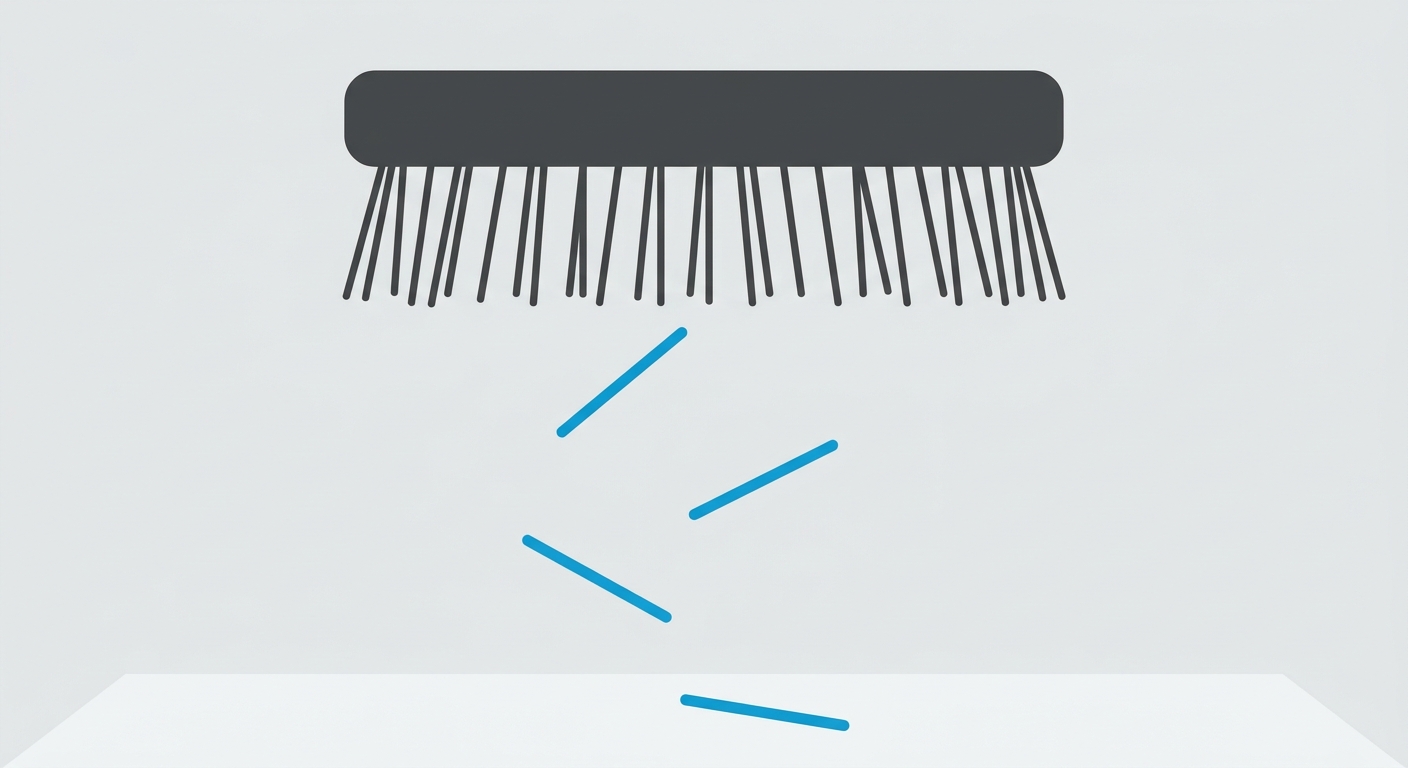
Caption: every filament that falls can become foreign matter on the production line
Not sure how to set the acceptance conditions? Tell us which process stage the brush is used in and which kind of foreign matter you are worried about, and we will reply with what can be done and where the limits are → Send a technical question
Three sources of shedding in industrial brushes: loose filaments, broken filaments and tuft pull-out
Brush shedding has at least 3 sources: loose filaments that were not cleaned out before shipment, filaments that break in use, and whole tufts that are pulled out. ASTM D7834, a standard of the American Society for Testing and Materials, includes both of the 2 types of brush fill, natural bristle and synthetic filament, in the scope of its shedding test (ASTM International, 2024). In other words, shedding is not a problem of one particular material.
Only when you know which kind it is do you know whom to go to and what to check.
Internally we tell the three apart by "when it sheds":
| Source of shedding | When it appears | What falls off | How to check | Main countermeasure |
|---|---|---|---|---|
| Loose filaments | A new brush just unpacked, the first few uses | Scattered short and stray filaments | Finger-comb test | Factory cleaning |
| Broken filaments | After a period of use | Half-length pieces broken at the middle or the root | Look at the break and the operating conditions | Change the material, adjust pressure and the way of contact |
| Tuft pull-out | At any time, often under load | A whole tuft or a small bunch coming off together | Pull test | Tuft anchoring method and hole position precision |
Loose filaments: short pieces that were never anchored
Cutting and trimming the brush face produces a lot of short filaments. They sit between the tufts and look like part of the brush, but they are not anchored. Most of what a new brush sheds at the beginning is this kind.
The good news is that loose filaments can be cleaned out before shipment.
Broken filaments: filaments that break in use
Broken filaments are caused by use. Repeated bending, pressing in too deep, or contact with a chemical that attacks the filament can all make a single filament break in the middle. This is not something cleaning can solve; you have to go back and review the material and the operating conditions. For how to choose a material, see the comparison of brush material properties.
Tuft pull-out: a whole tuft pulled out
When a whole tuft comes off, the anchoring is insufficient. The hole may be too large, the anchor wire or staple may not be pressed tight, or the adhesive may not fully cover the tuft. This is a process problem, and it is checked with a pull test.
Three sources, three countermeasures. Lumping them together and asking "will this brush shed" gets you no answer.
Why factory cleaning uses machine combing and not manual shaking
Factory cleaning has to be done by combing every brush by machine, because the loose filaments caught at the root of the tufts only come out when the comb teeth reach in. The factory requirement at YC Brushes is worded very directly: before packaging, every brush is cleaned with a combing machine or equivalent equipment, and the 3 substitutes of manual shaking, tapping and air blowing are not accepted.
Why word it so rigidly?
Because "give it a shake" is the operation most easily reduced to a formality. Shaking only removes the loose filaments on the surface; the short pieces hidden between the tufts do not move at all. The brush looks clean at shipment and starts shedding as soon as the customer uses it.
In September 2026 we made a batch of hog bristle brushes with bamboo handles for an electronic materials plant, with a handle of 7 × 19 × 320 mm and a trim length of 35 mm. For this batch we added an extra cleaning operation to the outgoing procedure, and it consists of three things:
- Every brush is combed by machine to remove loose filaments, broken filaments and stray filaments
- Manual shaking, tapping or air blowing is not used as a substitute
- A brush that has not been combed is not packaged and not shipped
In the same period, for another of our products, a small synthetic filament brush, the specification only required "full, firm tufting with no shedding" and did not add this cleaning operation. Natural bristle such as hog bristle varies in length and leaves more short pieces behind after cutting, so we chose to spell it out in rigid terms.
The limit has to be stated clearly, though: machine cleaning deals with loose filaments. It does not make a poorly anchored tuft secure, and it does not make an unsuitable material durable. However well the cleaning is done, the other two kinds of shedding still have to be handled separately.
The three-stroke finger-comb test: a shedding check you can do in 1 minute on receipt
The finger-comb test works like this: comb along the direction of the filament with your hand 3 times, open your palm, and there must be no loose filaments in it. If anything has come off, the cleaning is deemed incomplete. The check needs no instrument, and the person receiving the goods can finish it within 1 minute.
There are only four steps:
- Pick one brush at random from the batch; do not take the one on top
- Hold the handle in one hand and run the fingers of the other hand along the filament, from the root toward the tip
- Comb three times in a row
- Open your hand and see whether there is any filament in the palm

Caption: comb three times along the filament and open your palm; cleaning counts as complete only if the palm is clean
Where does this standard come from? It is the judgment clause we write into our production specification: "Comb by hand along the filament direction three times; no loose filaments may come off." What happens on failure is written into the same clause: any brush that sheds as soon as it is combed is deemed not to have completed cleaning, and the whole batch has to be cleaned again before it can be packaged. It is the whole batch that is cleaned again, not only the few brushes that shed: the cleaning conditions were the same for the entire batch, so if one fails, the others cannot be assumed to have passed.
Treating shedding as a quality to be measured is not our invention. ASTM D7834 is a shedding test method for paint brushes. Its description says that during painting a brush may shed filling material onto the coated surface, and that measuring the amount shed can determine the ability of the brush to resist shedding during application (ASTM International, 2024).
So does combing three times amount to running the ASTM test? No.
There are three limits here that both buyer and seller should know:
- Combing three times is a quick check of factory cleaning, not a standard test, and cannot be used to claim "compliance with ASTM D7834"
- It checks for loose filaments; it cannot check service life, and it cannot check tuft anchoring strength
- The force of a hand varies from person to person, so we pair it with a video record so that both sides are looking at the same action
Simple, cheap and doable for every batch: that is its value.
What a pull test checks, and what it does not
A pull test checks the anchoring strength of the tufts. It catches whole tufts coming off; it does not catch loose filaments. Taking manual toothbrushes as an example, the tuft retention test in ISO 20126 pulls a single tuft at a constant speed of 20 mm/min, and the maximum pull force must not be lower than 15 N (Mecmesin). 15 N converts to about 1.5 kilogram-force.
Can this number be used directly as the threshold for an industrial brush?
Our view is that it cannot simply be applied as it is, for three reasons:
- The subject is different: ISO 20126 governs manual toothbrushes, and its starting point is safety of use in the mouth
- The tufts are different: the tuft diameter and hole diameter of a toothbrush are relatively fixed, while the tufts of industrial brushes range widely from fine to coarse, and the coarser the tuft, the greater the force naturally needed to pull it out
- The anchoring method is different: industrial brushes use anchor wire, staples, adhesive and other methods, each with different strength characteristics
So the more practical approach is for buyer and seller to agree on a threshold according to the application, and to write three things into the specification: how many tufts are tested, the pull speed, and the minimum pull force. The 15 N of the toothbrush standard can serve as a starting point for discussion, but it is not the pass line for industrial brushes.
A pull test also has things it cannot check. A brush whose tufts are anchored very firmly can still be full of loose filaments that were never cleaned out. Conversely, a brush that has been cleaned very thoroughly may lose whole tufts after a short time because the hole positions are off.
The two tests each cover one thing, and leaving one out means missing half.
When a formal report is needed, the test can be commissioned from a laboratory that has a tensile testing machine. The cost depends on the number of samples and on whether a separate clamping fixture has to be made; before sending samples, confirm that the grips can actually hold your tufts. For how to prepare the various kinds of test document, see the guide to submitting brushes for testing.
Want to state the acceptance conditions clearly in one go?
Responsibility for shedding is mostly decided before the order is placed. Write the cleaning operation and the method of judgment into the specification and raise them together with your inquiry, so that the quote and the lead time take this operation into account.
→ Send your inquiry with your acceptance conditions attached
How to write acceptance requirements into the purchase specification and contract
The acceptance requirements should be written as 4 clauses: cleaning operation, method of judgment, handling of failures, and acceptance video. If any one is missing, a dispute over shedding goes back to "you say it was cleaned, I say it was not".
The wording of these four acceptance clauses comes from our own outgoing specification and can be adapted directly into your purchase clauses:
| Clause | Sample wording | What this clause guards against |
|---|---|---|
| Cleaning operation | Before packaging, the filament of every brush must be cleaned with a combing machine or equivalent equipment; manual shaking, tapping or air blowing may not be used as a substitute | The operation being reduced to a formality |
| Method of judgment | Comb by hand along the filament direction three times; no loose filaments may come off | Each side having its own version of "clean or not" |
| Handling of failures | A brush that sheds when combed is deemed not to have completed cleaning; the entire batch must be cleaned again before it may be packaged | Reworking only the few brushes that shed |
| Acceptance video | Before shipment, finished pieces are picked at random and a video is taken showing the palm after three combing strokes | Finding out only after arrival, with nothing to compare against |
The fourth clause is the one we think gives the best return. Filming the finger-comb video before shipment leaves a record that both sides can see while the goods are still in the factory. Before shipment we also line up at least 10 finished pieces neatly and photograph them, to confirm appearance, proportions and the state of the packaging.
Some people ask: will this not make the lead time longer?
It does add an operation; that is a fact. Cleaning and filming both take time, so the requirement should be raised at the inquiry stage, so that the quote and the lead time take it into account. Adding it after the order has been placed is what really delays delivery.
Packaging deserves an extra sentence too. If cleaned brushes are shipped squeezed together, the filament is pressed out of shape and the tips catch and pull on each other, which brings out new shed filaments. Our practice is to bag each brush individually; the bag has to be long enough to enclose the brush head completely, and the filament must not be under pressure.
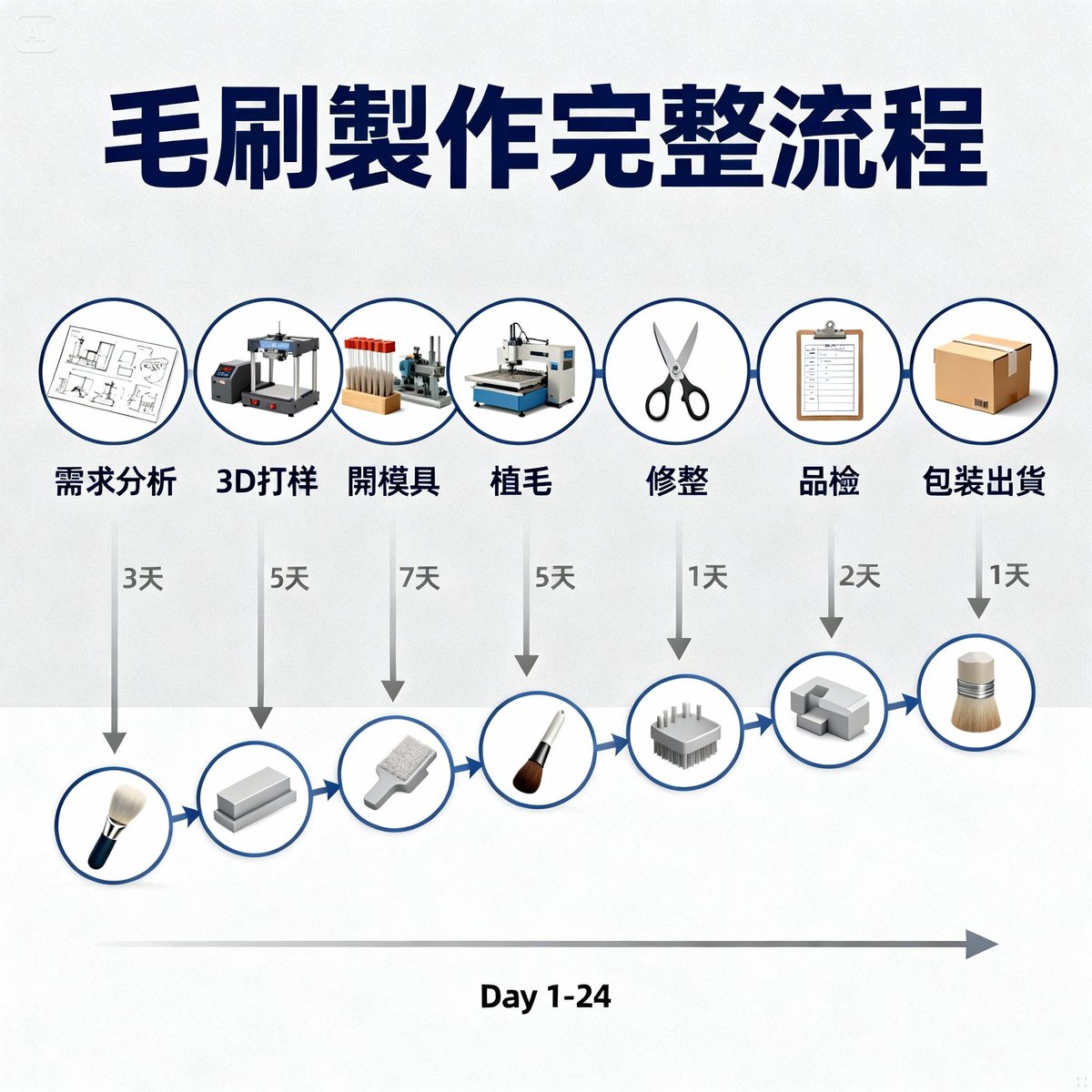
For what else to prepare when asking for a quote, see the specification checklist for custom brush inquiries. For where inspection sits in the overall manufacturing flow, see the full description of the brush manufacturing process.
Additional requirements on shedding in cleanrooms and precision processes
Cleanrooms and precision processes have an even lower tolerance for shedding. ISO 14644-1 divides cleanrooms into 9 classes, from ISO 1 to ISO 9. Taking particles of 0.5 micrometers and larger as an example, the upper limit per cubic meter is 352,000 particles for ISO 7 and 3,520,000 particles for ISO 8 (Setra). A single filament is far larger than these particles, so in addition to the 4 clauses of cleaning operation, method of judgment, handling of failures and acceptance video, you also have to go back and check whether the filament and the handle material themselves can be brought into the room.
We will not rewrite that part here. The reason is simple: whether animal hair can be used, and whether a wooden handle generates particles, depends on the cleanroom class, and that is a separate set of judgments. The full explanation is in the material restrictions for cleanroom brushes.
Only one reminder here. Cleaning and the finger-comb test deal with "filament you can see"; they cannot prove that a brush meets a given cleanliness class. Where proof of class is needed, materials and test documents have to be discussed separately.
If your brush is an abrasive filament brush, you also need to watch for filament breakage; for selection, see the filament diameter and abrasive criteria for deburring brushes. The tuft holes and base plate stability of a plate brush are directly related to tuft pull-out; see the comparison of base plate materials for tufted plate brushes.
FAQ
Is it normal for a new industrial brush to shed a few filaments on first use?
What a new brush sheds in its first few uses is mostly loose filaments, that is, short pieces left over from cutting that were never anchored. For a brush that was machine-cleaned before shipment, the palm should be clean after combing along the filament 3 times. If it sheds as soon as you comb it after unpacking, the cleaning was not finished, and you can require the whole batch to be cleaned again in accordance with the specification.
Which sheds more easily, a hog bristle brush or a nylon brush?
Both shed. The shedding test in ASTM D7834 covers both of the 2 types of brush fill, natural bristle and synthetic filament. In our experience, hog bristle varies in length and leaves more short pieces after cutting, so it needs factory cleaning even more. How much a brush sheds depends mainly on how well the cleaning and anchoring are done, not on the material alone.
Where can a brush pull test be done, and how is the cost calculated?
A tuft pull test can be commissioned from a laboratory that has a tensile testing machine. The cost depends on the number of samples and on whether a separate clamping fixture has to be made, so there is no fixed price. Confirm 3 things before sending samples: how many tufts are tested, the pull speed, and the minimum pull force. These numbers have to be agreed between buyer and seller first.
I only found the shedding after the goods arrived. Can I ask for a return or re-cleaning?
Whether you can depends on what the specification says. If the purchase specification states "no loose filaments may come off after three combing strokes; if this is not met, the whole batch is cleaned again", you have a clear basis. If it only says "no shedding" and nothing more, with no method of judgment, each side easily ends up with its own version. We recommend writing the method of judgment and the handling of failures into the specification.
How do I require a supplier to deliver brushes that do not shed?
Write the requirement as 4 clauses: cleaning operation, method of judgment, handling of failures, and acceptance video. Writing only "non-shedding brush" is not enough, because nobody knows what counts as not shedding. Specify machine combing, judgment by combing along the filament 3 times, and a finger-comb video before shipment; only then can the requirement actually be accepted against.
Keep the shedding in the factory, not on the production line
Shedding is not a matter of luck. It is a matter of specification.
Tell loose filaments, broken filaments and tuft pull-out apart: the first is handled by factory cleaning and the three-stroke finger-comb test, the last by the pull test and the tufting process, and the one in the middle goes back to the material and the operating conditions. Then write the cleaning operation, method of judgment, handling of failures and acceptance video into the specification, and most disputes over shedding disappear.
This approach also has things it cannot do. It cannot make a brush never shed, and it cannot replace test documents for a cleanroom class or a material. What it can do is make sure every batch has been measured with the same ruler before it leaves the factory.
Is your specification ready?
Send a drawing or a sample together with the acceptance conditions you want, and we will assess the quote and lead time against the actual specification. If the specification is not settled yet, we can start by talking about the operating environment.
→ Send your inquiry | Ask a technical question first
Further reading
- The brush manufacturing process: the complete steps from design to shipping
- How to submit brushes for testing: four document types and when testing is needed
- How to choose cleanroom brushes: three red lines where the class decides the material
- What to prepare for a custom brush quote: the three spec elements
- Brush materials explained: properties of hog bristle, nylon and steel wire compared